20160430

Physics quiz archive: magnetism, induction

Physics 205B Quiz 6, spring semester 2016
Cuesta College, San Luis Obispo, CA
Sections 30882, 30883, version 1
Exam code: quiz06eL3k


Sections 30882, 30883 results
0- 6 :   *   [low = 6]
7-12 :   *****
13-18 :   *********************   [mean = 17.0 +/- 5.1]
19-24 :   **********
25-30 :   *   [high = 27]

20160421

Astronomy quiz archive: stellar evolution

Astronomy 210 Quiz 6, spring semester 2016
Cuesta College, San Luis Obispo, CA

Section 30674, version 1
Exam code: quiz06s7ll


Section 30674
0- 8.0 :  
8.5-16.0 :   ***** [low = 12.0]
16.5-24.0 :   ***** [mean = 23.4 +/- 6.2]
24.5-32.0 :   ********
32.5-40.0 :   ** [high = 33.0]


Section 30676, version 1
Exam code: quiz06nUm6


Section 30676
0- 8.0 :  
8.5-16.0 :   ******* [low = 8.5]
16.5-24.0 :   ************
24.5-32.0 :   ****************** [mean = 25.7 +/- 6.2]
32.5-40.0 :   *********** [high = 40.0]

20160417

Physics quiz archive: circuits (2)

Physics 205B Quiz 5, spring semester 2016
Cuesta College, San Luis Obispo, CA
Sections 30882, 30883, version 1
Exam code: quiz05Tt1p


Sections 30882, 30883 results
0- 6 :  
7-12 :   *** [low = 12]
13-18 :   **************
19-24 :   ************* [mean = 20.8 +/- 5.0]
25-30 :   ******** [high = 30]

20160331

Astronomy quiz archive: sun/spectra/star properties

Astronomy 210 Quiz 5, spring semester 2016
Cuesta College, San Luis Obispo, CA

Section 30674, version 1
Exam code: quiz05nUL7


Section 30674
0- 8.0   :
8.5-16.0 :   *** [low = 12.0]
16.5-24.0 :   *******
24.5-32.0 :   ** [mean = 25.9 +/- 8.8]
32.5-40.0 :   ******* [high = 40.0]


Section 30676, version 1
Exam code: quiz05sPrB


Section 30676
0- 8.0 :   * [low = 8.0]
8.5-16.0 :   ****
16.5-24.0 :   ************
24.5-32.0 :   ******************* [mean = 27.5 +/- 7.3]
32.5-40.0 :   *************** [high = 40.0]

20160327

Physics midterm problem: comparing total electric field magnitudes

Physics 205B Midterm 1, spring semester 2016
Cuesta College, San Luis Obispo, CA

Two point charges are held at fixed locations. A +5 nC charge is at the origin, and a second –1 nC charge is at x = +4 cm. Discuss why the magnitude of the electric field at x = +2 cm is less than the magnitude of the electric field at x = +3 cm. Show your work and explain your reasoning using properties of electric forces, fields, and vector superposition.

Solution and grading rubric:
  • p:
    Correct. Discusses/demonstrates that the (total) electric field magnitude would be greater at x = +3 cm than at x = +2 cm by:
    1. evaluating the individual electric field magnitudes E1 and E2 created by the source charges Q1 and Q2 at each location (four separate terms), and;
    2. discussing how for each location the individual electric field magnitudes add together, as they both point in the same direction to the right (away from Q1 = +5 nC, and in towards Q2 = −1 nC), and;
    3. either completely evaluating the total electric field magnitude at each location, or comparing their values in terms of in common relative terms of k, nC, and cm2.
  • r:
    As (p), but argument indirectly, weakly, or only by definition supports the statement to be proven, or has minor inconsistencies or loopholes. May have a minor computational error, but at least conclusion is consistent with result.
  • t:
    Nearly correct, but approach has conceptual errors, and/or major/compounded math errors. At least some attempt at evaluating electric fields created by each source charge at both locations and vector superposition.
  • v:
    Limited relevant discussion of supporting evidence of at least some merit, but in an inconsistent or unclear manner. Some garbled attempt at applying electric forces, fields, and vector superposition.
  • x:
    Implementation/application of ideas, but credit given for effort rather than merit. No clear attempt at applying electric forces, fields, and vector superposition.
  • y:
    Irrelevant discussion/effectively blank.
  • z:
    Blank.
Grading distribution:
Sections 30882, 30883
Exam code: midterm01rx1C
p: 22 students
r: 7 students
t: 8 students
v: 4 students
x: 2 student
y: 0 students
z: 0 students

A sample "p" response (from student 0001), explicitly evaluating the electric field magnitudes:

A sample "p" response (from student 0720), eliminating common factors:
>

20160324

Astronomy quiz archive: solar system

Astronomy 210 Quiz 4, spring semester 2016
Cuesta College, San Luis Obispo, CA

Section 30674, version 1
Exam code: quiz04nG4N


Section 30674
0- 8.0 :   * [low = 4.0]
8.5-16.0 :   ****
16.5-24.0 :   ******* [mean = 21.6 +/- 7.7]
24.5-32.0 :   ******
32.5-40.0 :   * [high = 36.5]

Section 30676, version 1
Exam code: quiz04stP7


Section 30676
0- 8.0 :  
8.5-16.0 :   *** [low = 12.0]
16.5-24.0 :   *********************** [mean = 24.9 +/- 6.9]
24.5-32.0 :   ************
32.5-40.0 :   *********** [high = 40.0]

20160315

Astronomy midterm question: winter coming when Orion rises in evening?

Astronomy 210 Midterm 1, spring semester 2016
Cuesta College, San Luis Obispo, CA

The following story relates how the constellation Orion is used to track the coming of winter[*]:
Orion is a sure sign that winter is near. During the first two weeks of December you can see Orion beginning to emerge above the eastern horizon in the early evening.
Discuss why this description of Orion is plausible for an observer in San Luis Obispo, CA. Defend your answer by clearly explaining how you used your starwheel to do this, along with any assumptions that you may have made.

[*] souledout.org/nightsky/orionavigation/orionavigation.html.

Solution and grading rubric:
  • p:
    Correct. Discussion includes the following:
    1. sets starwheel to some date in the first two weeks of December at a plausible "early evening" time;
    2. verifies that Orion is "beginning to emerge" from the eastern horizon.
  • r:
    Nearly correct (explanation weak, unclear or only nearly complete); includes extraneous/tangential information; or has minor errors.
  • t:
    Contains right ideas, but discussion is unclear/incomplete or contains major errors.
  • v:
    Limited relevant discussion of supporting evidence of at least some merit, but in an inconsistent or unclear manner. At least attempts to use starwheel in a systematic manner to locate Orion in the sky at certain dates/times.
  • x:
    Implementation/application of ideas, but credit given for effort rather than merit. Discussion not clearly based on using a starwheel in a systematic manner.
  • y:
    Irrelevant discussion/effectively blank.
  • z:
    Blank.
Grading distribution:
Section 30674
Exam code: midterm01n0rD
p: 19 students
r: 0 students
t: 0 students
v: 3 students
x: 0 students
y: 0 students
z: 0 students

A sample "p" response (from student 0414):

A sample "p" response (from student 1597):

Astronomy midterm question: low waning crescent moon in twilight sky

Astronomy 210 Midterm 1, spring semester 2016
Cuesta College, San Luis Obispo, CA

Shown at right is a photograph[*] published with the following caption:
The Golden Gate Bridge framed the [low] crescent shaped moon perfectly as viewed [facing south] from the Marin headlands of Sausalito.
Assuming that this is a twilight sky (dark, but not completely dark) in this photograph, discuss why this caption is plausibly correct. Support your answer using a diagram showing the positions of the sun, moon, Earth, and an observer on Earth.

[*] Frederic Larson (April 5, 2005) for The Chronicle, in Katie Dowd, "83 Years Ago Today, Construction Started on the Golden Gate Bridge," January 5, 2016, 
sfgate.com/bayarea/article/83-years-construction-starts-on-golden-gate-bridge-6735946.php#photo-3097833.

Solution and grading rubric:
  • p:
    Correct. Complete diagram and reasoning includes the following explanations:
    1. identifies the waning crescent moon, which rises at 3 AM, is highest overhead at 9 AM, and sets at 3 PM;
    2. sky is "dark, but not completely dark," so the photograph must have been taken just before sunrise (approximately 5-6 AM);
    3. this range of "twilight" times is consistent with the moon being "low," (still rising and not yet highest overhead), but before the sunrise.
  • r:
    Nearly correct (explanation weak, unclear or only nearly complete); includes extraneous/tangential information; or has minor errors.
  • t:
    Contains right ideas, but discussion is unclear/incomplete or contains major errors.
  • v:
    Limited relevant discussion of supporting evidence of at least some merit, but in an inconsistent or unclear manner. At least attempts to draw a moon phase diagram and apply rise/overhead/set times.
  • x:
    Implementation/application of ideas, but credit given for effort rather than merit. Discussion not clearly based on a moon phase diagram.
  • y:
    Irrelevant discussion/effectively blank.
  • z:
    Blank.
Grading distribution:
Section 30674
Exam code: midterm01n0rD
p: 8 students
r: 3 students
t: 4 students
v: 4 students
x: 3 students
y: 0 students
z: 0 students

Section 30676
Exam code: midterm01sN0w
p: 23 students
r: 8 students
t: 5 students
v: 10 students
x: 8 students
y: 0 students
z: 0 students

A sample "p" response (from student 8211):

Astronomy midterm question: Mercury rising while Venus is setting?

Astronomy 210 Midterm 1, spring semester 2016
Cuesta College, San Luis Obispo, CA

An astronomy question on an online discussion board[*] was asked and answered:
Pdg: At the same time you can see Venus setting, can you see Mercury rising?
DcM: Regardless of where they are in their orbits about the sun, while Venus can set in the west, it isn't possible to see Mercury rising in the east at the same time.
Discuss why this answer is correct for an observer in San Luis Obispo, CA, and how you know this. Support your answer using a diagram showing the positions of the sun, Mercury, Venus, Earth, and an observer on Earth.

[*] answers.yahoo.com/question/index?qid=20160114114820AAEJYPB.

Solution and grading rubric:
  • p:
    Correct. Complete diagram and reasoning includes the following explanations:
    1. for an observer on Earth at sunset (6 PM), Venus appears to be setting in the west (or some other late afternoon/early evening time) when placed in an orbit inside Earth's orbit;
    2. this sunset observer cannot see Mercury rising in the east, as that would mean Mercury would have to be in an orbit outside of Earth's.
  • r:
    Nearly correct (explanation weak, unclear or only nearly complete); includes extraneous/tangential information; or has minor errors.
  • t:
    Contains right ideas, but discussion is unclear/incomplete or contains major errors. Problems with either diagram or discussion.
  • v:
    Limited relevant discussion of supporting evidence of at least some merit, but in an inconsistent or unclear manner. Diagram and discussion problematic.
  • x:
    Implementation/application of ideas, but credit given for effort rather than merit.
  • y:
    Irrelevant discussion/effectively blank.
  • z:
    Blank.
Grading distribution:
Section 30674
Exam code: midterm01n0rD
p: 6 students
r: 0 students
t: 4 students
v: 7 students
x: 4 students
y: 0 students
z: 1 student

Section 30676
Exam code: midterm01sN0w
p: 17 students
r: 15 students
t: 10 students
v: 8 students
x: 2 students
y: 1 student
z: 1 student

A sample "p" response (from student 2117):

A sample "p" response (from student 2919):

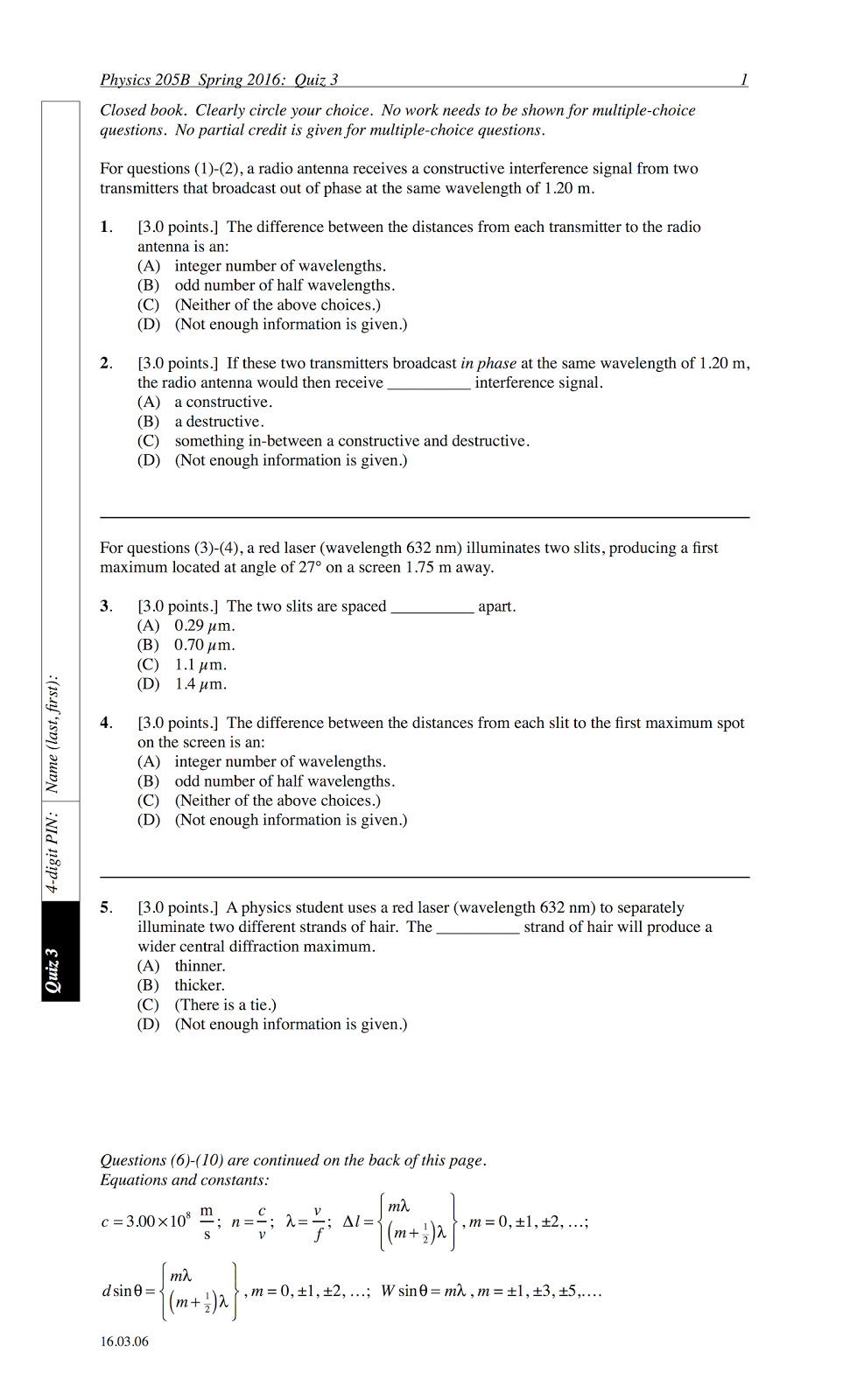
20160311

Physics quiz archive: interference, electrostatics

Physics 205B Quiz 3, spring semester 2016
Cuesta College, San Luis Obispo, CA
Sections 30882, 30883, version 1
Exam code: quiz03Ccf7


Sections 30882, 30883 results
0- 6 :   ** [low = 6]
7-12 :   ***********
13-18 :   ******
19-24 :   *************** [mean = 18.8 +/- 7.2]
25-30 :   ****** [high = 30]