Showing posts with label binary star system. Show all posts

20090927

Central Coast Astronomical Society monthly meeting: NASA Kepler Misssion

090926-1110782
http://www.flickr.com/photos/waiferx/3964831259/
Originally uploaded by Waifer X

Dr. Laurance Doyle, SETI principal investigator and NASA Kepler Space Telescope mission science team member, giving a presentation on the "NASA Kepler Mission: Detection of (Tatooine-Like) Habitable Planets Around Double Stars" at California Polytechnic University, San Luis Obispo, CA, September 26, 2009, hosted by the Central Coast Astronomical Society. Photo by Cuesta College Physical Sciences Division instructor Dr. Patrick M. Len.

20081202

Binary star masses

081129-1060829-invert
http://www.flickr.com/photos/waiferx/3069568005/
Originally uploaded by Waifer X

Proper motion data of Sirius A and B, used to determine their masses using Kepler's third law.

20081029

Overheard: accretion vs. secretion

Astronomy 210, fall semester 2008
Cuesta College, San Luis Obispo, CA

(Overheard in class during an in-class activity on mass transfer in close binary star systems.)

Student: "What does 'accretion' stand for?"

Instructor: "As in an 'accretion disk?' ...It's 'gathering' stuff from the companion star."

Student: "So, it's like the opposite of 'secretion?' Like in giving out stuff?"

Instructor: "Yeah--like exuding or oozing stuff out."

Esprit d'escalier:
Instructor: "'Accrete' is an obscure term, but it's similar to 'acquire' and 'accumulate.'"

20080514

Astronomy quiz question: type Ia supernovae

Astronomy 10 Quiz 10, Spring Semester 2008
Cuesta College, San Luis Obispo, CA

Astronomy 10 learning goal Q10.3

[3.0 points.] Which one of the following choices best explains why an isolated white dwarf cannot explode as a type Ia supernova?
(A) There is no companion star to heat up.
(B) There is no external source of hydrogen.
(C) There is no companion star to distort spacetime.
(D) It expended all of its extra energy during the planetary nebula phase.
(E) There is not enough degeneracy pressure.

Correct answer: (B)

If there is no companion star to transfer hydrogen to a white dwarf, then the white dwarf star cannot collect and compact this material onto its surface, making it undergo fusion to undergo a type Ia supernova (or a mere nova) explosion.

Student responses
Section 5166
(A) : 8 students
(B) : 17 students
(C) : 4 students
(D) : 6 students
(E) : 7 students

Previous post:
Astronomy in-class activity: compact objects with companion stars.

20080513

Astronomy quiz question: x-ray bursts

Astronomy 10 Quiz 10, Spring Semester 2008
Cuesta College, San Luis Obispo, CA

Astronomy 10 learning goal Q10.3

[3.0 points.] Which one of the following choices best explains why an isolated neutron star cannot have repeated x-ray bursts?
(A) There is no companion star to heat up.
(B) There is no companion star to distort spacetime.
(C) It expended all of its extra energy during its type II supernova.
(D) There is no external source of hydrogen.
(E) There is not enough degeneracy pressure.

Correct answer: (D)

If there is no companion star to transfer hydrogen to a neutron star, then the neutron star cannot collect and compact this material onto its surface, making it undergo fusion to produce an x-ray burst.

Student responses
Section 4160
(A) : 7 students
(B) : 1 student
(C) : 10 students
(D) : 16 students
(E) : 0 students

Previous post:
Astronomy in-class activity: compact objects with companion stars.

20080512

Astronomy quiz question: accretion disk blackbody radiation

Astronomy 10 Quiz 10, Spring Semester 2008
Cuesta College, San Luis Obispo, CA

Astronomy 10 learning goal Q10.3

[3.0 points.] Which one of the following choices best explains how accretion disks emit intense ultraviolet, and/or x-ray blackbody radiation?
(A) Heat generated from friction.
(B) Electrons jump down to lower orbits.
(C) Electrons flip their spins.
(D) Curvature of spacetime.
(E) Hydrogen fuses into helium.

Correct answer: (A)

A companion star of a compact object (white dwarf, neutron star, or black hole) may be close enough such that it will overflow its Roche lobe when it becomes a giant or superigant, thus transferring hydrogen to the compact object. This infalling hydrogen collects into an accretion disk surrounding the compact object, and due to Kepler's third law, the outer part of the disk orbits slower than the inner part of the disk. Due to the density of the disk, the difference in speeds between adjacent parts causes friction, producing enough heat for the disk to become incandescent, thus emitting blackbody radiation.

Student responses
Section 5166
(A) : 9 students
(B) : 17 students
(C) : 2 students
(D) : 3 students
(E) : 5 students

Previous post:
Astronomy in-class activity: compact objects with companion stars.

20080511

Astronomy quiz question: black holes with companion stars

Astronomy 10 Quiz 10, Spring Semester 2008
Cuesta College, San Luis Obispo, CA

Astronomy 10 learning goal Q10.3

[3.0 points.] Which one of the following statements best explains why x-rays are observed from close binary systems comprised of black holes with companion stars?
(A) Only x-ray photons are fast enough to escape from black holes.
(B) Electrons falling into lower energy orbitals release x-ray photons.
(C) Black holes can only emit x-ray photons.
(D) Accretion disks surrounding black holes emit very hot blackbody radiation.
(E) Companion stars orbiting black holes emit very hot blackbody radiation.

Correct answer: (D)

A companion star of a black hole may be close enough such that it will overflow its Roche lobe when it becomes a giant or superigant, thus transferring hydrogen to the black hole. This infalling hydrogen collects into an accretion disk surrounding the black hole, heating up in the process to become incandescent, emitting blackbody radiation.

Student responses
Section 4160
(A) : 3 students
(B) : 5 students
(C) : 6 students
(D) : 16 students
(E) : 4 students

Previous post:
Astronomy in-class activity: compact objects with companion stars.

20080510

Astronomy quiz question: mass transfer in close-pair binaries

Astronomy 10 Quiz 10, Spring Semester 2008
Cuesta College, San Luis Obispo, CA

Astronomy 10 learning goal Q10.2

[3.0 points.] Which one of the following choices best explains why the Roche lobes of two stars in a close-pair (mass-exchanging) binary system get smaller as they begin to orbit closer to each other?
(A) Gravitational forces get weaker.
(B) Centrifugal forces get stronger.
(C) Degeneracy pressure increases.
(D) Hydrogen is transferred slowly.
(E) Repeated nova explosions disrupts hydrogen transfer.

Correct answer: (B)

Due to conservation of angular momentum, the orbital speeds of the stars will increase as their separation distance decreases (as they would during hydrogen transfer from a more massive star to a less massive star). This will increase the centrifugal forces exerted on them, decreasing the size of their Roche lobes.

Student responses
Section 5166
(A) : 5 students
(B) : 29 students
(C) : 4 students
(D) : 7 students
(E) : 2 students

Related post:
Astronomy in-class activity: mass transfer in close-pair binaries.

20080509

Astronomy quiz question: mass transfer in close-pair binaries

Astronomy 10 Quiz 10, Spring Semester 2008
Cuesta College, San Luis Obispo, CA

Astronomy 10 learning goal Q10.2

[3.0 points.] Which one of the following statements best explains why the transfer of hydrogen in a close-pair binary system from a less massive star to a more massive star happens very slowly?
(A) There is not much hydrogen left in the less massive star.
(B) They move farther apart from each other.
(C) The less massive star has not yet ended its main sequence lifetime.
(D) The more massive star produces strong winds.
(E) (None of above choices (A)-(D), as it is not possible for hydrogen to be transferred from a less massive star to a more massive star.)

Correct answer: (B)

When a less massive star is transferring hydrogen to a more massive star, their masses become more unequal, such that their separation distance increases. This decreases their orbital speeds, decreasing centrifugal forces, resulting in enlarging their Roche lobes, making it more difficult for the less-massive star to overflow its Roche lobe. This will slow down, and eventually stop the transfer of hydrogen from the less massive to the more massive star.

Student responses
Section 4160
(A) : 11 students
(B) : 11 students
(C) : 6 students
(D) : 1 student
(E) : 5 students

Related post:
Astronomy in-class activity: mass transfer in close-pair binaries.

20080506

Astronomy clicker question: close-pair binary star system observations

Astronomy 10, Spring Semester 2008
Cuesta College, San Luis Obispo, CA

Astronomy 10 learning goal Q10.2

Students were asked the following clicker question (Classroom Performance System, einstruction.com) near the end of their learning cycle (specifically, following the astronomy in-class activity: mass transfer in close-pair binaries).

[0.3 points.] If you were to survey every visible close pair (mass-exchanging) binary star system, which one of the choices (A)-(D) would best describe your observations?
I. Mass being transferred from a more-massive star to a less-massive star.
II. Mass being transferred from a less-massive star to a more-massive star.
(A) You would see (I) more often than (II).
(B) You would see (I) just as often as (II).
(C) You would see (II) more often than (I).
(D) You would only be able to see (I), as it is impossible for (II) to occur.

Correct answer: (C)

Student responses
Section 4160
(A) : 7 students
(B) : 13 students
(C) : 10 students
(D) : 0 students

Section 5166
(A) : 4 students
(B) : 10 students
(C) : 8 students
(D) : 10 students

20080505

Astronomy in-class activity: mass transfer in close-pair binaries

Astronomy 10 In-class activity 23 v.07.04.30, Spring Semester 2008
Cuesta College, San Luis Obispo, CA

Astronomy 10 learning goal Q10.2

Students find their assigned groups of three to four students, and work cooperatively on an in-class activity worksheet to summarize the three stages of initial mass transfer in a close-pair (mass transferring) binary star system.Star B is more massive than Star A, due to its being closer to the center of mass, and also because of its larger Roche lobes. As a result, Star B will end its main sequence lifetime earlier than Star A, and become a giant or supergiant.

As a result of Star B expanding and filling its Roche lobe up to the "neck" or "pinch point," hydrogen will then be transferred to Star A. This makes their masses become more equal, making their separation distance decrease, while increasing their orbital speeds. As a result, centrifugal forces increase, such that the size of Star B's lobe shrinks (while it is expanding in its giant/supergiant phase), making the "spillage" from Star B to Star A rapid.

Eventually the masses of Star B and Star A equalize; this is when their separation distance is the smallest, and their lobes are equal in size, but the physical size of Star B (still) fills its (smaller) Roche lobe.

As Star B still transfers hydrogen to Star A, this makes their masses become unequal, making their separation distance increase, while decreasing their orbital speeds. As a result, centrifugal forces decrease, such that the size of Star B's lobe expands. This makes it harder for Star B to "spill over" hydrogen out of its Roche lobe, and the transfer of material slows, and eventually stops when Star B is unable to exceed its much larger Roche lobe.

(Transfer from Star A, when it eventually ends its main sequence lifetime, to Star B will eventually occur, but this discussion is outside the scope of this course.)

Thus with all observations of close-pair binary star systems where mass transfer is taking place, it is more likely to see a less-massive star feeding a more-massive star than vice versa.

Follow-up post:

20071130

Astronomy quiz question: x-ray bursts

Astronomy 10 Quiz 10, Fall Semester 2007
Cuesta College, San Luis Obispo, CA

Astronomy 10 learning goal Q10.3

[3.0 points.] Which one of the following choices best describes a close pair (mass-exchanging) binary system that can have repeatable x-ray bursts?
(A) Two neutron stars.
(B) A massive main sequence star and a red dwarf.
(C) A black hole and a neutron star.
(D) A supergiant and a neutron star.
(E) A supergiant and a black hole.

Correct answer: (D)

The hydrogen shed from a supergiant will form a degenerate layer around a neutron star companion, and this outer layer will undergo fusion, producing an x-ray burst.

Student responses
Section 0135
(A) : 5 students
(B) : 3 students
(C) : 10 students
(D) : 9 students
(E) : 5 students

Student responses
Section 1073
(A) : 7 students
(B) : 3 student
(C) : 6 students
(D) : 22 students
(E) : 5 students

Previous post: Astronomy quiz question: novae and type Ia supernovae

20070724

Interactive binary star system


Binary Stars Interactive (*.swf)
McGraw-Hill Online Learning Center

Astronomy 10 learning goal Q10.2

Begin with setting M_A = 0.5 solar masses, M_B = 5.0 solar masses, and separation distance = 20 solar radii. Point out that the more massive star B is closer to the center of mass/rotation axis, while the less massive star A is farther away. Ask the students which star will eventually reach the end of its main sequence lifetime first, and why (star B, as it is more massive), and which star will have the larger Roche lobe (star B, as it is both more massive and slower in orbital speed, resulting in less centrifugal force, which counteracts gravity).

If the separation distance is decreased to 7.0 solar radii, the Roche lobes of both stars shrink, as they will both have faster orbital speeds (and thus stronger centrifugal forces, which decreases the volume of space that matter will accelerate in towards either star). The more massive star B still has a larger Roche lobe than star A.

http://highered.mcgraw-hill.com/olcweb/cgi/pluginpop.cgi?it=swf::100%::100%::/sites/dl/free/007299181x/78778/Binary_Nav.swf::Binary%20Stars%20Interactive

20070723

Astronomy quiz question: close-binary mass transfer

Astronomy 10 Quiz 10, Summer Session 2007
Cuesta College, San Luis Obispo, CA

Astronomy 10 learning goal Q10.2

[3.0 points.] Shown at right are the equipotentials of a close pair (mass-exchanging) binary system. Which one of the following choices best describes the transfer of hydrogen in the figure at right?
(A) A giant taking hydrogen from a more massive neutron star.
(B) A giant feeding hydrogen to a more massive neutron star.
(C) A giant taking hydrogen from a less massive neutron star.
(D) A giant feeding hydrogen to a less massive neutron star.
(E) (None of the above choices (A)-(D), as no hydrogen is being transferred.)

Correct answer: (B)

The star on the left has less mass than the star on the right, as the center of mass of the binary star system is closer to the star on the right. The star on the left is in its giant phase, as it has expanded in size to its Roche lobe, and thus is transferring hydrogen to the more massive neutron star on the right.

Student responses
Section 8027
(A) : 3 students
(B) : 6 students
(C) : 3 students
(D) : 1 student
(E) : 0 students

20070511

Astronomy quiz question: novae and type Ia supernovae

Astronomy 10 Quiz 8, Spring Semester 2007
Cuesta College, San Luis Obispo, CA

Astronomy 10 learning goal Q10.3

[Version 1]

[3.0 points.] Which one of the following choices best describes a close-pair (mass-exchanging) binary system that can have many cycles of nova explosions?
(A) A massive main sequence star and a red dwarf.
(B) A black hole and a white dwarf.
(C) A supergiant and a white dwarf.
(D) A supergiant and a black hole.
(E) Two red dwarfs.

Correct answer: (C)
The hydrogen shed from a supergiant will form a degenerate layer around a white dwarf companion, and this outer layer will undergo fusion, producing a nova explosion.

Student responses
Section 4136
(A) : 6 students
(B) : 0 students
(C) : 26 students
(D) : 1 student
(E) : 0 students

[Version 2]

[3.0 points.] Which one of the following choices best describes a close-pair (mass-exchanging) binary system that can have a type Ia supernova explosion?
(A) A massive main sequence star and a red dwarf.
(B) A black hole and a white dwarf.
(C) A supergiant and a white dwarf.
(D) A supergiant and a black hole.
(E) Two red dwarfs.

Correct answer: (C)

When the hydrogen shed from a supergiant quickly forms a thick degenerate layer around a white dwarf companion (or the alternate theory is that this transfer has been going on for prolonged time over many nova explosion cycles), then the entire white dwarf will undergo fusion, producing a type Ia supernova explosion.

Student responses
Section 5076
(A) : 0 students
(B) : 2 students
(C) : 15 students
(D) : 1 student
(E) : 0 students

20060802

Black hole accretion disk "string theory" model


http://heasarc.gsfc.nasa.gov/docs/xte/outreach/HEG/bhm/bhm_intro.html
Kimberly S. Adams, Argyle Middle School, Silver Spring, MD

Astronomy 10 learning goal Q10.3

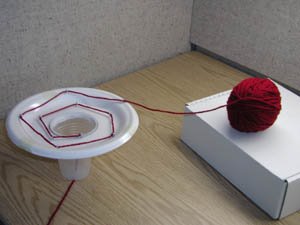
Simple model of mass transfer from a giant/supergiant to a black hole.   Conservation of angular momentum from the orbits of this binary system results in the mass transferred from the giant/supergiant forming an accretion disk around the black hole, rather than falling "straight in."

20060726

The garbage disposal effect


http://www.spacetelescope.org/videos/html/heic0211d.html
NASA/European Space Agency, and Felix Mirabel (French Atomic Energy Commission, and the Institute for Astronomy and Space Physics/Conicet of Argentina)

Astronomy 10 learning goal Q10.3

Short movie clip dramatizing the behavior of the black hole and companion star that comprise "microquasar" GRO J1655-40.   The "garbage disposal effect" is where material will fly up and out of the drain of a garbage disposal while operating, and is a crude analog of the bipolar jets emitted by the black hole.

20060725

We like the stars, the stars that go boom!


http://www.spacetelescope.org/videos/html/heic0415b.html
NASA/European Space Agency, and P. Ruiz-Lapuente (University of Barcelona)

Astronomy 10 learning goal Q10.3

Short movie clip dramatizing the type Ia supernova documented by Tycho Brahe in 1572.   A white dwarf of degenerate carbon steals hydrogen from its companion star.   When enough material has accumulated on the surface of the white dwarf, it undergoes runaway fusion, annihilating itself, and freeing its companion to roam the Milky Way alone.