Showing posts with label resolving power. Show all posts

20200304

Astronomy quiz archive: telescopes

Astronomy 210 Quiz 3, spring semester 2020
Cuesta College, San Luis Obispo, CA

Section 30674, version 1
Exam code: quiz03n1g6


Section 30674
0- 8.0 :   * [low = 0.5]
8.5-16.0 :   *******
16.5-24.0 :   ******** [mean = 22.5 +/- 9.9]
24.5-32.0 :   *****
32.5-40.0 :   ****** [high = 40.0]


Section 30676, version 1
Exam code: quiz03smGL


Section 30676
0- 8.0 :   ** [low = 8.0]
8.5-16.0 :   ******
16.5-24.0 :   *************** [mean = 24.0 +/- 9.3]
24.5-32.0 :   ********
32.5-40.0 :   ********** [high = 40.0]

20200212

Online reading assignment: history of astronomy, telescope powers (SLO campus)

Astronomy 210, spring semester 2020
Cuesta College, San Luis Obispo, CA

Students have a weekly online reading assignment (hosted by SurveyMonkey.com), where they answer questions based on reading their textbook, material covered in previous lectures, opinion questions, and/or asking (anonymous) questions or making (anonymous) comments. Full credit is given for completing the online reading assignment before next week's lecture, regardless if whether their answers are correct/incorrect. Selected results/questions/comments are addressed by the instructor at the start of the following lecture.

The following questions were asked on reading textbook chapters and previewing presentations on reviewing the history of astronomy, Kepler's and Newton's laws, and telescope powers.


Selected/edited responses are given below.

Describe something you found interesting from the assigned textbook reading or presentation preview, and explain why this was personally interesting for you.
"The progression of ideas and theories and how astronomers figured them out through time."

"The different ancient astronomers' ideas about how the universe worked was very interesting, how some were based on science but some were completely not science-based, but were still believed since they were based on first principles."

"I enjoyed reading about the history of each of the early astronomers and the contributions they made to helping demystify the universe. It was interesting to me personally because I am a storyteller, so hearing peoples stories is far more engaging for me than reading the theories."

"I found it interesting that all the astronomers were a part of the Renaissance. We typically look at the Renaissance as a time of art, but it also was a time for questioning the foundation of what we had."

"The way planets orbit and how Kepler and Newton managed to figure out how and why planets move in certain way, and why planetary motion could tell us do much about the laws of the gravity apply to Earth folks and the notion of outer space. "

"I found Newton's laws and Kepler's laws to be very interesting. I think it is crazy how they came up with all these theories regarding the planets and motion."

"I found the history of astronomy interesting, because it makes it more applicable to everyday life. A lot of times learning about science makes it seem like the scientists who discovered what we know today were less human because of all the things they discovered. But reading about how long it took and how many revisions it took for astronomers to get it right, makes it easier to follow."

"Kepler's second and third laws, it reminded me of how when I play video games like Mario Cart I try to find the closest spot to the inner track so that I can take the fastest route."

"The visuals for Kepler's laws, because the orbit of the plants seemed random before I took this class."

"Galileo's observation that added to the understanding of Earth's revolution is interesting. The fact that other planets like Venus and Jupiter go around the sun aids in the understanding that Earth can revolve around the sun without losing the moon as well."

"That basically everything I had known about Galileo was wrong. He wasn't the first person to invent or even use a telescope. He just built it himself, and got credit for it."

"That before the technology like telescopes and cameras, astronomers dedicated their lives to studying and tracking the motion of the plants with just their naked eye. It is incredible to think about how much work was necessary to understand what we do now, and more so how the studies were so in-depth that the teachings were passed through lifetimes, such as Kepler picking up where Tycho left off."

"When an object orbits earth, it's like they are constantly falling around Earth because Earth's gravity is pulling them in, but they are traveling fast enough to not fall into the ground."

"Learning about telescopes from the textbook. I own a telescope and have always been interested in them and wanted to know how they worked and how you use them. And learning about the different pieces and how they are used and what they are used for was very helpful. Learning about the mirrors, the way light reflects and the primary lens was very helpful and I can apply that in my life which is great for me."

"I thought learning about how telescopes work was interesting. Like how, rather then just zooming into the sky, it captures light."

"One of the many things I personally found interesting was that magnifying power isn't as important as I thought it was for telescopes. I believed that magnifying power was very important because of the close view we got to see when seeing the moon through the telescope."

"It was interesting learning what to look for when picking out a telescope. I always thought the bigger the telescope the better, but it's more like the bigger the primary lens or mirror the better."

Describe something you found confusing from the assigned textbook reading or presentation preview, and explain why this was personally confusing for you.
"Retrograde motion was confusing for me."

"I find the history portion of this week's readings a little confusing because history is not my best subject."

"I think trying to remember the different ideas and models of each astronomer and also how others incorporated or used the ideas of others and formed their own work out of it will be something that I need to focus and study on."

"I had a very difficult time understanding the theories and laws. For instance Kepler's laws: ellipses, semi-major axes and eccentricities--I couldn't begin to explain what those are about. It has to do with how I learn, I have a difficult time understanding concepts like this just by reading them. I need them explained, broken down, pictures, example, etc."

"Kepler's laws and how they work."

"I found Kepler's second law confusing. I read the explanation in both the book and online presentation and I'm still not quite getting it. I feel like I almost understand, but not enough to explain it to someone else."

"I think I am struggling most with grasping Kepler's second and third laws. My understandings from the text itself are very vague, but I am hoping the topic will be clarified during lecture or in assignments. The diagrams for the first law helped me understand better, so not having visuals for the second and third are what I believe is causing me confusion."

"Newton's cannon kind of confused me, like the paths the cannonball takes."

"The electromagnetic spectrum a bit confusing. It is just very hard for me to conceptualize everything and understand the vocabulary terms."

"I feel like I will struggle to remember everything about the telescopes."

"The telescope stuff! So much terminology and it's hard just reading straight from the book, without being able to visualize it in person."

"I'm having a hard time understanding all of the parts of a telescope and how they work together so we can see a magnified version of a far away object. I'm sure once we're in class and actually using telescopes I'll understand them because I'm more of a kinetic learner."

"I don't really understand the difference between D, fprimary, and feyepiece. They all seem pretty similar to me and I get a little confused trying to figure out which is which."

"I didn't find anything confusing, I actually understood the chapters."

"There wasn’t anything confusing to me."

"I will read it all tomorrow before class."

When a planet is undergoing retrograde motion, over several nights it moves __________ with respect to the background stars.
east to west.   ***************** [17]
west to east.   *********** [11]
(Unsure/lost/guessing/help!)   ******* [7]

When a planet is undergoing prograde motion, over several nights it moves __________ with respect to the background stars.
east to west.   ********** [10]
west to east.   **************** [16]
(Unsure/lost/guessing/help!)   ********* [9]

Categorize each of Kepler's laws.
(Only correct responses shown.)
Kepler's first law: describes the shape of a planet's orbit. [80%]
Kepler's second law: describes the speed of a planet along its orbit. [77%]
Kepler's third law: describes the speed of a planet along its orbit. [51%]

Categorize each of Newton's laws.
(Only correct responses shown.)
Newton's first law: relates forces with changes in motion. [57%]
Newton's second law: relates forces with changes in motion. [69%]
Newton's third law: describes a property of forces. [63%]

The __________ power of a telescope depends on the: (Only correct responses shown.)
light-gathering: diameter of the primary lens/mirror [54%]
resolving: diameter of the primary lens/mirror [63%]
magnifying: both the focal lengths of the primary lens/mirror and eyepiece: [69%]

The least important feature to consider when purchasing an optical telescope is the __________ of its images.
brightness.   *** [3]
resolution.   * [1]
magnification.   ********************** [22]
(Unsure/lost/guessing/help!)   ********* [9]

Briefly explain your answer for the least important feature to consider when purchasing an optical telescope.
"Magnification is the least important feature to consider when purchasing an optical telescope because higher magnifying power does not mean that there is more detail."

"I think the magnification feature is the least important feature. The magnification feature only enlarges the images after the fact. If the telescope doesn't have good brightness or resolution feature, then dim, fuzzy pictures will be enlarged."

"Just because you make something bigger, doesn't mean that it provides a clearer picture."

"Not sure."

Ask the instructor an anonymous question, or make a comment. Selected questions/comments may be discussed in class.
"Can you please explain what prograde motion is? Is it just once a planet is no longer in retrograde it goes back to prograde and does that mean it moves the normal west to east direction in the sky? Or something else?" (Yes, and Yes.)

"Why don't we feel the movement of Earth?" (You can--you would need very sensitive and/or large-scale experiments to detect Earth's motions. The sway of a long pendulum will drift over several hours, which measures the rotation of Earth about its own axis; and the directions of starlight changes slightly over many months, which measures the revolution of Earth around the sun.)

"Why can't the sun be at the center of an ellipse?" (A flattened circle would just have one "center"; but an ellipse officially has two foci, or two "centers," with the sun located at one focus (while the other focus is empty!).)

"Newton's second law: exerting a force (such as gravity) on an object (such as a planet) will change its motion. The more force you exert, then the object's motion will change more. I found this to be interesting because in sci-fi movies there's always some catastrophe happening in space and I always wonder if that was accurate or not. Is there gravity in space?" (Yes, there is gravity in space, which changes the motion of objects. If you're near a planet or a star, then the gravity will affect your motion by pulling you in, and/or forcing you into a closed/open orbit. Only if you are really far away from any planet or star will there be no gravity (or a negligible amount) to affect your motion.)

"Is a telescope's size measured by focal length or by lens diameter. The text doesn't appear to say." (Both "sizes" are important. We'll be sure to carefully distinguish between them in class.)

"Do you own a telescope at home? If so, how often do you use it?" (No, because I can use Cuesta College telescopes whenever I feel like it.)

"Struggling in this class because everything makes sense in lecture, and then nothing makes sense when I'm home...I'd benefit from reviewing things again. It's also hard to conceptualize these ideas (stars, moon phases, etc) and not be able to make it make sense in real life." (I think that's pretty normal. Just keep letting me know in these reading assignments what you're having problems with, so we can get these cleared up when we're in class. Also, email me or come into office hours if you have specific questions, and you can also drop in and see the embedded tutor at the Student Success Center.)

"I feel I can only partly understand topics through the textbook itself, and instead am relying on class lecture for clarification. Do you have any tips for reading that would help make the topics more clear?" (The textbook does make for some pretty thick reading. Don't worry if it all doesn't make sense the first time you go through it; also look at the blog presentations (which emphasize the important topics) and the quiz question packets (which are examples of what you are responsible to know for the quizzes) and then go back through the textbook chapter again. Multiple read-throughs are going to be typical for a lot of these chapters, but hopefully they will make more sense each time you go through them again. Just allow yourself time to visit the textbook multiple times.)

"Do astronomers know when precession will change the north star again and what star will be the new north star after Polaris?" (Because of precession, after Polaris, in a few thousand years Gamma Cephei will be the next official north star.)

"Do you believe the Mercury retrograde can affect how people act and feel?" (I'm going to defer to what my Magic 8-Ball® says.)

"I had no idea that it was the phases of the moon that primarily controls the tides. I honestly did not know how any of it worked. Will we learn more about how gravity from the sun and moon affects the tides?" (Actually that would be a very technical topic we don't have time for in this class, but the textbook gives a nice graphical summary of the concepts involved. Instead concentrate on how Newton's laws and gravity are used to explain planetary motion (although Newton's laws and gravity can be used to explain lots of other things such as tides).)

"No comment." (You just did.)

20200211

Online reading assignment: history of astronomy, telescope powers (NC campus)

Astronomy 210, spring semester 2020
Cuesta College, San Luis Obispo, CA

Students have a weekly online reading assignment (hosted by SurveyMonkey.com), where they answer questions based on reading their textbook, material covered in previous lectures, opinion questions, and/or asking (anonymous) questions or making (anonymous) comments. Full credit is given for completing the online reading assignment before next week's lecture, regardless if whether their answers are correct/incorrect. Selected results/questions/comments are addressed by the instructor at the start of the following lecture.

The following questions were asked on reading textbook chapters and previewing presentations on reviewing the history of astronomy, Kepler's and Newton's laws, and telescope powers.


Selected/edited responses are given below.

Describe something you found interesting from the assigned textbook reading or presentation preview, and explain why this was personally interesting for you.
"I find the strange patterns we see in the moment of planets when viewed from an also moving Earth to be fascinating."

"That planets go through retrograde because before this class I had no idea that the planets can go the opposite way for a bit of time."

"The phases that Venus undergoes, when it's going between the sun and Earth."

"Kepler's laws and Newton's laws--I think it's interesting overall to read about how much astronomy has evolved and to learn about those who affected astronomy in large ways and how they affected science."

"Newton's cannon was super-interesting, because it could debunk the theory of flat Earth."

"What I thought was cool was learning about Galileo in this text versus in my philosophy class. I was told he invented the telescope but as I just read that is not true."

"I didn't know that light could travel through a vacuum. I thought this was interesting because I thought it would behave like sound and not be able to travel through it."

"How magnifying power was the least important power for a telescope."

Describe something you found confusing from the assigned textbook reading or presentation preview, and explain why this was personally confusing for you.
"Retrograde motion and prograde motion. I just hard time remembering which one goes west and which one goes east."

"The concept of ellipses remains a bit confusing to me."

"I liked learning about telescopes, but there were some things I didn't really understand."

"How to identify whether or not a telescope was a refractor or reflector, and how to measure the fprimary, and I was wondering if that would be the same for those two types of telescopes."

"What I found a bit confusing was the types of telescopes. I think I found this confusing because there are so many new terminological definitions to remember and having to distinguish them from one another. Mainly, it's new terminology to get used to that I might have to go over more."

"Honestly, all the reading was confusing because there was a lot of info being thrown at once."

"There was no content that I found confusing from this assigned reading or presentation."

When a planet is undergoing retrograde motion, over several nights it moves __________ with respect to the background stars.
east to west.   ************ [12]
west to east.   ********** [10]
(Unsure/lost/guessing/help!)   *** [3]

When a planet is undergoing prograde motion, over several nights it moves __________ with respect to the background stars.
east to west.   ************ [12]
west to east.   ********* [9]
(Unsure/lost/guessing/help!)   **** [4]

Categorize each of Kepler's laws.
(Only correct responses shown.)
Kepler's first law: describes the shape of a planet's orbit. [88%]
Kepler's second law: describes the speed of a planet along its orbit. [80%]
Kepler's third law: describes the speed of a planet along its orbit. [56%]

Categorize each of Newton's laws.
(Only correct responses shown.)
Newton's first law: relates forces with changes in motion. [32%]
Newton's second law: relates forces with changes in motion. [56%]
Newton's third law: describes a property of forces. [52%]

The __________ power of a telescope depends on the: (Only correct responses shown.)
light-gathering: diameter of the primary lens/mirror [52%]
resolving: diameter of the primary lens/mirror [64%]
magnifying: both the focal lengths of the primary lens/mirror and eyepiece: [56%]

The least important feature to consider when purchasing an optical telescope is the __________ of its images.
brightness.   **** [4]
resolution.   [0]
magnification.   ****************** [18]
(Unsure/lost/guessing/help!)   *** [3]

Briefly explain your answer for the least important feature to consider when purchasing an optical telescope.
"Magnification will make the image larger and becomes much more faint."

"Magnification enlarges any distortions due to the telescope and atmosphere."

"Optical telescopes are meant to gather visible light, so it makes sense that brightness and resolution are needed in order to see that, I'm not sure if magnification is as important, but I'm also not 100% that my answer is correct."

"Magnification because it might make an image larger, but not clearer."

"Magnification only causes images to get large but don't give any clarity."

"Without the brightness and resolution for a telescope you will see no image, making magnification useless because their would be nothing to magnify."

"Doesn't matter how big/close you can make something if you can't see it."

Ask the instructor an anonymous question, or make a comment. Selected questions/comments may be discussed in class.
"I enjoy doing the in-class activities, I feel that it will help me to improve my learning."

"Can you go over the ellipses? I was super-confused."

"Could you go over retrograde and prograde motions?"

"What are key differences between Kepler's laws and Newton's laws."

"How does gravity pull things into an orbit so it actually moves around the planet and not fall right into it?"

"This section has been rough due to the different terminology. It's hard to remember specific definitions."

"Can you clarify more about telescopes?"

"Do you personally own a telescope? (No, because I use Cuesta College telescopes whenever I feel like it.)

20191008

Astronomy quiz question: Balloon Experimental Twin Telescope for Infrared Interferometry (BETTII)

Astronomy 210 Quiz 3, fall semester 2014
Cuesta College, San Luis Obispo, CA

"BETTII3_low.jpg"
NASA Goddard Space Flight Center
asd.gsfc.nasa.gov/bettii/

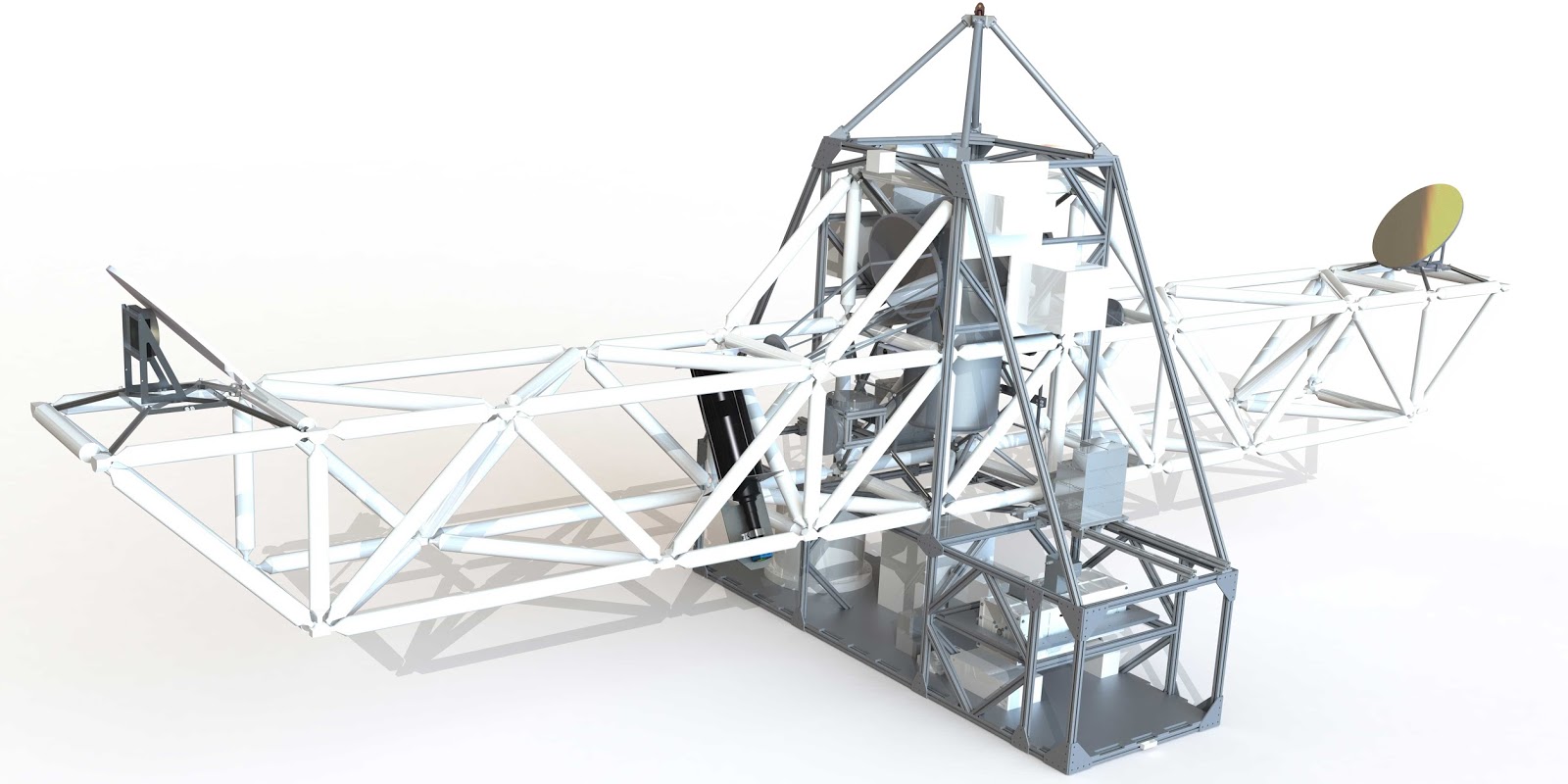
The two far-infrared reflector telescopes of the Balloon Experimental Twin Telescope for Infrared Interferometry (BETTII)[*] have the same 0.50 m (1.6 ft) diameter, and are separated by a distance of 8.0 m (26 ft) between them. This telescope system is attached to a balloon that ascends to an altitude of 40 km (25 miles) in the upper atmosphere.[**] If the two mirrors of this telescope system were instead combined into a single mirror with the same total surface area, the resolving power would:
(A) decrease.
(B) remain the same.
(C) increase.
(D) (The telescope would no longer be able to function.)

[*] S. A. Rinehart ; R. B. Barclay ; R. K. Barry ; D. J. Benford ; P. C. Calhoun, et al., "Design and status of the Balloon Experimental Twin Telescope for infrared interferometry (BETTII): an interferometer at the edge of space," Proc. SPIE 8445, Optical and Infrared Interferometry III, 844508 (September 12, 2012), dx.doi.org/10.1117/12.926376.
[**] asd.gsfc.nasa.gov/bettii/.

Correct answer (highlight to unhide): (A)

Increasing the distance between telescopes creates a much larger effective diameter to increase resolving power. Thus decreasing this separation distance would decrease resolving power.

Section 70158
Exam code: quiz03s8tE
(A) : 27 students
(B) : 8 students
(C) : 5 students
(D) : 0 students
(No response: 1 student)

Success level: 66% (including partial credit for multiple-choice)
Discrimination index (Aubrecht & Aubrecht, 1983): 0.45

Section 70160
Exam code: quiz03n6n4
(A) : 24 students
(B) : 7 students
(C) : 4 students
(D) : 0 students

Success level: 72% (including partial credit for multiple-choice)
Discrimination index (Aubrecht & Aubrecht, 1983): 0.60

20190926

Astronomy quiz archive: telescopes

Astronomy 210 Quiz 3, fall semester 2019
Cuesta College, San Luis Obispo, CA

Section 70158, version 1
Exam code: quiz03St3M


Section 70158
0- 8.0 :   * [low = 6.5]
8.5-16.0 :   **
16.5-24.0 :   ************** [mean = 23.8 +/- 7.3]
24.5-32.0 :   **********
32.5-40.0 :   ***** [high = 36.0]


Section 70160, version 1
Exam code: quiz03Nz6L


Section 70160
0- 8.0 :   ** [low = 7.0]
8.5-16.0 :   *******
16.5-24.0 :   ***** [mean = 20.9 +/- 8.5]
24.5-32.0 :   ******
32.5-40.0 :   ** [high = 36.0]

20190904

Online reading assignment: history of astronomy, telescope powers (SLO campus)

Astronomy 210, fall semester 2019
Cuesta College, San Luis Obispo, CA

Students have a weekly online reading assignment (hosted by SurveyMonkey.com), where they answer questions based on reading their textbook, material covered in previous lectures, opinion questions, and/or asking (anonymous) questions or making (anonymous) comments. Full credit is given for completing the online reading assignment before next week's lecture, regardless if whether their answers are correct/incorrect. Selected results/questions/comments are addressed by the instructor at the start of the following lecture.

The following questions were asked on reading textbook chapters and previewing presentations on reviewing the history of astronomy, Kepler's and Newton's laws, and telescope powers.


Selected/edited responses are given below.

Describe something you found interesting from the assigned textbook reading or presentation preview, and explain why this was personally interesting for you.
"That many of the original astronomers/scientists had very detailed ideas of how the universe worked simply from two assumptions: Earth is the center of motion, and everything was created in perfect patterns."

"It was interesting (and super-impressive) what some of the early astronomers were able to figure out and make good guesses, even if they were wrong, with equipment that only helped the unaided eye."

"The history of astronomy--the universe was too complex to be understood, but thanks to the contribution of earlier astronomers we have a better understanding of the solar system."

"I liked how a lot of the enlightenment thinkers were alive at the same time, interacted, supported or refuted each other's theories."

"The persecution of Galileo was decided on what was a technicality from a previous order years ago."

"That Galileo Galilei was sort of a pompous ass! It was funny to me that the textbook described him as 'outspoken, forceful, and sometimes tactless.' He offended a lot of people, including the pope."

"It's crazy to think that Galileo went on trial for his defense of Copernicus which resulted in a life of confinement, just because of the belief that God could make the universe in a way that 'appeared different to humans.'"

"I find it incredibly interesting that Galileo's middle finger is preserved. The irony behind his actions and how now he is an established figure of science, when back in his era the church tried to silence him for heresy is quite amusing."

"That Galileo was able to see the phases of Venus. I found this interesting because it closely related to the phases of the moon that we recently learned about."

"The difference between Kepler's laws and Newtons laws, since one is 'how' and the other 'why' planets move in our solar system."

"It's crazy to think that Earth revolves around the sun with an inconsistent speed."

"That planets move faster when closer to the sun and slower when farther away, because that's a completely new concept for me!"

"I liked the idea of Newton's cannon and that it is almost impossible to build. People should definitely build it."

"I really liked being able to grasp the concept of elliptical orbits and exactly how it happens. Newton's cannon along with the online simulation perfectly showed the progression and formation of an orbit."

"I think it's super cool that telescopes have so many parts to them, but it is also confusing."

"Telescopes are really cool. It's crazy that they can see so far and be so accurate. It reminds me of a time I went to santa margarita lake and there were a bunch of astronomers with HUGE telescopes set up and the detail was pretty mind blowing. Still don't know how they work completely though."

"I found it interesting that the magnifying power of a telescope doesn't matter as much as it's light-gathering power or its resolving power. It is interesting that it doesn't help you see more detail in general."

"The many components of a telescope, and why they need to be so large."

Describe something you found confusing from the assigned textbook reading or presentation preview, and explain why this was personally confusing for you.
"Nothing in particular is confusing about the historical past of astronomy to me. It's just history."

"How did Kepler figure out the orbits of planets in extreme detail? I simply have no idea how he was able to such a thing."

"Trying to understand Kepler's laws; I can't wrap my head around the geometry of elliptical orbits."

"I was slightly confused when it came to Kepler's laws. They aren't as easy to understand for me compared to that of Newton's laws. I would like to go over Kepler's laws a little more to have them make more sense."

"I didn't find anything that was too confusing. But I would like a refresher on the differences between Kepler's laws and Newton's laws."

"In the book they state that objects orbiting Earth are falling towards Earth's center, and that because of its horizontal velocity the object orbits instead of runs into Earth. I have a hard time imagining how objects orbiting Earth are falling toward earths center but managing to stably orbit Earth without running into it. I understand that orbiting works because of the horizontal velocity but, I can't understand how objects are falling towards Earth's center while also orbiting."

"Telescopes have so many parts to them, so I did kinda get lost trying to understand what each one is for."

"I am having trouble understanding the parameters of a telescope. Specifically, I'm getting stuck at the primary focal length because I don't fully understand the difference between the different telescopes and which has a lens and/or mirror. "

"How light gathering power and resolving power are both dependent on the same component of a telescope, but not in the same way."

"I'm having a hard time understanding all the parts of the telescopes and what they do. I'm more of an auditory learner, so I think if we go over this in class I should be fine."

When a planet is undergoing retrograde motion, over several nights it moves __________ with respect to the background stars.
east to west.   ************************* [25]
west to east.   ******* [7]
(Either of the above choices is possible.)   [0]
(Unsure/lost/guessing/help!)   * [1]

When a planet is undergoing prograde motion, over several nights it moves __________ with respect to the background stars.
east to west.   ******* [7]
west to east.   ************************** [26]
(Either of the above choices is possible.)   [0]
(Unsure/lost/guessing/help!)   [0]

Categorize each of Kepler's laws.
(Only correct responses shown.)
Kepler's first law: describes the shape of a planet's orbit. [91%]
Kepler's second law: describes the speed of a planet along its orbit. [94%]
Kepler's third law: describes the speed of a planet along its orbit. [64%]

Categorize each of Newton's laws.
(Only correct responses shown.)
Newton's first law: relates forces with changes in motion. [61%]
Newton's second law: relates forces with changes in motion. [82%]
Newton's third law: describes a property of forces. [52%]

The __________ power of a telescope depends on the: (Only correct responses shown.)
light-gathering: diameter of the primary lens/mirror [70%]
resolving: diameter of the primary lens/mirror [67%]
magnifying: both the focal lengths of the primary lens/mirror and eyepiece: [30%]

The least important feature to consider when purchasing an optical telescope is the __________ of its images.
brightness.   ***** [5]
resolution.   ** [2]
magnification.   ****************** [18]
(Two of the above choices.)   ****** [6]
(Unsure/lost/guessing/help!)   ** [2]

Briefly explain your answer for the least important feature to consider when purchasing an optical telescope.
"The least important feature to an optical telescope is its magnifying power. This is the ability to enlarge the image seen through the telescope. Light gathering power and detail are the most important when buying a telescope."

"The magnification is the least important feature of an optical telescope because the magnification can be changed by changing the eyepiece. The light-gathering power and resolving power of an optical telescope cannot be changed, and these properties affect the amount of detail that can be seen. A higher magnification does not necessarily show more detail."

"Well, reading the book it states that the magnifying power is the weakest part when considering to buy a telescope because the magnifying power doesn't necessarily show more detail when using it."

"Magnification is the least important feature. The most important thing is getting bright, clear images that you can enlarge after the fact."

Ask the instructor an anonymous question, or make a comment. Selected questions/comments may be discussed in class.
"It was hard to find the difference between prograde and retrograde."

"I didn't know that the planets moved in retrograde! It makes more sense now why visible planets like Mars hang around the same spot in the sky for a while before prograding and moving further across the horizon."

"Are Kepler's laws and Newton's laws interconnected in any way?" (Definitely yes, and we'll make sure to make those connections in class tonight.)

"I would like to know more about how to choose a telescope."

"Do you own a telescope? And if you do, how often do you use it to look at the sky?" (No, because I get to use Cuesta College telescopes whenever I feel like it.)

"Could you talk more about light and telescopes in class please?"

20190903

Online reading assignment: history of astronomy, telescope powers (NC campus)

Astronomy 210, fall semester 2019
Cuesta College, San Luis Obispo, CA

Students have a weekly online reading assignment (hosted by SurveyMonkey.com), where they answer questions based on reading their textbook, material covered in previous lectures, opinion questions, and/or asking (anonymous) questions or making (anonymous) comments. Full credit is given for completing the online reading assignment before next week's lecture, regardless if whether their answers are correct/incorrect. Selected results/questions/comments are addressed by the instructor at the start of the following lecture.

The following questions were asked on reading textbook chapters and previewing presentations on reviewing the history of astronomy, Kepler's and Newton's laws, and telescope powers.


Selected/edited responses are given below.

Describe something you found interesting from the assigned textbook reading or presentation preview, and explain why this was personally interesting for you.
"I found pretty interesting that although planets all orbit around the sun, they move at different paces and for different lengths of time. It's as if they're not just planets, but have their own purpose in the universe."

"I found reading about the ancient astronomers most interesting--history has always been an interest of mine and learning how astronomy relates to history has been fun."

"Kepler's three laws of planetary motion. The first law states that the orbit of the planets are ellipses with the sun at one focus. The second law talks about the distance between the sun and planet. The third talks about a planet's orbital period."

"I found Kepler's laws to be very interesting. The fact that there are all these different ways planets move was very interesting to me. Newton's laws were interesting too, but easier to understand, having learned about those laws in other science classes before."

"Newton's first law states what happens if there were no force--because I think it's crazy then how if something is moving it will continue to move, and if its stationary it will stay still."

"Newton's cannon. I thought it was interesting because that would be really cool if we could actually do an experiment like shown on the presentation."

"Newton's cannon--it looked really cool and I'm sure there's a lot of math and physics behind it but I really tried to understand what was going on."

"The telescope reading was interesting for me because of the different types of telescope there are, and how some work better then others."

Describe something you found confusing from the assigned textbook reading or presentation preview, and explain why this was personally confusing for you.
"Retrograde motion overall kind of confuses me. Orbital mechanics are something I've never really had to think about other than in video games."

"Protograde and retrograde motion, it's just a weird subject to digest."

"I'll need a better breakdown of Kepler's laws."

"I am confused a bit on Kepler's second and third law. I kind of understand how the distance between the sun and planet affects the speed of said planet but I still need more explaining. Also a bit confused on the semi-major axis."

"The whole Newton's cannon thing. I understood the general gist of it, but perhaps a little more information in terms of the relation to Kepler's laws."

"The entire telescope presentation isn't confusing until it gets to light gathering power and area and so forth."

"The whole telescope presentation was very confusing to me. I feel like maybe it will make sense once I actually use one, but just reading about it confuses me a bit."

When a planet is undergoing retrograde motion, over several nights it moves __________ with respect to the background stars.
east to west.   ********* [9]
west to east.   ***** [5]
(Either of the above choices is possible.)   * [1]
(Unsure/lost/guessing/help!)   *** [3]

When a planet is undergoing prograde motion, over several nights it moves __________ with respect to the background stars.
east to west.   ****** [6]
west to east.   ******** [8]
(Either of the above choices is possible.)   * [1]
(Unsure/lost/guessing/help!)   *** [3]

Categorize each of Kepler's laws.
(Only correct responses shown.)
Kepler's first law: describes the shape of a planet's orbit. [72%]
Kepler's second law: describes the speed of a planet along its orbit. [89%]
Kepler's third law: describes the speed of a planet along its orbit. [50%]

Categorize each of Newton's laws.
(Only correct responses shown.)
Newton's first law: relates forces with changes in motion. [78%]
Newton's second law: relates forces with changes in motion. [72%]
Newton's third law: describes a property of forces. [67%]

The __________ power of a telescope depends on the: (Only correct responses shown.)
light-gathering: diameter of the primary lens/mirror [44%]
resolving: diameter of the primary lens/mirror [33%]
magnifying: both the focal lengths of the primary lens/mirror and eyepiece: [0%]

The least important feature to consider when purchasing an optical telescope is the __________ of its images.
brightness.   * [1]
resolution.   [0]
magnification.   ************ [12]
(Two of the above choices.)   * [1]
(Unsure/lost/guessing/help!)   **** [4]

Briefly explain your answer for the least important feature to consider when purchasing an optical telescope.
"Magnification is the least important because light gathering power and resolving power are most important."

"I am not sure, I am guessing it is magnification because in order to see through a telescope the brightness of the object must be visible in order to study it?"

"You have to gather enough light first to capture the image before zooming in."

"It doesn't help to magnify it if it is still blurry."

"I'm not sure. They all seem kind of important."

"In the reading it says 'magnifying power can be changed simply by changing the eyepiece,' that's why I chose my answer."

Ask the instructor an anonymous question, or make a comment. Selected questions/comments may be discussed in class.
"Were others tried for their beliefs about the planets or just Galileo and if he was the only one then why?" (In the 16th century Giordano Bruno proposed stars could each have planets that could host life, and that the universe is infinite and has no center. Although technically he was tried and burned at the stake mainly for his unconventional religious beliefs, his radical ideas on cosmology certainly brought him a lot of undue attention.)

"Crazy to think how Newton thought of all these things."

"Can you just go over the slides a bit, This week's reading and slides were a little hard to understand, yet it was interesting."

"What is the importance of the different telescope features. I know the slides explain it just having a hard time to process it."

"I think it's cool how telescope work."

"What are we going to focus on more, optical telescopes or radio telescopes?" (Definitely optical telescopes, although light gathering power and resolving power in terms of the size of radio telescopes works similar to optical telescopes.)

"Can we please go over the last few questions based on the telescopes?"

"Why is it so important to measure a telescope's lens or mirror?" (Those measurements will tell you how powerful (or not) a telescope is at gathering light, resolving small details, and/or magnifying images. We'll practice measuring telescopes and comparing their powers on Thursday.)

"I'm just pretty confused on everything. I'm not sure what to ask just yet."

20190307

Astronomy quiz archive: telescopes

Astronomy 210 Quiz 3, spring semester 2019
Cuesta College, San Luis Obispo, CA

Section 30674, version 1
Exam code: quiz03nrDr


Section 30674
0- 8.0 :   ** [low = 5.0]
8.5-16.0 :   *****
16.5-24.0 :   ********* [mean = 24.1 +/- 9.3]
24.5-32.0 :   *********
32.5-40.0 :   ******** [high = 40.0]


Section 30676, version 1
Exam code: quiz03SnDr


Section 30676
0- 8.0 :  
8.5-16.0 :   ****** [low = 8.5]
16.5-24.0 :   **************** [mean = 23.1 +/- 7.7]
24.5-32.0 :   *********
32.5-40.0 :   ****** [high = 40.0]

20190213

Online reading assignment: history of astronomy, telescope powers (SLO campus)

Astronomy 210, spring semester 2019
Cuesta College, San Luis Obispo, CA

Students have a weekly online reading assignment (hosted by SurveyMonkey.com), where they answer questions based on reading their textbook, material covered in previous lectures, opinion questions, and/or asking (anonymous) questions or making (anonymous) comments. Full credit is given for completing the online reading assignment before next week's lecture, regardless if whether their answers are correct/incorrect. Selected results/questions/comments are addressed by the instructor at the start of the following lecture.

The following questions were asked on reading textbook chapters and previewing presentations on reviewing the history of astronomy, Kepler's and Newton's laws, and telescope powers.


Selected/edited responses are given below.

Describe something you found interesting from the assigned textbook reading or presentation preview, and explain why this was personally interesting for you.
"That planets sometimes go into retrograde. I always assumed this term meant something spiritual since people would use it in that context."

"That Johannes Kepler took over Tycho Brahe's work after he passed away and came up with the three laws of planetary motion."

"I loved all the history on the astronomers. I've always enjoyed learning about the journey to reach certain conclusions, and science history has always fascinated me for that reason."

"The first thing I saw from the presentation was the GIF of Galileo's observations of moons orbiting Jupiter. The dedication to keep track and just the fact that Galileo was able to observe and record the patterns of Jupiter's moons really impressed me from what was accomplished so far back in history."

"I think it's awesome how far we have come with understand outer space. Going from thinking we were at the center of the universe to knowing we're not is just crazy."

"Newton's laws interested me specifically because it really interesting to learn how planets move and why."

"Isaac Newton invented calculus! This is personally interesting because I took some calculus."

"Maybe interesting isn't the word, but I find it nice that in 1992 Pope John Paul II admitted that the Inquisition had mistakenly condemned Galileo."

"That Galileo was able to build a telescope from descriptions without actually seeing the original himself."

"How there are particular things one should look into prior to purchasing a telescope. What is more exciting is that we will be taking a look at some telescopes tomorrow for the in-class activity."

Describe something you found confusing from the assigned textbook reading or presentation preview, and explain why this was personally confusing for you.
"I found really confusing how we were supposed to determine how sunlight would hit planets and what certain planets would be able to see because I couldn't pair the times with the positions."

"Orbital motion and Kepler's laws."

"I found Kepler's laws most confusing, and I can't really tell the difference that well with what each law is referring to. The third one just throws me off with the whole thing, and there doesn't seem like a cohesive structure as to why there are three laws."

"I found everything about the telescopes to be confusing. I mainly had an issue with understanding how the focal lengths relate to everything."

"The section about telescopes was confusing to me, specifically what the different lenses do."

"Wait, so are the measurements put into an equation for the telescope? How do we know what lens or mirror to use from the get go?"

"Pretty straightforward."

"Almost everything because I only skimmed the book."

When a planet is undergoing retrograde motion, over several nights it moves __________ with respect to the background stars.
east to west.   ***************** [17]
west to east.   *********** [11]
(Either of the above choices is possible.)   **** [4]
(Unsure/lost/guessing/help!)   **** [4]

When a planet is undergoing prograde motion, over several nights it moves __________ with respect to the background stars.
east to west.   ************* [13]
west to east.   ******************** [20]
(Either of the above choices is possible.)   [0]
(Unsure/lost/guessing/help!)   *** [3]

Categorize each of Kepler's laws.
(Only correct responses shown.)
Kepler's first law: describes the shape of a planet's orbit. [69%]
Kepler's second law: describes the motion of a planet along its orbit. [78%]
Kepler's third law: describes the motion of a planet along its orbit. [58%]

Categorize each of Newton's laws.
(Only correct responses shown.)
Newton's first law: relates forces with changes in motion. [56%]
Newton's second law: relates forces with changes in motion. [64%]
Newton's third law: describes a property of forces. [58%]

The __________ power of a telescope depends on the: (Only correct responses shown.)
light-gathering: diameter of the primary lens/mirror [69%]
resolving: diameter of the primary lens/mirror [75%]
magnifying: both the focal lengths of the primary lens/mirror and eyepiece: [42%]

The least important feature to consider when purchasing an optical telescope is the __________ of its images.
brightness.   ****** [6]
resolution.   [0]
magnification.   ************************** [26]
(Two of the above choices.)   * [1]
(Unsure/lost/guessing/help!)   *** [3]

Briefly explain your answer for the least important feature to consider when purchasing an optical telescope.
"Magnifying power is the least important and as a result as mentioned on the lesson just because you can make it bigger it doesn't necessarily mean it will be clearer."

"Magnification just gives you a enlarged fuzzy image."

"Brightness is necessary to see the images of planets and resolution lets us see that image clearly, without those two features first I wouldn't be able to see anything in the first place."

"The least important feature is the magnification because it can be changed by simply switching the eyepiece."

Ask the instructor an anonymous question, or make a comment. Selected questions/comments may be discussed in class.
"I would like to understand the entirety of retrograde/prograde motion."

"I'm really glad we are moving away from the spatial astronomy part and going into the historical part of astronomy."

"I am so bad at history stuff can we please do more spatial stuff."

"What are some tips you considered when study for a astronomy quiz?" (Go over the quiz question packet, for the history of astronomy section there are a lot of sample reading comprehension-type questions.)

"I would like for you to maybe go over Kepler's laws one more time. I think I understand them, but it would be good to go over them again when we can ask questions."

"Will we be using telescopes? Do we have huge telescopes in our campus' observatory?" (Yes, tonight!)

"Will we be getting a demonstration on how to determine focal length, diameters, etc. in class? Perhaps a visualization/hands on experience might make it easier to understand?"

"Why does a better magnification not show a better image? If two telescopes are the same exactly but one has a better magnification would that one not present a better image?" (If both telescopes produce the same dim, blurry image, then the one with better magnification would merely produce a bigger dim, blurry image than the other.)

"How do you feel about the Flat Earth Society?" (To me they sound like they like a lot of first principles.)

"I don't have much trouble understanding the reading at home. However, I highly respect your teaching style and you do make it that much clearer of a picture. Your lessons are great the way they are, however, if you would like to add more depth, I am all for it. Thanks for educating!"

"Astronomy is hard for me. There are a lot of people in class and groups who seem to be confident in their work. Can you please ask people to raise their hand if they need one on one assistance and help them as best as you can. I know you can't spend several minutes on each student but I believe there are students who need more help and guidance than others, even with the online presentations. Sometimes group work moves too fast and group members don't stop to help one another. Thank you!"

20190212

Online reading assignment: history of astronomy, telescope powers (NC campus)

Astronomy 210, spring semester 2019
Cuesta College, San Luis Obispo, CA

Students have a weekly online reading assignment (hosted by SurveyMonkey.com), where they answer questions based on reading their textbook, material covered in previous lectures, opinion questions, and/or asking (anonymous) questions or making (anonymous) comments. Full credit is given for completing the online reading assignment before next week's lecture, regardless if whether their answers are correct/incorrect. Selected results/questions/comments are addressed by the instructor at the start of the following lecture.

The following questions were asked on reading textbook chapters and previewing presentations on reviewing the history of astronomy, Kepler's and Newton's laws, and telescope powers.


Selected/edited responses are given below.

Describe something you found interesting from the assigned textbook reading or presentation preview, and explain why this was personally interesting for you.
"Even though you talked about retrograde planetary motion in class, I enjoyed reading about it. I never knew planets did that before."

"I enjoyed the breakdown of Kepler and Newton's laws. I liked thinking about Kepler as making observations and explain what was happening, while Newton was explaining why it was happening."

"Kepler's second law: equal distance and equal area swept out in orbit. This is a very interesting relationship and I wonder what explains it."

"I found Newton's cannon to be pretty interesting because of the fact that pretty much proved how gravity worked if something were to be shot out of it. The object shot from the cannon would eventually land onto Earth's surface because of the gravity pulling it down towards Earth."

"The different types, powers, and characteristics of telescopes was very interesting because I never knew how a telescope actually worked and all of the components within a telescope."

"That there are two different kinds of telescopes. I thought it was cool and interesting reading about refracting telescopes vs. reflecting telescopes because I never really knew that there were multiple kinds. After reading however, I know know the difference between them."

"I read through it but I was still kinda lost."

"Personally I didn't think anything was too interesting."

Describe something you found confusing from the assigned textbook reading or presentation preview, and explain why this was personally confusing for you.
"Remembering all the different laws is confusing for me! There are just a lot of them and each are similar but also so different."

"I feel like I partially understand Kepler's laws. I get them conceptually, but not how to apply them."

"Newton's laws were confusing to visualize, therefore understand."

"Remembering all the different laws is confusing for me! There are just a lot of them and each are similar but also so different."

"All the different pieces to the telescope. With so many different pieces and terminology that sound similar, it's easy to get them mixed up."

When a planet is undergoing retrograde motion, over several nights it moves __________ with respect to the background stars.
east to west.   ************** [14]
west to east.   *********** [11]
(Either of the above choices is possible.)   * [1]
(Unsure/lost/guessing/help!)   **** [4]

When a planet is undergoing prograde motion, over several nights it moves __________ with respect to the background stars.
east to west.   *********** [11]
west to east.   ************* [13]
(Either of the above choices is possible.)   [0]
(Unsure/lost/guessing/help!)   ****** [6]

Categorize each of Kepler's laws.
(Only correct responses shown.)
Kepler's first law: describes the shape of a planet's orbit. [63%]
Kepler's second law: describes the motion of a planet along its orbit. [63%]
Kepler's third law: describes the motion of a planet along its orbit. [60%]

Categorize each of Newton's laws.
(Only correct responses shown.)
Newton's first law: relates forces with changes in motion. [80%]
Newton's second law: relates forces with changes in motion. [57%]
Newton's third law: describes a property of forces. [60%]

The __________ power of a telescope depends on the: (Only correct responses shown.)
light-gathering: diameter of the primary lens/mirror [33%]
resolving: diameter of the primary lens/mirror [50%]
magnifying: both the focal lengths of the primary lens/mirror and eyepiece: [10%]

The least important feature to consider when purchasing an optical telescope is the __________ of its images.
brightness.   ******* [7]
resolution.   ** [2]
magnification.   **************** [16]
(Two of the above choices.)   [0]
(Unsure/lost/guessing/help!)   ***** [5]

Briefly explain your answer for the least important feature to consider when purchasing an optical telescope.
"Magnification just enlarges images, so if the other parts are not good you will just get a larger image that is dim and fuzzy."

"Light-gathering power and resolving power already get you a bright, clear picture. The magnifying power just makes it bigger."

"Magnification is the least important power, because higher magnification does not necessarily show you more detail. The amount of detail you can see in practice is limited by a combination of the seeing conditions and the telescope's resolving power and optical quality."

"Magnification can be changed by changing the eyepiece."

"I am still a little lost..."

Ask the instructor an anonymous question, or make a comment. Selected questions/comments may be discussed in class.
"I need a great help understanding this chapter!"

"Why doesn't Kepler's third law explain why the time periods happen to be different for the inner/outer planets? Maybe the answer is staring me right in the face or is extremely obvious, but I was a bit confused on why Kepler didn't include this information within his third law, at least for clarification." (You need to understand the relationship between motion and forces in order to explain why planets move the way they do, which is what Newton discovered.)

"Honestly, the telescopes were confusing."

"Will we ever use the telescopes to see planets or other objects from space?" (Yes, later this semester. We had a star night planned this week, but it's cancelled because of the rainy forecast.)

"What is the most common type of telescope used today? Reflecting or refracting?" (Many small telescopes are refractors (lenses in front bend and focus the light), but most serious and/or large telescopes are reflectors (mirrors in back bounce and focus the light), as it much more practical to make a large precision mirror than a large precision lens.)

"What are we going to do for the telescope in class activity?" (We'll be looking at telescopes hands-on and up-close, measuring and comparing telescope parameters and powers.)

"This may be off-topic at the moment but, how come the majority of the moon's massive craters are all measured at the same depth after impact?" (As we'll see in a few weeks, these craters were all filled in about the same time with lava when the moon was still geologically active a long time ago.)

"Have you had a interest in space and the stars since a young age?" (Yes, I always like going to visit the planetarium at the Bishop Museum in Honolulu while growing up.)

"Is it valid to assume that space vampires are a possibility being that telescopes are reliant on mirrors?"

"Astronomy-related-riddle-time: When the temperature gets higher, It makes this liquid metal rise. It is also a planet's name, Which is the one smallest in size..."