Showing posts with label Copernicus. Show all posts

20200220

Astronomy quiz question: morning star Venus?

Astronomy 210 Quiz 2, spring semester 2020
Cuesta College, San Luis Obispo, CA

The locations of Mercury, Venus, and Earth are shown in the diagram below (not to scale, and orbits have been simplified as circles instead of ellipses).


At sunrise, Venus will be:
(A) low over the east horizon.
(B) somewhere high up in the sky.
(C) low over the west horizon.
(D) not visible in the sky.

Correct answer (highlight to unhide): (A)

If a line is drawn from Earth to the sun, the observer at sunrise (6 AM) is located perpendicular to that line.


Everything above that line would be above the horizon, such that Venus will be visible at sunrise, low over the east horizon.

Section 30676
Exam code: quiz02SnRl
(A) : 20 students
(B) : 2 students
(C) : 8 students
(D) : 14 students

Success level: 48% (including partial credit for multiple-choice)
Discrimination index (Aubrecht & Aubrecht, 1983): 0.60

Astronomy quiz archive: eclipses/history of astronomy

Astronomy 210 Quiz 2, spring semester 2020
Cuesta College, San Luis Obispo, CA

Section 30674, version 1
Exam code: quiz02n1xI


Section 30674
0- 8.0 :   ** [low = 6.0]
8.5-16.0 :   *****
16.5-24.0 :   ******* [mean = 23.8 +/- 9.0]
24.5-32.0 :   *********
32.5-40.0 :   ******* [high = 36.5]


Section 30676, version 1
Exam code: quiz02SnRl


Section 30676
0- 8.0 :   ** [low = 8.0]
8.5-16.0 :   *******
16.5-24.0 :   *************
24.5-32.0 :   ********* [mean = 24.8 +/- 9.2]
32.5-40.0 :   ************* [high = 40.0]

Astronomy quiz question: evening star Venus?

Astronomy 210 Quiz 2, spring semester 2020
Cuesta College, San Luis Obispo, CA

The locations of Mercury, Venus, and Earth are shown in the diagram below (not to scale, and orbits have been simplified as circles instead of ellipses).


At sunset, Venus will be:
(A) low over the east horizon.
(B) somewhere high up in the sky.
(C) low over the west horizon.
(D) not visible in the sky.

Correct answer (highlight to unhide): (D)

If a line is drawn from Earth to the sun, the observer at sunset (6 PM) is located perpendicular to that line.


Everything below that line would be below the horizon, such that Venus will not be visible at sunset.

Section 30674
Exam code: quiz02n1xI
(A) : 5 students
(B) : 3 students
(C) : 5 students
(D) : 18 students

Success level: 59% (including partial credit for multiple-choice)
Discrimination index (Aubrecht & Aubrecht, 1983): 0.88

20200205

Online reading assignment: eclipses, history of astronomy (SLO campus)

Astronomy 210, spring semester 2020
Cuesta College, San Luis Obispo, CA

Students have a weekly online reading assignment (hosted by SurveyMonkey.com), where they answer questions based on reading their textbook, material covered in previous lectures, opinion questions, and/or asking (anonymous) questions or making (anonymous) comments. Full credit is given for completing the online reading assignment before next week's lecture, regardless if whether their answers are correct/incorrect. Selected results/questions/comments are addressed by the instructor at the start of the following lecture.

The following questions were asked on reading textbook chapters and previewing presentations on eclipses, and an preliminary overview of the history of astronomy.


Selected/edited responses are given below.

Describe something you found interesting from the assigned textbook reading or presentation preview, and explain why this was personally interesting for you.
"I found the lunar eclipses very interesting. I am a photographer and in 2015 when there was a good 'blood moon' I took photos of it and I never knew why it was red but I thought it was cool. Then I discovered it's because of sunlight scattering through earth's atmosphere then hitting the moon causing that look."

"I went and saw the total solar eclipse in Oregon, and it was the most beautiful and amazing experience, so to understand more behind it was interesting."

"When I lived in Oregon I saw the total solar eclipse, and to read about it now is really interesting to put it together like that. Also we had to buy special glasses to watch the sun just before and after just totality so it wouldn't hurt our eyes."

"That when you are observing a solar eclipse you can still get blinded by the sun even when the sun is not quite completely blocked."

"That lunar eclipses always occur on full moons, but not every full moon and solar eclipses always occur on new moons, but not ever new moon. This was interesting to me because I've always been intrigued with eclipses, so knowing they occur quite often now makes me excited to go out and watch them."

"I really liked looking at the pictures of the solar and lunar eclipses. I thought those pictures were so cool to look at."

"I didn't know that lunar eclipses were when Earth blocks out light to the moon. Now I understand why it's called a lunar eclipse because the moon (luna) is being eclipsed! Go figure."

"To see the exact measurements for how far and big the sun is compared to the moon. It's insane that they just happen to line up to create eclipses. So weird to me."

"That solar eclipses only happen during the new moon phase."

"The history of astronomy and how far we have come from then to now."

"The historical evolution of how we understood our solar system; I had never learned the order in which correct conclusions were made, and it was cool to know the order in which things were figured out."

"That ancient astronomers abided by 'first principles' for so long."

"All the philosophers who kept changing the model of planetary motion over and over again. I thought the first principles were interesting in that everyone just agreed with them, even though there was no research."

Describe something you found confusing from the assigned textbook reading or presentation preview, and explain why this was personally confusing for you.
"I'm just bad at starwheel questions. The starwheel always confuses me a little."

"The terminology for everything having to do with eclipses is overwhelming. I know that it can be learned with practice, but I hope to understand what each term means and be able to explain it with understanding and not just memorization."

"This might sound dumb but I didn't know the difference between the lunar and solar eclipse. I also didn't know why or how often they happened."

"Picking apart the differences between solar and lunar eclipses. This was confusing because there are a lot of things going on for each eclipse that can easily get crossed."

"I found the terms and umbra and penumbra confusing, because they weren't really defined. Also, I'm confused in the order they occur in when it comes to eclipses."

"I thought the lunar eclipse was confusing at first because if Earth is in front of the moon, wouldn't the moon be just dark? Then I figured out it doesn't work like that."

"In the textbook it says for a lunar eclipse the sun can turn a coppery red, because the moon is hiding in Earth's shadow, and Earth is blocking the sunlight. I haven't looked it up, but based solely on the textbook reading, I don't understand why the moon would turn red if it's in the shadow, and why it wouldn't just be dark or not visible."

"I was confused as to why a lunar eclipse could occur only during a full moon. While it made sense why this might affect visibility when viewing it from Earth, wouldn't the phenomenon still take place regardless of moon phase?"

"The only thing that was slightly confusing was why solar eclipses and lunar eclipses don't happen at every full/new moon."

"I found the GIF animation in the presentationthat shows the moon and Earth's movements as seen from the sun a little hard to understand. I understand that when the moon is in the right phase and the orbit is aligned, that's when there is an eclipse. But when the GIF is in motion it is hard for me to distinguish when the orbit is aligning."

"I think having to remember the different astronomers and the order in which they contributed will be a struggle and also having to differentiate whether they are a mover or disprover."

"One thing I think could be confusing will be trying to remember the order of the different astronomers and each of their contributions and ideas."

"Though I am not entirely lost on the subject, the idea of movers and disprovers is what I am understanding least. They each have specific roles in the progression of our understandings, but I am confused as to why they must be separated into groups, I feel all movers should attempt to disprove their own models in order to strengthen their arguments?"

"The idea of planets going into retrograde and moving the opposite direction that there supposed to for a short amount of time was difficult for me to visualize. but after thinking about it a little and reading the explanation about a runner on a track and how it's like when you pass someone and it appears they are moving backward compared to their background helped a lot."

A friend of yours has a birthday on March 30. According to your starwheel, the sun would have been located in front of which zodiac sign on that date? (Ignore daylight saving time.)
Aries.  **** [4]
Taurus.  [0]
Gemini.  [0]
Cancer.  [0]
Leo.  [0]
Virgo.  * [1]
Libra.  [0]
Scorpio.  [0]
Sagittarius.  [0]
Capricorn.  [0]
Aquarius.  [0]
Pisces.  *********************************** [35]
(Unsure/guessing/lost/help!)  ** [2]

I believe astrology is able to make accurate predictions about my future. (This is a follow-up question.)
Strongly disagree.  ****** [6]
Disagree.  ********** [10]
Neutral.  ********************** [22]
Agree.  ** [2]
Strongly agree.  ** [2]

Briefly discuss what you know now (that you didn't know before) that may (or may not have) affected your earlier opinion regarding your belief/disbelief in astrology. (This is a follow-up question.)
"I am still confused with astrology so I am still neutral because I don't exactly know what it is."

"I didn't know that percession existed therefore changed my idea on the predictions we see today."

"I've always been curious about astrology, but never a big believer that it has a certain say in my future. I think it predicts some things that makes me think it could be true, but then it's also always vague. What I didn't know is that everyone's astrological sign is off! That's so funny to me, and makes me disbelieve in it more."

"I never understood what people meant by 'sun-sign," I always assumed you had only one sign and it dealt with when you were born. Understanding now that your house is where the sun lined up with the constellations is really interesting but my opinion remains neutral on the subject"

"I personally didn't know my sun-sign. But now I'm able to find it on the starwheel."

"I do not believe my answer affects my opinion because I like to trust my thinking."

"I'm very neutral about astrology because I do believe and I do not believe in some of the predictions that are made about us."

"How I can predict what constellation will be in the sky on a specific night."

"I feel like my opinion stays the same due to the fact that I said it was neutral because sometimes they are true and others they are false. "

"I learned that our sun-sign is on a one-month shift and our sign is actually different than what the horoscope says. This still doesn't really change my view. I still do not think that astrology can determine our personalities or tell our futures."

"I didn't know that astrology was 'discovered' so long ago, that the sky has changed now, and that it changes which stars are in the sun on certain days. I didn't believe in the social media predictions of astrology before, so it doesn't really change my opinion."

"I find it weird that I was told I was a Scorpio growing up but now that I have seen in the lecture I'm a Libra."

"I now know that the sun-signs used in modern astrology are not really your true sun-sign, and that it really has no correlation to life events or personality."

"I still kinda do not believe it especially now that I know that the dates are shifted one month over My belief has not changed, I do not believe in astrology as fortune telling."

"I don't believe scientifically in the big bang, I believe in God's creation."

"What I know now that has affected my earlier opinion is that your house sign will most likely not be the same as your birthday zodiac sign. It makes me believe more in astrology and its process."

"I still don't think my future is affected by astrology and horoscopes but I am a little offended to be a Leo when using the star chart. Being a 'Virgo cusp' I have always fully identified as a Virgo, but found Leo's in my life to be polarizing. Being a Leo by the star chart made me not want to believe it matters..."

"It didn't change my opinion at all to be honest I still believe that it has no affect in your life at all."

"I didn't know that the zodiac signs are different now then when we recorded them I don’t believe that this makes astrology able to predict my future."

"That sun-signs don't necessarily fall within the typical dates, but rather when the sun is "in" each zodiac constellation. I still believe in astrology despite it being a psuedoscience- it's fun and something for me and my friends to talk about."

"The fact that our signs are different according to the starwheel makes me question some of the legitimacy of astrology and those who wholeheartedly believe in it as if it were a religion."

"I never knew that the signs were so off! I also didn't even know or understand how we even got our sun-signs in the first place. I totally believe a little bit that it has something to do with who you are because I have always thought that I was more of a Leo, rather than a Virgo, and according to the starwheel, I am, lol."

"I still don't know enough abut them to make a different opinion."

"I don't believe that stars have a direct influence on our life. I do believe that some of the zodiacs can be extremely accurate to describe a person which is interesting. If there is any influence I believe that it's through people reading their zodiac and acting how they think they are destined too."

"I didn't know how the constellations correlated with the date of birth or that the zodiacs have changed over time."

"I was already quite skeptical of the sun-signs, learning that they are all completely off though really was pretty entertaining."

"I didn't know that our signs are a whole month behind our actual signs. This is huge in showing people that astrology is a bunch of bologna."

"I thought I was a Cancer according to my 'natal chart' and it told me all my personality traits but now that I know all of the zodiac signs are off because of precession I think it's all fake."

"I think the ideas of a mover and disprover help to give background to the different thought processes and help bring light to the ideas behind them and allows others to form their own opinion."

"I didn't know about the different solstice and equinoxes and now I know a bit more about them and when they occur."

"My opinion stays the same. I don't think your astrological sign can predict your future, but I think that people with the same astrological signs can carry similar character traits."

"During class, I learned that precession affects the accuracy of monthly changes in astronomical signs. This explains why the signs sometimes differ for the same given date depending on whether a starwheel or horoscope is used. After learning this, I only became more convinced that astrology cannot make accurate predictions about the future (my initial belief to begin with)."

"I learned how to find my true zodiac sign from in class and learned more about the history behind the sun-signs. But I still don't think that means it can predict my future or who I am."

"Well I never knew that the zodiac symbols where off by a month and I thought I was a Aquarius but I'm in-between Capricorn and Sagittarius (Jan 25)."

"I previously didn't believe that astrology could make accurate predictions about my future. The last lecture re-enforced that by going over how astrology is actually not even correct. In the sense that precision has shifted the zodiac constellations roughly a month off. This makes it even harder to believe that this system could predict anything."

"Everything is a lie, and sun-signs attest to that statement."

"I did not know that most people actually have a different sun-sign than what is posted online."

"I didn't know that precession has changed the location of the zodiac constellations in relation to the time of the year. Astrology was never something I took super-seriously, but I take it even less seriously now."

"Knowing that the constellations in the sky when people are born has changed over the years doesn't really affect my opinion on astrology. When I speak to people about astrology I have always looked at both what their house is listed as well as the one to come and the previous house. I still find that there are aspects in the descriptions of these types of people within each of the different houses. I still don't look to astrology to make predictions about my future."

"I learned that due to precession, the dates for our astrological signs have changed. Therefore, predictions made by horoscopes are meant for people born in months other than those they are stated for. For instance, I'm a Leo but my starwheel says that I'm a Cancer. Therefore, astrological readings for Leo that are supposed to be predictions for me are 'inaccurate.'"

Match the phase of the moon during these eclipse types. (Only correct responses shown.)
Total solar eclipse: new moon [74%]
Partial solar eclipse: new moon [57%]
Annular solar eclipse: new moon [62%]
Total lunar eclipse: full moon [88%]
Partial lunar eclipse: full moon [69%]

Place these astronomers in chronological order of their historical contribution to astronomy. (Only correct responses shown.)
Aristotle [83%]
Ptolemy [71%]
Copernicus [79%]
Tycho [57%]
Kepler [55%]
Galileo [55]
Newton [76%]

Match these terms with their descriptions. (Only correct responses shown.)
Ideas accepted as truth without further examination: first principles [88%]
Predictions that could be tested by observations: hypotheses [86%]
Universal statements of cause and effect: rational laws [76%]
Describe phenomena without explaining why it occurs: empirical laws [67%]

Ask the instructor an anonymous question, or make a comment. Selected questions/comments may be discussed in class.
"Can you explain the sun and lunar eclipses more in class?"

"Still not too sure about the eclipse phases."

"I would like a little bit of clarification on the relationship between full solar eclipses, annular eclipses, and partial eclipses. The way I understand it is that a full solar eclipse is when the moon totally blocks the sun, and an annular eclipse is when the moon isn't big enough to cover the whole sun so there is that ring. What I wanted was clarification on is (1) is it considered a partial eclipse if you are in the penumbra for either of those eclipses, and (2) is an annular eclipse is always considered a partial eclipse since it doesn't totally cover the sun?" ((1) Yes, if you are only in the penumbra (one of the side shadow zones of the moon) for any type of solar eclipse, then you are only seeing a partial solar eclipse, where only the edge of the sun is covered up. (2) Annular eclipse means that you are actually in the "negative shadow" (the antumbra), and while the sun is not completely covered up by the moon, it is still centered on the sun, so it's not considered a partial solar eclipse.)

"How many total solar eclipses have you witnessed, if any?" (Just one, so far, in Hawaii with my family in 1991. Hopefully I'll get to take Mrs. P-dog somewhere to see her first total solar eclipse one day.)

"Are the predictions or estimates all true of annular and partial eclipses since they predict or estimate through 2024 in the book?" (Yes, but here's a list of upcoming eclipses specifically for San Luis Obispo, CA.)

"How much time do you think we should put aside for extra studying for tests and quizzes to do well? Are going over notes or studying the textbook more in-depth going to be more helpful?" (I would say that going over the past semester's quiz, and the quiz question packet would be most helpful, and then referring to your notes and/or the textbook as needed to answer those questions.)

"This homework assignment was difficult for me and the reading took me a while."

"How long did the mustache take to grow?" (A long time. Too long. Now that I've had it for the past sixty semesters, I don't think I'll ever shave it off.)

"I can't think of a question yet!" (Well, you were able to think of a comment.)

20200204

Online reading assignment: eclipses, history of astronomy (NC campus)

Astronomy 210, spring semester 2020
Cuesta College, San Luis Obispo, CA

Students have a weekly online reading assignment (hosted by SurveyMonkey.com), where they answer questions based on reading their textbook, material covered in previous lectures, opinion questions, and/or asking (anonymous) questions or making (anonymous) comments. Full credit is given for completing the online reading assignment before next week's lecture, regardless if whether their answers are correct/incorrect. Selected results/questions/comments are addressed by the instructor at the start of the following lecture.

The following questions were asked on reading textbook chapters and previewing presentations on eclipses, and an preliminary overview of the history of astronomy.


Selected/edited responses are given below.

Describe something you found interesting from the assigned textbook reading or presentation preview, and explain why this was personally interesting for you.
"Eclipses. I never really took the time to realize there was more than one. Finding out there's more and that they can look different really blew my mind."

"Differences between lunar and solar eclipses. A lunar eclipse is when the moon passes through Earth's shadow and a solar eclipse is when the moon casts its shadow on Earth. I was aware of the existence of eclipses but not the types of it."

"How a lunar eclipse turns the moon into a copper-red color and how the lunar eclipse occurs when the Moon moves through the shadow of the Earth. I found this interesting because I remember seeing the Moon making this beautiful color in the sky but I didn't know why it did that before reading this chapter in the text."

"I found the reason why eclipses don't happen every month interesting. Even though you know an eclipse happens when the sun aligns with the moon or the sun, moon, and Earth align, you don't really think about why they don't happen every month."

"That solar eclipses are predictable."

"During a solar eclipse, if you look at the sun, if you wear sunglasses it can still cause damage to your eyes."

"I still find it interesting that you can't look at a solar eclipse. We're taught that we shouldn't look at the sun so technically we shouldn't look at the eclipse. It's one of those things that you know you shouldn’t do but don't really think much of why."

"How a shadow from an eclipse is consisted of two parts the umbra and penumbra. This whole time I thought it was one big shadow that covered the total surface."

"It took two thousand years for astronomers to eventually come to the conclusion that the geocentric model was wrong. So many incorrect and completely wrong calendars over those years and then Copernicus and others finally fixed it."

"How long ago the first astronomers made their mark on history. This is insane to me because despite their lack of technology and prior knowledge they were able to make ground-breaking discoveries."

"Copernicus 'challenging belief in the locations of heaven and hell' to disagree with Aristotle's model of the universe. I found this interesting compared to now because of how easy it is to disagree with someone else regardless of 'beliefs,' we have more freedom of expression today."

"That a 'disprover' is someone who tears things down--an astronomer who argues against a previously-held model of planetary motion."

"That astronomers of the past found ways to explain things that worked, but were ultimately proved wrong."

Describe something you found confusing from the assigned textbook reading or presentation preview, and explain why this was personally confusing for you.
"I was very confused on some of the explanations of the eclipses maybe it was just the wording."

"Shadow zones and differences between lunar eclipses and solar eclipses."

"I can't wrap my head around the penumbra and umbra."

"The phase of the moon is in for different types of eclipses."

"I remember when the partial solar eclipse happened a few years ago, there were posts all over the internet of crescent-shaped images of the sun cast by leaves and stuff but I don't really get why."

"The difference between lunar eclipse and solar eclipse was confusing to me because I don't quite understand the difference between the two. I also don't understand the difference between the total solar eclipse compared to partial and annular."

"I find it confusing how and when an eclipse will happen and why it happens, and why not every full moon is a lunar eclipse."

"My source of confusion is often in visualizing how things look spatially, and this chapter was no exception. I knew planets appeared to move backwards in the sky sometimes and that it had to do with how our orbit varies from theirs, but its hard to think of how that would look without an animated GIF."

"What was confusing that the scientists in Tycho's time had no telescopes or anything of the like, but they would still make their own observations."

"The astronomers. I have never personally been good at remembering names and dates. Remembering seven different people seems a bit confusing."

"I would like to understand the history of astrology more, it kind of turned into a mess in my brain. When trying to remember on the spot, who is a disprover or a mover, or who is scientific or nonscientific, it's difficult for me to distinguish between the astrologists. It was also kind of confusing to me their ways of doing things and how they created what they did. I'm not sure if it's shown anywhere how they figured out what the universe looked like or how they envisioned it so well without technology, it would be really cool to know."

A friend of yours has a birthday on March 30. According to your starwheel, the sun would have been located in front of which zodiac sign on that date? (Ignore daylight saving time.)
Aries.  * [1]
Taurus.  [0]
Gemini.  [0]
Cancer.  [0]
Leo.  [0]
Virgo.  ** [2]
Libra.  * [1]
Scorpio.  [0]
Sagittarius.  [0]
Capricorn.  [0]
Aquarius.  * [1]
Pisces.  *********************** [23]
(Unsure/guessing/lost/help!)  **** [4]

I believe astrology is able to make accurate predictions about my future. (This is a follow-up question.)
Strongly disagree.  * [1]
Disagree.  *********** [11]
Neutral.  ***************** [17]
Agree.  *** [3]
Strongly agree.  [0]

Briefly discuss what you know now (that you didn't know before) that may (or may not have) affected your earlier opinion regarding your belief/disbelief in astrology. (This is a follow-up question.)
"There are way more astrology signs than I thought. I know now that the time periods for each sun-sign are based off old positions for constellations recorded in ancient times. So the ridiculous personality traits attached to each sun-sign aren't even based off the right constellations for those birthdays."

"I already knew about how because of the way the months are going each time there will be a new horoscope. I still don't think the stars are fortune-tellers but I did learn it takes the moon a month to go around Earth."

"I knew that astrology had to do with your sign and all that but im surprised its more to do with the moon and sun-signs."

"I didn't know that there were more than three types of eclipses."

"Something I know now that I didn't before was figuring out our actual zodiac signs. The internet is off by 20 days each sign. To find your sign you line up your birthday with noon on your starwheel and which ever is in the line of the sun going from south to north, that's your zodiac sign."

"Personally nothing stood out as something I really didn't know before, I still remain neutral on the subject. I don't really believe that astrology is going to sway my beliefs much."

"After learning more about zodiac signs about timing in the sky, I changed my opinion to being neutral on this question. I think that astrology could have accurate predictions about my future after learning more about zodiac signs and what there is out there that describes people born in a specific month."

"Before this lesson I didn't understand the differences in the types of eclipses, I figured they were all the same. Understanding how they work and why they occur makes much interested in viewing an eclipse."

"I'm honestly still pretty neutral on it. It is still interesting but I haven’t had a point where I’m like, 'Yeah, this is totally predicting the future.'"

"I have learned that horoscope astrology signs are off and I am actually a taurus. It hasn't really changed my beliefs but it's cool to learn about."

"Something that I didn't know that I know now is how scientists don't update the zodiac signs to the correct dates and months due to the movement of the constellations. It has not affected my opinion on astrology at all i'm still neutral."

"Something I know now is that our zodiac signs are slightly different than what actual constellations our birthdays on the internet assigns. For example how I am considered a libra, however the sun is not located in front of that on my birthday, it is actually located in front of Virgo. This somewhat affected my opinion making my disbelief opinion stronger simply because what is said online is already incorrect based on what the star wheel tells us, which makes it harder for me to believe."

"I am not sure how to answer this question, I just know how it can't predict the future but there is some coincidences sometimes."

"I have learned that the zodiac signs that we usually see are off by one month, they're not accurate. That being said, I definitely support the fact I that astrology cant predict our future. I know know that the zodiacs that I think I know are a month off present time and now I know I'm not a Leo, I'm a Cancer."

"I put agree because I found that astronomy was interesting in high school and couldn't decide if I should major in criminal justice or astronomy."

"Knowing that the zodiacs were a month off does push my thoughts of astrology to neutral from disagree. I don't think that they can completely predict something but they can hit some points that may apply to you."

"My opinion on astrology hasn't changed all that much. I have learned a couple new things but my opinion hasn't been affected much."

"I still say neutral due to the fact that I don't really know how the information I have already obtained from the course would help me on deciding in belief of disbelief."

"There is no way for someone to see the future their is no way to know what will happen in the distant future."

"My opinion that it relies on confirmation bias still stands, with the added point that technically it can predict a very specific part of the future, by which I mean one can predict what stars will be where when on any date including the future."

"I had no idea about provers and disprovers, tearing an idea down or trying to prove a idea. Astrological signs don't line up with the constellations."

"I still feel the same about astrology. I disagree that it has any impact on the events in our lives and our personalities, as it has been disproved by various scientists to be supported by the scientific method. A new thing I did learn though was that the zodiac constellations and zodiac horoscopes do not match up, as the zodiac constellations on the starwheel and the dates for the horoscopes are a month off from each other. This may show that astrology is not completely reliable."

"I'm still curious as to why people believe that these star signs can predict things. I want to see some sort of reasoning from astrology fans. I have a hard time believing anything without proof or reason."

"I don't really know much about astrology still and that makes me not confident in choosing whether or not I believe or disbelieve in astrology. I think my lack of information is holding me back from forming an opinion."

"I believe it's not true that it can predict one's future because the star wheel says my zodiac sign is different from what I have thought my whole life."

"I think my line of thinking, that people believe in astrology because they fulfill the expectations of behavior of their signs and focus on features they share with their sign and ignoring contradicting features, still stands? Technically you could say you can make accurate predictions about your future using astrology, but it would be very specific things like what constellation will be on the meridian on your birthday, or 6 months after your birthday, or such."

"I previously had chosen that I agreed, but after finding out that well there not really off new data the stars are always changing, but we have not changed with it. I am a Virgo originally but come to find out my true sign is Leo. So when I look now it is totally ruined for me because I'm technically not Virgo anymore. I am now neutral about it."

Match the phase of the moon during these eclipse types. (Only correct responses shown.)
Total solar eclipse: new moon [78%]
Partial solar eclipse: new moon [56%]
Annular solar eclipse: new moon [66%]
Total lunar eclipse: full moon [91%]
Partial lunar eclipse: full moon [72%]

Place these astronomers in chronological order of their historical contribution to astronomy. (Only correct responses shown.)
Aristotle [75%]
Ptolemy [59%]
Copernicus [69%]
Tycho [56%]
Kepler [50%]
Galileo [41%]
Newton [69%]

Match these terms with their descriptions. (Only correct responses shown.)
Ideas accepted as truth without further examination: first principles [72%]
Predictions that could be tested by observations: hypotheses [94%]
Universal statements of cause and effect: rational laws [63%]
Describe phenomena without explaining why it occurs: empirical laws [68%]

Ask the instructor an anonymous question, or make a comment. Selected questions/comments may be discussed in class.
"Do you think it is cooler to witness a solar eclipse or lunar eclipse and why?" (A total solar eclipse, no question. It is really cool to see the sun literally transform into a black dot and they sky turn into stars over just a few minutes. Also hearing all the birds freak out, and the streetlights pop on in the middle of totality.)

"Can you explain the moon phases and their effect on eclipses?"

"Explain differences between solar and lunar, they make no sense to me."

"Something I found confusing was why we are not allowed to look directly at the eclipse. I know that it is dangerous but why does it make it so dangerous." (During a solar eclipse sun gets covered up enough that it seems safe enough to look at directly, but because you want to watch it for a few minutes, you will wind up damaging your eyes without knowing it.)

"Overall this section was a little harder to grasp for me. The stuff about eclipses just needs some going over for me. The historical stuff was just dull to get through, but it was still interesting to see the different kinds of models that were made leading up to ours."

"All the wack models of the solar system that ancient minds thought made total sense are so interesting to me, like Anaximander's model from the 7th century BCE where Earth is surrounded by air, encased in a spherical shell with holes in it, and behind those holes is a layer of fire that gives stars their light."

"How did these astronomers effect astronomy? I couldn't find where we discussed this." (The textbook is background reading; we'll be discussing this in class this week and next week.)

"Why do you think it took so long for heliocentrism to be figured out when the Greeks easily figured out that Earth was a sphere?" (Well, even then not everyone was convinced with the geometrical proof that Earth was spherical. Old beliefs die hard.)

"Will there be a lot of questions delving into each astronomers and what they've done, or will it be major accomplishments they've achieved?" (We'll concentrate on their contributions on developing (or refuting) models of explaining why planets undergo retrograde motion.)

"Good class so far, keep it up ;)"

20190912

Astronomy quiz question: morning star Jupiter?

Astronomy 210 Quiz 2, fall semester 2019
Cuesta College, San Luis Obispo, CA

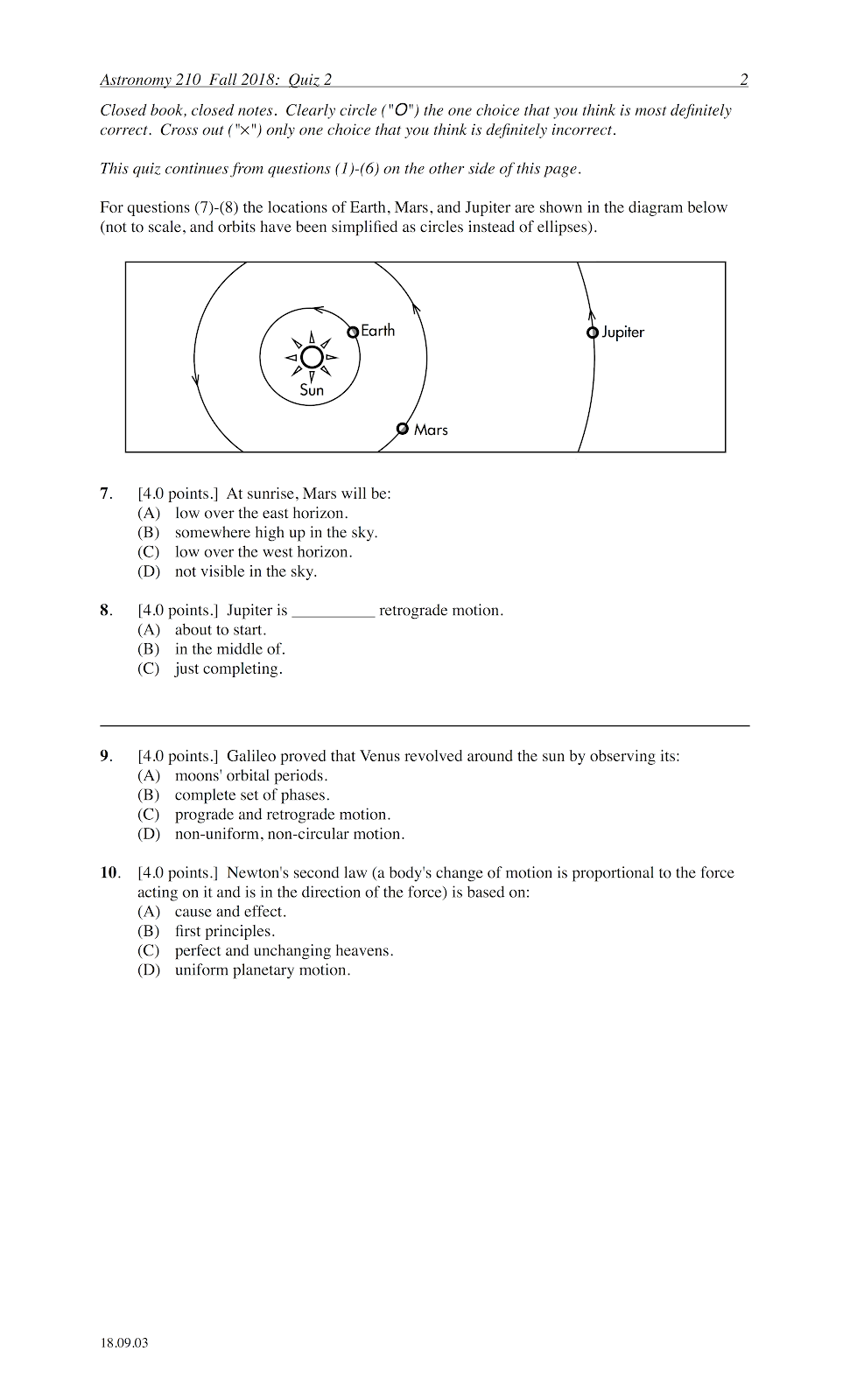
The locations of Earth, Jupiter, and Saturn are shown in the diagram below (not to scale, and orbits have been simplified as circles instead of ellipses).


At sunrise, Jupiter will be:
(A) low over the east horizon.
(B) somewhere high up in the sky.
(C) low over the west horizon.
(D) not visible in the sky.

Correct answer (highlight to unhide): (D)

If a line is drawn from Earth to the sun, the observer at sunrise (6 AM) is located perpendicular to that line.


Everything below that line would be below the horizon, such that Jupiter will not be visible at sunrise.

Section 70158
Exam code: quiz02SnPy
(A) : 7 students
(B) : 3 students
(C) : 4 students
(D) : 20 students

Success level: 60% (including partial credit for multiple-choice)
Discrimination index (Aubrecht & Aubrecht, 1983): 0.89

Astronomy quiz question: evening star Saturn?

Astronomy 210 Quiz 2, spring semester 2019
Cuesta College, San Luis Obispo, CA

The locations of Earth, Jupiter, and Saturn are shown in the diagram below (not to scale, and orbits have been simplified as circles instead of ellipses).


At sunset, Saturn will be:
(A) low over the east horizon.
(B) somewhere high up in the sky.
(C) low over the west horizon.
(D) not visible in the sky.

Correct answer (highlight to unhide): (C)

If a line is drawn from Earth to the sun, the observer at sunset (6 PM) is located perpendicular to that line.


Everything above that line would be above the horizon, such that Saturn will be visible at sunset, and be located low over the west horizon (above the sun setting in the west).

Section 70160
Exam code: quiz02n4rN
(A) : 5 students
(B) : 0 students
(C) : 14 students
(D) : 3 students

Success level: 66% (including partial credit for multiple-choice)
Discrimination index (Aubrecht & Aubrecht, 1983): 0.17

Astronomy quiz archive: eclipses/history of astronomy

Astronomy 210 Quiz 2, fall semester 2019
Cuesta College, San Luis Obispo, CA

Section 70158, version 1
Exam code: quiz02SnPy


Section 70158
0- 8.0 :   * [low = 4.0]
8.5-16.0 :   *******
16.5-24.0 :   ****
24.5-32.0 :   ******** [mean = 28.1 +/- 9.8]
32.5-40.0 :   ***************** [high = 40.0]


Section 70160, version 1
Exam code: quiz02n4rN


Section 70160
0- 8.0 :   * [low = 8.0]
8.5-16.0 :   *
16.5-24.0 :   ********
24.5-32.0 :   ******* [mean = 25.8 +/- 7.4]
32.5-40.0 :   ***** [high = 40.0]

20190828

Online reading assignment: eclipses, history of astronomy (SLO campus)

Astronomy 210, fall semester 2019
Cuesta College, San Luis Obispo, CA

Students have a weekly online reading assignment (hosted by SurveyMonkey.com), where they answer questions based on reading their textbook, material covered in previous lectures, opinion questions, and/or asking (anonymous) questions or making (anonymous) comments. Full credit is given for completing the online reading assignment before next week's lecture, regardless if whether their answers are correct/incorrect. Selected results/questions/comments are addressed by the instructor at the start of the following lecture.

The following questions were asked on reading textbook chapters and previewing presentations on eclipses, and an preliminary overview of the history of astronomy.


Selected/edited responses are given below.

Describe something you found interesting from the assigned textbook reading or presentation preview, and explain why this was personally interesting for you.
"I was interested when I started to find more out about astrology. I wasn't sure what it was or what is had to do with. I was surprised when I found out that a zodiac sign is what constellation the sun lined up with on your birthday. It was interesting to find out that I'm not the zodiac sign I was. This has to do with precession."

"That there are different types of eclipses! I thought there was only one! The differences in eclipses is what interest me the most and am awaiting the class discussion behind these things."

"A lunar eclipse happens when the moon is in the umbra of Earth's shadow. I like imagining Earth blocking the sunlight to the moon. I found it interesting that the moon entering the umbra can take up to an hour and another hour for the moon to be totally eclipsed. I have always wanted to see a total lunar eclipse, so understanding how it works and the process it takes to totality is intriguing."

"That it is always full moon during a lunar eclipse, and that it is always new moon during a solar eclipse. Also interesting to me was that the lunar orbit path around Earth is like a spinning coin or spinning plate that's about to fall flat (can't think of another way to describe it)...And that is how the moon gets light from the sun even when it is behind Earth. And when that orbit path aligns just right we get eclipses...very interesting!"

"That lunar eclipses always happen during a full moon. But for every full moon there isn't going to be a lunar eclipse."

"I always wondered why lunar eclipses have a copper-red color--now I know the glow is created by Earth's simultaneous sunrises and sunsets, which illuminate the moon during totality. I watched a lunar eclipse within this past year, but had no knowledge of how eclipses worked."

"I had never heard of annular eclipses, and they seem crazy to see. I’m surprised they are not more commonly talked about."

"I actually did not realize that we has occurrences like annular solar eclipses. From my lifetime, I can only remember only ever hearing about and seeing total solar eclipses. I looked up images, and the annular solar eclipses are amazing!"

"Personally, I never really paid any attention to solar eclipses or lunar eclipses, but reading about them and all their different positions/ components was rather interesting and made me look forward to possibly seeing one someday."

"We don't see an eclipse every full moon because the moon is either tilted too high or too low. The bottom or top part of the moon is how you can tell if there is an eclipse or not."

"I love learning about the astronomers of history and how they made discoveries about the night sky. Without them, we would be sitting in class learning about how we're the center of the universe!"

"I have to say that the idea of a paradigm of a geocentric universe is very interesting. It makes sense to an extent--people just want to agree with what further strengthens their preexisting beliefs, but it's also strange that they were not open to new ideas and understandings. Nowadays, I feel like most of us are open to new ideas and proposals and just sticking with old-school beliefs or styles (in regards to anything) seems counterproductive. I understand why they fell victim to these paradigms, it's just interesting to see how the scientific method and other things of the same sort have allowed for modernization in beliefs."

Describe something you found confusing from the assigned textbook reading or presentation preview, and explain why this was personally confusing for you.
"The eclipse thing was also confusing to me for quite a while. I sat and looked over the book and presentation multiple times to try and figure out which phases did what and when it didn't matter or if it did."

"How to tell the difference between solar and lunar eclipses."

"It took me a while to fully comprehend the idea of lunar and solar eclipses. I couldn't figure out how they worked or why. I still don't truly understand the true reason why the moon goes in front of the sun or why Earth ends up in front of the moon, but for the most part I get it."

"I still can't quite grasp the idea of how the sun, moon, and Earth line up to create eclipses, and why it doesn’t happen more often."

"The umbra and penumbra of the moon is difficult to understand when thinking about how the shadows effect the visibility of the sun. I have a hard time imagining how the umbra covers the earth surface fully while the penumbra would give you a partial eclipse."

"Do the phases of the moon look different from different places on Earth? Why isn't there an eclipse at every new/full moon?"

"I'm still a bit lost in understanding why eclipses do or do not happen during every new or full moon. I get that it involves the orbit of the moon being too high or too low, but I'm having trouble distinguishing what the 'perfect' angle is for an eclipse to occur."

"Remembering names and dates isn't exactly my strong suit, and trying to distinguish and remember each of the seven astronomers and what they individually did, without confusing them together, is somewhat difficult for me."

"Why were ancient astronomers so dead set on following the first principles and never questioned the accuracy of them?"

"I found it challenging to remember all of the categorization of all of the different astronomers and what they all mean. I think it will just take me more time and practice to match each category to astronomer."

"Nothing this week was confusing in any way."

A friend of yours has a birthday on March 30. According to your starwheel, the sun would have been located in front of which zodiac sign on that date? (Ignore daylight saving time.)
Aries.  **** [4]
Taurus.  *[1]
Gemini.  [0]
Cancer.  [0]
Leo.  [0]
Virgo.  **** [4]
Libra.  [0]
Scorpio.  [0]
Sagittarius.  [0]
Capricorn.  [0]
Aquarius.  ** [2]
Pisces.  *********************** [23]
(Unsure/guessing/lost/help!)  ****** [6]

I believe astrology is able to make accurate predictions about my future. (This is a follow-up question.)
Strongly disagree.  ****** [6]
Disagree.  ****************** [18]
Neutral.  ******* [7]
Agree.  ******** [8]
Strongly agree.  * [1]

Briefly discuss what you know now (that you didn't know before) that may (or may not have) affected your earlier opinion regarding your belief/disbelief in astrology. (This is a follow-up question.)
"I feel the same way. Before I had said that Astrology was a form of pseudoscience, that's why I didn't believe it could possibly make accurate predictions about my future."

"Astrology being off by a month. Didn't change my opinion much."

"I had no idea that astrology was off by a whole month due to precession, and I actually find it pretty funny. This further affirms my belief that astrology is pseudoscience."

"No new information was provided that changed my perspective on astrology. I'm not saying its not a thing... I'm just saying it can't be used to predict/determine human behavior or personal information."

"I feel the same about astrology. Its fun to read sometimes but I don't think it actually makes accurate predictions about the future."

"I learned that you can go back in time within a database and find out exactly what the night sky looked like on a particular night 3,000 years ago. This fact reiterates what I had previously stated in my disbelief of astrology. I still think astrology can make somewhat accurate predictions about the future night sky, but it cannot make accurate predictions about my future in particular. My future life is solely dependent upon my choices."

"I'm honestly just mildy annoyed that I am an Ares and not a Taurus. And every connection that I've seen with myself and the 'Taurus' identity confuses me greatly."

"Nothing has affected my beliefs in astrology up until now. I've thought it was bogus ever since I started a degree in astrophysics back at UC Riverside two years ago."

"The planets are not in perfect orbits, and are not a part of a mystical heavenly clock, such as what the Greeks believed. And still don't believe in it."

"My opinion is still the same. I think western astrology is bogus. Whereas India astrology, aka Jyotish, from what I have heard (anecdotal I guess), can make very accurate predictions (this is what some of my Indian friends have told me). I know that, for example, the shifting of the north star is something that IS accounted for in their calculations. Regardless, I am still neutral about astrology."

"The starwheel affected my belief in astrology because it gave me a different zodiac sign. I was under the belief that I was a Taurus but the star wheel says that I am an Aries."

"I never knew much about the science behind astrology all I knew is that I was a Pisces and anything I looked up about my sign aligned a lot in some ways with how I view myself."

"I didn't know that your sun sign is the zodiac constellation the sun is in on your birthday honestly. It didn't really influence my neutral attitude towards astrology though."

"I now know a lot more about the specific type of moon phases and eclipse types, which I didn't know much about before taking this class. Knowing more about astrology solidifies my belief in it."

"I know astrology is not accurate but I still am entertained by it and definitely read my horoscope on the regular. Also, I am kinda mad about the fact that I am actually a Cancer and not a Leo (July 23rd)."

"I still have the same opinion because what I learn in class of our zodiac signs and what I have read still makes me believe that astrology can predict the future but it can make mistakes."

"My opinion remains unchanged, people can believe what they want as long as their beliefs do not impede others ideals."

"I think that there are some things that can be predicted using science (such as when certain celestial bodies will be in certain places) however this has little to do with what we commonly refer to as 'astrology.'"

"With the sun signs being a month off from common astrology signs, predictions will overlap and be different depending on who is making them."

"I always believed in astrology so I am biased."

"I didn't know how zodiac signs worked previous to this class. After learning that zodiacs came from constellations I was really intruigued on how that all worked, but I still don't think it has anything to do with my future or any of that."

"Everything I’ve learned so far has only further strengthened my belief in astrological phenomena :-)"

"I never knew that your sun-sign changes do too the change of axis. Everyone has a completely different zodiac sign then they previously thought!"

"I don't think the position of the stars while you were born has a huge impact on your personality traits."

"Since astrology seems to be so popular right now, it's almost funny to think that people use their sun signs as justification for their behavior, yet in reality they are an entirely different sign but they don't know it yet."

"I learned a bit about how the sun and stars move throughout the year with the zodiac constellations and as I do believe the zodiac signs effect some monthly changes in the universe. I still don't believe in astrology, because I don't believe the alignment of the sun and stars on our birth months actually effects who we are as people."

"Well now I know that there are lunar and solar eclipses and the annular."

"I now know that everyone's original zodiac sign is a month different than what it really is. It is interesting to see that this has been different for many years and people rarely shine light upon the subject."

"Nothing will change my opinion on the matter."

"I believe I still feel the same. Believing there is some truth but it is usually taken overboard."

"I did not know that the zodiac signs were assigned based on when the sun went through the star paths during certain months. I also didn't know that they change either. I thought they were just given random months just because, but now I know otherwise."

"Again, astrology can tell me no more than where the planet will be in its orbit in six months. It cannot predict that I will find the love of my life this week and then dump him two months later because he bought be the wrong flowers."

"I don't believe horoscopes because according to the starwheel on my birthday, my true zodiac is between Sagittarius and Libra. There's a disparity between 'wikipedia' zodiacs and true zodiacs."

"I feel like maybe it has some type of effect, like maybe it'll explain like good or bad luck (?) but ultimately it goes come down to you as a person and the choices you make."

Match the phase of the moon during these eclipse types. (Only correct responses shown.)
Total solar eclipse: new moon [80%]
Partial solar eclipse: new moon [60%]
Annular solar eclipse: new moon [53%]
Total lunar eclipse: full moon [88%]
Partial lunar eclipse: full moon [58%]

Place these astronomers in chronological order of their historical contribution to astronomy. (Only correct responses shown.)
Aristotle [83%]
Ptolemy [68%]
Copernicus [75%]
Tycho [70%]
Kepler [70%]
Galileo [53%]
Newton [83%]

Match these terms with their descriptions. (Only correct responses shown.)
Ideas accepted as truth without further examination: first principles [80%]
Predictions that could be tested by observations: hypotheses [95%]
Universal statements of cause and effect: rational laws [75%]
Describe phenomena without explaining why it occurs: empirical laws [60%]

Ask the instructor an anonymous question, or make a comment. Selected questions/comments may be discussed in class.
"I never study astronomy before, and I was always curious about how does the universe work and how it was created. Therefore, what I learn when I read the chapters and during lectures is very fascinating."

"Could you maybe talk about the moon phases relating to the eclipse types?"

"I would like some demonstrations/further explanation on the solar and lunar eclipses."

"I couldn't find anything in the reading on how the phase of the moon is related to solar and lunar eclipses."

"I am amazed at the theories that some of these ancient astronomers had, and some that I had never even heard of before."

"Terms and descriptions for first principles, empirical laws, hypotheses, and rational laws wasn't very clear to me. Could you elaborate in class?"

20190827

Online reading assignment: eclipses, history of astronomy (NC campus)

Astronomy 210, fall semester 2019
Cuesta College, San Luis Obispo, CA

Students have a weekly online reading assignment (hosted by SurveyMonkey.com), where they answer questions based on reading their textbook, material covered in previous lectures, opinion questions, and/or asking (anonymous) questions or making (anonymous) comments. Full credit is given for completing the online reading assignment before next week's lecture, regardless if whether their answers are correct/incorrect. Selected results/questions/comments are addressed by the instructor at the start of the following lecture.

The following questions were asked on reading textbook chapters and previewing presentations on eclipses, and an preliminary overview of the history of astronomy.


Selected/edited responses are given below.

Describe something you found interesting from the assigned textbook reading or presentation preview, and explain why this was personally interesting for you.
"Precession. I had no idea that after thousands of years, our zodiac sign changes because of precession. It was engaging to learn about these changes because of the sky shifts. I was amazed at how Polaris wasn't a north star before."

"Eclipses are really cool and I've always wanted to know what has to occur in order for them to naturally happen."

"The differences between solar and lunar eclipses was interesting. The differences make more sense after reading about it on the presentation."

"I found both the solar and lunar eclipses interesting. The textbook does a well job in explaining what each of them is and how they can be predicted. I also wasn’t aware that there were more than two types of eclipses."

"I didn't know that there were specific eclipses such as partial or annular. I thought there was only total eclipses. I also found interesting how they tell you to look at a solar eclipse safely, though it makes sense so you don't harm your eyes."

"Retrograde motion. It took me a little bit too understand the concept, but blew me away when I actually figured it out."

"Finding out who were some of the big names is astronomy was interesting especially because for those that I knew about I had forgotten what they 'did.'"

Describe something you found confusing from the assigned textbook reading or presentation preview, and explain why this was personally confusing for you.
"Learning about the moon's phases was confusing for me. Especially the 'all the moon questions' diagrams. I didn't know how to determine the overhead time until I positioned the moon in its orbit. This was because it was difficult to have the images of all the phases memorized."

"Something that I found confusing was the timing of an eclipse. It looks similar but just the time of the motions of earth inside the moon."

"I don't know the difference between a lunar and a solar eclipse."

"Overall everything was straightforward, I am slightly confused on how to identify each type of eclipse. Like I know the different types there are, I just don't know how to fully distinguish them from each other. Also, are we supposed to memorize all of the astronomers and what they did?"

"The retrograde motion of Mars. I am confused on why it seems to slow down and even come to a stop. I am confused on what causes this and is it just for Mars."

"Skimmed the reading but I got them mixed up and review would be nice. "

"Nothing really seemed too confusing, just interesting. I would like to go over the moon phases during an eclipse and the different kinds of astronomers."

A friend of yours has a birthday on March 30. According to your starwheel, the sun would have been located in front of which zodiac sign on that date? (Ignore daylight saving time.)
Aries.  * [1]
Taurus.  [0]
Gemini.  [0]
Cancer.  [0]
Leo.  [0]
Virgo.  * [1]
Libra.  [0]
Scorpio.  [0]
Sagittarius.  [0]
Capricorn.  [0]
Aquarius.  ** [2]
Pisces.  *************** [15]
(Unsure/guessing/lost/help!)  [0]

I believe astrology is able to make accurate predictions about my future. (This is a follow-up question.)
Strongly disagree.  ** [2]
Disagree.  **** [4]
Neutral.  ******** [8]
Agree.  **** [4]
Strongly agree.  * [1]

Briefly discuss what you know now (that you didn't know before) that may (or may not have) affected your earlier opinion regarding your belief/disbelief in astrology. (This is a follow-up question.)
"I remained neutral again, I still don't really understand how astrology would be able to predict my future, but I'm genuinely curious as to someone can do that."

"I now know that my astrological sign has changed since the ancient times and now I'm not so sure what sign I truly am."

"Nothing has changed. Astrology is pure fabrication."

"I honestly don't disagree with astrology nor do I believe in it, I did however learned that throughout time the constellations move as Earth rotates and that they don't always line up with their zodiac signs (if that makes any sense)."

"I still feel as though it holds some power as I shared before because I went according to my mood not from listening to my zodiac as apparently when I did it was all wrong. But it did make me doubt myself a little so now maybe my belief isn't so strong."

"I didn't know much about eclipses. All I knew before was the moon going in front of the sun and big shade occurring on a certain part of the planet. Yet now I know the more elements they have such as the umbra and penumbra. Which made me believe that there's more out there than I thought there was."

"My answer is still the same from the other reading assignment."

"I went through a brief phases where I'd use a few horoscope/prediction apps and sites to track if my day was going to go fine or not. Almost every prediction was exactly the same between references and the predictions themselves were almost entirely accurate for daily, weekly and monthly."

"My belief that astrology 'controls my life' is still neutral--however it was really fun pissing off my friends this weekend showing and proving to them that they were wrong about their zodiacs."

"Precession still blows me away about how much it affects, and the fact that astrologists still base their 'science' off of star charts from thousands of years ago makes me believe it's completely fake."

"What I know now is that the zodiac signs in astrology can have a meaning to you. Each sign has their different meanings and each person has a sign depending on their birthday."

"Same thing as before I just haven't had any impact."

Match the phase of the moon during these eclipse types. (Only correct responses shown.)
Total solar eclipse: new moon [84%]
Partial solar eclipse: new moon [53%]
Annular solar eclipse: new moon [42%]
Total lunar eclipse: full moon [89%]
Partial lunar eclipse: full moon [63%]

Place these astronomers in chronological order of their historical contribution to astronomy. (Only correct responses shown.)
Aristotle [79%]
Ptolemy [68%]
Copernicus [74%]
Tycho [47%]
Kepler [53%]
Galileo [42%]
Newton [58%]

Match these terms with their descriptions. (Only correct responses shown.)
Ideas accepted as truth without further examination: first principles [79%]
Predictions that could be tested by observations: hypotheses [63%]
Universal statements of cause and effect: rational laws [63%]
Describe phenomena without explaining why it occurs: empirical laws [47%]

Ask the instructor an anonymous question, or make a comment. Selected questions/comments may be discussed in class.
"Could you please go over eclipses, it was very confusing for me to understand."

"Will we be shown visuals of the different types of eclipses during class?" (Yes.)

"It would be very helpful to know the answers to the the reading assignment after submitting it." (At the top of every reading assignment, there is a link so you can go over the answers to the previous reading assignment.)

"How did astronomers knew where and what was in space with very little technology?" (That is the history of astronomy, as it progressed from non-scientific thinking to the first science.)

"Will any of this be on the quiz we have tomorrow? If not will there be a quiz based on this information?" ((1) No, not on Quiz 1. (2) Yes, this new material (eclipses, history of astronomy, planetary motion) will be on Quiz 2.)