Showing posts with label convection. Show all posts

20151211

Physics quiz archive: temperature, thermal equilibrium, heat transfer

Physics 205A Quiz 7, fall semester 2015
Cuesta College, San Luis Obispo, CA
Sections 70854, 70855, 73320, version 1
Exam code: quiz07zSOL


Sections 70854, 70855, 73320 results
0- 6 :   * [low = 3]
7-12 :   *****
13-18 :   *****************
19-24 :   ****************************** [mean = 21.2 +/- 5.6]
25-30 :   **************** [high = 30]

20141211

Physics quiz archive: temperature, thermal equilibrium, heat transfer

Physics 205A Quiz 7, fall semester 2014
Cuesta College, San Luis Obispo, CA
Sections 70854, 70855, 73320, version 1
Exam code: quiz07cO4t


Sections 70854, 70855, 73320 results
0- 6 :  
7-12 :   **** [low = 9]
13-18 :   *******
19-24 :   ******************** [mean = 24.2 +/- 5.5]
25-30 :   ********************** [high = 30]

20141203

Physics presentation: heat transfer applications

Let's now shift gears and preview the various heat transfer phenomena you will be investigating during the last laboratory of this semester: convection, conduction, and radiation.

A Cooper Cooler™, where beverages are spun while being sprayed with ice water:
"The Cooper Cooler™ chills beverages on demand forty times faster than a freezer. So that means you can chill a bottle of wine in six minutes, and your sodas in one minute... And because it's spinning and not shaking your carbonated beverages, you don't have to worry about them exploding."
If you choose, you can investigate whether these claims are valid with an actual Cooper Cooler™! (Video link: "Cooper Cooler - Rapid Beverage Cooler.")

Or Coffee Joulies™:
"Fresh coffee is often too hot to drink when it's first brewed. This is especially true when you throw it in your insulated travel mug and you head out to work, and you're waiting and you're waiting for it to cool down enough and you carry it around and you can't even drink your coffee..."

"[Coffee Joulies™ are] shaped like giant coffee 'beans' made of stainless steel. You just drop these in your hot coffee, one 'bean' for every four ounces of coffee, and it cools right down to 140° in a few seconds, that's the perfect temperature for drinking. Then the Coffee Joulies™ hold your coffee at that temperature so you can take your time and enjoy it."

"The secret is inside--there's a proprietary substance that's encapsulated inside the steel 'beans' and it's called a phase-change material. This one has a melting temperature of exactly 140°, so when you put it in your hot coffee, it absorbs the heat, cooling all the coffee around it, so it's completely liquid inside the steel 'bean.' Then the phase-change material slowly releases that heat back into the coffee until it becomes a solid again. And in our tests, they kept coffee at 140° for two full hours..."
Again, in laboratory, you can choose to investigate these claims--however, not with actual Coffee Joulies™ (they're somewhat pricey), but with packets containing the same phase-change substance (food-grade sodium acetate). (Video link: "Coffee Temperature Regulator.")

And reflective "space blankets," used in emergency survival situations to retain body warmth:
"This thermal sheet functions by reflecting your body heat back to you. If you wrap it around yourself while already freezing, it will be in vain."

"Also when using only a space blanket (with just a tank top and shorts), as the snow lands on your shoulders it will immediately drive the heat from your body. In an actual snowfall, you must have insulation (jacket and pants) between you and the blanket to minimize this."
You can also choose to investigate the most effective use of space blankets. (Video link: "SOL Emergency Heatsheet/Blanket Review in Snow.")

20141201

Physics presentation: heat transfers

Oh, chocolate bunny, how do I love thee? Let me count the ways: conduction, convection, radiation. (Video link: "Chocolade Haas (Chocolate Bunny)."

In a previous presentation, we considered what happens to an object when heat is transferred into, or out of it. Here we will look more closely at the transfers themselves, that is, how thermal energy is transferred.

First, conduction, where heat is transferred through an object.

This house is shown in visible wavelengths on the left side of the image, and in infrared wavelengths on the right side of the image, where we can see that while the walls of the house are not allowing much heat to pass through them, there is quite a bit heat exiting the house through the windows.

The power (amount of heat conducted per time, in units of joules/second, or watts) through a wall is proportional to the temperature difference ∆T on either side (as per the zeroth law of thermodynamics, heat flows from high to low temperatures), and inversely proportional to the thermal resistance R of the object, which is a measure of how difficult it is for heat to flow per time through it:

R = d/(κ·A),

where the resistance is proportional to the thickness d of the material, and inversely proportional to the exposed surface area A and the material-dependent conductivity κ (lower-case Greek letter "kappa," in units of watts/m·K), which characterizes how well this material allows (or does not allow) heat to flow through it.

In order to minimize the amount of heat flowing per time through these exterior walls, the thermal resistance R of the insulation installed should be maximized--by having a large or small conductivity κ value? A small or large insulation thickness d? Should the walls be constructed with a small or large surface area A?

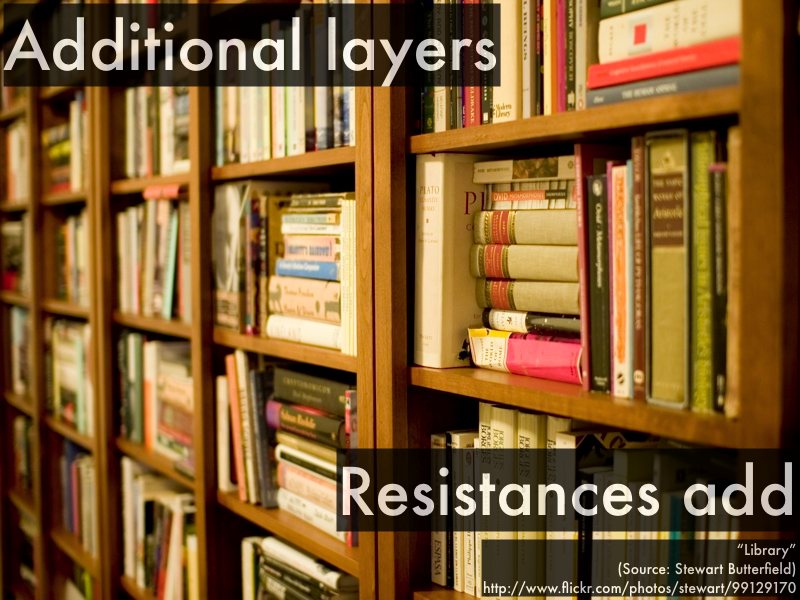
If an additional layer is added to existing insulation, such as this wall-spanning bookcase full of books, then the overall thermal resistance of the bookcase and insulation layer in the wall would be the sum of their individual resistances:

Rtotal = Rwall + Rbooks,

Rtotal = (dwall/(κwall·Awall)) + (dbooks/(κbooks·Abooks)),

where presumably the shared area A of the wall and the bookcase is the same value, but they have different d thicknesses and κ conductivities. The resulting power (heat flow per time) through the book layer and wall insulation is then:

Power = (heat flow)/time = ∆T/Rtotal.

Second, convection, the transport of heat via circulating air. We will just discuss this qualitatively, in contrast to conduction and later, radiation.

Natural convection is where a fluid (liquid or gaseous) will circulate and transport thermal energy from a high temperature to a low temperature region (again, the zeroth law of thermodynamics). In this lava lamp, there is a light bulb heating up these wax globules from below. As the wax globules heat up and expand, their density decreases relative to the clear solvent, and subsequently rise upwards. At the top of the lava lamp, the wax globules cool down and contract, such that their density increases relative to the clear solvent, and subsequently begin to sink. Notice that thermal energy is not being conducted from bottom to top through a static substance, it is being "carried" within the rising globules. (Video link: "080913-1050512.")

You can also transport thermal energy via forced convection, where instead of the fluid circulating naturally due to relative changes in buoyancy, it is forced to carry off thermal energy, typically by blowing across the surface of hot soup.

Third, radiation, where heat is transported in the form of light.

Stefan's law of radiation quantitatively describes the power, or net amount of heat transferred in the form of light to/from an object, which is depends on the difference of the fourth powers of the object's surrounding environment temperature and the temperature of the object itself (in kelvin), the total surface area A of the object, and the emissivity e of the object. Note the obligatory numerical constant σ.

In order to be consistent with all the other definitions of heat flow in this course, a negative sign must be put in to the version of the equation that is given in your textbook. Since a positive heat flow per time is energy being put into the object from the environment, this occurs if the temperature Tenv of the surrounding environment is greater than the object's temperature Tobj. A negative heat flow per time is energy being taken from the object out to the environment, so the temperature Tenv of the surrounding environment must be less than the object's Tobj temperature.

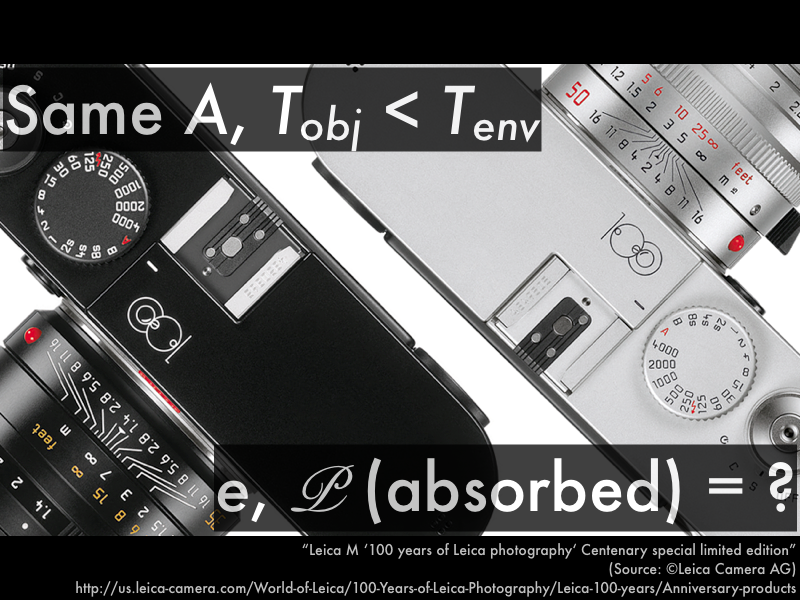
A blackbody is an object that is good at absorbing heat transferred in the form of light. But radiation is a two-way street, so an object that is good at absorbing heat will also be good at emitting heat. This is why objects that are meant to cool off efficiently by radiating (or heat up efficiently by absorbing) light are painted black--here, the entire surface of this SR-71 Blackbird. A perfect blackbody has an emissivity e = 1.

In contrast, a silverbody is an object that is good at reflecting light (and poor at absorbing heat in the form of light). Again, radiation is a two-way street, so an object that is poor at absorbing heat will also be poor at emitting heat. Here this early NASA communication satellite will efficiently reflect light, but will also be very inefficient at radiating heat should it get too hot. A perfect silverbody has an emissivity e = 0.

For these two Leica M cameras, if they are both cooler than the surrounding environment, both will begin to heat up by absorbing radiative heat (say, from the sun). Which will have a faster rate of heat absorbed per time--the black model, or the silver model?

For these snowboarders, if they are warmer than the surrounding environment, they will begin to cool down by emitting radiative heat (say, to the overcast sky and the snowy landscape). Which snowboarder will have a faster rate of heat radiated per time--the snowboarder with the black jacket, or the white jacket?

20131211

Physics quiz archive: temperature, thermal equilibrium, heat transfer

Physics 205A Quiz 7, fall semester 2013
Cuesta College, San Luis Obispo, CA
Sections 70854, 70855, 73320, version 1
Exam code: quiz07b0o7


Sections 70854, 70855, 73320 results
0- 6 :   ** [low = 6]
7-12 :   ****
13-18 :   ****************************** [mean = 18.5 +/- 4.8]
19-24 :   ********************
25-30 :   *** [high = 30]

20121214

Physics quiz archive: temperature, thermal equilibrium, heat transfer

Physics 205A Quiz 7, fall semester 2012
Cuesta College, San Luis Obispo, CA
Sections 70854, 70855, version 1
Exam code: quiz07Di5k


Sections 70854, 70855 results
0- 6 : ***** [low = 3]
7-12 : ************
13-18 : ********************** [mean = 15.2 +/- 5.4]
19-24 : *********** [high = 24]
25-30 :

20120804

Presentation: jovian planets

Moons, rings, and belt-zones, oh my! (Video link: "Outer Space.")

Despite their fascinating moons and rings, in this presentation we will concentrate only on certain features of the jovian planets themselves, many of the details will be covered only in the textbook reading.

All of the jovian planets are composed primarily of hydrogen, but for the purposes of comparison we can group together Jupiter and Saturn as "gas giants," while Uranus and Neptune are grouped together as "ice giants," due to their weird warm slushy ice layers.

First, the gas giants: Jupiter and Saturn.

These are cylindrical maps of Jupiter and Saturn, if you unwrapped their exteriors and laid them flat by unrolling them. You are actually looking at the tops of their clouds, which are visibly more active and colorful on Jupiter than on Saturn. Let's investigate the reasons why weather on Jupiter is more active and bolder. (Video link: "PIA02863: Planetwide Color Movie.")

Jupiter is much more massive than Saturn, so the "turkey/cornish hen effect" discussed for terrestrial planets applies here as well--Jupiter retains much more core heat than Saturn.

The weather on jovian planets is driven by core heat, like these cups of coffee, one of which is steaming hot, while the other has been chilled in a refrigerator. Cream is poured into both cups, and the only stirring is due to convection currents (or lack thereof). What do you observe that lets you know which cup is hotter, and which is cooler? (Video link: "081126-1060756.")

Although core heat provides the energy for active weather patterns on Jupiter, sunlight is the energy for Jupiter's bolder cloud colors. Here are cross-sections of Jupiter's and Saturn's atmospheres (scale has been normalized for comparison), where the sun is shown at different sizes to represent the amount of energy each planet receives. The topmost clouds of both planets is identical in composition and color, but the clouds in Jupiter a warmed more by sunlight, and rise higher up than on Saturn, where clouds do not receive as much sunlight, and so sink lower in the atmosphere, where their colors are obscured.

So there are two distinct sources of energy that drive the weather in these gas giants--core heat (determined by mass), and sunlight (determined by distance from the sun) that make weather more active and colorful on Jupiter, and less active and hazy on Saturn.

Second, the ice giants: Uranus and Neptune.

Cylindrical maps of Uranus and Neptune, if you unwrapped their exteriors and laid them flat by unrolling them. (These approximate features visible to the naked eye, many images of Uranus and Neptune that show more features have been enhanced, or are other wavelengths such ultraviolet or infrared.)
Why does Neptune have more atmospheric circulation than Uranus?
(A) Neptune is closer to the sun.
(B) Neptune has more moons to exert tidal heating.
(C) Neptune is hotter.
(D) Neptune rotates faster.
(E) (Unsure/guessing/lost/help!)

This is interesting because Neptune is further from the sun than Uranus, so sunlight cannot be the energy source for Neptune's more active weather patterns, and they are approximately the same mass, so core heat does not seem to be the energy source that accounts for their differences in weather activity. What is markedly different is that Uranus' axis is drastically tilted over. Rotating on a tilted axis by itself should not be the cause for differences in weather activity, but it may stem from the cause of this tilted axis...

Consider a Cooper CoolerTM, which spins a bottle in a circulating ice water bath. This demonstrably chills faster than keeping a bottle still in an unstirred ice water bath. It is not the sideways rotation axis that is important here, but the continuous forced circulation that accounts for the faster cooling rate. A large impact hypothesis may explain not only how Uranus' axis was tilted over from being vertical (like all other planets, and the sun from the formation of the solar system) to sideways, but the stirring up of Uranus' interior during this large impact would have forced it to cool off faster, resulting in much less weather patterns than Neptune, which has retained more of its core heat. These large impacts in the early stages of planet-forming may indeed be very common, as seen with similar hypotheses for the formation of the moon and the disproportionally large core of Mercury. (Video link: "081108-1060446.")

20120721

Presentation: medium-mass stars

Last time you were asked to ponder which car can drive farthest on a full tank: a Hummer H2, or a SmartCar fortwo? Perhaps stars are like cars...or maybe not.

In this presentation, we'll discuss the life, and more interestingly, the death of medium-mass stars.

First, main-sequence lifetimes of medium-mass stars, which is how long until they have depleted the hydrogen in their cores, fusing it into helium.

Consider the Hummer versus SmartCar range question. It turns out that they have the same range on a full fuel tank--but how can this be possible? The Hummer, with lower mileage than the SmartCar, would need to have a larger fuel tank. (This comparison uses 2008 data, as the Hummer H2 was discontinued soon afterwards.)

Now consider the main-sequence lifetimes of a medium-mass "sun-like" star and a low-mass "red dwarf"--calling to mind the previous Hummer versus SmartCar comparison of how long they can travel before running of fuel. As it turns out, stars are not like cars. A medium-mass star will run out of hydrogen in its core in 10 billion years, but the low-mass star will take much longer to run out of hydrogen to fuse--56 billion years, which is longer than the current age of the universe (14 billion years). So these low-mass red dwarfs are still chugging along, as none have yet to run out of fuel. How is this possible?

Which star fuses hydrogen faster: medium-mass or low-mass? How do you know this? Then in order for the low-mass star to "last longer," which star has a larger "fuel tank" capacity: medium-mass or low-mass? Does this make sense to you? Let's make this make sense.

If we look at cross-sections of these stars, we can see the convection currents that lie just under their surface photospheres, and the cores where energy is produced, due to high pressures and temperatures required for fusion. For the medium-mass star, once all the hydrogen in its core is depleted, its main-sequence lifetime is over. However, for the low-mass star, the convection currents just under its surface actually circulate down into the core, so as it depletes the hydrogen in its much smaller core, more hydrogen is circulated back in, so its "fuel tank" turns out to be the entirety of the low-mass stars--much larger than just the core of the medium-mass star. Imagine a SmartCar not only with better mileage than a Hummer, but with a fuel tank that was much larger than the Hummer's as well!

So stars are definitely not like cars...

How many stars will you find buried here? While all low-mass stars will eventually die, due to their extremely frugal use of large stores of hydrogen, none have ever died yet. So for the purposes of our discussion we will not worry about "Little Star Cemetery," but instead focus on the stars that will and have died: the medium-mass stars. (The deaths of massive stars will be covered in the next presentation.)

Second, how medium-mass stars die...alone.

Do you live alone, with no roommates? Does your refrigerator look like this? So what's for dinner tonight? First, probably the leftovers or frozen dinners--the easiest and most convenient things to eat. After that, what's left? If you must, you could always pull stuff out of your refrigerator to cook something nutritious and delicious. But once that stuff runs out, and you're still starving, then you might start getting desperate enough to eat the less delicious and nutritious stuff like mayonnaise, ketchup, and those wilted celery stalks from the bottom bin. Well, maybe you wouldn't go that far down the refrigerator food chain...

As it turns out, a medium-mass star has the same problem at the end of it main-sequence lifetime, having converted all the hydrogen in the core into helium. So what's left to eat for this star? Hydrogen is the convenient and most nutritious stuff for a star to eat. To fuse helium requires higher pressures and temperatures than hydrogen, and not as much energy would be released afterwards, so helium is not as convenient and nutritious as hydrogen, but hey, a star's gotta eat. But after fusing all the helium in its core into carbon, then that's where a medium-mass star draws the line, and it begins to die.

(A massive star, as we'll discuss in the subsequent presentation, has no qualms about going further down the refrigerator food chain, eating everything inside, even down to the takeout soy sauce packets and the brine left in bottom of pickle jars. But it's just putting off the inevitable, as once its refrigerator's has been emptied of anything of (debatable) nutritional value, it too will begin to die...)

So once a medium-mass star has reached the end of its main-sequence lifetime, depleting its hydrogen, it begins to take desperate measures to stave off "starvation," becoming a giant. Once its has converted all of its helium into much less tasty carbon, it will truly begin to die, and its outer layers will expand and dissipate as a planetary nebula, while the remaining core shrinks into a white dwarf. Like the desperate refrigerator scenario, let's introduce further analogies to extend our understanding of these giant, planetary nebula, and white dwarf stages beyond reading the textbook.

Since the less convenient and nutritious helium requires higher pressures and temperatures than hydrogen in order to fuse into carbon, the red/yellow giant stages are a result of a medium-mass star undergoing changes within to "jump start" helium fusion. Once helium fusion begins in the core, then things will keep chugging along until all the helium is converted into carbon.

While this happening, the outer layers of the medium-mass star will expand and cool. You can try this for yourself by "huffing" body-temperature breath from your lips onto the back of your hand. But if you were to purse you lips and "blow" this same body-temperature breath such that the air expands, it will feel cooler on the back of your hand...because it really is cooler.

As a medium-mass star depletes the helium in its core, the outer layers keep expanding and will dissipate outwards, much like a dandelion puffball.

The core will collapse and become a white-hot super-dense ball of carbon...and stay that way as it very slowly cools off. White dwarfs are boring, but hey, that's what you get for dying alone.

Third, what happens if you don't die alone (you get to take somebody with you).

Here two stars were born at the same time, but due to their different masses, have evolved at different rates (as discussed in the previous presentation) such the first star to die becomes a white dwarf, and will begin to pull hydrogen in from its companion star. Recall that a white dwarf is the remnant of a medium-mass star that underwent "star-vation" and could not go further past helium fusion. However, with a fresh supply of delicious, nutritious hydrogen that is easy to fuse, things get interesting.

If the white dwarf steals hydrogen from its companion star relatively slowly, then it will steadily build up a thin coat of hydrogen, and "flash-fuse" it, resulting in a nova explosion. The companion star is still contributing hydrogen, so in tens to hundreds of years, the white dwarf will build up another hydrogen coat to fuse, so these flashes would typically repeat at regular intervals. (Video link: "Explosions—Large and Small (Z Camelopardalis).")

If the white dwarf steals hydrogen from its companion star relatively quickly, then it will rapidly be smothered by a thick coat of hydrogen. This will drastically increase pressures and temperatures throughout the white dwarf, such that carbon fusion can finally begin, and as a result the entire white dwarf will undergo a type Ia supernova explosion. Here nothing is left of the white dwarf (and the surviving companion star as well). (Video link: "Artist's impression of vampire star.")

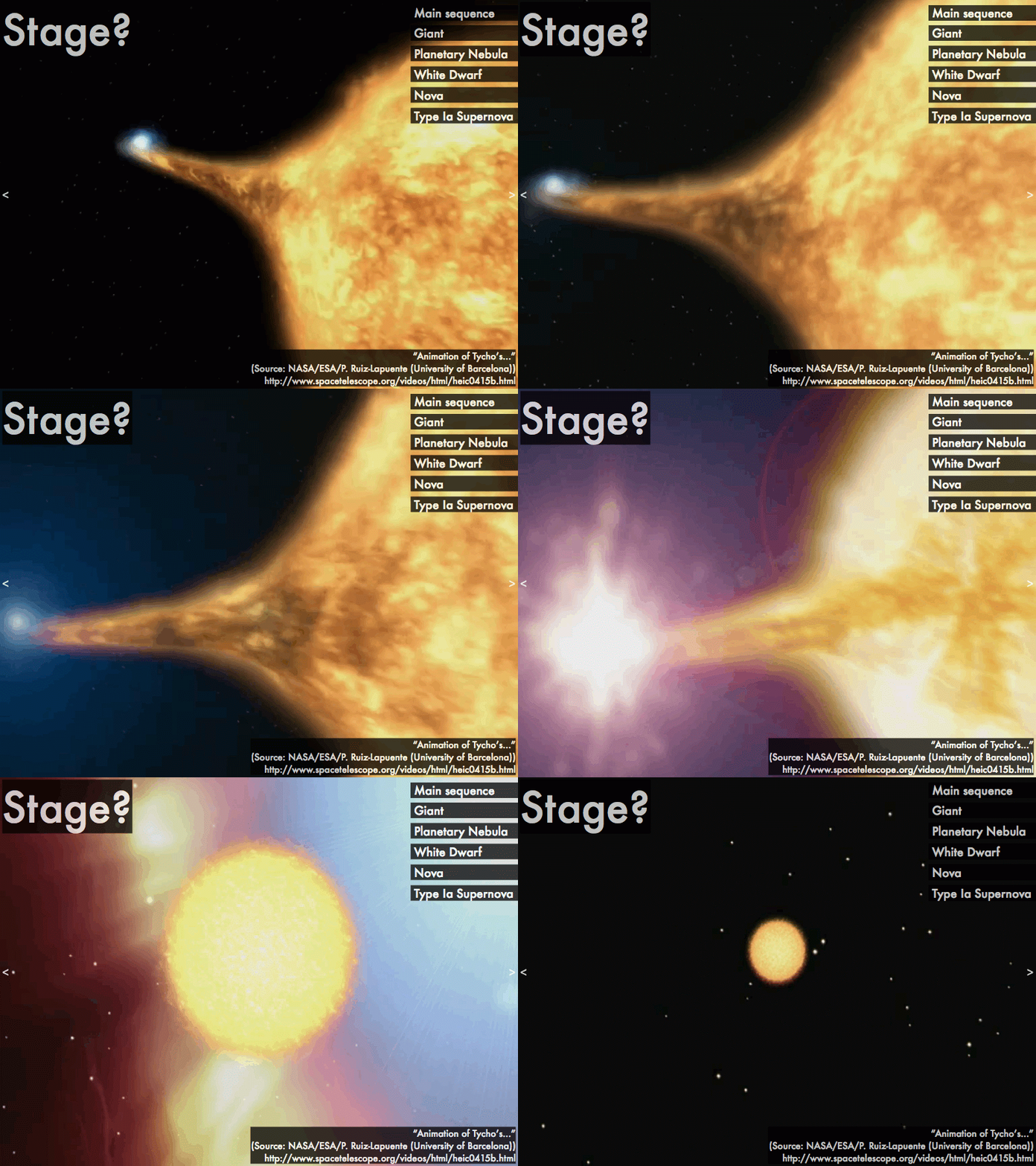
In order to consolidate the many details of medium-mass star death, let's have a picto-quiz, with figurative or actual representations of the stages a star like our sun will go through.

What stage is this? What did you notice that tells you this? (Well, this should be obvious.)

What stages are these? What did you notice that tells you this?

What stage is this? What did you notice that tells you this? What must be located in the center? (Which planet(s) would this resemble, as seen through an early telescope? Hence, the name.)

What stage is this? What did you notice that tells you this? What must be located in the center? (What do you think causes the "pinched" effect in the middle?)

What stage is this? What did you notice that tells you this?

Before this simulation movie clip begins, what is being shown here? What two possible stages might result due to these circumstances? (After watching the aftermath of this explosion, was your guess correct?) (Video link: "Animation of Tycho's....")