Showing posts with label normal force. Show all posts

20190924

Physics quiz archive: vectors, projectile motion, forces

Physics 205A Quiz 3, fall semester 2019
Cuesta College, San Luis Obispo, CA
Sections 70854, 70855
Exam code: quiz03Ch3V


Sections 70854, 70855 results
0- 6 :   * [low = 6]
7-12 :   ***
13-18 :   **************
19-24 :   ******************* [mean = 21.7 +/- 5.8]
25-30 :   ***************** [high = 30]

20180924

Physics quiz archive: vectors, projectile motion, forces

Physics 205A Quiz 3, fall semester 2018
Cuesta College, San Luis Obispo, CA
Sections 70854, 70855 version 1
Exam code: quiz03pRH5


Sections 70854, 70855 results
0- 6 :  
7-12 :   ***** [low = 9]
13-18 :   **********
19-24 :   ******************* [mean = 23.1+/- 6.0]
25-30 :   ********************** [high = 30]

20171003

Physics quiz archive: vectors, projectile motion, forces

Physics 205A Quiz 3, fall semester 2017
Cuesta College, San Luis Obispo, CA
Sections 70854, 70855 version 1
Exam code: quiz03T4uC


Sections 70854, 70855 results
0- 6 :  
7-12 :   ********* [low = 9]
13-18 :   ****************
19-24 :   *********************** [mean = 19.2 +/- 5.2]
25-30 :   ****** [high = 27]

20160926

Physics quiz archive: vectors, projectile motion, forces

Physics 205A Quiz 3, fall semester 2016
Cuesta College, San Luis Obispo, CA
Sections 70854, 70855, 73320, version 1
Exam code: quiz03sHO7


Sections 70854, 70855, 73320 results
0- 6 :   ********** [low = 0]
7-12 :   ************************* [mean = 12.7 +/- 5.4]
13-18 :   **********
19-24 :   ******* [high = 24]
25-30 :  

20150930

Physics quiz archive: vectors, projectile motion, forces

Physics 205A Quiz 3, fall semester 2015
Cuesta College, San Luis Obispo, CA
Sections 70854, 70855, 73320, version 1
Exam code: quiz03re3T


Sections 70854, 70855, 73320 results
0- 6 :   * [low = 6]
7-12 :   *
13-18 :   *******************
19-24 :   ****************************** [mean = 22.4 +/- 4.9]
25-30 :   ********************** [high = 30]

20140930

Physics quiz archive: vectors, projectile motion, forces

Physics 205A Quiz 3, fall semester 2014
Cuesta College, San Luis Obispo, CA
Sections 70854, 70855, 73320, version 1
Exam code: quiz03fkfs


Sections 70854, 70855, 73320 results
0- 6 :   **** [low = 3]
7-12 :   *********
13-18 :   ***************************** [mean = 18.4 +/- 6.1]
19-24 :   **********************
25-30 :   ******** [high = 30]

20131020

Physics midterm problem: range of possible static friction coefficient values

Physics 205A Midterm 1, fall semester 2013
Cuesta College, San Luis Obispo, CA

Cf. Giambattista/Richardson/Richardson, Physics, 2/e, Problem 4.63

A force of 10.0 N pushes on 5.0 kg crate that is initially stationary, and as a result it becomes unstuck and begins to slide. When the 2.0 kg book is stacked on top of the crate, a force of 10.0 N pushes on the crate, and both book and crate remain motionless. Determine a plausible numerical value for the coefficient of static friction µs for the crate and the floor. Show your work and explain your reasoning using a free-body diagram, the properties of forces, and Newton's laws.

Solution and grading rubric:
  • p:
    Correct. Draws free-body diagrams and applies Newton's laws and definitions of maximum static friction forces. For the crate, the applied force of 10.0 N must be just at or above the maximum static friction force of µs⋅(49 N), which yields a maximum value of 0.20 for µs. For the book stacked on the crate, the applied force of 10.0 N must be below the maximum static friction force of µs⋅(68 N), which yields a minimum value of 0.15 for µs. Thus the static coefficient of friction µs between the crater and floor must have some specific value between 0.15 and 0.20. May instead have determined that µs = 0.20 for the critical case of the applied force just being able to unstick the crate, and demonstrates that this µs value would result in a maximum static friction force of 14 N for the book on crate, such that it would remain stationary; or determined that µs = 0.15 for the critical case of the applied force just being able to unstick the book on crate, and demonstrates that this µs value would result in a maximum static friction force of 7.4 N for the crate, such that it would become unstuck.
  • r:
    Nearly correct, but includes minor math errors. Determines bounding values for µs (0.15, 0.20), but does not explicitly interpret µs must be some value between 0.15 and 0.20.
  • t:
    Nearly correct, but approach has conceptual errors, and/or major/compounded math errors. Has free-body diagram and methodical application of Newton's laws to determine one of the boundary values of µs from one of the two cases, but does not explicitly demonstrate that it would apply to the other case.
  • v:
    Implementation of right ideas, but in an inconsistent, incomplete, or unorganized manner. Free-body diagram identifies most forces and their directions, with some attempt at applying Newton's laws.
  • x:
    Implementation of ideas, but credit given for effort rather than merit. Garbled/incomplete free-body diagram with little to no application of Newton's laws, etc.
  • y:
    Irrelevant discussion/effectively blank.
  • z:
    Blank.
Grading distribution:
Sections 70854, 70855, 73320
Exam code: midterm01p0To
p: 18 students
r: 9 students
t: 9 students
v: 33 students
x: 4 students
y: 0 students
z: 0 students

A sample "p" response (from student 0825), finding the range of possible µs values:

Another sample "p" response (from student 0494), demonstrating that the lowest possible µs value would work in both cases:

20131003

Physics quiz archive: vectors, projectile motion, forces

Physics 205A Quiz 3, fall semester 2013
Cuesta College, San Luis Obispo, CA
Sections 70854, 70855, 73320, version 1
Exam code: quiz03eL3v


Sections 70854, 70855, 73320 results
0- 6 : ** [low = 6]
7-12 : ********************
13-18 : *************************** [mean = 16.6 +/- 5.2]
19-24 : ****************
25-30 : ***** [high = 27]

20130911

Whiteboard: lecture notes on forces, interactions

20121013

Physics midterm problem: Swiffer® Sweeper force

Physics 205A Midterm 1, fall semester 2012
Cuesta College, San Luis Obispo, CA

Cf. Giambattista/Richardson/Richardson, Physics, 2/e, Problem 4.65


"Cleans more than us"
Christopher Heschong
flic.kr/p/7G7H4n

A child pushes along the handle of a Swiffer® Sweeper at an angle of 55° with respect to the vertical. If the mass of a dry Swiffer® Sweeper pad is 0.15 kg, and the coefficient of kinetic friction between the pad and the floor[*] is 0.17, determine the amount of force applied along the handle for a Swiffer® Sweeper pad to slide along the horizontal floor with constant speed. Show your work and explain your reasoning using a free-body diagram, and the properties of forces, and Newton's laws.

[*] flic.kr/p/dftcPA.

Solution and grading rubric:
  • p:
    Correct. Draws free body diagram to illustrate that the normal force upwards must have the same magnitude as the y-component of the applied force plus the weight force downwards, due to Newton's first law; and that the x-component of the applied force must have the same magnitude as the static friction force points, also due to Newton's first law. Then expresses Newton's first law in the vertical (N = w + Fapplied,x) and horizontal (Fapplied,y = fk) directions, and substitutes fk = μkN to solve for the magnitude of the applied force.
  • r:
    Nearly correct, but includes minor math errors.
  • t:
    Nearly correct, but approach has conceptual errors, and/or major/compounded math errors. Typically neglects y-component of applied force, such that the upwards normal force is set equal in magnitude to the downwards weight force. Then uses N = w = mg result to calculate kinetic friction force fk = μkN = 0.25 N, and equates this fk to the x-component of the applied force, using trigonometry to determine magnitude of applied force.
  • v:
    Implementation of right ideas, but in an inconsistent, incomplete, or unorganized manner. Free body diagram identifies most forces and their directions, with some attempt at applying Newton's laws.
  • x:
    Implementation of ideas, but credit given for effort rather than merit. Garbled/incomplete free body diagram with little to no application of Newton's laws, etc.
  • y:
    Irrelevant discussion/effectively blank.
  • z:
    Blank.
Grading distribution:
Sections 70854, 70855
Exam code: midterm01sWFf
p: 1 student
r: 3 students
t: 30 students
v: 11 students
x: 12 students
y: 0 students
z: 0 students

A sample "p" response (from student 6377):

A sample "t" response (from student 2507), where the magnitude of the normal force is set equal to the weight of the pad:

20121002

Physics quiz archive: vectors, projectile motion, forces

Physics 205A Quiz 3, fall semester 2012
Cuesta College, San Luis Obispo, CA
Sections 70854, 70855, version 1
Exam code: quiz03sQr7


Sections 70854, 70855 results
0- 6 : * [low = 6]
7-12 : ***
13-18 : ***********************
19-24 : ********************** [mean = 19.3 +/- 4.7]
25-30 : ****** [high = 30]

20111015

Physics midterm problem: SmartCar wet pavement turn

Physics 205A Midterm 1, fall semester 2011
Cuesta College, San Luis Obispo, CA

Cf. Giambattista/Richardson/Richardson, Physics, 2/e, Problem 5.19, Comprehensive Problem 5.75

"Tiny U circle in a smart car"
Guy Smith
youtu.be/eO4KiKAk7kE

A SmartCar Pure Coupe (mass of 900 kg[*]) can turn around in a circle with a minimum radius of 4.4 m[**]. If the coefficient of static friction between tires and a wet parking lot is 0.20[***], what is the maximum possible speed for this turn on a flat, wet parking lot, without skidding? Show your work and explain your reasoning using a free body diagram, and the properties of forces, Newton's laws, and uniform circular motion.

[*] "Turning circle = 28.7 ft; ECE weight without driver = 1,808 lbs," smartusa.com/models/pure-coupe/specifications.aspx.
[**] "The size of a [turning] circle is actually its diameter, not its radius," wki.pe/Turning_radius.
[***] engineeringtoolbox.com/friction-coefficients-d_778.html.

Solution and grading rubric:
  • p:
    Correct. Draws free-body diagram to illustrate that the normal force upwards must have the same magnitude as the weight force downwards, due to Newton's first law, and that the static friction force points inwards to satisfy Newton's second law for uniform circular motion (or these may be implicit in setting up N = m·g and µs·N = mv2/r equations). Solves for v..
  • r:
    Nearly correct, but includes minor math errors. Correct numerical result, but no free body diagram or clear use of Newton's first law and Newton's second law, or free body diagram may include (fictitious) centrifugal forces.
  • t:
    Nearly correct, but approach has conceptual errors, and/or major/compounded math errors.
  • v:
    Implementation of right ideas, but in an inconsistent, incomplete, or unorganized manner. Some attempt at applying Newton's laws.
  • x:
    Implementation of ideas, but credit given for effort rather than merit. Use of angular kinematic equations, etc.
  • y:
    Irrelevant discussion/effectively blank.
  • z:
    Blank.

Grading distribution:
Sections 70854, 70855
Exam code: midterm01w4Sh
p: 18 students
r: 8 students
t: 4 students
v: 12 students
x: 10 students
y: 0 students
z: 1 student

A sample "p" response (from student 3389):

20111003

Physics quiz archive: vectors, projectile motion, forces

Physics 205A Quiz 3, fall semester 2011
Cuesta College, San Luis Obispo, CA
Sections 70854, 70855, version 1

Sections 70854, 70855 results
Exam code: quiz03Fn37
 0- 6 : ****  [low = 3]
7-12 : ************
13-18 : *************** [mean = 18.4 +/- 7.6]
19-24 : ***********
25-30 : ************* [high = 30]

20110720

Physics presentation: interactions

Yes, beer is good. (Perhaps there's an extra letter in this sign that shouldn't be there...) But if you walked into a microbrewery with a wide selection of fine beers on tap, how do you know which beer is good? You don't have the time, money, or wherewithal to order and drink a pint of each different type of beer. So what do you do?

Some microbreweries offer what they call a "Brew-Ski," where a small sample of each of their beers on tap is placed, literally, on a "ski," in order to introduce you to their line-up. (These samplers are sometimes called "flights.")

Sampling individual beers separately is fine, but what would happen if all the different beers from a "Brew-Ski" were combined into the same glass? Is this so wrong?

Which leads us to our discussion of different types of mechanical interactions--forces. Since we will investigate the details of these forces later in this (algebra-based college physics) course to, let's settle for the "Brew-Ski" approach, where we'll look at a selection of important forces, briefly. And since many situations in the real world involve more than one type of force acting on the same object at the same time, we'll consider the result of combining different types of beers--that is, forces--into a net force.

Here's our "Brew-Ski" force line-up. Remember, we'll go into more detail on each of these as the course progresses, but for now, this will just be an introductory tasting.

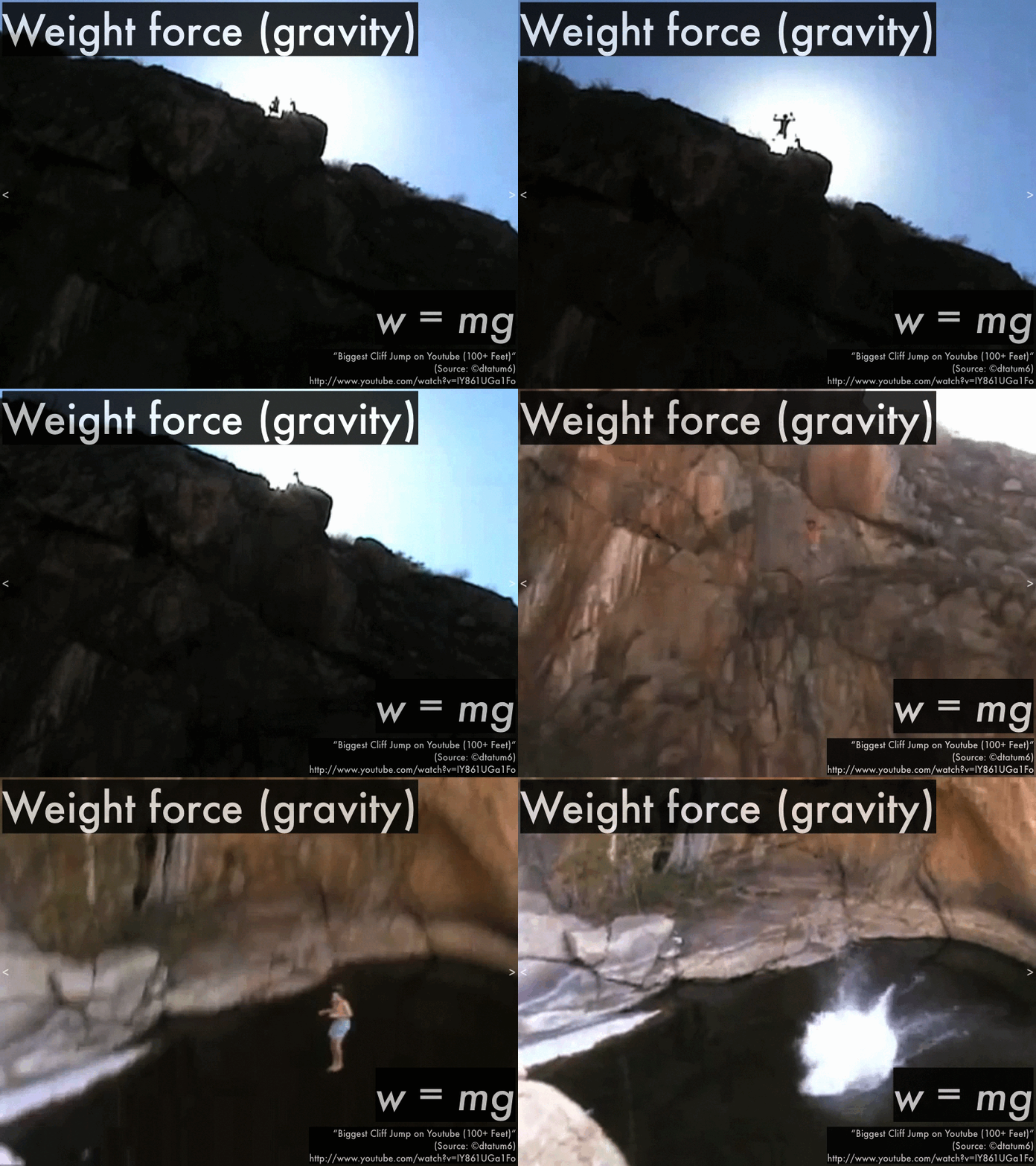
Weight, or the force of gravity, is the easy-cheesy force. For our purposes its magnitude is always equal to the product of the object's mass m, and the gravitational strength constant g ("acceleration due to gravity"), regardless of the motion or location of the object. (Movie link: "Biggest Cliff Jump on Youtube (100+ Feet).")

The normal force is the supporting contact force exerted by a surface. Its magnitude can vary from zero (no or barely any contact) up to ∞, but practically speaking a surface can only exert up to a maximum value, depending on structural integrity of the underlying material, until it fails. In this case, the floor can exert a normal force to support the weight of the contents of the room, but only up to when the room gets filled with too much water. (Movie link: "Collapsing floor by filling room with water.")

The tension force is the force exerted along a string, rope, or cable. Its magnitude can vary from zero (slack or barely pulling) up to ∞, but practically speaking a rope will have a maximum value, depending on the strength of its material/construction, until it fails. Here, a towing "snatch" strap exerts a tension force to pull on a stuck vehicle, but only up to when it is pulled too much. (Movie link: "Broken snatch strap.")

The static and kinetic friction forces apply to unsticking or subsequently sliding an object across a surface, respectively. The magnitude of the static friction force can vary from zero (no or barely trying to unstick an object) up to a maximum value, at which point the object becomes unstuck, and just begins to move. The magnitude of the kinetic friction force magnitude is always a constant value, once the object is already unstuck and moving. Note that the maximum magnitude of "stiction" (static friction) is greater than the magnitude of "sliption" (kinetic friction). (Movie link: "Static vs. Sliding Friction.")

So much for the "Brew-Ski" overview of different types of forces. Let's move on to more complex situations, and the tools used to handle them.

Most everyday situations involve more than one type of interaction happening at the same time--consider the forces acting on the board: weight, normal force, tension, static friction force (assuming that the girl is not sliding off of the board), and kinetic friction force (assuming that the board is already sliding across the sand).

Each force is represented with a vector--the magnitude (length) represents the strength of the interaction, and the direction represents, well, the direction of the force exerted. Typically many forces, all acting on the same object can be depicted on a free body diagram.

Forces all acting on the same object all add together to result in a net force (Fnet), which is what the summation operator signifies. Since mathematically vectors can be broken up into x- and y- components, and then separately added together to find the resulting x- and y- components of the net force.

Looking ahead, how many Newton's laws are there? (Three.) But there are only two ways to classify motion--constant, or changing, corresponding to Newtons first law, or second law. Or only two ways to classify net force--zero, or non-zero, corresponding to Newton's first law, or second law.

So if there's only two types of motion, and two types of net forces, what's up with Newton's third law? As it turns out, Newton's third law has nothing to do with motion or net force, but something else entirely, something much more universal and encompassing than considering a particular type of motion or net force...