Showing posts with label projectile motion. Show all posts

20190924

Physics quiz archive: vectors, projectile motion, forces

Physics 205A Quiz 3, fall semester 2019
Cuesta College, San Luis Obispo, CA
Sections 70854, 70855
Exam code: quiz03Ch3V


Sections 70854, 70855 results
0- 6 :   * [low = 6]
7-12 :   ***
13-18 :   **************
19-24 :   ******************* [mean = 21.7 +/- 5.8]
25-30 :   ***************** [high = 30]

20180924

Physics quiz archive: vectors, projectile motion, forces

Physics 205A Quiz 3, fall semester 2018
Cuesta College, San Luis Obispo, CA
Sections 70854, 70855 version 1
Exam code: quiz03pRH5


Sections 70854, 70855 results
0- 6 :  
7-12 :   ***** [low = 9]
13-18 :   **********
19-24 :   ******************* [mean = 23.1+/- 6.0]
25-30 :   ********************** [high = 30]

20171020

Physics midterm problem: world-record washing machine throw

Physics 205A Midterm 1, fall semester 2017
Cuesta College, San Luis Obispo, CA

"Washing Machine Throwing Showdown"
Guinness World Records
youtu.be/YC0oj7BcWiI

In 2017, Zydrunas Savickas set a world record throwing a 46 kg (101 lb) washing machine that landed a horizontal distance of 4.13 m from its starting position atop his head. Savickas' height is 1.91 m, and the washing machine was airborne for 1.84 s starting from just off the top of his head to just before hitting the ground[*].

Find both the horizontal and vertical components (v0x, v0y) of the initial velocity vector for the washing machine, as it was thrown and released from just above the top of Savickas' head. Neglect air resistance, and treat the washing machine as a point object. Show your work and explain your reasoning using properties of projectile motion.

[*] Rachel Swatman, "Watch Game of Thrones Star Take on World’s Strongest Man Winner in Washing Machine Throwing Showdown" (January 13, 2017), guinnessworldrecords.com/news/2017/1/watch-game-of-thrones-star-take-on-world%E2%80%99s-strongest-man-winner-in-washing-machi-458290.

Solution and grading rubric:
  • p:
    Correct. Discusses/demonstrates:
    1. uses given values of t = 1.84 s and x = +4.13 m to solve for the initial (and constant) horizontal velocity v0x (where t0 = 0, x0 = 0); and
    2. uses given values of t = 1.84 s and y = −1.91 m to solve for the initial vertical velocity v0y (where t0 = 0, y0 = 0).
  • r:
    Nearly correct, but includes minor math errors. May have intentionally or unintentionally used y = +1.91 m or y = 0 instead of y = −1.91 m.
  • t:
    Nearly correct, but approach has conceptual errors, and/or major/compounded math errors. At least has one initial velocity component correct, but other component has errors in addition to those listed in (r), such as setting vy = 0 in y = (1/2)⋅(vy0 + vy)⋅t to solve for vy0, or setting vx = 0 in x = (1/2)⋅(v0x + vx)⋅t to solve for vx0, etc.
  • v:
    Implementation of right ideas, but in an inconsistent, incomplete, or unorganized manner.
  • x:
    Implementation of ideas, but credit given for effort rather than merit.
  • y:
    Irrelevant discussion/effectively blank.
  • z:
    Blank.
Grading distribution:
Sections 70854, 70855
Exam code: midterm01mOoL
p: 20 students
r: 16 students
t: 12 students
v: 3 students
x: 1 student
y: 0 students
z: 0 students

A sample "p" response (from student 1956):

20171003

Physics quiz archive: vectors, projectile motion, forces

Physics 205A Quiz 3, fall semester 2017
Cuesta College, San Luis Obispo, CA
Sections 70854, 70855 version 1
Exam code: quiz03T4uC


Sections 70854, 70855 results
0- 6 :  
7-12 :   ********* [low = 9]
13-18 :   ****************
19-24 :   *********************** [mean = 19.2 +/- 5.2]
25-30 :   ****** [high = 27]

20161015

Physics midterm problem: Snake River Canyon rocket jump

Physics 205A Midterm 1, fall semester 2016
Cuesta College, San Luis Obispo, CA

"Stuntman successfully jumps Snake River Canyon"
KTVB Channel 7
ktvb.com/news/stuntman-successfully-jumps-snake-river-canyon/319488060

Stuntman Eddie Braun successfully completed a rocket jump over the Snake River in Idaho[*]. With a reported launch speed of 190 m/s at an angle of 55° above the horizontal, after traveling a horizontal distance of 740 m, the rocket reached a maximum height of 670 m above the ground.

Determine whether the reported 190 m/s was a plausible value for the launch speed (to within two significant figures). Neglect air resistance and the propulsion engine of the rocket (thus treating it as a thrown object). Show your work and explain your reasoning using properties of projectile motion.

[*] Loz Blain, "Eddie Braun Jumps the Snake River Canyon in an Evel Knievel-style Rocket Bike" (September 16, 2016), newatlas.com/eddie-braun-rocket-bike-jump-snake-river-knievel/45477/.

Solution and grading rubric:
  • p:
    Correct. Discusses/demonstrates:
    1. given maximum height y = +670 m at x = +740 m, calculates the initial speed (or initial velocity components);
    2. compares calculated initial speed (or initial velocity components) with reported value, and concludes there is a discrepancy of more than two significant figures.
    May instead discuss/demonstrate:
    1. holding other given values as fixed to find some other inconsistency in a reported value, such as time t to reach y = +670 m, time t to reach x = +740 m, or looks for a non-zero vertical velocity component vy at y = +670 m, etc.;
    2. interprets that reported initial speed of 190 m/s is plausible in that the rocket jump would exceed the reported trajectory parameters and be "successful."
  • r:
    Nearly correct, but includes minor math errors. At least successfully solves for the horizontal v0x and vertical v0y components of the initial velocity vector, but calculation and/or conclusion from finding/deducing a derived value to compare to a reported value is garbled.
  • t:
    Nearly correct, but approach has conceptual errors, and/or major/compounded math errors. At least enough steps are shown that would theoretically result in a complete answer, multiple errors notwithstanding.
  • v:
    Implementation of right ideas, but in an inconsistent, incomplete, or unorganized manner.
  • x:
    Implementation of ideas, but credit given for effort rather than merit.
  • y:
    Irrelevant discussion/effectively blank.
  • z:
    Blank.
Grading distribution:
Sections 70854, 70855, 73320
Exam code: midterm01br1Q
p: 29 students
r: 9 students
t: 6 students
v: 9 students
x: 3 students
y: 1 student
z: 0 students

A sample "p" response (from student 8321), finding that the reported initial velocity would result in a trajectory that would be higher and longer than the state values, and concludes that it is a plausible value in the sense that it would outdistance the (assumed) required trajectory:

Another sample "p" response (from student 3575), demonstrating that after the rocket has traveled a horizontal distance of 740 m, it is at a higher height than the stated maximum height of 670 m, and concludes that the reported initial velocity is a plausible value in that air resistance was not included in this analysis:

Yet another sample "p" response (from student 4566), showing a discrepancy in the vertical initial velocity component required in order for the rocket to reach its highest height of 670 m after traveling a horizontal distance of 740 m:

20160926

Physics quiz archive: vectors, projectile motion, forces

Physics 205A Quiz 3, fall semester 2016
Cuesta College, San Luis Obispo, CA
Sections 70854, 70855, 73320, version 1
Exam code: quiz03sHO7


Sections 70854, 70855, 73320 results
0- 6 :   ********** [low = 0]
7-12 :   ************************* [mean = 12.7 +/- 5.4]
13-18 :   **********
19-24 :   ******* [high = 24]
25-30 :  

20150930

Physics quiz archive: vectors, projectile motion, forces

Physics 205A Quiz 3, fall semester 2015
Cuesta College, San Luis Obispo, CA
Sections 70854, 70855, 73320, version 1
Exam code: quiz03re3T


Sections 70854, 70855, 73320 results
0- 6 :   * [low = 6]
7-12 :   *
13-18 :   *******************
19-24 :   ****************************** [mean = 22.4 +/- 4.9]
25-30 :   ********************** [high = 30]

20150902

Physics presentation: projectile motion

There is nothing more awesome than watching physics being applied successfully to the real-world. Make this a meme: APPLIED PHYSICS IS APPLIED. (Movie link: "DC SHOES: HOOPS COMMERCIAL.")

We'll analyze the principles behind this type of motion, and the equations used to analyze this motion.

Some working definitions: a projectile is an object that is subject only to the force of gravity once underway, and we'll consider the simplest (but not necessarily realistic) case where drag is negligible.

With these assumptions, then the trajectory--the path that this projectile travels along--has certain special properties.

Let's see how we can extend our previous understanding of objects moving vertically in free fall to projectile motion, and watch various examples of projectiles in motion.

If we shoot a ball vertically upwards, its upwards and subsequent downwards motion is only subject to the force of gravity (neglecting drag). This can be considered a special case of projectile motion.

Suppose that the cart that vertically launches the ball moves at a constant speed horizontally, here, along a smooth track.

When this horizontally moving cart launches a ball vertically...

...the ball will move along a trajectory...

...such that it will subsequently land back into the cart. This means that the horizontal motion of both ball and cart were always in sync, and that their horizontal motion is independent of the vertical motion of the ball. (Movie link: "110725-1240640-r.")

So projectile motion depends on two independent ingredients--vertical: free fall motion; horizontal: constant velocity motion.

If there is no horizontal motion, then projectile motion is the simple vertical free fall case. Here, stacking two anvils with a generous amount of gunpowder sandwiched between them results in...a vertical anvil trajectory. (Movie link: "Downieville Gold Rush Anvil Launch.")
Which initial velocity component(s) for the anvil (v0x, v0y) is/are zero? positive? Negative?
Which (constant) acceleration component(s) for the anvil (ax, ay) is/are zero? positive? Negative?
Driving a car off of a cliff results in another example of projectile motion, but remember that this is just vertical free fall, with the constant horizontal motion of the car's initial velocity as it drove off of the cliff. (Movie link: "Car Off Cliff.")
Which initial velocity component(s) for the car (v0x, v0y) is/are zero? positive? Negative?
Which (constant) acceleration component(s) for the car (ax, ay) is/are zero? positive? Negative?
Not content to drive a car off of a cliff, here a car is launched diagonally upwards, and then hit with an anti-tank rocket (which may or may not be a computer generated special effect). Again this is just vertical free fall, with constant horizontal motion. (Movie link: "Jeremy Clarkson - Hot Metal.")
Which initial velocity component(s) for the car (v0x, v0y) is/are zero? positive? Negative?
Which (constant) acceleration component(s) for the car (ax, ay) is/are zero? positive? Negative?
Hijinks aside, it's time to look at the boring but important equations that describe projectile motion.

Vertical motion is described with the same set of free fall equations that we have seen before.

With the sometimes necessary quadratic formula...

The only new equation here reflects the constant horizontal motion that goes on simultaneously with the vertical free fall motion. Since horizontal velocity never changes, horizontal acceleration is zero, so the only important equation is how horizontal displacement increases linearly with elapsed time.

So whereas we had five equations to describe vertical free fall motion, we only need one more equation--constant horizontal motion--to fully describe projectile trajectories.

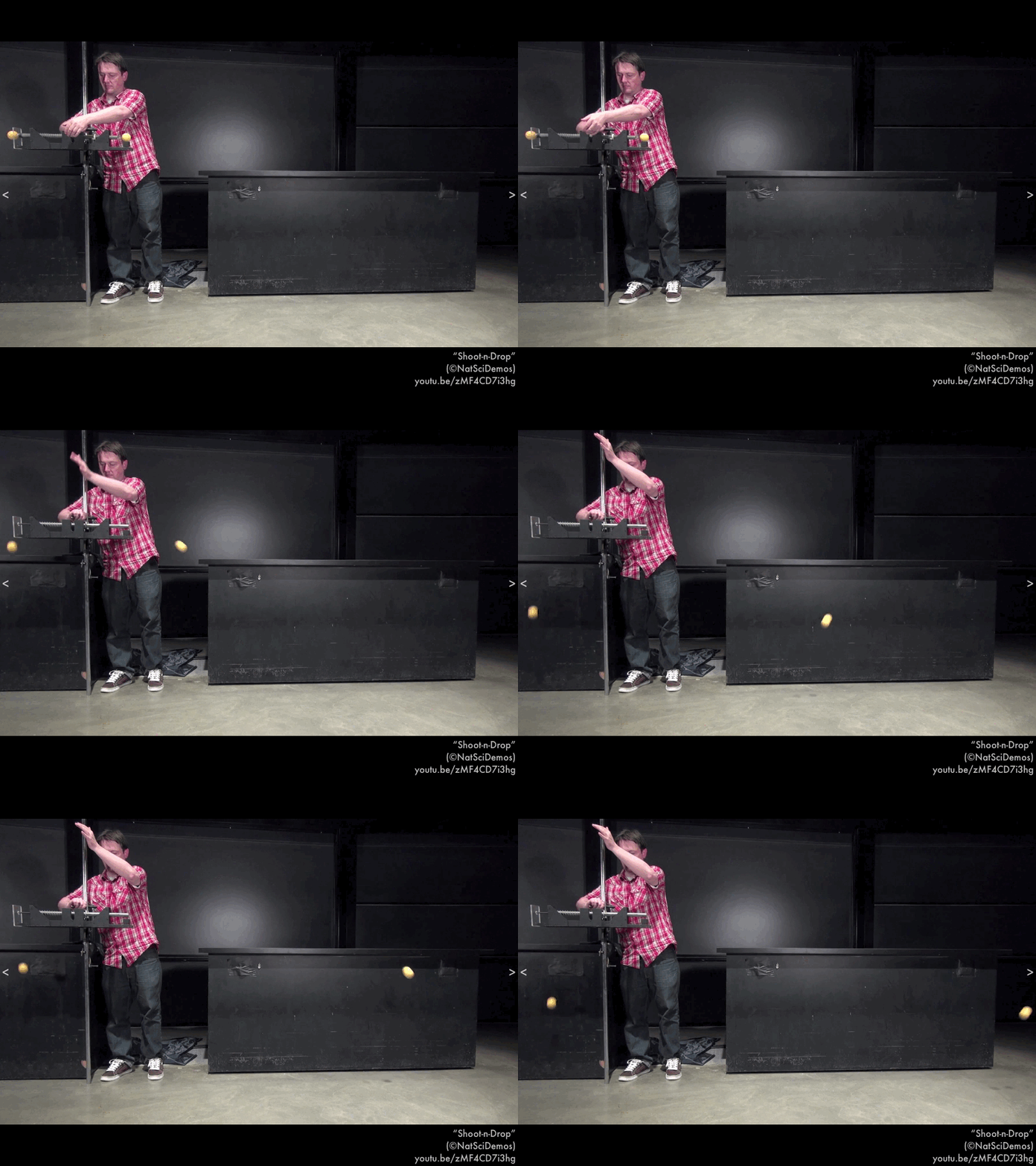
Closing note--trajectory motion is merely vertical free fall, with an added horizontal velocity component: so two billiard balls released simultaneously, with one dropped from rest, the other with an initial horizontal velocity will have the same vertical motion, and must hit the floor at the same time. (Movie link: "Shoot-n-Drop.")