Showing posts with label accretion disk. Show all posts

20130611

Astronomy in-class activity: compact objects with close-transfer binary companion stars

Astronomy 210 In-class activity 19 v.13.06.11, fall semester 2013
Cuesta College, San Luis Obispo, CA

Students find their assigned groups of three to four students, and work cooperatively on an in-class activity worksheet on the features of compact objects (white dwarfs, neutron stars, and black holes) with close-transfer binary companion stars.


20081029

Overheard: accretion vs. secretion

Astronomy 210, fall semester 2008
Cuesta College, San Luis Obispo, CA

(Overheard in class during an in-class activity on mass transfer in close binary star systems.)

Student: "What does 'accretion' stand for?"

Instructor: "As in an 'accretion disk?' ...It's 'gathering' stuff from the companion star."

Student: "So, it's like the opposite of 'secretion?' Like in giving out stuff?"

Instructor: "Yeah--like exuding or oozing stuff out."

Esprit d'escalier:
Instructor: "'Accrete' is an obscure term, but it's similar to 'acquire' and 'accumulate.'"

20080720

Accretion disk radiation

"Brewster Rockit: Space Guy!" by Tim Rickard
July 5, 2008

There would probably be x-rays rather than near-UV rays emitted from the accretion disk surrounding a black hole, or perhaps beta particles (whether electrons or positrons) from Hawking radiation, especially if the black hole was sufficiently small.

20080514

Astronomy quiz question: type Ia supernovae

Astronomy 10 Quiz 10, Spring Semester 2008
Cuesta College, San Luis Obispo, CA

Astronomy 10 learning goal Q10.3

[3.0 points.] Which one of the following choices best explains why an isolated white dwarf cannot explode as a type Ia supernova?
(A) There is no companion star to heat up.
(B) There is no external source of hydrogen.
(C) There is no companion star to distort spacetime.
(D) It expended all of its extra energy during the planetary nebula phase.
(E) There is not enough degeneracy pressure.

Correct answer: (B)

If there is no companion star to transfer hydrogen to a white dwarf, then the white dwarf star cannot collect and compact this material onto its surface, making it undergo fusion to undergo a type Ia supernova (or a mere nova) explosion.

Student responses
Section 5166
(A) : 8 students
(B) : 17 students
(C) : 4 students
(D) : 6 students
(E) : 7 students

Previous post:
Astronomy in-class activity: compact objects with companion stars.

20080513

Astronomy quiz question: x-ray bursts

Astronomy 10 Quiz 10, Spring Semester 2008
Cuesta College, San Luis Obispo, CA

Astronomy 10 learning goal Q10.3

[3.0 points.] Which one of the following choices best explains why an isolated neutron star cannot have repeated x-ray bursts?
(A) There is no companion star to heat up.
(B) There is no companion star to distort spacetime.
(C) It expended all of its extra energy during its type II supernova.
(D) There is no external source of hydrogen.
(E) There is not enough degeneracy pressure.

Correct answer: (D)

If there is no companion star to transfer hydrogen to a neutron star, then the neutron star cannot collect and compact this material onto its surface, making it undergo fusion to produce an x-ray burst.

Student responses
Section 4160
(A) : 7 students
(B) : 1 student
(C) : 10 students
(D) : 16 students
(E) : 0 students

Previous post:
Astronomy in-class activity: compact objects with companion stars.

20080512

Astronomy quiz question: accretion disk blackbody radiation

Astronomy 10 Quiz 10, Spring Semester 2008
Cuesta College, San Luis Obispo, CA

Astronomy 10 learning goal Q10.3

[3.0 points.] Which one of the following choices best explains how accretion disks emit intense ultraviolet, and/or x-ray blackbody radiation?
(A) Heat generated from friction.
(B) Electrons jump down to lower orbits.
(C) Electrons flip their spins.
(D) Curvature of spacetime.
(E) Hydrogen fuses into helium.

Correct answer: (A)

A companion star of a compact object (white dwarf, neutron star, or black hole) may be close enough such that it will overflow its Roche lobe when it becomes a giant or superigant, thus transferring hydrogen to the compact object. This infalling hydrogen collects into an accretion disk surrounding the compact object, and due to Kepler's third law, the outer part of the disk orbits slower than the inner part of the disk. Due to the density of the disk, the difference in speeds between adjacent parts causes friction, producing enough heat for the disk to become incandescent, thus emitting blackbody radiation.

Student responses
Section 5166
(A) : 9 students
(B) : 17 students
(C) : 2 students
(D) : 3 students
(E) : 5 students

Previous post:
Astronomy in-class activity: compact objects with companion stars.

20080511

Astronomy quiz question: black holes with companion stars

Astronomy 10 Quiz 10, Spring Semester 2008
Cuesta College, San Luis Obispo, CA

Astronomy 10 learning goal Q10.3

[3.0 points.] Which one of the following statements best explains why x-rays are observed from close binary systems comprised of black holes with companion stars?
(A) Only x-ray photons are fast enough to escape from black holes.
(B) Electrons falling into lower energy orbitals release x-ray photons.
(C) Black holes can only emit x-ray photons.
(D) Accretion disks surrounding black holes emit very hot blackbody radiation.
(E) Companion stars orbiting black holes emit very hot blackbody radiation.

Correct answer: (D)

A companion star of a black hole may be close enough such that it will overflow its Roche lobe when it becomes a giant or superigant, thus transferring hydrogen to the black hole. This infalling hydrogen collects into an accretion disk surrounding the black hole, heating up in the process to become incandescent, emitting blackbody radiation.

Student responses
Section 4160
(A) : 3 students
(B) : 5 students
(C) : 6 students
(D) : 16 students
(E) : 4 students

Previous post:
Astronomy in-class activity: compact objects with companion stars.

20080507

Astronomy in-class activity: compact objects with companion stars

Astronomy 210 In-class activity 23 v.07.04.28, spring semester 2008
Cuesta College, San Luis Obispo, CA

Students find their assigned groups of three to four students, and work cooperatively on an in-class activity worksheet to compare and contrast the different features of compact objects with companion stars. Students are instructed to look for connections and similarities, then to concentrate on specific differences.

20060802

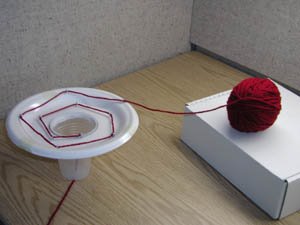
Black hole accretion disk "string theory" model


http://heasarc.gsfc.nasa.gov/docs/xte/outreach/HEG/bhm/bhm_intro.html
Kimberly S. Adams, Argyle Middle School, Silver Spring, MD

Astronomy 10 learning goal Q10.3

Simple model of mass transfer from a giant/supergiant to a black hole.   Conservation of angular momentum from the orbits of this binary system results in the mass transferred from the giant/supergiant forming an accretion disk around the black hole, rather than falling "straight in."

20060726

The garbage disposal effect


http://www.spacetelescope.org/videos/html/heic0211d.html
NASA/European Space Agency, and Felix Mirabel (French Atomic Energy Commission, and the Institute for Astronomy and Space Physics/Conicet of Argentina)

Astronomy 10 learning goal Q10.3

Short movie clip dramatizing the behavior of the black hole and companion star that comprise "microquasar" GRO J1655-40.   The "garbage disposal effect" is where material will fly up and out of the drain of a garbage disposal while operating, and is a crude analog of the bipolar jets emitted by the black hole.

20060725

We like the stars, the stars that go boom!


http://www.spacetelescope.org/videos/html/heic0415b.html
NASA/European Space Agency, and P. Ruiz-Lapuente (University of Barcelona)

Astronomy 10 learning goal Q10.3

Short movie clip dramatizing the type Ia supernova documented by Tycho Brahe in 1572.   A white dwarf of degenerate carbon steals hydrogen from its companion star.   When enough material has accumulated on the surface of the white dwarf, it undergoes runaway fusion, annihilating itself, and freeing its companion to roam the Milky Way alone.