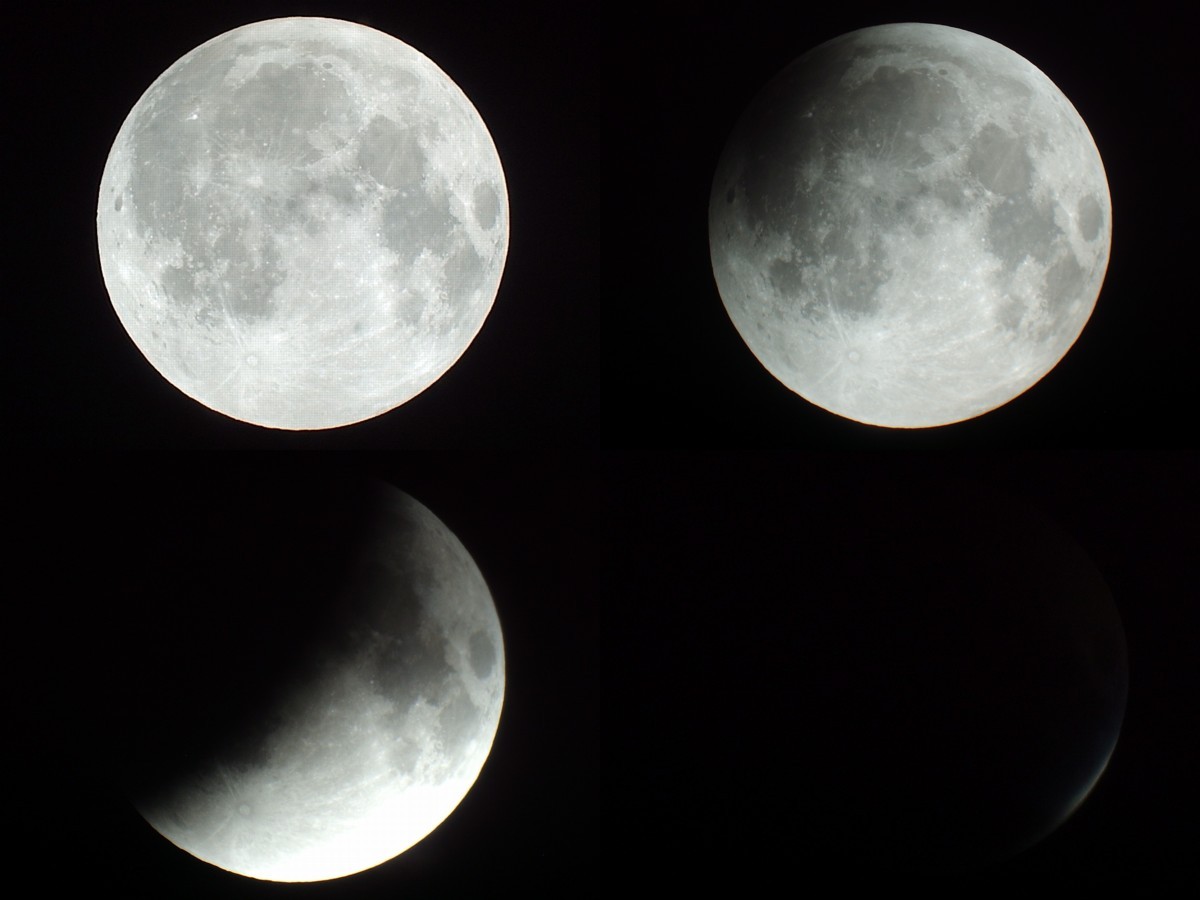
Showing posts with label lunar eclipse. Show all posts

20180927

Astronomy quiz question: January 20, 2019 total lunar eclipse

Astronomy 210 Quiz 3, spring semester 2016
Cuesta College, San Luis Obispo, CA

A total lunar eclipse will be visible for observers in San Luis Obispo, CA occur January 20, 2019[*]. During this total lunar eclipse, these observers would see:
(A) the moon, completely within Earth's shadow.
(B) the moon, completely illuminated by the sun.
(C) the moon completely blocking the sun.
(D) the sun, with part of it being blocked by the moon.
(E) the sun, with no part of it being blocked by the moon.

[*] timeanddate.com/eclipse/lunar/2019-january-21.

Correct answer (highlight to unhide): (A)

During a total lunar eclipse, the full moon will be completely within Earth's umbra, and would typically appear a very, very dark brown-red.

(If there is no lunar eclipse of any time, the full moon would be completely illuminated by the sun. During a partial lunar eclipse the full moon would have a dark shadow across part of it (assuming that is the extent of what is covered on the full moon), when only part of it (at most) would be within Earth's umbra.)

(The entire sun would be blocked by a new moon during a total solar eclipse, as seen by an observer located under the moon's umbra; only part of the sun would be blocked by a new moon (assuming that is the extent of what is covered by the moon) during a partial solar eclipse, where the observer is in the moon's penumbra.)

Section 70158
Exam code: quiz03zH0g
(A) : 25 students
(B) : 3 students
(C) : 2 students
(D) : 3 students
(E) : 3 students

Success level: 71% (including partial credit for multiple-choice)
Discrimination index (Aubrecht & Aubrecht, 1983): 0.40

Section 70160
Exam code: quiz03McC6
(A) : 10 students
(B) : 2 students
(C) : 4 students
(D) : 0 students
(E) : 0 students

Success level: 64% (including partial credit for multiple-choice)
Discrimination index (Aubrecht & Aubrecht, 1983): 0.60

20171005

Astronomy quiz question: not being able to see the July 27, 2018 total lunar eclipse

Astronomy 210 Quiz 3, fall semester 2017
Cuesta College, San Luis Obispo, CA

A total lunar eclipse will occur on July 27, 2018[*]. During this event, observers in San Luis Obispo, CA will not be able to see it because:
(A) the moon will be too far away.
(B) the moon's orbit will be too tilted.
(C) the moon will have the wrong phase.
(D) it will be daytime in San Luis Obispo, CA.

[*] timeanddate.com/eclipse/lunar/2018-july-27.

Correct answer (highlight to unhide): (D)


When the moon is completely within Earth's umbra, then it will appear very, very dark brown-red during a total lunar eclipse. Everyone on the night side of Earth will be able to see this occur simultaneously; while everyone on the day side of Earth will not be able to see this, as they will on the side of Earth facing away from the moon. (The total lunar eclipse shown above depicts the near-opposite of the July 27, 2018 total lunar eclipse, where observers in North and South America are on the night side of Earth and are able to see the total lunar eclipse, while observers in Europe and Africa are on the day slide of Earth and are not able to this total lunar eclipse.)

Section 70158
Exam code: quiz03S3ir
(A) : 1 student
(B) : 10 students
(C) : 1 student
(D) : 32 students

Success level: 73% (including partial credit for multiple-choice)
Discrimination index (Aubrecht & Aubrecht, 1983): 0.73

Section 70160
Exam code: quiz03Ni5t
(A) : 1 student
(B) : 13 students
(C) : 6 students
(D) : 11 students

Success level: 39% (including partial credit for multiple-choice)
Discrimination index (Aubrecht & Aubrecht, 1983): 0.21

20160917

Astronomy quiz question: September 16, 2016 partial lunar eclipse

Astronomy 210 Quiz 2, fall semester 2016
Cuesta College, San Luis Obispo, CA

A partial lunar eclipse will occur on September 16, 2016.[*] Observers in New Delhi, India will be able to see this eclipse while it happens, because they will be located:
(A) on Earth's daylight side.
(B) on Earth's night side.
(C) in the moon's penumbra.
(D) in the moon's negative shadow.
(E) in the moon's umbra.

[*] eclipsewise.com/oh/oh-figures/ec2016-Fig04.pdf.

Correct answer (highlight to unhide): (B)

For a partial lunar eclipse, the full moon is partially in both the umbra and in the penumbra shadow zones of Earth. All observers on the night side of Earth would be able to see the full moon during this partial lunar eclipse; however, observers on the daylight side of Earth would not.

(Observers in any of the moon's shadow zones (the umbra, penumbra, or "negative shadow" (antumbra)) during any type of lunar eclipse would then be located somewhere behind the dark side of the moon!)

Section 70158
Exam code: quiz02sr7Y
(A) : 4 students
(B) : 12 students
(C) : 18 students
(D) : 2 students
(E) : 4 students

Success level: 34% (including partial credit for multiple-choice)
Discrimination index (Aubrecht & Aubrecht, 1983): 0.55

Section 70160
Exam code: quiz02nYNy
(A) : 3 students
(B) : 3 students
(C) : 16 students
(D) : 6 students
(E) : 4 students

Success level: 16% (including partial credit for multiple-choice)
Discrimination index (Aubrecht & Aubrecht, 1983): 0.22

20160304

Astronomy quiz question: March 23, 2016 penumbral lunar eclipse

Astronomy 210 Quiz 3, spring semester 2016
Cuesta College, San Luis Obispo, CA

Before sunrise on the morning of March 23, 2016, the moon will pass inside Earth's penumbra for observers in San Luis Obispo, CA[*]. These observers will see:
(A) a dark shadow across part of a full moon.
(B) a very, very dark brown-red full moon.
(C) a full moon slightly dimmer than usual.
(D) only part of the sun blocked by a new moon.
(E) the entire sun blocked by a new moon.
(F) a new moon not large enough to entirely block the sun while in front of it.

[*] timeanddate.com/eclipse/lunar/2016-march-23.

Correct answer (highlight to unhide): (C)

When the moon is completely within Earth's penumbra, it is still illuminated by some of the sun's light, and will be only slightly dimmer (but usually not noticeably dimmer, to the naked eye) than a regular full moon.

(The full moon would appear a very, very dark brown-red during a total lunar eclipse, when it is completely within Earth's umbra; and the full moon would have a dark shadow across part of it (assuming that is the extent of what is covered on the full moon) during a partial lunar eclipse, when only part of it (at most) would be within Earth's umbra.)

(The entire sun would be blocked by a new moon during a total solar eclipse, as seen by an observer located under the moon's umbra; only part of the sun would be blocked by a new moon (assuming that is the extent of what is covered by the moon) during a partial solar eclipse, where the observer is in the moon's penumbra; and a new moon not large enough to entirely block the sun while in front of it would be seen during an annular solar eclipse, where the observer is in the moon's antumbra (in this class, called the "negative shadow").)

Section 30674
Exam code: quiz03n0V4
(A) : 5 students
(B) : 5 students
(C) : 1 student
(D) : 5 students
(E) : 3 students
(F) : 1 student

Success level: 8% (including partial credit for multiple-choice)
Discrimination index (Aubrecht & Aubrecht, 1983): 0.17

Section 30676
Exam code: quiz03s4rA
(A) : 12 students
(B) : 9 students
(C) : 12 students
(D) : 9 students
(E) : 3 students
(F) : 3 students

Success level: 28% (including partial credit for multiple-choice)
Discrimination index (Aubrecht & Aubrecht, 1983): 0.36

20150919

Astronomy quiz question: next full moon after total lunar eclipse

Astronomy 210 Quiz 2, fall semester 2015
Cuesta College, San Luis Obispo, CA

Observers in San Luis Obispo, CA will see a total lunar eclipse in the evening of September 27, 2015.[*][**] There will not be a total lunar eclipse in the following month because:
(A) the moon always keeps the same side facing Earth.
(B) the moon's orbit around Earth is tilted.
(C) the moon's orbit is not a perfect circle.
(D) Earth's axis precesses over a 23,000 year cycle.

[*] timeanddate.com/eclipse/lunar/2015-september-28.
[**] eclipse.gsfc.nasa.gov/LEplot/LEplot2001/LE2015Sep28T.pdf.

Correct answer (highlight to unhide): (B)

When the moon is full and the moon's orbit is seen edge-on from the sun's perspective, there will be a total eclipse as the moon passes completely behind Earth, in Earth's umbral shadow. However, the moon's orbit will typically change its tilt such the subsequent full moon will no longer pass directly behind Earth, being either too high or low to pass into Earth's umbral shadow, making it just a regular full moon instead of a total lunar eclipse.


Response (A) explains why the near side of the moon appears to be constant; response (C) explains why some solar eclipses are annular rather than total; and response (D) is the reason why Polaris will not always be the pole star.

Section 70158
Exam code: quiz02s5Sz
(A) : 3 students
(B) : 25 students
(C) : 13 students
(D) : 1 student

Success level: 63% (including partial credit for multiple-choice)
Discrimination index (Aubrecht & Aubrecht, 1983): 0.83

Section 70160
Exam code: quiz02Nnz2
(A) : 0 students
(B) : 16 students
(C) : 13 students
(D) : 0 students

Success level: 57% (including partial credit for multiple-choice)
Discrimination index (Aubrecht & Aubrecht, 1983): 0.75

20130609

Astronomy in-class activity: eclipses

Astronomy 210 In-class activity 5 v.13.06.09, fall semester 2013
Cuesta College, San Luis Obispo, CA

Students find their assigned groups of three to four students, and work cooperatively on an in-class activity worksheet to discuss the categories and causes of different types of eclipses.


20120630

Presentation: eclipses

Cats casting shadows. Eh, this looks Photoshopped. How can you tell? What clues do you look for? As we'll see, it's not just the shadows cast by objects that are important, but where we are located relative to these shadows.

In the previous presentation, we discussed the motion and cycles of the moon--specifically lunar phases--and here we'll complete our discussion of the moon with eclipses.

Just a public service announcement about watching solar eclipses--make sure you are not looking directly at the sun with the unprotected eye. Either project an image of the sun using a pinhole, binoculars, or telescope...

...or use filters specifically labeled for observing the sun. My dog can practice safe solar eclipse viewing, and so should you.

First, the boring but necessary terminology.

Make sure you can distinguish between very similar terms:
  • full and new moon (well, this should be self-explanatory).
  • lunar eclipse and solar eclipse (light from the sun that would illuminate the full moon is blocked by Earth; direct light from the sun that would reach Earth is blocked by the moon).
  • partial, total, and annular eclipse (sun or moon partially or totally covered/darkened, respectively; annular refers to an "annulus" or "little ring," where the moon is centered on the sun, but does not completely cover the sun).

Let's observe a simulation of a total lunar eclipse in April 14, 2014, as seen from the perspective of the sun. Note that Earth blocks light to the moon. Where would you have to be located (on Earth) to observe this total lunar eclipse? Where on Earth would observers not be able to see this total lunar eclipse? What phase is the moon in during this total lunar eclipse? (Why is there not a total lunar eclipse during every full moon?) (Video link: "1-5-140415-Lunar.mov.")

Here's a simulation of a total solar eclipse from July 11, 1991, again seen from the perspective of the sun, where the moon blocks light to Earth (casting a much smaller shadow). Where would you have to be located (on Earth) to observe this total solar eclipse? Where on Earth would observers not be able to see this total solar eclipse? What phase is the moon in during this total solar eclipse? (Why is there not a total solar eclipse during every new moon?) (Video link: "1-5-910711-Solar.mov.")

Time to do a picto-quiz--you'll be shown a picture or movie clip of the moon and/or sun (assume that each of these situations is the maximum extent of something being shadowed or blocked), and then be prompted with possible responses. At that point, if you know the correct answer, shout it out--because yes, the loudest answer is the most correct answer...

Is this a solar or lunar eclipse, or not an eclipse at all? Is this eclipse partial, total, or annular?

Is this a solar or lunar eclipse, or not an eclipse at all? Is this eclipse partial, total, or annular?

Is this a solar or lunar eclipse, or not an eclipse at all? Is this eclipse partial, total, or annular?

Is this a solar or lunar eclipse, or not an eclipse at all? Is this eclipse partial, total, or annular?

Is this a solar or lunar eclipse, or not an eclipse at all? Is this eclipse partial, total, or annular?

Is this a solar or lunar eclipse, or not an eclipse at all? How do you know that this is not an eclipse? What phase is this moon?

One more slide, for you Twihards--which team are you on? (Why is there no Team Bella?)

Second, let's consider why not every full moon is a lunar eclipse, and not every new moon is a solar eclipse.

This is a to-scale simulation of the moon revolving around Earth, while Earth revolves around the sun, as seen from the perspective of the sun. A lot goes on simultaneously, so just watch this and observe the different types of motions. After we discuss what details we should be looking for, we'll run this simulation again. (Video link: "1-5-Linesofnodes.mov.")

Note that the orbit of the moon is tilted, and the bright part is closest to us (the sun) and tilted downwards, while the dim part is farthest away from us, and tilted upwards. Which phase is the moon in right now? How do you know that an eclipse is not occurring right now? How do you know this?

The tilt of the moon's orbit changes slowly over time. Which phase is the moon in right now? How do you know that an eclipse is not occurring right now? How do you know this?

Generally an eclipse can happen only if (1) the moon is either new or full, and (2) the moon's orbit is aligned edge-on. Our previous two examples had the right phase, but wrong orbit; then the right orbit, but the wrong phase. Now we have both the right phase (although it is not clear whether it is new or full) and the right orbit (edge-on), and some type of eclipse (whether solar or lunar) is occurring right now. The timing between the moon phase and slowly changing moon orbit is crucial, and if the timing between these two cycles is not perfect (as it usually isn't), this is why there is not a solar or lunar eclipse every new or full moon.

Back to our simulation. When an eclipse happens (whether solar or lunar), you all say "now." Synchronize! Approximately how many months lapsed during this time? How many eclipses (whether solar or lunar) occurred during this time?

Let's look at two full moons, and flip between them. One is a (nearly) full moon that is just about to undergo a total lunar eclipse, and the other is a full moon that will not undergo any type of lunar eclipse. Can you determine the difference(s) between these two full moons?

Remember that the reason a lunar eclipse does not occur every full moon is that the orbit of the moon is usually tilted not edge-on, but too high or too low. Notice that the "Not to be eclipsed" moon has a slight shadow on the bottom, meaning that its orbit is too high, while the "To be eclipsed" moon has sharp edges at both top and bottom, meaning that its orbit is edge-on and will pass directly behind Earth for a total lunar eclipse. Next time just before the moon is completely full, take a careful look at the top and bottom edges of the moon (you will probably need binoculars or a telescope). If you see a slight ragged edge at the top or bottom, don't get too excited, as a total lunar eclipse is not impending.

In this promotional photograph for a certain obscure TV show from a few years ago, is it plausible that all these actors and actresses were present at in the studio at the same time? How do you know? What clues do you look for?

In the subsequent in-class activity, we'll be looking carefully at the different "shadow zones" cast by either the moon or Earth, and what would be observed if were located in each of these zones: umbra, penumbra, and antumbra (not a common term, we'll refer to the antumbra as the "negative shadow").

20120222

Astronomy quiz question: total solar eclipse location

Astronomy 210 Quiz 2, spring semester 2012
Cuesta College, San Luis Obispo, CA

An observer in San Luis Obispo, CA is watching a total solar eclipse. During this eclipse, the observer is located in:
(A) the moon's umbra.
(B) the moon's penumbra.
(C) the moon's negative shadow.
(D) Earth's umbra.
(E) Earth's penumbra.

Correct answer (highlight to unhide): (A)

For a total solar eclipse, the new moon is between the sun and Earth, blocking light the light from the sun. All observers in the umbra (the "complete" shadow zone) of the moon would have all sunlight blocked from reaching them, and thus they would see a total solar eclipse.

(Response (B) would be for a partial solar eclipse (assuming that is the maximum extent of its progress), response (C) would be for an annular solar eclipse. Responses (D) and (E) correspond to the location of the moon during a total and partial lunar eclipse, respectively.)

Section 30676
Exam code: quiz02SnT4
(A) : 20 students
(B) : 4 students
(C) : 7 students
(D) : 9 students
(E) : 1 student
(No response : 1 student)

Success level: 52% (including partial credit for multiple-choice)
Discrimination index (Aubrecht & Aubrecht, 1983): 0.57

20110930

Astronomy quiz question: in the moon's umbra

Astronomy 210 Quiz 3, fall semester 2011
Cuesta College, San Luis Obispo, CA

What type of eclipse is seen by an observer on the side of Earth facing the sun, located in the umbra of the moon?
(A) An annular solar eclipse.
(B) A partial solar eclipse.
(C) A total solar eclipse.
(D) A total lunar eclipse.
(E) A partial lunar eclipse.

Correct answer: (C).

Section 70158
Exam code: quiz03sO1L
(A) : 2 students
(B) : 6 students
(C) : 17 students
(D) : 11 students
(E) : 0 students

Success level: 52% (including partial credit for multiple-choice)
Discrimination index (Aubrecht & Aubrecht, 1983): 0.52

Section 70160
Exam code: quiz03N1rE
(A) : 4 students
(B) : 5 students
(C) : 14 students
(D) : 1 students
(E) : 3 students

Success level: 54% (including partial credit for multiple-choice)
Discrimination index (Aubrecht & Aubrecht, 1983): 0.86

20110926

Astronomy quiz question: partial solar eclipse

Astronomy 210 Quiz 2, fall semester 2011
Cuesta College, San Luis Obispo, CA

Consider a side view of the moon and Earth and their shadow zones, and the location of an observer on Earth. The sun is located to the left, far off of the page.


What type of eclipse is seen by the observer?
(A) An annular solar eclipse.
(B) A partial solar eclipse.
(C) A total solar eclipse.
(D) A total lunar eclipse.
(E) A partial lunar eclipse.

Correct answer: (B).

Since the observer is in the penumbra of the moon, the moon will not completely cover the sun, and the observer is observing a partial solar eclipse (assuming that this is a side of the moon and Earth, such that the moon's orbital motion comes out of the plane of the page).

Section 70158
Exam code: quiz02sHDw
(A) : 1 students
(B) : 20 students
(C) : 7 students
(D) : 0 students
(E) : 3 students

Success level: 69% (including partial credit for multiple-choice)
Discrimination index (Aubrecht & Aubrecht, 1983): 0.70

20110923

Astronomy quiz question: phase during total lunar eclipse

Astronomy 210 Quiz 2, fall semester 2011
Cuesta College, San Luis Obispo, CA

An observer in San Luis Obispo, CA, is watching a total lunar eclipse. During this total lunar eclipse, the moon will be in its __________ phase.
(A) new.
(B) first quarter.
(C) full.
(D) third quarter.
(E) (Depends on the time of day.)

Correct answer (highlight to unhide): (C)

During a total lunar eclipse, the moon is completely within Earth's umbra (Earth being between the sun and the moon). Since the moon lined up with the sun and Earth on the night side of Earth, it must be in its full phase.

Section 70160
Exam code: quiz02n3rE
(A) : 7 students
(B) : 0 students
(C) : 20 students
(D) : 0 students
(E) : 0 students

Success level: 74% (including partial credit for multiple-choice)
Discrimination index (Aubrecht & Aubrecht, 1983): 0.29

20110909

Astronomy flashcard question: partial lunar eclipse

Astronomy 210, fall semester 2011
Cuesta College, San Luis Obispo, CA

Students were asked near the end of their learning cycle the following think-pair-share question, to be answered using flashcards.

Consider a side view of Earth and its shadow zones, the location of an observer on Earth, and the moon. The sun is located to the left, far off of the page. Which view does this observer see?

Section 70160 (pre-)
(A) : 8 students
(B) : 1 student
(C) : 1 student
(D) : 13 students
(E) : 4 students

This question was asked again after students were instructed to discuss with a neighbor how they chose their answer, and to convince each other why their answer is (in)correct.

Section 70160 (post-)
(A) : 0 students
(B) : 0 students
(C) : 0 students
(D) : 24 students
(E) : 4 students

Correct answer: (D)

Note that (A) is the view of Earth, as seen by an observer located somewhere on the northern hemisphere of the near side of the moon.

Pre- to post- peer-interaction gains:
pre-interaction correct = 48%
post-interaction correct = 86%
Hake (normalized) gain <g> = 73%

20110908

Astronomy flashcard question: total lunar eclipse

Astronomy 210, fall semester 2011
Cuesta College, San Luis Obispo, CA

Students were asked near the end of their learning cycle the following think-pair-share question, to be answered using flashcards.

While an observer in Seattle, WA is seeing a total lunar eclipse, an observer in San Luis Obispo, CA would see:
(A) a total lunar eclipse.
(B) a partial lunar eclipse.
(C) a normal full moon.
(D) (None of the above choices, as the moon would not be visible.)
(E) (Unsure/guessing/lost/help!)

Section 70160 (pre-)
(A) : 6 students
(B) : 10 students
(C) : 4 students
(D) : 0 students
(E) : 7 students

This question was asked again after students were instructed to discuss with a neighbor how they chose their answer, and to convince each other why their answer is (in)correct.

Section 70160 (post-)
(A) : 15 students
(B) : 12 students
(C) : 0 students
(D) : 0 students
(E) : 1 student

Correct answer: (A)

This was also asked as a midterm essay question in a previous semester.

Pre- to post- peer-interaction gains:
pre-interaction correct = 22%
post-interaction correct = 54%
Hake (normalized) gain <g> = 41%

20110221

Astronomy quiz question: cause of lunar eclipses

Astronomy 210 Quiz 2, Spring Semester 2011
Cuesta College, San Luis Obispo, CA

What causes a lunar eclipse?
(A) The slow, gradual rotation of the moon about its own axis.
(B) Earth blocks light from the sun, casting a shadow on the moon.
(C) The moon blocks light from the sun, casting a shadow on Earth.
(D) Different amounts of the day and night sides of the moon as seen from Earth.

Correct answer: (B)

During a lunar eclipse, the moon is in Earth's shadow, on the opposite side of Earth than the sun.

Section 30676
(A) : 2 students
(B) : 32 students
(C) : 13 students
(D) : 0 students

"Success level": 70% (including partial credit for multiple-choice)
Discrimination index (Aubrecht & Aubrecht, 1983): 0.38

20100315

Astronomy midterm question: simultaneous total lunar and total solar eclipses?

Astronomy 210 Midterm 1, Spring Semester 2010
Cuesta College, San Luis Obispo, CA

[20 points.] Consider the following excerpt regarding viewing total lunar and solar eclipses:
On July 6, 1982, a woman telephoned a radio show that had invited people to give their impressions of the total lunar eclipse then in progress. She said: 'We're seeing this total eclipse of the moon right now on our side of the world. Does that mean that at this same moment the people on the other side of the world are seeing a total eclipse of the sun?'"
—Guy Ottewell, Astronomical Calendar 2010, Universal Workshop, Raynham, MA, 2009, p. 43.
Decide whether seeing a total eclipse of the sun "at this same moment" is plausible or implausible. Support your answer using a diagram showing the positions of the sun, moon, and Earth.

Solution and grading rubric:
  • p = 20/20:
    Correct. Draws a correct diagram of a total lunar eclipse, where the moon is on the other side of Earth than the sun; and since the moon must be on the same side of Earth as the sun for there to be a total solar eclipse, it is implausible that observers anywhere on Earth can observe a total solar eclipse simultaneously with a total lunar eclipse. May also illustrate and argue the converse argument, when a total solar eclipse is occuring a total lunar eclipse cannot be simultaneously observed.
  • r = 16/20:
    Nearly correct (explanation weak, unclear or only nearly complete); includes extraneous/tangential information; or has minor errors. Diagram is problematic (misalignment of sun-Earth-moon line), but essential argument that the moon cannot be at two different locations on either side of Earth correct.
  • t = 12/20:
    Contains right ideas, but discussion is unclear/incomplete or contains major errors. Diagram missing, but essential argument correct, or vice versa.
  • v = 8/20:
    Limited relevant discussion of supporting evidence of at least some merit, but in an inconsistent or unclear manner. Argument based on timing of time zones, size of moon's umbral spot, or improbable sun-Earth-moon diagrams.
  • x = 4/20:
    Implementation/application of ideas, but credit given for effort rather than merit.
  • y = 2/20:
    Irrelevant discussion/effectively blank.
  • z = 0/20:
    Blank.
Grading distribution:
Section 30674
p: 36 students
r: 1 student
t: 1 student
v: 6 students
x: 0 students
y: 0 students
z: 0 students

Section 30676
p: 62 students
r: 6 students
t: 23 students
v: 13 students
x: 13 students
y: 1 student
z: 3 students

A sample "p" response (from student 1802):

Another sample "p" response (from student 7129), lamenting the fact that Earth does not have two moons:

Another sample "p" response (from student 2425):

A sample "v" response (from student 9696), with two Earths?

20100306

Astronomy quiz question: partial lunar eclipse

Astronomy 210 Quiz 3, Spring Semester 2010
Cuesta College, San Luis Obispo, CA

During a partial lunar eclipse, the moon is located:
(A) both in the umbra and penumbra of Earth.
(B) completely in the umbra of Earth.
(C) completely in the penumbra of Earth.
(D) outside of either the umbra and penumbra of Earth.

Correct answer: (A)

The dark red/brown portion of the moon during a partial lunar eclipse is in the umbra of Earth, while the remaining illuminated portion is in Earth's penumbra.

Section 30674
(A) : 22 students
(B) : 2 students
(C) : 18 students
(D) : 3 students

"Success level": 54% (including partial credit for multiple-choice)
Discrimination index (Aubrecht & Aubrecht, 1983): 0.57

20100217

Astronomy quiz question: partial lunar eclipse

Astronomy 210 Quiz 2, Spring Semester 2010
Cuesta College, San Luis Obispo, CA

What would be seen by an observer on the side of Earth facing the moon, during a partial lunar eclipse?
(A) The entire sun blocked by a new moon.
(B) Part of the sun will be blocked by a new moon.
(C) A new moon that will not be big enough to entirely block the sun when it passes in front of it.
(D) A full moon that will appear a very, very dark brown-red.
(E) A dark shadow across part of a full moon.
(F) A full moon that will appear to be slightly dimmer than usual.

Correct answer: (D)

During a partial lunar eclipse, an observer on Earth will see the full moon partly in Earth's umbra and penumbra, where the umbra portion will be dark, while the penumbra portion will not be noticeably dimmer.

Section 30674
(A) : 1 student
(B) : 10 students
(C) : 4 students
(D) : 0 students
(E) : 28 students
(F) : 1 student
(Blank: 1 student)

Success level: 66% (including partial credit for multiple-choice)
Discrimination index (Aubrecht & Aubrecht, 1983): 0.64

20090920

Astronomy quiz question: total lunar eclipses

Astronomy 210 Quiz 2, Fall Semester 2009
Cuesta College, San Luis Obispo, CA

Why does a total lunar eclipse not occur every time the moon is full?
(A) The orbit of the moon is not a perfect circle, but is an ellipse.
(B) The moon rotates such that it always keeps the same side facing Earth.
(C) The orbit of the moon around Earth is tilted with respect to the orbit of Earth around the sun.
(D) The direction of Earth's axis precesses over a 23,000 year cycle.

Correct answer: (C)

When the moon is full, it is on the opposite side of Earth from the sun, but due to its tilted orbit may be either above or below Earth's umbral and penumbral shadow zones, such that there is no (total) lunar eclipse.

Response (A) explains why some solar eclipses are annular rather than total. Response (B) explains why the near side of the moon is constant; response (D) is the reason why Polaris will not always be the pole star.

Section 70158
(A) : 9 students
(B) : 3 students
(C) : 36 students
(D) : 1 student
(blank): 1 student

Success level: 74% (including partial credit for multiple-choice)
Discrimination index (Aubrecht & Aubrecht, 1983): 0.47

20090315

Astronomy midterm question: total lunar eclipse versus total solar eclipse duration

Astronomy 210 Midterm 1, Spring Semester 2009
Cuesta College, San Luis Obispo, CA

[20 points.] Why does an observer see a total lunar eclipse lasting much longer than a total solar eclipse? Defend your answer using a diagram showing the positions of an observer, Earth, the moon, and shadow zones.

Solution and grading rubric:
  • p = 20/20:
    Correct. The size of the umbra created by the Moon makes total solar eclipses last only a few minutes, as the umbral spot passes quickly over an observer's position. The size of the umbra created by the Earth makes total lunar eclipses last a few hours, as it will take that long for the Moon to pass through this shadow zone of the Earth. Has a correct explanation, and clear, correct diagrams of a total solar eclipse and a total lunar eclipse demonstrating the effect of umbra sizes.
  • r = 16/20:
    Nearly correct (explanation weak, unclear or only nearly complete); includes extraneous/tangential information; or has minor errors. Typically incomplete or inconsistent diagrams.
  • t = 12/20:
    Contains right ideas, but discussion is unclear/incomplete or contains major errors. Diagrams problematic, but at least recognizes importance of sizes of umbrae.
  • v = 8/20:
    Limited relevant discussion of supporting evidence of at least some merit, but in an inconsistent or unclear manner. Plausible arguments involving varying orbital speeds, precession of nodes, varying orbital distances, with some attempt at diagrams. Or substantively correct diagrams only.
  • x = 4/20:
    Implementation/application of ideas, but credit given for effort rather than merit. Involving unrelated factors.
  • y = 2/20:
    Irrelevant discussion/effectively blank.
  • z = 0/20:
    Blank.
Grading distribution:
Section 30674
p: 8 students
r: 6 students
t: 7 students
v: 17 students
x: 2 students
y: 0 students
z: 0 students

A sample "p" response (from student 1959):

A sample "t" response (from student 1889):

A sample "v" response, with diagram only (from student 1213):

20090219

Astronomy quiz question: total lunar eclipse phase

Astronomy 210 Quiz 2, Spring Semester 2009
Cuesta College, San Luis Obispo, CA

[4.0 points.] What phase is the Moon in during a total lunar eclipse?
(A) New.
(B) Full.
(C) (The phase depends on whether the total lunar eclipse occurs at sunrise, midnight, or sunset.)
(D) (The Moon does not have a phase during a total lunar eclipse.)

Section 30674
(A) : 10 students
(B) : 21 students
(C) : 4 students
(D) : 2 students
(No response: 1 student)

Correct answer: (B)

The Moon will be behind Earth with respect to the Sun, and thus will be full during a total lunar eclipse.

"Difficulty level": 58% (including partial credit for multiple-choice)
Discrimination index (Aubrecht & Aubrecht, 1983): 0.64