 Cats casting shadows. Eh, this looks Photoshopped. How can you tell? What clues do you look for? As we'll see, it's not just the shadows cast by objects that are important, but where we are located relative to these shadows.
  In the previous presentation, we discussed the motion and cycles of the moon--specifically lunar phases--and here we'll complete our discussion of the moon with eclipses.
 Just a public service announcement about watching solar eclipses--make sure you are not looking directly at the sun with the unprotected eye. Either project an image of the sun using a pinhole, binoculars, or telescope...
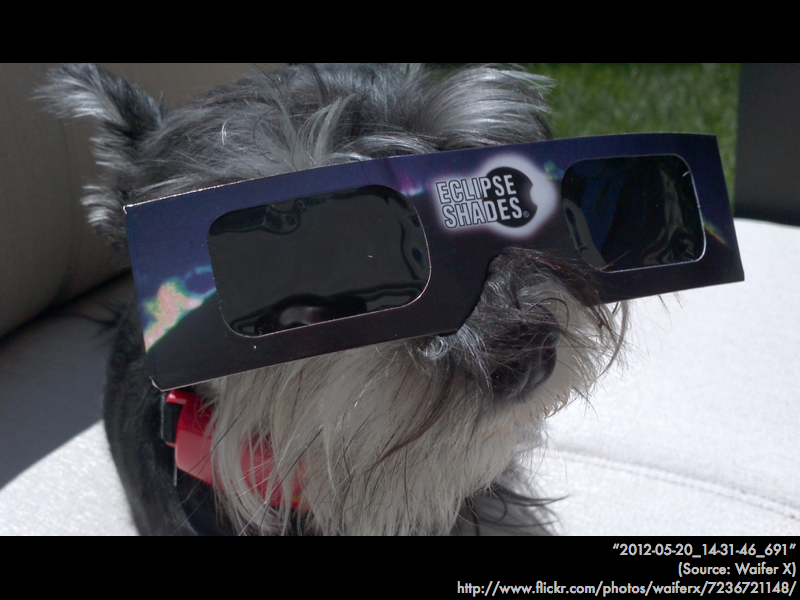 ...or use filters specifically labeled for observing the sun. My dog can practice safe solar eclipse viewing, and so should you.
 First, the boring but necessary terminology.
 Make sure you can distinguish between very similar terms:
- full and new moon (well, this should be self-explanatory).
- lunar eclipse and solar eclipse (light from the sun that would illuminate the full moon is blocked by Earth; direct light from the sun that would reach Earth is blocked by the moon).
- partial, total, and annular eclipse (sun or moon partially or totally covered/darkened, respectively; annular refers to an "annulus" or "little ring," where the moon is centered on the sun, but does not completely cover the sun).


Time to do a picto-quiz--you'll be shown a picture or movie clip of the moon and/or sun (assume that each of these situations is the maximum extent of something being shadowed or blocked), and then be prompted with possible responses. At that point, if you know the correct answer, shout it out--because yes, the loudest answer is the most correct answer...
 Is this a solar or lunar eclipse, or not an eclipse at all? Is this eclipse partial, total, or annular?
 Is this a solar or lunar eclipse, or not an eclipse at all? Is this eclipse partial, total, or annular?
 Is this a solar or lunar eclipse, or not an eclipse at all? Is this eclipse partial, total, or annular?
 Is this a solar or lunar eclipse, or not an eclipse at all? Is this eclipse partial, total, or annular?
 Is this a solar or lunar eclipse, or not an eclipse at all? Is this eclipse partial, total, or annular?
 Is this a solar or lunar eclipse, or not an eclipse at all? How do you know that this is not an eclipse? What phase is this moon?
 One more slide, for you Twihards--which team are you on? (Why is there no Team Bella?)
 Second, let's consider why not every full moon is a lunar eclipse, and not every new moon is a solar eclipse.
 Note that the orbit of the moon is tilted, and the bright part is closest to us (the sun) and tilted downwards, while the dim part is farthest away from us, and tilted upwards. Which phase is the moon in right now? How do you know that an eclipse is not occurring right now? How do you know this?
 The tilt of the moon's orbit changes slowly over time. Which phase is the moon in right now? How do you know that an eclipse is not occurring right now? How do you know this?
  Generally an eclipse can happen only if (1) the moon is either new or full, and (2) the moon's orbit is aligned edge-on. Our previous two examples had the right phase, but wrong orbit; then the right orbit, but the wrong phase. Now we have both the right phase (although it is not clear whether it is new or full) and the right orbit (edge-on), and some type of eclipse (whether solar or lunar) is occurring right now. The timing between the moon phase and slowly changing moon orbit is crucial, and if the timing between these two cycles is not perfect (as it usually isn't), this is why there is not a solar or lunar eclipse every new or full moon.
Let's look at two full moons, and flip between them. One is a (nearly) full moon that is just about to undergo a total lunar eclipse, and the other is a full moon that will not undergo any type of lunar eclipse. Can you determine the difference(s) between these two full moons?

 Remember that the reason a lunar eclipse does not occur every full moon is that the orbit of the moon is usually tilted not edge-on, but too high or too low. Notice that the "Not to be eclipsed" moon has a slight shadow on the bottom, meaning that its orbit is too high, while the "To be eclipsed" moon has sharp edges at both top and bottom, meaning that its orbit is edge-on and will pass directly behind Earth for a total lunar eclipse. Next time just before the moon is completely full, take a careful look at the top and bottom edges of the moon (you will probably need binoculars or a telescope). If you see a slight ragged edge at the top or bottom, don't get too excited, as a total lunar eclipse is not impending.
  In this promotional photograph for a certain obscure TV show from a few years ago, is it plausible that all these actors and actresses were present at in the studio at the same time? How do you know? What clues do you look for?
In the subsequent in-class activity, we'll be looking carefully at the different "shadow zones" cast by either the moon or Earth, and what would be observed if were located in each of these zones: umbra, penumbra, and antumbra (not a common term, we'll refer to the antumbra as the "negative shadow").


