Showing posts with label volume. Show all posts

20191204

Physics quiz archive: temperature, thermal equilibrium, heat transfers

Physics 205A Quiz 7, fall semester 2019
Cuesta College, San Luis Obispo, CA
Sections 70854, 70855
Exam code: quiz07VlnC


Sections 70854, 70855 results
0- 6 :   * [low = 3]
7-12 :   **********
13-18 :   **************
19-24 :   ******************* [mean = 18.9 +/- 6.2]
25-30 :   ******* [high = 30]

20181205

Physics quiz archive: temperature, thermal equilibrium, heat transfers

Physics 205A Quiz 7, fall semester 2018
Cuesta College, San Luis Obispo, CA
Sections 70854, 70855, version 1
Exam code: quiz07PeA7


Sections 70854, 70855 results
0- 6 :   ** [low = 6]
7-12 :   ****
13-18 :   ***********
19-24 :   ********************** [mean = 20.8 +/- 6.0]
25-30 :   ************ [high = 30]

20171213

Physics quiz archive: temperature, thermal equilibrium, heat transfers

Physics 205A Quiz 7, fall semester 2017
Cuesta College, San Luis Obispo, CA
Sections 70854, 70855, version 1
Exam code: quiz07Whu7


Sections 70854, 70855 results
0- 6 :  
7-12 :   ******* [low = 9]
13-18 :   *************
19-24 :   ******************* [mean = 18.9 +/- 5.4]
25-30 :   *** [high = 27]

20161207

Physics quiz archive: temperature, thermal equilibrium, heat transfer

Physics 205A Quiz 7, fall semester 2016
Cuesta College, San Luis Obispo, CA
Sections 70854, 70855, 73320, version 1
Exam code: quiz07p4sT


Sections 70854, 70855, 73320 results
0- 6 :   * [low = 6]
7-12 :   *************
13-18 :   ***************
19-24 :   *************** [mean = 18.5 +/- 6.6]
25-30 :   ******** [high = 30]

20151211

Physics quiz archive: temperature, thermal equilibrium, heat transfer

Physics 205A Quiz 7, fall semester 2015
Cuesta College, San Luis Obispo, CA
Sections 70854, 70855, 73320, version 1
Exam code: quiz07zSOL


Sections 70854, 70855, 73320 results
0- 6 :   * [low = 3]
7-12 :   *****
13-18 :   *****************
19-24 :   ****************************** [mean = 21.2 +/- 5.6]
25-30 :   **************** [high = 30]

20141211

Physics quiz archive: temperature, thermal equilibrium, heat transfer

Physics 205A Quiz 7, fall semester 2014
Cuesta College, San Luis Obispo, CA
Sections 70854, 70855, 73320, version 1
Exam code: quiz07cO4t


Sections 70854, 70855, 73320 results
0- 6 :  
7-12 :   **** [low = 9]
13-18 :   *******
19-24 :   ******************** [mean = 24.2 +/- 5.5]
25-30 :   ********************** [high = 30]

20141116

Physics presentation: temperature

When is the best time to pull into a gas station to fill up your tank? During the night, when the temperature is cooler, or during the day, when the temperature is warmest? Because the volume of gasoline contracts or expands depending on the temperature.

Most fuel companies compensate for these temperature-dependent volume changes, but some do not, and notify you with a sticker notification. If a fuel company does not compensate for temperature, are you necessarily getting ripped off? Or can this be used to your advantage?

So let's consider the connection between temperature and the linear and volume expansion of solids and liquids. In fact, the expansion of materials is what ultimately defines what a change in temperature "is."

Start with a working definition of temperature and temperature changes (a more precise definition will follow in a subsequent presentation). Hot things have high temperatures, cool things have low temperatures. An increase or decrease in temperature then corresponds to an object heating up, or cooling off. For the purposes of this course we'll use Celsius (° C) and kelvin (K) scales, so don't worry about having to convert to and from Fahrenheit. Note that while the Celsius and kelvin temperature scales are offset from each other, the change in temperature ∆T will be the same whether expressed in Celsius or kelvin.

The key to length and volume expansion and contraction is not the temperature, but the changes (increases/decreases) in temperature. This is extremely important when constructing structures, as gaps are typically designed to account for the changes in size depending on temperature.

First, linear expansion.

We've already discussed how stress causes strain for elastic solids. Here instead of applying force to an object to change its length, we'll apply thermal stress by changing the temperature of an object to change its length. The material-dependent linear expansion coefficient (in units of inverse kelvin, or alternatively inverse Celsius) characterizes the response of the material to thermal stress. As a result, both sides of this relation are unitless.

These steel beams have the same expansion coefficient α (being made of the same material). Assume that we can heat them separately in order to get them to each expand by 1.0 cm from their original lengths.

For the different length steel beams, which will require a greater temperature increase to expand by 1.0 cm from its original length: the shorter beam, or the longer beam?

Let's rewrite the linear expansion equation in terms of L and ΔT, as these are different for the short and long steel beams, and have the thermal expansion coefficient α and expansion ΔL on the other side of the equation, as these quantities are both the same for both short and long beams:

L⋅ΔT = (∆L/α).

So the right-hand side of this equation is the same for both the short and long beams:

Lshort⋅ΔTshort = (∆L/α),

Llong⋅ΔTlong = (∆L/α),

so we can set the left-hand sides of both these equations equal to each other:

Lshort⋅ΔTshort = Llong⋅ΔTlong.

Since Lshort < Llong, then for the equality to hold, ∆Tshort > ∆Tlong, and thus the shorter beam will require a greater increase in temperature to expand the same amount as the longer beam.

Second, extending these linear expansion concepts to volume expansion.

Applying thermal stress by changing the temperature of a liquid or solid changes its volume. The material-dependent volume expansion coefficient β (in units of inverse kelvin, or alternatively inverse Celsius) characterizes the response of the material to thermal stress, and for solids this is merely three times the linear expansion coefficient α (due to expansion along each of its three dimensions of length, width, and height). Similar to the linear thermal expansion relation, both sides of this volume expansion relation are unitless.

The liquid that fills a container to the brim can undergo an expansion in volume depending on an increase in temperature. However, the liquid may not necessarily overflow this container, as the container will also undergo an expansion in volume with an increase in temperature. Ultimately you would need to compare the volume expansions of both materials--if the liquid expands less than the container's expansion, the level of liquid would be lower; if the liquid expands greater than the container's expansion, then the liquid would overflow. If the liquid and the container both expand the same amount for the same increase in temperature (meaning that their volume expansion coefficients are equal), then the liquid will still fill the container to the brim.

This is how thermometers work--the volume of liquid inside the bulb (mercury, or more commonly red-colored alcohol) expands more than the enclosing glass bulb as temperature increases, and the overflow of the red-colored alcohol out of the bulb shows up as a rising level in the attached tube. This is how a given amount of temperature increase was originally intended to be scaled--the temperature difference, say, between freezing and boiling of water would be assigned as a value of "180° (Fahrenheit)" between the corresponding low and high liquid level marks on a thermometer. Then 1/180th of the distance between these two marks would then be assigned a value of a change in temperature of "1° Fahrenheit."

Which material has a greater volume expansion coefficient for this thermometer: glass, or alcohol?

This plastic rainwater basin was filled to the brim last night, but ignoring evaporative losses, the next morning, when it was a little cooler, the level of water is lower than the brim of the plastic basin. (For simplicity ignore the unusual slight expansion behavior of water as it cools down to nearly the freezing point, and concentrate on water expanding as it heats up, and contracting as it cools down like most other solids and liquids.)

Which material has a greater volume expansion coefficient: plastic, or water?

So back to the gas pumps that do not compensate for temperature. If you fill up your car at a pump that does not adjust for temperature, would it be a better deal to purchase a "cold-dispensed" gallon of gasoline, or a "warm-dispensed" gallon of gasoline--even though the volume of each type of gasoline is exactly one gallon? What is the difference between gasoline dispensed at different temperatures?

20141031

Physics presentation: ideal fluid flow

When this pump or vacuum system is started, air begins to flow through this hose, which has a slight crimp, and as a result this hose begins to totally collapse. Now don't you say it's because of suction, because as you know, physics don't suck. (It blows.) (Video link: "hose collapse.")

In a previous presentation we investigated the behavior of static fluids, now we'll consider dynamic fluids--more specifically, ideal fluid flow. First we'll define what we mean by "ideal" fluids, then we'll see how two conservation laws are applied simultaneously to flowing ideal fluids.

Ideal fluids fall under a restrictive class of fluids--let's take a look at the characteristics that set ideal fluids apart from, say, real fluids.

Ideal fluids are incompressible, which water is to some extent. Note that while air is not incompressible, there are situations where we can make the crude approximation that it is.

An ideal fluid should undergo laminar flow, where the adjacent particles flow smoothly past each other, as opposed to turbulent flow, where particles swirl around in a chaotic manner. Like many fluids water can undergo both laminar and turbulent flow, so we'll restrict our attention to certain conditions where water undergoes laminar flow.

Lastly, an ideal fluid should be non-viscous, that is, flow without appreciable frictional losses, as opposed to a viscous fluid that, well, looks and is literally, "gooey." (Video link: "Viscosity.")

Streamlines are a way to visualize ideal fluid flow. Here air is undergoing incompressible, laminar, non-viscous flow over the front end of a car in this wind tunnel, where the streamlines are smoothly conforming to the contours of the car and to adjacent streamlines. Note the rear of the car, where the streamlines are turbulent, and indicate the presence of non-ideal fluid flow. (Video link: "Mercedes-Benz SLS AMG Developement and Testing Wind tunnel.")

The first conservation law for ideal fluid flow follows from its incompressible nature.

Even if a pipe changes radius, the incompressibility of an ideal fluid means that the same volume flowing in one end must equal to the same volume coming out the other end in the same amount of time. "Stuff in, stuff out."

This conservation of volume flow rate can be reinterpreted in terms of cross-sectional areas and fluid speeds in the continuity equation. A large-area section of pipe will have a slower fluid speed than a small-area section of the same pipe, which will have a faster fluid speed. Note that the product of cross-sectional area and fluid speed at any section of a pipe results in the volume flow rate.
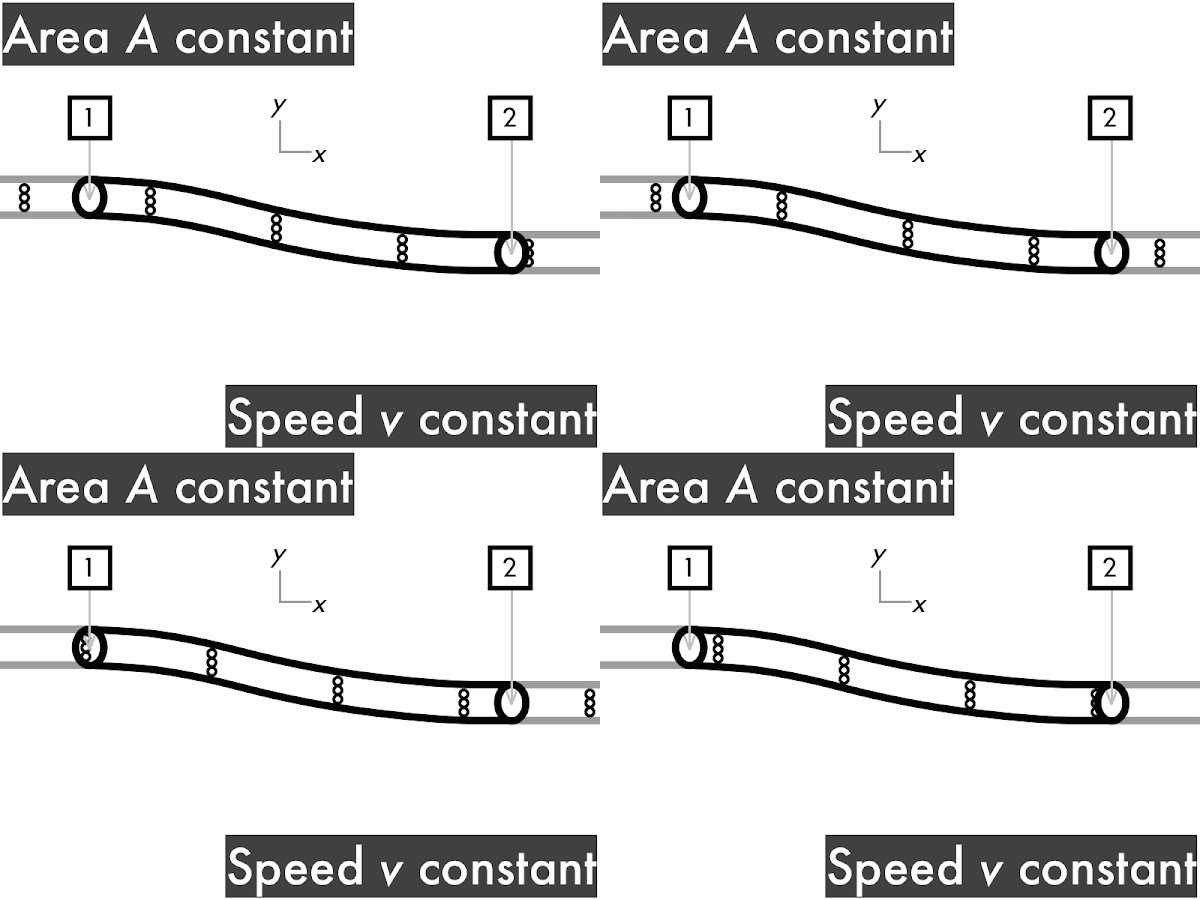
Use a real friend to do this with you. Not an imaginary friend.
For a pipe with a constant cross-sectional area, the volume flow rate ∆V/∆t through the pipe is constant. To convince yourself of this you'll need a friend to watch this animation with you. Every time you see fluid particles entering the pipe, say "in." "In. In. In..." Keep doing that. Convince your friend to say "out" every time fluid particles are leaving the pipe. "Out. Out. Out..." If the two of you do this correctly, each time you say "in," your friend immediately follows-up by saying "out." This means that rate of fluid volume going in (represented here by three dots) must continuously be equal to the rate of fluid volume going out. "Stuff in, stuff out," right?

Then from the continuity equation:

A1·v1 = A2·v2,

since the cross-sectional areas of where the fluid goes in and where it goes out are the same (A1 = A2), then v1 = v2, so the speed of the fluid flowing through this pipe must be constant as well.

For a pipe with increasing cross-sectional area, the volume flow rate ∆V/∆t through the pipe is also constant. Let's do the same "in and out" exercise as above. Every time you see fluid particles entering the narrow end of the pipe, say "in," while your friend says "out" every time fluid particles are leaving the wider end of the pipe. "In. Out. In. Out. In. Out..." As before, since each time you say "in," your friend immediately follows-up by saying "out," so the rate of fluid volume going in the narrow end (represented here by three dots) must continuously be equal to the rate of fluid volume going out the wider end. "Stuff in, stuff out," right?

Then from the continuity equation:

A1·v1 = A2·v2,

since the cross-sectional area of where the fluid goes in is smaller than the cross-sectional area of where it goes out (A1 < A2), then v1 > v2, so the speed of the fluid flowing through this pipe slows down.
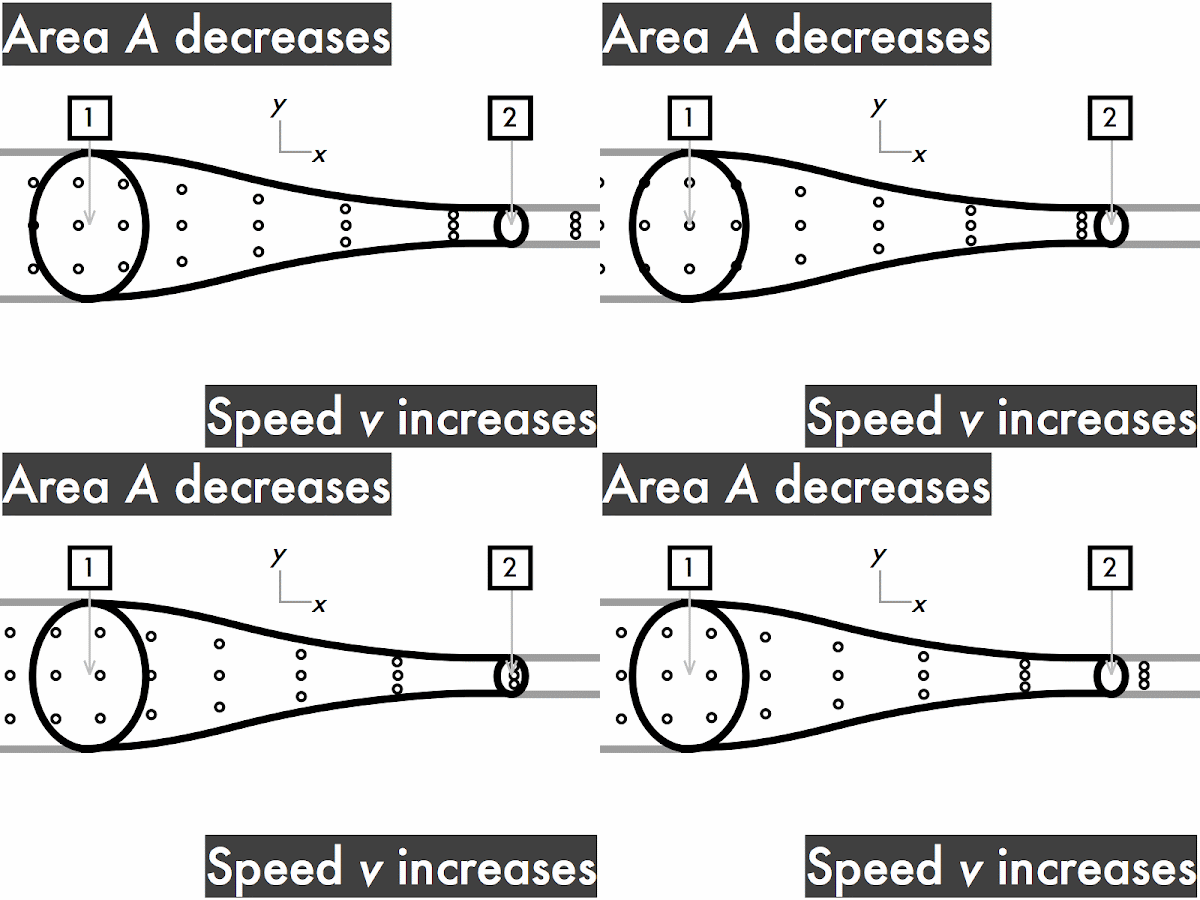
Conversely, for a pipe with decreasing cross-sectional area, the speed of the fluid through this pipe must have a corresponding increase, such that it flows more quickly through the narrow portion of the tube.

The second conservation law for ideal fluid flow follows from its laminar, non-viscous nature, as energy per volume density will be conserved if there are no losses to dissipative turbulence and frictional losses. (Incompressibility matters here too, such that the volume term in the energy per volume will be conserved.)

Bernoulli's equation is the extension of the static fluid relationship between pressure and gravitational potential energy per volume changes, to ideal fluid flow, with the addition of a translational kinetic energy per volume term. All three terms have equivalent units of Pa or J/m3, such that they can transfer to/from each other, as long as the net balance of exchanges is zero.
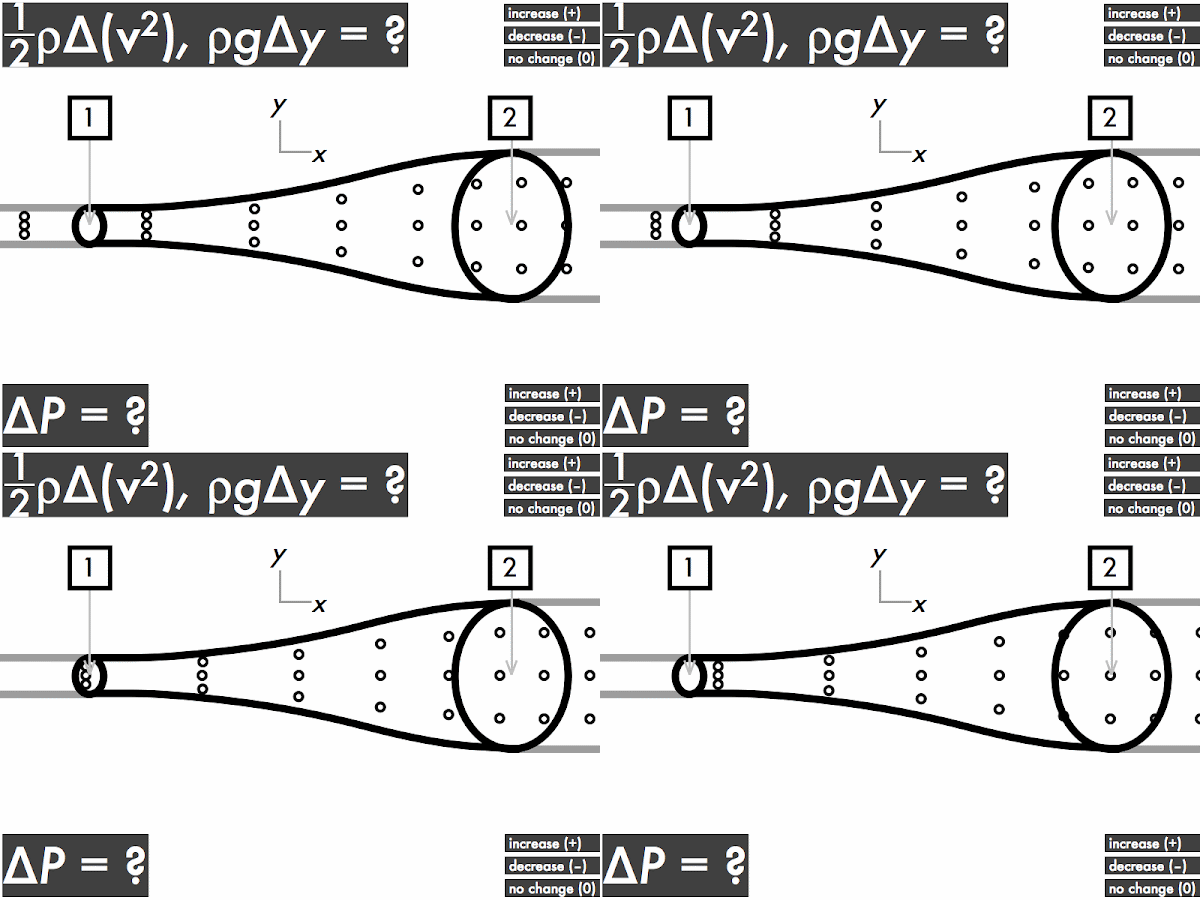
For an ideal fluid flowing through a horizontal pipe with a widening cross-sectional area, does the kinetic energy density term (1/2)·ρ·∆(v2) term increase, decrease, or have no change? Let's refer back to the continuity equation discussion above and recall that while the volume flow rate doesn't change, the speed changes, where the fluid slows down travels through this pipe. This means that the kinetic energy density will decrease (as it depends on the square of the speed), and this term will be negative.

Does the gravitational potential energy density term ρ·g·∆y term increase, decrease, or have no change? Since the center of the pipe has no change in height (even though the cross-sectional areas are different, they are still "horizontally aligned" with each other), there is no change in the gravitational potential energy density term, and this term will be zero.

Then as a result, does the pressure of the ideal fluid flowing through this pipe increase, decrease, or have no change? Note the steps in determining the changes (if any) in pressure for this ideal flowing fluid--first we apply the continuity equation to determine the change in speeds (if any), which tells us the change (if any) in the kinetic energy density. We then look at the change in height of the centerline of the pipe (if any), which tells us the change (if any) in the gravitational potential energy density. Then we can look at Bernoulli's equation:

0 = ∆P + ρ·g·∆y + (1/2)·ρ·∆(v2),

and look at the increases (+) or decreases (–) (or no changes) of the terms we know so far:

0 = ∆P + (0) + (–).

In order to balance out this equation to equal zero on the left-hand side, the pressure of the fluid as it flows through this pipe must increase, making ∆P positive, such that:

0 = (+) + (0) + (–),

and both sides of Bernoulli's equation are balanced. So for this ideal fluid flowing through this widening pipe, the pressure will increase. This is why a weakened, enlarged blood vessel (an aneurysm) is dangerous, as blood flowing through this damaged, wider section will temporarily experience an increase in pressure as it slows down, and may widen the blood vessel even more and cause it to eventually rupture.

For an ideal fluid flowing through a horizontal pipe with a narrowing cross-sectional area, does the kinetic energy density term (1/2)·ρ·∆(v2) term increase, decrease, or have no change? (Refer back to the continuity equation discussion to determine this.) Does the gravitational potential energy density term ρ·g·∆y term increase, decrease, or have no change?

Then as a result, does the pressure of the ideal fluid flowing through this pipe increase, decrease, or have no change?

(Note that the pressure should decrease in the narrow portion of this pipe, which is why the crimped hose at the start of this presentation collapsed--as air flowed through the narrow crimped portion of the hose, its speed increased, which made the pressure decrease inside the hose, and the surrounding atmospheric pressure then flattened the crimped portion even further.)

For an ideal fluid flowing through a descending horizontal pipe with a constant cross-sectional area, does the kinetic energy density term (1/2)·ρ·∆(v2) term increase, decrease, or have no change? (Refer back to the continuity equation discussion to determine this.) Does the gravitational potential energy density term ρ·g·∆y term increase, decrease, or have no change?

Then as a result, does the pressure of the ideal fluid flowing through this pipe increase, decrease, or have no change?

20141025

Physics presentation: static fluids

In this scene from Man from Atlantis, Mark Harris (played by Patrick Duffy) is put into a water pressure chamber that simulates different depths, and watches as test canisters are crushed by pressures equivalent to 20,000 ft, 25,000 ft, and 30,000 ft below sea level.

On a more reality-based aside, consider tourists who float in the high salinity waters of the Dead Sea.

We'll discuss these two different aspects of static fluids here: pressure, and buoyancy.

First, pressure--as a force per unit area density, then reinterpreted as a pressure per unit area density.

Pressure can be consider as the amount of force exerted over a certain area on a surface, whether by a macroscopic object, or by the random bombardment by atoms/molecules of gases or liquids. If you don't wear snowshoes, the force of your weight, distributed over the area of your feet will create a pressure that cannot be supported by soft, unpacked snow, and your feet will sink in.

However, the force of your weight distributed over a much larger snowshoe area will reduce the pressure exerted on the snow, and you will not sink in much, if at all.

From the definition of pressure as a force per area density, the unit of pressure is pascals (Pa), equivalent to N/m2.

A more useful interpretation of pressure, especially in regards to fluids (gases and liquids) is to think of it as an energy per unit volume. Notice how the units of pascals equals N/m2, and when both numerator and denominator by are multiplied by meters (m), these units become N/m2 = (N·m)/(m3) = J/m3.

By interpreting pressure as a form of energy per unit volume, we can connect it to gravitational potential energy per unit volumeUgrav/V = m·g·y/V = (m/Vg·∆y = ρ·g·∆y, which also has units of J/m3.

Pressure and gravitational potential energy per unit volume are then terms in an energy density "conservation" equation, and they are allowed to "exchange" Pa provided the fluid is static and there is no external work being put in or taken out of the fluid. In this form, then by picking two locations in the same static fluid, an increase or decrease in the ρ·g·∆y must have a corresponding decrease or increase in pressure (∆P).

A weather balloon that is partially filled at ground level will rise, and will seemingly inflate and eventually explode at very high elevations.

To explain what's going on here, we are going to analyze the static fluid that exists at both ground level and at a higher elevation: the air surrounding the balloon (i.e., the entire atmosphere), and not the contents of the balloon, which do not simultaneously exist at both locations (as it is "transported," and technically not a "static" fluid.)

Let's compare the air surrounding the balloon at ground level, and compare it to the air at the final higher elevation. Since the gravitational potential energy density depends on elevation, as the elevation of the balloon increases, the gravitational potential energy density of the surrounding air increases.

Looking at the energy density "conservation" equation for static fluids:

0 = ΔP + ρ·g·∆y,

Since the gravitational potential energy density of the air surrounding the balloon increases as it moves to higher elevations, then ρ·g·∆y is positive. In order to balance out this equation to equal zero on the left-hand side, the pressure of the air surrounding the balloon must have a corresponding decrease, making ΔP negative, such that:

0 = (–) + (+),

meaning that there is more air pressure at ground level than at a higher elevation. Essentially the pressure within the balloon remains constant, and because it is surrounded with lower pressure air at a higher elevation, the balloon will expand in size, and eventually "pop."

Notice the full-sized Styrofoam™ cup in the back, compared to other cups that were carried in the outside storage compartment of a submarine, where the air pockets inside these cups were collapsed by the surrounding water, effectively permanently shrinking the sizes of these cups. During this process, did the ρ·g·∆y increase or decrease? Did the water pressure surrounding the cups increase or decrease?

Second, buoyancy.

The buoyant force on an object depends on the density ρ of the fluid, and the volume of the object that is actually submerged in the fluid. While this is a simple definition, knowing the appropriate amount of volume to use in this equation is key to understanding buoyancy.

For a fully-submerged object, the volume used in calculating the buoyant force is the volume of the entire object, such that the buoyant force is given by:

FB = ρ·g·V,

where ρ is the density of the surrounding fluid (water), and volume V is the entire volume of the diver, as he is fully submerged.

Here, since the object (the submerged diver) is floating underwater, Newton's first law applies, and the downwards weight force and the upwards buoyant force balance out.

For a partially-submerged object like this red ship, the volume used in calculating the buoyant force is not the volume of the entire object, but only the portion of the object that is actually submerged.

For the red ship, which Newton's law applies to its motion? How do the magnitudes of the downwards weight force and the upwards buoyant force compare? What fluid density should be put into the ρ in the buoyant force calculation?