Astronomy 10 Quiz 10, Fall Semester 2007
Cuesta College, San Luis Obispo, CA
Astronomy 10 learning goal Q10.3
[3.0 points.] Which one of the following choices best describes a close pair (mass-exchanging) binary system that can have repeatable x-ray bursts?
(A) Two neutron stars.
(B) A massive main sequence star and a red dwarf.
(C) A black hole and a neutron star.
(D) A supergiant and a neutron star.
(E) A supergiant and a black hole.
Correct answer: (D)
The hydrogen shed from a supergiant will form a degenerate layer around a neutron star companion, and this outer layer will undergo fusion, producing an x-ray burst.
Student responses
Section 0135
(A) : 5 students
(B) : 3 students
(C) : 10 students
(D) : 9 students
(E) : 5 students
Student responses
Section 1073
(A) : 7 students
(B) : 3 student
(C) : 6 students
(D) : 22 students
(E) : 5 students
Previous post: Astronomy quiz question: novae and type Ia supernovae


20071119
Astronomy in-class activity: OBAFGKM poetry slam
Astronomy 10, Fall Semester 2007
Cuesta College, San Luis Obispo, CA
Astronomy 10 learning goal Q8.5
Students were instructed to use at least OBAFGKM, and/or part or all of the additional OBAFGKMRNSC or OBAFGKMLT extensions to individually write an original, coherent and an appropriate (nothing worse than "PG-13" rated!) mnemonic, and to give a rousing reading of their OBAFGKM mnemonic poem for the class.
Some favorites from this semester:
Order Beer And Forget your Grades and Keeping (your) Money.
--C. B.
Open Bag And Feel Gold, King Midas
--C. B. (2)
One Boy Accidentally Found Grandpa's Kinky Magazine
--K. D.
Oleanders bloom.
Awkward feelings grow.
Kiss me.
--J. H.
Over-Bearing And Fiesty Girls Kiss More.
--J. H. (2)
Obama Believes Against Foreign Gas and Killing Muslims
--M. N.
Old But Agile Female Gladiators Kill Mockers
--S. O.
Old Bachelors Are Fat Gross Kissing Machines
--D. R.
Orbiting Big Asteroids, Freakishly Ginormous Krypton Masses Radiate Nauseous Substances
--M. W.
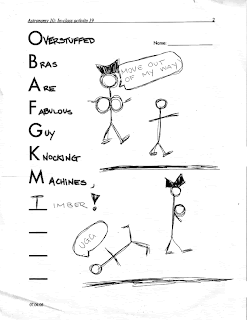 Overstuffed Bras Are Fabulous Guy-Knocking Machines, Timber!
--H. L.
Previous post: OBAFGKM poetry slam (Summer Session 2007).
Cuesta College, San Luis Obispo, CA
Astronomy 10 learning goal Q8.5
Students were instructed to use at least OBAFGKM, and/or part or all of the additional OBAFGKMRNSC or OBAFGKMLT extensions to individually write an original, coherent and an appropriate (nothing worse than "PG-13" rated!) mnemonic, and to give a rousing reading of their OBAFGKM mnemonic poem for the class.
Some favorites from this semester:
Order Beer And Forget your Grades and Keeping (your) Money.
--C. B.
Open Bag And Feel Gold, King Midas
--C. B. (2)
One Boy Accidentally Found Grandpa's Kinky Magazine
--K. D.
Oleanders bloom.
Awkward feelings grow.
Kiss me.
--J. H.
Over-Bearing And Fiesty Girls Kiss More.
--J. H. (2)
Obama Believes Against Foreign Gas and Killing Muslims
--M. N.
Old But Agile Female Gladiators Kill Mockers
--S. O.
Old Bachelors Are Fat Gross Kissing Machines
--D. R.
Orbiting Big Asteroids, Freakishly Ginormous Krypton Masses Radiate Nauseous Substances
--M. W.
 Overstuffed Bras Are Fabulous Guy-Knocking Machines, Timber!
--H. L.
Previous post: OBAFGKM poetry slam (Summer Session 2007).
20071116
Physics clicker question: pendulum period miscalculation
Physics 5A, Fall Semester 2007
Cuesta College, San Luis Obispo, CA
Cf. Giambattista/Richardson/Richardson, Physics, 1/e, Problem 10.60
Students were asked the following clicker question (Classroom Performance System, einstruction.com) near the end of their learning cycle:
[0.6 participation points.] A mass of weight 10.0 N has a period of 1.0 s. The length of the pendulum string is _____ m.
Sections 0906, 0907
"0.25" : 20 students
"24" : 7 students
"10" : 3 students
"5": 2 students
(Other responses, 1 student each: "0.06," "1.02," "2," "3.2," "21.7")
Correct answer: 0.25 m
The period of a pendulum is given by:
T = 2*pi*sqrt(L/g).
Note that the weight, or mass of the pendulum bob does not matter. Solving for L:
L = g*(T/(2*pi))^2.
However, many students did not watch how the order of operations were performed on their graphing calculators. Typically they entered the following:
1/2*pi
ANS^2
ANS*9.8
Because of the factor of pi multiplying the 0.5 evaluated just before it, this results in the incorrect answer of 24 (m?!?), which dangerously resembles the correct answer, apparently only with a misplaced decimal error ("did we need to convert to centimeters?").
In order to force the pi to be evaluated in the denominator, parentheses could be used (or each step could be executed separately, step-by-step):
1/(2*pi)
ANS^2
ANS*9.8
This gives the correct answer of 0.25 m.
Cuesta College, San Luis Obispo, CA
Cf. Giambattista/Richardson/Richardson, Physics, 1/e, Problem 10.60
Students were asked the following clicker question (Classroom Performance System, einstruction.com) near the end of their learning cycle:
[0.6 participation points.] A mass of weight 10.0 N has a period of 1.0 s. The length of the pendulum string is _____ m.
Sections 0906, 0907
"0.25" : 20 students
"24" : 7 students
"10" : 3 students
"5": 2 students
(Other responses, 1 student each: "0.06," "1.02," "2," "3.2," "21.7")
Correct answer: 0.25 m
The period of a pendulum is given by:
T = 2*pi*sqrt(L/g).
Note that the weight, or mass of the pendulum bob does not matter. Solving for L:
L = g*(T/(2*pi))^2.
However, many students did not watch how the order of operations were performed on their graphing calculators. Typically they entered the following:
1/2*pi
ANS^2
ANS*9.8
Because of the factor of pi multiplying the 0.5 evaluated just before it, this results in the incorrect answer of 24 (m?!?), which dangerously resembles the correct answer, apparently only with a misplaced decimal error ("did we need to convert to centimeters?").
In order to force the pi to be evaluated in the denominator, parentheses could be used (or each step could be executed separately, step-by-step):
1/(2*pi)
ANS^2
ANS*9.8
This gives the correct answer of 0.25 m.
20071112
Astronomy quiz question: stellar distances
Astronomy 10 Quiz 8, Fall Semester 2007
Cuesta College, San Luis Obispo, CA
Astronomy 10 learning goal Q8.2
Refer to the table below in answering the following question.
[Version 1]
[3.0 points.] Which one of the following choices best corresponds to the star that is the farthest from the Earth?
(A) Sirius.
(B) Canopus.
(C) Capella.
(D) Rigel.
(E) Fomalhaut.
Correct answer: (D)
A star 10 parsecs away will have the same value for apparent and absolute magnitude. A star that is farther than 10 parsecs away will "brighten when brought closer" to the standard 10 parsec distance, and thus its absolute magnitude should be brighter than its apparent magnitude. What is notable for this version of this question is that many students selected Fomalhaut, which most nearly at the standard 10 parsec distance (actually slightly farther than 10 parsecs away).
Student responses
Section 0135
(A) : 2 students
(B) : 3 students
(C) : 1 student
(D) : 9 students
(E) : 14 students
[Version 2]
[3.0 points.] Which one of the following choices best corresponds to the star that is the nearest to the Earth?
(A) Sirius.
(B) Canopus.
(C) Capella.
(D) Rigel.
(E) Fomalhaut.
Correct answer: (A)
A star 10 parsecs away will have the same value for apparent and absolute magnitude. A star that is closer than 10 parsecs away will "dim when pushed away" to the standard 10 parsec distance, and thus its absolute magnitude should be dimmer than its apparent magnitude.
Student responses
Section 1073
(A) : 23 students
(B) : 3 students
(C) : 5 students
(D) : 7 students
(E) : 4 students
Cuesta College, San Luis Obispo, CA
Astronomy 10 learning goal Q8.2
Refer to the table below in answering the following question.
| m apparent magnitude | M absolute magnitude | |
| Sirius | –1.47 | +1.4 |
| Canopus | –0.72 | -3.1 |
| Capella | +0.05 | -0.7 |
| Rigel | +0.14 | -6.8 |
| Fomalhaut | +1.15 | +1.9 |
[Version 1]
[3.0 points.] Which one of the following choices best corresponds to the star that is the farthest from the Earth?
(A) Sirius.
(B) Canopus.
(C) Capella.
(D) Rigel.
(E) Fomalhaut.
Correct answer: (D)
A star 10 parsecs away will have the same value for apparent and absolute magnitude. A star that is farther than 10 parsecs away will "brighten when brought closer" to the standard 10 parsec distance, and thus its absolute magnitude should be brighter than its apparent magnitude. What is notable for this version of this question is that many students selected Fomalhaut, which most nearly at the standard 10 parsec distance (actually slightly farther than 10 parsecs away).
Student responses
Section 0135
(A) : 2 students
(B) : 3 students
(C) : 1 student
(D) : 9 students
(E) : 14 students
[Version 2]
[3.0 points.] Which one of the following choices best corresponds to the star that is the nearest to the Earth?
(A) Sirius.
(B) Canopus.
(C) Capella.
(D) Rigel.
(E) Fomalhaut.
Correct answer: (A)
A star 10 parsecs away will have the same value for apparent and absolute magnitude. A star that is closer than 10 parsecs away will "dim when pushed away" to the standard 10 parsec distance, and thus its absolute magnitude should be dimmer than its apparent magnitude.
Student responses
Section 1073
(A) : 23 students
(B) : 3 students
(C) : 5 students
(D) : 7 students
(E) : 4 students
20071109
Astronomy quiz question: applying the Stefan-Boltzmann law
Astronomy 10 Quiz 8, Fall Semester 2007
Cuesta College, San Luis Obispo, CA
Astronomy 10 learning goal Q8.5
[Version 1]
[3.0 points.] Consider two stars with the same luminosity. Which one of the following choices best describes the star that is larger in size?
(A) The star with the higher surface temperature.
(B) The star with the lower surface temperature.
(C) The star with the brighter apparent magnitude.
(D) The star with the dimmer apparent magnitude.
(E) (None of the above choices (A)-(D), as these two stars must have the same size.)
Correct answer: (B)
The Stefan-Boltzmann law states that luminosity is proportional to size and (temperature)^4. For two stars with the same luminosity, the larger size star must have a lower surface temperature.
Student responses
Section 0135
(A) : 7 students
(B) : 17 students
(C) : 3 students
(D) : 2 students
(E) : 0 students
[Version 2]
[3.0 points.] Consider two stars with the same size. Which one of the following choices best describes the star that has the higher surface temperature?
(A) The star with the brighter apparent magnitude.
(B) The star with the dimmer apparent magnitude.
(C) The star with the brighter luminosity.
(D) The star with the dimmer luminosity.
(E) (None of the above choices (A)-(D), as these two stars must have the same surface temperature.)
Correct answer: (C)
The Stefan-Boltzmann law states that luminosity is proportional to size and (temperature)^4. For two stars of the same size, the brighter luminosity star must have the higher surface temperature.
Student responses
Section 1073
(A) : 6 students
(B) : 1 student
(C) : 31 students
(D) : 3 students
(E) : 1 student
Cuesta College, San Luis Obispo, CA
Astronomy 10 learning goal Q8.5
[Version 1]
[3.0 points.] Consider two stars with the same luminosity. Which one of the following choices best describes the star that is larger in size?
(A) The star with the higher surface temperature.
(B) The star with the lower surface temperature.
(C) The star with the brighter apparent magnitude.
(D) The star with the dimmer apparent magnitude.
(E) (None of the above choices (A)-(D), as these two stars must have the same size.)
Correct answer: (B)
The Stefan-Boltzmann law states that luminosity is proportional to size and (temperature)^4. For two stars with the same luminosity, the larger size star must have a lower surface temperature.
Student responses
Section 0135
(A) : 7 students
(B) : 17 students
(C) : 3 students
(D) : 2 students
(E) : 0 students
[Version 2]
[3.0 points.] Consider two stars with the same size. Which one of the following choices best describes the star that has the higher surface temperature?
(A) The star with the brighter apparent magnitude.
(B) The star with the dimmer apparent magnitude.
(C) The star with the brighter luminosity.
(D) The star with the dimmer luminosity.
(E) (None of the above choices (A)-(D), as these two stars must have the same surface temperature.)
Correct answer: (C)
The Stefan-Boltzmann law states that luminosity is proportional to size and (temperature)^4. For two stars of the same size, the brighter luminosity star must have the higher surface temperature.
Student responses
Section 1073
(A) : 6 students
(B) : 1 student
(C) : 31 students
(D) : 3 students
(E) : 1 student
20071108
Physics clicker question: buoyancy comparison
Physics 5A, Fall Semester 2007
Cuesta College, San Luis Obispo, CA
Cf. Giambattista/Richardson/Richardson, Physics, 1/e, Conceptual Question 9.6 (extended)
Students were asked the following clicker question (Classroom Performance System, einstruction.com) at the beginning of their learning cycle:
Three objects (same volumes, but different densities) float (or do not float) in a tank of water.
 [0.6 participation points.] Which object has the greatest weight?
(A) Object X.
(B) Object Y.
(C) Object Z.
(D) (More than one of the objects listed above has the greatest weight.)
(E) (I'm lost, and don't know how to answer this.)
Sections 0906, 0907
(A) : 1 student
(B) : 0 students
(C) : 29 students
(D) : 2 students
(E) : 0 students
Correct answer: (C)
Most students appealed to their intuition to determine that Object Z was the heaviest. Weight force vectors are now drawn on the diagram, and the next question is asked.
 [0.6 participation points.] Which object has the greatest bouyant force exerted on it?
(A) Object X.
(B) Object Y.
(C) Object Z.
(D) (More than one of the objects listed above has the greatest bouyant force exerted on it.)
(E) (I'm lost, and don't know how to answer this.)
Sections 0906, 0907
(A) : 22 students
(B) : 3 students
(C) : 2 students
(D) : 7 students
(E) : 0 students
Correct answer: (D)
The magnitude of the bouyant force is the weight of the volume of water displaced. Object X displaces only a portion of its volume, and thus has the least amount of bouyant force exerted on it. Both Objects Y and Z are completely submerged, and thus have the same amount of bouyant force exerted on it. (However, Object Z also has a normal force exerted on it, from the bottom of the tank.)

Cuesta College, San Luis Obispo, CA
Cf. Giambattista/Richardson/Richardson, Physics, 1/e, Conceptual Question 9.6 (extended)
Students were asked the following clicker question (Classroom Performance System, einstruction.com) at the beginning of their learning cycle:
Three objects (same volumes, but different densities) float (or do not float) in a tank of water.
 [0.6 participation points.] Which object has the greatest weight?
(A) Object X.
(B) Object Y.
(C) Object Z.
(D) (More than one of the objects listed above has the greatest weight.)
(E) (I'm lost, and don't know how to answer this.)
Sections 0906, 0907
(A) : 1 student
(B) : 0 students
(C) : 29 students
(D) : 2 students
(E) : 0 students
Correct answer: (C)
Most students appealed to their intuition to determine that Object Z was the heaviest. Weight force vectors are now drawn on the diagram, and the next question is asked.
 [0.6 participation points.] Which object has the greatest bouyant force exerted on it?
(A) Object X.
(B) Object Y.
(C) Object Z.
(D) (More than one of the objects listed above has the greatest bouyant force exerted on it.)
(E) (I'm lost, and don't know how to answer this.)
Sections 0906, 0907
(A) : 22 students
(B) : 3 students
(C) : 2 students
(D) : 7 students
(E) : 0 students
Correct answer: (D)
The magnitude of the bouyant force is the weight of the volume of water displaced. Object X displaces only a portion of its volume, and thus has the least amount of bouyant force exerted on it. Both Objects Y and Z are completely submerged, and thus have the same amount of bouyant force exerted on it. (However, Object Z also has a normal force exerted on it, from the bottom of the tank.)

20071107
Physics clicker question: empty can derby
Physics 5A, Fall Semester 2007
Cuesta College, San Luis Obispo, CA
Cf. Giambattista/Richardson/Richardson, Physics, 1/e, Conceptual Example 8.12
 "All Disks Roll the Same," 1Q1035.mov
University of Minnesota, School of Physics & Astronomy
http://groups.physics.umn.edu/demo/mechanics/1Q1035.html
Students were asked the following clicker question (Classroom Performance System, einstruction.com) near the end of their learning cycle:
A V-8 can and a Diet Pepsi can (both empty) are placed at the top of an inclined plane, and are released such that they begin to roll down at the same time. (This experiment is set-up, but not yet demonstrated yet for the students until after answers have been compiled.)
[0.6 participation points.] Which empty can do you think will reach downhill first?
(A) V-8 can.
(B) Soda can.
(C) (They will reach the bottom of the slope at approximately the same time.)
(D) (I'm lost, and don't know how to answer this.)
Sections 0906, 0907
(A) : 11 students
(B) : 21 students
(C) : 5 students
(D) : 0 students
Correct answer: (C)
 The energy conservation equation for a rolling ring (which approximates an empty beverage can) is:
0 = (1/2)*m*v_f^2 + (1/2)*I*w_f^2 + M*g*h,
where I = m*R^2, such that:
v_f = sqrt(g*h).
Thus both cans will have the same speed as they reach the bottom of the inclined plane, which can plausibly be reasoned to mean that they reach the bottom at the same time.
Cuesta College, San Luis Obispo, CA
Cf. Giambattista/Richardson/Richardson, Physics, 1/e, Conceptual Example 8.12
 "All Disks Roll the Same," 1Q1035.mov
University of Minnesota, School of Physics & Astronomy
http://groups.physics.umn.edu/demo/mechanics/1Q1035.html
Students were asked the following clicker question (Classroom Performance System, einstruction.com) near the end of their learning cycle:
A V-8 can and a Diet Pepsi can (both empty) are placed at the top of an inclined plane, and are released such that they begin to roll down at the same time. (This experiment is set-up, but not yet demonstrated yet for the students until after answers have been compiled.)
[0.6 participation points.] Which empty can do you think will reach downhill first?
(A) V-8 can.
(B) Soda can.
(C) (They will reach the bottom of the slope at approximately the same time.)
(D) (I'm lost, and don't know how to answer this.)
Sections 0906, 0907
(A) : 11 students
(B) : 21 students
(C) : 5 students
(D) : 0 students
Correct answer: (C)
 The energy conservation equation for a rolling ring (which approximates an empty beverage can) is:
0 = (1/2)*m*v_f^2 + (1/2)*I*w_f^2 + M*g*h,
where I = m*R^2, such that:
v_f = sqrt(g*h).
Thus both cans will have the same speed as they reach the bottom of the inclined plane, which can plausibly be reasoned to mean that they reach the bottom at the same time.
20071106
Physics clicker question: falling stick derby
Physics 5A, Fall Semester 2007
Cuesta College, San Luis Obispo, CA
Cf. Giambattista/Richardson/Richardson, Physics, 1/e, Comprehensive Problems 8.97, 8.98
 "Falling Meter Sticks--Scaling," 1Q2060.mov
University of Minnesota, School of Physics & Astronomy
http://groups.physics.umn.edu/demo/mechanics/1Q2060.html
Students were asked the following clicker question (Classroom Performance System, einstruction.com) near the end of their learning cycle:
A 1-m stick and a 2-m stick are held vertically upright, and are released such that they begin to fall over at the same time. (This experiment is set-up, but not yet demonstrated yet for the students until after answers have been compiled.)
[0.6 participation points.] Which stick do you think will fall and hit the ground first?
(A) 1 m stick.
(B) 2 m stick.
(C) (They will hit the ground at approximately the same time.)
(D) (I'm lost, and don't know how to answer this.)
Sections 0906, 0907
(A) : 10 students
(B) : 7 students
(C) : 17 students
(D) : 1 student
Correct answer: (A)
 The energy conservation equation for a falling stick is:
0 = (1/2)*I*w_f^2 + M*g*(L/2),
where I = (1/3)*M*L^2, such that:
w_f = sqrt(3*g/L).
Thus the shorter stick will have the faster speed as it hits the ground, which can plausibly be reasoned to be the stick that will reach the ground first, before the longer stick does.
Cuesta College, San Luis Obispo, CA
Cf. Giambattista/Richardson/Richardson, Physics, 1/e, Comprehensive Problems 8.97, 8.98
 "Falling Meter Sticks--Scaling," 1Q2060.mov
University of Minnesota, School of Physics & Astronomy
http://groups.physics.umn.edu/demo/mechanics/1Q2060.html
Students were asked the following clicker question (Classroom Performance System, einstruction.com) near the end of their learning cycle:
A 1-m stick and a 2-m stick are held vertically upright, and are released such that they begin to fall over at the same time. (This experiment is set-up, but not yet demonstrated yet for the students until after answers have been compiled.)
[0.6 participation points.] Which stick do you think will fall and hit the ground first?
(A) 1 m stick.
(B) 2 m stick.
(C) (They will hit the ground at approximately the same time.)
(D) (I'm lost, and don't know how to answer this.)
Sections 0906, 0907
(A) : 10 students
(B) : 7 students
(C) : 17 students
(D) : 1 student
Correct answer: (A)
 The energy conservation equation for a falling stick is:
0 = (1/2)*I*w_f^2 + M*g*(L/2),
where I = (1/3)*M*L^2, such that:
w_f = sqrt(3*g/L).
Thus the shorter stick will have the faster speed as it hits the ground, which can plausibly be reasoned to be the stick that will reach the ground first, before the longer stick does.
20071105
Lolcat: feline collision
 "clunk!" by ridemonke
icanhascheezburger.com
March 27, 2007
Physics 8A learning goal Q8.5
Whether or not the cats rebound from each other or not, momentum would still be conserved, provided that the collision was very brief, and/or that external impulses are negligible.
These cats were apparently posed and photographed from above while sleeping, and not actually photographed while in mid-collision.
Subscribe to:
Posts (Atom)