20130611

Astronomy in-class activity: SETI and BETI

Astronomy 210 In-class activity 24 v.13.06.11, fall semester 2013
Cuesta College, San Luis Obispo, CA

Students find their assigned groups of three to four students, and work cooperatively on an in-class activity worksheet to discuss how messages are anticoded, and experience practical issues with incommensurability barrier by attempting to analyze content in a fictitious message from an extraterrestrial advanced technological civilization.

Start out with going over the original Arecibo message (and presumptive crop circle reply in Chilbolton, England, 2001) in a whole-class discussion. Point out to or ask students about the key features of these messages: counting (binary); height and population of inhabitants; schematic representation of planetary systems and communication devices (radio dishes and supposed crop-crushing apparatus).


With these clues, students then start working in their groups.


This is a truncated version of a much longer in-class activity which also involves counting systems and arithmetic operations used in anticoded messages.

Astronomy in-class activity: compact objects with close-transfer binary companion stars

Astronomy 210 In-class activity 19 v.13.06.11, fall semester 2013
Cuesta College, San Luis Obispo, CA

Students find their assigned groups of three to four students, and work cooperatively on an in-class activity worksheet on the features of compact objects (white dwarfs, neutron stars, and black holes) with close-transfer binary companion stars.


Astronomy in-class activity: stellar evolution stages

Astronomy 210 In-class activity 19 v.13.06.11, fall semester 2013
Cuesta College, San Luis Obispo, CA

Students find their assigned groups of three to four students, and work cooperatively on an in-class activity worksheet on the different evolutionary tracks of different mass stars.


20130610

Astronomy in-class activity: star sizes

Astronomy 210 In-class activity 16 v.13.06.10, fall semester 2013
Cuesta College, San Luis Obispo, CA

Students find their assigned groups of three to four students, and work cooperatively on an in-class activity worksheet on applying Wien's law and the Stefan-Boltzmann law to determine the relative sizes of select pairs of stars.

(For the purposes of this in-class activity, the proportionality constant in the Stefan-Boltzmann law is omitted, as only relative rather than absolute values of star luminosities, temperatures, and sizes are compared.)


Astronomy in-class activity: Kirchhoff's laws

Astronomy 210 In-class activity 14 v.13.06.10, fall semester 2013
Cuesta College, San Luis Obispo, CA

Students find their assigned groups of three to four students, and work cooperatively on an in-class activity worksheet on different spectrum types and Kirchhoff's laws, and on the Doppler effect.


Astronomy in-class activity: allowed electron transitions

Astronomy 210 In-class activity 13 v.13.06.10, fall semester 2013
Cuesta College, San Luis Obispo, CA

Students find their assigned groups of three to four students, and work cooperatively on an in-class activity worksheet on electron transitions in a Bohr model of an atom.


Astronomy in-class activity: planet classification schemes

Astronomy 210 In-class activity 12 v.13.06.10, fall semester 2013
Cuesta College, San Luis Obispo, CA

Students find their assigned groups of three to four students, and work cooperatively on an in-class activity worksheet to discuss the evolution of how planets are categorized, and how to implement the current International Astronomical Union classification scheme to categorize different solar system bodies.


Some samples of student responses (fall semester 2008) to question 2(h) ("Discuss a plausible motivation for why it was necessary to revise the definitions of planets in the 1860s and in 2006") are given below. Students in each group are referred to by a confidential four-digit identification number.

Many responses discussed the narrowing of the planet definition in order to exclude a "multitude" of planet candidates:
"We were getting too many planets, in 1860 there were 200+ large bodies and in 1992-present there were [approximately 1,300+] bodies."
--0013, 1327, 4245

"Because of the massive amounts of large bodies that would have been considered planets."
--0217, 0911, 1186

"Because there were too many."
--1208, 3248, 9387

"[A lot of] planets are a lot of planets to track. If the large bodies in the Kuiper belt count why don't the bodies in-between Mars and Jupiter of the same size count?"
--3273, 3903

"Because of new discoverys [sic] of 'bodies' so they had to limit the definition of what an actual planet could be."
--1990, 2580

"Without the definitions it would include [too many] large bodies and that would be way too many."
--4555, 9259

"There are too many 'planets' like Pluto in the outer solar system."
--3912, 5805
Some other groups also discussed other plausible motivations, in addition to limiting the number of potential planets:
"They would be hard to determine because they haven't cleared their orbit even though they do have a shape 'rounded out' by gravity. It would be hard to study because there a lot."
-3089, 4207, 7120

"Because it would be hard to have an accurate scale to compare any two 'planets.' So thus limiting the requirements makes comparisons easier."
--2639, 4127, 8187

"The definition was too wide including objects that were extremely different from each other."
--2020, 8808

"Too many bodies to classify. Easier to maintain."
--0805, 7776

"Too many variations between [planets], too many planets. Needed new scientific classifications."
--1988, 5389
Other groups discussed other reasons, but still received full credit for their responses:
"The advancement of technology gives us more accurate ways of classifying our solar system."
--1307

"We want to explore the universe and classify it."
--4018, 6586, 5997

Astronomy in-class activity: geo-atmospheric cycles and histories

Astronomy 210 In-class activity 23 v.13.06.10, fall semester 2013
Cuesta College, San Luis Obispo, CA

Students find their assigned groups of three to four students, and work cooperatively on an in-class activity worksheet comparing the geological and atmospheric cycle histories of Earth, Venus, and Mars. Students are already familiar with the Earth's cycles from a previous learning cycle and quiz, such that if an entry is to be used more than once, then it should appear in the same box on other planets as it does on the Earth (e.g. "CO2").

Students apply the individual effects of distance from sun and presence of greenhouse gases, but may result in more than one plausible result for the questions on the third page, as comparing the relative amounts of competing effects is not covered in the scope of this course.


20130609

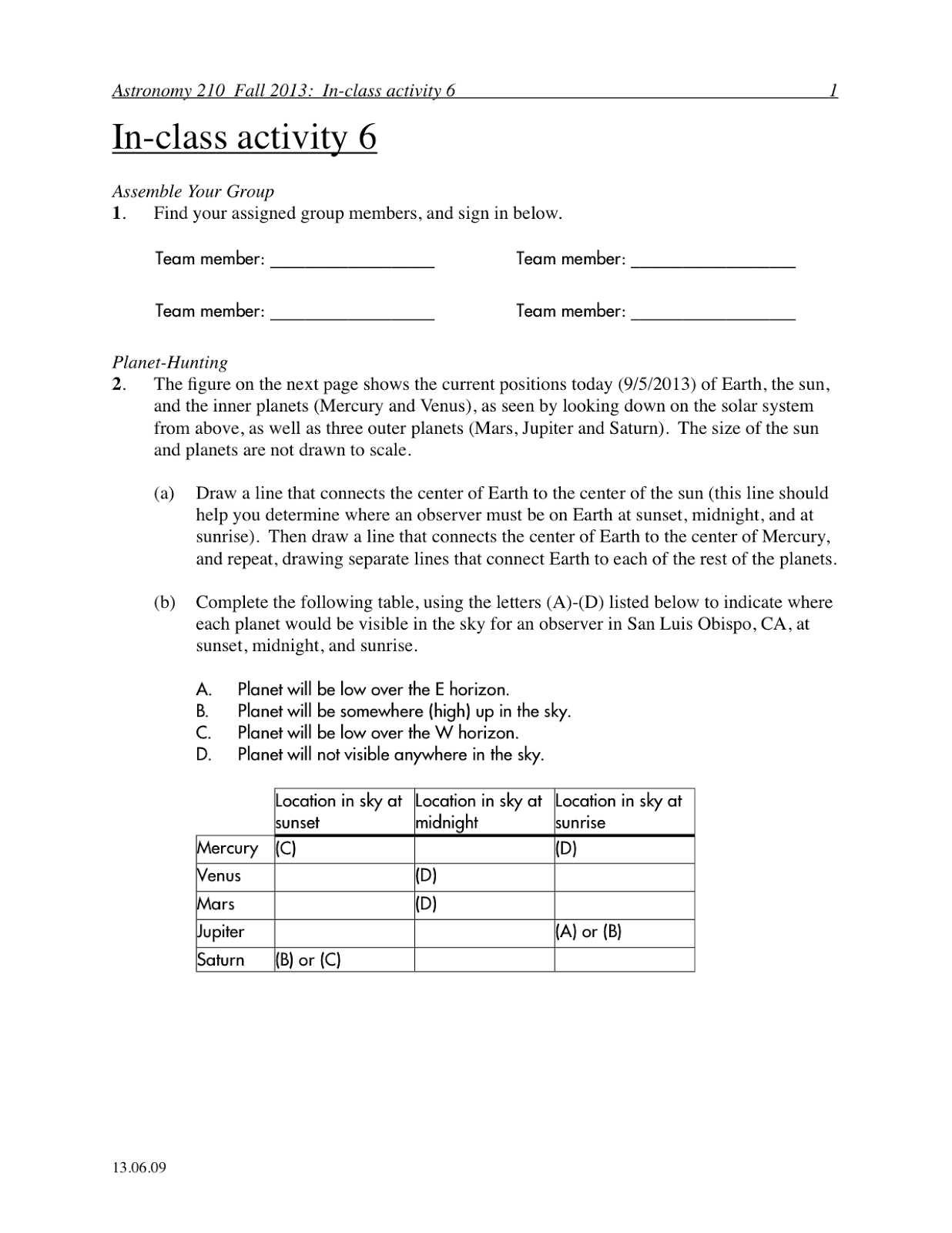
Astronomy in-class activity: planet-hunting

Astronomy 210 In-class activity 6 v.13.06.09, fall semester 2013
Cuesta College, San Luis Obispo, CA

Students find their assigned groups of three to four students, and work cooperatively on an in-class activity worksheet to determine where in the sky each naked-eye planet will be observed on a given date (here, September 5, 2013).


Previous posts:

Astronomy in-class activity: eclipses

Astronomy 210 In-class activity 5 v.13.06.09, fall semester 2013
Cuesta College, San Luis Obispo, CA

Students find their assigned groups of three to four students, and work cooperatively on an in-class activity worksheet to discuss the categories and causes of different types of eclipses.


Astronomy in-class activity: diurnal motion of circumpolar constellations

Astronomy 210 In-class activity 2 v.13.06.09, fall semester 2013 (spring semester 2014)
Cuesta College, San Luis Obispo, CA

Students find their assigned groups of three to four students, and work cooperatively on an in-class activity worksheet to use a starwheel ("planisphere") to determine the clockwise or counterclockwise diurnal motion of circumpolar constellations.