Showing posts with label constructive. Show all posts

20160223

Presentation: double-slit interference

Here we have microwaves (as discussed previously, a long wavelength form of electromagnetic radiation) from two side-by-side in-phase sources, interfering at a detector that can be moved at various locations to detect their interference, whether constructive or destructive (as translated into an audio signal). (Video link: "MIT Physics Demo--Microwave Interference.")

In the previous presentation we discussed the conditions for constructive or destructive interference for waves (of the same wavelength) due to phase and/or path differences. In this presentation we discuss the very specific case of waves (again, of the same wavelength) from two side-by-side in-phase sources, which we will see has been classically called "double-slit" interference.

First, path-length differences.

The waves we are considering will come from two sources that are in phase, so we do not need to concern ourselves with the out of phase sources. Since source phase differences don't matter here--only path differences--then we must pay careful attention to the difference in path length: how much longer the wave from one source travels than the wave from the other source, as they reach and interfere at the position of the detector, as it moves from side-to-side.

We are going to make the assumption that the detector is sufficiently (approaching infinitely?) far away from the two sources (spaced apart by a distance d) that the two waves will travel along a parallel path 1 and path 2. Then the location of the detector can be specified merely by the angle θ (where θ = 0° would be on the center line).

In this case, for the angle θ shown, waves travel longer along path 2. How much longer the waves travel along this longer path can be given by the relation ∆l = dsinθ. (There is a trigonometry derivation using the right triangle for this relation, but the focus here is on relating ∆l with the resulting constructive interference (maxima) or destructive interference (minima), and later on during problem-solving we'll use the ∆l = dsinθ relation to find these maxima and minima θ angles, without worrying too much about how to derive this ∆l = dsinθ relationship.)

Here's the simple case (θ = 0°) where both waves leave their slits to travel equal distances to the distant detector towards the right. Do the waves start from their slits in phase or out-of-phase? Is the path difference a whole wavelength or a half-wavelength? Does constructive interference (maxima) or destructive interference (minima) occur at the detector?

In this case, both waves leave their slits to travel unequal distances to the distant detector towards the right, located at an angle of θ = +23° off the (dashed) center line, such that path 1 is shorter than path 2. Do the waves start from their slits in phase or out-of-phase? Is the path difference a whole wavelength or a half-wavelength? Does constructive interference (maxima) or destructive interference (minima) occur at the detector? What would happen if the detector were instead placed at θ = –23° (same angle but on the other side of the center line)?

Now in this case, both waves leave their slits again to travel unequal distances to the distant detector towards the right, located at an angle of θ = –51° off the (dashed) center line, such that path 1 is longer than path 2. Do the waves start from their slits in phase or out-of-phase? Is the path difference a whole wavelength or a half-wavelength? Does constructive interference (maxima) or destructive interference (minima) occur at the detector? What would happen if the detector were instead placed at θ = +51° (same angle, but on the other side of the center line)?

Second, where we are going with this path-length difference relation: locating where these two sources interfere constructive (maxima) or destructively (minima).

As discussed before, for in phase sources, the difference in path length will be some integer m multiple of a wavelength for constructive interference, or will be some integer and a half (m + 1/2) multiple of wavelength for destructive interference.

So now let's put in our approximation for the path difference ∆l = dsinθ, for two waves from side-by-side sources reaching a (distant) detector located at an angle θ. What we will wind up with is a relation between the angle θ that a distant detector is located at, and the condition for either constructive (maxima) or destructive (minima) interference to occur. So given the wavelength λ of the two side-by-side sources, and the separation distance d between the two side-by-side sources, then plugging in different integer m values (0, ±1, ±2, ±3, etc.) allows us to solve for different θ angles where either constructive (maxima) or destructive (minima) interference occurs.

You will demonstrate this for yourselves in recreating a classic experiment in laboratory. Using laser light (of a given wavelength λ) that illuminates two very closely spaced together slits (two in-phase sources spaced a distance d apart), there will appear bright (maxima, or constructive interference) regions and dark (minima, or destructive interference) regions on a screen (the detector) at certain θ angles, as predicted by the double-slit interference maxima/minima equations.

20130126

Presentation: interference

And he has a butler.
This is your neighbor. You know, the guy who plays his stereo system way too loud. (Video link: "Maxell Tape: Blown Away (1979).")
Butler: "The usual sir?"
Blown Away Guy: "Please."
(Tape player starts blaring Richard Wagner's Walkürenritt ("Ride of the Valkyries").)
Narrator: "Even after 500 plays, our high-fidelity tape still delivers...high fidelity."
Nobody who plays cassette tapes over a two-channel sound system deserves to crank up the volume.
Maybe we can do something about that, next time we just happen to be in his apartment (invited or not), with some minor adjustments to his stereo system wiring.

Last semester we discussed the behavior of sound waves, and so far this semester have been extending those concepts to model the behavior of electromagnetic radiation. Here we specifically look at the superposition of two waves in general, first sound, then later extending these concepts to visible light in a subsequent presentation.

First, defining a few terms.

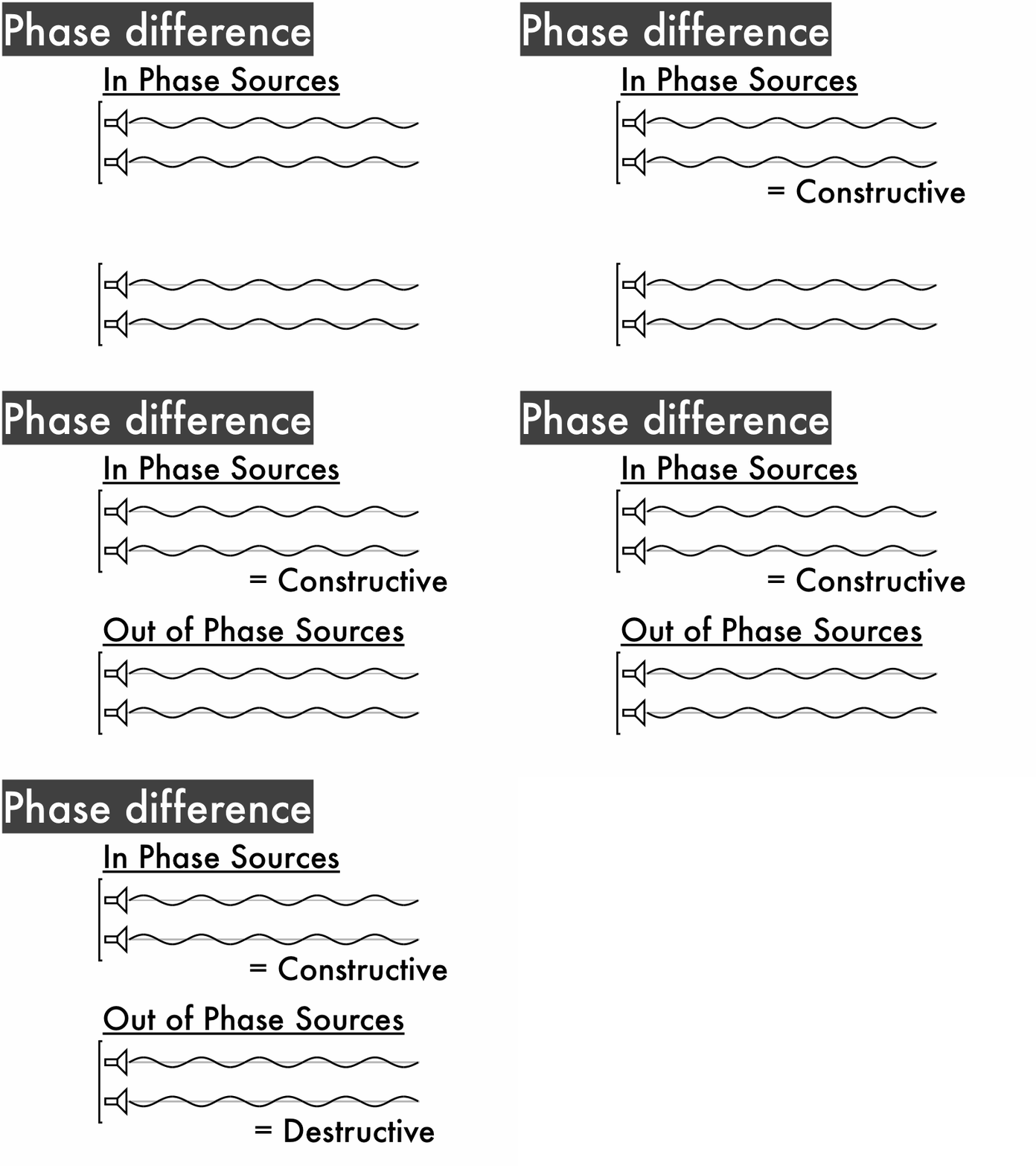
Here we have two speakers, which are our sources of two sound waves. Since they are plugged into the same frequency source, they will generate sound waves of the same frequency f (which is depends only on the source), same speed v (which depends only on the medium), and thus the same wavelength λ (which depends on both f and v). If the speakers are wired the same way--red and black wires to red and black plugs--then they will oscillate in phase, with both speaker cones moving forward and backwards in unison.

However, if the speakers are wired with opposite polarities--here, the speaker on the left is wired with black and red wires to red and black plugs--then they will oscillate out of phase, with one speaker cone moving backwards while the other is moving forwards, and then forwards while the other is moving backwards.

When we have two in phase sound sources with speaker cones that move in unison with each other, then the waves they generate will have crests and troughs that line up with each other. The superposition of these two waves will result in constructive interference, which will be a single louder wave.

If instead we have two out of phase sources with speaker cones that move contrary to each other, then the waves they generate will have crests and troughs that line up with the other speaker's troughs and crests. The superposition of these two waves will result in destructive interference--which would ideally be silence--but more realistically would be a single wave that is much quieter. (This is what would result if you switched the speaker wire polarities for one side of your neighbor's stereo system.)

Now let's consider two in phase sound speakers, but for an observer located at a position where the distance from each speaker--the path length--is different.

Here waves from the left speaker travel approximately 0.81 m, while the path length for the waves from the right speaker is about 0.63 m. The path differencel is the (absolute value) of how much farther one wave travels than the other, so in this case ∆l = 0.81 m - 0.63 m = 0.18 m.

This is why you should sit in the 'sweet spot,' equally distant from both speakers in order to minimize any path differences that may cause destructive interference.
Even with in phase speakers we can get either constructive or destructive interference, if the waves from each speaker travel different path lengths, resulting in certain path differences ∆l. For two in phase speakers where one wave travels a half-wavelength longer than the other, the path difference is (1/2)λ, and as a result crests and troughs line up with the other speaker's troughs and crests: destructive interference.

For two in phase speakers where one wave travels a whole wavelength longer than the other, the path difference is λ, and as a result crests and troughs line up with the other speaker's crests and troughs: constructive interference.

Second, mixing up the source phases and path difference conditions for constructive and destructive interference.

Here are two cases where both source phases and path differences matter. The top example is where two sources with a half-wavelength path difference results in constructive interference. The bottom example is where two sources with a whole wavelength path difference results in destructive interference. So how can we account for cases like these?

Whether constructive or destructive interference occurs depends on both the sources (how the waves start out, whether in phase or out of phase) and the path difference ∆l (how far each wave travels farther than the other, whether a whole wavelength or a half-wavelength longer than the other). There are four different cases:
  • For two in phase sources, if each wave travels a whole wavelength longer than the other, then constructive interference occurs (this is the solid black line.)
  • For two in phase sources, if each wave travels a half-wavelength longer than the other, then destructive interference occurs (this is the dashed black line.)
  • For two out of phase sources, if each wave travels a whole wavelength longer than the other, then destructive interference occurs (this is the solid red line.)
  • For two out of phase sources, if each wave travels a half-wavelength longer than the other, then constructive interference occurs (this is the dashed red line.)
Right now these different conditions look rather intimidating, so we'll make sure to be able to practice applying these conditions to various scenarios of in phase sources and out of phase sources with different shifted positions. Remember, there are only four unique cases of different phases and path differences.

20100216

Online homework assignment: destructive thin film reflections

Physics 205B Homework Assignment 4, Spring Semester 2010
Cuesta College, San Luis Obispo, CA

Cf. Giambattista/Richardson/Richardson, Physics, 2/e, Problem 25.17

A thin film of oil (n = 1.50) of thickness 0.40e-6 m is spread over a puddle of water (n = 1.33). The two visible wavelengths that will destructively interfere for reflection will have values of __________ nm and __________ nm in air. (Visible wavelengths in air are in the range of 400 nm to 700 nm.)

Correct answer: 400 nm, 600 nm.

Light in air reflects off of the top of the oil film with a 180 degree phase shift ("fast off of slow"). Light in oil reflects off the top of the water with no phase shift ("slow off of fast"). The two reflections are out of phase.

For destructive interference of these two out of phase reflections, the path difference condition is:

delta(l) = m*lambda_oil,

where the path difference between the two reflected waves is twice the thickness of the oil film, or 2*t, and lambda_oil is related to the lambda_air wavelengths in air:

lambda_oil = lambda_air/n_oil,

as wavelengths are shorter in slower media, compared to the longest in air (or vacuum).

Substituting delta(l) = 2*t, and lambda_oil = lambda_air/n_oil into the destructive interference condition for out of phase reflections:

2*t = m*(lambda_air/n_oil),

2*t*n_oil/m = lambda_air,

with m = 0, 1, 2, 3, 4, ..., possible wavelengths in air that would destructively interfere would be infinite, 1200 nm, 600 nm, 400 nm, 300 nm, ..., respectively, of which only 400 nm and 600 nm are in the visible range in air.

Student responses
Section 31988
537 nm, 637 nm: 1 response
400 nm, 600 nm: 2 responses
429 nm, 687 nm: 1 response
(Blank/no work submitted: 9 responses)