Showing posts with label conductor. Show all posts

20150311

Presentation: circuit basics

Wet plywood. Wires clipped to nails. Wires connected to a source of 15,000 volts. What could be more beautiful than this basic circuit? Or dangerous? (Video link: 15,000 volts.")

In this presentation we will take a first look at the basics of basic circuits. As with the set-up above, some of these very basic circuits are also very dangerous, so unless you absolutely know what you're doing (that is to say, you know enough physics to understand the perils involved), do not try these at home!

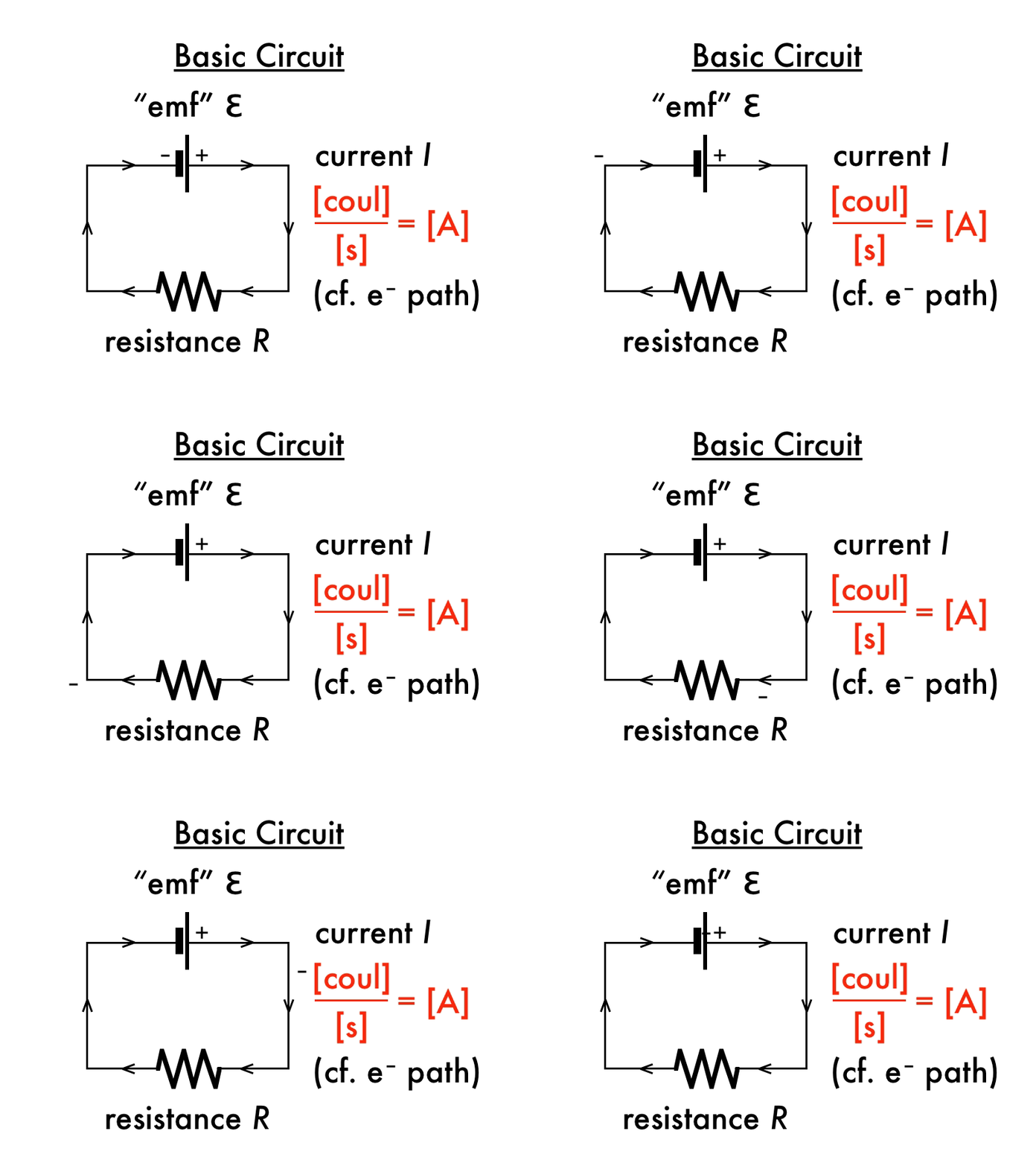
The most basic circuit we can build will have an ideal "electromotive" (emf) source of voltage connected to a resistor, such that charges can flow continuously around and around. Peculiarly the definition of current is the amount of positive charge (in coulombs (C)) that circulates per time (in seconds (s)), and these units of C/s are defined as amps (A). But as discussed in a previous presentation, in a conductor it is actually the negatively charged electrons that are free to move. So by convention we refer to "current" flowing clockwise through this circuit, while the electrons actually circulate in the opposite counterclockwise direction through this circuit. Just keep watching this GIF animation for a while until you get used to those current direction concepts. More on emf sources and resistors below, when you're ready.

An ideal battery uses chemical reactions that exchange charges in order to release electric potential energy, giving potential (that is, electric potential energy per charge, or voltage, measured in volts (V)) to the charges that circulate in a circuit.

Different chemical reactions will release different amounts of electric potential energy per charge, and thus different amounts of voltage. Note that these different batteries all have the same "AA" size, but the different chemical reactants inside (nickel metal hydride (NiMh), alkaline, or lithium) release different amounts of voltage (∆V = 1.2 V, 1.5 V, or 3.6 V, respectively). (Ideally the amount of voltage provided will be constant; but later we'll consider the effects of depleting the reactants inside "real" batteries, and the effect this has on their actual voltage output over time.)

Some larger voltage batteries are made up of a combination of individual batteries, in order to "stack" the voltage output ∆V, which is cumulative provided that their terminals are connected (+) to (-), etc. The result of stacking six individual 1.5 V alkaline batteries results in a single 9.0 V battery, as seen in several different stacking configurations.

The other part of a basic circuit is a resistor, which uses up voltage (electric potential energy per charge) as current flows through it. Different types of materials and shapes and sizes will result in different resistance values, measured in ohms (Greek letter Ω). (This is the inverse of conductance, so a good conductor (such as a metal wire) will have a low resistance value, while a poor conductor (such as an insulator) will have a high resistance value.)

If several resistors (here, Christmas light bulbs) are strung together in a line, forcing current to flow through each one in turn, then the equivalent resistance is their individual resistances added together. (This is not the only possible way to wire together resistors, but we'll stick to this basic configuration for now.)

Ohm's law can be applied to a basic circuit to determine how much current will flow in it, given the total amount of voltage from ideal batteries, and the equivalent resistance of all the resistors. Note how the different units are related in Ohm's law: a volt over an ohm is equivalent to an ampere, etc. (After a certain point you will just have to trust that all these units will work out in the end.)

So let's look at some very basic, very dangerous circuits.

We can use a wire (which has a very low resistance) to complete a basic circuit, connecting it to the (+) and (-) terminals of a 9.0 V (ideal) battery. Note the very small spark of current that leaps across the gap just as the wire completes the circuit. Now an absurd configuration of 244 9.0 V batteries are stacked with (+) terminals to (-) terminals. (How much emf voltage is that?) When a wire is connected to complete this stacked battery circuit, how does the amount of emf voltage compare to the single 9.0 V battery circuit? How does the amount of current compare to the single 9.0 V battery circuit? (Video source: "Fun with a few 9V batteries. (244 of them).")

Our next very dangerous basic circuit involves deionized water, itself a relatively poor conductor, as there are no free charges in it to transport current, so connecting a basic circuit of water with a household 120 V outlet as an emf source (where the light bulb is used to indicate the amount of current that is flowing) doesn't yield much current. When salt is poured into the water, introducing charged sodium (Na+) and chloride (Cl-) ions, how did the amount of resistance of this circuit change? How did the amount of current through this circuit change? (Video source: "Experiment electricity with saltwater.")

Our last very dangerous basic circuit is a power transformer used as an emf source, with a metal screw used to complete the circuit. This will result in a "short circuit," which is due to a very large or very small resistance? Does a very large or very small current result? (Video source: "The Metal Melter.")

In subsequent presentations we will go over more specific rules of circuit analysis for more complex configurations of emf sources and resistors, and power dissipation.

20130215

Presentation: charges and materials

Static electricity is never your friend. Not at the gas station. Nope. (Video link: "Fuel Pump Fire.")

In this presentation we will discuss how charges move differently through certain materials, and the effects of this behavior in certain situations.

We will assume that you already familiar with certain basics of electrostatics, in that there are positive and negative charges...

...and that two charges with opposite signs (positive-negative, or negative-positive) will attract, while two charges with the same sign (positive-positive, or negative-negative) will repel.

First, the mobility of these charges in certain materials.

We will also assume that you are already familiar with a simple atomic model of solids, where the positive charged nuclei of atoms are held at fixed locations, while their negatively charged outmost electrons are relatively free to move. The degree to which these electrons can move depends on the type of material.

For an insulator, the outermost electrons are more or less fixed to their atomic locations, but at least are able to move somewhat around these locations. (As in the gas station spark movie shown above, electrons can be exchanged when two different types of insulators that have different affinities for electrons are rubbed against each other.)

In contrast, the outermost electrons in a conductor are much more free to move about the entire material.

For a polar molecule, while the molecule itself may be neutrally charged, the electrons are distributed such that certain atoms at each end of the molecule have a permanent small positive or small negative charge. In a liquid state, these molecules would be free to align in different orientations.

Second, the response, or polarization for these different materials to external charged objects held nearby.

When a positively charged object is brought near a neutral insulator, the outermost electrons at each atom will be drawn to the side facing the positively charged object. Note that for each atom, the outermost electrons are slightly closer to the positively charged object (and feel an attractive force), while the positively charged nuclei are slightly farther away from the positively charged object (and feel a repulsive force). But since the outermost electrons are slightly closer to the positively charged object, and the positively charged nuclei are slightly farther away from the positively charged object, then the attractive forces will be slightly greater than the repulsive forces, such that there is a net attraction between the neutral insulator and positively charged object.

When a negatively charged object is brought near a neutral insulator, the outermost electrons at each atom will move to the side facing away from the negatively charged object. Note that for each atom, the outermost electrons are slightly farther way from the negatively charged object (and feel a repulsive force), while the positively charged nuclei are slightly closer to the negatively charged object (and feel a attractive force). But since the outermost electrons are farther away from the negatively charged object, and the positively charged nuclei are slightly closer to the negatively charged object, then the repulsive forces will be slightly less than the attractive forces, such that there is a net attraction between the neutral insulator and negatively charged object.

An example of this is when an insulating object (here, a cat) acquires a charge, due to rubbing or sliding against a different type of insulator. It doesn't matter whether the cat lost electrons (and thus becomes positively charged) or gained electrons (and thus becomes negatively charged) from this rubbing, as in either case the object will still attract neutral insulators (such as these styrofoam packing peanuts).

Convince yourself that a similar effect occurs when a charged object (positive or negative) is brought near a neutral conductor. While outermost electrons are much more mobile than in an insulator, they will still move to the side facing towards a positively charged object, or away from a negatively charged object, such that net attraction will result in either case.

Again, let's start with an insulating object (here, a balloon) acquiring a charge, due to rubbing or sliding against a different type of insulator (a fabric curtain). It doesn't matter whether the balloon lost electrons (and thus becomes positively charged) or gained electrons (and thus becomes negatively charged) from this rubbing, as in either case the object will still attract neutral conductors (such as this aluminum can). (Video link: "Aluminium can static roll.")

Once again a similar effect occurs when a charged object (positive or negative) is brought near a a liquid containing polar molecules. However, in this case the molecule will reorient itself such that the negative end will move to the side facing towards a positively charged object, or away from a negatively charged object, such that net attraction will result in either case.

Once again, start with an insulating object (here, a comb) acquiring a charge, due to contact with a different type of insulator (hair). It doesn't matter whether the comb lost electrons (and thus becomes positively charged) or gained electrons (and thus becomes negatively charged) from this rubbing, as in either case the comb will still attract neutral polar molecules (such as in this water stream). (Video link: "Water Bending.")