Showing posts with label constellation. Show all posts

20200316

Astronomy midterm question: Great Square and Big Dipper just after sunset

Astronomy 210 Midterm 1, spring semester 2020
Cuesta College, San Luis Obispo, CA

An online astronomy magazine article describes the positions of the "Great Square" (located between the constellations Andromeda and Pegasus) and the Big Dipper just after sunset:[*]:
After dark now the Great Square [between Andromeda and Pegasus] is declining low in the west, tipped onto one corner. Meanwhile the Big Dipper is creeping up in the northeast, tipped up on its handle.
Discuss a plausible date and time for someone in San Luis Obispo, CA to make this observation of the Great Square and the Big Dipper in the early evening sky. If there is no such plausible date and time, then explain why. Defend your answer by clearly explaining how you used your starwheel to do this, along with any assumptions that you may have made. (Ignore daylight saving time.)

[*] skyandtelescope.com/observing/sky-at-a-glance/.

Solution and grading rubric:
  • p:
    Correct. Discussion includes the following:
    1. locates the Great Square and the Big Dipper asterisms on the starwheel, and rotates starwheel such that the Great Square is just above the west horizon, while the Bigger Dipper is near the northeast horizon; and
    2. selects a time that is dark enough to see stars in the early evening (somewhere between 7 PM and 10 PM or so); and
    3. looks up a specific date corresponding to that early evening time.
  • r:
    Nearly correct (explanation weak, unclear or only nearly complete); includes extraneous/tangential information; or has minor errors. May have selected midnight, sunrise or some other time of night not convincingly "after dark," "just after sunset" or an "early evening" time.
  • t:
    Contains right ideas, but discussion is unclear/incomplete or contains major errors. May have Great Square near east horizon, and Big Dipper near the west horizon.
  • v:
    Limited relevant discussion of supporting evidence of at least some merit, but in an inconsistent or unclear manner. At least attempts to use starwheel in a systematic manner.
  • x:
    Implementation/application of ideas, but credit given for effort rather than merit. Discussion not clearly based on using a starwheel in a systematic manner.
  • y:
    Irrelevant discussion/effectively blank.
  • z:
    Blank.
Grading distribution:
Section 30674
Exam code: midterm01n7in
p: 21 students
r: 5 students
t: 3 students
v: 1 student
x: 0 students
y: 0 students
z: 0 students

Section 30676
Exam code: midterm01S7wY
p: 27 students
r: 11 students
t: 2 students
v: 3 students
x: 2 students
y: 0 students
z: 0 students

A sample "p" response (from student 2020):

20200205

Astronomy quiz archive: stars/sun/seasons/moon phases

Astronomy 210 Quiz 1, spring semester 2020
Cuesta College, San Luis Obispo, CA

Section 30674, version 1
Exam code: quiz01N3ve


Section 30674
0- 8.0 :   * [low = 6.0]
8.5-16.0 :   ****************
16.5-24.0 :   ********** [mean = 21.6 +/- 8.6]
24.5-32.0 :   *************
32.5-40.0 :   **** [high = 40.0]


Section 30676, version 1
Exam code: quiz01s4L3


Section 30676
0- 8.0 :   * [low = 8.0]
8.5-16.0 :   ****
16.5-24.0 :   ***************
24.5-32.0 :   *********** [mean = 26.6 +/- 9.5]
32.5-40.0 :   ************** [high = 40.0]

20191008

Astronomy midterm question: Auriga, Gemini, and Leo in early evening sky

Astronomy 210 Midterm 1, fall semester 2019
Cuesta College, San Luis Obispo, CA

An astronomy magazine article describes the positions of constellations in the night sky at a certain time of year[*]:
Early in the evening, Auriga and Gemini are high in the sky, while Leo, the Lion, stands at attention about halfway up the sky.
Discuss a plausible date and time for an observer in San Luis Obispo, CA to make this observation of Auriga, Gemini, and Leo in the early evening sky. If there is no such plausible date and time, then explain why. Defend your answer by clearly explaining how you used your starwheel to do this, along with any assumptions that you may have made. (Ignore daylight saving time.)

[*] "Sky Maps: December 2018-December 2019," Skywatch (2019), p. 18.

Solution and grading rubric:
  • p:
    Correct. Discussion includes the following:
    1. locates the constellations Auriga and Gemini on the starwheel, and rotates starwheel such that both are at or near the zenith (Leo will then be visible somewhere between the zenith and the eastern horizon); and
    2. selects a time that is dark enough to see stars in the early evening (somewhere between 7 PM and 10 PM or so); and
    3. looks up the date (March/April) corresponding to that early evening time.
  • r:
    Nearly correct (explanation weak, unclear or only nearly complete); includes extraneous/tangential information; or has minor errors. Places Auriga and Gemini at the zenith, but discusses December at 12 AM or June at 1 PM as an "early evening" time, or has March/April but does not explicitly choose a time.
  • t:
    Contains right ideas, but discussion is unclear/incomplete or contains major errors. Finds a plausible date and evening time (or discusses that this would be impossible) when Auriga and Gemini are low in the west horizon, with Leo high in the sky.
  • v:
    Limited relevant discussion of supporting evidence of at least some merit, but in an inconsistent or unclear manner. At least attempts to use starwheel in a systematic manner.
  • x:
    Implementation/application of ideas, but credit given for effort rather than merit. Discussion not clearly based on using a starwheel in a systematic manner.
  • y:
    Irrelevant discussion/effectively blank.
  • z:
    Blank.
Grading distribution:
Section 70158
Exam code: midterm01Sw3e
p: 19 students
r: 6 students
t: 9 students
v: 2 students
x: 0 students
y: 0 students
z: 0 students

Section 70160
Exam code: midterm01N0dL
p: 7 students
r: 3 students
t: 11 students
v: 2 students
x: 0 students
y: 0 students
z: 0 students

A sample "p" response (from student 2120):

20190827

Astronomy quiz archive: stars/sun/seasons/moon phases

Astronomy 210 Quiz 1, fall semester 2019
Cuesta College, San Luis Obispo, CA

Section 70158, version 1
Exam code: quiz01SLYc

Section 70158
0- 8.0 :   * [low = 6.0]
8.5-16.0 :   ****************
16.5-24.0 :   ********** [mean = 21.6 +/- 8.6]
24.5-32.0 :   *************
32.5-40.0 :   **** [high = 40.0]


Section 70160, version 1
Exam code: quiz01nGh7

Section 70160
0- 8.0 :   *** [low = 8.0]
8.5-16.0 :   *******
16.5-24.0 :   ******* [mean = 19.0 +/- 7.6]
24.5-32.0 :   ***
32.5-40.0 :   * [high = 36.0]

20190315

Astronomy midterm question: Cassiopeia and Orion visible in March 27 night sky?

Astronomy 210 Midterm 1, spring semester 2019
Cuesta College, San Luis Obispo, CA

Shown at right is a comic strip[*] published on March 27, 1994. Determine a plausible time for an observer in San Luis Obispo, CA to be able to see both the constellation Cassiopeia and the constellation Orion somewhere in the night sky on this date, or discuss why this comic strip is not plausible. Defend your answer by clearly explaining how you used your starwheel to do this, along with any assumptions that you may have made.

[*] Mort Walker and Chance Browne, "Hi & Lois" (March 27, 1994), King Features Syndicate.

Solution and grading rubric:
  • p:
    Correct. Locates the constellations Cassiopeia and Orion on the starwheel, and rotates starwheel such that both are still visible in the sky on March 27 (from approximately 12 PM to 11 PM), and within that range selects a time that is dark enough to see stars (after approximately 7 PM), such that this would be plausible for time within the range 7 PM to 11 PM on that date.
  • r:
    Nearly correct (explanation weak, unclear or only nearly complete); includes extraneous/tangential information; or has minor errors. Discusses how this is not plausible, because at 12 AM on March 27 Orion will have already set, but does not consider a slightly earlier time that night where both Cassiopeia and Orion would be visible.
  • t:
    Contains right ideas, but discussion is unclear/incomplete or contains major errors. Discusses some date other than March 27 to find a time when both Cassiopeia and Orion would be visible in the night sky.
  • v:
    Limited relevant discussion of supporting evidence of at least some merit, but in an inconsistent or unclear manner. At least attempts to use starwheel in a systematic manner.
  • x:
    Implementation/application of ideas, but credit given for effort rather than merit. Discussion not clearly based on using a starwheel in a systematic manner.
  • y:
    Irrelevant discussion/effectively blank.
  • z:
    Blank.
Grading distribution:
Section 30676
Exam code: midterm01SFBk
p: 31 students
r: 5 students
t: 3 students
v: 4 students
x: 1 student
y: 0 students
z: 0 students

A sample "p" response (from student 1929):

Another sample "p" response (from student 4132):

Another sample "p" response (from student 7415):

A sample "r" response (from student 0815), only considering midnight on March 27 to test for (im)plausibility:

A sample "t" response (from student 7563), testing for a plausible time on another date besides March 27:

20190207

Astronomy quiz archive: stars/sun/seasons/moon phases

Astronomy 210 Quiz 1, spring semester 2019
Cuesta College, San Luis Obispo, CA

Section 30674, version 1
Exam code: quiz01n1aR


Section 30674
0- 8.0 :   *** [low = 8.0]
8.5-16.0 :   ********
16.5-24.0 :   ******** [mean = 23.3 +/- 9.7]
24.5-32.0 :   *******
32.5-40.0 :   ********* [high = 40.0]


Section 30676, version 1
Exam code: quiz01sRmB


Section 30676
0- 8.0 :   *** [low = 5.0]
8.5-16.0 :   *********
16.5-24.0 :   ************* [mean = 23.9 +/- 9.2]
24.5-32.0 :   **********
32.5-40.0 :   *********** [high = 40.0]

20181004

Astronomy midterm question: early evening Arcturus and Spica high in the sky at start of a season?

Astronomy 210 Midterm 1, fall semester 2018
Cuesta College, San Luis Obispo, CA

An astronomy magazine article[*] describes the positions of star and constellations in the sky at a certain time of year:
Arcturus and Spica are the two brightest stars in the constellations Boötes and Virgo. Both are now superbly placed high in the sky in the early evening at the start of this season.
Discuss at the start of which season (spring/summer/fall/winter) would be the most plausible for an observer in San Luis Obispo, CA to see Arcturus and Spica high in the sky in the early evening. If there is no such plausible start of a season, then explain why. Defend your answer by clearly explaining how you used your starwheel to do this, along with any assumptions that you may have made. (Ignore daylight saving time.)

[*] "Sky Maps: December 2016-December 2017," Skywatch (2017), p. 20.

Solution and grading rubric:
  • p:
    Correct. Discussion includes the following:
    1. turns starwheel such that Arcturus and Spica are "placed high in the sky" (at or near the meridian);
    2. reads off a plausible date corresponding to a time in the "early evening" (6 PM-9 PM?); and
    3. relates this date to a specific start of a season (in this case, late June, hence the start of summer).
    May argue that this sky in the early evening does not exactly coincide with the exact start of summer (or any season), and thus no start of any season is possible.
  • r:
    Nearly correct (explanation weak, unclear or only nearly complete); includes extraneous/tangential information; or has minor errors. May have interpreted "early evening" to be 5 PM-6 PM, and thus picks mid-August as the "start(?) of fall."
  • t:
    Contains right ideas, but discussion is unclear/incomplete or contains major errors. Picks October or November in the early evening, but this places Arcturus and Spica low in the western sky, and not "placed high in the sky."
  • v:
    Limited relevant discussion of supporting evidence of at least some merit, but in an inconsistent or unclear manner. At least attempts to use starwheel in a systematic manner.
  • x:
    Implementation/application of ideas, but credit given for effort rather than merit. Discussion not clearly based on using a starwheel in a systematic manner.
  • y:
    Irrelevant discussion/effectively blank.
  • z:
    Blank.
Grading distribution:
Section 70158
Exam code: midterm01Sa1Y
p: 19 students
r: 6 students
t: 0 students
v: 0 students
x: 0 students
y: 0 students
z: 0 students

Section 70160
Exam code: midterm01n4mR
p: 17 students
r: 4 student
t: 13 students
v: 0 students
x: 2 students
y: 1 student
z: 0 students

A sample "p" response (from student 1168)

Another sample "p" response (from student 4747)

20180830

Astronomy quiz archive: stars/sun/seasons/moon phases

Astronomy 210 Quiz 1, fall semester 2018
Cuesta College, San Luis Obispo, CA

Section 70158, version 1
Exam code: quiz01S1ri


Section 70158
0- 8.0 :   * [low = 4.0]
8.5-16.0 :   *********
16.5-24.0 :   ********
24.5-32.0 :   ********** [mean = 25.5 +/- 9.6]
32.5-40.0 :   ********** [high = 40.0]


Section 70160, version 1
Exam code: quiz01nHa0


Section 70160
0- 8.0 :   *** [low = 4.0]
8.5-16.0 :   ***
16.5-24.0 :   ******* [mean = 18.6 +/- 7.9]
24.5-32.0 :   ****** [high = 32.0]
32.5-40.0 :  

20180201

Astronomy quiz archive: stars/sun/seasons/moon phases

Astronomy 210 Quiz 1, spring semester 2018
Cuesta College, San Luis Obispo, CA

Section 30674, version 1
Exam code: quiz01n0rK


Section 30674
0- 8.0 :   * [low = 8]
8.5-16.0 :   ****
16.5-24.0 :   ***
24.5-32.0 :   ******** [mean = 28.0 +/- 9.6]
32.5-40.0 :   ********* [high = 40]


Section 30676, version 1
Exam code: quiz02S1Bn


Section 30676
0- 8.0 :  
8.5-16.0 :   ********* [low = 9.5]
16.5-24.0 :   ************
24.5-32.0 :   *********** [mean = 26.1 +/- 9.0]
32.5-40.0 :   ************** [high = 40]

20170907

Astronomy quiz archive: stars/sun/seasons/moon phases

Astronomy 210 Quiz 1, fall semester 2017
Cuesta College, San Luis Obispo, CA

Section 70158, version 1
Exam code: quiz01S3aN

Section 70158
0- 8.0 :   * [low = 8]
8.5-16.0 :   *******
16.5-24.0 :   ***************
24.5-32.0 :   *************** [mean = 26.0 +/- 8.3]
32.5-40.0 :   ********** [high = 40]


Section 70160, version 1
Exam code: quiz01nMm5

Section 70160
0- 8.0 :  
8.5-16.0 :   **** [low = 12]
16.5-24.0 :   ********
24.5-32.0 :   ********** [mean = 27.3 +/- 8.5]
32.5-40.0 :   ********** [high = 40]

20170311

Astronomy midterm question: Sagittarius as both sun-sign and rising-sign?

Astronomy 210 Midterm 1, spring semester 2017
Cuesta College, San Luis Obispo, CA

An astronomy question on an online discussion board was asked and answered[*]:
NSt: I recently went to see an astrologer in my town, and was told that that my sun-sign is Libra and my rising sign is Aquarius. Anyways, is that wrong? If you want to figure it out, I was born 12/25 at 8:30 AM.
ArZ: It looks to me like you are clearly both a Sagittarius sun-sign with a Sagittarius rising sign.
Discuss why this answer is correct for an observer in San Luis Obispo, CA. Support your answer by clearly explaining how you used your starwheel to do this, along with any assumptions that you may have made. (Ignore daylight saving time. Assume you can see stars in daylight.)

[*] answers.yahoo.com/question/index?qid=20080921194418AAO10gc.

Solution and grading rubric:
  • p:
    Correct. Discussion includes the following:
    1. confirms that Sagittarius is the sun-sign for a 12/25 birthday by finding that it is on the meridian at 12 PM on that day (where the sun also be located); and
    2. confirms that Sagittarius is the rising sign, as it is rising on the east horizon at 8:30 AM on 12/25.
  • r:
    Nearly correct (explanation weak, unclear or only nearly complete); includes extraneous/tangential information; or has minor errors.
  • t:
    Contains right ideas, but discussion is unclear/incomplete or contains major errors. Only has correct verification of sun-sign or rising-sun only.
  • v:
    Limited relevant discussion of supporting evidence of at least some merit, but in an inconsistent or unclear manner. At least attempts to use starwheel in a systematic manner.
  • x:
    Implementation/application of ideas, but credit given for effort rather than merit. Discussion not clearly based on using a starwheel in a systematic manner.
  • y:
    Irrelevant discussion/effectively blank.
  • z:
    Blank.
Grading distribution:
Section 30674
Exam code: midterm01nghT
p: 16 students
r: 0 students
t: 6 students
v: 1 student
x: 0 students
y: 0 students
z: 0 students

Section 30676
Exam code: midterm01sP4m
p: 35 students
r: 4 students
t: 5 students
v: 0 students
x: 0 students
y: 0 students
z: 0 students

A sample "p" response (from student 1988):
Another sample "p" response (from student 9449):

20170204

Astronomy quiz archive: stars/sun/seasons/moon phases

Astronomy 210 Quiz 1, spring semester 2017
Cuesta College, San Luis Obispo, CA

Section 30674, version 1
Exam code: quiz01nK0n

Section 30674
0- 8.0 :  
8.5-16.0 :   ** [low = 12]
16.5-24.0 :   *******
24.5-32.0 :   *********** [mean = 26.3 +/- 6.6]
32.5-40.0 :   ** [high = 40]


Section 30676, version 1
Exam code: quiz01s7vN

Section 30676
0- 8.0 :  
8.5-16.0 :   ***** [low = 12]
16.5-24.0 :   *********
24.5-32.0 :   **************** [mean = 27.9 +/- 7.6]
32.5-40.0 :   **************** [high = 40]

20161008

Astronomy midterm question: time for northeast-rising constellation to reach meridian

Astronomy 210 Midterm 1, fall semester 2016
Cuesta College, San Luis Obispo, CA

The following claim was made on an online discussion board[*]:
Ricd: Assuming that a constellation is rising in the east (and not the northeast), then it will be at its highest point in the sky around six hours later.
Discuss how the time for a constellation to rise from the northeast and reach its highest point would be different than six hours, for an observer in San Luis Obispo, CA. Support your answer by clearly explaining how you used your starwheel to do this, along with any assumptions that you may have made. (Ignore daylight saving time. Assume you can see stars in daylight.)

[*] answers.yahoo.com/question/index?qid=20121011073839AA7dhdS .

Solution and grading rubric:
  • p:
    Correct. Discussion includes the following:
    1. selects a constellation that rises in the northeast;
    2. determines on a given date that there are more than six hours from the rise time to the highest overhead time (when at the meridian); or finds that six hours after rising from the northeast, the constellation has not yet reached the meridian.
  • r:
    Nearly correct (explanation weak, unclear or only nearly complete); includes extraneous/tangential information; or has minor errors.
  • t:
    Contains right ideas, but discussion is unclear/incomplete or contains major errors.
  • v:
    Limited relevant discussion of supporting evidence of at least some merit, but in an inconsistent or unclear manner. At least attempts to use starwheel in a systematic manner.
  • x:
    Implementation/application of ideas, but credit given for effort rather than merit. Discussion not clearly based on using a starwheel in a systematic manner.
  • y:
    Irrelevant discussion/effectively blank.
  • z:
    Blank.
Grading distribution:
Section 70158
Exam code: midterm01s4uL
p: 18 students
r: 11 students
t: 4 students
v: 5 students
x: 5 students
y: 0 students
z: 0 students

Section 70160
Exam code: midterm01n4AN
p: 10 students
r: 2 students
t: 5 students
v: 6 students
x: 6 students
y: 1 student
z: 0 students

A sample "p" response (from student 4135) for Gemini:

Another sample "p" response (from student 2727) for Boötes:

Yet another sample "p" response (from student 0730), comparing the "Great Square" asterism with Aquarius:

20160901

Astronomy quiz archive: stars/sun/seasons/moon phases

Astronomy 210 Quiz 1, fall semester 2016
Cuesta College, San Luis Obispo, CA

Section 70158, version 1
Exam code: quiz01swE3


Section 70158
0- 8.0 :   **** [low = 8]
8.5-16.0 :   *****
16.5-24.0 :   **************** [mean = 23.5 +/- 8.1]
24.5-32.0 :   **************
32.5-40.0 :   ****** [high = 40]


Section 70160, version 1
Exam code: quiz01n4Ps


Section 70160
0- 8.0 :   * [low = 8]
8.5-16.0 :   *********
16.5-24.0 :   *********** [mean = 22.9 +/- 8.3]
24.5-32.0 :   *********
32.5-40.0 :   *** [high = 40]

20160822

Backwards faded scaffolding laboratory/presentation: limiting magnitude (Orion's Torso)

Astronomy 210L, spring semester 2011
Cuesta College, San Luis Obispo, CA
(This is the second Astronomy 210L laboratory at Cuesta College, San Luis Obispo, CA. This course is a one-semester, optional adjunct laboratory to the Astronomy 210 introductory astronomy lecture, taken primarily by students to satisfy their general education science transfer requirement.)
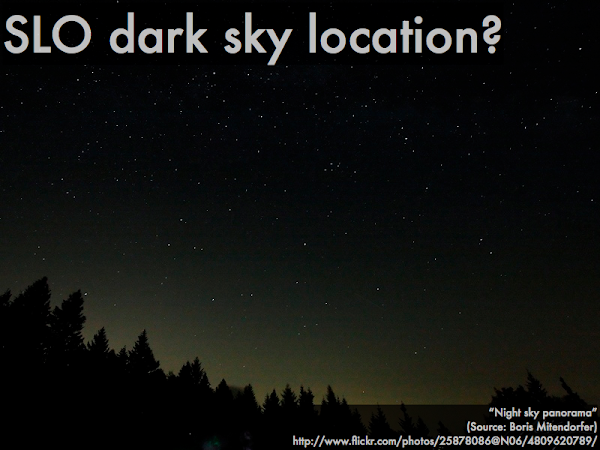
So where would you go in San Luis Obispo county to find the darkest skies available?
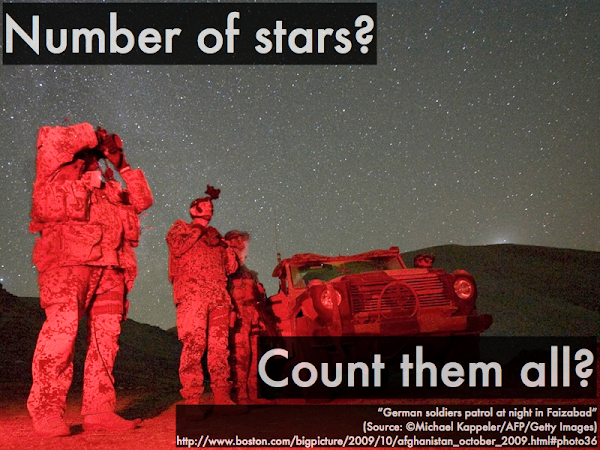
...and once you were there, let's say you were so impressed by the sheer number of stars that you wanted to count them all.
Maybe not--you might be able to look up the expected number of stars in a dark sky.

Or better yet, let's consider a systematic approach where you can count the number of stars on and within a certain part of the sky (the "Orion's Torso" asterism), and then be able to extrapolate this count to the total number of stars in the rest of the sky.
First, let's consider how to rate the brightness of a star. This is not the same thing as the "true" brightness of a star, just how bright a star is as it appears in the our sky. (So yes, our sun, a rather mediocre brightness star "cheats" because it happens to be very close, so that's why we talk about its "apparent" magnitude being bright in comparison to the rest of the stars that we can see from Earth.)
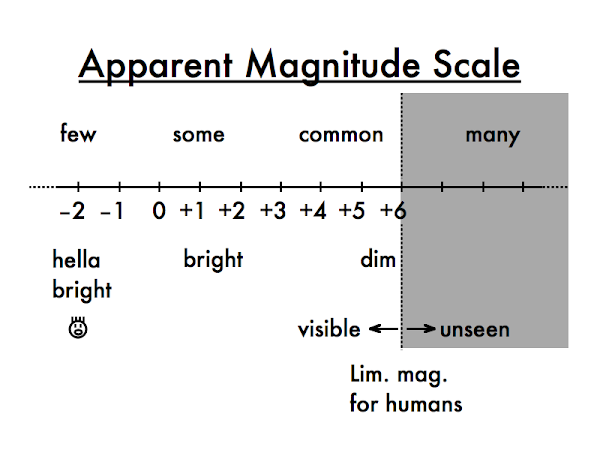
The original Greek scale has +1 for the brightest stars, and +6 for the dimmest stars. If the smaller number for brighter stars bothers you, think of ranking schemes (as did the Greeks), where the brightest stars were "first place" or "top tier" stars, and the dimmest stars are in "sixth place," earning the Miss Congeniality prize. And the scale did need to get revised, as there a few stars that blow the top off the original +1 to +6 scale. Brighter than the "first place" +1 stars are "zero place" stars, and brighter than those stars are "-1 place" stars. These are the hella bright stars--at least, for those astronomers who come from Northern California. There are also lots of stars dimmer than +6, but due to the limitation of the human eye these cannot be seen with the naked eye, even under the best of circumstances, but these stars can easily be observed with telescopes or even decent binoculars.
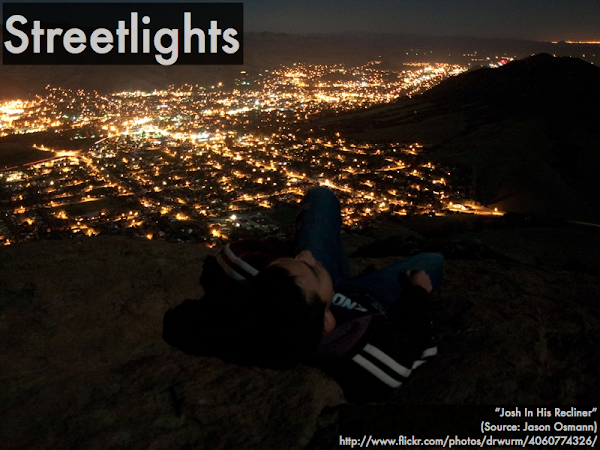
Streetlights cause light pollution. However, the other part of this effect is the atmosphere itself, as stuff in the air reflects the upward light back down towards our eyes, making it difficult to see the stars. And light pollution is not all manmade--the moon also does its damage as well.

So compare this view seen from a dark sky location (here seen through a telescope, so there are lots of stars much dimmer than +6 visible, as well as nebulae)...

...with the same part of the sky, seen with the skyglow of downwards reflected streetlight. The dim stars disappear, and even the brighter stars are harder to make out.

So instead of the naked eye being limited to seeing stars +6 and brighter, light pollution shifts the limiting magnitude to the left.
Let's now get to the process of counting stars within a representative, manageable portion of the sky, in order to extrapolate this to find the total stars in the rest of the sky.

Each group will pick up a packet of star charts showing Orion's Torso under dark, suburban, and urban conditions. Consider this training for actually doing this observation in the night sky.
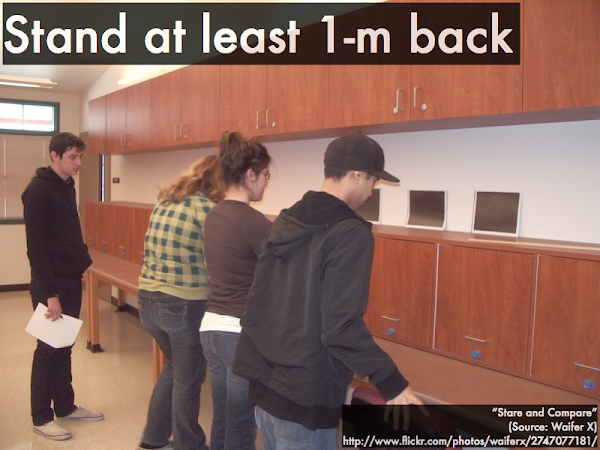
You can't touch the stars with your fingers...no way, nuh-uh. So you need to stand at least 1 m back from the charts, and count these stars in your head, in order to simulate the approximate conditions for counting stars at night. Count stars on the border as well as inside Orion's Torso, compare results with your group members (you might even discover a "secret star" or two!), and determine the average number of stars within Orion's Torso for each light pollution condition.

The "Orion's Torso Stars, Ranked by Apparent Magnitude" table lists the stars from brightest to dimmest apparent magnitudes. If say, your group had counted an average of 22 stars under certain lighting conditions, then you look up the 22nd brightest star in Orion's Torso, and since it has an apparent magnitude of +4.93, this is the limiting magnitude for those lighting conditions--you can see all stars +4.93 and brighter, and can't see stars dimmer than +4.93.

Now use the "Number of Celestial Sphere Stars versus Limiting Magnitude" graph. With our example of a limiting magnitude of +4.93 in Orion's Torso, draw a line vertically upwards until you hit this diagonal, and then go horizontally and read off the corresponding number of stars in the entire celestial sphere under these lighting conditions. Here, approximately 1,600 stars.
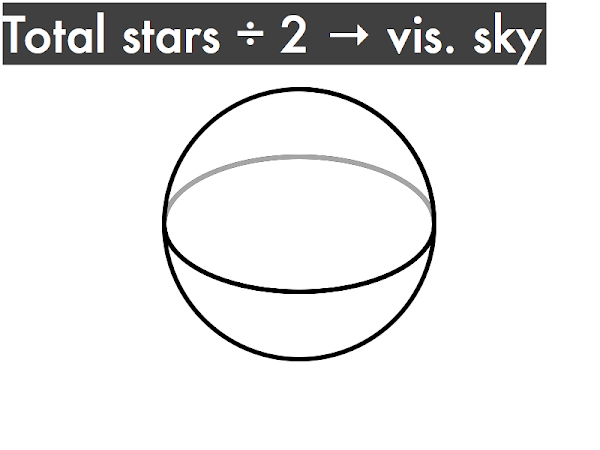
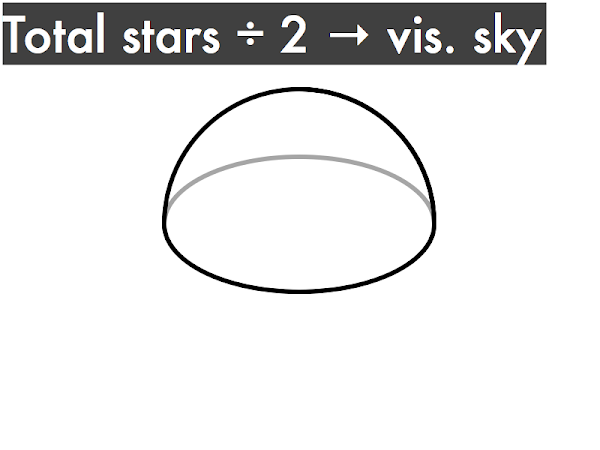
But since this 1600 is the stars in the entire celestial sphere, and you can only see half of the celestial sphere above the horizon at any given time, then under these lighting conditions (22 stars in Orion's Torso, limiting magnitude +4.93), there would be expected to be only 1600/2 = 800 stars in the night sky.
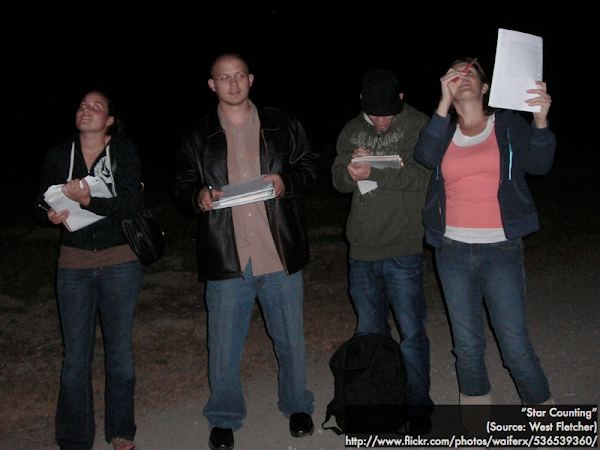
After completing this laboratory, you should then be successfully trained star counters, and can find the limiting magnitude (and total number of visible stars in the sky) at various locations around San Luis Obispo county. Good times.

EQUIPMENT
Cuesta ThinkPad(TM) laptops (wireless networking, internet browser)
(appropriate, responsible in-class use of personal laptops allowed)
Orion's Torso light pollution star charts
"Orion's Torso Stars, Ranked by Apparent Magnitude" table
"Number of Celestial Sphere Stars versus Limiting Magnitude" graph
meter sticks (1 m)
rulers

CURRENT EVENTS QUIZ
(First 10 minutes of laboratory.)

BRIEFING
Limiting Magnitude (*.pdf) (*.mov)

BIG IDEA
Star brightnesses in the night sky are quantified by (apparent) magnitudes; man-made (and moon) light pollution limits the stars that can be seen with the naked eye.

GOAL
Students will conduct a series of inquiries about the magnitudes of stars using printed-out simulations of key asterisms, and be able to locate these asterisms using internet simulations and in the night sky for potential observations.

COMPUTER SETUP
Access the Heavens Above website for your campus by clicking on the appropriate link below, and then select "Astronomy > Sky Chart":
*Bowen Observatory, San Luis Obispo campus (*.html)
*Telescope shelter, North County campus (*.html)

You should now see a star chart for the current time/date, where north is at the top, and west is to the right.

TASKS
1. Exploration
"Orion's Torso" is not a true constellation, but an asterism made up of the brightest stars of the central part of the constellation Orion. You will determine when Orion's Torso will be highest overhead on the next available moon-less night. Then you will simulate counting the visible stars on and inside Orion's Torso, in order to determine the limiting magnitude, and the total number of visible stars in the sky.

a. Advance the time such that Orion's Torso is highest overhead tonight. If the sun and/or moon is visible anywhere in the sky, you will need to advance the date and adjust the time to find a moon-less date/time later this semester, within the next month or so when Orion's Torso is highest overhead at night. Record the following date/time below:

Available moon-less night within next month or so: __________.
Orion's Torso highest overhead time (to within +/- 10 min): __________.

b. Use a meter stick to space yourself at least 1.0 meter away from charts showing Orion's Torso under various conditions (dark sky, suburban sky, and urban sky). Count the number of stars visible on or within Orion's Torso (include the "corner stars"). Do this individually first, then determine the average result in your group for each viewing condition.

Dark sky average count: __________.
Suburban sky average count: __________.
Urban sky average count: __________.

c. Refer to the "Orion's Torso Stars, Ranked by Apparent Magnitude" table, which lists Orion's Torso stars, ranked from brightest to dimmest, along with the value of their apparent magnitude, denoted by m. List the names of Orion's Torso stars (if any) that are brighter than Polaris (the "North Star," a +2.00 magnitude star).

Stars brighter than Polaris in Orion's Torso (if any): __________.

d. The limiting magnitude corresponds to the dimmest star that can be seen under given viewing conditions. Using the "Orion's Torso Stars, Ranked by Apparent Magnitude" table, determine the average limiting magnitude value for your group for each viewing condition.

Dark sky limiting magnitude: __________.
Suburban sky limiting magnitude: __________.
Urban sky limiting magnitude: __________.

e. Refer to the "Number of Celestial Sphere Stars versus Limiting Magnitude" graph, which allows you to look up the total number N of visible stars in the entire celestial sphere, given a limiting magnitude from +1.00 to +6.00. (Divide N by two to get the number of visible stars in the sky, as it is only possible to see half of the entire celestial sphere at any given time.) From your limiting magnitudes in (d), use this graph to determine the total number of visible stars in the sky for each viewing condition.

Dark sky visible stars: __________.
Suburban sky visible stars: __________.
Urban sky visible stars: __________.

f. What generalization statements, in a complete sentences, can you make about (1) how the limiting magnitude changes with respect to light pollution; and (2) how the number of visible stars in the sky changes with respect to light pollution?

Generalization statements: __________.

Each person in your group should summarize their own Exploration answers, to be turned in today and selected randomly to be graded for their group(*).

2. Does Evidence Match a Given Conclusion?
Consider the following claim:
"In the center of a city, where the naked-eye limiting magnitude due to extreme amounts of light pollution can be [+4] or less, as few as 200 to 500 stars are visible [in the sky]."
--http://en.wikipedia.org/wiki/Naked_eye
Would you agree or disagree with this generalization based on the methods/evidence used in the previous task? Explain your reasoning and provide specific evidence from data to support your reasoning(*).

3. What Conclusions Can You Draw From This Evidence?
Due to campus streetlights, and from the neighboring Camp San Luis Obispo and the California Men's Colony, the Bowen Observatory on the roof of Building 2400 on the San Luis Obispo campus experiences a certain amount of light pollution.

What conclusions and generalizations can you make from data collected by Cuesta College Astronomy 210L students in spring 2006-2010 in terms of "Does the Bowen Observatory experience light pollution comparable to other suburban areas in San Luis Obispo county?"

Location:Orion's Torso stars:
Morro Bay27
South San Luis Obispo40
Creekside Farms, Paso Robles    21
San Miguel19
Santa Margarita35
Morro Bay23
Central San Luis Obispo19
Central San Luis Obispo17
Bishop's Peak30
Just off Cal Poly campus25
Cal Poly campus23
Templeton20
Bowen Observatory14, 13, 19, 17, 16, 17

Explain your reasoning and provide specific evidence to support your reasoning(*).

4. What Evidence Do You Need to Pursue?
Describe precisely what evidence you would need to collect in order to answer the research question of, "Is there more or less light pollution at the star party location on the North County campus (at the Telescope Shelter) than at the Bowen Observatory on the San Luis Obispo campus (Building 2400)?" You do not need to actually complete the steps in the procedure you are writing.

Create a detailed, step-by-step description of evidence that needs to be collected and a complete explanation of how this could be done--not just "Drive to each location and count stars," but exactly what would someone need to do, step-by-step, to accomplish this. You might include a table and sketches--the goal is to be precise and detailed enough that someone else could follow your procedure by simply checking off each step, without having to "interpret" the instructions(*). (Note: be sure to specify a moon-less date/time at least one week from today that these observations can be made.) Write up your procedure on whiteboards(*), to be worked on and presented as a group.

Reference: