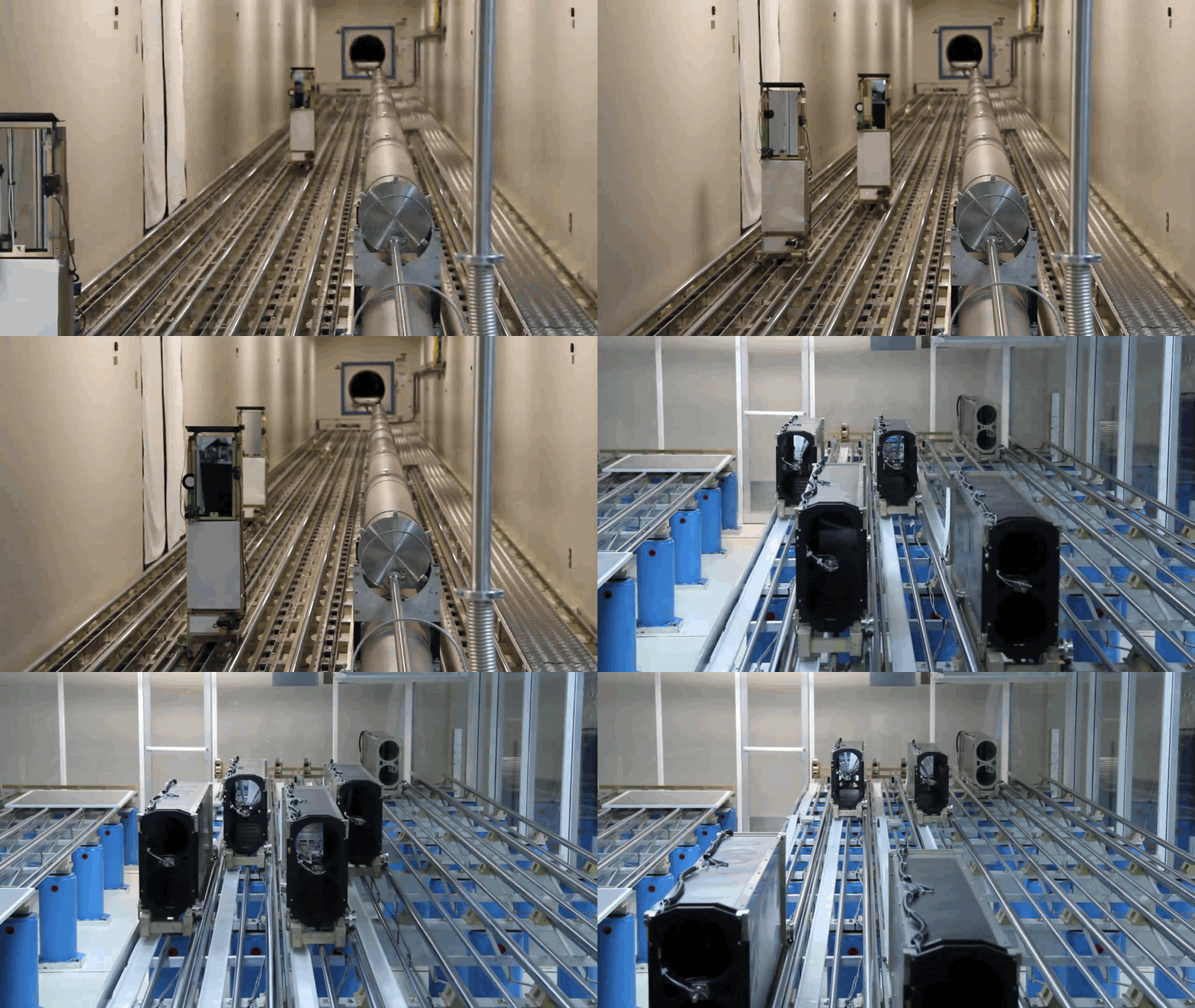
Showing posts with label interferometry. Show all posts

20191022

Astronomy quiz question: Balloon Experimental Twin Telescope for Infrared Interferometry (BETTII)

Astronomy 210 Quiz 3, fall semester 2019
Cuesta College, San Luis Obispo, CA

"BETTII3_low.jpg"
NASA Goddard Space Flight Center
asd.gsfc.nasa.gov/bettii/

The two far-infrared reflector telescopes of the Balloon Experimental Twin Telescope for Infrared Interferometry (BETTII)[*] have the same 0.50 m (1.6 ft) diameter, and are separated by a distance of 8.0 m (26 ft) between them. This telescope system is attached to a balloon that ascends to an altitude of 40 km (25 miles) in the upper atmosphere.[**] Taking this far-infrared telescope system into the upper atmosphere improves the light-gathering power due to less __________ at high altitudes.
(A) absorption.
(B) turbulence.
(C) light pollution.
(D) temperature fluctuations.

[*] S. A. Rinehart ; R. B. Barclay ; R. K. Barry ; D. J. Benford ; P. C. Calhoun, et al., "Design and status of the Balloon Experimental Twin Telescope for infrared interferometry (BETTII): an interferometer at the edge of space," Proc. SPIE 8445, Optical and Infrared Interferometry III, 844508 (September 12, 2012), dx.doi.org/10.1117/12.926376.
[**] asd.gsfc.nasa.gov/bettii/.


Correct answer (highlight to unhide): (A)

Far-infrared light entering the top of the atmosphere from space does not make it down to sea level (the bottom edge of the graph), due to absorption of this wavelength by the atmosphere. However, it can still be detected in the upper atmosphere, as has traveled a shorter distance through the atmosphere, where there was less absorption (primarily due to water vapor).

Section 70158
Exam code: quiz03St3M
(A) : 3 students
(B) : 11 students
(C) : 17 students
(D) : 1 student

Success level: 15% (including partial credit for multiple-choice)
Discrimination index (Aubrecht & Aubrecht, 1983): 0.25

Section 70160
Exam code: quiz03Nz6L
(A) : 0 students
(B) : 8 students
(C) : 12 students
(D) : 2 students

Success level: 5% (including partial credit for multiple-choice)
Discrimination index (Aubrecht & Aubrecht, 1983): 0

20191008

Astronomy quiz question: Balloon Experimental Twin Telescope for Infrared Interferometry (BETTII)

Astronomy 210 Quiz 3, fall semester 2014
Cuesta College, San Luis Obispo, CA

"BETTII3_low.jpg"
NASA Goddard Space Flight Center
asd.gsfc.nasa.gov/bettii/

The two far-infrared reflector telescopes of the Balloon Experimental Twin Telescope for Infrared Interferometry (BETTII)[*] have the same 0.50 m (1.6 ft) diameter, and are separated by a distance of 8.0 m (26 ft) between them. This telescope system is attached to a balloon that ascends to an altitude of 40 km (25 miles) in the upper atmosphere.[**] If the two mirrors of this telescope system were instead combined into a single mirror with the same total surface area, the resolving power would:
(A) decrease.
(B) remain the same.
(C) increase.
(D) (The telescope would no longer be able to function.)

[*] S. A. Rinehart ; R. B. Barclay ; R. K. Barry ; D. J. Benford ; P. C. Calhoun, et al., "Design and status of the Balloon Experimental Twin Telescope for infrared interferometry (BETTII): an interferometer at the edge of space," Proc. SPIE 8445, Optical and Infrared Interferometry III, 844508 (September 12, 2012), dx.doi.org/10.1117/12.926376.
[**] asd.gsfc.nasa.gov/bettii/.

Correct answer (highlight to unhide): (A)

Increasing the distance between telescopes creates a much larger effective diameter to increase resolving power. Thus decreasing this separation distance would decrease resolving power.

Section 70158
Exam code: quiz03s8tE
(A) : 27 students
(B) : 8 students
(C) : 5 students
(D) : 0 students
(No response: 1 student)

Success level: 66% (including partial credit for multiple-choice)
Discrimination index (Aubrecht & Aubrecht, 1983): 0.45

Section 70160
Exam code: quiz03n6n4
(A) : 24 students
(B) : 7 students
(C) : 4 students
(D) : 0 students

Success level: 72% (including partial credit for multiple-choice)
Discrimination index (Aubrecht & Aubrecht, 1983): 0.60

20160215

Video: "Keck in Motion" excerpts

"Keck in Motion"
Andrew Cooper
vimeo.com/36442707

Excerpts for whole-class discussion (ask students: "what do you notice is going on?")


20151003

Astronomy quiz question: comparing infrared telescope resolutions

Astronomy 210 Quiz 3, fall semester 2015
Cuesta College, San Luis Obispo, CA

In 2004, NASA's Stratospheric Observatory for Infrared Astronomy (SOFIA) is a 2.5 m diameter reflecting telescope that was first operated at ground level for testing purposes.[*] If the Hubble Space Telescope's 2.4 m diameter reflecting telescope had also been tested at ground level, it would have made near-infrared observations with _________ amount of resolving power compared to the SOFIA telescope at ground level.
(A) a lesser.
(B) the same.
(C) a greater.
(D) (Not enough information is given.)

[*] sofia.usra.edu/News/releases/pr_2004/OnSky.pdf .

Correct answer (highlight to unhide): (A)

Resolving power depends on the diameter of the primary mirror of a telescope, such that when both making observations at ground level, the Hubble Space Telescope's slightly smaller diameter would have slightly less resolving power compared to the SOFIA telescope, which has a slightly larger diameter and thus slightly more resolving power.

Section 70158
Exam code: quiz03Sss5
(A) : 32 students
(B) : 7 students
(C) : 1 student
(D) : 2 students

Success level: 78% (including partial credit for multiple-choice)
Discrimination index (Aubrecht & Aubrecht, 1983): 0.36

Section 70160
Exam code: quiz03Nnnn
(A) : 14 students
(B) : 5 students
(C) : 6 students
(D) : 4 students

Success level: 51% (including partial credit for multiple-choice)
Discrimination index (Aubrecht & Aubrecht, 1983): 0.38

20150307

Astronomy quiz question: Combined Array for Research in Millimeter-wave Astronomy interferometry

Astronomy 210 Quiz 3, spring semester 2015
Cuesta College, San Luis Obispo, CA

"CARMA_2012_11.jpg"
Mike Peel
commons.wikimedia.org/wiki/File:CARMA_2012_11.jpg.

The Combined Array for Research in Millimeter-wave Astronomy (CARMA)[*] is a facility in the Inyo Mountains near Big Pine, CA that has 23 separate radio telescope dishes that are together used as an interferometer. These radio telescope dishes were spread out from each other to improve:
(A) light-gathering power.
(B) resolving power.
(C) magnifying power.
(D) the amount of radio waves received through the atmosphere.

[*] mmarray.org.

Correct answer (highlight to unhide): (B)

Spreading out these interconnected dishes creates a much larger effective diameter to increase resolving power.

Section 30674
Exam code: quiz03n4T7
(A) : 12 students
(B) : 21 students
(C) : 3 students
(D) : 5 students

Success level: 54% (including partial credit for multiple-choice)
Discrimination index (Aubrecht & Aubrecht, 1983): 0.86

20130228

Astronomy quiz question: adaptive optics

Astronomy 210 Quiz 3, spring semester 2013
Cuesta College, San Luis Obispo, CA

Adaptive optics improves the resolution of telescope images by using a computer to rapidly:
(A) change the humidity inside the tube.
(B) trigger a laser to heat up the atmosphere.
(C) combine the light collected by several connected telescopes.
(D) adjust the shape of the mirror.

Correct answer: (D)

Distortions in images caused by atmospheric turbulence can be removed in real-time by using a computer to reshape the (secondary) mirror such that a reference star (or a laser beam) within the field of view has a point-like shape. Response (C) is interferometry (which also improves the resolution of telescope images).

Section 30676
Exam code: quiz03sPmP
(A) : 0 students
(B) : 0 students
(C) : 17 students
(D) : 27 students

Success level: 64% (including partial credit for multiple-choice)
Discrimination index (Aubrecht & Aubrecht, 1983): 0.55

20120927

Astronomy quiz question: HESS interferometry

Astronomy 210 Quiz 3, fall semester 2012
Cuesta College, San Luis Obispo, CA

Consider two of the High Energy Stereoscopic System telescopes, located near Windhoek, Namibia. These two reflector telescopes have different diameters, and different focal lengths. These and other HESS telescopes were constructed to be spread out from each other to improve:
(A) light-gathering power.
(B) resolving power.
(C) magnifying power.
(D) (Two of the above choices.)
(E) (All of the above choices.)
(F) (None of the above choices.)

(Image credit: HESS Collaboration/Stefan Schwarzburg, http://www.mpi-hd.mpg.de/hfm/HESS/pages/press/2012/HESS_II_first_light/.)

Correct answer: (B)

Increasing the distance between telescopes creates a much larger effective diameter to increase resolving power.

Section 70158
Exam code: quiz03s3Er
(A) : 2 students
(B) : 20 students
(C) : 1 student
(D) : 7 students
(E) : 6 students
(F) : 1 student

Success level: 58% (including partial credit for multiple-choice)
Discrimination index (Aubrecht & Aubrecht, 1983): 0.50

Section 70160
Exam code: quiz03ni3R
(A) : 3 students
(B) : 17 students
(C) : 3 students
(D) : 4 student
(E) : 2 students
(F) : 0 students

Success level: 62% (including partial credit for multiple-choice)
Discrimination index (Aubrecht & Aubrecht, 1983): 0.56

20120226

Astronomy quiz question: Large Binocular Telescope interferometry

Astronomy 210 Quiz 3, spring semester 2012
Cuesta College, San Luis Obispo, CA

Consider the Large Binocular Telescope located at Mt. Graham, AZ. The mirrors of these two optical telescopes are separated from each other to improve:
(A) light-gathering power.
(B) resolving power.
(C) magnifying power.
(D) (Two of the above choices.)
(E) (All of the above choices.)
(F) (None of the above choices.)

(Image credit: Large Binocular Telescope/NASA, http://www.nasa.gov/topics/universe/features/lbti20101206-i.html.)

Correct answer: (B)

Increasing the distance between connected telescopes creates a much larger effective diameter to increase resolving power.

Section 30674
Exam code: quiz03n0T7
(A) : 5 students
(B) : 23 students
(C) : 2 students
(D) : 3 students
(E) : 0 students
(F) : 0 students

Success level: 73% (including partial credit for multiple-choice)
Discrimination index (Aubrecht & Aubrecht, 1983): 0.89

Section 30676
Exam code: quiz03SL3w
(A) : 12 students
(B) : 18 students
(C) : 2 students
(D) : 4 students
(E) : 2 students
(F) : 2 students

Success level: 50% (including partial credit for multiple-choice)
Discrimination index (Aubrecht & Aubrecht, 1983): 0.60

20111002

Astronomy quiz question: interferometry

Astronomy 210 Quiz 3, fall semester 2011
Cuesta College, San Luis Obispo, CA

Interferometry improves the resolution of visible light telescope images by:
(A) changing the humidity inside the tube.
(B) triggering a laser to heat up the atmosphere.
(C) using a computer to adjust the shape of the mirror.
(D) combining the light collected by several connected telescopes.

Correct answer: (D).

The distance between several connected telescopes acts as a much larger effective diameter to increase resolving power. Response (C) is adaptive optics (which also improves the resolution of telescope images).

Section 70160
Exam code: quiz03N1rE
(A) : 3 students
(B) : 1 student
(C) : 11 students
(D) : 12 students

Success level: 50% (including partial credit for multiple-choice)
Discrimination index (Aubrecht & Aubrecht, 1983): 0.14

20111001

Astronomy quiz question: adaptive optics

Astronomy 210 Quiz 3, fall semester 2011
Cuesta College, San Luis Obispo, CA

Adaptive optics improves the resolution of telescope images by using a computer to rapidly:
(A) change the humidity inside the tube.
(B) trigger a laser to heat up the atmosphere.
(C) combine the light collected by several connected telescopes.
(D) adjust the shape of the mirror.

Correct answer: (D)

Distortions in images caused by atmospheric turbulence can be removed in real-time by using a computer to reshape the (secondary) mirror such that a reference star (or a laser beam) within the field of view has a point-like shape. Response (C) is interferometry (which also improves the resolution of telescope images).

Section 70158
Exam code: quiz03sO1L
(A) : 1 student
(B) : 1 student
(C) : 17 students
(D) : 15 students

Success level: 59% (including partial credit for multiple-choice)
Discrimination index (Aubrecht & Aubrecht, 1983): 0.71

20101003

Astronomy quiz question: telescope interferometry

Astronomy 210 Quiz 3, Fall Semester 2010
Cuesta College, San Luis Obispo, CA

Increasing the separation distance between several small diameter telescopes that combine their light would increase their:
(A) light-gathering power.
(B) resolving power.
(C) magnifying power.
(D) (None of the above choices.)

Correct answer: (B)

Resolving power depends on the diameter of the primary of a single telescope, or on the greatest separation distance between several telescopes used as an interferometer (thus acting as "edge fragments" of a much larger telescope). Separating several small telescopes does not affect their collective light-gathering power, nor their magnifying power.

Section 70158
(A) : 15 students
(B) : 28 students
(C) : 3 students
(D) : 1 student

Success level: 64% (including partial credit for multiple-choice)
Discrimination index (Aubrecht & Aubrecht, 1983): 0.53

Section 70160
(A) : 17 students
(B) : 22 students
(C) : 1 student
(D) : 0 students

Success level: 57% (including partial credit for multiple-choice)
Discrimination index (Aubrecht & Aubrecht, 1983): 0.52

20080922

Astronomy clicker question: interferometry

Astronomy 210, Fall Semester 2008
Cuesta College, San Luis Obispo, CA

Students were asked the following clicker question (Classroom Performance System, einstruction.com) at the end of their learning cycle:


What disadvantage does the proposed Thirty Meter Telescope have, compared to the combination of the two W. M. Keck Observatory telescopes used as an interferometer?
(A) Light-gathering power.
(B) Resolving power.
(C) Magnifying power.
(D) (More than one of the above choices.)
(E) (None of the above choices.)
(F) (I'm lost, and don't know how to answer this.)

Section 70158
(A) : 12 students
(B) : 30 students
(C) : 10 students
(D) : 9 students
(E) : 4 students
(F) : 0 students

This question was asked again after displaying the tallied results with the lack of consensus, with the following results. No comments were made by the instructor, in order to see if students were going to be able to discuss and determine the correct answer among themselves.

Section 70158
(A) : 2 students
(B) : 51 students
(C) : 8 students
(D) : 2 students
(E) : 1 student
(F) : 1 student

Correct answer: (B)

Light-gathering power depends on the area of the primary mirror (or lens) of a telescope, while the resolving power depends on the diameter of the primary mirror, whether it is a single contiguous piece (as for the Thirty Meter Telescope), or separated components (as for the Keck Interferometer).

Pre- to post- peer-interaction gains:
pre-interaction correct = 46%
post-interaction correct = 78%
Hake (normalized) gain <g> = 60%