20150311

Presentation: circuit basics

Wet plywood. Wires clipped to nails. Wires connected to a source of 15,000 volts. What could be more beautiful than this basic circuit? Or dangerous? (Video link: 15,000 volts.")

In this presentation we will take a first look at the basics of basic circuits. As with the set-up above, some of these very basic circuits are also very dangerous, so unless you absolutely know what you're doing (that is to say, you know enough physics to understand the perils involved), do not try these at home!

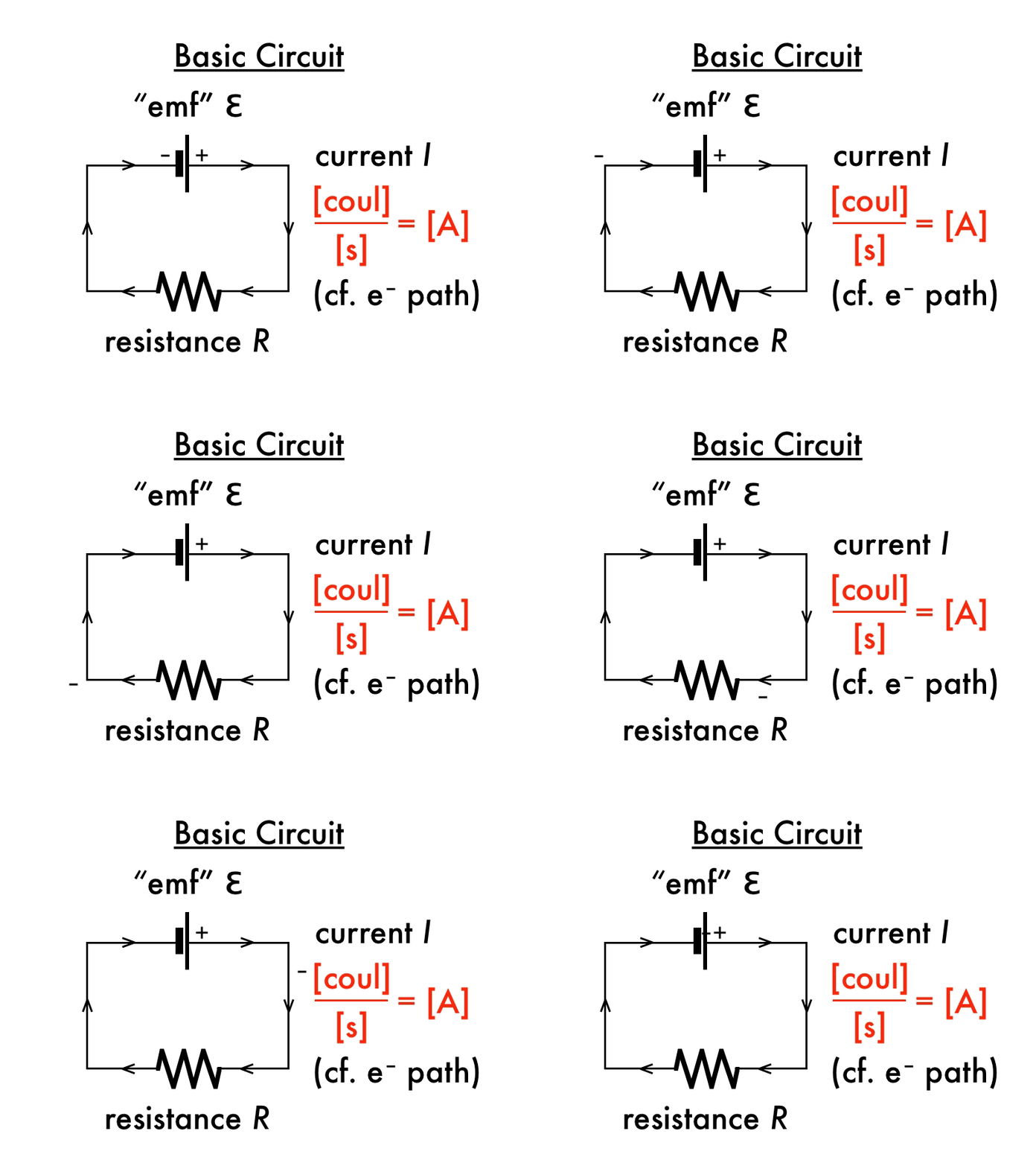
The most basic circuit we can build will have an ideal "electromotive" (emf) source of voltage connected to a resistor, such that charges can flow continuously around and around. Peculiarly the definition of current is the amount of positive charge (in coulombs (C)) that circulates per time (in seconds (s)), and these units of C/s are defined as amps (A). But as discussed in a previous presentation, in a conductor it is actually the negatively charged electrons that are free to move. So by convention we refer to "current" flowing clockwise through this circuit, while the electrons actually circulate in the opposite counterclockwise direction through this circuit. Just keep watching this GIF animation for a while until you get used to those current direction concepts. More on emf sources and resistors below, when you're ready.

An ideal battery uses chemical reactions that exchange charges in order to release electric potential energy, giving potential (that is, electric potential energy per charge, or voltage, measured in volts (V)) to the charges that circulate in a circuit.

Different chemical reactions will release different amounts of electric potential energy per charge, and thus different amounts of voltage. Note that these different batteries all have the same "AA" size, but the different chemical reactants inside (nickel metal hydride (NiMh), alkaline, or lithium) release different amounts of voltage (∆V = 1.2 V, 1.5 V, or 3.6 V, respectively). (Ideally the amount of voltage provided will be constant; but later we'll consider the effects of depleting the reactants inside "real" batteries, and the effect this has on their actual voltage output over time.)

Some larger voltage batteries are made up of a combination of individual batteries, in order to "stack" the voltage output ∆V, which is cumulative provided that their terminals are connected (+) to (-), etc. The result of stacking six individual 1.5 V alkaline batteries results in a single 9.0 V battery, as seen in several different stacking configurations.

The other part of a basic circuit is a resistor, which uses up voltage (electric potential energy per charge) as current flows through it. Different types of materials and shapes and sizes will result in different resistance values, measured in ohms (Greek letter Ω). (This is the inverse of conductance, so a good conductor (such as a metal wire) will have a low resistance value, while a poor conductor (such as an insulator) will have a high resistance value.)

If several resistors (here, Christmas light bulbs) are strung together in a line, forcing current to flow through each one in turn, then the equivalent resistance is their individual resistances added together. (This is not the only possible way to wire together resistors, but we'll stick to this basic configuration for now.)

Ohm's law can be applied to a basic circuit to determine how much current will flow in it, given the total amount of voltage from ideal batteries, and the equivalent resistance of all the resistors. Note how the different units are related in Ohm's law: a volt over an ohm is equivalent to an ampere, etc. (After a certain point you will just have to trust that all these units will work out in the end.)

So let's look at some very basic, very dangerous circuits.

We can use a wire (which has a very low resistance) to complete a basic circuit, connecting it to the (+) and (-) terminals of a 9.0 V (ideal) battery. Note the very small spark of current that leaps across the gap just as the wire completes the circuit. Now an absurd configuration of 244 9.0 V batteries are stacked with (+) terminals to (-) terminals. (How much emf voltage is that?) When a wire is connected to complete this stacked battery circuit, how does the amount of emf voltage compare to the single 9.0 V battery circuit? How does the amount of current compare to the single 9.0 V battery circuit? (Video source: "Fun with a few 9V batteries. (244 of them).")

Our next very dangerous basic circuit involves deionized water, itself a relatively poor conductor, as there are no free charges in it to transport current, so connecting a basic circuit of water with a household 120 V outlet as an emf source (where the light bulb is used to indicate the amount of current that is flowing) doesn't yield much current. When salt is poured into the water, introducing charged sodium (Na+) and chloride (Cl-) ions, how did the amount of resistance of this circuit change? How did the amount of current through this circuit change? (Video source: "Experiment electricity with saltwater.")

Our last very dangerous basic circuit is a power transformer used as an emf source, with a metal screw used to complete the circuit. This will result in a "short circuit," which is due to a very large or very small resistance? Does a very large or very small current result? (Video source: "The Metal Melter.")

In subsequent presentations we will go over more specific rules of circuit analysis for more complex configurations of emf sources and resistors, and power dissipation.

20150308

Astronomy quiz archive: eclipses/history of astronomy

Astronomy 210 Quiz 2, spring semester 2015
Cuesta College, San Luis Obispo, CA

Section 30674, version 1
Exam code: quiz02n4S7


Section 30674
0- 8.0 :  
8.5-16.0 :   *** [low = 11.0]
16.5-24.0 :   *************
24.5-32.0 :   ************** [mean = 26.2 +/- 7.7]
32.5-40.0 :   ********** [high = 40.0]


Section 30676, version 1
Exam code: quiz05s7yK


Section 30676
0- 8.0 :  
8.5-16.0 :   *** [low = 12.0]
16.5-24.0 :   **********
24.5-32.0 :   **************** [mean = 28.8 +/- 7.7]
32.5-40.0 :   ****************** [high = 40.0]

20150307

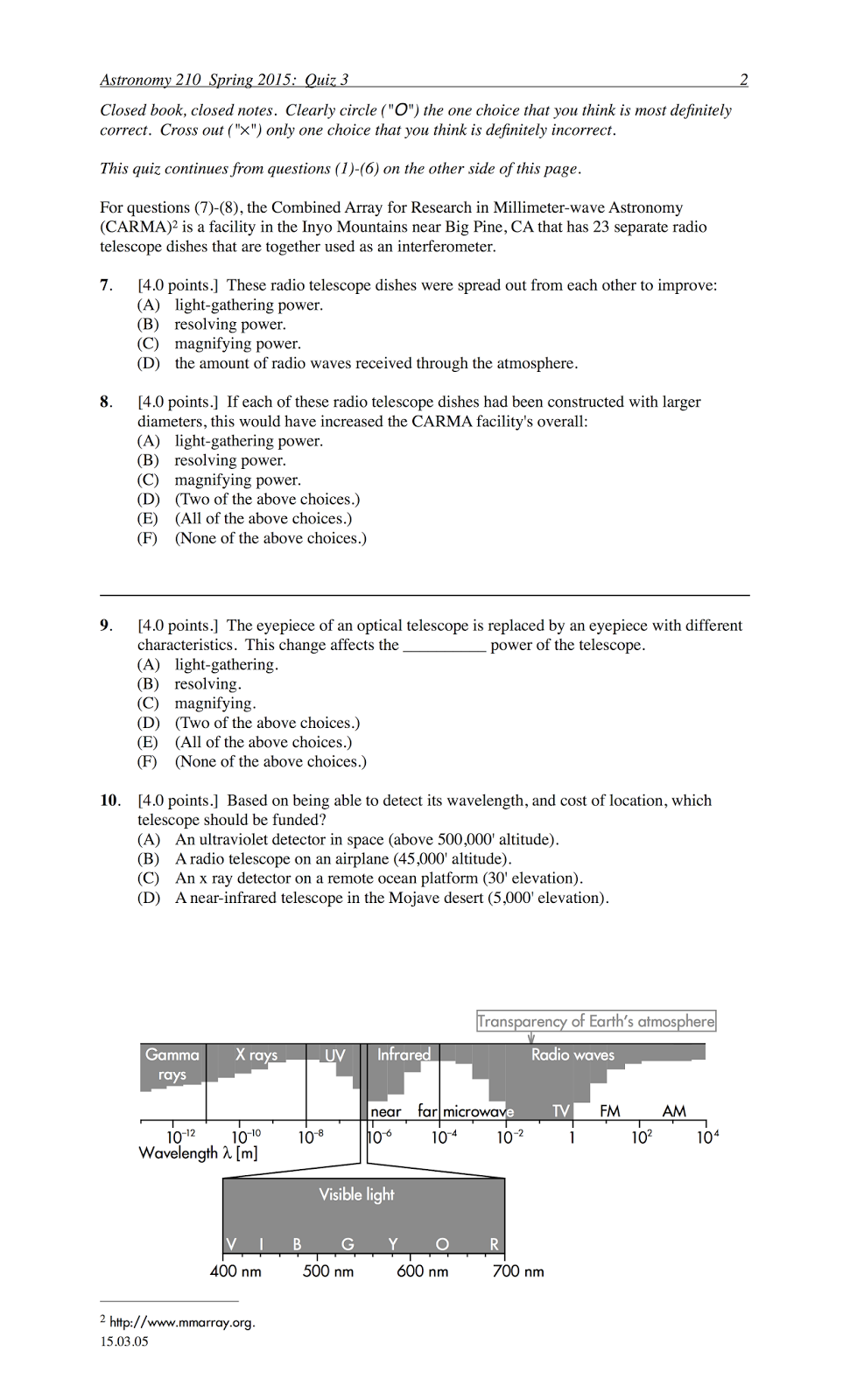
Astronomy quiz archive: telescopes

Astronomy 210 Quiz 3, spring semester 2015
Cuesta College, San Luis Obispo, CA

Section 30674, version 1
Exam code: quiz03n4T7


Section 30674
0- 8.0 :   ** [low = 8.0]
8.5-16.0 :   *******
16.5-24.0 :   ************* [mean = 23.6 +/- 8.7]
24.5-32.0 :   ***********
32.5-40.0 :   ******** [high = 40.0]


Section 30676
Exam code: quiz03SeR0


Section 30676
0- 8.0 :   * [low = 4.0]
8.5-16.0 :   **********
16.5-24.0 :   ************* [mean = 23.7 +/- 8.1]
24.5-32.0 :   ********************
32.5-40.0 :   ********* [high = 36.5]

20150304

Physics quiz archive: lenses, optical instruments

Physics 205B Quiz 2, spring semester 2015
Cuesta College, San Luis Obispo, CA
Sections 30882, 30883, version 1
Exam code: quiz02r0cK


Sections 30882, 30883 results
0- 6 :  
7-12 :   ******* [low = 9]
13-18 :   *************
19-24 :   ****************** [mean = 19.9 +/- 5.7]
25-30 :   ************** [high = 30]

20150211

Physics quiz archive: electromagnetic waves, reflection/refraction

Physics 205B Quiz 1, spring semester 2015
Cuesta College, San Luis Obispo, CA
Sections 30882, 30883, version 1
Exam code: quiz01c0Co


Sections 30882, 30883 results
0- 6 :   *** [low = 6]
7-12 :   ***
13-18 :   ***********
19-24 :   ************************* [mean = 19.9 +/- 5.7]
25-30 :   ****** [high = 30]

20150207

Astronomy quiz archive: stars/sun/seasons/moon phases

Astronomy 210 Quiz 1, spring semester 2015
Cuesta College, San Luis Obispo, CA

Section 30674, version 1
Exam code: quiz01nW0r


Section 30674
0- 8.0 :  
8.5-16.0 :   *** [low = 11.0]
16.5-24.0 :   ****************
24.5-32.0 :   ***************** [mean = 24.8 +/- 6.4]
32.5-40.0 :   ****** [high = 36.5]


Section 30676, version 1
Exam code: quiz01Su8L


Section 30676
0- 8.0 :   *** [low = 4.0]
8.5-16.0 :   ***************
16.5-24.0 :   ********** [mean = 22.1 +/- 7.9]
24.5-32.0 :   ************************
32.5-40.0 :   *** [high = 36.0]

20150120

Presentation: instructor background

(Slides shown introducing the instructor for the first day of class.)


...let's talk about the most important component of this course...me.  So let me introduce myself--I'm Dr. Len, which is a bit formal, so I'm kind of just 'meh' about that.

If you want to get a bit less formal and more friendly, I'm okay with being on a first-name basis in class.

And if you really want to get on my good side, you can call me...'P-dog.'  Remember, there are only two types of students in this class--those that can call me 'P-dog,' and those that just can't.  You'll figure it out soon enough.  It's not that hard.


Some deep background about my education.  I was born and raised in Hawaii, and I graduated from my hometown high school in Aiea, which is the notably the only city in the U.S. that does not have any consonants in it.

Then I went away to Washington University in St. Louis, Missouri, and took a lot of math and fine arts classes, until declaring a major in physics at the end of my second year.  As a result I have a B.A.--a liberal arts degree--in physics, along with double minors in both math and fine arts.

Since I wanted to be able to teach physics, I needed to get a graduate degree, so after seven years of evil doctor school at UC-Davis, I got my Ph.D. in physics.

After getting my Ph.D. at UC-Davis, I also taught introductory physics there for six years as a lecturer.  My UC-Davis students freaked me out, because they were in a very competitive pre-med program, which made them very sensitive about their grades.  And they were just weird, in general.

Which is why Mrs. P-dog and I decided to move to where students keep it more real.  Which would be Cuesta College.  We've been here more than 14 years, and we like it here.


20150110

Astronomy in-class activity: planet-hunting

Astronomy 210 In-class activity 6 v.15.01.10, spring semester 2015
Cuesta College, San Luis Obispo, CA

Students find their assigned groups of three to four students, and work cooperatively on an in-class activity worksheet to determine where in the sky each naked-eye planet will be observed on a given date (here, February 4, 2015).


Previous posts:

Astronomy in-class activity: telescope powers

Astronomy 210 In-class activity 8 v.16.09.17, fall semester 2016
Cuesta College, San Luis Obispo, CA

Students find their assigned groups of three to four students, and work cooperatively on an in-class activity worksheet to measure tube lengths and diameters on actual telescopes set up in the classroom, and then rank them in terms of relative light-gathering, resolving, and magnifying powers.

San Luis Obispo campus telescopes:


North County campus telescopes:


20150109

Astronomy in-class activity: star cluster age

Astronomy 210 In-class activity 18 v.15.01.09, spring semester 2015
Cuesta College, San Luis Obispo, CA

Students find their assigned groups of three to four students, and work cooperatively on an in-class activity worksheet on comparing evolution rates of different-mass stars, and ranking relative star cluster ages given their H-R diagrams.