20170525

Presentation: marketplace astronomy (results)

Let's compare your results with students from a previous semester. Here is the word tag cloud generated by Wordle.net for astronomy-related car makes and models. Frequently-listed cars are larger, while cars used only once are smallest. How many of these cars were you able to list? Anyone have cars not listed here?

Here is the word tag cloud for astronomy-related food brand names from a previous semester. Again, frequently-listed brands are larger, while brand names used only once are smallest. How many of these brand names were you able to list? Anyone have brand names not listed here?

Astronomy-related non-food brand names from a previous semester. Again, how many of these brand names were you able to list? Anyone have brand names not listed here?

Now we have potentially interesting astronomy topics from another previous semester. A lot of you are looking forward to learning about "black holes" this semester. Anyone have interesting topics not listed here?

And potentially confusing astronomy topics from another previous semester. "Black holes" is prominent here as well! Anyone have interesting topics not listed here? (Some of you may consider "math" as potentially confusing--yes, there is an algebra math prerequisite for this course, but there are no explicit calculations as we'll be focusing on graphs, dependencies, and proportionalities--essentially math without equations.)

And we have time to answer a few of your questions and comments.

"If you discovered a planet, P-dog, what would you name it?"
I would name it after my wife. I would name it: "Mrs. P-dog."
"Do you believe in aliens? Or life on other planets?"
Yes, and yes. I would bet money on it. I would bet $1. And I would win. But if I lost, it'd just be $1.
"Do you think Pluto should still be a planet?"
Let me tell you a story of my senior year in high school, way back when. I turned 18 during my senior year, and that was a big deal because you only needed to be 18 to be able to purchase and drink alcohol. My senior year was awesome. Commencement was awesome. Graduation parties were awesome...until a few years later, when the legal drinking age was raised from 18 to 21. And there was no grandfather clause. So before, it was legal for me to drink; but afterwards, I was no longer allowed to drink anymore. And that wasn't fair... So when it comes to Pluto, which was a planet, and then rules were changed so it is now no longer a planet, and there was no grandfather clause--I say, suck it up, Pluto.

Previous posts:

20170513

Physics quiz archive: radioactive decay, Feynman diagrams

Physics 205B Quiz 7, spring semester 2017
Cuesta College, San Luis Obispo, CA
Sections 30882, 30883, version 1
Exam code: quiz07N4ci


Sections 30882, 30883 results
0- 6 :   **** [low = 0]
7-12 :   ************** [mean = 10.5 +/- 6.1]
13-18 :   *****
19-24 :   *
25-30 :   * [high = 27]

20170510

Astronomy quiz archive: Milky Way, cosmology

Astronomy 210 Quiz 7, spring semester 2017
Cuesta College, San Luis Obispo, CA

Section 30674, version 1
Exam code: quiz07N4rR


Section 30674
0- 8.0 :   * [low = 6.5]
8.5-16.0 :   ******
16.5-24.0 :   ***** [mean = 20.9 +/- 7.7]
24.5-32.0 :   *****
32.5-40.0 :   ** [high = 36.0]


Section 30676, version 1
Exam code: quiz07Sl1M


Section 30676
0- 8.0 :   **** [low = 4.0]
8.5-16.0 :   ********
16.5-24.0 :   ************** [mean = 20.1 +/- 7.4]
24.5-32.0 :   ************
32.5-40.0 :   ** [high = 36.5]

20170507

Physics midterm problem: pencil lead variable resistor

Physics 205B Midterm 2, spring semester 2017
Cuesta College, San Luis Obispo, CA

A real battery with an emf of 6.0 V and an internal resistance of r = 1.2 Ω is attached to an ideal voltmeter, and is connected to an ideal ammeter and a pencil lead that acts as a variable resistor. If the amount of pencil lead between the contacts is shortened such that its resistance is reduced from 8.0 Ω to 1.0 Ω, discuss why the voltmeter reading will decrease while the ammeter reading will increase. Show your work and explain your reasoning using Kirchhoff's rules, Ohm's law, and properties of ammeters and voltmeters.

Solution and grading rubric:
  • p:
    Correct. Explains why the voltmeter reading will decrease while the ammeter reading will increase as the amount of pencil lead between the contacts is shortened by discussing:
    1. the decrease in the resistance of the pencil lead resistor will reduce the equivalent resistance of the circuit (pencil lead and internal resistance are in series), such that from applying Ohm's law the amount of current passing everywhere through the circuit will increase, resulting in a higher ammeter reading; and
    2. the voltmeter measures the potential difference of the 6.0 V rise from the emf and the voltage drop Ir from the internal resistance, such that an increase in current will result in a lower voltage reading ΔV = +ε − Ir.
  • (May instead discuss how the voltmeter is equivalently measuring the voltage drop ΔV = −IR across the pencil lead resistor, but must clearly show that the eight-fold decrease in the resistance (from 8.0 Ω to 1.0 Ω) will be larger than the corresponding approximate four-fold increase in current (0.65 A to 2.7 A) to result in a lower voltage reading.)
  • r:
    Nearly correct, but includes minor math errors.
  • t:
    Nearly correct, but approach has conceptual errors, and/or major/compounded math errors. At least numerically or qualitatively demonstrates how current would increase, but does not definitely show why voltmeter reading would decrease.
  • v:
    Implementation of right ideas, but in an inconsistent, incomplete, or unorganized manner. Some attempt at applying Kirchhoff's rules, Ohm's law, and equivalent resistance.
  • x:
    Implementation of ideas, but credit given for effort rather than merit. Approach other than that of applying Kirchhoff's rules, Ohm's law, and properties of ammeters and voltmeters.
  • y:
    Irrelevant discussion/effectively blank.
  • z:
    Blank.
Grading distribution:
Sections 30882, 30883
Exam code: midterm02GruT
p: 12 students
r: 0 students
t: 8 students
v: 8 students
x: 1 student
y: 0 students
z: 0 students

A sample "p" response (from student 1412):

Another sample "p" response (from student 2643):

A sample "x" response (from student 9319):

20170429

Physics quiz archive: magnetism, induction

Physics 205B Quiz 6, spring semester 2017
Cuesta College, San Luis Obispo, CA
Sections 30882, 30883, version 1
Exam code: quiz06LnDr


Sections 30882, 30883 results
0- 6 :  
7-12 :  
13-18 :   ******** [low = 15]
19-24 :   ************** [mean = 21.8 +/- 4.1]
25-30 :   ******* [high = 30]

Astronomy midterm question: plausible AMNH classification of Ceres and asteroids?

Astronomy 210 Midterm 2, spring semester 2017
Cuesta College, San Luis Obispo, CA

An astronomer at the American Museum of Natural History proposed an alternate scheme for defining planets and non-planets[*]:
A planet is (1) a body that has swept up or scattered most of the material from its orbit around the sun, and (2) has an orbit that can never collide with another planet. A non-planet is (1) a body that has not swept up or scattered most of the material from its orbit around the sun, and (2) has an orbit that can collide with either a planet or another non-planet.
Discuss how Ceres could be considered a planet under these new rules, but the asteroids would not. Explain your answer using these new rules, and characteristics of Ceres and of the asteroids.

[*] Steven Soter, "What is a Planet?" The Astronomical Journal, vol. 132, pp. 2513-2519 (August 16, 2006), arxiv.org/pdf/astro-ph/0608359.pdf. (As discussed in this article, however, Ceres would still not be considered a planet with this new scheme.)

Solution and grading rubric:
  • p:
    Ceres is a dwarf planet that is rounded in shape and is much larger than the remainder of the asteroids, which are much smaller and are irregular in shape. Since Ceres is much larger, it can be argued that (1) if it "swept up most of the material from its orbit," and (2) since it can only collide with asteroids in its orbit, and thus can be considered a planet under these two rules. Since the asteroids are much smaller, it can be argued that (1) they did not sweep up most of the material from their orbits, and (2) are in orbits that can collide with each other or with Ceres, classifying them as non-planets.
  • r:
    Nearly correct (explanation weak, unclear or only nearly complete); includes extraneous/tangential information; or has minor errors. At least discusses three of the four points above.
  • t:
    Contains right ideas, but discussion is unclear/incomplete or contains major errors. Explicitly discusses the AMNH rules, but does not apply them correctly/consistently/completely, typically only Ceres or only asteroids, or only the first or second criteria to both.
  • v:
    Limited relevant discussion of supporting evidence of at least some merit, but in an inconsistent or unclear manner. Discussion only tangentially related to the AMNH rules.
  • x:
    Implementation/application of ideas, but credit given for effort rather than merit. Discussion unrelated to the AMNH rules.
  • y:
    Irrelevant discussion/effectively blank.
  • z:
    Blank.
Grading distribution:
Section 30674
Exam code: midterm02nDcc
p: 13 students
r: 2 students
t: 5 students
v: 1 student
x: 0 students
y: 0 students
z: 0 students

Section 30676
Exam code: midterm02sL0w
p: 28 students
r: 7 students
t: 5 students
v: 3 students
x: 0 students
y: 0 students
z: 0 students

A sample "p" response (from student 1515):

Astronomy midterm question: same absolute magnitude stars, different distances closer than 10 parsecs?

Astronomy 210 Midterm 2, spring semester 2017
Cuesta College, San Luis Obispo, CA

An astronomy question on an online discussion board[*] was asked and answered:
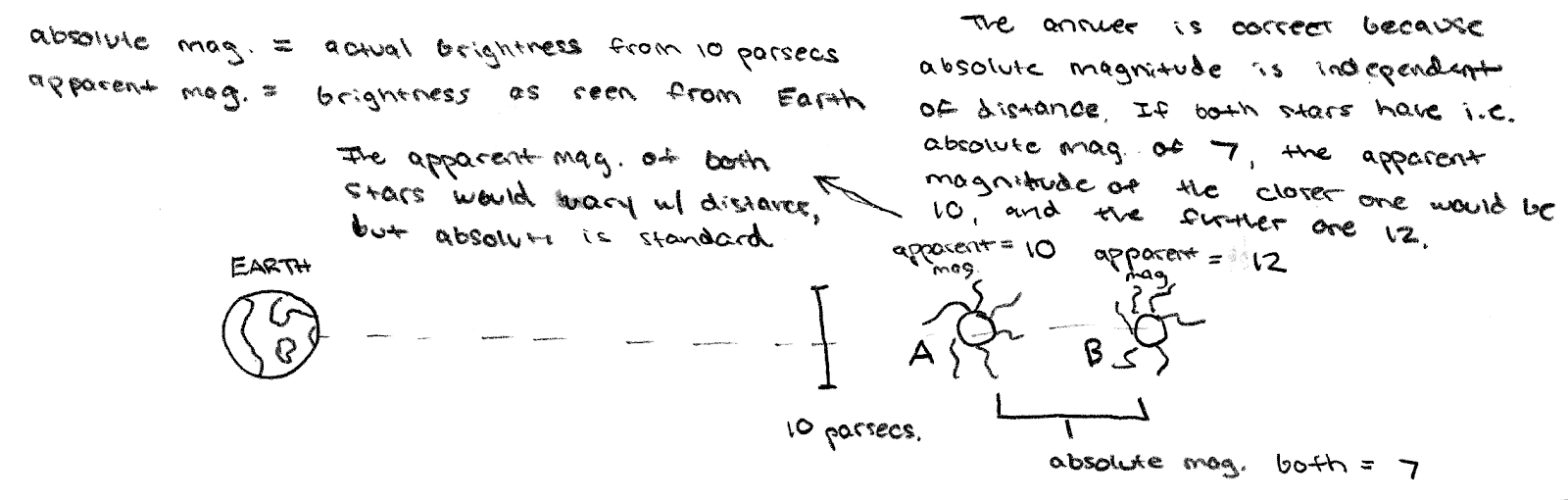
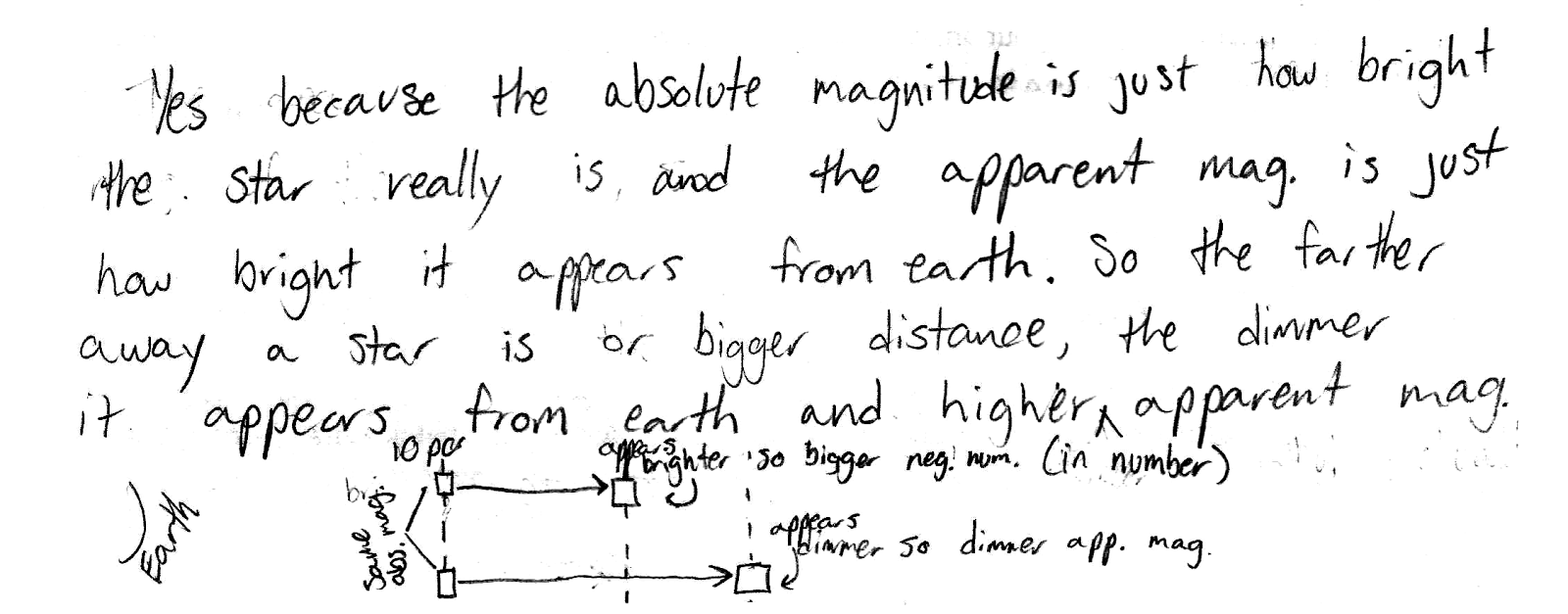
Pdg: Can two stars have the same absolute magnitude, if they both have different distances closer than 10 parsecs?
pub: Yes, if the nearer star has a brighter apparent magnitude (bigger negative number, or smaller positive number), and the farther star has a dimmer apparent magnitude.
Discuss whether this answer is correct or incorrect, and how you know this. Explain using the relationships between apparent magnitude, absolute magnitude, and distance.

[*] answers.yahoo.com/question/index?qid=20170305023512AAeRXO8.

Solution and grading rubric:
  • p:
    Correct. Understands difference between apparent magnitude m (brightness as seen from Earth, when placed at their actual distance from Earth) and absolute magnitude M (brightness as seen from Earth, when placed at the "fair comparison distance" of 10 parsecs away), and discusses:
    1. a star 10 parsecs away with a certain absolute magnitude will get brighter when placed closer than 10 parsecs away from Earth, and thus its apparent magnitude will be brighter than its absolute magnitude; and
    2. since both stars have the same absolute magnitude at 10 parsecs, the nearer star would be located much closer than 10 parsecs, resulting in a much brighter apparent magnitude, while the farther star would be located just a little closer than 10 parsecs, resulting in only a slightly brighter apparent magnitude, dimmer than the other star.
  • r:
    Nearly correct (explanation weak, unclear or only nearly complete); includes extraneous/tangential information; or has minor errors. May have one star located closer than 10 parsecs, or moving in the wrong direction to change its apparent magnitude to its absolute magnitude.
  • t:
    Contains right ideas, but discussion is unclear/incomplete or contains major errors. At least discussion demonstrates understanding of relationships between apparent magnitudes, absolute magnitudes, and distances.
  • v:
    Limited relevant discussion of supporting evidence of at least some merit, but in an inconsistent or unclear manner. At least attempts to use relationships between apparent magnitudes, absolute magnitudes, and distances.
  • x:
    Implementation/application of ideas, but credit given for effort rather than merit. Discussion based on garbled definitions of, or not based on proper relationships between apparent magnitudes, absolute magnitudes, and distances.
  • y:
    Irrelevant discussion/effectively blank.
  • z:
    Blank.
Grading distribution:
Section 30674
Exam code: midterm02nDcc
p: 13 students
r: 2 students
t: 2 students
v: 4 students
x: 0 students
y: 0 students
z: 0 students

A sample "p" response (from student 7697):

Another sample "p" response (from student 5150):

Astronomy midterm question: same absolute magnitude stars, different distances farther than 10 parsecs?

Astronomy 210 Midterm 2, spring semester 2017
Cuesta College, San Luis Obispo, CA

An astronomy question on an online discussion board[*] was asked and answered:
Pdg: Can two stars have the same absolute magnitude, if they both have different distances farther than 10 parsecs?
pub: Yes, if the nearer star has a brighter apparent magnitude (bigger negative number, or smaller positive number), and the farther star has a dimmer apparent magnitude.
Discuss whether this answer is correct or incorrect, and how you know this. Explain using the relationships between apparent magnitude, absolute magnitude, and distance.

[*] answers.yahoo.com/question/index?qid=20170305023512AAeRXO8.

Solution and grading rubric:
  • p:
    Correct. Understands difference between apparent magnitude m (brightness as seen from Earth, when placed at their actual distance from Earth) and absolute magnitude M (brightness as seen from Earth, when placed at the "fair comparison distance" of 10 parsecs away), and discusses:
    1. a star at 10 parsecs away with a certain absolute magnitude will get dimmer when placed further than 10 parsecs away from Earth, and thus its apparent magnitude will be dimmer than its absolute magnitude; and
    2. since both stars have the same absolute magnitude at 10 parsecs, the nearer star would be located just a little farther away from 10 parsecs, resulting in a slightly dimmer apparent magnitude, while the farther star would be located much farther away from 10 parsecs, resulting in a much dimmer apparent magnitude.
  • r:
    Nearly correct (explanation weak, unclear or only nearly complete); includes extraneous/tangential information; or has minor errors. May have one star located closer than 10 parsecs, or moving in the wrong direction to change its apparent magnitude to its absolute magnitude.
  • t:
    Contains right ideas, but discussion is unclear/incomplete or contains major errors. At least discussion demonstrates understanding of relationships between apparent magnitudes, absolute magnitudes, and distances.
  • v:
    Limited relevant discussion of supporting evidence of at least some merit, but in an inconsistent or unclear manner. At least attempts to use relationships between apparent magnitudes, absolute magnitudes, and distances.
  • x:
    Implementation/application of ideas, but credit given for effort rather than merit. Discussion based on garbled definitions of, or not based on proper relationships between apparent magnitudes, absolute magnitudes, and distances.
  • y:
    Irrelevant discussion/effectively blank.
  • z:
    Blank.
Grading distribution:
Section 30676
Exam code: midterm02sL0w
p: 18 students
r: 6 students
t: 4 students
v: 9 students
x: 6 students
y: 0 students
z: 0 students

A sample "p" response (from student 0428):

Another sample "p" response (from student 0511):

Astronomy midterm question: example of a cooler star larger than a hotter star?

Astronomy 210 Midterm 2, spring semester 2017
Cuesta College, San Luis Obispo, CA

An astronomy question on an online discussion board[*] was asked and answered:
Pdg: What is an example of a cooler star being larger than a hotter star?
nin: The sun and a red star like Betelgeuse.
Discuss why this answer is correct, and how you know this. Explain using Wien's law, the Stefan-Boltzmann law and/or an H-R diagram.

[*] answers.yahoo.com/question/index?qid=20170301055021AAZuNwb.

Solution and grading rubric:
  • p:
    Correct. Uses Wien's law to determine that the sun would be the hotter (yellow) star, while Betelgeuse would be the (red) cooler star. Then uses the Stefan-Boltzmann law and/or interprets H-R diagram to demonstrate how Betelgeuse would need to be either a red giant or a red supergiant (which it actually is) in order to be cooler and larger than the sun, a medium-mass main-sequence star.
  • r:
    Nearly correct (explanation weak, unclear or only nearly complete); includes extraneous/tangential information; or has minor errors. Compares two stars (hotter, smaller vs. cooler, larger), where the hotter star is more luminous than the cooler star, but does not explicitly compare the sun versus a red (giant/supergiant) star.
  • t:
    Contains right ideas, but discussion is unclear/incomplete or contains major errors. At least discussion demonstrates understanding of Wien's law, but the Stefan-Boltzmann law and/or H-R diagram discussion is garbled, with a hotter, smaller sun having the same luminosity as a cooler, larger red (giant/supergiant) star; or may have erroneously claimed that the two stars have the same temperature, but Stefan-Boltzmann law and/or H-R diagram discussion is consistent with this mistake in Wien's law.
  • v:
    Limited relevant discussion of supporting evidence of at least some merit, but in an inconsistent or unclear manner. At least attempts to use Wien's law, the Stefan-Boltzmann law, and/or H-R diagram.
  • x:
    Implementation/application of ideas, but credit given for effort rather than merit. Discussion not clearly based on Wien's law, the Stefan-Boltzmann law, and/or H-R diagram.
  • y:
    Irrelevant discussion/effectively blank.
  • z:
    Blank.
Grading distribution:
Section 30674
Exam code: midterm02nDcc
p: 9 students
r: 9 students
t: 2 students
v: 1 student
x: 0 students
y: 0 students
z: 0 students

A sample "p" response (from student 9433):

Astronomy midterm question: example of a cooler star smaller than a hotter star?

Astronomy 210 Midterm 2, spring semester 2017
Cuesta College, San Luis Obispo, CA

An astronomy question on an online discussion board[*] was asked and answered:
Pdg: What is an example of a cooler star being smaller than a hotter star?
nin: The sun and a red star like Barnard's star.
Discuss why this answer is correct, and how you know this. Explain using Wien's law, the Stefan-Boltzmann law and/or an H-R diagram.

[*] answers.yahoo.com/question/index?qid=20170301055021AAZuNwb.

Solution and grading rubric:
  • p:
    Correct. Uses Wien's law to determine that the sun would be the hotter (yellow) star, while Barnard's star would be the (red) cooler star. Then uses the Stefan-Boltzmann law and/or interprets H-R diagram to demonstrate how Barnard's star would need to be a red dwarf in order to be cooler and smaller than the sun, a medium-mass main-sequence star.
  • r:
    Nearly correct (explanation weak, unclear or only nearly complete); includes extraneous/tangential information; or has minor errors. Compares two stars (hotter, larger vs. cooler, smaller), where the hotter star is more luminous than the cooler star, but does not explicitly compare the sun versus a red (dwarf) star.
  • t:
    Contains right ideas, but discussion is unclear/incomplete or contains major errors. At least discussion demonstrates understanding of Wien's law, but the Stefan-Boltzmann law and/or H-R diagram discussion is garbled, with a hotter, larger sun having the same luminosity as a cooler, smaller red (dwarf) star; or may have erroneously claimed that the two stars have the same temperature, but Stefan-Boltzmann law and/or H-R diagram discussion is consistent with this mistake in Wien's law.
  • v:
    Limited relevant discussion of supporting evidence of at least some merit, but in an inconsistent or unclear manner. At least attempts to use Wien's law, the Stefan-Boltzmann law, and/or H-R diagram.
  • x:
    Implementation/application of ideas, but credit given for effort rather than merit. Discussion not clearly based on Wien's law, the Stefan-Boltzmann law, and/or H-R diagram.
  • y:
    Irrelevant discussion/effectively blank.
  • z:
    Blank.
Grading distribution:
Section 30676
Exam code: midterm02sL0w
p: 22 students
r: 4 students
t: 9 students
v: 5 students
x: 3 students
y: 0 students
z: 0 students

A sample "p" response (from student 3428):