20130228

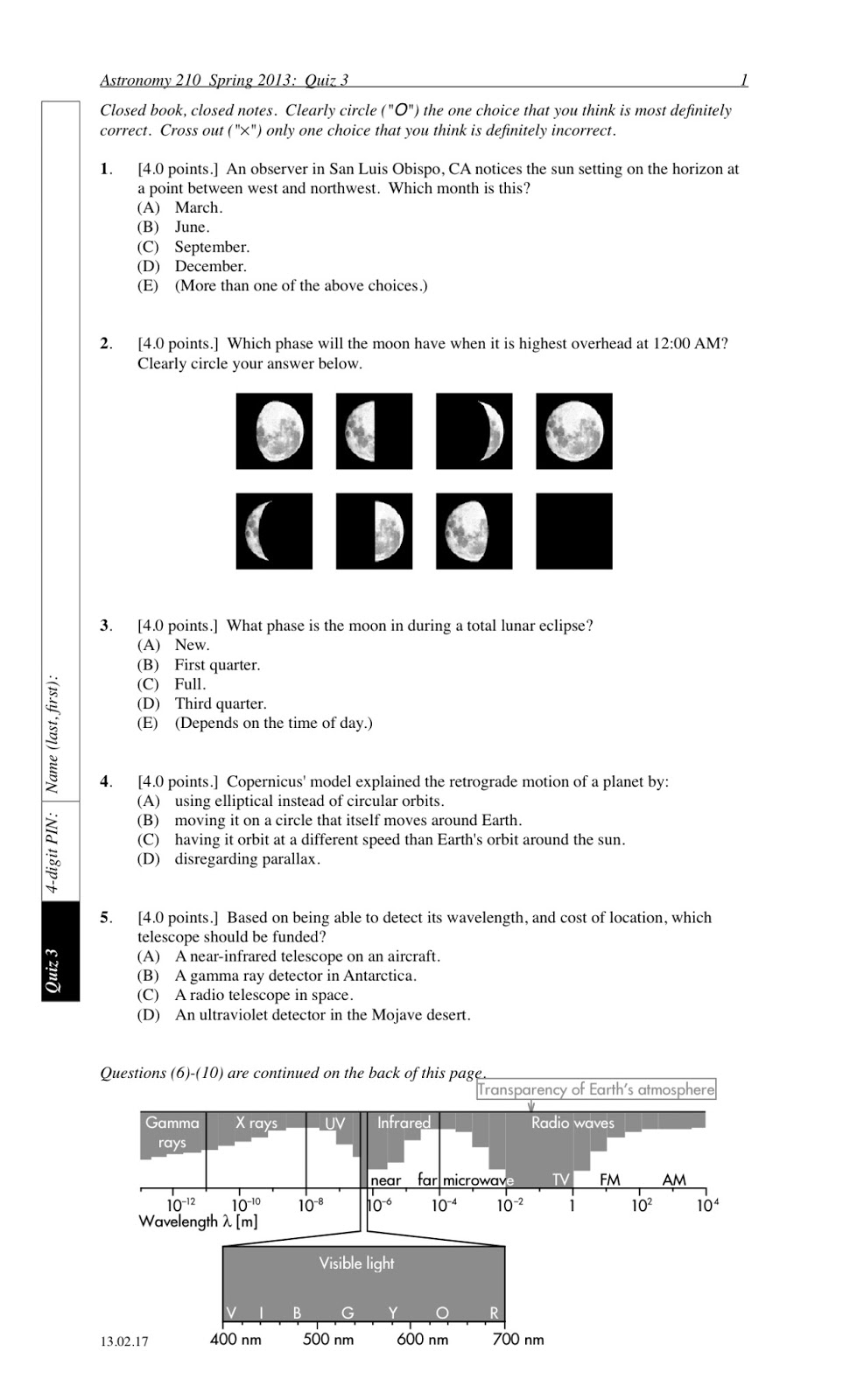
Astronomy quiz archive: telescopes

Astronomy 210 Quiz 3, spring semester 2013
Cuesta College, San Luis Obispo, CA

Section 30674, version 1
Exam code: quiz03nPmP


Section 30674
0- 8.0 :
8.5-16.0 : ***** [low = 8.0]
16.5-24.0 : *******
24.5-32.0 : ********* [mean = 25.7 +/- 8.1]
32.5-40.0 : ******* [high = 40.0]


Section 30676, version 1
Exam code: quiz03sPmP


Section 30676
0- 8.0 :
8.5-16.0 : ******** [low = 10.0]
16.5-24.0 : ****************** [mean = 23.0 +/- 6.7]
24.5-32.0 : ***********
32.5-40.0 : ******* [high = 36.5]

20130223

Presentation: electric forces and fields

Look at this van de Graff generator exerting attractive and repulsive forces on these soap bubbles. Just look at it. (Video link: "Static Electricity and Bubbles!")

While we will quantify how charges exert electric forces on other charges, consider the philosophical problem of why charges are able to exert electric forces on other charges, without touching, across empty space. This is the action-at-a-distance problem. We are going to "solve" this problem in this presentation--well, sort of--and much later will only be able to completely "solve" the action-at-a-distance problem near the end of this semester by introducing the concept of quantum electrodynamics.

In this presentation we will discuss two models of how charges exert electric forces on other charges.

First, a "direct" model of electric forces.

By convention we label the two charges that exert forces on each other as "source" and "test" charges, where the source charge q1 is said to be exerting a force on the test charge q2. This force is attractive if the source charge and test charge have opposite signs, and repulsive if the source charge and test charge have the same sign.

Coulomb's law quantifies the magnitude of the force that a source charge exerts on a test charge, separated by a distance r. Note that the signs of the charges do not matter when calculating the magnitude of the force, and that the constant k handles unit cancellation and conversion to express the force with the proper units of newtons.

Second, an "indirect" or two-step model of electric forces.

Here the convention is to label the source charge and test charge as Q and q, respectively. Instead of the source charge Q directly exerting a force on the test charge q, in this two-step model, the source charge Q is said to create an electric field everywhere around it, and it is this electric field that exerts a force on a test charge q.

Let's focus on the first step of this two-step model. The source charge Q creates an electric field everywhere around it. The magnitude of this electric field can be calculated for a location at a distance r from the source charge, and has units of newtons per coulomb (N/C). The direction of this electric field depends on the sign of the source charge Q: if the source charge is positive, the electric field vectors point outwards from it; if the source charge is negative, the electric field vectors point in towards it.

An electric field is depicted as filling in all space surrounding a source charge, and is drawn as field lines that point outwards from a positive source charge, and point in towards a negative source charge.

Now what? If there is another charge anywhere in the presence of an electric field, this electric field will exert a force on the test charge q. Note that this is a vector equation, where the force F (magnitude and direction) exerted on the test charge q is the test charge q multiplied by the electric field E (magnitude and direction) at the test charge's location. Since the test charge q could be positive or negative, then the electric force exerted on it could have the same or opposite direction as the electric field lines.

Here, from before, we show the electric fields filling in all space surrounding a positive or a negative source charge. Putting a positive test charge in the presence of these electric fields will cause an electric force to be exerted along a field line, while putting a negative test charge in the presence of these electric fields will cause an electric force to be exerted in the opposite direction of a field line. (In any case, as a check the direction of the force on any source charge q should be attractive or repulsive depending on whether it has the opposite or same sign as the source charge Q.)

So if using Coulomb's law in the direct model of calculates the electric force a source charge exerts on a test charge, why do we need a two-step model of a source charge generating a field, and this field exerting an electric force on a test charge?

Here in this excerpt from Star Wars Episode IV: The Empire Strikes Back (Lucasfilm/Twentieth Century Fox, 1980), Luke Skywalker is trying to grab his lightsaber, which is just beyond is reach. He could use the "force" to pull his lightsaber, but this brings up the philosophical problem of how a force of one object on another can be exerted across empty space.

Instead, let's reinterpret this in terms of the two-step field model. Luke goes into a trance, and let's say that he is generating some sort of field around himself (as Obi-Wan Kenobi explains: "...an energy field created by all living things. It surrounds us and penetrates us; it binds the galaxy together"). This field spreads out from and surrounds Luke, and it is this field that exerts a force on the lightsaber, pulling it out of the snowbank. Mayhem ensues.

So now we've "solved" the action-at-a-distance problem here by discussing a field as occupying the empty space surrounding and between the source object (Luke) and the test object (the lightsaber). (Perhaps, then, Luke is really using the "Field," and not the "Force" in the Star Wars universe.) And we put "solved" in quotes because this really recasts the philosophical action-at-a-distance problem as a philosophical question of what exactly is a field (and is it really generated by and surrounds a source object)? In a subsequent presentation near the end of this semester we will explain the physical nature of what a field is, but for now we will merely take an electric field as a given in our two-step model of how charges exert electric forces on other charges.

In this discussion we only considered the force exerted by a single source charge on a test charge, or the field generated by a single source charge. Later in class we will go through more complex situations where there may be multiple source charges, each exerting forces on the same test charge (thus requiring us to determine the net force on the test charge); or multiple source charges, each creating an electric field at the same location in space (thus requiring us to determine the net electric field at that location). So be sure to brush up on one-dimensional vector addition, as discussed last semester.

So remember, may the field be with you...

20130221

Astronomy quiz archive: eclipses/history of astronomy

Astronomy 210 Quiz 2, spring semester 2013
Cuesta College, San Luis Obispo, CA

Section 30674, version 1
Exam code: quiz03Ne3v


Section 30674
0- 8.0 :
8.5-16.0 : ******* [low = 11.0]
16.5-24.0 : ********** [mean = 22.8 +/- 6.7]
24.5-32.0 : ***********
32.5-40.0 : *** [high = 36.0]


Section 30676, version 1
Exam code: quiz02Sl1v


Section 30676
0- 8.0 : **** [low = 0.0]
8.5-16.0 : **********
16.5-24.0 : ***************** [mean = 19.7 +/- 7.7]
24.5-32.0 : ********
32.5-40.0 : **** [high = 33.0]

20130215

Presentation: charges and materials

Static electricity is never your friend. Not at the gas station. Nope. (Video link: "Fuel Pump Fire.")

In this presentation we will discuss how charges move differently through certain materials, and the effects of this behavior in certain situations.

We will assume that you already familiar with certain basics of electrostatics, in that there are positive and negative charges...

...and that two charges with opposite signs (positive-negative, or negative-positive) will attract, while two charges with the same sign (positive-positive, or negative-negative) will repel.

First, the mobility of these charges in certain materials.

We will also assume that you are already familiar with a simple atomic model of solids, where the positive charged nuclei of atoms are held at fixed locations, while their negatively charged outmost electrons are relatively free to move. The degree to which these electrons can move depends on the type of material.

For an insulator, the outermost electrons are more or less fixed to their atomic locations, but at least are able to move somewhat around these locations. (As in the gas station spark movie shown above, electrons can be exchanged when two different types of insulators that have different affinities for electrons are rubbed against each other.)

In contrast, the outermost electrons in a conductor are much more free to move about the entire material.

For a polar molecule, while the molecule itself may be neutrally charged, the electrons are distributed such that certain atoms at each end of the molecule have a permanent small positive or small negative charge. In a liquid state, these molecules would be free to align in different orientations.

Second, the response, or polarization for these different materials to external charged objects held nearby.

When a positively charged object is brought near a neutral insulator, the outermost electrons at each atom will be drawn to the side facing the positively charged object. Note that for each atom, the outermost electrons are slightly closer to the positively charged object (and feel an attractive force), while the positively charged nuclei are slightly farther away from the positively charged object (and feel a repulsive force). But since the outermost electrons are slightly closer to the positively charged object, and the positively charged nuclei are slightly farther away from the positively charged object, then the attractive forces will be slightly greater than the repulsive forces, such that there is a net attraction between the neutral insulator and positively charged object.

When a negatively charged object is brought near a neutral insulator, the outermost electrons at each atom will move to the side facing away from the negatively charged object. Note that for each atom, the outermost electrons are slightly farther way from the negatively charged object (and feel a repulsive force), while the positively charged nuclei are slightly closer to the negatively charged object (and feel a attractive force). But since the outermost electrons are farther away from the negatively charged object, and the positively charged nuclei are slightly closer to the negatively charged object, then the repulsive forces will be slightly less than the attractive forces, such that there is a net attraction between the neutral insulator and negatively charged object.

An example of this is when an insulating object (here, a cat) acquires a charge, due to rubbing or sliding against a different type of insulator. It doesn't matter whether the cat lost electrons (and thus becomes positively charged) or gained electrons (and thus becomes negatively charged) from this rubbing, as in either case the object will still attract neutral insulators (such as these styrofoam packing peanuts).

Convince yourself that a similar effect occurs when a charged object (positive or negative) is brought near a neutral conductor. While outermost electrons are much more mobile than in an insulator, they will still move to the side facing towards a positively charged object, or away from a negatively charged object, such that net attraction will result in either case.

Again, let's start with an insulating object (here, a balloon) acquiring a charge, due to rubbing or sliding against a different type of insulator (a fabric curtain). It doesn't matter whether the balloon lost electrons (and thus becomes positively charged) or gained electrons (and thus becomes negatively charged) from this rubbing, as in either case the object will still attract neutral conductors (such as this aluminum can). (Video link: "Aluminium can static roll.")

Once again a similar effect occurs when a charged object (positive or negative) is brought near a a liquid containing polar molecules. However, in this case the molecule will reorient itself such that the negative end will move to the side facing towards a positively charged object, or away from a negatively charged object, such that net attraction will result in either case.

Once again, start with an insulating object (here, a comb) acquiring a charge, due to contact with a different type of insulator (hair). It doesn't matter whether the comb lost electrons (and thus becomes positively charged) or gained electrons (and thus becomes negatively charged) from this rubbing, as in either case the comb will still attract neutral polar molecules (such as in this water stream). (Video link: "Water Bending.")

20130212

Physics quiz archive: electromagnetic waves, reflection/refraction

Physics 205B Quiz 1, spring semester 2013
Cuesta College, San Luis Obispo, CA
Section 30882, version 1
Exam code: quiz01b3Es


Section 30882 results
0- 6 : * [low = 6]
7-12 : ****
13-18 : **************
19-24 : ************ [mean = 19.1 +/- 5.9]
25-30 : **** [high = 30]