 2012-05-31_12-44-40_342
http://www.flickr.com/photos/waiferx/7315166890/
Originally uploaded by Waifer X
Detail from Adam "Ape Lad" Koford's Connect the Dots installation at Cuesta College North County Campus, Paso Robles, CA.
2012-05-31_12-44-40_342 120605-1310651
 2012-06-05_15-55-48_825

| 0- 8.0 : | * [low = 6.0] |
| 8.5-16.0 : | **** |
| 16.5-24.0 : | ********* |
| 24.5-32.0 : | ******* [mean = 24.8 +/- 8.0] |
| 32.5-40.0 : | ********* [high = 36.5] |


| 0- 8.0 : | *** [low = 3.0] |
| 8.5-16.0 : | *********** |
| 16.5-24.0 : | ******* [mean = 19.8 +/- 8.5] |
| 24.5-32.0 : | ******* |
| 32.5-40.0 : | *** [high = 36.5] |
 Contributed talk presented at the Southern California Section of the American Physics Association of Teachers Spring 2012 meeting, April 21, 2012, 3:45 PM, room ARTS 240, California State University-San Marcos, San Marcos, CA.
 Myself.
 First off, let's have some audience participation with the classic "Astronomy in the Marketplace" activity (D. Schatz, "Why Should We Care About Exploding Stars?" Universe in the Classroom, no. 8, Spring 1987 (http://www.astrosociety.org/education/publications/tnl/08/stars2.html).
  Turn to your neighbor, and list some astronomy-related name brands you would find at a supermarket. Think of food-related brand names, and non-food related brand names.
 From the first day of instruction for introductory astronomy at Cuesta College, here is the word tag cloud generated by Wordle.net for food-related astronomy brand names. Frequently-listed brands are larger, while brand names used only once are smallest. How many of these brand names were you able to list? Anyone have brand names not listed here?
 Non-food related astronomy brand names listed by Cuesta College students. Again, how many of these brand names were you able to list? Anyone have brand names not listed here?
 Let's take a look at more specific examples of using word tag clouds to generate student-teacher discussion.
 Cuesta College introductory astronomy students were prompted to list words and concepts associated with "big bang" before instruction on this topic. Note how much larger explosion and theory are more than expansion.
 This was also done following the quiz on cosmology, where students listed expansion and theory much larger than explosion.
 Another example of how word tag clouds are used to stimulate student-teacher discussion is where Cuesta College (algebra-based) physics students listed topics they found interesting from the first midterm, which includes kinematics, Newton's laws, and circular motion.
  These students were also prompted to list confusing topics as well. Note the differences in how friction, Newtonslaws, projectilemotion, and circularmotion are shown in the interesting and confusing word tag clouds.
 Let's take a closer look at the process of generating word tag clouds. SurveyMonkey.com is used to assign and collect reading quizzes to prepare students before coming to lecture. Here it is used to prompt for word tags associated with Mars.
  These words/phrases are lightly edited, and then put into the Wordle.net interface to generate a tag cloud.
  And to close, a word tag cloud generated for the text of the presentation abstracts at this meeting. Note the predominant word: students.
 "I enjoyed the class" by Student 8166
 An ideal 12.0 V emf source is connected to two ideal light bulbs, an ideal resistor, an ideal voltmeter and an ideal ammeter, as shown at right. The voltmeter has a reading of 4.2 V, and the ammeter has a reading of 0.50 A. The two light bulbs have the same resistance r. Determine the resistance R of the resistor. Show your work and explain your reasoning.

 [20 points.] Two long straight wires carry currents of equal magnitude, but heading in opposite directions. The wires are shown perpendicular to the plane of this page. The magnetic field at point P has a magnitude and direction of 1.3×10⁻⁶ T in the +y direction. Calculate the amount of current in wire 2, and its direction. Show your work and explain your reasoning.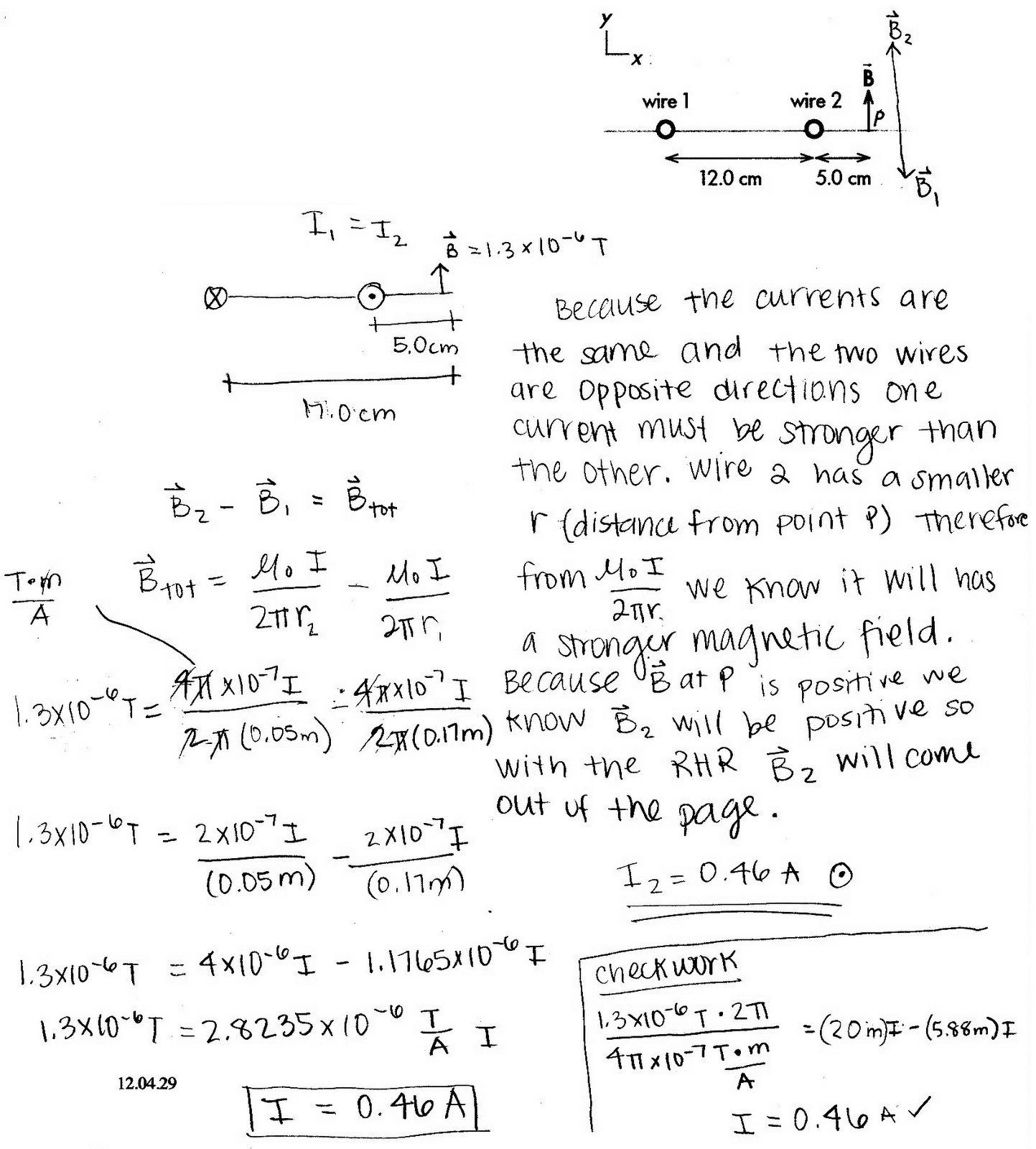
Tilly: Which star [has a brighter absolute magnitude]? Please help! :)?Decide whether or not if this answer is correct, and how you know this. Explain using the properties of apparent magnitude, absolute visual magnitude, and distance.
Star A, apparent magnitude [+9.0], ...distance of 10 pc.
Star B, apparent magnitude [+6.5], ...distance of 1,000 pc.
Charles From Collection Agency: Star A.


