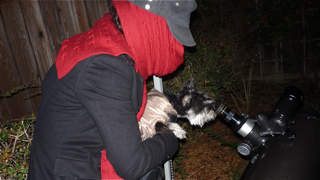
We'll start off the second semester of college physics with light, or more correctly, electromagnetic waves. Since we are covering this topic after rope and string waves, but before electricity and magnetism, this will concentrate on describing their behavior in terms of one-dimensional waves rather than explaining it in terms of three-dimensional electromagnetic fields.

Consider
all types of "light."

The electromagnetic spectrum encompasses all types of "light," here listed from low frequency to high frequency. Notice that
visible light is only a very small portion of the entire electromagnetic spectrum, which we perceive as colors. The vast majority of the electromagnetic spectrum is invisible to our eyes, but we can detect their presence indirectly with certain instruments, or even different parts of our bodies. (When discussing all types of "light," we'll use "electromagnetic waves," as often "light" refers only to visible light.) Let's introduce these types of light...oops,
electromagnetic waves, from lowest to highest frequency.

The lowest frequency form of electromagnetic waves are collectively known as radio waves, which are subdivided into microwave, TV, FM and AM bands depending on the type of device used to send and receive these forms of electromagnetic waves.

Slightly higher in frequency along the electromagnetic spectrum is infrared, also known as "heat waves," which our eyes cannot directly see (but we can indirectly feel), but certain devices allow us to "see" in the infrared. (Video link: "
infrared heat cam.")

Then slightly higher in frequency on the electromagnetic spectrum is visible light, the only type of "light" we can directly see with our eyes. (What is this person looking at?)

Higher in frequency on the electromagnetic spectrum, we're back again to types of "light" we cannot directly see with our eyes, but we can indirectly "see" with special devices, or in this case, materials that react in certain ways to being exposed to ultraviolet, such as our skin, or this Milky Way
TM candy bar.

"Who was Count Dooku's Jedi Mentor?"

So either children are supposed be
Star Wars trivia experts, or have to go to a nightclub with "blacklights" in order to answer this correctly... (Video link: "
090529-1090772.")

Higher in frequency is x-rays, which again cannot be seen by our eyes (well, maybe for Superman), but can be made visible with special devices or certain materials. Note that tissue is relatively transparent to x-rays, while bone, and especially metals are opaque. (What is that thing in this person's nose?)

And highest in frequency are gamma rays, which have higher penetration than x-rays, allowing inspection inside metal shipping containers.

Now let's look at the parameters used to describe these forms of "light," and the connections between them. (From here on, since we'll be discussing the transmission of visible light through different types of transparent media, we'll drop the quotation marks around "light.")

(This is a review of a
previous discussion of one-dimensional rope and string waves from last semester.) Note the hierarchy of these wave parameters. Since the wave speed is determined by properties of the material it travels through (independent of the source), and the frequency is determined by the source (independent of the medium), these are said to be independent wave parameters. In contrast, the wavelength of the wave is dependent on both the independent speed and frequency parameters. Algebraically there is nothing wrong with expressing this relation as
v = λ
f and
f =
v/λ, as long as you recognize that the dependency of λ doesn't change.

This is a very simple but adequate model of how the independent and dependent parameters remain constant, or change. Consider light passing from a medium where it has a fast speed, into a different medium where it has a slow speed. The frequency of this light does not change (which depends on its source), so ideally it is still visible light, and hasn't changed frequency to become some other type of electromagnetic waves such as radio or gamma rays! Since the frequency (and type of light) is unchanged, but the speed does change (due to the change in medium), then the wavelength changes, here decreasing ("scrunching") due to the decrease in speed in the new medium.
(N.b.: we are ignoring dispersion for the purposes of this discussion.)

Light changes speed (and wavelength) as it travels through different materials. Commonly used instead of the speed of light through different materials is the "index of refraction."

The index of refraction is defined as the ratio of speed of light in vacuum (
c = 3.00x10
8 m/s) to the actual speed of light in that material. Thus for vacuum,
n = 1, while for all other materials, light will travel slower, such that
n > 1, and the index of refraction can be considered a measure of "optical slowness" of a material.

Light will travel quickest through vacuum, and the index of refraction is 1.

Through air, light will travel very slightly slower than it does through vacuum, so the index of refraction for air is slightly greater than 1, but to three or fewer significant figures,
n can be approximated as 1.

Light will travel noticeably slower through ice, so the index of refraction for ice is noticeably greater than 1.

Light travels a bit slower through water, and so the index of refraction for water is slightly greater than for ice.

Light typically travels slower through glass than through water, so again, a greater index of refraction for glass than water. (Note that different types of glass will have slightly different indices of refraction.)

At the extreme is light traveling through diamond, which for our purposes has the greatest "optical slowness," and the greatest possible index of refraction.
 Now that we've already been introduced to "light," that is, the electromagnetic spectrum, let's take a look at redirecting (visible) light. Note that like presentations in the previous first semester of this college physics sequence, this presentation will hopefully give you a sense of what Bill Nye ("The Science Guy") likes to describe as "PBJ"--the "passion, beauty, and joy" of reflecting and refracting light. We simply don't have time for an exhaustive, comprehensive discussion of this material in class--that's what your textbook is for!
  Reflection is redirecting light by bouncing it off of a surface.
  Conventionally we consider reflections off of flat surfaces. (Don't worry about what's about to happen here--it's art!)
 Even with reflections off of curved surfaces, each point on it can be considered a locally flat surface.
 And more "PBJ" for reflections--they have the curious property of reversing front-to-back symmetry (or here in this perspective, left-to-right symmetry).
 Instead of bouncing light off of surfaces, if light can pass into a transparent material, we will have refraction, where it is redirected by being "bent."
 Refraction occurs when light starts in one material, and passes into another. (This art installation only gives the illusion of seeing light from people underwater; instead there is only a thin layer of water supported by sheet of glass between these two levels.)
 When light does start in one medium, and pass into another medium, it will refract, or bend, which can produce curious results.
 Look at the exhaust plume from this jet: heat warms the air and changes its density, making light travel at a different speed through it, and it will be bent in interesting directions. Also note the shockwaves from leading edges on the jet--here air is compressed, and again light traveling through it will be bend it in interesting directions.

 Since the index of refraction is a measure of the "optical slowness" of a material, a faster speed of light corresponds to a lower index of refraction, and a larger angle, as it travels into a material with a slower speed, a higher index of refraction, and a smaller angle. Mnemonic: "Fast-to-slow, bend towards the normal."
 And since the index of refraction is a measure of the "optical slowness" of a material, a slower speed of light corresponds to a higher index of refraction, and a smaller angle, as it travels into a material with a faster speed, a lower index of refraction, and a larger angle. Mnemonic: "Slow-to-fast, bend away from the normal."