Astronomy 10, Spring Semester 2007
Cuesta College, San Luis Obispo, CA
Astronomy 10 learning goal M2.5
Students were asked the following clicker question (Classroom Performance System, einstruction.com) at the end of their learning cycle, during a review session just before the midterm. Students are encouraged to collaborate openly, as their review session clicker points for responding will double if the cumulative class success rate is at or over 80% (out of 10 questions).
[0.3 points.] Which one of the following choices best explains why Charon is neither categorized as a planet, nor a dwarf planet under the new International Astronomical Union rules?
(A) Charon is one of Pluto's three satellites.
(B) Charon did not clear its orbit of other Kuiper belt objects.
(C) Charon is the remnant of a giant impact on Pluto that produced icy debris that made the Kuiper belt.
(D) Charon is not spherical in shape.
(E) Charon is mainly composed of ice.
Correct answer: (A).
Student responses
Section 4136
(A) : 30 students
(B) : 0 students
(C) : 0 students
(D) : 2 students
(E) : 0 students
Section 5076
(A) : 20 students
(B) : 0 students
(C) : 1 student
(D) : 7 students
(E) : 0 students
So far, so good. Let's see how they did during the midterm...


20070323
Astronomy clicker question: what's wrong with the IAU?
Astronomy 10, Spring Semester 2007
Cuesta College, San Luis Obispo, CA
Astronomy 10 learning goal M2.5
Students were asked the following clicker question (Classroom Performance System, einstruction.com) at the beginning of their learning cycle:
[0.3 points.] What is problematic about the IAU (International Astronomical Union) classification scheme for planets and dwarf planets?
(A) It does not define how planets around other stars should be classified.
(B) It is not yet possible to measure the roundness of many distant, small bodies.
(C) It is too vague on how much a planet should "clear out" its orbit.
(D) The classification of a planet or dwarf planet depends on its neighbors, not on its own attributes.
Correct answer: (none, opinion only, but see comments below).
Student responses
Section 4136
(A) : 3 students
(B) : 4 students
(C) : 19 students
(D) : 6 students
Section 5076
(A) : 2 students
(B) : 0 students
(C) : 9 students
(D) : 7 students
This question prompts discussion on some of the objections to the recent International Astronomical Union (IAU) categorization scheme adopted at their August 2006 meeting in Prague.
(A) = The categorization scheme only applies to planets, dwarf planets, etc. around the Sun, and does not deign to classify the recently discovered "super-Jupiters" orbiting around other stars.
(B) = Many dwarf planet candidates are in limbo, without more information about their actual shape. The asteroids Pallas and Vesta, and as many as a hundred other Kuiper belt objects ("Santa" (2003 EL61), the "Easterbunny" (2005 FY9, et al.) may or may not be classified as dwarf planets for many years to come.
(C) = This is a real point of contention, as the IAU states that a planet must "clear out" its orbit. Students bring up the fact that the Earth definitely has not cleared out its orbit, as the dinosaurs can attest! The various Earth-crossing asteroid groups (the Apollos being the most prominent) indicate that the Earth has not "cleared out" its orbit, and thus under the letter of the law, the Earth is a dwarf planet, and not a planet! However, the spirit of the law suggests that since the Earth "dominates" its orbit, it clearly should not be demoted to dwarf planet status. Seems like the IAU needs some lawyers on retainer to help clean up their wording next time around.
(D) = This is also a real concern, as the "planetness" of an object is not an inherent property, it depends on the properties of its neighbors (whether they have been cleared out or not). Mercury is a good example, as it is in an empty part of the solar system. But placing it in the asteroid belt would mean that it is a dwarf planet, as it would not have enough gravitational influence to dominate, much less clear out its neighbors.
So stay tuned, as this topic is still very active and contentious...
Cuesta College, San Luis Obispo, CA
Astronomy 10 learning goal M2.5
Students were asked the following clicker question (Classroom Performance System, einstruction.com) at the beginning of their learning cycle:
[0.3 points.] What is problematic about the IAU (International Astronomical Union) classification scheme for planets and dwarf planets?
(A) It does not define how planets around other stars should be classified.
(B) It is not yet possible to measure the roundness of many distant, small bodies.
(C) It is too vague on how much a planet should "clear out" its orbit.
(D) The classification of a planet or dwarf planet depends on its neighbors, not on its own attributes.
Correct answer: (none, opinion only, but see comments below).
Student responses
Section 4136
(A) : 3 students
(B) : 4 students
(C) : 19 students
(D) : 6 students
Section 5076
(A) : 2 students
(B) : 0 students
(C) : 9 students
(D) : 7 students
This question prompts discussion on some of the objections to the recent International Astronomical Union (IAU) categorization scheme adopted at their August 2006 meeting in Prague.
(A) = The categorization scheme only applies to planets, dwarf planets, etc. around the Sun, and does not deign to classify the recently discovered "super-Jupiters" orbiting around other stars.
(B) = Many dwarf planet candidates are in limbo, without more information about their actual shape. The asteroids Pallas and Vesta, and as many as a hundred other Kuiper belt objects ("Santa" (2003 EL61), the "Easterbunny" (2005 FY9, et al.) may or may not be classified as dwarf planets for many years to come.
(C) = This is a real point of contention, as the IAU states that a planet must "clear out" its orbit. Students bring up the fact that the Earth definitely has not cleared out its orbit, as the dinosaurs can attest! The various Earth-crossing asteroid groups (the Apollos being the most prominent) indicate that the Earth has not "cleared out" its orbit, and thus under the letter of the law, the Earth is a dwarf planet, and not a planet! However, the spirit of the law suggests that since the Earth "dominates" its orbit, it clearly should not be demoted to dwarf planet status. Seems like the IAU needs some lawyers on retainer to help clean up their wording next time around.
(D) = This is also a real concern, as the "planetness" of an object is not an inherent property, it depends on the properties of its neighbors (whether they have been cleared out or not). Mercury is a good example, as it is in an empty part of the solar system. But placing it in the asteroid belt would mean that it is a dwarf planet, as it would not have enough gravitational influence to dominate, much less clear out its neighbors.
So stay tuned, as this topic is still very active and contentious...
20070322
Astronomy clicker question: why shouldn't Pluto be demoted?
Astronomy 10, Spring Semester 2007
Cuesta College, San Luis Obispo, CA
Astronomy 10 learning goal M2.5
Students were asked the following clicker question (Classroom Performance System, einstruction.com) at the middle of their learning cycle:
[0.3 points.] Why should Pluto not be demoted from a planet to dwarf planet?
(A) Planet status, once given, cannot be revoked.
(B) It is the "king of the Kuiper belt."
(C) It has satellites (moons) of its own.
(D) (Pluto should be demoted from planet to dwarf planet.)
Correct answer: (none, opinion only, but see comments below).
Student responses
Section 4136
(A) : 9 students
(B) : 2 students
(C) : 9 students
(D) : 10 students
Section 5076
(A) : 3 students
(B) : 1 student
(C) : 9 students
(D) : 7 students
Each of these choices brings up opinions that many people have about demoting Pluto from planet to dwarf planet status. After the results of this clicker question are displayed, each of these issues are discussed.
(A) = "No takebacks." However, the first few asteroids that were discovered were touted as new planets, and astrological symbols were generated for them. But as more information was known about these "planets," there was determined to be many more of them in what is known as the asteroid belt, and their small size ultimately meant that their planetary status was stripped.

(B), (C) = "Pluto is special." Eris (2003 UB313, or "Xena") is even bigger than Pluto, and also has a satellite. So it has even more of what made Pluto so "special."
(D) = So why should Pluto be a planet, once these objections are addressed?

Periodically updated comparison chart of the sizes of the Earth, Moon, Mercury, Ceres, Vesta, Pallas, Pluto, Xena, and other TNOs ("Trans-Neptunian Objects," aka Kuiper belt objects), posted by Wm. Robert Johnson (www.johnstonsarchive.net).
Cuesta College, San Luis Obispo, CA
Astronomy 10 learning goal M2.5
Students were asked the following clicker question (Classroom Performance System, einstruction.com) at the middle of their learning cycle:
[0.3 points.] Why should Pluto not be demoted from a planet to dwarf planet?
(A) Planet status, once given, cannot be revoked.
(B) It is the "king of the Kuiper belt."
(C) It has satellites (moons) of its own.
(D) (Pluto should be demoted from planet to dwarf planet.)
Correct answer: (none, opinion only, but see comments below).
Student responses
Section 4136
(A) : 9 students
(B) : 2 students
(C) : 9 students
(D) : 10 students
Section 5076
(A) : 3 students
(B) : 1 student
(C) : 9 students
(D) : 7 students
Each of these choices brings up opinions that many people have about demoting Pluto from planet to dwarf planet status. After the results of this clicker question are displayed, each of these issues are discussed.
(A) = "No takebacks." However, the first few asteroids that were discovered were touted as new planets, and astrological symbols were generated for them. But as more information was known about these "planets," there was determined to be many more of them in what is known as the asteroid belt, and their small size ultimately meant that their planetary status was stripped.

(B), (C) = "Pluto is special." Eris (2003 UB313, or "Xena") is even bigger than Pluto, and also has a satellite. So it has even more of what made Pluto so "special."
(D) = So why should Pluto be a planet, once these objections are addressed?

Periodically updated comparison chart of the sizes of the Earth, Moon, Mercury, Ceres, Vesta, Pallas, Pluto, Xena, and other TNOs ("Trans-Neptunian Objects," aka Kuiper belt objects), posted by Wm. Robert Johnson (www.johnstonsarchive.net).
20070321
Astronomy clicker question: why is Pluto not a planet?
Astronomy 10, Spring Semester 2007
Cuesta College, San Luis Obispo, CA
Astronomy 10 learning goal M2.5
Students were asked the following clicker question (Classroom Performance System, einstruction.com) at the beginning of their learning cycle:
[0.3 points.] Why was Pluto demoted from planet to dwarf planet?
(A) It does not orbit the Sun.
(B) It did not have enough formation heat to completely melt, and enough gravity to round itself into a spherical shape.
(C) It did not clear out its orbit.
(D) (All of the above choices (A)-(C).)
Correct answer: (C).
Student responses
Section 4136
(A) : 1 student
(B) : 10 students
(C) : 10 students
(D) : 11 students
Section 5076
(A) : 2 students
(B) : 8 students
(C) : 6 students
(D) : 5 students
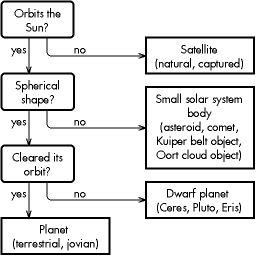 At the International Astronomical Union (IAU) August 2006 meeting in Prague, the solar system was categorized by three criteria, as shown at right. To be classified as a planet, Pluto must separately fulfill all three criterion--it orbits the Sun (and not a planet), it is sufficiently large enough to have retained formation heat and enough gravity to reshape itself into a sphere (and not some lumpy potato shape), and enough influence over its domain to clear its orbit (which it has not, being one of as many as 10 billion other Kuiper belt objects located 30-50 AU from the Sun, just beyond the orbit of Neptune).
The Astronomy Education Review (http://aer.noao.edu) has several articles of interest:
Fraknoi, A. 2006, "Teaching What a Planet Is: A Roundtable on the Educational Implications of the New Definition of a Planet," Astronomy Education Review, 5(2).
An overview of the IAU categorization scheme.
LoPresto, M. C. 2006, "A First Glimpse of Student Attitudes about Pluto's 'Demotion,'" Astronomy Education Review, 5(2).
Further discussion on student views of Pluto's planetary demise.
Cuesta College, San Luis Obispo, CA
Astronomy 10 learning goal M2.5
Students were asked the following clicker question (Classroom Performance System, einstruction.com) at the beginning of their learning cycle:
[0.3 points.] Why was Pluto demoted from planet to dwarf planet?
(A) It does not orbit the Sun.
(B) It did not have enough formation heat to completely melt, and enough gravity to round itself into a spherical shape.
(C) It did not clear out its orbit.
(D) (All of the above choices (A)-(C).)
Correct answer: (C).
Student responses
Section 4136
(A) : 1 student
(B) : 10 students
(C) : 10 students
(D) : 11 students
Section 5076
(A) : 2 students
(B) : 8 students
(C) : 6 students
(D) : 5 students
 At the International Astronomical Union (IAU) August 2006 meeting in Prague, the solar system was categorized by three criteria, as shown at right. To be classified as a planet, Pluto must separately fulfill all three criterion--it orbits the Sun (and not a planet), it is sufficiently large enough to have retained formation heat and enough gravity to reshape itself into a sphere (and not some lumpy potato shape), and enough influence over its domain to clear its orbit (which it has not, being one of as many as 10 billion other Kuiper belt objects located 30-50 AU from the Sun, just beyond the orbit of Neptune).
 The Astronomy Education Review (http://aer.noao.edu) has several articles of interest:
Fraknoi, A. 2006, "Teaching What a Planet Is: A Roundtable on the Educational Implications of the New Definition of a Planet," Astronomy Education Review, 5(2).
An overview of the IAU categorization scheme.
LoPresto, M. C. 2006, "A First Glimpse of Student Attitudes about Pluto's 'Demotion,'" Astronomy Education Review, 5(2).
Further discussion on student views of Pluto's planetary demise.
20070320
Bon mot: Burns' hog-weighing method
Physics 8A learning goal Q6.5
"Burns' Hog-Weighing Method:
(1) Get a perfectly symmetrical plank and balance it across a sawhorse.
(2) Put the hog on one end of the plank.
(3) Pile rocks on the other end until the plank is again perfectly balanced.
(4) Carefully guess the weight of the rocks."
--Robert Burns (1759-1796)
This quote is shown on the announcements section on the overhead projector just before a statics/dynamics midterm, to provide some source of levity for stressed-out students.
"Burns' Hog-Weighing Method:
(1) Get a perfectly symmetrical plank and balance it across a sawhorse.
(2) Put the hog on one end of the plank.
(3) Pile rocks on the other end until the plank is again perfectly balanced.
(4) Carefully guess the weight of the rocks."
--Robert Burns (1759-1796)
This quote is shown on the announcements section on the overhead projector just before a statics/dynamics midterm, to provide some source of levity for stressed-out students.
20070313
Dynamic-axis ("rolling") system

Physics 8A learning goal Q6.4
Example of a dynamic-axis system where there is rolling without slipping. In this case, allowing the user to enjoy a barefoot stroll through the grass in the middle of the city.
20070312
Thinking about blinking

"Under the Tuscan Sun," Touchstone Pictures movie, 2003
Astronomy 10 learning goal Q8.1
Students can demonstrate the method of stellar parallax for themselves that holding up a finger, and looking at it with one eye, and then the other, will make the finger appear to shift with respect to a distant background (such as the opposite classroom wall). Holding their finger closer will result in a larger shift; holding their finger farther away will result in a smaller shift. Thus the shift angle will be inversely correlated with the distance.
Here Diane Lane is using the method of stellar parallax to determine the distance to the wine bottle. Several Cuesta College students recognize her visiting one of the many Starbucks coffeeshops around San Luis Obispo, CA. One student reports that her cousin (a restaurant server) claims that Diane Lane has different colored eyes...
20070309
Astronomy current events question: start of daylight savings time
Astronomy 10L, Spring Semester 2007
Cuesta College, San Luis Obispo, CA
Students are assigned to read online articles on current astronomy events (skytonight.com, from Sky & Telescope magazine), and take a short current events quiz during the first 10 minutes of lab. (This movitvates students to show up promptly to lab, as the time cut-off for the quiz is strictly enforced!)
[0.2 points.] How should San Luis Obispo, CA clocks be set for daylight savings time at 2:00 AM on Sunday morning, March 11? Circle your answer below.
(A) Clocks should be set forward one hour, such that an hour is "lost."
(B) Clocks should be set back one hour, such that an hour is "gained."
(C) (California will not begin daylight savings time until 2:00 AM on Monday morning, March 12.)
(D) (California will not begin daylight savings time until the first Sunday in April.)
(E) (California will not observe daylight savings time for 2007.)
Correct answer: (A).
Student responses
Section 4137
(A) : 20 students
(B) : 3 students
(C) : 0 students
(D) : 0 students
(E) : 0 students
Section 4138
(A) : 13 students
(B) : 5 students
(C) : 1 student
(D) : 0 students
(E) : 0 students
Section 4139
(A) : 14 students
(B) : 2 students
(C) : 0 students
(D) : 0 students
(E) : 1 student
Most students memorized, "spring forward, fall back."
Pop quiz on Monday, March 12--will students show up to their first morning class on time? Let's see if cell phone service providers do this properly, as many students rely on their cell phones to tell time. Note to instructors: do not schedule midterms on the first Monday following a daylight savings time switch!
Cuesta College, San Luis Obispo, CA
Students are assigned to read online articles on current astronomy events (skytonight.com, from Sky & Telescope magazine), and take a short current events quiz during the first 10 minutes of lab. (This movitvates students to show up promptly to lab, as the time cut-off for the quiz is strictly enforced!)
[0.2 points.] How should San Luis Obispo, CA clocks be set for daylight savings time at 2:00 AM on Sunday morning, March 11? Circle your answer below.
(A) Clocks should be set forward one hour, such that an hour is "lost."
(B) Clocks should be set back one hour, such that an hour is "gained."
(C) (California will not begin daylight savings time until 2:00 AM on Monday morning, March 12.)
(D) (California will not begin daylight savings time until the first Sunday in April.)
(E) (California will not observe daylight savings time for 2007.)
Correct answer: (A).
Student responses
Section 4137
(A) : 20 students
(B) : 3 students
(C) : 0 students
(D) : 0 students
(E) : 0 students
Section 4138
(A) : 13 students
(B) : 5 students
(C) : 1 student
(D) : 0 students
(E) : 0 students
Section 4139
(A) : 14 students
(B) : 2 students
(C) : 0 students
(D) : 0 students
(E) : 1 student
Most students memorized, "spring forward, fall back."
Pop quiz on Monday, March 12--will students show up to their first morning class on time? Let's see if cell phone service providers do this properly, as many students rely on their cell phones to tell time. Note to instructors: do not schedule midterms on the first Monday following a daylight savings time switch!
20070308
Moon and Mercury confusion
 "The Earth's Moon" movie (frame from 06'01")
Starry Night Pro 5.0 DVD, starrynight.com
 Santa Maria Rupes (detail)
NASA, JPL, Mariner 10, © Calvin J. Hamilton (LANL)
Astronomy Picture of the Day, "Mercury's Faults," January 21, 1996
Astronomy 10 learning goals Q5.1, Q5.2
Apparently the editors at Starry Night Software goofed, as they have a rupes (a lobate scarp, or compression fault line) from Mercury's surface prominently shown in their Moon video. Have students to watch out for the Mercury feature in this movie!
20070307
Astronomy clicker question: hot or not (the cornish hen/turkey effect)
Astronomy 10, Spring Semester 2007
Cuesta College, San Luis Obispo, CA
Astronomy 10 learning goal Q5.5
Students were asked the following clicker question (Classroom Performance System, einstruction.com) at the beginning of their learning cycle:
[0.3 points.] Which terrestrial planet has the hottest core?
(A) Mercury, which is closest to the Sun.
(B) Venus, which has the hottest atmosphere.
(C) Earth, which is the most massive.
(D) Mars, which has the tallest volcanos.
Correct answer: (C).
Student responses
Section 4136
(A) : 6 students
(B) : 3 students
(C) : 14 students
(D) : 10 students
Section 5076
(A) : 9 students
(B) : 7 students
(C) : 2 students
(D) : 4 students
The terrestrial planets are subject to the "cornish hen/turkey effect." Suppose a cornish hen and a turkey are both taken out of the oven, where they were at the same temperature. Allowed to cool off on the counter for an hour, the cornish hen (being much smaller) has cooled off considerably, while the interior of the turkey still retains a significant amount of heat. Thus small things cool off faster than larger things. The Earth has a hotter core than any of the other terrestrial planets because it is the most massive, and this results in its current of volcanic and tectonic plate motion activity, compared to the dormant or dead geological activity on the smaller terrestrial planets.
Cuesta College, San Luis Obispo, CA
Astronomy 10 learning goal Q5.5
Students were asked the following clicker question (Classroom Performance System, einstruction.com) at the beginning of their learning cycle:
[0.3 points.] Which terrestrial planet has the hottest core?
(A) Mercury, which is closest to the Sun.
(B) Venus, which has the hottest atmosphere.
(C) Earth, which is the most massive.
(D) Mars, which has the tallest volcanos.
Correct answer: (C).
Student responses
Section 4136
(A) : 6 students
(B) : 3 students
(C) : 14 students
(D) : 10 students
Section 5076
(A) : 9 students
(B) : 7 students
(C) : 2 students
(D) : 4 students
The terrestrial planets are subject to the "cornish hen/turkey effect." Suppose a cornish hen and a turkey are both taken out of the oven, where they were at the same temperature. Allowed to cool off on the counter for an hour, the cornish hen (being much smaller) has cooled off considerably, while the interior of the turkey still retains a significant amount of heat. Thus small things cool off faster than larger things. The Earth has a hotter core than any of the other terrestrial planets because it is the most massive, and this results in its current of volcanic and tectonic plate motion activity, compared to the dormant or dead geological activity on the smaller terrestrial planets.

Subscribe to:
Posts (Atom)