20130228

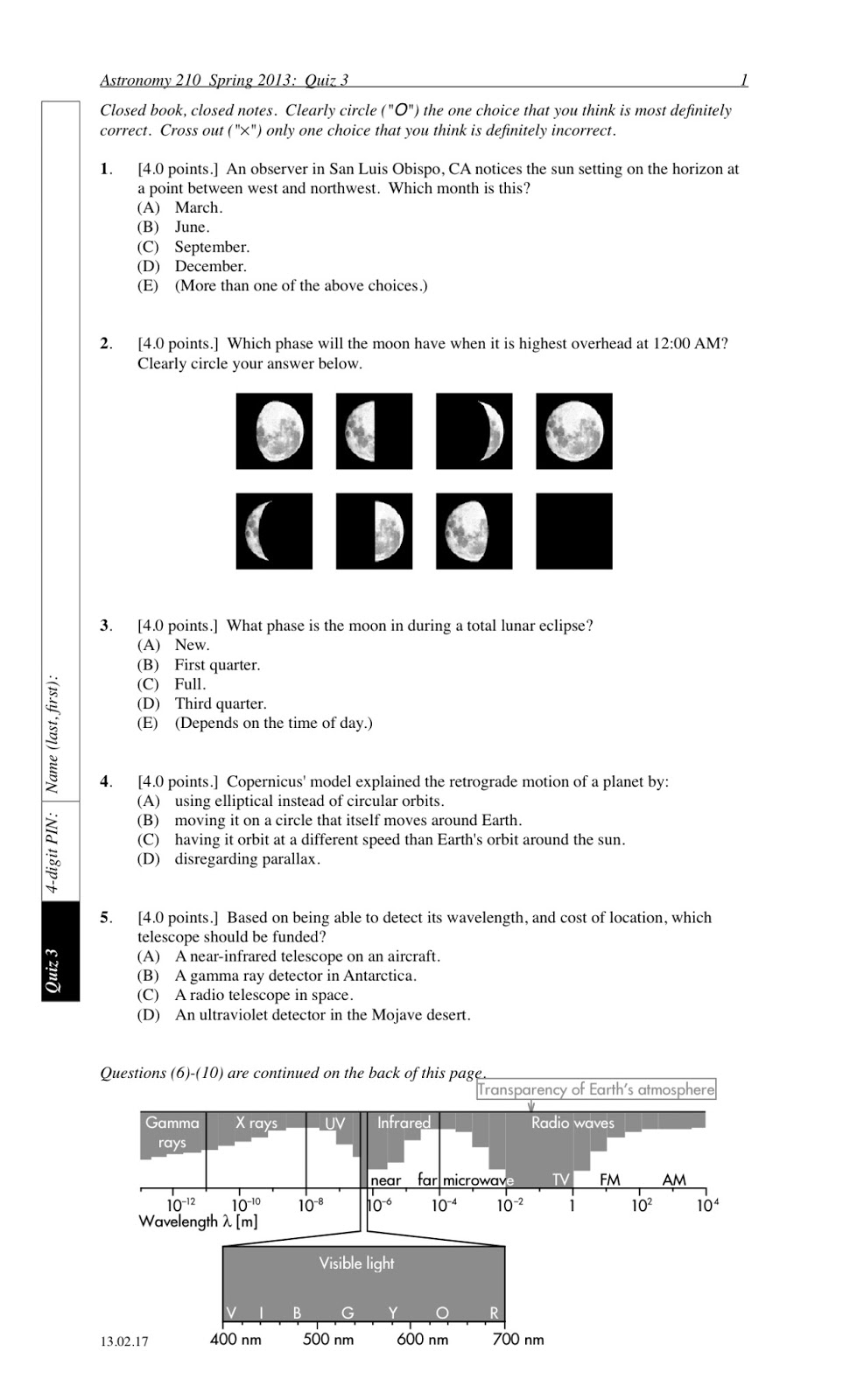
Astronomy quiz archive: telescopes

Astronomy 210 Quiz 3, spring semester 2013
Cuesta College, San Luis Obispo, CA

Section 30674, version 1
Exam code: quiz03nPmP


Section 30674
0- 8.0 :
8.5-16.0 : ***** [low = 8.0]
16.5-24.0 : *******
24.5-32.0 : ********* [mean = 25.7 +/- 8.1]
32.5-40.0 : ******* [high = 40.0]


Section 30676, version 1
Exam code: quiz03sPmP


Section 30676
0- 8.0 :
8.5-16.0 : ******** [low = 10.0]
16.5-24.0 : ****************** [mean = 23.0 +/- 6.7]
24.5-32.0 : ***********
32.5-40.0 : ******* [high = 36.5]

20130221

Astronomy quiz archive: eclipses/history of astronomy

Astronomy 210 Quiz 2, spring semester 2013
Cuesta College, San Luis Obispo, CA

Section 30674, version 1
Exam code: quiz03Ne3v


Section 30674
0- 8.0 :
8.5-16.0 : ******* [low = 11.0]
16.5-24.0 : ********** [mean = 22.8 +/- 6.7]
24.5-32.0 : ***********
32.5-40.0 : *** [high = 36.0]


Section 30676, version 1
Exam code: quiz02Sl1v


Section 30676
0- 8.0 : **** [low = 0.0]
8.5-16.0 : **********
16.5-24.0 : ***************** [mean = 19.7 +/- 7.7]
24.5-32.0 : ********
32.5-40.0 : **** [high = 33.0]

20130212

Physics quiz archive: electromagnetic waves, reflection/refraction

Physics 205B Quiz 1, spring semester 2013
Cuesta College, San Luis Obispo, CA
Section 30882, version 1
Exam code: quiz01b3Es


Section 30882 results
0- 6 : * [low = 6]
7-12 : ****
13-18 : **************
19-24 : ************ [mean = 19.1 +/- 5.9]
25-30 : **** [high = 30]

20130207

Astronomy quiz archive: stars/sun/seasons/moon phases

Astronomy 210 Quiz 1, spring semester 2013
Cuesta College, San Luis Obispo, CA

Section 30674, version 1
Exam code: quiz01N1nk


Section 30674
0- 8.0 :
8.5-16.0 : ***** [low = 12.0]
16.5-24.0 : ********
24.5-32.0 : ************* [mean = 25.6 +/- 7.6]
32.5-40.0 : ***** [high = 40.0]


Section 30676, version 1
Exam code: quiz01Sp4t


Section 30676
0- 8.0 : * [low = 4.0]
8.5-16.0 : ****
16.5-24.0 : ************************* [mean = 21.9 +/- 6.2]
24.5-32.0 : **************
32.5-40.0 : * [high = 33.0]

20130204

Astronomy in-class activity: planet-hunting

Astronomy 210 In-class activity 6 v.13.02.01, spring semester 2013
Cuesta College, San Luis Obispo, CA

Students find their assigned groups of three to four students, and work cooperatively on an in-class activity worksheet to determine where in the sky each naked-eye planet will be observed on a given date (here, February 6, 2013).


Previous posts:

20130123

Overheard: all the starwheel questions

2013-01-23_19-39-28_490
http://www.flickr.com/photos/waiferx/8409668035/
Originally uploaded by Waifer X

(Overheard after students practice all three possible types of starwheel (planisphere) questions in class.)

Instructor: "Hey, uh--do you know what Rage Comics are?" (Beat.) "But of course you do, you're college students." (Draws in Rage Comics' "All of the Things" character next to outline of possible starwheel questions.)

20130110

Picto-quiz: lenses and images

Let's apply the concepts introduced in a previous presentation, where we used ray tracings to find images produced by converging and diverging lenses.

Pair up in groups of two or three, pick up a whiteboard, and for each of these real-world examples, decide whether this is a converging or diverging lens, producing a real or virtual image, and choose the corresponding ray tracing diagram (or diagrams) from your worksheet.

For this image produced by a water glass, is this produced by a converging or diverging lens? Is this a real or virtual image? Which ray tracing(s) ((1)-(10)) best match(es) this?

How do you know this?

For this image produced by a camera lens attachment, is this produced by a converging or diverging lens? Is this a real or virtual image? Which ray tracing(s) ((1)-(10)) best match(es) this?

How do you know this?

For this image produced by magnifying glass, is this produced by a converging or diverging lens? Is this a real or virtual image? Which ray tracing(s) ((1)-(10)) best match(es) this?

How do you know this?

For this image produced by a pair of glasses, is this produced by a converging or diverging lens? Is this a real or virtual image? Which ray tracing(s) ((1)-(10)) best match(es) this?

How do you know this?

For this image on a frosted glass screen produced by a lens on an optical bench, is this produced by a converging or diverging lens? Is this a real or virtual image? Which ray tracing(s) ((1)-(10)) best match(es) this?

How do you know this?

For this image produced by a door peephole, is this produced by a converging or diverging lens? Is this a real or virtual image? Which ray tracing(s) ((1)-(10)) best match(es) this?

How do you know this?

For this image produced by a glass paperweight, is this produced by a converging or diverging lens? Is this a real or virtual image? Which ray tracing(s) ((1)-(10)) best match(es) this?

How do you know this?

For this image produced by a slide projector, is this produced by a converging or diverging lens? Is this a real or virtual image? Which ray tracing(s) ((1)-(10)) best match(es) this?

How do you know this?

20130106

Kudos: terrible at science

"Terrible at Science" by Student 1206
Astronomy 210
December 2012
Cuesta College, San Luis Obispo, CA

20130105

Kudos: wonderful facial hair

"Wonderful Facial Hair" by Student 2580
Physics 205A
December 2012
Cuesta College, San Luis Obispo, CA

20121219

Found astronomy: revised date for Mayan Apocalypse

2012-12-19-11-39-07_321
http://www.flickr.com/photos/waiferx/8289017394/
Originally uploaded by Waifer X

According to this "Sunrise and Sunset, July-December 2012 Universal Time at Greenwich Meridian" table (David M. F. Chapman, ed., Observer's Handbook 2012, The Royal Astronomical Society of Canada, Toronto, ISBN 978-0-9813292-6-0, p. 211), the Mayan Apocalypse will apparently not occur on December 21, 2012, but on December 32, 2012. Photo by Cuesta College Physical Sciences division instruction Dr. Patrick M. Len.