20130609

Astronomy in-class activity: planet-hunting

Astronomy 210 In-class activity 6 v.13.06.09, fall semester 2013
Cuesta College, San Luis Obispo, CA

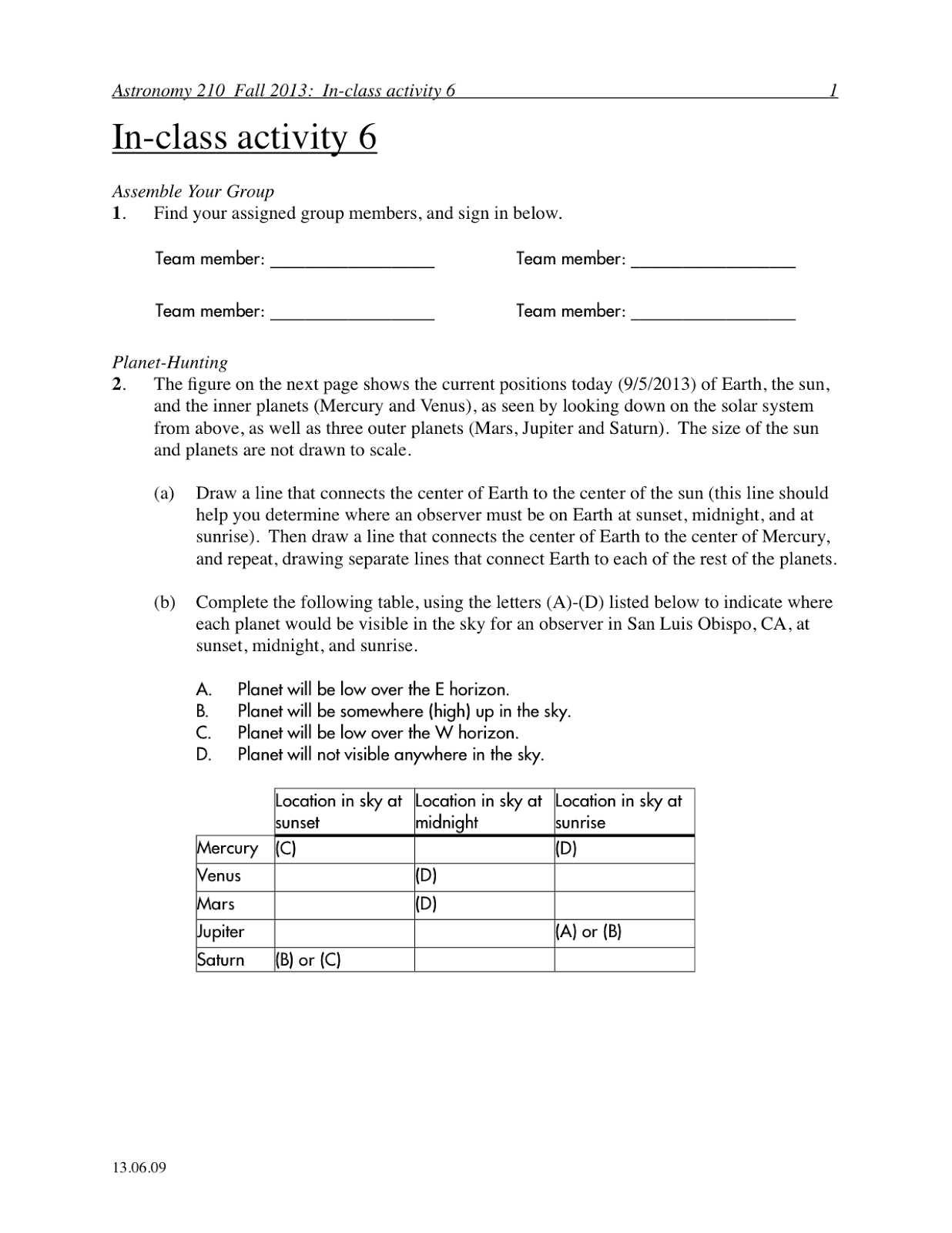
Students find their assigned groups of three to four students, and work cooperatively on an in-class activity worksheet to determine where in the sky each naked-eye planet will be observed on a given date (here, September 5, 2013).


Previous posts:

Astronomy in-class activity: eclipses

Astronomy 210 In-class activity 5 v.13.06.09, fall semester 2013
Cuesta College, San Luis Obispo, CA

Students find their assigned groups of three to four students, and work cooperatively on an in-class activity worksheet to discuss the categories and causes of different types of eclipses.


Astronomy in-class activity: diurnal motion of circumpolar constellations

Astronomy 210 In-class activity 2 v.13.06.09, fall semester 2013 (spring semester 2014)
Cuesta College, San Luis Obispo, CA

Students find their assigned groups of three to four students, and work cooperatively on an in-class activity worksheet to use a starwheel ("planisphere") to determine the clockwise or counterclockwise diurnal motion of circumpolar constellations.


20130521

Physics quiz archive: radioactive decay, Feynman diagrams

Physics 205B Quiz 7, spring semester 2013
Cuesta College, San Luis Obispo, CA
Section 30882, version 1
Exam code: quiz07f3yN


Section 30882 results
0- 6 : ** [low = 0]
7-12 : ****
13-18 : ************* [mean = 18.4 +/- 7.2]
19-24 : *****
25-30 : ******** [high = 30]

20130520

Astronomy quiz archive: solar system

Astronomy 210 Quiz 7, spring semester 2013
Cuesta College, San Luis Obispo, CA

Section 30674, version 1
Exam code: quiz07n4IA


Section 30674
0- 8.0 :
8.5-16.0 : **** [low = 10.0]
16.5-24.0 : *******
24.5-32.0 : ********** [mean = 24.1 +/- 7.9]
32.5-40.0 : ***** [high = 36.5]


Section 30676, version 1
Exam code: quiz07Sw0r


Section 30676
0- 8.0 : ***** [low = 7.0]
8.5-16.0 : *********
16.5-24.0 : ********************** [mean = 18.2 +/- 6.5]
24.5-32.0 : *****
32.5-40.0 : ** [high = 36.0]

20130513

Astronomy current events question: VLA detecting distant galaxy radio sources

Astronomy 210L, spring semester 2013
Cuesta College, San Luis Obispo, CA

Students are assigned to read online articles on current astronomy events, and take a short current events quiz during the first 10 minutes of lab. (This motivates students to show up promptly to lab, as the time cut-off for the quiz is strictly enforced!)
Dave Finley, "VLA Gives Deep, Detailed Image of Distant Universe," April 30, 2013
http://www.nrao.edu/pr/2013/vladeep/
Astronomers using data from the Very Large Array radio telescopes determined that background radio emissions from distant galaxies are mainly from:
(A) massive central black holes.
(B) dark matter.
(C) dark energy.
(D) very cold hydrogen clouds.
(E) gravity waves.

Correct answer: (A)

Student responses
Sections 30678, 30679, 30680
(A) : 12 students
(B) : 10 students
(C) : 1 student
(D) : 1 student
(E) : 7 students

Astronomy current events question: renaming asteroid (101955) 1999 RQ36

Astronomy 210L, spring semester 2013
Cuesta College, San Luis Obispo, CA

Students are assigned to read online articles on current astronomy events, and take a short current events quiz during the first 10 minutes of lab. (This motivates students to show up promptly to lab, as the time cut-off for the quiz is strictly enforced!)
Dwayne Brown and Nancy Neal Jones, "NASA Spacecraft Will Visit Asteroid with New Name," May 1, 2013
http://www.nasa.gov/home/hqnews/2013/may/HQ_13-128_OSIRIS-Rex_Asteroid.html
A third-grade student won a contest to __________ an asteroid to be explored by NASA's OSIRIS-REx spacecraft.
(A) send Facebook messages from.
(B) keep a sample from.
(C) claim mineral rights for.
(D) rename.
(E) be the official spokesperson for.

Correct answer: (D)

Student responses
Sections 30678, 30679, 30680
(A) : 0 students
(B) : 4 students
(C) : 1 student
(D) : 25 students
(E) : 2 students

Astronomy current events question: dark matter detector bubbles

Astronomy 210L, spring semester 2013
Cuesta College, San Luis Obispo, CA

Students are assigned to read online articles on current astronomy events, and take a short current events quiz during the first 10 minutes of lab. (This motivates students to show up promptly to lab, as the time cut-off for the quiz is strictly enforced!)
Fermilab press release, "New Dark Matter Detector Begins Search for Invisible Particles," May 2, 2013
http://www.fnal.gov/pub/presspass/press_releases/2013/Dark-Matter-Detector-2013.html
The COUPP-60 detector at the SNOLAB underground laboratory in Ontario, Canada will detect dark matter particles that produce __________ in a tank of water and fire extinguisher chemicals.
(A) bubbles.
(B) antimatter.
(C) neutrinos.
(D) radioactivity.
(E) photons.

Correct answer: (A)

Student responses
Sections 30678, 30679, 30680
(A) : 26 students
(B) : 1 student
(C) : 2 students
(D) : 3 students
(E) : 1 student

20130507

Astronomy current events question: Earth's core hotter than previously modeled

Astronomy 210L, spring semester 2013
Cuesta College, San Luis Obispo, CA

Students are assigned to read online articles on current astronomy events, and take a short current events quiz during the first 10 minutes of lab. (This motivates students to show up promptly to lab, as the time cut-off for the quiz is strictly enforced!)
Sebastian Anthony, "Earth's Core Is Much Hotter than Previously Thought--Hotter than the Surface of the Sun," April 26, 2013
http://www.extremetech.com/extreme/154357-earths-core-is-much-hotter-than-previously-thought-hotter-than-the-surface-of-the-sun
French researchers revised higher estimates of Earth's core temperature based on measuring the properties of iron:
(A) from micrometeorites.
(B) produced in the sun's core.
(C) squeezed between two diamonds.
(D) in volcanic calderas.
(E) placed in experimental fusion reactors.

Correct answer: (C)

Student responses
Sections 30678, 30679, 30680
(A) : 3 students
(B) : 7 students
(C) : 19 students
(D) : 9 students
(E) : 12 students

Astronomy current events question: Betelgeuse hot spots

Astronomy 210L, spring semester 2013
Cuesta College, San Luis Obispo, CA

Students are assigned to read online articles on current astronomy events, and take a short current events quiz during the first 10 minutes of lab. (This motivates students to show up promptly to lab, as the time cut-off for the quiz is strictly enforced!)
Aeron Haworth, "Mysterious Hot Spots Observed in a Cool Red Supergiant," April 25, 2013
http://www.manchester.ac.uk/aboutus/news/display/?id=9911
The e-MERLIN radio telescope array observed __________ within the supergiant Betelgeuse, which may be evidence of convection or pulsations in its outer regions.
(A) gravitational shockwaves.
(B) hot spots.
(C) granules.
(D) a pulsar.
(E) iron fusion.

Correct answer: (B)

Student responses
Sections 30678, 30679, 30680
(A) : 6 students
(B) : 32 students
(C) : 3 students
(D) : 7 students
(E) : 2 students