20070710

Lolcat: doomed

Doomed, by menopaws
icanhascheezburger.com
July 5, 2007

That general sense of dread associated with an impending exam.

20070709

Godzilla, virtuoso

Woot.com contest: "Show us your dream musical supergroup performing live"
First place, cascadeking--L.A. Philharmonster
Winners' Gallery: the Best of Contest 128
June 26, 2007

Physics 8B learning goal Q1.4

Would the fundamental frequency of Godzilla's violin be infrasonic?

20070705

Astronomy clicker question: jovian coffee model (1)

Astronomy 10, Summer Session 2007
Cuesta College, San Luis Obispo, CA

Astronomy 10 learning goal Q6.1

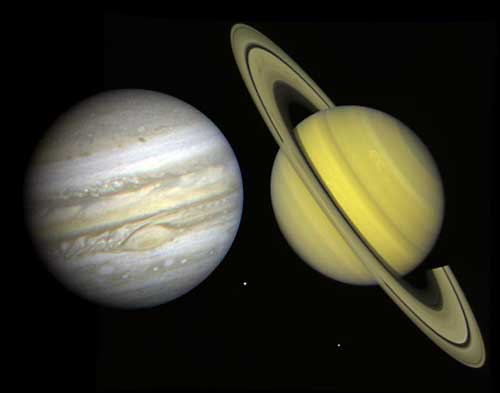
Jupiter and Saturn
http://www.spirit-alembic.com/Issue5/jupiter-saturn.jpg

Students were asked the following clicker question (Classroom Performance System, einstruction.com) near the beginning of their learning cycle:

[0.3 points.] Why is there less helium in the upper atmosphere of Saturn, compared to Jupiter?
(A) Saturn does not conduct as much electricity.
(B) Saturn was made out of less helium.
(C) Helium escaped to become rings.
(D) Saturn is cooler.

Correct answer: not revealed yet (see discussion below).

The above question is asked after some preliminary discussion on mass, size, and density of Jupiter and Saturn, retention of core heat, and the generation of the belt-zone and cyclonic weather patterns. Since Saturn's rings have not yet been discussed, students are expecting it to be the cause of the lack of helium in Saturn's upper atmosphere, compared to Jupiter, which lacks prominent rings.

Student responses
Section 8027
(A) : 1 student
(B) : 0 students
(C) : 12 students
(D) : 0 students

Two coffee cups are brought out. Students are asked whether they are experienced coffee drinkers (as opposed to energy drink users), and are directed to the fact that while the same amount of sugar was stirred into either coffee cup, one cup was kept warm, while the other cup was chilled, before being asked the following clicker question.

[0.3 points.] Two cups of coffee each have three spoonfuls of sugar stirred into them. One cup is kept very hot, while the other cup is allowed to cool off. If you take a sip from just off the top of each cup, which will taste sweeter?
(A) The hotter cup of coffee will taste sweeter.
(B) The cooler cup of coffee will taste sweeter.
(C) (Both cups of coffee will taste equally sweet.)
(D) (Not enough information is given to determine which cup of coffee will taste sweeter.)

Correct answer: (A).

Student responses
Section 8027
(A) : 6 students
(B) : 7 students
(C) : 0 students
(D) : 0 students

Students offer that sip off of the top of the cold cup of coffee tastes less sweet because its sugar has settled into a sludge in the bottom of the cup. Then the first clicker question is put up again, to see if students make the connection.

[0.3 points.] Why is there less helium in the upper atmosphere of Saturn, compared to Jupiter?
(A) Saturn does not conduct as much electricity.
(B) Saturn was made out of less helium.
(C) Helium escaped to become rings.
(D) Saturn is cooler.

Correct answer: (A).

Student responses
Section 8027
(A) : 0 students
(B) : 1 student
(C) : 1 student
(D) : 11 students

In this model, Jupiter the hotter cup of coffee, while Saturn is the cooler cup of coffee (being smaller in mass, it did not have as much original formation and radioactive decay heat, and cooled off faster). Coffee represents hydrogen molecules, while sugar represents helium in the atmospheres of these jovian planets. Jupiter's warmer atmosphere allows it to keep helium suspended (sugar stays dissolved in hot coffee, due to the thermal motion of water molecules), while Saturn's atmosphere is too cool, and helium begins to fall inwards (sugar is allowed to precipitate). This explains both the lack of helium in the upper atmosphere of Saturn, and also the observation that while cooler Saturn has less active belt-zone and cyclonic weather patterns than Jupiter, Saturn is not as cool as expected for its mass, as helium condensation now provides a secondary source of energy for Saturn.

Further discussion of this model is covered in a subsequent post: Jovian coffee model (2).

20070703

Astronomy quiz question: molecule escape from atmosphere

Astronomy 10 Quiz 4, Summer Session 2007
Cuesta College, San Luis Obispo, CA

Astronomy 10 learning goal Q4.1

[3.0 points.] Which one of the following statements best explains why it is not possible for molecules near sea level to escape from the Earth's atmosphere into space?
(A) Speeds are too slow.
(B) Frequent collisions with other molecules.
(C) Low temperatures.
(D) Infrared radiation trapped by the greenhouse effect.
(E) Tectonic plate motion and subduction.

Correct answer: (B).

The average speed of a molecule/atom in the atmosphere depends on the mass of the molecule/atom, and on the temperature. If this speed is greater than approximately one-sixth of the escape velocity of a planet (which depends on the mass of the planet), then the atmosphere will eventually leak out over several billion years. However, molecules/atoms may only escape from the exosphere (the upper atmosphere); no matter how fast their average speed is in the lower level, frequent collisions there prevent escape into space. This is the "mosh pit effect"--you can't leave the mosh pit if you are in the middle of the moshers, but once you can make your way to the edge, escape is possible (provided you don't get pulled back in).

Student responses
Section 8027
(A) : 3 students
(B) : 7 students
(C) : 1 student
(D) : 0 students
(E) : 2 students

Sinfest, by Tatsuya Ishida
www.sinfest.net
January 25, 2001 (excerpt)

20070628

Astronomy clicker question: retrograde/prograde rise/set

Astronomy 10, Summer Session 2007
Cuesta College, San Luis Obispo, CA

Astronomy 10 learning goal Q3.2

Students were asked the following clicker question (Classroom Performance System, einstruction.com) near the end of their learning cycle:

[0.3 points.] As seen from San Luis Obispo, CA, when a planet is in retrograde motion, how will it move in a single night?
(A) It will rise from the east horizon, and set in the west horizon.
(B) It will rise from the east horizon, and shortly afterwards set in the east horizon.
(C) It will rise from the west horizon, and set in the east horizon.
(D) It will rise from the west horizon, and shortly afterwards set in the west horizon.

Correct answer: (A).

Most students are probably thinking that retrograde motion (planet moves a very small distance east-to-west relative to the background stars) is the reason why it will rise in the east horizon, and set in the west horizon. The next clicker question will test for this misconception.

Student responses
Section 8027
(A) : 11 students
(B) : 1 student
(C) : 2 students
(D) : 0 students

[0.3 points.] As seen from San Luis Obispo, CA, when a planet is in prograde motion, how will it move in a single night?
(A) It will rise from the east horizon, and set in the west horizon.
(B) It will rise from the east horizon, and shortly afterwards set in the east horizon.
(C) It will rise from the west horizon, and set in the east horizon.
(D) It will rise from the west horizon, and shortly afterwards set in the west horizon.

Correct answer: (A).

This follow-up question causes a lot of consternation for students, who must realize that in prograde motion, a planet moves a very small distance west-to-east relative to the background stars, which themselves over a single night rise from the east horizon, and set in the west horizon. Thus a planet will be seen to rise from the east horizon, and set in the west horizon in a single night, regardless if it is undergoing retrograde or prograde motion!

Student responses
Section 8027
(A) : 3 students
(B) : 1 student
(C) : 10 students
(D) : 0 students

20070627

Carousel teacup epicycle movie


070526 Carousel Teacup Epicycle
Venetian Carousel, K Street Mall
Sacramento, CA
http://www.youtube.com/watch?v=FIsiezgo7nY

Astronomy 10 learning goal Q3.2

Dramatization of planetary motion in the Ptolemaic model. Watch the girl in the teacup (planet on epicycle) as the merry-go-round (the deferent), well, goes around and around.

20070626

General relativity: warped spacetime

"Spacetime 2"
David J. Grossman (c) 1996
http://unpronounceable.com/graphics/raytraces/spactim2.html

What better way to depict the gravitational distortion of spacetime than with distorted Einsteins?

20070625

Astronomy clicker question: lunar phases

Astronomy 10, Summer Session 2007
Cuesta College, San Luis Obispo, CA

Astronomy 10 learning goal Q2.1

Students were asked the following clicker question (Classroom Performance System, einstruction.com) at the start of their learning cycle:

[0.3 points.] Shown below are eight different Moon phases.


What causes these different phases of the Moon?
(A) Different amounts of the far and near sides of the Moon as seen from the Earth.
(B) Different amounts of the day and night sides of the Moon as seen from the Earth.
(C) The Earth blocks light from the Sun, casting a shadow on the Moon.
(D) The slow, gradual rotation of the Moon about its own axis.

Correct answer: (B).

The border between the sides of the Moon that are illuminated or non-illuminated by the Sun is the terminator. As the Moon orbits the Earth (in approximately 28 days), the terminator moves across the face of the Moon. Students are instructed to diagram this, in order to construct a mental model of this phenomenon.

Student responses
Section 8027
(A) : 1 student
(B) : 4 students
(C) : 7 students
(D) : 1 student

20070621

Universe expansion movie

Continued Consistent Expansion (*.mov, 3.7 MB)
Hubblesite.org

Astronomy 10 learning goal Q12.2

This movie is not just a zoom-in shot! Note that as the universe expands, the distances between galaxies increases, while the size of the galaxies remains constant (due to gravitational interactions). This can be illustrated during the movie by covering one of the galaxies with the mouse cursor, and showing that that the size of the galaxy does not change relative to the cursor.

20070620

Geocentrism, redux

"Something's going wrong. Stop the global warming."

Dogal Hayati Koruma Dernegi (Turkish Nature Life Protection Association), www.dhkd.org
(Via shedwa.blogspot.com)

Astronomy 10 learning goal Q3.2

Ignorance of global warming is equated with the antiquated geocentric model of planetary motion.