20141025

Online reading assignment question: keep, quit, start

Astronomy 210, fall semester 2014
Cuesta College, San Luis Obispo, CA

"2014-07-Astr210-keep+.png"
http://flic.kr/p/pwoPqR
Originally uploaded by Waifer X

Wordle.net tag cloud for "keep" resolutions generated by responses from Astronomy 210 students at Cuesta College, San Luis Obispo, CA, fall semester 2014 (http://www.wordle.net/show/wrdl/8261740/Untitled).


"2014-07-Astr210-quit+.png"
http://flic.kr/p/pwocs9
Originally uploaded by Waifer X

Wordle.net tag cloud for "quit" resolutions generated by responses from Astronomy 210 students at Cuesta College, San Luis Obispo, CA, fall semester 2014 (http://www.wordle.net/show/wrdl/8261742/Untitled).


"2014-07-Astr210-start+.png"
http://flic.kr/p/pwkyWZ
Originally uploaded by Waifer X

Wordle.net tag cloud for "start" resolutions generated by responses from Astronomy 210 students at Cuesta College, San Luis Obispo, CA, fall semester 2014 (http://www.wordle.net/show/wrdl/8261744/Untitled).

Students were asked to answer a "keep-quit-start" online reflection (hosted by SurveyMonkey.com) on their studying strategies/pitfalls (Mubayiwa, 2009).
Enter a word or brief phrase that describes what you intend to keep doing to study for this class. Explain your answer to the above question (what you intend to keep doing to study for this class).

Enter a word or brief phrase that describes what you intend to
quit doing to study for this class. Explain your answer to the above question (what you intend to quit doing to study for this class).

Enter a word or brief phrase that describes what you intend to
start doing to study for this class. Explain your answer to the above question (what you intend to start doing to study for this class).
[Word tags have been edited to consolidate related common subjects; student explanations are verbatim.]

Keep word tags:
everything
     Midterm 1 came around and my points total to 304 or something like that. Halfway to an A and halfway through the semester seems good to me so I plan on keeping up what I'm doing. I've completed all the work and if I max out reading assignment points I will still follow along with them to understand course material. I'm satisfied with my grades on quizzes and the midterm as I'm halfway to the A I desire. Keeping in mind the Reading Assignment maximum and potential fall off of nice extra credit I'm pretty sure the final will be worth about 100 points which be more than enough to make up for it if I'm just as successful on it plus i have to study for midterm 2 anyway.

flashcardquestions ("peer instruction," "think-pair-share")
     I print out the flashcard questions and work through them. It takes a long time but it is worth it.
     I have printed all of the quiz and midterm flashcard questions, and I have made some of my own flashcards with definitions. I go over them when I'm in between classes and occasionally on the weekend. The flashcards really seem to help. I know the information, its the anxiety I get when I'm taking a test that messes me up.
     I intend to keep printing out the quiz flashcards and previous mid-term exams to study for quizzes and mid-term exams.

gotoclass
     Attending and doing these online things seem to be sufficient to keep me in a high grade. So I'll keep showing up and occasionally ditching out on these surveys.
     I missed a few classes this semester and my lack of attendance mixed with a hectic schedule and not-so-good planning/studying on my part has affected my grade much more negatively than I anticipated for this subject. So I'm going to keep attending class and work extra hard to earn a higher grade.
     I'm going to continue to come to class so I can get all my points
     if i continue to not miss amy classes, i will have done all of the in-class activities and have learned what is explained in class better than in the book, and also benefit from talking to peers whom might be able to better clarify if i am confused by something
     If continue to attend the rest of the classes, I will not miss any in class activities or quizzes.
     All the powerpoints are online so it would be easy to miss class here and there but going to class help me better understand the material.
     I find attending class extremely important. Being able to participate in group activities and hear how my fellow students process and understand concepts helps me understand them as well.
     I intend to keep attending class because I do not want to miss any information that I learn in class and I am going to continue studying because unless I study, I will fail everything.
     I wont miss any class and I will continue to complete online surveys.

homework
     I plan to keep doing my reading assignments and studying for quizes.
     i have always done the online assignments and the group work assignments which seem to help me if I dont do good on the quizes.
     Homework to keep up with reading and passing the quizzes as well as attending class to do in class assignments and quizzes and tests. Plus the quick lectures that expand on the readings.
     Reading the material from the book really helps to put the topic in order before learning about it in class. It is helpful to know the basics of the subject prior to the in-class time.
     I have done ever single homework assignment and I need to keep doing that to get my grade up.
     These online surveys are easy points in the class, and give a good, brief preview of what next class session is going to bring.
     Completing the homework and attending class.
     Doing the homework helps me be ready for the in class discussion which leads to greater understanding of the material.

inclassactivities
     One of things I believe helps me the most in this class is working in groups on in-class activities. I feel like this is where most of my learning takes place as I am able to think through, practice, and discuss the material.
     I have gone to all of the classes so far this semester, and completed all of the in class assignments. I intend to continue to do this because it definitely helps my grade.

keeping up
     Sometimes i forget to do the pre-lab as i tend to get bogged down by other homework and extra curricular activities so it is important that i stay on top of that. Secondly it is important that i keep showing up to class because as we get further and further into class we continue to cover more and more subjects but a Wednesday night class from 6-830 is so easy just to blow off.

officehours
     I am going to continue going to the office hours because it is a very helpful way to review information and get immediate answers to my questions.

practicequizzes
     The practice problems really help for being prepared for quizes
     It helps me to look over the practice quizzes we take in class and that are online.
     I will keep going over thw quizzes before an exam. It helped to pre test myself and have you look over it.

reading
     Keep reading, doing the assignments on time.
     Although it' really tempting to not read the book, I know that the information is really helpful in understanding the concepts. Plus, it's interesting.
     I need to maintain my self-discipline abd read each chapter in order to keep doing well on the quizzes.
     I intend to keep reading the textbook and the power points and try and take as many notes as I can in order to help myself strive to do even better in this class.
     I have found i get a better understanding when i read through the assigned reading and take notes. This helps me because if i get confused in class i can look over the notes i took out of the text book and it helps me understand better. Taking notes on the presentations also helps me
     I need to read the book more, and more often.

rereading
     I not intend to keep reading my textbook, but I hope to read it more in depth to gain a better understanding of the class so that I can succeed better in your class.
     it takes me a couple times to understand the material so I have to reread it.
     I need to keep rereading notes on the reading and from class.
     I find myself either not reading or jumping all over when I do read. This did not work so well on that last quiz.
     Days I spend reviewing the material before lecture help me a ton. After reading it once and reviewing it in class the material seems to stick a whole lot easier.

reviewing
     Just doing online assignments and taking notes without going back from time to time to review the material covered isn't the most helpful! Revisiting the material is what helps it stick!
     Constantly review the online presentations
     The blogs and book work helped me quite a bit on our first midterm. I did very well by reviewing that for a few days before the test.

studying
     What I mean by studying is actually studying. I am doing the required reading and taking notes as watching the PowerPoint blogs but after I take the notes I don't go back and read them like I should. I have to keep pushing myself to review something even when I think I know the material because studying is actually reviewing the material more than once.
     Make sure i pass the tests
     Studying for the midterm really made a difference in my confidence and earned me an A
     I am going to continue studying for the quizzes and tests, because it helps ingrain the information in to my brain.
     I quiz myself before every quiz which helps me understand the information plus know what kind of questions will be on the quiz.
     I want to study the material that's given online for us, and use it to study for quizzes and tests. The practice quizzes online are really beneficial for me.
     I am going to not only study for midterms, but also study for quizzes to ensure success.
     I intend to keep doing the work necessary to maintain a high grade.

takenotes
     Taking notes for both the reading and in class during discussions. Taking pictures of the worksheets are helpful too.
     I intend to keep note taking on the presentations before class as well going over the reading material to see if I can understand the concepts of the week before the next class session when it will be explained and clarified.
     Taking notes during class and about in class activities.

understanding
     To do this i go over the readig assignments or the presentations over and over to make sure the material sticks but i also know how to explain it when asked.
Quit word tags:
distractions
      I try to study in my apartment and then get distracted by the smallest thing

failing
      It's time to be a winner! (and not fail because I need to pass this class!)

groupfrustration
      I am going to stop being annoyed with group work because I can learn from others and we can help each other grow and learn and that will help lead to success in this class.
      Getting frustrated when I have people in my group who don't even try to help or participate in the group

napping
      Quit sleeping all weekend.

nothing
      I did not see this question, but as I said in my previous answer I'm satisfied with my performance in the class as is and if anything I'll study for quizzes and tests just a little bit harder as per necessary to get 300 more points. I haven't had to stress about this class too much.

nottakingnotes
      I rarely take notes, and have noticed that although I understand what you are teaching us while you are I often forget aspects of it later.

overconfidence
      The last few quizzes/ test, i figured i knew the material well enough to get a decent score, but clearly turned out the opposite. The questions that I don't go over are always the ones that come up, so i need to start studying a little more in depth, rather that thinking its just enough.

procrastinating
      I should start the HW thursday when I get out of class and not wait so long.
      I put off doing the textbook readings and online quizzes until the last minute because of my work schedule. Homework in general is at the bottom of my schedule. I really like this class and I plan to get a degree in medical science of some kind so the fact that I put fascinating homework aside for work bothers even me. I hate my job by the way.
      With work and school sometimes it's hard to either find time or find the energy to work on homework and study although it is very important.
      I plan to quit putting off the reading assignments to the last second.
      I always forget to do my homework until the last minute so have to semi rush
      Always putting off homework till the last minute isn't really helping...
      delaying homework
      I really wait to the last minute to do them... then I get stressed out.
      Tonight, for example, I was doing other stuff until 11 tonight, I NEED to stop this. IT doesnt benefit me at all
      I need to stop putting off the textbook reading until the last minute because then I don't read it as much and as thoroughly as I should.
      I do study but maybe i dont study enough of the material sense i wait too long and dont have enough time
      I need to get right on the reading and surveys so I can go over anything I'm unsure of a few times.
      Procrastination is my worst trait. I tend to put things off for a while and then try to cram at the last second.
      i need to stop putting off textbook reading and doing online assignments the night before they are due.
      I procrastinate with my readings, i intend to start reading them when we are assigned them to do
      I work a lot and when I'm not I try to go see my parents and end up doing homework late after work the day before it's due.
      I tend to put things off for as long as possible before cracking down the day before it's due... Not the best decision sometimes.
      Procrastination makes it hard to retain the information
      I need to quit procrastinating in some things and just get things done when I have them so I don't stress about it when I am completing it because then, I can't focus because I'm just worried about getting it done rather than how well I actually do on it.
      I know avoiding procrastinating when it comes to the textbook reading would help become more successful in this class. If I took the time to read and summarize the content in the chapters thoroughly it would help me to reinforce the material and be prepared to discuss it in class.
      Waiting last minute to study or do HW adds unneeded stress and is easily solved by just planning ahead
      Because this is only a once a week class I sometimes put it off knowing I have time till the next class.
      I always wait until the last day to do the reading assignments, which has led to me not completing a few of them. Not the smartest decision on my part.
      I just do all the homework and surveys on Tuesday night rather than looking at the material 3 to 4 times a week.
      I usually spend time with my family and then study or do the reading. If I can do the reading between classes I can do the homework earlier leaving more time for my family and studying.
      I tend to leave the reading for last minute.
      I intend to quit procrastinating on online assignments and studying for quizzes. I need to stop waiting until the last second to look at the material provided for us.
      Need to be prepared for class before class, have read material and have any questions answered in class, not right before a test.
Astronomy isn't as class where the information sticks in my brain, I need to start studying earlier.
      Remembering the homework the night before can be very stressful. Doing it a few days ahead is the way to go.
      If i read material periodically instead of all at once ill have a better chance of memorizing it.
      I intend to quit putting off studying and late night cramming to better retain information.
      I usually do the blogs late at night on the weekends so it's difficult to focus
      I intend to quit procrastinating because it seems that every week i tend to be cramming trying to get all my work/reading done by the 12 deadline. As you can see i am doing this at 11:13 at night right before it is due.
      No more doing the online survey on Tuesday. I want to get it done earlier so I have more time to focus on concepts I don't understand.
      I found myself crunching in the reading the night or day of class. Or sometimes ill tell myself i will read it later and then never do (only sometimes)
      I need to stop putting off reading the book more.
      I need to set aside more time so I am not reading my book late at night or just hours before class.

skimming
      I'm going to quit skimming the chapters and start reading them.
      Assume I'm smart enough to skim over everything.
      im gonna stop skimming the material and actually read it.

skipclass
      I need to quit having poor attendance, because I am taking this class to learn. I don't learn the information nearly as well when I teach myself, and there is really no point in me taking classes unless I attend them.

slacking
      I need to quit not-doing surveys because they're extremely easy and it's just lazyness and quite honestly I'm going to keep at it.
      I need to stop only doing my homework and make room to do other studies as well like studying for our quizzes and tests.

spacingout
      I get really distracted because the class is so late and I usually work an eight hour shift before class so I need o be as attentive as possible.

worrying
      I need to stop worrying about everyone else and how well they are doing in the class. When I start to compare myself to others, I panic and feel like I'm not as smart as them and I just get caught up in my emotions. Like during a quiz or exam, when I see people finishing and leaving and I'm not done yet, I feel like I need to hurry and not be the last one. So I need to stop thinking about everyone else and focus on whats in front of me in that moment.
Start word tags:
askquestions
      I need to ask more questions to my peers and you when i do not understand a topic
      Sometimes during class a question will come up and I will not ask it because I feel like it is too basic or too far in the past compared to what we are currently working on. I know I shouldn't hold back and should start asking any questions I have when they come up because other people may have the same question.
      If I have more questions I will stop being intimidated and ask for help.

bettergrades
      I really hope I can start doing a better job at taking quizes, ive never been a good test taker, but i really need to be.
      I need to get a good test grade because I cannot afford to fail this class.

betternotes
      I tend to focus mainly on the vocabulary terms and anything that appears on the study cards in the back of the textbook. I used to take very detailed notes in my high school AP classes. My notes for this class are not what I want them to be but again with the heavy work schedule i just don't feel like I have the time to make them what I want them to be.

earlier
      I procrastinate a lot of studying until the day before. It would probably soak in better if I started even one day sooner.
      I am going to start my homework as soon as class is done.
      i need to start being more consistent about getting the texbook reading done before the start of class.
      Figure out better times I could get my assignments done before out of class activities.
      No more laziness!
      I want to get started on studying the material that's provided for us earlier than the night before. Going over it a little each day is far more beneficial than trying to cram in one night.
      It gets busy with other classes and work to keep up with homework in this class sometimes..but i want to find a better balance of studying for this class. I do have a study group for this class but the studying usually takes place a couple hours before class.

extracredit
      Last time I left early to get some In-n-Out for my husband and myself, so I didn't stay for the extra-credit. Next I intend to stay for the extra-credit.

flashcardquestions ("peer instruction," "think-pair-share")
      I never really used the flash cards because it doesn't show the correct answers, but I should train myself to look over those and make sure I feel confident about my answers.
      I haven't used the flashcards yet, because I haven't felt the need, but they would probably be helpful.
      I haven't tried flashcards yet and think they could be useful.
      Study the flashcards, in class activities and old quizzes to really keep up on material.

gotoclass
      I am going to start coming to every class so that I can learn the information to my highest potential. I will not let anything get in the way of my Wednesday nights for the rest of the semester.

nothing
      What I'm doing is working quite well, I'm satisfied so far.

organizing
      I intend to improve my time management to increase the effectiveness of my studying.
      I need to be more efficient with my time and setting designated time for Astro. Id like to use the online resources more as well.

participating
      Because participating more will be helpful because being in groups is extremely frustrating and I'd rather be doing the work alone and figuring it out on my own, but I realize that for this class I have to change my preference and for that reason I will be even more active in groups than I already am

preparing
      I chose prepare because it can mean prepare for class, quizzes, or tests. I want to start spending more time on the reading to prepare for class discussions and activities. I want to start preparing more efficiently for quizzes and tests by downloading the flash cards and practice quizzes in advance.

previewlectures
      I plan to thoroughly read through the lectures and make sure I note what I understand and what I don't yet.

reading
      work in progress
      Reading the chapters completely.

rereading
      I feel like I go through the book okay. I skim a lot, and read interesting sections, but I should probably be more thorough.
      I need to make sure to read over the chapters more than one time to fully understand the concepts.
      I have been skimming the book and I know if I want to succeed in this class I need to thoroughly read it.
      I rely to heavily on the lectures to cover all the subjects that we will cover in this class bbut doing this has caused my quiz scores to drop so reading more would help to improve my overall performance in class.
      read a little more everyday

review
      I need to give myself more time in my day to review the material in advanced so I'm not behind!
      I hope to revisit chapter and/or specific subjects to gain a better understanding for the parts of the class that confuse me. I need to gain a better understanding in order to achieve more in your class.
      Review a day before the keywords and phrases from the reading assigned.
      Possibly review my materials more then once or twice, regurgitate the information on a more regular basis.

reviewing
      I tend to just read the information then do not look at it. I need to start going over the material, flashcard questions, old quizzes, etc. I AM going to start going over everything more often!
      Before quizzes I need to refresh my memory with the information learned over the previous weeks because when the quiz comes I sometimes forget the information.

sleep
      I need to start getting a better night's sleep in order to stay completely focused on what I'm doing in class or when I'm doing the reading.
      Sleeping more. It's a good thing.
      Sometimes i do not get enough sleep so the next morning i feel tired and cannot stay awake for class or don't want o get up and work on homework.

studygroup
      I think that having a study buddy for this class would be extremely helpful, though it's always a matter of finding a time that would work for the both of us. Hearing something explained to me through another person always helps.
      I need to start creating or getting involved with study groups. I think that will help me to bonce ideas and answers off others. My flashcard answers could be wrong because its just me, but having others i can compare too and work together to finding and understanding the right answer would greatly help. So I am going to try and get a study group together.
      I want to start studying with other people.

studying
      Putting more time and effort in studying before quizzes and exams.
      I'll start studying for quizzes. I haven't been studying for the quizzes and just rely on my memory.
      Quizzes take up a decent portion of the grade so it is important that i do well on them

studymore
      I do well but I could do better if I study more
      Well shucks I answered this in the previous question again. I'll start studying more as is necessary...
      I intend on studying even more for quizzes, midterms, and in general so I learn the information better.
      I need to study more often throughout the week to stay on top of this class.
      studying more creates ease on test and doing homework earlier in the week leads to greater chill time

takenotes
      The material that is gone over in class is valuable and I should probably be taking better notes to use as a study tool for tests and quizzes.

20141024

Physics presentation: rotational dynamics

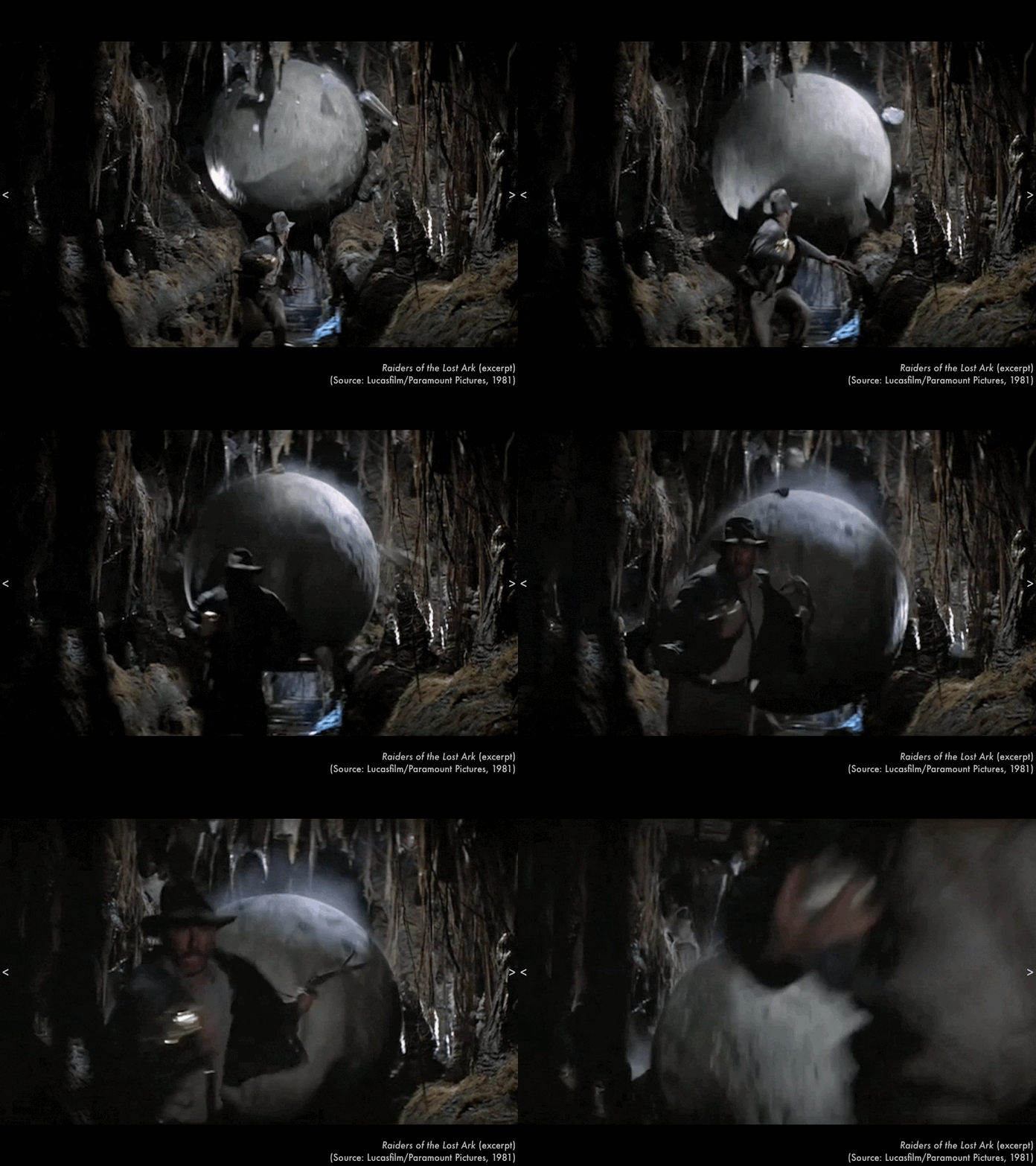
¡Adios, Sapito! In this iconic cinematic moment from Raiders of the Lost Ark (Lucasfilm, Paramount Pictures, 1981), Indiana Jones outruns a gigantic round boulder. Somehow I don't think the principle of energy conservation was on his mind at the moment, but it ought to have been.

Regardless of Dr. Jones having majored in archaeology instead of physics, we'll be pondering the inclusion of rotational motion into energy conservation.

First, let's define some rotational parameters.

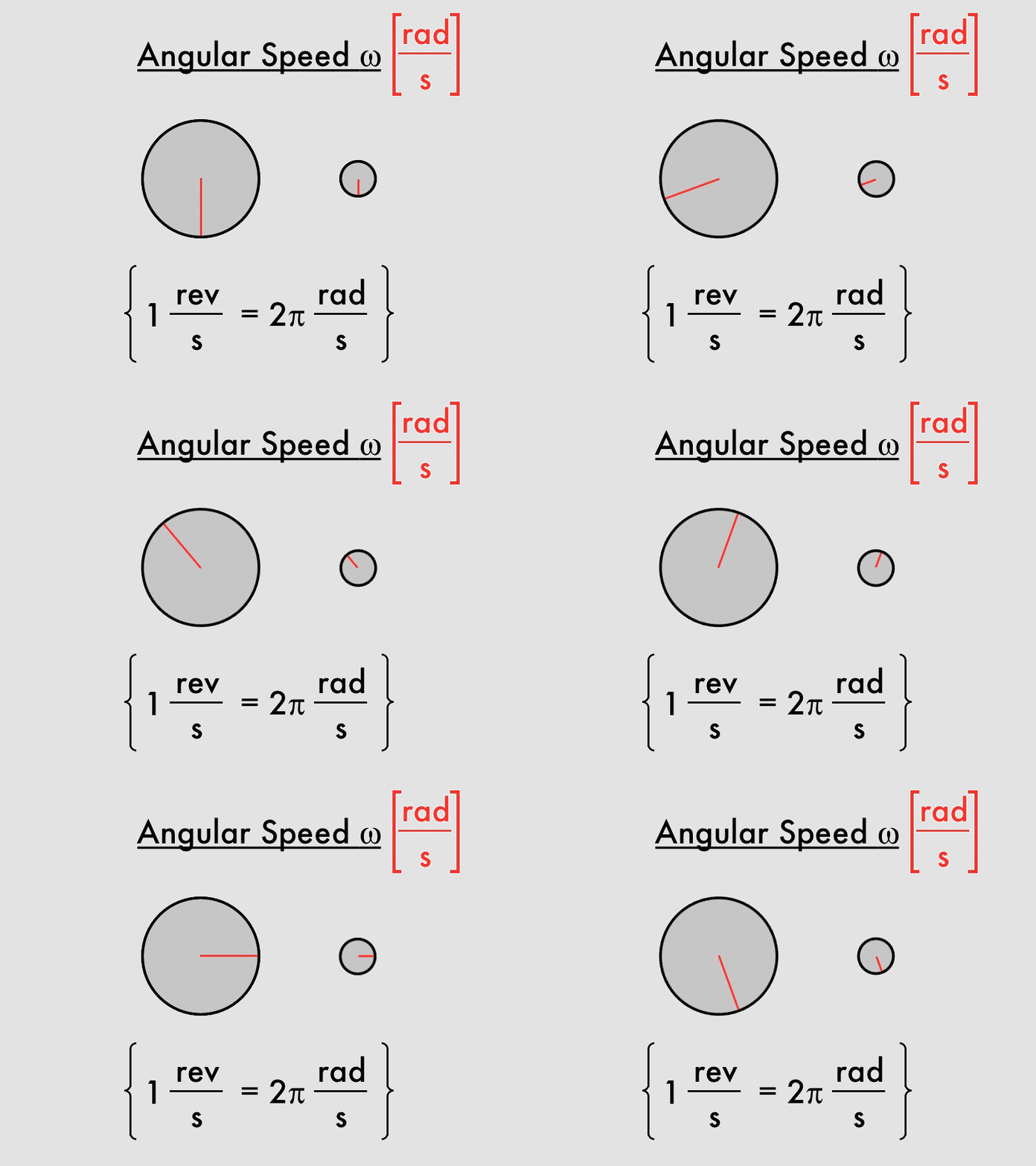
Angular speed (denoted by lower-case Greek letter ω) measures how fast an object rotates, using units of radians per second, where there are 2π radians per revolution. If an object is fixed such that rotates in place, then this is the only parameter necessary to describe its motion.

If an object rolls along a surface without slipping, then it will simultaneously travel with a translational speed v while rotating with an angular speed ω.

A rolling object's translational speed v and angular speed ω are constrained via the "rolling without slipping" condition v = r·ω, so an object with a radius r that has a slow or fast translational speed must also be rolling with a corresponding slow or fast angular speed. (Note the peculiar nature of the radians unit, where it conveniently disappears on the right-hand side of the equation such that v results in units of meters per second.)

Here two objects with different radii have the same translational speed v, but from the v = r·ω condition, the larger r radius object has a slower ω angular speed as it rolls, while the smaller r radius object has a faster ω angular speed in order to keep up.

Similar to how translational speed v and angular speed ω are related, there is a relationship between the mass M and the rotational inertia I of an object. Whereas an object's mass is a measure of how easy or difficult it is to change its translational motion, an object's rotational inertia (also known in more obscure calculus terminology as the "moment of inertia") measures the distribution of mass about its axis that makes it easy or difficult to change its rotational motion. The rotational inertia depends on the mass, size, and configuration of the object, and the appropriate expressions for rotational inertia should be used for each type of rotating object.

The simplest rotating object is a point mass M swung around in a circle of radius R; its moment of inertia is given by Ipoint mass = M·R2. (Video link: "2010 Asian Games - Men's Hammer Throw Final.")

The moment of inertia of a more complicated set of poi balls (two oil-soaked bundles at ends of chains) is simply twice the moment of inertia of a single point mass. This is the idea behind finding the moment of inertia of complex objects--merely the sum of the individual moment of inertia for its components. (Video link: "Ronan McLoughlin Fire Poi Slow motion (HD).")

Likewise for a uniform rod of mass M and length L that is swung around at one end, its moment of inertia is given by Irod, at end = (1/3)·M·R2. (The numerical factor of (1/3) for this object comes from calculus, but for the purposes of this course these numerical factors are merely to be looked up for each different type of object as needed.) (Video link: "2013 MLB Home Run Derby Extreme Slow Motion Swings.")

The moment of inertia of a three-bladed wind turbine--which can be thought of as a set of three uniform rods swung at their ends--is merely three times the individual moment of inertia of a single uniform rod. You can always look up the moment of inertia of simple objects, and for more complex objects merely add together the moment of inertia of each of its components. (Video link: "Enercon wind energy turbines in action.")

Second, incorporating rotational motion into energy conservation.

Rotational kinetic energy KErot is the energy of rotational motion. Rotational kinetic energy depends on the rotational inertia I and the square of the angular speed ω of the object, and the resulting units of kg·m2/s2 are also expressed as joules (once the peculiar units of rad2 disappear). A object that is not rotating has no rotational kinetic energy, and the faster an object rotates, the more rotational kinetic energy it has.

Instead of finding out how much rotational kinetic energy KErot an object has, often we are more concerned with its initial-to-final change KErot, which is the final amount of rotational kinetic energy minus the initial amount of rotational kinetic energy. Notice how the common factors of (1/2) and rotational inertia I (which is presumed to be constant) are pulled out, leaving a "difference of squares" for the final and initial angular speeds in the parenthesis.

For an object with both translational motion and rotational motion, it will have both translational kinetic energy and rotational kinetic energy. For the rider on this Solowheel, the translational kinetic energy KEtr will be given by (1/2)·(Mrider + mwheelv2, and the rotational kinetic energy KErot will be given by (1/2)·Iwheel·ω2. (Video link: "Riding the Solowheel to work - every days obstacle course.")

Note that the two kinetic energy expressions are not unrelated as the Solowheel rolls without slipping, such that the constraint v = r·ω can be used to connect the translational speed v in the translational kinetic energy expression with the angular speed ω in the rotational kinetic energy expression. We'll demonstrate this connection in some examples of objects that roll without slipping during lecture.

Now let's incorporate rotational kinetic energy into the total energy conservation equation, which shows how the transfer of energy (as work is done by non-conservative forces acting on or against the motion of the object) causes changes in any or all of the four known mechanical energy forms on the right-hand side of the equation.

As discussed previously, in the idealized case that there are no non-conservative forces (such as friction, drag, or from external sources), then the left-hand size of this equation would be zero. Then the individual energy terms on the right-hand side of this equation can then trade and balance amongst themselves, instead of with the outside world.

So now let's see how this more comprehensive transfer/balance equation can be applied to idealized situations where friction and drag are negligible.

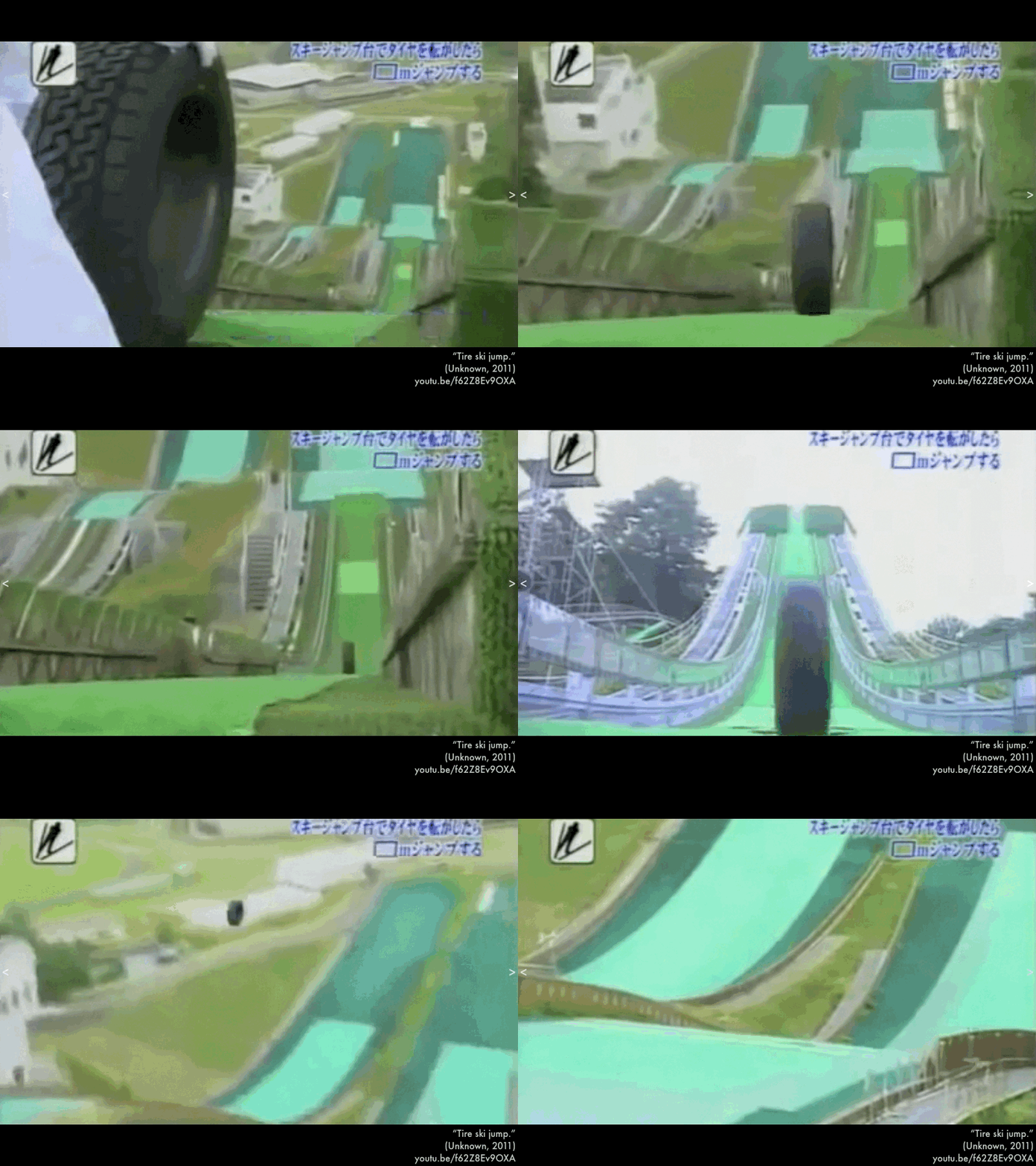
A tire is released from rest at the top of a ramp, and it rolls without slipping to reach the bottom of the ramp, where it then travels upwards off of a smaller ramp, where it reaches the top of its trajectory at a height lower than its initial starting point. And this was done for science. And must-see television. And now endures as a pervasive internet meme. (Video link: "Tire ski jump.")

From starting at the top of the ramp, down to the bottom of the ramp, the translational speed of the tire increases (from zero to a fast speed moving along the ramp), and since translational kinetic energy depends on the square of the tire's speed, as the tire's speed increases, its translational kinetic energy increases. (If you calculated the change in translational kinetic energy you would get a positive value, which is consistent with an increase.)

From starting at the top of the ramp, down to the bottom of the ramp, the vertical height decreases from a higher elevation to a lower elevation, and since gravitational potential energy depends on height, as the tire's height decreases, its gravitational potential energy decreases. (If you calculated the change in gravitational potential energy you would get a negative value, which is consistent with a decrease.)

Now let's consider the new type of energy introduced in this section--rotational kinetic energy. From starting at the top of the ramp, down to the bottom of the ramp, the rotational speed of the tire increases (from zero to quickly rolling along the ramp), and since rotational kinetic energy depends on the square of the tire's rotational speed, as the tire's rotational speed increases, its rotational kinetic energy increases. (If you calculated the change in rotational kinetic energy you would get a positive value, which is consistent with an increase.)

Since we are assuming friction and drag are negligible, then there is no non-conservative work done on the tire, so the left-hand side of the transfer/balance equation is zero:

Wtr = ∆KEtr + ∆PEgrav + ∆PEelas + ∆KErot,

0 = ∆KEtr + ∆PEgrav + ∆PEelas + ∆KErot,

and since there are no changes in elastic potential energy while the tire rolls down the ramp, we are only left with the changes in the translational kinetic energy, gravitational potential energy, and rotational kinetic energy terms:

0 = ∆KEtr + ∆PEgrav + 0 + ∆KErot,

0 = ∆KEtr + ∆PEgrav + ∆KErot,

0 = (+) + (–) + (+).

Now we can see that the amount that the tire's gravitational potential energy decreases (where ∆PEgrav is negative) must be directly related to the amounts that the tire's translational kinetic energy and rotational kinetic energy increase (where ∆KEtr and ∆KErot are both positive), in order to equal the zero on the left-hand side of the equation. So gravitational potential energy "feeds" (or is "transferred to") both translational kinetic energy and rotational kinetic energy during this process.

For the subsequent part of this stunt, from just as it leaves the upwards lip of the ramp, to reaching the highest point of its trajectory, does the tire's translational kinetic energy increase or decrease? Does its rotational kinetic energy increase or decrease? Does its gravitational potential energy increase or decrease?

Assuming that there is no friction/drag (such that we can neglect non-conservative work), which energy system experienced a greater amount of change (whether increase or decrease) for this process: translational kinetic energy, rotational kinetic energy, or gravitational potential energy? (Note that since there is no drag, the tire just freely spins in the air, maintaining whatever rotational speed it had when it left the end of the ramp.)

Astronomy current events question: audience vote on Pluto as a planet

Astronomy 210L, fall semester 2014
Cuesta College, San Luis Obispo, CA

Students are assigned to read online articles on current astronomy events, and take a short current events quiz during the first 10 minutes of lab. (This motivates students to show up promptly to lab, as the time cut-off for the quiz is strictly enforced!)
David A. Aguilar, Christine Pulliam, "Is Pluto a Planet? The Votes Are In," (September 22, 2014)
http://www.cfa.harvard.edu/news/2014-25
After presentations from three planetary scientists at the Harvard-Smithsonian Center for Astrophysics, __________ audience members voted on a definition for Pluto being a planet.
(A) NASA.
(B) International Astronomical Union.
(C) general public.
(D) preschool and kindergarten.
(E) Nobel Prize winner.

Correct answer: (C)

Student responses
Sections 70178, 70186
(A) : 4 students
(B) : 12 students
(C) : 22 students
(D) : 1 student
(E) : 0 students

Astronomy current events question: WASP-94 "cousin" planets

Astronomy 210L, fall semester 2014
Cuesta College, San Luis Obispo, CA

Students are assigned to read online articles on current astronomy events, and take a short current events quiz during the first 10 minutes of lab. (This motivates students to show up promptly to lab, as the time cut-off for the quiz is strictly enforced!)
waspplanets@gmail.com, "WASP-94: 'Cousin' Planets Around Twin Stars," (September 30, 2014)
http://wasp-planets.net/2014/09/30/wasp-94-cousin-planets-around-twin-stars/
The Wide-Angle Search for Planets telescopes discovered that binary system stars WASP-94A and WASP-94B are each orbited by a Jupiter-sized extrasolar planet, by observing these planets:
(A) wobbling their stars.
(B) colliding with each other.
(C) being torn apart by tidal forces.
(D) passing in front of their stars.
(E) emitting infrared light.

Correct answer: (D)

Student responses
Sections 70178, 70186
(A) : 3 students
(B) : 2 students
(C) : 3 students
(D) : 25 students
(E) : 6 students

Astronomy current events question: Titan's south pole cloud

Astronomy 210L, fall semester 2014
Cuesta College, San Luis Obispo, CA

Students are assigned to read online articles on current astronomy events, and take a short current events quiz during the first 10 minutes of lab. (This motivates students to show up promptly to lab, as the time cut-off for the quiz is strictly enforced!)
Preston Dyches, "Swirling Cloud at Titan's Pole is Cold and Toxic," (October 1, 2014)
http://www.nasa.gov/jpl/cassini/swirling-cloud-at-titans-pole-is-cold-and-toxic/index.html
NASA's Cassini mission observations of __________ revealed the temperature and chemical composition of the south pole cloud of Saturn's largest moon, Titan.
(A) a comet impact.
(B) radio interference.
(C) reflected sunlight.
(D) auroral lights.
(E) lightning storms.

Correct answer: (C)

Student responses
Sections 70178, 70186
(A) : 1 student
(B) : 5 students
(C) : 16 students
(D) : 6 students
(E) : 11 students

20141022

Online reading assignment: stellar parameters (SLO campus)

Astronomy 210, fall semester 2014
Cuesta College, San Luis Obispo, CA

Students have a weekly online reading assignment (hosted by SurveyMonkey.com), where they answer questions based on reading their textbook, material covered in previous lectures, opinion questions, and/or asking (anonymous) questions or making (anonymous) comments. Full credit is given for completing the online reading assignment before next week's lecture, regardless if whether their answers are correct/incorrect. Selected results/questions/comments are addressed by the instructor at the start of the following lecture.

The following questions were asked on reading textbook chapters and previewing presentations on parallax, distance, apparent magnitude, absolute magnitude, Wien's law and the Stefan-Boltzmann law.


Selected/edited responses are given below.

Describe something you found interesting from the assigned textbook reading or presentation preview, and explain why this was personally interesting for you.
"That we are able to find out the size of a star based upon its luminosity and temperature."

"Wien's law is neat because you can tell how hot a star is by just looking at what color it is."

"The H-R diagram--because this gives you an idea of how big, how hot, and how other stars are related to the sun."

"White hot stars are hotter than the red ones."

"I never knew that there was this much information on stars. I'm totally interested but I'm totally confused at the same time."

Describe something you found confusing from the assigned textbook reading or presentation preview, and explain why this was personally confusing for you.
"Pretty much everything."

"The differences between apparent and absolute magnitude."

"How to calculate distance and brightness! Oh my gosh, help!"

"The S-B Law because I just don't understand how it works."

"The stars and all of their classifications! After the video [Wonders of the Universe: Stardust] last week, I became aware of how much there is to know about stars and I was blown away. And I knew this was going to trip me up. So just all the information and keeping it straight is the hardest part."

Explain how apparent magnitude and the absolute magnitude are defined differently.
"Apparent magnitude is how bright a star looks like from the naked eye and absolute magnitude is how bright a star really is (once the distance of the star is accounted for)."

"Apparent magnitude is how bright we see a star, regardless of its distance from the earth. Absolute magnitude is how bright a star would appear if we put it at 32.616 light-years [10 parsecs] away."

"I'm unsure."

"Apparent is a guesstimate, and absolute is exact."

Suppose the sun was moved to a distance of 10 parsecs away. As a result, its __________ magnitude would become dimmer.
absolute.  ********* [9]
apparent.  ******************* [19]
(Both of the above choices.)  ***** [5]
(Neither of the above choices.)  [0]
(Unsure/guessing/lost/help!)  **** [4]

Rank the temperatures of these stars (1 = hottest, 4 = coolest; there are no ties).
(Only correct responses shown.)
Hottest: blue main sequence star [81%]
Second hottest: white main sequence star [76%]
Third hottest: yellow main sequence star [84%]
Coolest: red main sequence star [92%]

Rank the temperatures of these stars (1 = hottest, 4 = coolest; there are no ties).
(Only correct responses shown.)
Hottest: blue supergiant [78%]
Second hottest: white dwarf [51%]
Third hottest: yellow supergiant [64%]
Coolest: red dwarf [87%]

Two stars (equally far away) have the same temperature, but one star is dimmer, and the other star is brighter. The __________ star will be larger in size.
dimmer.  ****** [6]
brighter.  **************************** [28]
(These stars would be the same size.)  [0]
(Unsure/guessing/lost/help!)  *** [3]

Two stars (equally far away) have the same brightness, but one star is cooler, and the other star is hotter. The __________ star will be larger in size.
cooler.  ********************* [21]
hotter.  ********* [9]
(These stars would be the same size.)  **** [4]
(Unsure/guessing/lost/help!)  *** [3]

Ask the instructor an anonymous question, or make a comment. Selected questions/comments may be discussed in class.
"More examples and charts would be good. Please go over the distance of the stars and what is cooler/hotter and dimmer/brighter." (Yes.)

"Parsecs (pc) are better than light-years (ly)!" (Yes.)

"Do we need to memorize all of these equations?" (What equations? More seriously, you do need to "memorize" the logical reasoning behind the mathematics we'll be learning this week in order to apply it to quiz and exam questions.)

"What are you going to be for Halloween?" (Come to Madonnaween at the Madonna Inn the Monday before Halloween, and find out. I'm not dressing up as a DJ, but I am DJing!))

Online reading assignment: torque and rotations

Physics 205A, fall semester 2014
Cuesta College, San Luis Obispo, CA

Students have a weekly online reading assignment (hosted by SurveyMonkey.com), where they answer questions based on reading their textbook, material covered in previous lectures, opinion questions, and/or asking (anonymous) questions or making (anonymous) comments. Full credit is given for completing the online reading assignment before next week's lecture, regardless if whether their answers are correct/incorrect. Selected results/questions/comments are addressed by the instructor at the start of the following lecture.

The following questions were asked on reading textbook chapters and previewing a presentation on torque and rotations.


Selected/edited responses are given below.

Describe what you understand from the assigned textbook reading or presentation preview. Your description (2-3 sentences) should specifically demonstrate your level of understanding.
"Torque is the twisting by a force that tends to cause rotation."

"Torque is the product of force (N) and the length of the perpendicular lever arm (m). The force vector (line of action) is perpendicular to the perpendicular lever arm."

"N1 applies to torque when the object is in equilibrium. N2 applies when the object is starting to rotate."

Describe what you found confusing from the assigned textbook reading or presentation preview. Your description (2-3 sentences) should specifically identify the concept(s) that you do not understand.
"Net torque."

"How an object can have a net force of zero while the torque is nonzero. I also do not get how if its torque was nonzero and net force was zero, how such an object could have a nonzero angular acceleration."

"I am not 100% on drawing out a diagram for torque."

"Line of action for a force."

"The lever arm, and how it was drawn/what function it serves."

What is the SI (Système International) unit for torque?
"N·m."

"Tau."

"Newtons."

Briefly describe how the line of action should be drawn for a given force.
"The line of action should extend along the force vector direction."

"I have no idea."

"With a dashed line."

When a lever arm (or moment arm) is drawn, briefly explain where it starts, and how it should intersect the line of action for a force.
"The lever arm starts at the rotation axis and is perpendicular to the line of action."

"I have no clue. Sorry."

For the stuck wrench (assuming that it is rigid and not flexing), Newton's rotational __________ law applies, and the clockwise torques and counterclockwise torques acting on the wrench are __________.
first; balanced.   ************************************************* [49]
second; unbalanced.   ********* [9]
(Unsure/lost/guessing/help!)   ***** [5]

For the crane, Newton's rotational __________ law applies, and the clockwise torques and counterclockwise torques acting on the crane are __________.
first; balanced.   ******** [8]
second; unbalanced.   ************************************************* [49]
(Unsure/lost/guessing/help!)   ****** [6]

Ask the instructor an anonymous question, or make a comment. Selected questions/comments may be discussed in class.
"I once broke a torque wrench trying to loosen the lug nuts on a Lexus. They must have been torqued up to 200 ft·lbs. Apparently, they don't want you to do anything to their cars at all." (Unless you had a Nutcracker®.)

"Can you go over how to draw diagrams for these problems? Can you please go over the 'line of action?'" (Yes, and yes.)

"I apologize for turning in such a shameful assignment. I will definitely read the material before class, so I can follow what is going on."

"Does the extra credit from lab count as a part of the total extra credit for the class?"(No, lab points are capped at a 100 points maximum.)

"Would it be possible to do a really good review for the upcoming quiz?" (Let's see how well you can rock the sample quiz from last year.)

"Didn't think it could get any harder. You must be mad smart."

"I think I am going to like this section."

20141021

Physics midterm question: water-filled bucket twirled in a vertical circle

Physics 205A Midterm 1, fall semester 2014
Cuesta College, San Luis Obispo, CA

Cf. Giambattista/Richardson/Richardson, Physics, 2/e, Problem 5.39

Water is poured into a bucket attached to an ideal string, and is then twirled around in a circle. Discuss why the magnitude of the normal force of the bucket on the water is greater than the magnitude of the weight force of Earth on the water, when the bucket is at the bottom of its circular path. Explain your reasoning by using a free-body diagram, the properties of forces and Newton's laws.

Solution and grading rubric:
  • p:
    Correct. Understands that the water in the bucket has two vertical forces acting on it:
    Weight force of Earth on water (downwards, magnitude w = m·g).
    Normal force of bucket on water (upwards, magnitude varies but must be greater than w).
    Because the water is (momentarily) undergoing uniform circular motion as it goes through the bottom of its swing, then Newton's second law applies to the motion of the water (speed is constant but direction of the velocity vector is changing), and the net force must point upwards (towards the center of the circular path). This means that the upwards normal force must have a magnitude greater than the magnitude of the weight force.
  • r:
    As (p), but argument indirectly, weakly, or only by definition supports the statement to be proven, or has minor inconsistencies or loopholes. Some attempt at applying Newton's laws to a free-body diagram, but may have a centrifugal or centripetal "m·v/r2" force in addition to the normal and weight forces.
  • t:
    Nearly correct, but argument has conceptual errors, or is incomplete. Problematic attempt at applying Newton's laws (N1 or N3) to a free-body diagram (with extraneous or missing forces, or inconsistent with Newton's laws).
  • v:
    Limited relevant discussion of supporting evidence of at least some merit, but in an inconsistent or unclear manner. Effectively only has a substantive attempt at a free-body diagram, or only a substantive attempt at discussing Newton's laws.
  • x:
    Implementation of ideas, but credit given for effort rather than merit. Approach other than that of applying Newton's laws to a free-body diagram.
  • y:
    Irrelevant discussion/effectively blank.
  • z:
    Blank.
Grading distribution:
Sections 70854, 70855, 73320
Exam code: midterm01m0oU
p: 8 students
r: 24 students
t: 28 students
v: 13 students
x: 0 students
y: 0 students
z: 1 student

A sample "p" response (from student 0203):

Another sample "p" response (from student 1828):

A sample "r" response (from student 1914), with an additional centripetal force on the free-body diagram:

A sample "v" response (from student 3474):

Online reading assignment: stellar parameters (NC campus)

Astronomy 210, fall semester 2014
Cuesta College, San Luis Obispo, CA

Students have a weekly online reading assignment (hosted by SurveyMonkey.com), where they answer questions based on reading their textbook, material covered in previous lectures, opinion questions, and/or asking (anonymous) questions or making (anonymous) comments. Full credit is given for completing the online reading assignment before next week's lecture, regardless if whether their answers are correct/incorrect. Selected results/questions/comments are addressed by the instructor at the start of the following lecture.

The following questions were asked on reading textbook chapters and previewing presentations on parallax, distance, apparent magnitude, absolute magnitude, Wien's law and the Stefan-Boltzmann law.


Selected/edited responses are given below.

Describe something you found interesting from the assigned textbook reading or presentation preview, and explain why this was personally interesting for you.
"That astronomers use triangulation to calculate the distance of a star. It is nice to see this practical application of trigonometry which, interestingly, can be compared to how surveyors calculate distance as well."

"I found the whole chapter pretty interesting, especially how the color really shows the temperature of the star. This is mostly due to the fact that we usually see blue and white as cool colours, so when it turns out that they're in fact indicators of the hottest suns it seems somewhat counter intuitive. Even though I know blue flames are hotter than red flames, it still seems so odd."

"The Stefan-Boltzamann law, because I was trying to figure out all the concepts (luminosity, temperature, and size) how they all come together to determine different things about the stars."

"How bigger stars aren't necessarily hotter."

"That you can tell which star has the most luminosity based on it's color and size. This is interesting because I didn't know it was so simple as this."

"The charts for determining the luminosity of stars was cool. I didn't think it would be that easy, but it makes sense and is really quick to do!"

"It's cool to know that I'm not crazy or seeing things when I see a star as having a red color."

Describe something you found confusing from the assigned textbook reading or presentation preview, and explain why this was personally confusing for you.
"How can we measure the distances to stars?"

"The Stefan-Boltzamann law because I feel I still need examples to understand it completely and be able to use it."

"Apparent magnitude and absolute magnitude. It's hard to conceptualize."

"I was confused about what I found to be interesting. That is, why we don't see stars of all colors of the rainbow."

"Light-years and parsecs. I get that they ares a units of measure but why did we choose them? What would be an examples of them?"

Explain how apparent magnitude and the absolute magnitude are defined differently.
"Apparent magnitude is what we see from Earth. Absolute is what the actual brightness is."

Suppose the sun was moved to a distance of 10 parsecs away. As a result, its __________ magnitude would become dimmer.
absolute.  *** [3]
apparent.  ****************** [18]
(Both of the above choices.)  ** [2]
(Neither of the above choices.)  ** [2]
(Unsure/guessing/lost/help!)  **** [4]

Rank the temperatures of these stars (1 = hottest, 4 = coolest; there are no ties).
(Only correct responses shown.)
Hottest: blue main sequence star [70%]
Second hottest: white main sequence star [59%]
Third hottest: yellow main sequence star [83%]
Coolest: red main sequence star [90%]

Rank the temperatures of these stars (1 = hottest, 4 = coolest; there are no ties).
(Only correct responses shown.)
Hottest: blue supergiant [83%]
Second hottest: white dwarf [59%]
Third hottest: yellow supergiant [72%]
Coolest: red dwarf [93%]

Two stars (equally far away) have the same temperature, but one star is dimmer, and the other star is brighter. The __________ star will be larger in size.
dimmer.  *** [3]
brighter.  ************************** [26]
(These stars would be the same size.)  [0]
(Unsure/guessing/lost/help!)  [0]

Two stars (equally far away) have the same brightness, but one star is cooler, and the other star is hotter. The __________ star will be larger in size.
cooler.  ************** [14]
hotter.  ************** [14]
(These stars would be the same size.)  [0]
(Unsure/guessing/lost/help!)  * [1]

Ask the instructor an anonymous question, or make a comment. Selected questions/comments may be discussed in class.
"How do they know the temperature of a star?" (By looking at its color.)

"Could we please briefly discuss in class the relationship between a star's color and its temperature?"(Yes.)

"What's up with your hearing aid?" (I'm the world's deafest swing DJ. #fml #strongthanhearingloss)

20141020

Online reading assignment: collisions

Physics 205A, fall semester 2014
Cuesta College, San Luis Obispo, CA

Students have a weekly online reading assignment (hosted by SurveyMonkey.com), where they answer questions based on reading their textbook, material covered in previous lectures, opinion questions, and/or asking (anonymous) questions or making (anonymous) comments. Full credit is given for completing the online reading assignment before next week's lecture, regardless if whether their answers are correct/incorrect. Selected results/questions/comments are addressed by the instructor at the start of the following lecture.

The following questions were asked on reading textbook chapters and previewing a presentation on collisions.


Selected/edited responses are given below.

Describe what you understand from the assigned textbook reading or presentation preview. Your description (2-3 sentences) should specifically demonstrate your level of understanding.
"I understand the different types of collisions. I also understand how to use the conservation law equations."

"Total momentum is a sum total of momenta of objects in a system. Internal interactions do not change total momentum, external interactions might change it. Reading also touches on what a collision is."

"A perfectly inelastic collision occurs when two objects stick together. Inelastic occurs when one object pushes the other away and there's visible damage. Finally, an elastic collision occurs when one object completely pushes another and there is no visible damage."

"I assumed that two objects stuck together wouldn't lose lots of energy, but after reading more about it, they can lose lots of kinetic energy."

Describe what you found confusing from the assigned textbook reading or presentation preview. Your description (2-3 sentences) should specifically identify the concept(s) that you do not understand.
"The relative velocity kinetic energy conservation equation just is not clicking for me. A brief explanation of why that equation is what it is would help greatly."

"You lost me at the concept of momentum."

Explain the difference between a (partially) inelastic collision and a perfectly inelastic collision.
"If two cars hit each other and do not stick to each other , but are crushed or bent, then the collision is partially inelastic. If two cars collide and are stuck together, the collision is perfectly inelastic."

"In an inelastic collision both objects bounce off each other and there is visible damage, in a perfectly inelastic collision, however, both objects are stuck together in addition to visible damage."

Explain why drag, friction, and other external forces do not matter during sufficiently "brief" collisions, in order for momentum to be conserved.
"We're limiting it to the initial state just before the collision and the final state just after the collision. The external forces have negligible impulses in the short time span."

"The system needs to be isolated from all external factors, because if it isn't then momentum is not conserved. To put it into context, external forces will always be a factor, but the forces involved within a collision are so large that any external forces can be safely ignored, for they do not alter the final result in a significant way."

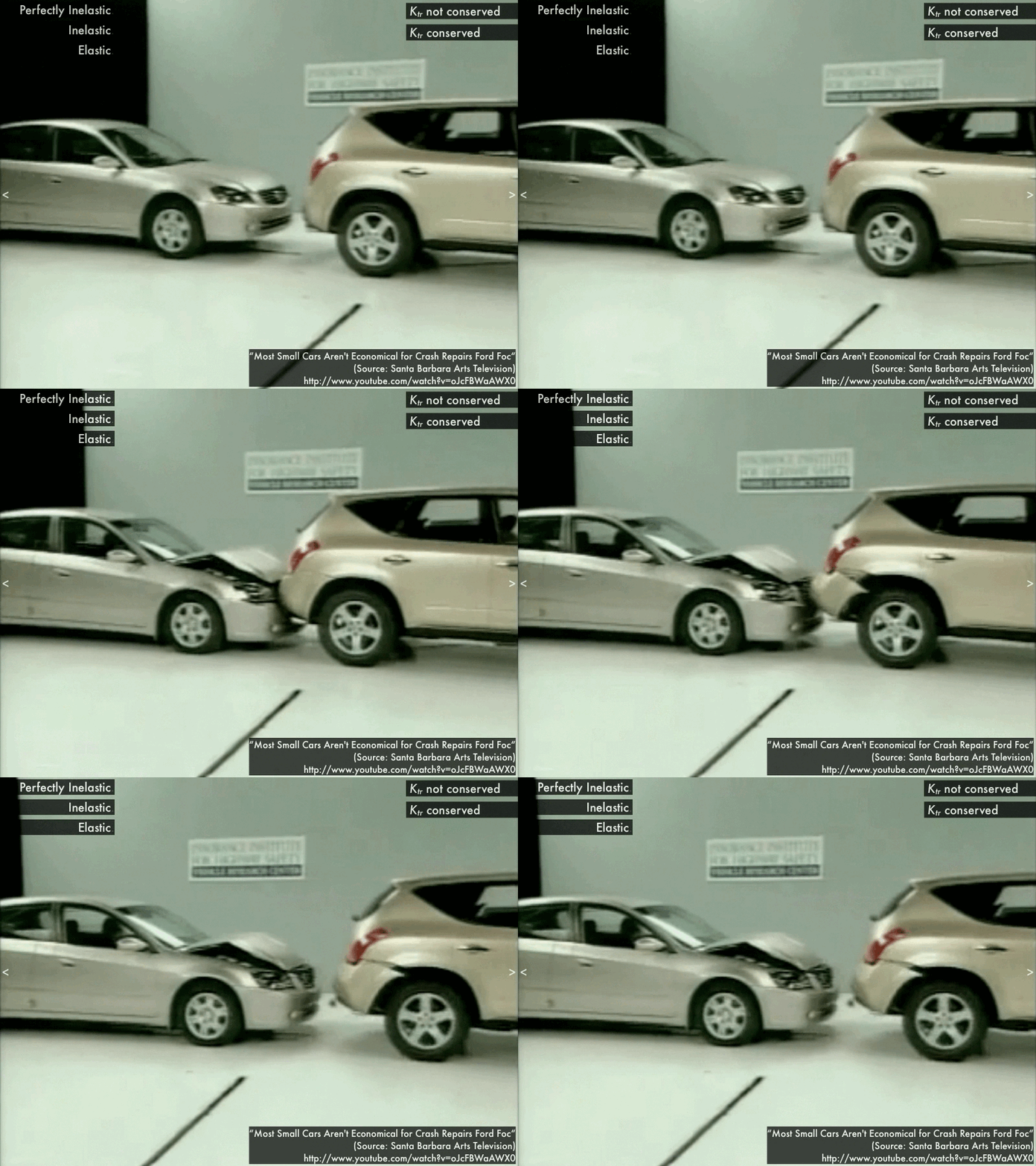
For the Nissan Altima and Nissan Rogue crash test, classify the type of collision. (Neglect drag/friction/external forces during this "brief" collision.)
Perfectly inelastic (kinetic energy not conserved).   ** [2]
(Partially) inelastic (kinetic energy not conserved).   **************************************** [40]
Elastic (kinetic energy conserved).   ***** [5]
(Unsure/lost/guessing/help!)   ******** [8]

For the Ford Explorer and Ford Taurus crash test, classify the type of collision. (Neglect drag/friction/external forces during this "brief" collision.)
Perfectly inelastic (kinetic energy not conserved).   ******** [8]
(Partially) inelastic (kinetic energy not conserved).   ****** [6]
Elastic (kinetic energy conserved).   ********************************* [33]
(Unsure/lost/guessing/help!)   ******** [8]

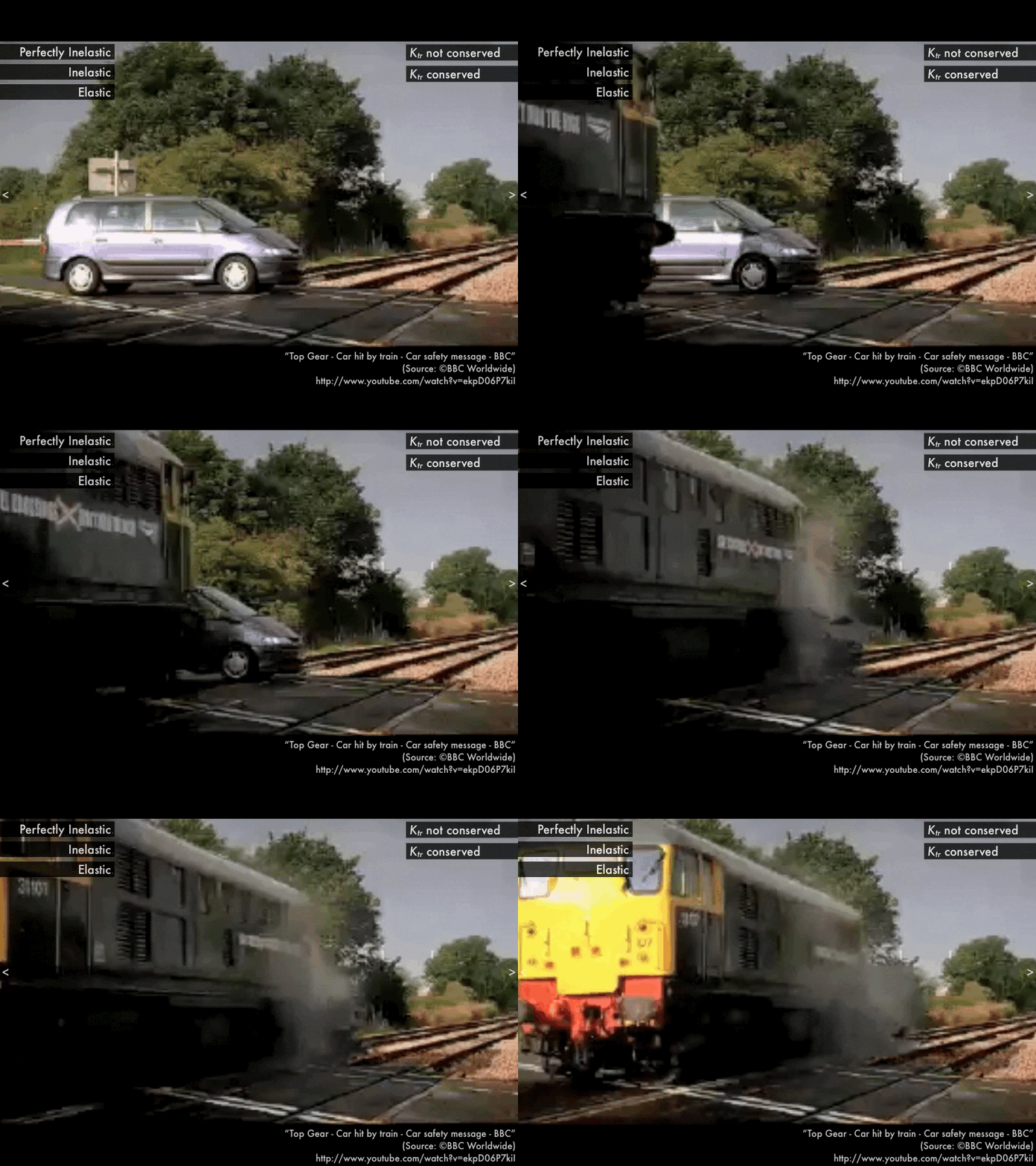
For the train and minivan crash, classify the type of collision. (Neglect drag/friction/external forces during this "brief" collision.)
Perfectly inelastic (kinetic energy not conserved).   ******************************* [31]
(Partially) inelastic (kinetic energy not conserved).   ******* [7]
Elastic (kinetic energy conserved).   ***** [5]
(Unsure/lost/guessing/help!)   ************ [12]

For the bullet burrowing through and back out of the baseball, classify the type of collision. (Neglect drag/friction/external forces during this "brief" collision.)
Perfectly inelastic (kinetic energy not conserved).   *** [3]
(Partially) inelastic (kinetic energy not conserved).   **************************** [28]
Elastic (kinetic energy conserved).   ************ [12]
(Unsure/lost/guessing/help!)   ************ [12]

For the bullet shot out of this gun, classify the type of collision. (Neglect drag/friction/external forces during this "brief" collision.)
Perfectly inelastic (kinetic energy not conserved).   *** [3]
(Partially) inelastic (kinetic energy not conserved).   ****************** [18]
Elastic (kinetic energy conserved).   ******************** [20]
(Unsure/lost/guessing/help!)   ************** [14]

Ask the instructor an anonymous question, or make a comment. Selected questions/comments may be discussed in class.
"I am having some trouble understanding elastic, partially inelastic, and perfectly inelastic collisions, and momentum conservation and kinetic energy conservation equations. Would you be able to go over some examples in class please? Could you also go over kinetic energy being conserved or not being conserved?" (Yes. And if time allows, you'll get to solve an example as well.)

"How do you tell the difference between perfectly inelastic and partially inelastic collisions? Is it just the sticking (or not)?" (Yes, for a perfectly inelastic collision, the objects are stuck-together after the collision. It's actually quite common in automobile accidents.)

"What would it be if two objects collided, stuck together, and did not have deformation?" (If there is not visible deformation, then translational kinetic energy was dissipated into other forms, such as sound, heat, etc.)

"Can you go over the last question on the midterm?" (It's discussed on the blog, along with samples of student solutions.)

"Do you celebrate Halloween?" (My people celebrate something called "Madonnaween.")