Showing posts with label capacitor. Show all posts

20200311

Online reading assignment: capacitors

Physics 205B, spring semester 2020
Cuesta College, San Luis Obispo, CA

Students have a bi-weekly online reading assignment (hosted by SurveyMonkey.com), where they answer questions based on reading their textbook, material covered in previous lectures, opinion questions, and/or asking (anonymous) questions or making (anonymous) comments. Full credit is given for completing the online reading assignment before next week's lecture, regardless if whether their answers are correct/incorrect. Selected results/questions/comments are addressed by the instructor at the start of the following lecture.

The following questions were asked on reading textbook chapters and previewing presentations on capacitors.


Selected/edited responses are given below.

Describe what you understand from the assigned textbook reading or presentation preview. Your description (2-3 sentences) should specifically demonstrate your level of understanding.
"The concept of the capacitor charging: in the GIF animation, the charging seems to be due to a negative charge leaving one side and when the negative charge leaves, a positive charge is left over. The positive charge then attracts a negative charge in the opposite side of the capacitor."

"The SI unit of capacitance is a farad, or coulombs squared over joules. Also that the capacitance is fixed once the construction of the capacitor is complete, and the only way to change the capacitance is to change the build of the capacitor. The potential applied to the capacitor can be altered however by using different batteries."

"A capacitor constructed from two plates and a space in-between. I also understand the capacitor construction formula."

"That once a capacitor is constructed you cannot change the capacitance of it without changing its build (plate area or separation distance)."

"Capacitors are built by putting parallel metal plates together with a small distance in between. Charging a capacitor requires a battery and will cause electrons to move freely from the top plate to the bottom plate until the top plate demonstrates a positive charge and the bottom plate have a negative charge. However, as more and more electrons move towards the bottom panel, it requires more work and creates a larger EPE charge due to the voltage."

"Capacitors store electric charge. Capacitors have a capacitance, which reflects their ability to store electric charge. While their capacitance is determined by surface area and separation distance of parallel metal plates, changing the voltage applied to the capacitor also changes their charge but does not change the capacitance of the capacitor."

"Capacitors store up electric potential energy by creating a potential difference across 2 parallel metal plates. The more charge the capacitor holds, the more energy it takes to move it across to the opposing plate. Unlike batteries, a charged capacitor can release its energy in a short burst over a short period of time."

Describe what you found confusing from the assigned textbook reading or presentation preview. Your description (2-3 sentences) should specifically identify the concept(s) that you do not understand.
"Understanding voltage and especially understanding how it relates to capacitance is difficult."

"I don't understand how a capacitor gets charged."

"I do not understand capacitor charge because I see charges staying or leaving."

"Electric potential energy storage explanation."

"The capacitor energy storage formulas were different depending on the scenario. I need to work problems out to understand the differences."

"I found most of this reading assignment confusing. I could definitely use some clarification on the math."

"Nothing at this time, just want more examples of applications in class."

Describe two quantities that a capacitor is designed to store/hold.
"A capacitor is designed to hold voltage and electric potential energy."

"The capacitor holds charges. Both positive and negative?"

"Charge and electric potential energy."

State the unit of capacitance, and give its definition in terms of other SI units.
"farad, F, which is C (coulombs) squared divided by joules."

"Coulombs/volts = farads; where coulomb is electric charge, while volt is electric potential."

For a parallel-plate capacitor, ___________ the plate area and __________ the plate separation would increase its capacitance.
decreasing; decreasing.  [0]
decreasing; increasing.  ** [2]
increasing; decreasing.  ************************ [24]
increasing; increasing.  *** [3]
(Unsure/guessing/lost/help!)  *** [3]

For a parallel-plate capacitor, increasing the voltage (electric potential) difference applied to the capacitor would __________ the amount of charge stored in it.
decrease.  ******* [7]
increase.  **************** [16]
have no effect on.  ******* [7]
(Unsure/guessing/lost/help!)  **[2]

Explain why increasing or decreasing the voltage (electric potential difference) of a capacitor cannot change the numerical value of its capacitance.
"I don't know. I would think increasing the voltage also increases the capacitance?"

"Because it only affects the actual amount of charge it has, not the storage ability, or size of the actual capacitor."

"The capacitor is based on the plate separation distance and cross-sectional area."

"The capacitor holds a specific amount and adding or decreasing the voltage does not change. This is due to the fact that once it is constructed, the capacitance is fixed."

Ask the instructor an anonymous question, or make a comment. Selected questions/comments may be discussed in class.
"Do we get to use capacitors in any labs?"

"I am definitely struggling with this section, are we going to take a pretty deep dive on this?" (We will, but in lab.)

"Oh man, this electricity stuff is challenging."

"Capacitors shockingly weren't as difficult as I was anticipating."

"I noticed that farads are named after Michael Faraday. I hear his name mentioned a lot when discussing physics. Has he made a lot of contributions to the physics of electricity?" (Yes, but so did a lot of other physicists that have units named after them: Coulomb, Volta, Ohm, Ampere, Weber, Henry, and Tesla; along with others who don't have units named after them: Franklin, Maxwell, Ørsted, Lorentz, etc.)

20190510

Physics midterm question: comparing same-energy, different potential capacitors

Physics 205B Midterm 2, spring semester 2019
Cuesta College, San Luis Obispo, CA

A capacitor is connected to a 1.5 V battery and a different capacitor is connected to a 6.0 V battery. Both capacitors store the same amount of electrical potential energy. Discuss why the capacitor connected to the 1.5 V battery has a larger capacitance than the capacitor connected to the 6.0 V battery. Explain your reasoning by using the properties of capacitors, charge, electric potential, and energy.

Solution and grading rubric:
  • p:
    Correct. Discusses why the capacitor connected to the 1.5 V battery has a greater capacitance than the capacitor connected to the 6.0 V battery because:
    1. from EPE = (1/2)⋅Q⋅(ΔV), both capacitors store the same amount of electrical potential energy; such that the capacitor connected to the 1.5 V battery holds a larger charge than the capacitor connected to the 6.0 V battery; and
    2. from C = QV, since the capacitor connected to the 1.5 V battery has a smaller potential difference and a larger charge than the capacitor connected to the 6.0 V battery; then the capacitor connected to the 1.5 V battery must have a larger capacitance.
  • r:
    As (p), but argument indirectly, weakly, or only by definition supports the statement to be proven, or has minor inconsistencies or loopholes.
  • t:
    Nearly correct, but argument has conceptual errors, or is incomplete. Typically assumes that both capacitors have the same charge, and/or does not explicitly use the given fact that the capacitors store the same amount of electrical potential energy.
  • v:
    Limited relevant discussion of supporting evidence of at least some merit, but in an inconsistent or unclear manner. Some attempt at applying properties of capacitors, charge, electric potential, and energy.
  • x:
    Implementation/application of ideas, but credit given for effort rather than merit. No clear attempt at systematically applying properties of capacitors, charge, electric potential, and energy.
  • y:
    Irrelevant discussion/effectively blank.
  • z:
    Blank.
Grading distribution:
Sections 30882, 30883
Exam code: midterm02u7aH
p: 22 students
r: 1 student
t: 18 students
v: 0 students
x: 1 student
y: 1 student
z: 0 students

A sample "p" response (from student 2334):

Another sample "p" response (from student 1842), substituting in Q = C·ΔV into the electric potential energy equation:

20190313

Online reading assignment: capacitors

Physics 205B, spring semester 2019
Cuesta College, San Luis Obispo, CA

Students have a bi-weekly online reading assignment (hosted by SurveyMonkey.com), where they answer questions based on reading their textbook, material covered in previous lectures, opinion questions, and/or asking (anonymous) questions or making (anonymous) comments. Full credit is given for completing the online reading assignment before next week's lecture, regardless if whether their answers are correct/incorrect. Selected results/questions/comments are addressed by the instructor at the start of the following lecture.

The following questions were asked on reading textbook chapters and previewing presentations on capacitors.


Selected/edited responses are given below.

Describe what you understand from the assigned textbook reading or presentation preview. Your description (2-3 sentences) should specifically demonstrate your level of understanding.
"A capacitor consists of two conducting plates of the same geometry and with opposite charges of the same magnitude close together but not touching. The space between capacitors is sometimes filled with a non-conductive dielectric substance. When a dielectric is used, the capacitance (the proportional constant of a capacitor) increases and the electric field between the plates decreases."

"Capacitors store EPE and charges."

"Capacitance is fixed once constructed. The capacitor has a bigger capacitance with a bigger area and a smaller separation distance."

"They capacitance of a capacitor is fixed once it's built, but you can change the amount of potential applied. Applying a high potential will allow it to store more charge, if you apply less potential then it it stores less charge."

"Plate capacitors work similar to batteries in that they store electric charges and create 'pressure' that causes a circuit to function."

Describe what you found confusing from the assigned textbook reading or presentation preview. Your description (2-3 sentences) should specifically identify the concept(s) that you do not understand.
"I don't quite understand the whole idea of changing the amount of charge that each capacitor can hold. I just don't quite understand how changing the potential difference would change the amount of charge a capacitor."

"How is electricity initially stored in the capacitor and how is it released evenly?"

"What I don't understand is why the first electron moves quickly and the last moves the slowest. I don't understand the concept of 'start-up' and 'end-cost.'"

"I'm a bit confused on how to use the equations for capacitor energy storage."

"Can we go over substituting terms in the EPE equations?"

"Why there are three equations for capacitor energy storage and why they're all necessary."

"I'm confused about the units that is being used in this chapter. Id like to have explanation on this chapter little bit more time."

"The equations are confusing."

Describe two quantities that a capacitor is designed to store/hold.
"Charge and electric potential energy."

"Capacitors are designed to store/hold electric potential energy by storing a given amount of charge."

"Coulombs and joules."

"Positive and negative charges?"

State the unit of capacitance, and give its definition in terms of other SI units.
"The unit of capacitance is farads, which are coulombs2 per joule. It measures the units for charge per potential."

"The farad (F) named for Michael Faraday. The units are coulombs/volt."

"The unit of capacitance is farads (F). As far as defining in terms of other SI units I am confused. I battle with units and conversion. Wut? Confused guy emoji."

For a parallel-plate capacitor, ___________ the plate area and __________ the plate separation would increase its capacitance.
decreasing; decreasing.  [0]
decreasing; increasing.  ***** [5]
increasing; decreasing.  ******************** [20]
increasing; increasing.  *** [3]
(Unsure/guessing/lost/help!)  ** [2]

For a parallel-plate capacitor, increasing the voltage (electric potential) difference applied to the capacitor would __________ the amount of charge stored in it.
decrease.  [6]
increase.  **************** [16]
have no effect on.  ***** [5]
(Unsure/guessing/lost/help!)  *** [3]

Explain why increasing or decreasing the voltage (electric potential difference) of a capacitor cannot change the numerical value of its capacitance.
"Because the capacitance is fixed once the capacitor is built."

"With the voltage change the amount of charge also changes."

Ask the instructor an anonymous question, or make a comment. Selected questions/comments may be discussed in class.
"Knowing that 'endless amounts of amusement await us when doing capacitor energy problems' is good to know. Now were prepared and understand that this is something we really need to figure out how to do right."

"It was interesting to learn that the 'ones' and 'zeros' in computers are stored/delineated through in and with transistor/capacitor combinations (in the millions) in RAM chips. This was such an abstract idea for me for a long time. It is odd to start understanding how it works now."

"I am not really familiar with capacitors, so I'm not entirely sure what they are or what they do (in a practical sense), like what are they used for? I get the whole process of making them, how they work, etc., but I don't really know what they are in other than defibrillators." (As in defibrillators, capacitors are really good at storing energy (and charge) that can be released quickly, for things like camera flashes and tasers. But they can also take in energy (and charge) very quickly--so they can regulate and control surges in circuits--and can be found in surge protectors, chargers, and in audio systems.)

"Does the material of a capacitor matter?" (For the plates, no, as long as they are made of any conductive metal. However, the material between the plates does matter, whether you use a gap of air between them, or some other insulating material (a "dielectric") such as a layer of glass or plastic, or even certain types of oil or solvents, these materials will typically raise the capacitance value more than having just air between the plates.)

"A lot of the online presentation was not loading for me last night. It would have been nice to see the photos because I was a little confused on what the presentation was talking about." (It wasn't just you; the presentation slides are hosted by Google, which had connectivity issues last night.)

"I would like the 'KRIF' image example to be explained a little more." (Capacitors are commonly used in sound systems to regulate current surges, so high-capacitance capacitors are sold at a premium to people who are willing to pay those prices for their audio systems. This means there are unscrupulous manufacturers who deliberately mislabel and repackage their low-capacitance capacitors as having much higher capacitance values. Caveat emptor.)

"Electricity is scary conceptually and in actuality."

"More practice on equations please."

20180505

Physics midterm question: decreasing capacitor charge

Physics 205B Midterm 2, spring semester 2018
Cuesta College, San Luis Obispo, CA

A parallel-plate capacitor is constructed by placing two foil sheets between different pages in a phone book. The capacitor is then connected to a power source that slowly decreases the voltage applied from 9.0 V to 0 V. Discuss why the amount of charge stored in the capacitor must also decrease while this is happening. Explain your reasoning by using the properties of capacitors, charge, electric potential, and energy.

Solution and grading rubric:
  • p:
    Correct. Discusses why the charge stored in the capacitor will decrease because:
    1. the capacitance of the capacitor is constant, as it has been already constructed and thus its plate area and separation distance remain unchanged; and
    2. as the applied voltage ΔV decreases, because the capacitance remains constant, then the charge stored must also decrease.
  • r:
    As (p), but argument indirectly, weakly, or only by definition supports the statement to be proven, or has minor inconsistencies or loopholes. Discusses (2), but assumes and does not explain (1) why capacitance is constant.
  • t:
    Nearly correct, but argument has conceptual errors, or is incomplete. Assumes and does not explain why capacitance is constant, and somehow argues from C = QV how Q is inversely related to ΔV; or discusses how decreasing ΔV causes a decreasing Q because EPE decreases (from EPE = (1/2)⋅Q⋅ΔV), but does not discuss why EPE is expected to decrease (from EPE = (1/2)⋅C(⋅ΔV)2, where capacitance is constant).
  • v:
    Limited relevant discussion of supporting evidence of at least some merit, but in an inconsistent or unclear manner. Some attempt at applying properties of capacitors, charge, electric potential, and energy.
  • x:
    Implementation/application of ideas, but credit given for effort rather than merit. No clear attempt at systematically applying properties of capacitors, charge, electric potential, and energy.
  • y:
    Irrelevant discussion/effectively blank.
  • z:
    Blank.
Grading distribution:
Sections 30882, 30883
Exam code: midterm02iFtW
p: 14 students
r: 8 students
t: 9 students
v: 2 students
x: 1 student
y: 0 students
z: 0 students

A sample "p" response (from student 4632):


Another sample "p" response (from student 3693):

20180307

Online reading assignment: capacitors

Physics 205B, spring semester 2018
Cuesta College, San Luis Obispo, CA

Students have a bi-weekly online reading assignment (hosted by SurveyMonkey.com), where they answer questions based on reading their textbook, material covered in previous lectures, opinion questions, and/or asking (anonymous) questions or making (anonymous) comments. Full credit is given for completing the online reading assignment before next week's lecture, regardless if whether their answers are correct/incorrect. Selected results/questions/comments are addressed by the instructor at the start of the following lecture.

The following questions were asked on reading textbook chapters and previewing presentations on capacitors.


Selected/edited responses are given below.

Describe what you understand from the assigned textbook reading or presentation preview. Your description (2-3 sentences) should specifically demonstrate your level of understanding.
"The capacitance of a capacitor is fixed given its separation distance and area. Capacitance gives us an idea of the potential energy a capacitor can carry."

"The capacitance of a capacitor is fixed once it is constructed, in order to change the capacitance the area or the separation distance must first be changed."

"A capacitator has two metal plates held at a fixed distance apart, and an equal area. You charge them up by connecting them to a voltage source."

"Capacitance is fixed once a capacitor is constructed. And I understand that with a bigger area and a smaller separation distance the capacitor has a bigger capacitance."

"That once built, a capacitor can't change it capacitance. This is because its parameters are inherently fixed, and they just serve as a way to hold a charge."

"Capacitance is fixed once a capacitor is made, the only way to change its value is to reconstruct the capacitor itself. Capacitance is a measure of 'charge-storing efficiency.'"

"You can store electrical potential energy in a capacitor for extended periods of time. I also understand that you can calculate the amount of energy a capacitor can store."

"Once constructed a capacitor has a fixed amount of storage, and capacitors store potential electric energy that can be released very quickly unlike a battery."

"Capacitors can hold an electrical charge that dumps over time. When a machine is turned off then it still can have electrical charge due to the capacitors."

"Capacitors store electric potential energy by transferring electrons between plates. The first electrons to be transferred do so "easily", while the last electrons are more "difficult" and that is how the capacitor reaches its maximum storage."

Describe what you found confusing from the assigned textbook reading or presentation preview. Your description (2-3 sentences) should specifically identify the concept(s) that you do not understand.
"I would like clarification on what capacitance actually is. What are farads?"

"How the positive charge knows to go to one end of the capacitor. I understand electrons can move, but aren't the protons technically moving too? I am confused."

"I would like to actually see in class examples of how to use the capacitor energy storage equations. Both the equations were hard for me to understand."

"Pretty much all of the reading was confusing. Especially the construction section."

"The formulas that you use to determine a capacitors ability to store energy."

"I am struggling with using the equations from this chapter."

"I think I would need more time before deciding on what topics I need more clarification for."

"Most of this."

"Nothing for now."

"I think I'm understanding this topic correctly."

Describe two quantities that a capacitor is designed to store/hold.
"A capacitor is designed to hold voltage and electric potential energy."

"Coulombs and volts."

"Charges and EPE."

"Positive and negative charges."

"Capacitors are designed to store charge and electric energy or voltage. The charge and energy comes from the electrons that it is storing."

"Electrons and electric potential energy."

"Area and separation distance?"

State the unit of capacitance, and give its definition in terms of other SI units.
"The unit of capacitance is the farads (F)."

"C2/J, also known as farads."

"The unit of capacitance is the farad (F) which is coulombs/volt."

"Farads (F). Would like clarification on this."

"Not sure yet."

"C?"

For a parallel-plate capacitor, ___________ the plate area and __________ the plate separation would increase its capacitance.
decreasing; decreasing.  * [1]
decreasing; increasing.  ***** [5]
increasing; decreasing.  **************** [16]
increasing; increasing.  **** [4]
(Unsure/guessing/lost/help!)  *** [3]

For a parallel-plate capacitor, increasing the voltage (electric potential) difference applied to the capacitor would __________ the amount of charge stored in it.
decrease.  **** [4]
increase.  *************** [15]
have no effect on.  ******** [8]
(Unsure/guessing/lost/help!)  ** [2]

Explain why increasing or decreasing the voltage (electric potential difference) of a capacitor cannot change the numerical value of its capacitance.
"Because capacitance is defined by the capacitor's construction, not its charge."

"Because there is only a certain amount of capacitance that a capacitor can have based on its plate area and the separation of the plates."

"Capacitance is fixed once the capacitor is made."

"The capacitance of a capacitor is fixed once it is constructed, as the only way to change the capacitance is to change its 'build' parameters: the area A and/or the separation distance d."

"The capacitance of a capacitor is fixed once it is constructed. The only way to increase/decrease its capacitance is to change the area (A) and/or the separation distance (d) of its parallel metal plates. Increasing/decreasing the voltage only creates a potential difference between the plates."

"You are not changing the 'build' of the capacitor, only the EPE of it."

"No clue. It should make the capacitor's capacitance value go up and down?"

"Not sure yet."

Ask the instructor an anonymous question, or make a comment. Selected questions/comments may be discussed in class.
"Could you please explain why increasing or decreasing the voltage of a capacitor cannot change the numerical value of its capacitance?" (We'll go over this in more detail in class today, but the capacitance of a capacitor depends on how you built it--area of the plates, separation distance between the plates, etc. How you use the capacitor (by applying a certain voltage to it, by putting a certain amount of charges on it, by storing a certain amount of energy in it) does not change how it was built.)

"Could you go over how the electrons move while the protons essentially stay fixed? The GIF animation in the presentation was pretty confusing for me." (In a conductor, the protons are all in nuclei of the metal atoms that are fixed (because we're talking about solids, right?), while the valence electrons are free to move from atom to atom.)

"Hey P-dog!" (Holla.)

"Ugh... I am so behind. :("

20170602

Physics final exam question: voltmeter reading of leaking capacitor

Physics 205B Final Exam, spring semester 2017
Cuesta College, San Luis Obispo, CA

A capacitor is made from two parallel metal plates, and is charged with equal amounts of opposite charge. Both capacitor plates slowly lose their charge, due to being exposed to humid air. Discuss why the voltmeter reading attached to the capacitor decreases as this happens. Explain your reasoning by using the properties of capacitors, charge, electric potential, and energy.

Solution and grading rubric:
  • p:
    Correct. Explains why the voltmeter reading will decrease as the capacitor plates lose their charge, by discussing:
    1. that the capacitance must remain constant, as the plate area and the spacing between the plates remain constant; and
    2. because capacitance remains constant, then charge and voltage difference are proportional to each other, and thus a decrease in charge results in a decrease in voltage difference.
  • r:
    As (p), but argument indirectly, weakly, or only by definition supports the statement to be proven, or has minor inconsistencies or loopholes. Does not explicitly discuss (1).
  • t:
    Nearly correct, but argument has conceptual errors, or is incomplete.
  • v:
    Limited relevant discussion of supporting evidence of at least some merit, but in an inconsistent or unclear manner. Some garbled attempt at applying the properties of capacitors, charge, electric potential, and energy.
  • x:
    Implementation/application of ideas, but credit given for effort rather than merit. No clear attempt at applying the properties of capacitors, charge, electric potential, and energy.
  • y:
    Irrelevant discussion/effectively blank.
  • z:
    Blank.
Grading distribution:
Sections 30882, 30883
Exam code: finalmR3x
p: 7 students
r: 8 students
t: 1 student
v: 5 students
x: 5 students
y: 0 students
z: 0 students

A sample "p" response (from student 4447):

20170507

Physics midterm question: electron between capacitor plates

Physics 205B Midterm 2, spring semester 2017
Cuesta College, San Luis Obispo, CA

An electron is placed between the plates of a charged capacitor connected to an ideal 9.0 V emf source. Discuss whether the electron should move to the left or to the right between these plates in order to increase its electric potential energy. Explain your reasoning by using the properties of capacitors, charge, electric potential, and energy.

Solution and grading rubric:
  • p:
    Correct. Discusses how the electron would increase its electrical potential energy by moving from right-to-left, by using at least one of the two arguments:
    1. the right plate of the capacitor is at a higher potential, and the left plate of the capacitor is at a lower potential, such that a postive charge moving from left-to-right would increase its electric potential energy (ΔU = q⋅ΔV), and thus the negatively charged electron would need to move in the opposite direction (right-to-left) in order to increase its electric potential energy; or
    2. the right plate of the capacitor is positively charged, and the left plate of the capacitor is negatively charged, such that the negatively charged electron would require work to be done on it to move right-to-left, bringing it closer to the negative plate (which repels it) while moving farther away from the positive plate (which attracts it).
  • r:
    As (p), but argument indirectly, weakly, or only by definition supports the statement to be proven, or has minor inconsistencies or loopholes. May not explicitly recognize that the potential difference ΔV applied to the capacitor is constant.
  • t:
    Nearly correct, but argument has conceptual errors, or is incomplete. Some attempt at applying properties of capacitors, charge, electric potential, and energy.
  • v:
    Limited relevant discussion of supporting evidence of at least some merit, but in an inconsistent or unclear manner. Some attempt at applying properties of capacitors, charge, electric potential, and energy.
  • x:
    Implementation/application of ideas, but credit given for effort rather than merit. Approach other than that of applying properties of capacitors, charge, electric potential, and energy.
  • y:
    Irrelevant discussion/effectively blank.
  • z:
    Blank.
Grading distribution:
Sections 30882, 30883
Exam code: midterm02GruT
p: 8 students
r: 9 students
t: 7 students
v: 5 students
x: 0 students
y: 0 students
z: 0 students

A sample "p" response (from student 6969):

20170409

Physics quiz question: separating capacitor plates

Physics 205B Quiz 4, spring semester 2017
Cuesta College, San Luis Obispo, CA

A parallel plate capacitor is charged by connecting it to a 9.0 V battery, and is then disconnected. Afterwards, the parallel plates are separated a little more, without any charge on the plates being lost. As the parallel plates are separating, the potential difference of the capacitor:
(A) decreases.
(B) remains constant.
(C) increases.
(D) (Not enough information is given.)

Correct answer (highlight to unhide): (C)

Separating the parallel plates of the capacitor will decrease the capacitance, as increasing d will decrease C in:

C = A/(4·π·k·d).

Since the battery is disconnected from the capacitor, the charge Q on the capacitor will remain constant, as the plates are electrically isolated as they are separated from each other, resulting in an increase in ∆V (while decreasing C), as seen from:

C = Q/∆V.

Student responses
Sections 30882, 30883
Exam code: quiz04Br7w
(A) : 7 students
(B) : 7 students
(C) : 9 students
(D) : 0 students

Success level: 39%
Discrimination index (Aubrecht & Aubrecht, 1983): 0.46

20170310

Online reading assignment: capacitors

Physics 205B, spring semester 2017
Cuesta College, San Luis Obispo, CA

Students have a bi-weekly online reading assignment (hosted by SurveyMonkey.com), where they answer questions based on reading their textbook, material covered in previous lectures, opinion questions, and/or asking (anonymous) questions or making (anonymous) comments. Full credit is given for completing the online reading assignment before next week's lecture, regardless if whether their answers are correct/incorrect. Selected results/questions/comments are addressed by the instructor at the start of the following lecture.

The following questions were asked on reading textbook chapters and previewing presentations on capacitors.


Selected/edited responses are given below.

Describe what you understand from the assigned textbook reading or presentation preview. Your description (2-3 sentences) should specifically demonstrate your level of understanding.
"This section was on capacitors. We can calculate the capacitance of a given parallel-plate capacitor from its area A and separation distance d. The capacitance of a capacitor is fixed once it is constructed."

"I understand that capacitors use two metal plates, one positively charged and one negatively charge, to hold electric charge for later use, given a potential. Capacitance is a measure of how well it can do it, with some parameters being the surface area and the distance between the plates."

"The construction of the capacitors. They are build with two metal plates with same area and a space between the whether it be air, vacuum, or some type of dielectric."

"Even though capacitors come in many different shapes and sizes, carefully taking one apart will demonstrate certain common features. In the case of this cylindrical capacitor, after removing the casing, and unrolling its layers, there are two parallel metal sheets."

"It is interesting that the same system is used in defibrillators and camera flashes. Such different processes, yet they utilize the same technology."

"In contrast to batteries capacitors can release electric potential energy stored much quicker and with more energy due to its epe being stored. Electric energy that is traveling through our body can be considered electric potential energy just as that of a capacitor. Capacitance equation are interchangeable with which variable you chose to solve for. ∆V (or potential value) and Q the charge of an atom or electron is what makes up electric potential energy."

"A capacitor's capacitance is fixed once it is constructed. One is able to change the amount of charge it can store by connecting it up to a battery or another power source. The charge can occur fast and easy at first, but when the positive plate start to become increasingly positive, it requires more energy to pull the negative electron away, and it takes more energy to force the electron onto the already negatively charged negative plate."

"The capacitance of a capacitor is a fixed value based on the area of two metal plates and the distance between the two plates. When a capacitor is charged by a voltage source, the initial cost of charging is minimal, and the end cost of charging is significant. The difference in the cost of charging is caused by the extent to which the plates are no longer neutral; highly charged plates will continue to charge at a higher cost."

"Capacitors! Capacitors! Capacitors!"

Describe what you found confusing from the assigned textbook reading or presentation preview. Your description (2-3 sentences) should specifically identify the concept(s) that you do not understand.
"I am slightly confused how capacitors store electric potential energy. I understand it is when connected to an energy source but does it matter how much energy?"

"How the two parameters Q and ∆V in the electric potential energy equation can each be substituted out, yielding two other equivalent equations for electric potential energy EPE."

"I'm confused by how we can calculate the capacitance of a given parallel-plate capacitor from its area A and separation distance d. "

"Still unsure how the equations relate, and why the parameters can be swapped out."

"There are a lot of variables and terms in this lesson, so I need more practice with solving problems using these equations."

"A lot, honestly. I read through the blogs twice but im still a bit confused. probably because its hard to keep in mind what's meant by all the terms, as they are all somewhat new to me."

"Electricity is confusing."

Describe two quantities that a capacitor is designed to store/hold.
"They store separate positive and negative charges."

"The capacitor is designed to store electrical charges and energy."

"Electric potential energy and electrons."

"Charge and energy."

State the unit of capacitance, and give its definition in terms of other SI units.
"Farads. The capacitance of a capacitor in which one coulomb of charge causes a potential difference of one volt."

"The unit of capacitance is Farad which is (coulombs2)/joules."

"Potential energy, V?"

For a parallel-plate capacitor, ___________ the plate area and __________ the plate separation would increase its capacitance.
decreasing; decreasing.  [0]
decreasing; increasing.  *** [3]
increasing; decreasing.  ********************** [22]
increasing; increasing.  [0]
(Unsure/guessing/lost/help!)  ** [2]

For a parallel-plate capacitor, increasing the voltage (electric potential) difference applied to the capacitor would __________ the amount of charge stored in it.
decrease.  ***** [5]
increase.  ******************* [14]
have no effect on.  ******* [7]
(Unsure/guessing/lost/help!)  * [1]

Explain why increasing or decreasing the voltage (electric potential difference) of a capacitor cannot change the numerical value of its capacitance.
"It's independent of the voltage."

"The capacitance is dependent on the area of the plate and the distance of air between the plates, once that is set (the capacitor is built) it cannot be changed. So if you bring in the outside source of voltage the capacitor will only be able to handle whatever it was built for."

"The only way the numerical value of a capacitor's storage can be changed is by manipulating the build parameters: area and or separation distance."

"The capacitance is a fixed value. The only things that can be shifted in a capacitor is the voltage or the amount of charge inside."

"When the voltage increases or decreases the charge does so as well. According to our equation C = Q/∆V, the capacitance will not change.When a capacitor is built, the capacitance is fixed."

Ask the instructor an anonymous question, or make a comment. Selected questions/comments may be discussed in class.
"Are capacitors used in the KERS (Kinetic Energy Recovery Systems) for Formula One cars?" (A KERS car converts kinetic energy that would be normally lost to braking and instead stores that energy mechanically in flywheels (weighted rotating disks) or electrically in lithium-ion batteries. Energy could instead be stored in capacitors, but right now their storage efficiency is only about 5% that of lithium-ion batteries.)

"I'm not sure if Q and EPE are the same thing?" (Charge and electrical potential energy are not the same thing, but they're related. If you move two opposite sign charges away from each other, then you doing work separating them, and this means that there is now electrical potential energy stored. So, for capacitors, if you start with both plates being neutral, and separate out positive and negative charges so they're stored on each plate, then you did work to sort them out this way (remember, positive and negative charges are attracted to each other and don't like being apart from each other), and so this shows up as the electrical potential energy stored in the capacitor. Later on, if you let the charges flow back to each others' plates, then the electrical potential energy is released as an electrical current.)

"I don't fully understand how a capacitor 'stores' energy, I get that charges get separated to each plate, but how do they just stay there?" (You can either leave the capacitor connected to a battery (which keeps "pushing" on the charges to keep them from flowing back to each others' plates), or you can disconnect the battery, leaving each plate separated and isolated from each other. If you did connect a wire from one plate to the other, or touched both plates, then the charges can flow back to each others' plates, "discharging" the capacitor and releasing energy in the process.)

"How is a capacitor different from a battery?" (A capacitor stores energy by the separation of opposite charges, this energy can be released later when the charges are free to flow back to each others' plates. A battery stores energy by the separation of different chemicals/materials (which have different affinities for electrons), this energy can be released later when electrons are allowed to flow from one chemical/material to the other.)

"Can capacitors still store energy when they aren't connected to a battery?" (Yes, although capacitors in properly-designed power supplies are meant to discharge in a reasonable amount of time after they are turned off. Still, to be safe, electricians will exercise caution by manually discharging a capacitor before handling it.)

"Remember to turn your clock forward an hour this weekend!" (#springfoward.)

20160508

Physics midterm question: inserting new dielectric into capacitor

Physics 205B Midterm 2, spring semester 2016
Cuesta College, San Luis Obispo, CA

The insulating material between the plates of a capacitor that is connected to an ideal emf source is replaced with a different material of the same thickness. This is done to increase the electric potential energy of the capacitor. Discuss why the capacitance also increases. Explain your reasoning by using the properties of capacitors, charge, electric potential, and energy.

Solution and grading rubric:
  • p:
    Correct. Recognizes that the potential difference ΔV applied to the capacitor does not change (as it still connected to its emf source), uses at least one of two similar arguments:
    1. because the electric potential energy is stated as increasing, then from EPE = (1/2)⋅Q⋅ΔV, then the charge Q in the capacitor must increase, and then from C = QV an increasing Q (with ΔV constant) means that the capacitance C must increase; or
    2. from using EPE = (1/2)⋅C⋅(ΔV)2, increasing EPE with ΔV constant means that the capacitance C must increase.
  • r:
    As (p), but argument indirectly, weakly, or only by definition supports the statement to be proven, or has minor inconsistencies or loopholes. May not explicitly recognize that the potential difference ΔV applied to the capacitor is constant.
  • t:
    Nearly correct, but argument has conceptual errors, or is incomplete.
  • v:
    Limited relevant discussion of supporting evidence of at least some merit, but in an inconsistent or unclear manner. Some attempt at applying properties of capacitors, charge, electric potential, and energy.
  • x:
    Implementation/application of ideas, but credit given for effort rather than merit. Approach other than that of applying properties of capacitors, charge, electric potential, and energy.
  • y:
    Irrelevant discussion/effectively blank.
  • z:
    Blank.
Grading distribution:
Sections 30882, 30883
Exam code: midterm02Mc4s
p: 20 students
r: 7 students
t: 5 students
v: 10 students
x: 0 students
y: 0 students
z: 0 students

A sample "p" response (from student 1104):

Another sample "p" response (from student 3214):

20160325

Physics quiz question: pushing capacitor plates together

Physics 205B Quiz 4, spring semester 2015
Cuesta College, San Luis Obispo, CA

"What's In A Candle Flame?"
Veritasium (Derek Muller)
youtu.be/a7_8Gc_Llr8

A capacitor is constructed using two circular metal plates (each with an area of 0.13 m2) separated by 0.15 m, and connected to a 20,000 V emf source[*]. As the plates of this capacitor are brought closer together (while still connected to the same 20,000 V emf source), its __________ will increase.
(A) capacitance.
(B) charge.
(C) (Both of the above choices.)
(D) (Neither of the above choices.)

[*] youtu.be/a7_8Gc_Llr8.

Correct answer (highlight to unhide): (C)

The capacitance is given by:

C = A/(4·π·k·d),

so decreasing the separation distance d ("the plates of this capacitor are brought closer together") will increase the capacitance.

The relation between the capacitance, the charge stored, and the potential difference applied is:

C = Q/∆V,

so decreasing the separation distance d, while maintaining the potential difference ("still connected to the same 20,000 emf source") would increase the capacitance C, and thus increase the amount of charge stored.

Sections 30882, 30883
Exam code: quiz04eQu7
(A) : 19 students
(B) : 7 students
(C) : 16 students
(D) : 1 student

Success level: 36%
Discrimination index (Aubrecht & Aubrecht, 1983): 0.62

20160311

Online reading assignment: capacitors

Physics 205B, spring semester 2016
Cuesta College, San Luis Obispo, CA

Students have a bi-weekly online reading assignment (hosted by SurveyMonkey.com), where they answer questions based on reading their textbook, material covered in previous lectures, opinion questions, and/or asking (anonymous) questions or making (anonymous) comments. Full credit is given for completing the online reading assignment before next week's lecture, regardless if whether their answers are correct/incorrect. Selected results/questions/comments are addressed by the instructor at the start of the following lecture.

The following questions were asked on reading textbook chapters and previewing presentations on capacitors.


Selected/edited responses are given below.

Describe what you understand from the assigned textbook reading or presentation preview. Your description (2-3 sentences) should specifically demonstrate your level of understanding.
"That electrons are the only ones that are moving in conductors. I assumed protons moved around as well, but I came to the conclusion that its just electrons."

"The basic model of a capacitor is very similar, with two parallel metal plates of equal area A, held a fixed distance d apart. To keep things simple we assume that the space between the plates is air."

"Capacitors hold charge through an electrical potential difference between two metal sheets. Changing the voltage input to the capacitor can change the storage on a capacitor, though each capacitor has a specific capacity based on the area of the metal plates and the distance between sheets."

"Capacitors can store EPE and voltage. Capacitors are made of two plates with fixed distance, where only electrons can move. Capacitors can release all of its charges very quickly as opposed to batteries."

"Capacitors store electric charge and thus energy. When a capacitor charges work is done on it by moving the electrons from one plate (+) to the other (-)."

Describe what you found confusing from the assigned textbook reading or presentation preview. Your description (2-3 sentences) should specifically identify the concept(s) that you do not understand.
"How to calculate the capacitance. I'm not sure if I quite understand the logic of using the equation."

"I would like to go through everything in general, I'm having a hard time grasping this section. I mainly want to go over what is happening within capacitors."

"How batteries and capacitors interact with each other from a physical standpoint."

"I understand that the batteries apply a potential to the capacitor allowing it to charge, but I guess I'm confused with the electron flow and how the battery facilitates that."

"All makes sense."

"Nope."

Describe two quantities that a capacitor is designed to store/hold.
"Voltage and electrical potential."

"The two quantities are positive charges and negative electric charges."

"It stores electric charges, and it stores electric potential energy in the form of those electric charges."

State the unit of capacitance, and give its definition in terms of other SI units.
"Farads, which equals coulombs per volt."

"Farads, which are coulombs-squared per joule."

For a parallel-plate capacitor, ___________ the plate area and __________ the plate separation would increase its capacitance.
decreasing; decreasing.  [0]
decreasing; increasing.  ** [2]
increasing; decreasing.  ************************ [24]
increasing; increasing.  * [1]
(Unsure/guessing/lost/help!)  ****** [6]

For a parallel-plate capacitor, increasing the voltage (electric potential) difference applied to the capacitor would __________ the amount of charge stored in it.
decrease.  ***** [5]
increase.  *********************** [23]
have no effect on.  *** [3]
(Unsure/guessing/lost/help!)  ** [2]

Explain why increasing or decreasing the voltage (electric potential difference) of a capacitor cannot change the numerical value of its capacitance.
"Capacitance is based on the built parameters of the capacitor. Without changing its construction, C cannot be changed."

"Because the voltage isn't even included in the capacitor equation."

"Because the charge stored would increase/decrease in direct proportion to the increase/decrease in voltage."

"The plate area and plate separation are fixed so the capacitance is unchanged."

"Not sure how to explain this."

":O"

Ask the instructor an anonymous question, or make a comment. Selected questions/comments may be discussed in class.
"I'm a little confused as to how you can change the amount of charge stored in a given capacitor, yet its capacitance remains fixed." (The "capacitance" of a capacitor is a proportionality "rating" of how much charge it can hold for a given amount of voltage applied. So if a certain capacitor is attached to a 1.5 V battery, it can hold 5.0 µC of charge. If instead a 9.0 V battery is attached to this capacitor (six times more voltage), then it will hold six times more charge, or 30 µC. You can't change this ratio of voltage to charge, unless you use a different capacitor, or somehow change how the capacitor was constructed.)

"Nothing I'm getting very frustrated with the topics presented. I can't read the book and just understand this stuff. I don't think enough explanation is given in class." (You're not alone. I don't think anyone can just read the textbook at first and understand this stuff. But we'll start with practicing the math in class (even if the concepts are a little shaky right now), and then hopefully with more context from the calculations the concepts will start to make more sense. This electricity stuff is very conceptually opaque, so go through this stuff at a slightly slower pace for this part of the semester. Just keep asking questions in class, lab, office hours, and/or e-mail.)

20160304

Presentation: capacitors

Look at these capacitors. Just look at them. How dangerous could these be? One of them even looks like an M&M™...

Notice the smile on the woman at the end of the clip.
Well, maybe just a little dangerous, when embedded in protective clothing for self-protection purposes. But why? Are capacitors "shocking" because they store charge? Voltage? Energy? All three? (Video link: "No-Contact™ Conducted Energy Clothing.")

In this presentation we will look at the construction of capacitors, and how and what they "store."

First, the construction and charging of capacitors.

Even though capacitors come in many different shapes and sizes, carefully taking one apart will demonstrate certain common features. In the case of this cylindrical capacitor, after removing the casing, and unrolling its layers, there are two parallel metal sheets (here kept a fixed distance apart by an oil-impregnated sheet). (Video link: "MAKE presents: The Capacitor.")

The basic model of a capacitor is very similar, with two parallel metal plates of equal area A, held a fixed distance d apart. To keep things simple we assume that the space between the plates is air (or vacuum, although this space could be filled by an insulating liquid or solid "dielectric").

We can calculate the capacitance of a given parallel-plate capacitor from its area A and separation distance d. As the constant k has units of coulombs2 per joule (C2/J) that remain after canceling out the A and d units, we redefine the C2/J units of capacitance as farads (F).

The capacitance of a capacitor is fixed once it is constructed, as the only way to change the capacitance is to change its "build" parameters: the area A and/or the separation distance d.

Now let's charge up a capacitor. This is done by connecting the capacitor plates to a voltage source such as a battery, in order to create a potential difference (in volts). As discussed in a previous presentation, electrons are the only mobile charges in a conductor, so only they are free to move, while the positively charged atomic nuclei remain fixed. Each and every electron taken from the top plate makes the top plate increasingly positively charged, and each and every one of these electrons are eventually deposited onto the bottom plate, making the bottom plate increasingly negatively charged. After the capacitor is fully charged, no more electrons can be moved, and the top and bottom plate have the same final charge of +Q and –Q.

So just how much charge could a capacitor store on its plates? When does a capacitor "know" when to stop charging?

Capacitance is the key relation between how much potential difference (voltage) is applied to the plates, and how much charge will finally be stored.

(The units for charge (in coulombs, C) and potential (in volts, V; or joules/coulomb, J/C) again work out to coulombs2 per joule, or farads for the capacitance.)

The key is to realize that the capacitance of a capacitor, once built, is fixed. However, one can change the amount of potential applied to the capacitor (by connecting different batteries, etc.). With a given value of capacitance, then applying a high potential to the capacitor will allow it to store more charge, and applying a low potential to the capacitor will have it store less charge.

Thus capacitance can be said to be a measure of "charge-storing efficiency" with respect to a given potential, in that a large capacitance capacitor will store more charge than one with a small capacitance, if they are connected to the same potential source (such as a battery).

Capacitance is a critical parameter, as seen by disassembling a supposed ginormous 6,800 µF capacitor (which would store a lot of charge when connected to a given battery), and finding a cheaper 2,200 µF capacitor inside, which would store a lot less charge. What's up with that? ("KIRF" = "keeping it real fake.")

Second, storing electric potential energy in capacitors.

Let's watch a capacitor being charged, by applying a potential source to it (such as a battery), and watching the electrons removed from the top plate (making it positively charged) being deposited onto the bottom plate (making it negatively charged). Note how the first electron q travels quickly because it's "easy" to move, while the last electron q moves very slowly because it's "hard" to move.
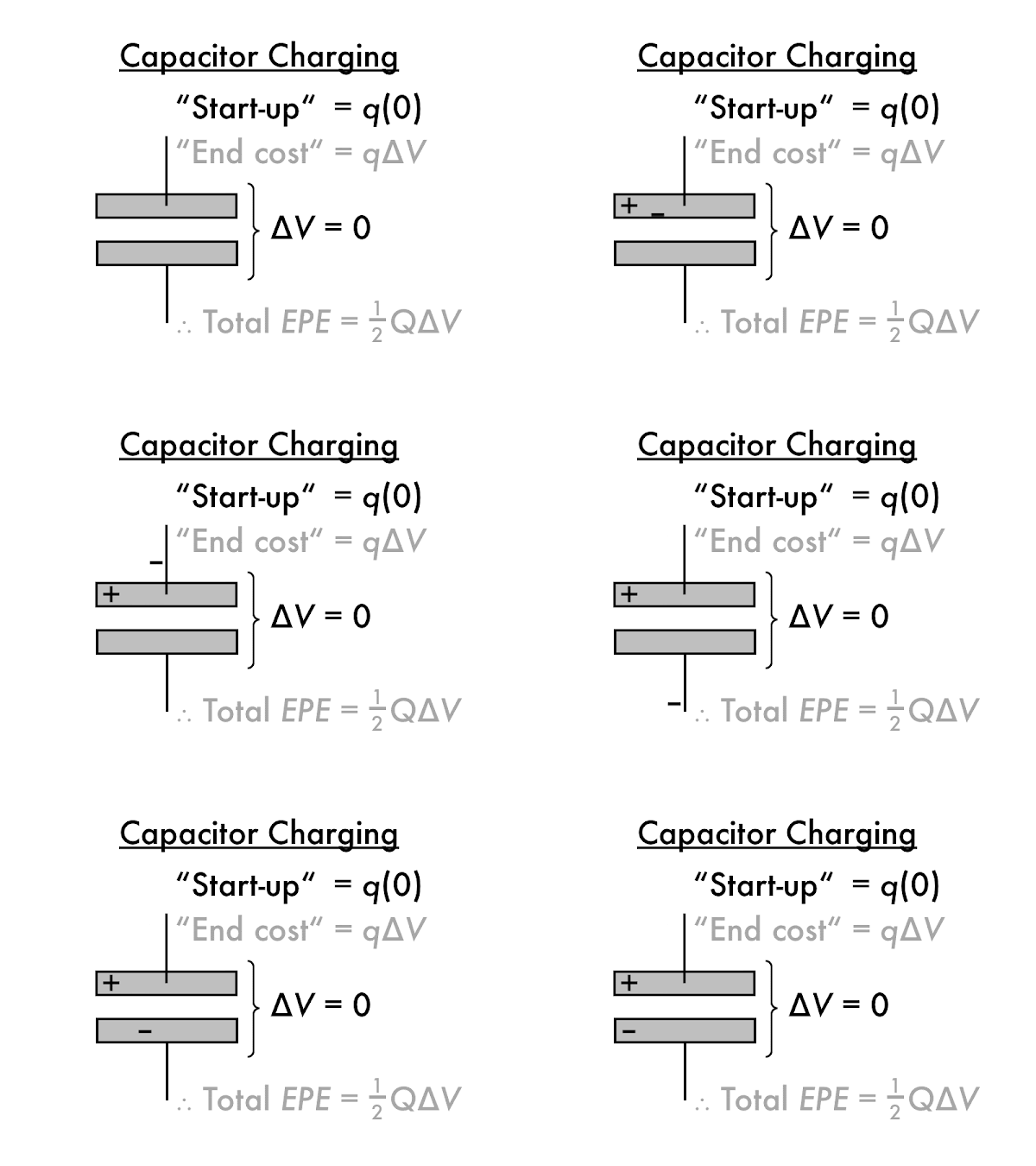
The first electron q has a "start-up" energy cost of effectively zero, as it moved from and to plates that are nearly or effectively uncharged (and start with zero potential, such that ∆EPE = q·(0) = 0 J).

However, the last electron q must be removed from a very positively charged plate, which requires a lot of work, and also must be moved onto a very negatively charged plate, again requiring a lot of work (the difficulty of which is indicated by the slowness of moving this electron). Since the plates are at or nearly at their final potential value ∆V, the last electron q has an energy "end cost" of ∆EPE = q·∆V (don't worry about negative signs in this argument).

Thus the first electron moved costs nothing (or nearly nothing), while the last electron requires a much higher q·∆V cost to move. The average cost of moving each electron, then, can be said to be (1/2)·q·∆V, such that the total cost of moving all electrons is (1/2)·Q·∆V, where the total charge of all N electrons moved is Q = N·q. (This argument is deliberately trying to avoid calculus to integrate the gradually increasing cost of each electron over all electrons moved, but the result is the same.)

So capacitors store electric potential energy by storing a given amount of charge when connected to a potential source (such as a battery). With the C = Q/∆V relation, the two parameters Q and ∆V in the electric potential energy equation can each be substituted out, yielding two other equivalent equations for electric potential energy EPE.

Endless hours of amusement await you when solving capacitor energy problems, so use caution when you use these equations, and more importantly, use only the equation you really need.

As in shock-deterrent clothing, capacitors are used to store electric potential energy to be used at a later time, such as camera flashes and this cardiac defibrillator. Sure, when you get "shocked" by a capacitor, charges are coming off of the capacitor (and traveling through your body), but it is the electric potential energy carried by these charges that makes capacitors hazardous. And more importantly, a key advantage capacitors have over batteries in storing electric potential energy for later use, is that the energy from a capacitor can be released in a very brief amount of time (as opposed to a small steady amount over a long period of time), as we will see in a subsequent presentation.