Showing posts with label critical angle. Show all posts

20200211

Physics quiz archive: electromagnetic waves, polarization, reflection/refraction

Physics 205B Quiz 1, spring semester 2020
Cuesta College, San Luis Obispo, CA
Sections 30882, 30883, version 1
Exam code: quiz01PxP7


Sections 30882, 30883 results
0- 6 :   * [low = 6]
7-12 :   **
13-18 :   *********
19-24 :   *********** [mean = 21.9 +/- 5.9]
25-30 :   ************ [high = 30]

20200203

GIF animation: Today is Laser Täg

Physics 205B, spring semester 2020
Cuesta College, San Luis Obispo, CA


"Today is Laser Täg"
flic.kr/p/2ioGjcr
Waifer X

20190211

Physics quiz archive: electromagnetic waves, polarization, reflection/refraction

Physics 205B Quiz 1, spring semester 2019
Cuesta College, San Luis Obispo, CA
Sections 30882, 30883, version 1
Exam code: quiz01aN7u


Sections 30882, 30883 results
0- 6 :   * [low = 3]
7-12 :   ****
13-18 :   *******
19-24 :   ***************** [mean = 20.8 +/- 5.7]
25-30 :   ******** [high = 27]

20180324

Physics midterm question: wavelengths at total internal reflection interface

Physics 205B Midterm 1, spring semester 2018
Cuesta College, San Luis Obispo, CA

Light of wavelength 533 nm in a unknown material (index of refraction n1) undergoes total internal reflection from an interface with a different unknown material (index of refraction n2). (Drawing is not to scale.) Show that the wavelength in the n2 material would be longer than 533 nm (assuming that light could eventually be transmitted out in the n2 material). Explain your reasoning using the properties of light and refraction.

Solution and grading rubric:
  • p:
    Discusses/demonstrates that the wavelength λ2 in the second n2 material would be longer than 533 nm by:
    1. qualitatively or quantitatively showing that n2 < n1 by appealing to the critical angle θ2 = sin−1(n2/n1) (where n2 < n1 in order to avoid a domain error in the inverse sine function); or Snell's law n1⋅sinθ1 = n2⋅sinθ2 where θ2 = 90°, and thus n2 < n1; and
    2. that since index of refraction n = c/v, a smaller index of refraction n2 results in a faster speed of light v2; and
    3. since the wavelength λ = v/f, since the second material has a faster speed of light v2, and the frequency of light is independent of the medium it travels through, then it will have a longer wavelength in that material.
    May combine arguments in (1)-(2) by arguing that total internal reflection occurs when light traveling in a slower material is "frustrated" in trying to travel out into a faster material.
  • r:
    As (p), but argument indirectly, weakly, or only by definition supports the statement to be proven, or has minor inconsistencies or loopholes. Typically one of arguments (1)-(3) missing, incomplete, or problematic.
  • t:
    Nearly correct, but argument has conceptual errors, or is incomplete. Typically two of arguments (1)-(3) missing, incomplete, or problematic.
  • v:
    Limited relevant discussion of supporting evidence of at least some merit, but in an inconsistent or unclear manner. Some garbled attempt at applying Snell's law and/or critical angles, indices of refraction, wave speed, frequency and wavelengths.
  • x:
    Implementation/application of ideas, but credit given for effort rather than merit. No clear attempt at applying Snell's law and/or critical angles, indices of refraction, wave speed, frequency and wavelengths.
  • y:
    Irrelevant discussion/effectively blank.
  • z:
    Blank.
Grading distribution:
Sections 30882, 30883
Exam code: midterm01cVdP
p: 17 students
r: 6 students
t: 9 students
v: 3 students
x: 0 students
y: 0 students
z: 0 students

A sample "p" response (from student 3673):

A sample "p" response (from student 1929):

20180205

Physics quiz archive: electromagnetic waves, polarization, reflection/refraction

Physics 205B Quiz 1, spring semester 2018
Cuesta College, San Luis Obispo, CA
Sections 30882, 30883, version 1
Exam code: quiz01AM0l


Sections 30882, 30883 results
0- 6 :  
7-12 :   * [low = 9]
13-18 :   ****
19-24 :   **********
25-30 :   ************** [mean = 24.7 +/- 4.9] [high = 30]

20170206

Physics quiz archive: electromagnetic waves, polarization, reflection/refraction

Physics 205B Quiz 1, spring semester 2017
Cuesta College, San Luis Obispo, CA
Sections 30882, 30883, version 1
Exam code: quiz01Om6A


Sections 30882, 30883 results
0- 6 :  
7-12 :   **** [low = 9]
13-18 :   **********
19-24 :   ******* [mean = 19.7 +/- 6.0]
25-30 :   ******* [high = 30]

20160209

Physics quiz archive: electromagnetic waves, reflection/refraction

Physics 205B Quiz 1, spring semester 2016
Cuesta College, San Luis Obispo, CA
Sections 30882, 30883, version 1
Exam code: quiz01sN0w


Sections 30882, 30883 results
0- 6 :   *** [low = 6]
7-12 :   **
13-18 :   ************
19-24 :   ****************** [mean = 20.7 +/- 6.1]
25-30 :   ******** [high = 30]

20150329

Physics midterm question: total internal reflection at fluorite-water interface?

Physics 205B Midterm 1, spring semester 2015
Cuesta College, San Luis Obispo, CA

Cf. Giambattista/Richardson/Richardson, Physics, 2/e, Comprehensive Problem 23.78

Light in fluorite (index of refraction of 1.39) is incident at an ethyl alcohol interface (index of refraction of 1.36), and this light is totally internally reflected back down into fluorite. (Drawing is not to scale.) Then the ethyl alcohol is replaced with a layer of water (index of refraction of 1.33) poured onto the fluorite. Discuss whether or not total internal reflection also occurs at the fluorite-water interface, if the angle in fluorite is the same as before. Explain your reasoning using the properties of light and refraction.

Solution and grading rubric:
  • p:
    Correct. Discusses/demonstrates:
    1. because the critical angle for fluorite up into ethyl alcohol is 78.1°, the incident angle in fluorite must be greater than 78.1° for total internal reflection to occur at the fluorite-ethyl alcohol interface;
    2. with this same angle in fluorite (any value at or greater than 78.1°), this is larger than the critical angle for fluorite up into water (73.1°), such that total internal reflection also occurs at the fluorite-ethyl alcohol interface. (May instead put any angle at or greater than 78.1° as the incident angle in fluorite in Snell's law to find that the transmitted angle in water is undefined, and interprets this as total internal reflection occurring at the fluorite-water interface.)
  • r:
    As (p), but argument indirectly, weakly, or only by definition supports the statement to be proven, or has minor inconsistencies or loopholes. Typically solves for the two critical angles, but either does not sufficiently explain total internal reflection for the fluorite-water interface, or explains that total internal reflection will not occur.
  • t:
    Nearly correct, but argument has conceptual errors, or is incomplete. Some attempt at solving for the critical angles, but switches the incident and transmitted indices of refraction (resulting in an calculator error), or because the incident and transmitted indices are switched, discusses how total internal reflection will not occur.
  • v:
    Limited relevant discussion of supporting evidence of at least some merit, but in an inconsistent or unclear manner. Some garbled attempt at applying Snell's law and/or critical angles.
  • x:
    Implementation/application of ideas, but credit given for effort rather than merit. Approach other than that of applying Snell's law and/or critical angles.
  • y:
    Irrelevant discussion/effectively blank.
  • z:
    Blank.
Grading distribution:
Sections 30882, 30883
Exam code: midterm01p34K
p: 24 students
r: 7 students
t: 11 students
v: 4 students
x: 1 student
y: 0 students
z: 0 student

A sample "p" response (from student 0203):

Another sample "p" response (from student 1828):

A sample "t" response (from student 0550):

20150211

Physics quiz archive: electromagnetic waves, reflection/refraction

Physics 205B Quiz 1, spring semester 2015
Cuesta College, San Luis Obispo, CA
Sections 30882, 30883, version 1
Exam code: quiz01c0Co


Sections 30882, 30883 results
0- 6 :   *** [low = 6]
7-12 :   ***
13-18 :   ***********
19-24 :   ************************* [mean = 19.9 +/- 5.7]
25-30 :   ****** [high = 30]

20130528

Physics final exam question: light ray at Plexiglas®-air interface

Physics 205B Final Exam, spring semester 2013
Cuesta College, San Luis Obispo, CA

Cf. Giambattista/Richardson/Richardson, Physics, 2/e, Problem 23.11, Comprehensive Problem 23.91
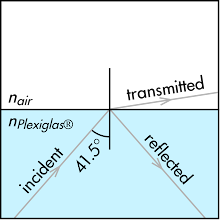
Light in Plexiglas® (index of refraction[*] of 1.491) is incident at an angle of 41.5° at the interface between Plexiglas® and air (index of refraction of 1.000). (Drawing is not to scale.) If the incident angle of the beam of light in Plexiglas® is increased slightly from 41.5° to 42.0°, describe what will happen to the beam. Explain your reasoning using the properties of light and refraction.

[*] wiki.pe/Acrylic_glass.

Solution and grading rubric:
  • p:
    Correct. With an incident angle less than the critical angle, light will still be transmitted out into air instead of totally internally reflected back into Plexiglas® (there will also be a partially reflected ray in Plexiglas® as well). Directly calculates the critical angle to compare to the incident angle, or attempts a (successful) trial solution for the transmitted angle in air using Snell's law.
  • r:
    As (p), but argument indirectly, weakly, or only by definition supports the statement to be proven, or has minor inconsistencies or loopholes.
  • t:
    Nearly correct, but argument has conceptual errors, or is incomplete.
  • v:
    Limited relevant discussion of supporting evidence of at least some merit, but in an inconsistent or unclear manner.
  • x:
    Implementation/application of ideas, but credit given for effort rather than merit.
  • y:
    Irrelevant discussion/effectively blank.
  • z:
    Blank.
Grading distribution:
Sections 30882
Exam code: finalpL3x
p: 19 students
r: 1 student
t: 5 students
v: 5 students
x: 0 students
y: 0 students
z: 0 students

A sample "p" response (from student 1408), first attempting a trial solution to Snell's law (which would indicate no total internal reflection):

Another sample "p" response (from student 6377), explicitly solving for the critical angle first, and then noting that the incident angle is smaller than the critical angle:

20120209

Physics quiz question: incident angle less than critical angle

Physics 205B Quiz 1, spring semester 2012
Cuesta College, San Luis Obispo, CA

Cf. Giambattista/Richardson/Richardson, Physics, 2/e, Problem 23.11

A beam of light strikes the interface between flint glass and air with an incident angle equal to the critical angle of 35.9°, such that the beam undergoes total internal reflection. (Drawing is not to scale.) If the incident angle of the beam of light in flint glass is decreased slightly from 35.9° to 35.8°, the incident beam would be:
(A) reflected back into flint glass.
(B) transmitted into air.
(C) (Both choices (A) and (B).)
(D) (Not enough information is given.)

Correct answer: (C)

If the incident angle in flint glass is less than the critical angle, then light will be transmitted out into the air, as well as partially reflected back into the flint glass.

Section 30882
Exam code: quiz01pL2r
(A) : 9 students
(B) : 3 students
(C) : 17 students
(D) : 0 students

Success level: 59%
Discrimination index (Aubrecht & Aubrecht, 1983): 0.67