Showing posts with label galaxy. Show all posts

20191204

Astronomy quiz archive: Milky Way, nucleosynthesis, cosmology

Astronomy 210 Quiz 7, fall semester 2019
Cuesta College, San Luis Obispo, CA

Section 70158, version 1
Exam code: quiz07sNt4


Section 70158
0- 8.0 :  
8.5-16.0 :   ***** [low = 11.5]
16.5-24.0 :   ***
24.5-32.0 :   ************ [mean = 27.7 +/- 8.3]
32.5-40.0 :   ********** [high = 40.0]


Section 70160, version 1
Exam code: quiz07No37


Section 70160
0- 8.0 :   * [low = 8.0]
8.5-16.0 :   ********
16.5-24.0 :   ****** [mean = 18.5 +/- 8.5]
24.5-32.0 :   ****
32.5-40.0 :   * [high = 36.5]]

Online reading assignment: origin of life, are we alone? (SLO campus)

Astronomy 210, fall semester 2019
Cuesta College, San Luis Obispo, CA

Students have a weekly online reading assignment (hosted by SurveyMonkey.com), where they answer questions based on reading their textbook, material covered in previous lectures, opinion questions, and/or asking (anonymous) questions or making (anonymous) comments. Full credit is given for completing the online reading assignment before next week's lecture, regardless if whether their answers are correct/incorrect. Selected results/questions/comments are addressed by the instructor at the start of the following lecture.

The following questions were asked on reading textbook chapters and previewing presentations on the origin of life, a "Here Is Today" timeline, LEGO® washing tips and the extraterrestrial hypothesis.

Selected/edited responses are given below.

Describe something you found interesting from the assigned textbook reading or presentation preview, and explain why this was personally interesting for you.
"It's crazy how the timespan humans have existed is such a small amount in comparison to the life of the universe."

"How life was formed."

"The transition from chemical compounds in the atmosphere to life forms is fascinating."

"How long it takes to build life naturally, just to create a simple (yet not simple) organism."

"The Miller-Urey experiment."

"That we live in a very small moment in time, it's a very sobering perspective."

"How small our window of existence is in the whole cosmological timeline. It makes me feel so insignificant."

"How it would take massive amounts of energy, fuel, and time to even propel a spaceship to the nearest star because there is no way we can travel at the speed of light. I think this is a significant piece of evidence in disproving UFO's and aliens visiting Earth because it is pretty much impossible."

"That moons of other planets have water."

"All of it!!! I have always wanted to know more of the history of our Earth and evolution so that is why learning about it is interesting to me."

"The Drake equation is something I've never heard of and is an interesting way to explain or predict scientific situations like the Goldilocks zones."

"I like the chemistry turning into biology, as molecular chains begin to react to surroundings."

"The 'Here is Today' website was very interesting, as it was cool to see new we are in the timeline of Earth."

"Human life is barely shown by the thinnest red line ever on a timeline of life. crazy how we haven't caused a bigger dent."

Describe something you found confusing from the assigned textbook reading or presentation preview, and explain why this was personally confusing for you.
"Nothing was confusing."

"The LEGO-washing presentation."

"The Drake equation (just a little bit)."

"The complex molecules going from being randomly assembled in their environment to them self replicating."

"I found the Drake equation pretty confusing, but naturally anything with numbers confuses me."

"The Drake equation."

"How is life could be so uncommon. granted there are way too many unknowns, but you'd think the great Random Number Generator Gods might throw in a couple of winning civilizations."

"I felt the Chilbolton radio message that we sent out is so anthropocentric. Why on Earth did the people sending it ever think aliens (if there were any) would ever understand it, and if they did, would care to answer to us--a bunch of talking apes?"

"How we can expect other technological civilizations to exist and be able to actually communicate with us via radio. How can we expect them to know or even have the means of understanding to send a different anti-coded message back to us? I just find it hard to believe."

"That water on the moon would boil away into the atmosphere. It's confusing because I thought the moon is cold."

"When it starts to get a bit like chemistry I got confused trying to understand the different atoms and molecules."

"I don't understand the part about the crop circles and sending coded messages. How are pixelated messages sent through radio frequencies?"

"I think crop circles are kind of dumb, but also whoever is making them is putting a lot of effort into making them look good."

"The Drake equation, because of the many factors that are can't be discovered."

"I understand the definition for the Drake equation but the actual equation and the variables are a huge question mark."

Briefly describe a difference between life and non-living things.
"Life has the ability to regenerate, adapt, and overcome problems and difficulties that are presented in front of it in order to survive."

"Living things manipulate their environment and create a new generation which will also manipulate their environment."

"The difference is that life living things keep evolving, reproducing, and adapting for survival."

"Living things are composed of cells while non-living things do not have a specialized structure."

"Living things require a form of nutrients to keep surviving, while non-living things have no need of any."

"Voluntary movement."

"Living things basically grow, respire, need energy, move, reproduce, evolve, or maintain homeostasis. Anything that doesn't do this is 'non-living.' But ultimately, this definition is just a subjective yardstick we humans have created to classify the two."

"Living things are able to manipulate their environment and use energy to live. Non-living things simply exist and are made up of solids, liquids, and gases."

"Living things breath, non-living things don't."

"Living things maintain themselves."

"Non-living things do not attempt to alter their surroundings in order to grow. Living things manipulate their surroundings to reproduce and grow."

"Life is able to reproduce, and each generation adapts to the environment, which by its existence life is also causing to change. Non-living things just lay there as stuff (Laws of physics) happens to them without the components to react to their environment."

"Living things can reproduce on their own, move by themselves, can grow and are comprised of cells. Non-living things cannot do one of the following, depending on the organism. Viruses cannot reproduce on their own, they hijack a living cell and use that to reproduce, thus viruses are lot living things."

"Non-living things do not obtain abilities of living thing like: the ability to breath, evolve, age, grow, etc."

Rank the amounts of time it takes for each of the following to have occurred on Earth.
(Only correct responses shown.)
Time after the formation of Earth for single-cell life to arise: a medium amount of time (about 1 billion years) [41%]
Time for the first types of simple single-cell life to evolve into fishlike creatures: the longest amount of time (about 3 billion years) [55%]
Time for fishlike creatures to evolve into more complex land-based animals today: the shortest amount of time (about 0.5 billion years) [55%]

How important is it to you to know whether or not there may be life elsewhere other than on Earth?
Unimportant.  ** [2]
Of little importance.  **** [4]
Somewhat important.  ****** [6]
Important.  ****** [6]
Very important.  **** [4]

Briefly explain your answer regarding the importance of knowing whether there may be life elsewhere other than on Earth.
"I think knowing there is life elsewhere would give the people of earth new way of looking at things and inspire a generation."

"Although it likely will not really affect me or my way of life if I know the answer, knowing whether or not there is other life (specifically intelligent life) out there will answer a lot of philosophical and theological questions that we otherwise have no way of answering."

"It is not important because I believe there is only life on Earth."

"Because there has always been a mystery about life elsewhere outside our planet and I would like to know how truth that is."

"It is important for the development of the human race as we progress off of the planet and into space, but it does not effect our day-to-day lives."

"Knowing that other civilizations may be out there is extremely mind boggling to think about. To know that they have a completely different way of functioning would be astounding to learn about."

"Just not something I think we will find in my lifetime, so dwelling on it seems pointless."

"I am not actively searching for an answer to whether other life exists, but if someone came to me and told me that NASA found proof of extraterrestrials, I can assure you that it would rise to the top of my priority list."

"If so, and life is elsewhere than Erth, I think it would be extremely important. Especially if they have technology, if we communicated, our world could advance pretty significantly. I just think that would be a huge deal."

"If there is than they likely developed similar to the way we did. Essentially they probably wouldn't know that much more than us or be a threat to our way of life. They may just have slightly different developments in science and technology."

"To provide perspective. To understand how life evolves in foreign environments."

"There are only two options: Either we are alone in the universe, or we are not. Both prospects are equally terrifying. If there are others, they are either less intelligent than us (so dangerous but can't reach us). Or more intelligent than us (more civilized and therefore don't have any use of contacting us hairless apes). I am scared however that they could see us a guinea pigs for their experiments... "

"That the creation of life is either consistent or possible with alternative methods, but also that the greater amount of life indicated means that we are approaching towards the fermi paradox as something is preventing life is before us."

"I do not believe in alien life elsewhere other than Earth, but I do not deny that there are small, simple-celled terrestrial organisms on other planets (Mars being the biggest example). In my Christian faith, I believe that God created the heavens and Earth in seven days, and he specifically designed Earth for man to inhabit. I do not believe advanced, intelligent life forms were created on other planets at the beginning of mankind, so it is not important for me to know alien life forms are there because I do not think they exist."

"It would be very fascinating to learn of other life, however, I do not think it should be a top priority because there are lots of problems here on Earth that need to be addressed and worked on before worrying about other life."

"I assume there's life elsewhere. Or at least that it's very possible. It's kind of freaky, tho, so I don't concern myself with it."

"It would change things to know whether there may be life other places on Earth and increase our investigation of it perhaps leading to something greater"

"Knowing that there is other life in the universe would only be useful to me in the sense that it would blow my mind like most since does. However, if extraterrestrial life is found, the likelihood that it will have an impact on my life is so small that it is essentially pointless for me to care about."

"The wondering is okay, but I'm not obsessed with knowing. My opinion is that life of some sort (perhaps intelligent) is out there, but the distances are so vast it is likely that even if we exist at the same time, we won’t contact them; if they contact us, they will likely be dead; if we contact them, we will likely be gone before we get a response."

"It'd be super-cool to know about it!!! But I don't know if I'll be around to find out..."

"How can it not interest anyone if there is life outside of Earth? It's would be am extraordinary discovery, and a lot of new information would arise."

Which type of star would be least likely to have a planet that could support life?
Massive.  *************** [15]
Medium-mass.  *** [3]
Low-mass (red dwarf).  *** [3]
(Unsure/guessing/lost/help!)  * [1]

Briefly explain your answer to the previous question (type of star least likely to have a planet that could support life).
"It seems that a planet with neither extreme of conditions provides the highest chance of life."

"The lifetime of massive stars are too short for life to evolve."

"Low mass stars do not produce enough heat/light for life to comfortably take place."

"A medium-mass star is sun-like so we already know that given the correct circumstances, a medium-mass start can produce a planet with life. A red dwarf is not too big or hot, so I think it could possibly have a planet with life, but a massive star is far too big and hot."

"Massive stars have short lifespans and don't live for very long, and complex life organisms would need a lot of time to evolve and become complex."

"Since red dwarfs live so long, it would give the species enough evolution time to adapt to the cold, small environment."

Describe what the Drake equation is used for.
"Calculating how many intelligent species are in the Milky Way."

"It is used to estimate the total number of communicative civilizations in the Milky Way."

"It can determine the amount of life that is capable of communication."

In your opinion, how plausible is it that the Chilbolton message is a reply from extraterrestrials?
Implausible.  ******* [7]
Not very plausible.  ******** [8]
Somewhat plausible.  ******* [7]
Very plausible.  [0]
(Unsure/guessing/lost/help!)  [0]

Ask the instructor an anonymous question, or make a comment. Selected questions/comments may be discussed in class.
"Cool stuff."

"Do you think aliens look human-like, or somewhat like the 'little green men' in movies?"

"You should talk more about the Chilbolton crop circle."

"What exactly are the symbols/variables for the Drake equation?"

"How do you recommend us to prepare for the final?" (The study guide is already posted on this week's announcements page.)

"If I were to travel back in time, I'd bring a lunch with me to the Jurassic period to hang out with some dinosaurs! I'd be the Dino Whisperer."

"Extraterrestrial life is scary until you realize that we could be extraterrestrial life (to whatever life could be out there)."

"Little known fact: astronomy originated when groups of nerds were lured into star watching by the promise of limitless access to foreign celestial bodies."

"Have you heard this Joe Rogan vidcast with a US Navy pilot who says he has seen UFOs? If not, check it out. Definitely interesting to say the least."

"It seems like most of science relies on the idea of balance of forces, equal and opposite effects, and pairs of matter-antimatter particles. Doesn't this break down if one of these paired matter-antimatter particles gets sucked into a black hole, and then the blackhole suffers a Hawking 'evaporation?' If that evaporation happens, part of a pair is gone, and laws of physics start breaking down. Are we sticking to an idea of balance because we like the idea of balance, the same way that Aristotle liked circles? Or is it because our laws of physics aren't advanced enough yet to detect other forces and effects...?" (There's no imbalance here, because of the symmetry between mass (whether matter or antimatter) and energy--if one of the matter-antimatter particles falls into the black hole (while the other escapes), then the mass that is "removed" from the universe is expected to be made up by the resulting decrease (the "evaporation") in the mass of the black hole. That said, there have been no observations of this theoretical Hawking evaporation, yet.)

20191203

Online reading assignment: origin of life, are we alone? (NC campus)

Astronomy 210, fall semester 2019
Cuesta College, San Luis Obispo, CA

Students have a weekly online reading assignment (hosted by SurveyMonkey.com), where they answer questions based on reading their textbook, material covered in previous lectures, opinion questions, and/or asking (anonymous) questions or making (anonymous) comments. Full credit is given for completing the online reading assignment before next week's lecture, regardless if whether their answers are correct/incorrect. Selected results/questions/comments are addressed by the instructor at the start of the following lecture.

The following questions were asked on reading textbook chapters and previewing presentations on the origin of life, a "Here Is Today" timeline, LEGO® washing tips and the extraterrestrial hypothesis.


Selected/edited responses are given below.

Describe something you found interesting from the assigned textbook reading or presentation preview, and explain why this was personally interesting for you.
"I found the question on if we are alone as it is something I have always asked myself and something my friends and I always debate."

"The origin of life; how everything started."

"The most interesting thing to me was the Drake equation. To start off because the name I thought it was funny and to because I didn’t know there was an actual equation that could help us estimate the life span of an advanced civilization."

"How long we've really been around on Earth."

"The idea of not being alone."

Describe something you found confusing from the assigned textbook reading or presentation preview, and explain why this was personally confusing for you.
"I am a bit confused on the Cambrian explosion. The book doesn't go into much detail as to how or why the Cambrian explosion happened."

"I found the Drake equation very confusing and can use a lot more clarification and in simpler terms to understand."

"The Drake equation."

Briefly describe a difference between life and non-living things.
"Non-living things do not reproduce, grow, eat, or have any sense that all living organisms can."

"To be classified as living is to be able to manipulate and adapt to your environment."

"Living things around us are human beings, animals, plants and microorganisms. Non-livings things do not exhibit any characteristics of life."

Rank the amounts of time it takes for each of the following to have occurred on Earth.
(Only correct responses shown.)
Time after the formation of Earth for single-cell life to arise: a medium amount of time (about 1 billion years) [30%]
Time for the first types of simple single-cell life to evolve into fishlike creatures: the longest amount of time (about 3 billion years) [70%]
Time for fishlike creatures to evolve into more complex land-based animals today: the shortest amount of time (about 0.5 billion years) [70%]

How important is it to you to know whether or not there may be life elsewhere other than on Earth?
Unimportant.  [0]
Of little importance.  * [1]
Somewhat important.  ******* [7]
Important.  * [1]
Very important.  * [1]

Briefly explain your answer regarding the importance of knowing whether there may be life elsewhere other than on Earth.
"I'm just very curious to know if there is life out of our universe. It can't be that we are alone."

"I find the topic rather interesting, there's so much we don't know about our world that the slightest possibility of life elsewhere wouldn't surprise me."

"The odds of Earth being the only planet of life in an ever expanding universe is tiny. It’s almost selfish to believe life doesn't exist elsewhere."

"Well, if we ever find life outside of Earth is would be amazing to see what their species look like. If they end up being intelligent beings it would be really good for humans to develop and adapt to newer and better things to regarding resources."

"I find it important due to the environmental crisis that we are having on earth because if there is life on another planet we can possible be able to maybe explore and see if it is possible to travel to that other planet or maybe even see what methods they are doing to sustain life on their planet."

"It is important as it would fundamentally change everything that we know about life. If that life is similar to our own it would confirm many speculations about life and open up new ones as well. As this new life could be helpful to us one way or another."

"Even though we haven't found any yet I'm pretty sure it exists so I feel like I already know. I'd just want to learn more about them out of curiosity."

"Nothing more than just wanting to know."

"It is somewhat important because it would be cool to meet other life but then it wouldn't since we would know what it would be capable of."

Which type of star would be least likely to have a planet that could support life?
Massive.  ********* [9]
Medium-mass.  [0]
Low-mass (red dwarf).  [0]
(Unsure/guessing/lost/help!)  * [1]

Briefly explain your answer to the previous question (type of star least likely to have a planet that could support life).
"Life on Earth took approximately 1 billion years to arise which is longer than the life of a massive star."

"Massive star lifetimes are too short for complex forms of life to develop as they would go supernova within a few million years."

"Massive stars form and die faster than life can evolve into complex organisms."

Describe what the Drake equation is used for.
"To try to guesstimate the number of possibilities of other life that could communicate with us."

"It is used to estimate the numbers of an advanced civilization in the Milky Way."

"According to Wikipedia: 'a probabilistic argument used to estimate the number of active, communicative extraterrestrial civilizations in the Milky Way galaxy.'"

"I didn't really understand this."

In your opinion, how plausible is it that the Chilbolton message is a reply from extraterrestrials?
Implausible.  [0]
Not very plausible.  **** [4]
Somewhat plausible.  ***** [5]
Very plausible.  [0]
(Unsure/guessing/lost/help!)  * [1]

Ask the instructor an anonymous question, or make a comment. Selected questions/comments may be discussed in class.
"Will any of this be on the final?" (Yes. But from the Ch. 15 question packet.)

"Why is the Drake equation even a thing if certain variables are impossible to determine and there might be even more unknown variables?" (At least it lets us know what we do know, even if that might not be that much.)

"Do you think there are aliens?" (Eh. I think so. I don't spend too much time thinking about that, though.)

20191127

Online reading assignment: Milky Way history, big bang clues (SLO campus)

Astronomy 210, fall semester 2019
Cuesta College, San Luis Obispo, CA

Students have a weekly online reading assignment (hosted by SurveyMonkey.com), where they answer questions based on reading their textbook, material covered in previous lectures, opinion questions, and/or asking (anonymous) questions or making (anonymous) comments. Full credit is given for completing the online reading assignment before next week's lecture, regardless if whether their answers are correct/incorrect. Selected results/questions/comments are addressed by the instructor at the start of the following lecture.

The following questions were asked on reading textbook chapters and previewing presentations on the history of the Milky Way and big bang clues, a comic strip adaptation of Neil deGrasse Tyson's "The Most Astounding Fact" 2008 interview for TIME magazine, a TED-talk video explanation of measuring extreme distances, and Minute Physics video explanations of Olbers' paradox and the expanding universe.


Selected/edited responses are given below.

Describe something you found interesting from the assigned textbook reading or presentation preview, and explain why this was personally interesting for you.
"What I found quite interesting is how many compounds/things today come from stars in the past. I've never thought about that."

"That the calcium in our bones, carbon in our body and iron in our blood were all formed from a past star...like, what???"

"That for stars such as Deneb when we do see them we're looking at their past form, not its current state."

"The concept of light-years and seeing stars, planets, and galaxies as they were so many years ago is really crazy to think about and super-cool. So basically, hypothetically, if the sun were to go out, we would have a nice 8-ish minutes before freezing to death."

"The concept of space and time is fascinating. One fact from the 'light seconds, light years, light centuries' video that I thought was cool: the Big Dipper appears to us the way it looked 80 years ago, because it took that long for light to travel to Earth."

"That we can use type Ia supernovae to tell how far away something is from us in space. I didn't realize that supernovae were brighter than their galaxies."

"The universe having finite age, but not a finite size."

"To think that there isn't an edge to our universe, and I could see why a lot of people go along with the misconception that there is a 'center to the universe.' There is no center, and it appears to be that the space between galaxies continue to expand over time. We're on the grow!"

Describe something you found confusing from the assigned textbook reading or presentation preview, and explain why this was personally confusing for you.
"I'm kind of confused on how the amounts of elements changed over time, but other than that I'm good."

"I'm confused by what each thing produces which element and things of that sort; it's just a lot to take in and it's confusing me."

"I'm confused about the production of elements. I think I might need to learn about it in person to truly grasp the concept."

"The monolithic collapse and bottom-up models are slightly confusing because they are both theories about the formation of the Milky Way. I have a feeling I may or may not mix them up."

"Why the universe keeps expanding and why do younger stars have more metal than older stars? Will the universe stop expanding? Since older stars fuse elements heavier than helium, shouldn't they have more metal?"

"How does the universe continually expand? How is there no limit or will there ever be a limit?"

"How the universe is infinite. It's crazy trying to wrap my head around that. How can it have no end? It just never ends? It's mind-blowing, really."

"The age and 'boundary' of the universe, and how it is determined. I think the human brain isn't evolved enough to grasp such complex (and almost metaphysical) topics, so things can start seeming very counter-intuitive. I am looking forward to our in-class discussion to clarify the topic."

Indicate how the amount of these elements in the universe have changed over time.
(Only correct responses shown.)
Hydrogen: decreased [65%]
Metals (elements heavier than hydrogen and helium): increased [70%]

The outermost layers of __________ are more abundant in metals (elements heavier than hydrogen and helium).
extremely old stars that formed a long time ago.  **** [4]
young stars that formed very recently.  **************** [16]
(There is a tie.)  [0]
(Neither, as stars cannot have metals.)  [0]
(Unsure/guessing/lost/help!)  [0]

Indicate what produced these elements.
(Only correct responses shown.)
Hydrogen in the sun's core: the very early universe [45%]
Helium in the sun's core: the sun [40%]
Carbon in your body: another star, in the past [65%]
Calcium in your bones: another star, in the past [50%]
Iron in your blood: another star, in the past [75%]
Gold and silver from mines: another star, in the past [45%]

Ask the instructor an anonymous question, or make a comment. Selected questions/comments may be discussed in class.
"At first there is nothing...bada bing bada boom...now the universe exists!"

"Thank you for giving us a constant supply of astronomy comics."

"This class has put me in an existential crisis."

"How is it even possible that the big bang occurred?" (I don't think we can ever answer 'why the big bang occurred,' but we are certainly able to answer 'how do we know the big bang occurred?')

"Will the final cover the last few chapters we are going over?" (Yes, along with the last quiz.)

"Do we have more than one Hubble telescope in space right now?" (The Hubble Space Telescope is designed to observe visible light; all the other space telescopes are designed to observe in different wavelengths (such as x-ray, infrared, etc.) that would be blocked by Earth's atmosphere.)

"Headline: 'Swiss Deny Dairy Product Influence on Moon Composition.'"

"How close are we to seeing the big bang?" (We see its after-effects everywhere around us.)

"If humans are made from stardust, then are there aliens also made from stardust?" (Yes, unless those aliens are made up only of hydrogen.)

20191112

Online reading assignment: Milky Way history, big bang clues (NC campus)

Astronomy 210, fall semester 2019
Cuesta College, San Luis Obispo, CA

Students have a weekly online reading assignment (hosted by SurveyMonkey.com), where they answer questions based on reading their textbook, material covered in previous lectures, opinion questions, and/or asking (anonymous) questions or making (anonymous) comments. Full credit is given for completing the online reading assignment before next week's lecture, regardless if whether their answers are correct/incorrect. Selected results/questions/comments are addressed by the instructor at the start of the following lecture.

The following questions were asked on reading textbook chapters and previewing presentations on the history of the Milky Way and big bang clues, a comic strip adaptation of Neil deGrasse Tyson's "The Most Astounding Fact" 2008 interview for TIME magazine, a TED-talk video explanation of measuring extreme distances, and Minute Physics video explanations of Olbers' paradox and the expanding universe.


Selected/edited responses are given below.

Describe something you found interesting from the assigned textbook reading or presentation preview, and explain why this was personally interesting for you.
"The big bang."

"The 'top-down' hypothesis of how the Milky Way galaxy was formed, and the big bang theory since both explain theories of how things came to be."

"I like how when we look at the stars we could be looking at a star that's possibly already dead."

"Watching the video about how astronomers measure the distance in light stars to a star was very interesting, it was a question I had on my mind when we briefly started talking about lightyears in class. I am still genuinely curious how it the math goes down step by step."

"That we are basically made up of stuff from stars that went supernova; so we are made up of dead stars that gave us the materials to make other stars and planets and eventually would lead to life using metals like iron, calcium, carbon, oxygen, and nitrogen that help to form the basic building blocks of life that would eventually lead to us."

"Learning about galaxies was pretty interesting, but it takes on a whole new layer of intrigue when we're talking about our own galaxy. Very cool."

"I found it interesting that the universe isn't finite but that it is infinite and that the universe may have a starting date meaning that there was a certain time that it didn't exist until it did."

"That for stars such as Deneb when we DO see them we're looking at its past form, not its current state."

"One thing I found interesting was the finite speed of light. It turns out that we have a time-machine of sorts to actually see the universe as it was in the past."

"It's comforting knowing that the galaxy is pretty much responsible for polluting itself. Humans haven't totally ruined everything. And the Milky Way is essentially a disgusting extra smog day in Los Angeles. Eeek! I also appreciated learning how light years are calculated and found it completely mind-blowing that I have looked at what a galaxy [Andromeda] looked like 25.4 million years ago. This is one thing that I wrote down at the beginning of the semester that I wanted to learn."

"The big bang theory because you always hear people say it, but I never knew what it actually was."

"I really like the Zen Pencils comic strip because it involves life in the universe."

"How everything in general is pretty much made up of metals/dirt, which sorta (not really) debunks my 'space is mystical' thing."

Describe something you found confusing from the assigned textbook reading or presentation preview, and explain why this was personally confusing for you.
"I need a bit more clarification on the big bang theory, other than that everything was pretty straightforward."

"I was tripping out on that video that talked about why the space is black, so is it black because when we look at space we are actually looking at space in the past? Please go over this a bit."

"It is puzzling that we don't know if there is a true edge of the universe. And what happens if the universe has an edge? How does that affect our understanding of the universe?"

"Light years are a concept that continue to confuse me."

"Look-back time. And how do you calculate how far another galaxy is?"

"The 'gaps' between galaxies."

"Does hydrogen turn into the metals and how?"

"I am not understanding the differences between a halo and a disk as it refers to the Milky Way's different formations. They both seem the same to me."

"Trying to grasp the concept with an open mind as an infinite anything is hard to think of as well as that at one time there were no stars or anything is just hard to wrap my mind around."

"The Hubble law."

"The Hubble law, which sounded interesting, also kind of lost me a little."

Indicate how the amount of these elements in the universe have changed over time.
(Only correct responses shown.)
Hydrogen: decreased [33%]
Metals (elements heavier than hydrogen and helium): increased [73%]

The outermost layers of __________ are more abundant in metals (elements heavier than hydrogen and helium).
extremely old stars that formed a long time ago.  ***** [5]
young stars that formed very recently.  ********* [9]
(There is a tie.)  [0]
(Neither, as stars cannot have metals.)  [0]
(Unsure/guessing/lost/help!)  * [1]

Indicate what produced these elements.
(Only correct responses shown.)
Hydrogen in the sun's core: the very early universe [67%]
Helium in the sun's core: the sun [40%]
Carbon in your body: another star, in the past [40%]
Calcium in your bones: another star, in the past [53%]
Iron in your blood: another star, in the past [53%]
Gold and silver from mines: another star, in the past [33%]

Ask the instructor an anonymous question, or make a comment. Selected questions/comments may be discussed in class.
"Is there an actual answer to what caused the big bang?" (Not yet, but asking what caused the big bang might be like asking "why does time run forward?" or "why isn't gravity both attractive and repulsive?")

"Will we learn more about the big bang theory?" (Yes, after the second midterm.)

"Could you please go over the difference between a halo and a disk as it refers to the Milky Way?" (Here's a visual explainer from the European Space Agency.)

"I really enjoyed this reading."

"I love this class!"

"We're coming up nearer and nearer to the end, I can't wait to see what else you have in store." (You'll see.)

"If the universe wasn't infinite, then would could be beyond it?" (If it turns out that the universe wasn't infinite, then if you started traveling outwards, you wouldn't keep going and going, but after a long time you would eventually return back to your starting point.)

20191106

Online reading assignment: the Milky Way (SLO campus)

Astronomy 210, fall semester 2019
Cuesta College, San Luis Obispo, CA

Students have a weekly online reading assignment (hosted by SurveyMonkey.com), where they answer questions based on reading their textbook, material covered in previous lectures, opinion questions, and/or asking (anonymous) questions or making (anonymous) comments. Full credit is given for completing the online reading assignment before next week's lecture, regardless if whether their answers are correct/incorrect. Selected results/questions/comments are addressed by the instructor at the start of the following lecture.

The following questions were asked on reading textbook chapters and previewing presentations on the Milky Way's shape, size and composition and spiral arm structure and formation.


Selected/edited responses are given below.

Describe something you found interesting from the assigned textbook reading or presentation preview, and explain why this was personally interesting for you.
"I really liked the Fe[26] game, I may or may not have spent half an hour playing it when I should've been studying."

"I didn't think about the fact that we can not see the rest of our galaxy from our perspective."

"I find it interesting that if we use an infrared or radio telescope that we can see the whole Milky Way galaxy and if we don't do this we cannot see as much of it."

"Learning a bit about dark matter in the Milky Way was interesting. I had no idea that dark matter is what creates and spreads out the gravity in our galaxy. This unusual matter that does not deal with light or dust or gas is holding our galaxy together."

"Dark matter, thinking about the majority of matter is not seen/doesn't interact with our realm of reality is fascinating."

"I thought the 'MACHOs' and 'WIMPs' was interesting because I have never heard of those for explaining dark matter."

"I found it interesting how all the dark matter 'WIMPs' could have a substantive amount of mass and they don't interact with any light and that they permeate and pass through our galaxy."

"I like that the explanation for the broken spiral arms I saw in the lab is finally revealed."

"I liked the traffic jam analogy. It's interesting to think that stars form that way. And that sometimes they do form, and sometimes they don't."

"The density wave 'traffic jams' in galaxies. I was curious to know more about spiral galaxies."

Describe something you found confusing from the assigned textbook reading or presentation preview, and explain why this was personally confusing for you.
"Nothing really was confusing this week. I'm still scratching my head about our last two weeks' topics (star types and what they 'eat')."

"It was confusing thinking about the size of our galaxy."

"It's kind of difficult for me to imagine the Milky Way being a flattened disc in comparison to our position on Earth. I'm a very visual person and my brain wants to make the Milky Way rounded since we observe it from a rounded planet."

"The idea that we live in a 'flattened disk-shaped galaxy' is confusing because that is hard to visual. I don't see it like a flat disc."

"Dark matter--puzzling over exactly what is is difficult to grasp, as it almost doesn't seem to play by the same rules of physics as the observable world."

"Dark matter. Just like black holes, it's hard to imagine something that can't be seen."

"I don't fully understand how persistence of vision is associated with the Milky Way."

"The PimpStar Rims and traffic jams. I don't really know how to explain how they work."

"I am confused about the PimpStar Rims. Why do people do this to their cars? I truly don't understand."

"I found the PimpStar Rims and everything were confusing; I need more explanation on them."

"I don't really feel confused on anything."

In your experience, how much of the "Milky Way" (the band of faint stars across the celestial sphere) have you been able to see in the night sky?
As much as can be seen with the naked eye.  ******** [8]
Not very much.  ********* [9]
Barely seen it.  *** [3]
(Never been able to see it.)  *** [3]
(Unsure/guessing/lost/help!)  [0]

Using the most powerful light-gathering optical telescopes in the darkest skies, __________ of the stars in our entire galaxy can be observed from Earth.
1%.  *********** [11]
5%.  [0]
10%.  ******* [7]
50%.  * [1]
100%.  * [1]
(Unsure/guessing/lost/help!)  *** [3]

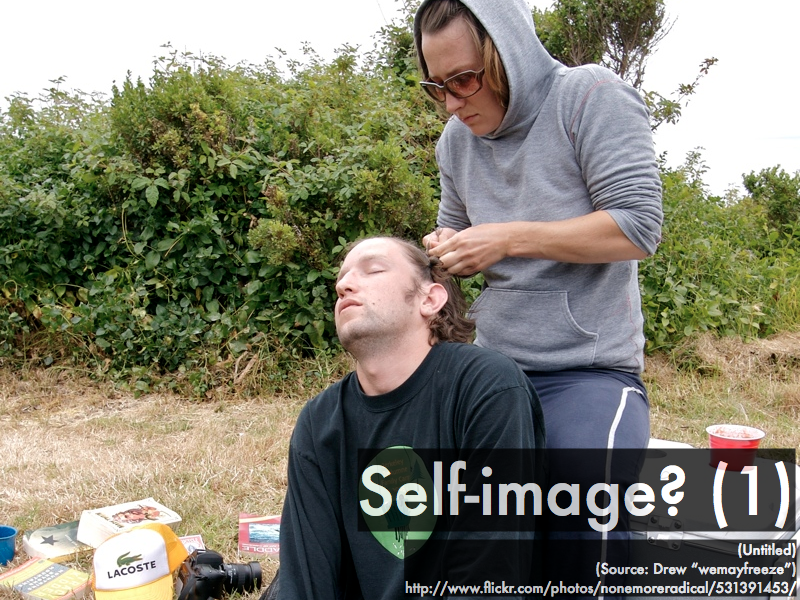
If you did not have access to a mirror while camping, what could you do to find out whether or not you're having a bad hair day?
"Ask the most honest person around you."

"Use a still pool of water as a mirror."

"Use the back of a spoon."

"Use your phone's camera."

"Just throw my hair in a messy bun that way it looks crazy on purpose."

"If you're really camping, every day is a bad hair day. You will feel the hair sticking out everywhere."

"I always have a bad hair day."

"Look for wild animals, see if they run."

"You can use your hands and feel your hair to find out if your having a bad hair day or not."

"Through your own shadow." "

Look at PimpStar Rims (*.html) for cars, or MonkeyLectric Rims (*.html) for bikes. Briefly explain how they work.
"Both have LEDs that flash and when put in motion, they appear to create a pattern or seemingly solid color due to blurring."

"They blink and leave an afterimage which is similar to a strobe effect."

"They're electronic lights that spin around the rim of the car and change on an interval that matches how fast the rim is spinning, once the wheel is spinning faster than the human mind is capable of interpreting, the changing colors of lights appear as an image."

"I'm really not too sure. Out of everything taught this was what was most confusing to me in class."

Ask the instructor an anonymous question, or make a comment. Selected questions/comments may be discussed in class.
"When you say compressed to describe the space where the arms of the galaxy show up, how much is compressed? Or how tightly packed does the matter in these arms need to be in order to generate star formation?" (Just enough to kick-start star formation, which is really hard to start on its own without any help.)

"Is it hard to teach a subject where almost nothing is fact?" (Wait, are you talking about astronomy? At least everything we've covered so far have been verified with evidence. Well, subject to further observations. #keeplooking)

"Can we take a field trip to see the Milky Way (or are there good viewing locations around here?)" (Just make sure the moon is not up. Then go somewhere dark and clear--I would suggest Carrizo Plain, but some other less remote, nearby locations might work.)

"I don't understand how matter isn't being sucked towards the center of the galaxy. If there's a supermassive black hole there, then what is stopping matter from being sucked towards it? I get the 'circling the drain' aspect but wouldn't everything eventually get sucked in?" (In terms of the total amount of stuff in our galaxy, the supermassive black hole is actually quite miniscule. It certainly has cleared out its immediate neighborhood and added it to its mass, but to the rest of everything outside of that vicinity, the amount of gravity from that central region is still the same whether it is a single supermassive black hole, or a cloud of gas, dust and stars. So everything else in the Milky Way goes about its business just the same.)

"Your bike is legit."

"Would you put PimpStar Rims on your car if you got them for free?" (I would add them to the lights on my bike.)

"At what location was your Milky Way picture taken?" (The Atwell Mill Campground in the Mineral King section of Sequoia National Park.)

"What is a telescope you would recommend to invest in for a broke college student?" (For telescopes, most anything you can get from Craigslist that is still functional--no sense buying a telescope new if you're just starting. But also consider binoculars as well.)

"When is our second midterm?" (In two weeks.)

20191105

Online reading assignment: the Milky Way (NC campus)

Astronomy 210, fall semester 2019
Cuesta College, San Luis Obispo, CA

Students have a weekly online reading assignment (hosted by SurveyMonkey.com), where they answer questions based on reading their textbook, material covered in previous lectures, opinion questions, and/or asking (anonymous) questions or making (anonymous) comments. Full credit is given for completing the online reading assignment before next week's lecture, regardless if whether their answers are correct/incorrect. Selected results/questions/comments are addressed by the instructor at the start of the following lecture.

The following questions were asked on reading textbook chapters and previewing presentations on the Milky Way's shape, size and composition and spiral arm structure and formation.


Selected/edited responses are given below.

Describe something you found interesting from the assigned textbook reading or presentation preview, and explain why this was personally interesting for you.
"That in very dark skies if you take a look at the Milky Way, which to the ancient Greeks resembled a milky stream across the sky."

"I thought the Milky Way night photo was super cool and interesting because it encompasses science and the outdoors in such a beautiful way. I love to be outdoors and in nature so this really resonated with me."

"I like how it was once again proven that we are not the center of the universe as I feel when we think this way without waiting for proof we are very narrow-minded."

"That the Milky Way sort of has arms. Making it look like a spiral."

"The mystery of dark matter is always interesting to hear about. What is dark matter? How can we find it, and once we find it how can we identify it? These are questions I sincerely hope are answered in my lifetime."

"Learning a bit about dark matter in the Milky Way galaxy was interesting. I had no idea that dark matter is what creates and spreads out the gravity in the galaxy. This unusual matter that does not deal with light or stars or gas or dust is holding our galaxy together."

"Dark matter--thinking about the majority of matter that is not seen and doesn't interact with our realm of reality is fascinating."

"Persistence of vision, along with the different examples provided."

"Something interesting was learning about stars' formation. As gas and dust compress, star formation occurs and lights up a spiral arm."

"I liked the traffic jam analogy. It's interesting to think that stars form that way. And that sometimes they do form, and sometimes they don't."

"The PimpStar Rims comparison was a very funny and clever way to compare the formation of the spiral arms in a galaxy. I was able to understand it better."

"I like that the explanation for the broken spiral arms I saw in the GalaxyZoo lab is finally revealed."

Describe something you found confusing from the assigned textbook reading or presentation preview, and explain why this was personally confusing for you.
"I found confusing as to how we can determine the shape of the Milky Way along with where the center is?"

"The fog model."

"The difference between the centered and spread-out mass in a galaxy."

"Dark matter."

"I don't fully understand how persistence of vision is associated with the Milky Way."

"I am confused with dwarf galaxy interactions and the triggering of density waves. I can get that when a smaller galaxy comes close to a bigger one it gets sucked in but I do not understand what it has to do with triggering density waves."

"The entire concept of density waves has gone completely over my head. I dearly hope you'll explain in easier-to-understand terms in class at some point."

"I don't really feel confused on anything."

In your experience, how much of the "Milky Way" (the band of faint stars across the celestial sphere) have you been able to see in the night sky?
As much as can be seen with the naked eye.  ****** [6]
Not very much.  ***** [5]
Barely seen it.  ***** [5]
(Never been able to see it.)  ****** [6]
(Unsure/guessing/lost/help!)  [0]

Using the most powerful light-gathering optical telescopes in the darkest skies, __________ of the stars in our entire galaxy can be observed from Earth.
1%.  ************ [12]
5%.  ** [2]
10%.  **** [4]
50%.  [0]
100%.  * [1]
(Unsure/guessing/lost/help!)  *** [3]

If you did not have access to a mirror while camping, what could you do to find out whether or not you're having a bad hair day?
"Ask the most honest person around you."

"Use a still pool of water as a mirror."

"Use your phone's camera."

"Just throw my hair in a messy bun that way it looks crazy on purpose."

"If you're really camping, every day is a bad hair day. You will feel the hair sticking out everywhere."

"I always have a bad hair day."

"Look for wild animals, see if they run."

"You can use your hands and feel your hair to find out if your having a bad hair day or not."

"Through your own shadow."

Look at PimpStar Rims (*.html) for cars, or MonkeyLectric Rims (*.html) for bikes. Briefly explain how they work.
"They work because of a series of blinking LED being placed under a rapid speed will emit a certain pattern."

"They blink and leave an afterimage which is similar to a strobe effect."

"It's a set of LED lights that are in the wheels that have a built in microprocessor and adapter. and as they spin it creates the magic."

"I am fairly certain they harness their sheer tastelessness to emit a glow of pure obnoxious energy."

Ask the instructor an anonymous question, or make a comment. Selected questions/comments may be discussed in class.
"Nearly ten years ago, I went camping with the boy scouts on Catalina Island. When the lights in the camp facilities went off, there was absolutely no light pollution for miles around, so I could see the entire night sky, including the milky way, totally unobstructed for the first time ever. I've always wanted to see the sky that way again, but I haven't been able to find a night sky so clear since then."

"The comic book style notes help."

"Do you imagine the PimpStar Rims or the MonkeyLectric Rims will become popular?" (I have them on my bike.)

"One thing I found confusing is disk stars and halo stars. Which one does our galaxy consists of?" (Both, although the halo star clusters above and below the disk are pretty sparse.)

"I have never gotten a good view of the Milky Way. Where and when in California is the best to view the Milky Way?" (Make sure the moon is not up. Then go somewhere dark and clear--I would suggest Carrizo Plain, but some other less remote, nearby locations might work.)

"What separates galaxies? Void? Void from lack of gravity? Is it safe to assume that space is infinite?" (The space between galaxies really is empty (no gas/dust, so no stars will ever be made in that space). Right now it seems that the universe is infinite, or at the least so large that it might as well be infinite, but that's not a completely settled question.)

"When is our second midterm?" (In two weeks.)