Showing posts with label lookback time. Show all posts

20191204

Astronomy quiz archive: Milky Way, nucleosynthesis, cosmology

Astronomy 210 Quiz 7, fall semester 2019
Cuesta College, San Luis Obispo, CA

Section 70158, version 1
Exam code: quiz07sNt4


Section 70158
0- 8.0 :  
8.5-16.0 :   ***** [low = 11.5]
16.5-24.0 :   ***
24.5-32.0 :   ************ [mean = 27.7 +/- 8.3]
32.5-40.0 :   ********** [high = 40.0]


Section 70160, version 1
Exam code: quiz07No37


Section 70160
0- 8.0 :   * [low = 8.0]
8.5-16.0 :   ********
16.5-24.0 :   ****** [mean = 18.5 +/- 8.5]
24.5-32.0 :   ****
32.5-40.0 :   * [high = 36.5]]

20190516

Astronomy quiz archive: Milky Way, nucleosynthesis, cosmology

Astronomy 210 Quiz 7, spring semester 2019
Cuesta College, San Luis Obispo, CA

Section 30674, version 1
Exam code: quiz07N4pP


Section 30674
0- 8.0 :  
8.5-16.0 :   **** [low = 12.0]
16.5-24.0 :   *********
24.5-32.0 :   ******* [mean = 26.3 +/- 8.5]
32.5-40.0 :   ******** [high = 40.0]


Section 30676, version 1
Exam code: quiz07SgD0


Section 30676
0- 8.0 :  
8.5-16.0 :   ********** [low = 9.5]
16.5-24.0 :   *********** [mean = 23.9 +/- 8.2]
24.5-32.0 :   ************
32.5-40.0 :   ********* [high = 40.0]

20181205

Astronomy quiz archive: Milky Way, nucleosynthesis, cosmology

Astronomy 210 Quiz 7, fall semester 2018
Cuesta College, San Luis Obispo, CA

Section 70158, version 1
Exam code: quiz07S4rA


Section 70158
0- 8.0 :   * [low = 4.0]
8.5-16.0 :   ****
16.5-24.0 :   ******
24.5-32.0 :   ************* [mean = 25.9 +/- 8.6]
32.5-40.0 :   ******* [high = 40.0]


Section 70160, version 1
Exam code: quiz07N4Ta


Section 70160
0- 8.0 :  
8.5-16.0 :   *** [low = 14.5]
16.5-24.0 :   ******* [mean = 22.7 +/- 5.7]
24.5-32.0 :   ******
32.5-40.0 :   * [high = 36.0]

20180509

Astronomy quiz archive: Milky Way, nucleosynthesis, cosmology

Astronomy 210 Quiz 7, spring semester 2018
Cuesta College, San Luis Obispo, CA

Section 30674, version 1
Exam code: quiz07nen4


Section 30674
0- 8.0 :  
8.5-16.0 :   ******** [low = 9.5]
16.5-24.0 :   **** [mean = 22.5 +/- 9.1]
24.5-32.0 :   *******
32.5-40.0 :   *** [high = 40.0]


Section 30676, version 1
Exam code: quiz07SumM


Section 30676
0- 8.0 :   ** [low = 7.5]
8.5-16.0 :   ***********
16.5-24.0 :   ************ [mean = 21.5 +/- 8.0]
24.5-32.0 :   ********
32.5-40.0 :   ***** [high = 40.0]

20171213

Astronomy quiz archive: Milky Way, nucleosynthesis, cosmology

Astronomy 210 Quiz 7, fall semester 2017
Cuesta College, San Luis Obispo, CA

Section 70158, version 1
Exam code: quiz07Sl0p


Section 70158
0- 8.0 :  
8.5-16.0 :   ******** [low = 9.5]
16.5-24.0 :   ******************* [mean = 23.0 +/- 7.2]
24.5-32.0 :   **********
32.5-40.0 :   ****** [high = 36.5]


Section 70160, version 1
Exam code: quiz07ni4N


Section 70160
0- 8.0 :  
8.5-16.0 :   ****** [low = 10.0]
16.5-24.0 :   ********* [mean = 23.3 +/- 7.1]
24.5-32.0 :   ***********
32.5-40.0 :   ** [high = 33.0]

20170510

Astronomy quiz archive: Milky Way, cosmology

Astronomy 210 Quiz 7, spring semester 2017
Cuesta College, San Luis Obispo, CA

Section 30674, version 1
Exam code: quiz07N4rR


Section 30674
0- 8.0 :   * [low = 6.5]
8.5-16.0 :   ******
16.5-24.0 :   ***** [mean = 20.9 +/- 7.7]
24.5-32.0 :   *****
32.5-40.0 :   ** [high = 36.0]


Section 30676, version 1
Exam code: quiz07Sl1M


Section 30676
0- 8.0 :   **** [low = 4.0]
8.5-16.0 :   ********
16.5-24.0 :   ************** [mean = 20.1 +/- 7.4]
24.5-32.0 :   ************
32.5-40.0 :   ** [high = 36.5]

20161207

Astronomy quiz archive: Milky Way, cosmology

Astronomy 210 Quiz 7, spring semester 2016
Cuesta College, San Luis Obispo, CA

Section 70158, version 1
Exam code: quiz07sAOr


Section 70158
0- 8.0 :   *** [low = 4.0]
8.5-16.0 :   *****
16.5-24.0 :   ************ [mean = 22.4 +/- 8.1]
24.5-32.0 :   **************
32.5-40.0 :   *** [high = 36.5]


Section 70160, version 1
Exam code: quiz07nt70


Section 70160
0- 8.0 :  
8.5-16.0 :   **** [low = 10.5]
16.5-24.0 :   ******** [mean = 23.1 +/- 5.9]
24.5-32.0 :   **********
32.5-40.0 :   ** [high = 36.0]

20160608

Astronomy final exam question: seeing Betelgeuse explode already?

Astronomy 210 Final Exam, spring semester 2016
Cuesta College, San Luis Obispo, CA

An astronomy question on an online discussion board[*] was asked:
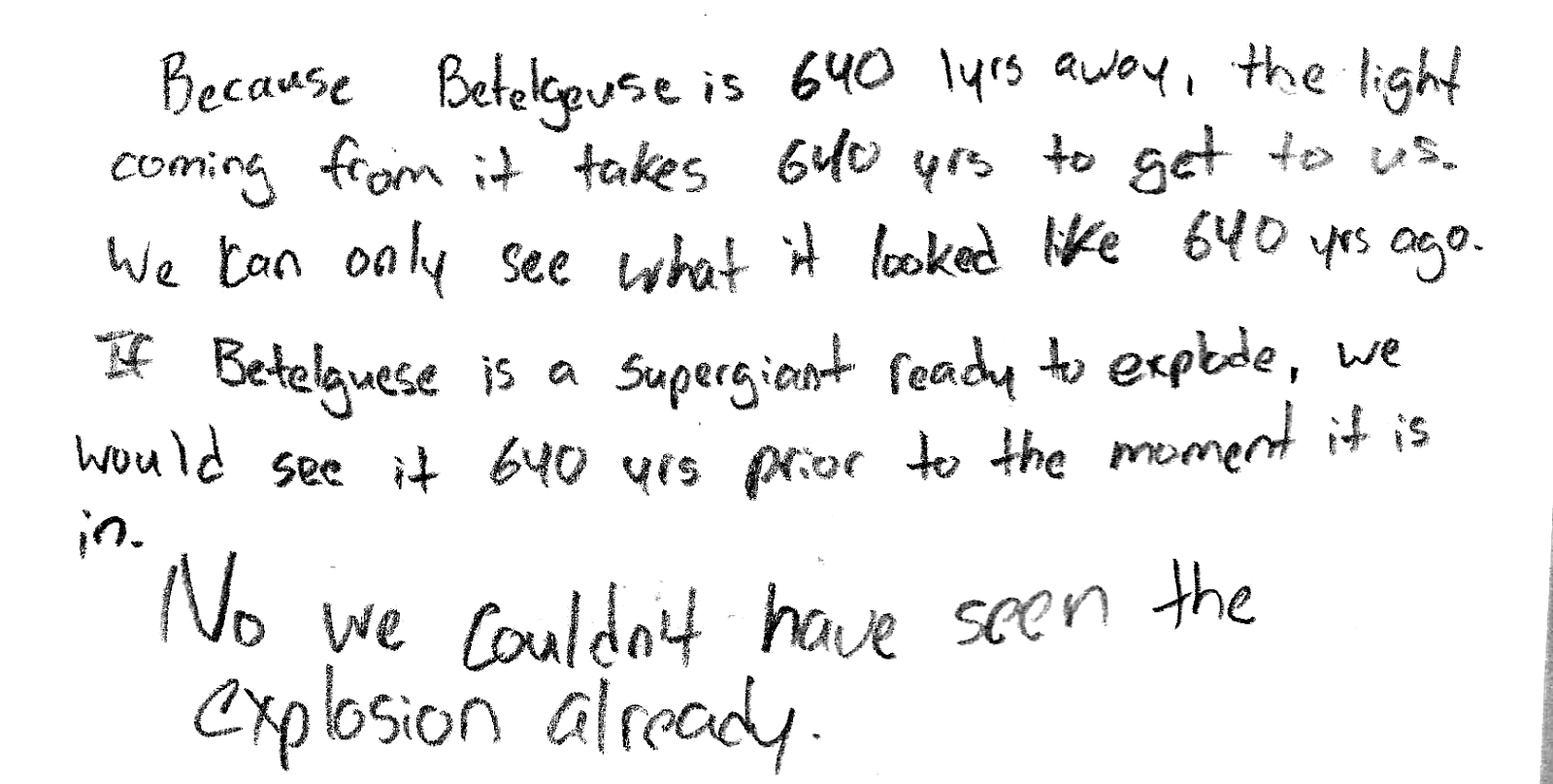
I've heard the star Betelgeuse is a supergiant [640 light years away], and could explode as a type II supernova any moment now. If that were true, wouldn't we have seen it already?
Discuss whether or not it is possible for us to have seen Betelgeuse explode if it is a supergiant right now. Explain using the properties of mass and stellar lifetimes, and light.

[*] answers.yahoo.com/question/index?qid=20160504225623AAy0q47.

Solution and grading rubric:
  • p:
    Correct. Discusses how it is not possible to have already seen Betelgeuse explode as a type II supernova if it is a supergiant right now, due to the finite speed of light (where it takes one year of time to travel a distance of one light-year), it will take 640 years for the light from Betelgeuse to travel to Earth, and applies this to one of the following arguments:
    1. if Betelgeuse were still a supergiant, it would take 640 years after it undergoes a type II supernova for this light to travel to Earth, and this explosion would only be visible 640 years from that moment; or
    2. if this explosion were visible now, it had to have happened 640 years in the past, and Betelgeuse would not still be a supergiant; or
    3. if Betelgeuse had already undergone a type II supernova less than 640 years ago, it would not be a supergiant right now, but we would not have yet seen this explosion.
  • r:
    Nearly correct (explanation weak, unclear or only nearly complete); includes extraneous/tangential information; or has minor errors.
  • t:
    Contains right ideas, but discussion is unclear/incomplete or contains major errors.
  • v:
    Limited relevant discussion of supporting evidence of at least some merit, but in an inconsistent or unclear manner. Garbled discussion of mass, stellar lifetimes, and light.
  • x:
    Implementation/application of ideas, but credit given for effort rather than merit. Discussion not based on mass, stellar lifetimes, and light.
  • y:
    Irrelevant discussion/effectively blank.
  • z:
    Blank.
Grading distribution:
Section 30674
Exam code: finalNKPd
p: 8 students
r: 3 students
t: 0 students
v: 1 student
x: 2 students
y: 0 students
z: 0 students

Section 30676
Exam code: finalSre6
p: 18 students
r: 6 students
t: 0 students
v: 2 students
x: 9 students
y: 6 students
z: 1 student

A sample "p" response (from student 1503):

Another sample "p" response (from student 0716):

20160512

Astronomy quiz archive: Milky Way, cosmology

Astronomy 210 Quiz 7, spring semester 2016
Cuesta College, San Luis Obispo, CA

Section 30674, version 1
Exam code: quiz07N4rK


Section 30674
0- 8.0 :   * [low = 8.0]
8.5-16.0 :   *****
16.5-24.0 :   ******** [mean = 19.1 +/- 6.1]
24.5-32.0 :  
32.5-40.0 :   ** [high = 33.0]


Section 30676, version 1
Exam code: quiz07SrRy


Section 30676
0- 8.0 :   ***** [low = 0.0]
8.5-16.0 :   ************
16.5-24.0 :   *************** [mean = 20.7 +/- 9.0]
24.5-32.0 :   ***********
32.5-40.0 :   ******* [high = 36.5]

20160504

Astronomy in-class activity: speed of light and look-back time

Astronomy 210 In-class activity 23 v.16.05.04, spring semester 2016
Cuesta College, San Luis Obispo, CA

Students find their assigned groups of three to four students, and work cooperatively on an in-class activity worksheet on the effect of the finite speed of light on look-back time.


20151215

Astronomy quiz question: current status of type Ia supernova seen tonight

Astronomy 210 Quiz 7, fall semester 2015
Cuesta College, San Luis Obispo, CA

A type Ia supernova in a distant galaxy seen in Earth's night sky tonight is currently a:
(A) protostar.
(B) white dwarf.
(C) planetary nebula.
(D) (None of the above choices.)

Correct answer (highlight to unhide): (D)

The finite speed of light means that it takes time for light from distant objects to reach the Earth. Thus looking at an object a given number of light years away means that it appears as it did that same number of years in the past. Since a type Ia supernova is the entire destruction of a white dwarf after rapidly stealing hydrogen from its companion star, then by the time observers on Earth see this explosion tonight, the white dwarf had already exploded in the past, and subsequently (and currently) nothing is left at that location.

Section 70158
Exam code: quiz07srrH
(A) : 8 students
(B) : 10 students
(C) : 11 students
(D) : 10 students

Success level: 29% (including partial credit for multiple-choice)
Discrimination index (Aubrecht & Aubrecht, 1983): 0.62

Section 70160
Exam code: quiz07nM0r
(A) : 5 students
(B) : 8 students
(C) : 4 students
(D) : 8 students

Success level: 36% (including partial credit for multiple-choice)
Discrimination index (Aubrecht & Aubrecht, 1983): 0.57

20151211

Astronomy quiz archive: Milky Way, cosmology

Astronomy 210 Quiz 7, fall semester 2015
Cuesta College, San Luis Obispo, CA

Section 70158, version 1
Exam code: quiz07srrH


Section 70158
0- 8.0 :   *** [low = 4.0]
8.5-16.0 :   **********
16.5-24.0 :   *********** [mean = 21.5 +/- 9.3]
24.5-32.0 :   *********
32.5-40.0 :   ****** [high = 40.0]


Section 70160, version 1
Exam code: quiz07nM0r


Section 70160
0- 8.0 :   *** [low = 4.0]
8.5-16.0 :   ******
16.5-24.0 :   ******* [mean = 20.7 +/- 9.6]
24.5-32.0 :   *******
32.5-40.0 :   ** [high = 40.0]

20150513

Astronomy quiz archive: Milky Way, cosmology

Astronomy 210 Quiz 7, spring semester 2015
Cuesta College, San Luis Obispo, CA

Sections 30674, 30676 version 1
Exam code: quiz07Ctlu


Section 30674
0- 8.0 :  
8.5-16.0 :   ***** [low = 9.5]
16.5-24.0 :   ***********
24.5-32.0 :   ************* [mean = 24.8 +/- 7.9]
32.5-40.0 :   ******* [high = 40.0]

Section 30676
0- 8.0 :   ** [low = 6.5]
8.5-16.0 :   *******
16.5-24.0 :   ********** [mean = 23.9 +/- 8.5]
24.5-32.0 :   ******************
32.5-40.0 :   ******* [high = 40.0]

20141211

Astronomy quiz archive: Milky Way, cosmology

Astronomy 210 Quiz 7, fall semester 2014
Cuesta College, San Luis Obispo, CA

Section 70158, version 1
Exam code: quiz07su4R


Section 70158
0- 8.0 :  
8.5-16.0 :   **** [low = 7.5]
16.5-24.0 :   ******************
24.5-32.0 :   *********** [mean = 25.0 +/- 6.8]
32.5-40.0 :   ****** [high = 36.5]


Section 70160, version 1
Exam code: quiz07n0Lb


Section 70160
0- 8.0 :  
8.5-16.0 :   ******* [low = 11.0]
16.5-24.0 :   ************* [mean = 22.4 +/- 7.4]
24.5-32.0 :   ******
32.5-40.0 :   ****** [high = 36.5]

20131218

Astronomy final exam question: "edge" of the universe?

Astronomy 210 Final Exam, fall semester 2013
Cuesta College, San Luis Obispo, CA

An astronomy question on an online discussion board[*] was asked and answered:
?: Is there an edge to all of the galaxies in the universe?
Nick: The galaxies could go on forever, but we wouldn't ever be able to see the rest of them. We've basically seen as far as we'll ever see, because we can't see any galaxies further than about 14 billion light years away.
Discuss why this answer is correct, and how you know this. Explain using the properties of the speed of light, stellar evolution, and galaxies.

[*] Adapted from http://answers.yahoo.com/question/index?qid=20110218090525AAf19m6.

Solution and grading rubric:
  • p:
    Correct. Recognizes how (1) light travels at a finite speed, so looking further out will see further back in time (look-back time); and why not seeing any galaxies further than approximately 14 billion light years out is an indication that the universe has a finite age of approximately 14 billion years (Olbers' paradox).
  • r:
    Nearly correct (explanation weak, unclear or only nearly complete); includes extraneous/tangential information; or has minor errors. One of the two points (1)-(2) correct, other is problematic/incomplete.
  • t: Contains right ideas, but discussion is unclear/incomplete or contains major errors. Both points (1)-(2) problematic/incomplete, or one point correct while other is missing.
  • v:
    Limited relevant discussion of supporting evidence of at least some merit, but in an inconsistent or unclear manner.
  • x:
    Implementation/application of ideas, but credit given for effort rather than merit. Discusses factors other than relevant to the speed of light, and Olbers' paradox.
  • y:
    Irrelevant discussion/effectively blank.
  • z:
    Blank.
Grading distribution:
Section 70158
Exam code: finals0oB
p: 18 students
r: 5 students
t: 8 students
v: 1 student
x: 4 students
y: 3 students
z: 0 students

Section 70160
Exam code: finaln4A6
p: 8 students
r: 3 students
t: 5 students
v: 4 students
x: 4 students
y: 0 students
z: 1 student

A sample "p" response (from student 0615):

A sample "y" response (from student 0221):