Showing posts with label antinodes. Show all posts

20170106

Physics final exam question: longer string, more tension fundamental standing wave

Physics 205A Final Exam, fall semester 2016
Cuesta College, San Luis Obispo, CA

A Physics 205A student builds a standing wave experiment with a mass hanging over a pulley to create tension in a string, which has a fundamental frequency of 20 Hz. The length of string used is increased by a factor of two, and the amount of mass hanging off of the string is also increased by a factor of two. (Ignore stretching in the string.) Discuss why the longer string with a greater hanging mass will have a fundamental frequency lower than 20 Hz. Explain your reasoning using the properties of wave speeds, and standing waves.

Solution and grading rubric:
  • p:
    Correct. Understands that:
    1. the fundamental standing wave frequency f1 depends on the wave speed v (set by the tension) and the physical length L of string between the ends; and
    2. the hanging mass increases by a factor of two, increasing the tension F in the string by a factor of, which increases the wave speed v by a factor of √2, and thus increases the fundamental standing wave frequency f1 by a factor of √2; and
    3. doubling the length L between the ends halves the fundamental standing wave frequency f1; such that the overall change in the fundamental standing wave frequency f1 will be such that it is lower, by a factor of (√2)/2, or 0.70 times the original value of f1.
  • r:
    As (p), but argument indirectly, weakly, or only by definition supports the statement to be proven, or has minor inconsistencies or loopholes.
  • t:
    Nearly correct, but argument has conceptual errors, or is incomplete. Only recognizes one of the arguments (2)-(3) as affecting f1.
  • v:
    Limited relevant discussion of supporting evidence of at least some merit, but in an inconsistent or unclear manner. Some garbled attempt at applying standing wave frequency parameters.
  • x:
    Implementation/application of ideas, but credit given for effort rather than merit. Approach other than applying standing wave frequency parameters.
  • y:
    Irrelevant discussion/effectively blank.
  • z:
    Blank.
Grading distribution:
Sections 70854, 70855, 73320
Exam code: finali0w4
p: 11 students
r: 3 students
t: 27 students
v: 7 students
x: 0 students
y: 0 students
z: 1 student

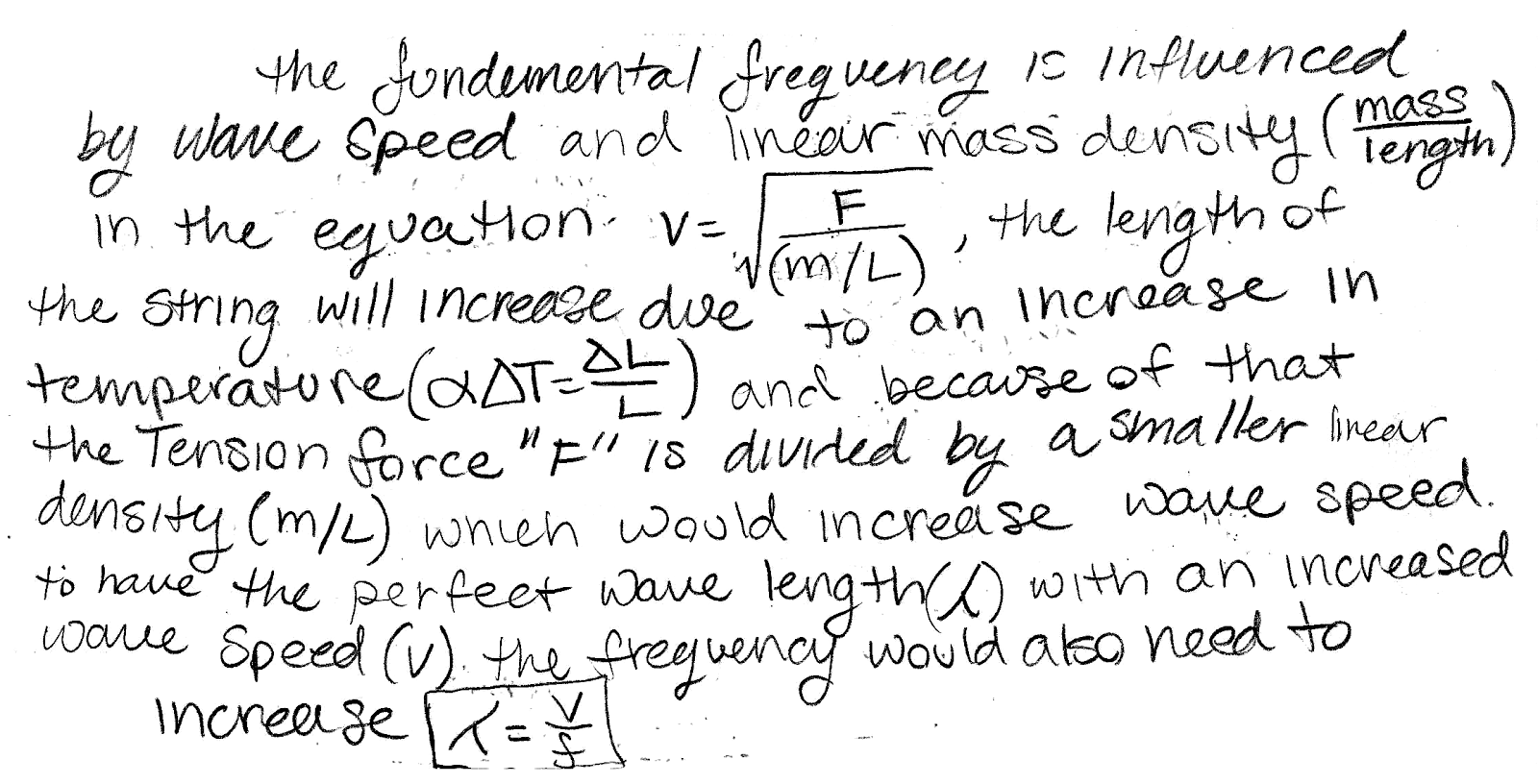
A sample "p" response (from student 0424):

20161127

Physics final exam question: standing wave frequency of thermally expanded string

Physics 205A Final Exam, fall semester 2015
Cuesta College, San Luis Obispo, CA

A Physics 205A student builds a standing wave experiment with a string and a mass hanging over a pulley to create tension, and at a certain temperature it has a fundamental frequency of 20.0 Hz. As the temperature increases, discuss why the fundamental frequency will increase. Only consider the thermal expansion of the string. Explain your reasoning using the properties of wave speeds, periodic waves, standing waves, and thermal expansion.

Solution and grading rubric:
  • p:
    Correct. Understands that:
    1. the fundamental standing wave frequency depends on the wave speed and the physical length L between nodes (which does not change);
    2. the wave speed depends on tension (which is set by the hanging mass, and does not change) and linear mass density (which does change);
    3. the linear mass density which depends on the total mass of the string (which does not change) and the overall length of the string (which expands due to the increase in temperature); such that the increase in temperature will decrease the linear mass density, which will increase the wave speed, resulting in a higher fundamental standing wave frequency. (For (1), may instead discuss how the wavelength λ remains constant, being twice the distance from the anchor to the pulley.)
  • r:
    As (p), but argument indirectly, weakly, or only by definition supports the statement to be proven, or has minor inconsistencies or loopholes. Typically does not explicitly discuss how L or λ remains constant in (1).
  • t:
    Nearly correct, but argument has conceptual errors, or is incomplete. Typically does not explicitly discuss how standing wave frequency depends on wave speed in (1), or conflates node-node distance L with overall (expanding) string length L.
  • v:
    Limited relevant discussion of supporting evidence of at least some merit, but in an inconsistent or unclear manner. Some garbled attempt at applying thermal expansion to the dependent wave speed and standing wave frequency parameters.
  • x:
    Implementation/application of ideas, but credit given for effort rather than merit. Approach other than applying thermal expansion to the dependent wave speed and standing wave frequency parameters.
  • y:
    Irrelevant discussion/effectively blank.
  • z:
    Blank.
Grading distribution:
Sections 70854, 70855, 73320
Exam code: final7rUk
p: 8 students
r: 13 students
t: 10 students
v: 28 students
x: 10 students
y: 0 students
z: 1 student

A sample "p" response (from student 0048):

20140111

Physics final exam question: speed of waves along standing wave strings

Physics 205A Final Exam, fall semester 2013
Cuesta College, San Luis Obispo, CA

Cf. Giambattista/Richardson/Richardson, Physics, 2/e, Conceptual Questions 11.3, 11.4, Multiple-Choice Questions 11.5, 11.6, 11.8

A string has its tension set by a hanging mass, and resonates at its fundamental frequency. If a shorter length of the string is used with the same hanging mass (which changes its fundamental frequency), discuss why the speed of waves along this string does not change. (Ignore stretching in the string.) Explain your reasoning using the properties of wave speeds, periodic waves, and standing waves.

Solution and grading rubric:
  • p:
    Correct. Understands that (1) wave speed depends on tension and linear mass density, and (2) since neither of these are changed by using a shorter portion of this same string (with the same mass hanging from it), then the wave speed remains constant.
  • r:
    As (p), but argument indirectly, weakly, or only by definition supports the statement to be proven, or has minor inconsistencies or loopholes.
  • t:
    Nearly correct, but argument has conceptual errors, or is incomplete.
  • v:
    Limited relevant discussion of supporting evidence of at least some merit, but in an inconsistent or unclear manner. At least understands the relationship between wave parameters.
  • x:
    Implementation/application of ideas, but credit given for effort rather than merit.
  • y:
    Irrelevant discussion/effectively blank.
  • z:
    Blank.
Grading distribution:
Sections 70854, 70855, 73320
Exam code: finaln0M3
p: 17 students
r: 25 students
t: 7 students
v: 9 students
x: 3 students
y: 0 students
z: 0 students

A sample "p" response (from student 7810):

20131123

Physics quiz question: swaying electrical transmission lines

Physics 205A Quiz 6, fall semester 2013
Cuesta College, San Luis Obispo, CA

Cf. Giambattista/Richardson/Richardson, Physics, 2/e, Conceptual Question 11.4, Multiple-Choice Question 11.5

"Swaying Power Lines.mpg"
lmwilliams100
youtu.be/US6iayPoBdM

An electrical transmission line in Northeast Arkansas covered with ice[*] sways back and forth at a fundamental frequency of 0.80 Hz, hanging from utility poles[**] with a spacing of 38 m. If the transmission line was no longer covered with ice (and assuming that the tension and length are relatively unchanged) the fundamental frequency would be __________ 0.80 Hz.
(A) lower than.
(B) equal to.
(C) higher than.
(D) (Not enough information is given.)

[*] youtu.be/US6iayPoBdM.
[**] wki.pe/Utility_pole.

Correct answer (highlight to unhide): (C)

The fundamental frequency f1 of a string of length L is given by:

f1 = v/(2·L),

where the speed v of transverse waves along the string depends on the tension F and the linear mass density (mass per unit length) (m/L):

v = sqrt(F/(m/L)).

If the transmission line was no longer covered by ice, and given that the tension and the length would be relatively unchanged, then there will be a decrease in mass per length of transmission line, such that (m/L) decreases, increasing v, and thus increasing the fundamental frequency f1 that the transmission lines will sway back and forth.

Sections 70854, 70855, 73320
Exam code: quiz06wR3k
(A) : 7 students
(B) : 24 students
(C) : 33 students
(D) : 0 students

Success level: 52%
Discrimination index (Aubrecht & Aubrecht, 1983): 0.51

20121228

Physics final exam question: strings with same frequencies, different harmonics

Physics 205A Final Exam, fall semester 2012
Cuesta College, San Luis Obispo, CA

Cf. Giambattista/Richardson/Richardson, Physics, 2/e, Problems 11.9, 11.54, Review Exercise 14, p. 454

A string has its tension set by a hanging mass M, and resonates at its fundamental frequency at 150 Hz. This same string will resonate with two antinodes at 150 Hz when a different mass m is hanging from it. Discuss why M > m. Explain your reasoning using the properties of wave speeds, periodic waves, and standing waves.

Solution and grading rubric:
  • p:
    Correct. Understands how (a) the fundamental frequency is proportional to wave velocity, and (b) the wave velocity depends on the square root of the mass creating the tension, and (c) the string vibrating at its second harmonic has a fundamental frequency half that of the other string, such that the second harmonic vibrating string has a slower wave velocity, a lower tension, and thus a smaller hanging mass.
  • r:
    As (p), but argument indirectly, weakly, or only by definition supports the statement to be proven, or has minor inconsistencies or loopholes.
  • t:
    Nearly correct, but argument has conceptual errors, or is incomplete.
  • v:
    Limited relevant discussion of supporting evidence of at least some merit, but in an inconsistent or unclear manner. At least understands how the hanging mass affects tension, and thus wave velocity.
  • x:
    Implementation/application of ideas, but credit given for effort rather than merit.
  • y:
    Irrelevant discussion/effectively blank.
  • z:
    Blank.
Grading distribution:
Sections 70854, 70855
Exam code: finalPr0p
p: 18 students
r: 6 students
t: 17 students
v: 9 students
x: 0 students
y: 0 students
z: 1 student

A sample "p" response (from student 2121):

Another sample "p" response (from student 9494):

20091201

Physics midterm problem: string standing waves

Physics 205A Midterm 2, fall semester 2009
Cuesta College, San Luis Obispo, CA

Cf. Giambattista/Richardson/Richardson, Physics, 2/e, Problem 11.49

A string is attached with a length of 0.80 m between supports and is stretched by a 4.5 kg hanging mass at one end. A function generator oscillates the string at its fundamental frequency of 170 Hz. Find (a) the linear mass density of the string, and (b) the mass that should hang off of the string such that the same 170 Hz frequency vibrates the n = 3 mode (as shown below). Show your work and explain your reasoning using the properties of wave speeds, periodic waves, and standing waves.


Solution and grading rubric:
  • p:
    Correct. Mass of the string is not provided. However, f1 = 170 Hz, L = 0.80 m, such that v = 272 m/s. With v and tension F = m·g = 44.1 N (where m is the hanging mass, not the string mass), linear mass density = 6.0×10⁴ kg/m. Then with a new situation, f3 = 170 Hz = 3·f1,new , and with L and the linear mass density the same as before, then the new hanging mass mnew = 0.50 kg. Or argues that for frequency to remain at 170 Hz, while n increases by a factor of three, the new wave speed must be reduced by a factor of three, such that the tension and the hanging mass must be reduced by a factor of nine.)
  • r:
    Nearly correct, but includes minor math errors. Correctly finds the linear mass density of the string (or may have omitted a factor of g = 9.80 m/s2), but instead has wave speed increased by a factor of three, and thus the hanging mass increases by a factor of nine, or 40.5 kg (or similar increase).
  • t:
    Nearly correct, but approach has conceptual errors, and/or major/compounded math errors. Typically finds linear mass density as (4.5 kg)/(0.80 m) = 5.6 kg/m, or confounds mu with mass, velocity with frequency, etc., but still has systematic attempt at finding linear mass density from original n = 1 case, and then feeds (erroneous) linear mass density into the n = 3 case, along with other algebraic or nomenclature errors.
  • v:
    Implementation of right ideas, but in an inconsistent, incomplete, or unorganized manner. Involves mass-spring or pendulum period equations.
  • x:
    Implementation of ideas, but credit given for effort rather than merit.
  • y:
    Irrelevant discussion/effectively blank.
  • z:
    Blank.

Grading distribution:
Sections 70854, 70855
p: 4 students
r: 11 students
t: 23 students
v: 10 students
x: 1 student
y: 0 students
z: 0 students

A sample "p" response (from student 2323):