Showing posts with label electric potential. Show all posts

20200311

Online reading assignment: capacitors

Physics 205B, spring semester 2020
Cuesta College, San Luis Obispo, CA

Students have a bi-weekly online reading assignment (hosted by SurveyMonkey.com), where they answer questions based on reading their textbook, material covered in previous lectures, opinion questions, and/or asking (anonymous) questions or making (anonymous) comments. Full credit is given for completing the online reading assignment before next week's lecture, regardless if whether their answers are correct/incorrect. Selected results/questions/comments are addressed by the instructor at the start of the following lecture.

The following questions were asked on reading textbook chapters and previewing presentations on capacitors.


Selected/edited responses are given below.

Describe what you understand from the assigned textbook reading or presentation preview. Your description (2-3 sentences) should specifically demonstrate your level of understanding.
"The concept of the capacitor charging: in the GIF animation, the charging seems to be due to a negative charge leaving one side and when the negative charge leaves, a positive charge is left over. The positive charge then attracts a negative charge in the opposite side of the capacitor."

"The SI unit of capacitance is a farad, or coulombs squared over joules. Also that the capacitance is fixed once the construction of the capacitor is complete, and the only way to change the capacitance is to change the build of the capacitor. The potential applied to the capacitor can be altered however by using different batteries."

"A capacitor constructed from two plates and a space in-between. I also understand the capacitor construction formula."

"That once a capacitor is constructed you cannot change the capacitance of it without changing its build (plate area or separation distance)."

"Capacitors are built by putting parallel metal plates together with a small distance in between. Charging a capacitor requires a battery and will cause electrons to move freely from the top plate to the bottom plate until the top plate demonstrates a positive charge and the bottom plate have a negative charge. However, as more and more electrons move towards the bottom panel, it requires more work and creates a larger EPE charge due to the voltage."

"Capacitors store electric charge. Capacitors have a capacitance, which reflects their ability to store electric charge. While their capacitance is determined by surface area and separation distance of parallel metal plates, changing the voltage applied to the capacitor also changes their charge but does not change the capacitance of the capacitor."

"Capacitors store up electric potential energy by creating a potential difference across 2 parallel metal plates. The more charge the capacitor holds, the more energy it takes to move it across to the opposing plate. Unlike batteries, a charged capacitor can release its energy in a short burst over a short period of time."

Describe what you found confusing from the assigned textbook reading or presentation preview. Your description (2-3 sentences) should specifically identify the concept(s) that you do not understand.
"Understanding voltage and especially understanding how it relates to capacitance is difficult."

"I don't understand how a capacitor gets charged."

"I do not understand capacitor charge because I see charges staying or leaving."

"Electric potential energy storage explanation."

"The capacitor energy storage formulas were different depending on the scenario. I need to work problems out to understand the differences."

"I found most of this reading assignment confusing. I could definitely use some clarification on the math."

"Nothing at this time, just want more examples of applications in class."

Describe two quantities that a capacitor is designed to store/hold.
"A capacitor is designed to hold voltage and electric potential energy."

"The capacitor holds charges. Both positive and negative?"

"Charge and electric potential energy."

State the unit of capacitance, and give its definition in terms of other SI units.
"farad, F, which is C (coulombs) squared divided by joules."

"Coulombs/volts = farads; where coulomb is electric charge, while volt is electric potential."

For a parallel-plate capacitor, ___________ the plate area and __________ the plate separation would increase its capacitance.
decreasing; decreasing.  [0]
decreasing; increasing.  ** [2]
increasing; decreasing.  ************************ [24]
increasing; increasing.  *** [3]
(Unsure/guessing/lost/help!)  *** [3]

For a parallel-plate capacitor, increasing the voltage (electric potential) difference applied to the capacitor would __________ the amount of charge stored in it.
decrease.  ******* [7]
increase.  **************** [16]
have no effect on.  ******* [7]
(Unsure/guessing/lost/help!)  **[2]

Explain why increasing or decreasing the voltage (electric potential difference) of a capacitor cannot change the numerical value of its capacitance.
"I don't know. I would think increasing the voltage also increases the capacitance?"

"Because it only affects the actual amount of charge it has, not the storage ability, or size of the actual capacitor."

"The capacitor is based on the plate separation distance and cross-sectional area."

"The capacitor holds a specific amount and adding or decreasing the voltage does not change. This is due to the fact that once it is constructed, the capacitance is fixed."

Ask the instructor an anonymous question, or make a comment. Selected questions/comments may be discussed in class.
"Do we get to use capacitors in any labs?"

"I am definitely struggling with this section, are we going to take a pretty deep dive on this?" (We will, but in lab.)

"Oh man, this electricity stuff is challenging."

"Capacitors shockingly weren't as difficult as I was anticipating."

"I noticed that farads are named after Michael Faraday. I hear his name mentioned a lot when discussing physics. Has he made a lot of contributions to the physics of electricity?" (Yes, but so did a lot of other physicists that have units named after them: Coulomb, Volta, Ohm, Ampere, Weber, Henry, and Tesla; along with others who don't have units named after them: Franklin, Maxwell, Ørsted, Lorentz, etc.)

20200309

Online reading assignment: electric potential energy

Physics 205B, spring semester 2020
Cuesta College, San Luis Obispo, CA

Students have a bi-weekly online reading assignment (hosted by SurveyMonkey.com), where they answer questions based on reading their textbook, material covered in previous lectures, opinion questions, and/or asking (anonymous) questions or making (anonymous) comments. Full credit is given for completing the online reading assignment before next week's lecture, regardless if whether their answers are correct/incorrect. Selected results/questions/comments are addressed by the instructor at the start of the following lecture.

The following questions were asked on reading textbook chapters and previewing presentations on electric potential energy.


Selected/edited responses are given below.

Describe what you understand from the assigned textbook reading or presentation preview. Your description (2-3 sentences) should specifically demonstrate your level of understanding.
"EPE is equal to the k constant times the source charge q1 times the test charge q1divided by a distance denoted as r. Voltage (potential) is equal to the k constant times the source charge Q divided by a distance from the source charge r."

"Electric potential energy can change when moving a source charge and test charge closer together, or moving them farther apart. One direction will give a positive change in EPE when pushing like signs together or pulling two opposite signs apart."

"Electric potential energy can be increased by pushing together like-sign charges or pulling apart opposite-sign charges. This results in a change in electric potential energy because it requires work to be done. Work is done by charges that are allowed to do what they want."

"I understood EPE can be increased by pushing like charges together or pulling apart opposite charges. While, allowing things to act without using 'work' results in a decreased EPE. Also, I believe to calculate ∆EPE, one must calculate the EPE at different locations and subtract."

"EPE utilizes a field of equipotentials, similar to electric fields."

"I get there is a difference between electric potential energy and electric potential, but I don’t really know what it is."
Describe what you found confusing from the assigned textbook reading or presentation preview. Your description (2-3 sentences) should specifically identify the concept(s) that you do not understand.
"Maybe the images on the blog explaining when something was negative rather than positive."

"I did not understand voltage, electric potential energy and what the peaks or wells mean."

"The difference between electric potential and electric potential energy is a bit confusing. I'm also getting lost on how the two-step approach is implemented in finding the potential energy."

"I had a hard time with the end of the presentation because I was confused about the circular equipotentials. Also, are EPE and potential are the same? I don't know why they have different labels in the equations."

"I am a little unclear with how to determine when something is a two-step approach versus a direct approach."

"The textbook does not have good examples of these types of problem. Can you please go over in class?"

"Nothing at this time. Possibly application."
Explain the difference between the units of electric potential V, and electric potential energy, EPE.
"EPE is in joules and potential is in joules per coulombs."

"The electric potential energy is an energy and is measured in joules. The electric potential is an energy per unit charge and is measured in joules per coulomb, or volts."

"The units."

"I don't understand the difference in units for the different energy potentials."

Explain the conceptual difference between the electric potential V, and electric potential energy, EPE.
"EPE is measured in joules because it is an energy. The volt is measured in joules per unit."

"Electric potential energy is an energy while electric potential is an energy per unit charge."

"Electric potential is created by a source charge. EPE is the energy stored in electric potential. I think this is why I'm so confused. I get one is an energy and the other one is an energy per charge but I don’t get how they relate to each other, or if one created the other..."

"Not really sure."

Briefly summarize the difference (if any) between "voltage" and electric potential.
"They are the same."

"A volt is the way to measure electric potential."

"There isn't a difference. Electric potential is measured in volts at a location in space."

"They are interchangeable."


Identify the changes in electric potential energy EPE (if any) for the following test charges (±q):
(Only correct responses shown.)
Positive test charge +q brought closer to a positive source charge +Q: increase [67%]
Negative test charge –q brought closer to a positive source charge +Q: decrease [70%]
Positive test charge +q brought closer to a negative source charge –Q: decrease [70%]
Negative test charge –q brought closer to a negative source charge –Q: increase [73%]

Identify the changes in electric potential V (if any) for the following test charges (±q):
(Only correct responses shown.)
Positive test charge +q brought closer to a positive source charge +Q: increase [48%]
Negative test charge –q brought closer to a positive source charge +Q: increase [48%]
Positive test charge +q brought closer to a negative source charge –Q: decrease [42%]
Negative test charge –q brought closer to a negative source charge –Q: decrease [45%]

Ask the instructor an anonymous question, or make a comment. Selected questions/comments may be discussed in class.
"Pleeeeease review the difference of potential and EPE."

"Thrilled to see the energy equation back with a new member added to it."

"That was electrifying."

"I am having a hard time with the last question, are you going to go over it in class?"

"Would like to review the last question above."

"You weren't lying when you said this material was THICK."

"Do the concepts in this section relate to how magnets work? (Not yet. Too soon.)

20190510

Physics midterm question: comparing same-energy, different potential capacitors

Physics 205B Midterm 2, spring semester 2019
Cuesta College, San Luis Obispo, CA

A capacitor is connected to a 1.5 V battery and a different capacitor is connected to a 6.0 V battery. Both capacitors store the same amount of electrical potential energy. Discuss why the capacitor connected to the 1.5 V battery has a larger capacitance than the capacitor connected to the 6.0 V battery. Explain your reasoning by using the properties of capacitors, charge, electric potential, and energy.

Solution and grading rubric:
  • p:
    Correct. Discusses why the capacitor connected to the 1.5 V battery has a greater capacitance than the capacitor connected to the 6.0 V battery because:
    1. from EPE = (1/2)⋅Q⋅(ΔV), both capacitors store the same amount of electrical potential energy; such that the capacitor connected to the 1.5 V battery holds a larger charge than the capacitor connected to the 6.0 V battery; and
    2. from C = QV, since the capacitor connected to the 1.5 V battery has a smaller potential difference and a larger charge than the capacitor connected to the 6.0 V battery; then the capacitor connected to the 1.5 V battery must have a larger capacitance.
  • r:
    As (p), but argument indirectly, weakly, or only by definition supports the statement to be proven, or has minor inconsistencies or loopholes.
  • t:
    Nearly correct, but argument has conceptual errors, or is incomplete. Typically assumes that both capacitors have the same charge, and/or does not explicitly use the given fact that the capacitors store the same amount of electrical potential energy.
  • v:
    Limited relevant discussion of supporting evidence of at least some merit, but in an inconsistent or unclear manner. Some attempt at applying properties of capacitors, charge, electric potential, and energy.
  • x:
    Implementation/application of ideas, but credit given for effort rather than merit. No clear attempt at systematically applying properties of capacitors, charge, electric potential, and energy.
  • y:
    Irrelevant discussion/effectively blank.
  • z:
    Blank.
Grading distribution:
Sections 30882, 30883
Exam code: midterm02u7aH
p: 22 students
r: 1 student
t: 18 students
v: 0 students
x: 1 student
y: 1 student
z: 0 students

A sample "p" response (from student 2334):

Another sample "p" response (from student 1842), substituting in Q = C·ΔV into the electric potential energy equation:

Physics midterm question: comparing voltmeter readings

Physics 205B Midterm 2, spring semester 2019
Cuesta College, San Luis Obispo, CA

An ideal 9.0 V emf source is connected to a light bulb and two resistors, with a voltmeter connected to the light bulb, and another voltmeter connected to one of the resistors. Discuss why the two voltmeters have the same reading (in volts). Show your work and explain your reasoning using Kirchhoff's laws, Ohm's law, and properties of voltmeters.

Solution and grading rubric:
  • p:
    Correct. Discusses/demonstrates how the two voltmeters have the same reading because:
    1. due to Kirchhoff's junction rule, the current flowing through each of the 4.0 Ω resistors is one-half of the current flowing through the 2.0 Ω resistor; and
    2. since each voltmeter will read the voltage drop (IR) of their respective resistors, the smaller current (factor of one-half) flowing through the 4.0 Ω resistor will be compensated by its larger resistance (factor of two).
  • r:
    As (p), but argument indirectly, weakly, or only by definition supports the statement to be proven, or has minor inconsistencies or loopholes.
  • t:
    Nearly correct, but argument has conceptual errors, or is incomplete.
  • v:
    Limited relevant discussion of supporting evidence of at least some merit, but in an inconsistent or unclear manner. Some attempt at applying properties of Kirchhoff's rules, Ohm's law, and properties of ammeters.
  • x:
    Implementation/application of ideas, but credit given for effort rather than merit. No clear attempt at systematically applying Kirchhoff's rules, Ohm's law, and properties of ammeters.
  • y:
    Irrelevant discussion/effectively blank.
  • z:
    Blank.
Grading distribution:
Sections 30882, 30883
Exam code: midterm02u7aH
p: 28 students
r: 4 students
t: 2 students
v: 8 students
x: 0 students
y: 0 students
z: 1 student

A sample "p" response (from student 1950):

Physics midterm question: ammeter reading after switch is closed

Physics 205B Midterm, spring semester 2019
Cuesta College, San Luis Obispo, CA

An ideal 6.0 V emf source is connected to an ammeter, a resistor, a light bulb, and an open switch. When the switch is closed, determine whether the ammeter reading (in amps) will decrease, increase, or remain the same, and explain why. 
Show your work and explain your reasoning using Kirchhoff's rules, Ohm's law, and properties of ammeters.

Solution and grading rubric:
  • p:
    Correct. Discusses/demonstrates how ammeter reading will increase when the switch is closed because:
    1. when the switch is open, the equivalent resistance is 3.0 Ω, and the ammeter will read the current of this circuit I = εeq/Req = (6.0 V)/(3.0 Ω) = 2.0 A;
    2. when the switch is closed, no current will flow through the 0.5 Ω resistor (flowing only through the zero resistance path of the closed switch), such that the equivalent resistance decreases to 2.5 Ω, such that the ammeter will read a higher amount of current in this circuit I = εeq/Req = (6.0 V)/(2.5 Ω) = 2.4 A.
  • r:
    As (p), but argument indirectly, weakly, or only by definition supports the statement to be proven, or has minor inconsistencies or loopholes.
  • t:
    Nearly correct, but argument has conceptual errors, or is incomplete.
  • v:
    Limited relevant discussion of supporting evidence of at least some merit, but in an inconsistent or unclear manner. Some attempt at applying properties of Kirchhoff's rules, Ohm's law, and properties of ammeters.
  • x:
    Implementation/application of ideas, but credit given for effort rather than merit. No clear attempt at systematically applying Kirchhoff's rules, Ohm's law, and properties of ammeters.
  • y:
    Irrelevant discussion/effectively blank.
  • z:
    Blank.
Grading distribution:
Sections 30882, 30883
Exam code: midterm02u7aH
p: 20 students
r: 4 students
t: 10 students
v: 6 students
x: 1 student
y: 0 students
z: 0 students

A sample "p" response (from student 1001):

Another sample "p" response (from student 1810):

Physics midterm problem: brightness of light bulbs in circuit

Physics 205B Midterm 2, spring semester 2019
Cuesta College, San Luis Obispo, CA

An ideal 9.0 V emf source is connected to several light bulbs that all have the same resistance. Calculate the powers dissipated (in watts) for each of these light bulbs. Show your work and explain your reasoning using Kirchhoff's rules, Ohm's law, and properties of electrical power.

Solution and grading rubric:
  • p:
    Correct. Solves for the powers dissipated by each light bulb by:
    1. finding equivalent resistance of the circuit by recognizing that the top light bulb is in series to the lower three parallel light bulbs);
    2. applying Ohm's law to determine the current of the equivalent circuit, which is the current flowing through the top light bulb;
    3. determines the power dissipated by the top light bulb;
    4. applies Kirchhoff's loop and/or junction rules to solve for the voltage difference used by and/or the current flowing through each of the lower three parallel light bulbs; and
    5. determines the power dissipated by each of the lower three parallel light bulbs.
  • r:
    Nearly correct, but includes minor math errors. Typically incorrect calculation in (1) or in (5), but otherwise everything else is consistent with this error.
  • t:
    Nearly correct, but approach has conceptual errors, and/or major/compounded math errors. Multiple issues in (1)-(5), but still attempts to systematically analyze most of (1)-(5) even with wrong numerical values.
  • v:
    Implementation of right ideas, but in an inconsistent, incomplete, or unorganized manner. Some attempt at applying Kirchhoff's rules, Ohm's law, and properties of electrical power.
  • x:
    Implementation of ideas, but credit given for effort rather than merit. No clear attempt at applying Kirchhoff's rules, Ohm's law, and properties of electrical power.
  • y:
    Irrelevant discussion/effectively blank.
  • z:
    Blank.
Grading distribution:
Sections 30882, 30883
Exam code: midterm02u7aH
p: 10 students
r: 6 students
t: 7 students
v: 18 students
x: 2 students
y: 0 students
z: 0 students

A sample "p" response (from student 1982):

Another sample "p" response (from student 8812):

20190422

Physics quiz archive: circuits (2)

Physics 205B Quiz 5, spring semester 2019
Cuesta College, San Luis Obispo, CA
Sections 30882, 30883, version 1
Exam code: quiz05eXpL


Sections 30882, 30883 results
0- 6 :  
7-12 :   ** [low = 9]
13-18 :   ****************
19-24 :   ***************** [mean = 20.2 +/- 4.7]
25-30 :   **** [high = 30]

20190410

Physics quiz archive: capacitors, circuits

Physics 205B Quiz 4, spring semester 2019
Cuesta College, San Luis Obispo, CA
Sections 30882, 30883, version 1
Exam code: quiz04KhhF


Sections 30882, 30883 results
0- 6 :  
7-12 :   **** [low = 9]
13-18 :   *****
19-24 :   *************** [mean = 23.4 +/- 6.0]
25-30 :   ***************** [high = 30]

Online reading assignment: advanced electricity (review)

Physics 205B, spring semester 2019
Cuesta College, San Luis Obispo, CA

Students have a bi-weekly online reading assignment (hosted by SurveyMonkey.com), where they answer questions based on reading their textbook, material covered in previous lectures, opinion questions, and/or asking (anonymous) questions or making (anonymous) comments. Full credit is given for completing the online reading assignment before next week's lecture, regardless if whether their answers are correct/incorrect. Selected results/questions/comments are addressed by the instructor at the start of the following lecture.

The following questions were asked on re-reading textbook chapters and reviewing presentations on advanced electricity concepts.


Selected/edited responses are given below.

Describe what you understand from the assigned textbook reading or presentation preview. Your description (2-3 sentences) should specifically demonstrate your level of understanding.
"How to calculate equivalent resistance for parallel circuits and series."

"In series resistors will add up to attain the resistor equivalent and that resistors in parallel will be the inverse of the resistance added together and then inversed again."

"Why an ammeter has to have a resistance of zero, because it measures current and if it had a resistance it would interfere in that."

"Since we had lab, I have a much better understanding of how voltmeters and ammeters work and why they need to have the resistance they have. Since ammeters are measuring the current through a circuit, they need to have a very very low resistance so they don't disturb the circuit they are measuring. The voltmeter measures the voltage difference for a resistor like a bulb. They have to have a very high resistance so they don't create a short in the circuit."

"When the amount of resistors in parallel goes up the resistance gets dangerously low and this causes current to get very high at which point it can become dangerous because its heat can melt the material used to insulate wires, thus exposing wires to other surrounding surfaces and possibly sparking a fire if they come in contact with each other."

"Grounding is an important aspect of safety when it comes to electrical appliances such as clothes dryers. A three-pronged plug connects the metal casing of a dryer to a copper pipe in the ground so that if wiring becomes lose inside the dryer and touches the casing, a person who is also touching the casing will not be shocked. This is because the copper pipe would have much less resistance than the person's body."

"I understand the relationship between resistance and current in series and parallel circuits a lot better after reviewing for this quiz. I understand the measurements that ammeters and voltmeters make better after reviewing the presentation."

Describe what you found confusing from the assigned textbook reading or presentation preview. Your description (2-3 sentences) should specifically identify the concept(s) that you do not understand.
"I'm still a little confused on the junction and loop rules."

"I'm still a little confused on why ammeters need to have a low resistance wile voltmeters want to have a high resistance. I'm also confused on the measurement process on a voltmeter."

"I do not quite understand joule heating."

"I'm still confused about power and how the amount of power used varies for resistors with different magnitudes in series or parallel circuit."

"I couldn't quite grasp the idea of the power dissipation. I guess I don't know what to use it for or how to use it..."

State the unit of electrical power, and give an equivalent definition in terms of other SI units.
"Watts, amps times volts."

"Watts, which is joules per second."

What are the resistances of these (ideal) devices?
(Only correct responses shown.)
Ideal light bulb: some finite value between 0 and ∞ [65%]
Burnt-out light bulb: ∞ [35%]
Ideal wire: 0 [58%]
Ideal (non-dead) battery: 0 [42%]
Real (non-dead) battery: some finite value between 0 and ∞ [61%]
Ideal switch, when open: ∞ [36%]
Ideal switch, when closed: 0 [42%]

Two light bulbs with different resistances r and R, where r < R, are connected in series with each other to an ideal emf source. Select the light bulb with the greater quantity.
(Only correct responses shown.)
More current flowing through it: (there is a tie) [46%]
Larger potential potential difference: light bulb R [45%]
More power used: light bulb R [52%]

Two light bulbs with different resistances r and R, where r < R, are connected in parallel with each other to an ideal emf source. Select the light bulb with the greater quantity.
(Only correct responses shown.)
More current flowing through it: light bulb r [55%]
Larger potential potential difference: (there is a tie) [23%]
More power used: light bulb r [36%]

Ask the instructor an anonymous question, or make a comment. Selected questions/comments may be discussed in class.
"Starting a fire from bubble gum wrapper was very interesting. I love it when the concepts we are learning are applied to survival skills."

"No questions today just hope class will clarify my confusion."

"I think you didn't post the blog that pertains to this reading assignment?" (Actually the presentations for this assignment were for review; and these are more advanced questions that build on top of what you've already seen in class and from the textbook, as opposed to being directly off of the presentation slides.)

"I like to get more examples about resistances problems like this in class and get to do a hands on problems."

"How does the internal resistance differ for an ideal versus real battery?" (Ideal batteries have zero internal resistance, they purely provide an emf (potential difference, voltage) without any other complications. A real battery does have an internal resistance, as the chemical reactions that release energy to produce its emf (voltage) also produce inert waste products that still sit inside the battery to impede current. A fresh new battery will have very little internal resistance (very little waste products), and an old battery will have some internal resistance (more waste products), while a dead battery will have a very high internal resistance (nearly all of it inside is waste products). You'll get to investigate this in a later lab.)

"You need to 'make it rain' more in terms of extra credit. You must increase the extra credit limit! This is because, among other things, the actual quizzes do not accurately reflect what is taught."

20190408

Online reading assignment: advanced electricity

Physics 205B, spring semester 2019
Cuesta College, San Luis Obispo, CA

Students have a bi-weekly online reading assignment (hosted by SurveyMonkey.com), where they answer questions based on reading their textbook, material covered in previous lectures, opinion questions, and/or asking (anonymous) questions or making (anonymous) comments. Full credit is given for completing the online reading assignment before next week's lecture, regardless if whether their answers are correct/incorrect. Selected results/questions/comments are addressed by the instructor at the start of the following lecture.

The following questions were asked on reading textbook chapters and reviewing presentations on circuit analysis and previewing presentations on advanced electricity concepts.


Selected/edited responses are given below.

Describe what you understand from the assigned textbook reading or presentation preview. Your description (2-3 sentences) should specifically demonstrate your level of understanding.
"An ammeter must have a resistance that is ideally 0 while a voltmeter must have a resistance that is ideally infinity. Joule heating is when the power used by the circuit's resistance due to the about of current flowing through it."

"Power measures the rate of electric potential energy usage. It can be calculated as current squared times resistance or current times potential. When resistors are connected in parallel, resistance decreases and current increases. This increase in current can overload the circuit."

"Voltmeters measure the amount of electrical potential used by an element in the circuit and ammeters measure the amount of current passing through an element of a circuit."

"Ammeters measure the current of any circuit element that is "broken" open by measuring the current after it travels through the element. The ideal resistance of an ammeter is zero. Voltmeters measure the amount of electric potential used by any circuit potential, and measures the current of both before and after the element. The ideal resistance of a voltmeter is infinite."

"Series wiring is when devices are connected so that the same current runs through both devices. Parallel wiring is when devices are connected so that the same voltage is applied across each device. The junction and loop rules set the parameters through which current and voltage can move through a circuit."

"If there is too much current going through something, that something will heat up and it can become dangerous and lead to a runaway current which can cause fires and other damages. I also understand how series resistors and parallel resistors divide/use the current in a circuit. Whatever potential a battery adds to a circuit, the resistors will use up the same amount. Circuit breakers are designed to trip a current before it becomes dangerously high turns to a runaway current."

"That runaway currents can be prevented by circuit breaker that interrupts the current if it becomes to high due to excessive appliances being plugged into the same outlet. Each appliance plugged in is considered a resistor, so when many appliances are plugged into the same outlet the resistance becomes dangerously low and the current becomes dangerously high. Outlet overload if dangerous because it causes the wires to heat up thus melting the outer coating that insulates the current flowing through the wire. When the coating is melted off it can make contact with other surfaces and create a spark which could cause a fire."

"Honestly not a lot. Parallel circuits and resistors. Circuit breakers."

Describe what you found confusing from the assigned textbook reading or presentation preview. Your description (2-3 sentences) should specifically identify the concept(s) that you do not understand.
"I'm going to need more help plugging in the numbers for the different equations."

"The equations may need more examples. Need extra practice on equations."

"I understood junction rule but could use another run through on it. Just in case."

"Can you describe more about the concept of parallel resistors?"

"The section on circuits wired in series and parallel. I am still trying to understand where one starts, the series or parallel."

"I do not really understand how a voltmeter makes measurements. I understand the equations involving power, but am unsure of how to apply the equations. I think it will make sense after practicing with lots of examples."

"I do not really understand why ammeters need to have a low resistance and voltmeters want to have a high resistance. Also (this might be from what we covered earlier) I do not understand why the resistance will decrease when multiple things are plugged into a circuit. This applies to my house because it happens fairly often and my circuit breaker stops the current."

"I am not sure why the resistance for an ideal ammeter is equal to zero while the resistance of and ideal voltmeter should be very high."

"I think I am kinda fuzzy on some of the terminology and how each of the aspects are used. I get the basic concepts of what is going on in each part of the presentation, but if I have to describe it using the right terminology, I am pretty lost."

"Not too confused after this chapter."

"It wasn't too confusing, but I need to read through it once more to get the concept a bit better."

"All pretty good I think! Maybe?"

What are the resistances of these (ideal) devices?
(Only correct responses shown.)
Ideal ammeter: 0 [75%]
Ideal voltmeter: ∞ [69%]

Determine what will happen to the following parameters when additional electrical appliances are plugged in and turned on in the same household circuit.
(Only correct responses shown.)
Equivalent resistance Req of circuit: decreases [78%]
Current I flowing through emf source: increases [56%]

A fuse or circuit breaker is designed to prevent too much __________ in household wiring.
current.  ********************** [22]
voltage.  *** [3]
(Both of the above choices.)  ****** [6]
(Neither of the above choices.)  [0]
(Unsure/guessing/lost/help!)  * [1]

Ask the instructor an anonymous question, or make a comment. Selected questions/comments may be discussed in class.
"This subject can be shocking."

"I really liked the 'Twinkle, twinkle, little star, Power equals I-squared R' nursery rhyme. I'll definitely remember this."

"This was a super-interesting lecture because my house burnt down and there were suspicions that it was because of a faulty circuit breaker! So now I understand how that could be majorly bad. I wonder how likely that is?"

"I guess the electrons could just be looked at as the current (or the amount of electrons flowing through a circuit is equal to the current)?" (Yes, but remember that the direction of current is actually the reverse of the actual direction of electrons, due to the arbitrary assignment of negative charge to electrons.)

"Why should a voltmeter have an ideal resistance of infinity?" (When current flows through a resistor, the current doesn't get "used up" (the same amount that goes in comes back out), but the potential/voltage/energy per charge gets "used up." So a voltmeter that measures how much voltage gets "used up" by a resistor is attached on either side of the resistor to compare how much voltage there is in the current before entering the resistor, to how much voltage there is in the current after exiting the resistor. You don't want current to actually flow through the voltmeter when taking these measurements (as you don't want it to affect the current flowing through the resistor that it's measuring), so it should ideally have a resistance of infinity in order to "block" current flowing through itself.)

"What is more dangerous volts/voltage or current? Are they the same?" (As for which is more dangerous, current is the actual (backwards) flow of electrons, and too much of that going through your body is bad. Voltage by itself is just the measure of how much energy per charge there is that current could potentially use to flow through you. A very crude analogy is that a bowling ball dropped on your foot is bad. A lot of bowling balls continuously dropped on your foot is very bad. (This is analogous to the amount of current.) Whether a bowling ball starts from an inch above your foot, or from up on a very high shelf above you is a measure of how much potential energy there is should it drop. (This is analogous to the amount of voltage.) So lots of current with a high voltage is dangerous, but high voltage by itself (with no current) is not dangerous, as long as you don't touch anything that would conduct current through yourself.)

20190320

Online reading assignment: circuit analysis

Physics 205B, spring semester 2019
Cuesta College, San Luis Obispo, CA

Students have a bi-weekly online reading assignment (hosted by SurveyMonkey.com), where they answer questions based on reading their textbook, material covered in previous lectures, opinion questions, and/or asking (anonymous) questions or making (anonymous) comments. Full credit is given for completing the online reading assignment before next week's lecture, regardless if whether their answers are correct/incorrect. Selected results/questions/comments are addressed by the instructor at the start of the following lecture.

The following questions were asked on reading textbook chapters and previewing presentations on circuit analysis.


Selected/edited responses are given below.

Describe what you understand from the assigned textbook reading or presentation preview. Your description (2-3 sentences) should specifically demonstrate your level of understanding.
"In a series the current must pass through the resistors in sequence while in a parallel, portions can pass through separately and independently."

"There are two types of configurations for equivalent resistances and they each have a different way of calculating them. First, if there is a series configuration--meaning that the resistors are connected in a chain pattern--to calculate the resistance all you do is add them. Secondly, if there is the parallel configuration, to calculate the resistance you take the inverse of each resistor and add them up, and invert the resulting sum."

"When the resistors are in series, more resistors would mean that the resistance increases; however, when the resistors are in parallel, more resistors would mean that the resistance decreases, which is good for an ideal circuit."

"Current conservation (what flows in must also come out). Current leaving a junction must equal current entered."

"I get the basic concept of what goes in must come out. Any potential increase has to equal the potential drop that occurs from the current flowing through the resistors and bulbs."

"Resistor drops downstream and rises upstream. Emf rises during 'power ups,' drops during 'penalties.'"

"If we follow a complete loop in an electric circuit such that we wind up back at our starting point all the electric rise this potential added together will equal of electric potential that dropped together. This is having the same location as the final and initial points travel in a complete Loop forming an electrical circuit."

"How resistors are connected in series and in parallel and the equivalent resistance calculations. I also understood Kirchhoff's rules."

"I am beginning to understand voltages and currents but I need more practice using Kirchoff's rules."

Describe what you found confusing from the assigned textbook reading or presentation preview. Your description (2-3 sentences) should specifically identify the concept(s) that you do not understand.
"Kirchoff's junction rule and loop rule are both confusing. Might need some examples in class to clarify."

"I am still wrapping my brain around why the series and parallel resistors are so different."

"I was a little confused how when resistors are connected in parallel the equivalent resistance is smaller than either resistor."

"I am confused about emf rises/drops with respect to the battery terminals and resistor rises/drops with respect to current."

"I am hazy about voltage potential difference drop and electric potential decrease when the circuit moves from positive to negative. Also voltage potential difference and electric potential increase when the circuit moves from negative to positive."

"I understand the basic concepts, but I think I could use some practice with the actual calculations and logistics of what happens when in regards to the potential and traveling in directions in a circuit."

"I found everything very interesting and understand just about everything in this presentation."

"I don't understand most of this terminology."

"Sorry, so much chemistry."

Determine what happens to the following parameters as current flows through an ideal wire.
(Only correct responses shown.)
Current: remains the same [59%]
Voltage: remains the same [45%]

Determine what happens to the following parameters if you go through a resistor along the direction of current.
(Only correct responses shown.)
Current: remains the same [34%]
Voltage: decreases [59%]

Determine what happens to the following parameters if you follow a path (regardless of current direction) into the (–) terminal and out of the (+) terminal of an ideal battery.
(Only correct responses shown.)
Current: remains the same [45%]
Voltage: increases [55%]

Briefly explain what quantity is conserved when applying Kirchhoff's junction rule.
"Current (amperage) is conserved."

"Charge flow per time is conserved."

"The quantity of current flowing into a junction is equal to the quantity of current flowing out of the junction."

"I think it is 'what goes in must come out' which apparently seems like a simple concept but is useful to enforce mathematically as well to analyze electrical circuits."

Briefly explain what quantity is conserved when applying Kirchhoff's junction rule.
"Electric potential is conserved."

"Energy per charge."

"Kirchhoff's loop rule: the conservation of electric potential (electric potential energy per charge). The sum of voltages around any closed loop in a circuit must equal zero (charge conservation and conservation of energy)."

"No idea."

Ask the instructor an anonymous question, or make a comment. Selected questions/comments may be discussed in class.
"I was following this up until about halfway then I started to get lost with these concepts."

"I am still a little hazy on some of the topics, but I really liked that there were some smaller pictures in the presentation that gave us examples of what was happening while we were reading the descriptions. That really helped and I liked the way it was set up :)" (Hopefully those pictures are what's in your head from now on when you visualize what's going on with the currents and potential rises/drops in circuits.)

"Hi, sorry I was studying for a chemistry test and pretty much just remembered about this assignment at the last minute. :/ "

"I thought I had a good understanding until I saw these examples. The amount of current in must eqaul the amount of current that out of a voltage source. Same goes for the potential difference, the sum of the electric potential rises must equal the sum of the electric potential drops." (That sounds pretty good, so far.)

"Is there anything covered early this semester that will not be on the upcoming midterm? (The study guide for the midterm next Wednesday is already up (five key topics, anything not listed will not be on the midterm), and for this weekend relevant practice problems have been assigned for you to work on, before our review session next Monday.)

20190318

Online reading assignment: circuit basics

Physics 205B, spring semester 2019
Cuesta College, San Luis Obispo, CA

Students have a bi-weekly online reading assignment (hosted by SurveyMonkey.com), where they answer questions based on reading their textbook, material covered in previous lectures, opinion questions, and/or asking (anonymous) questions or making (anonymous) comments. Full credit is given for completing the online reading assignment before next week's lecture, regardless if whether their answers are correct/incorrect. Selected results/questions/comments are addressed by the instructor at the start of the following lecture.

The following questions were asked on reading textbook chapters and previewing presentations on circuit basics.


Selected/edited responses are given below.

Describe what you understand from the assigned textbook reading or presentation preview. Your description (2-3 sentences) should specifically demonstrate your level of understanding.
"Most basic circuits that we can build will have an electromotive source of voltage connected to the resistor. In this way the charges can flow continuously around and around. I also learned that an ideal battery uses the chemical reactions that occur change charges in an order to release electric potential energy. I also learned that different chemical reactions will release different amounts of electrical potential energy which creates different voltages."

"An ideal circuit is one where charges can flow continuously through it. Electrons flow in the opposite direction of the current, which is how much positive charge in coulumbs that circulates per time in seconds. Coulombs per second is referred to as amps. Ideal batteries are used to release electric potential energy by exchanges charges. A circuit also consists of a resistor in which all different materials have different resistance values. We can use Ohm's law to determine how much current will flow through a circuit."

"When you stack ideal batteries, you add the total value of voltages. A good conductor has a low resistance value and a poor conductor has a high resistance value. When you string together resistors, you have to add their individual values together for an equivalent resistance value. Ohm's law can help determine how much current will flow given the total amount of voltage and resistance."

"In a basic circuit, charges can flow continuously around. A current is the positive charge that circulates while the electrons will flow around the other way."

"A basic circuit involves an electromotive force connected to a resistor so that a charge may flow continuously. A current is defined by the amount of positive charge flowing (out from the (+) terminal of the battery), but it is the electrons that are flowing in the opposite direction (out from the (–) terminal of the battery)."

"Amps (A) is what a positive current charge that circulates in coulombs per second."

"There is a direct relationship between resistance, voltage and current. These three variables describe different characteristics of a circuit. The equation is able to be manipulated easily to solve for the desired variable."

Describe what you found confusing from the assigned textbook reading or presentation preview. Your description (2-3 sentences) should specifically identify the concept(s) that you do not understand.
"I don't understand the idea of battery stacking in order to increase the voltage output. Does the electric current just flow between the batteries, how do the stacked batteries relate to each other in order to increase the voltage output?"

"What is amperage and how is it measured in contrast to voltage? Why are these two aspects inversely related and how does that apply to each circuit?"

"I think I'm understanding the basics, but it also feels like I'm really missing something."

"We hear AC/DC all our lives (not the band necessarily). I don't know that I've ever realized how simple that concept really is. Direct current is moving one way all the time and alternating current is alternating back-and-forth. what a concept!"

"For some reason this is really hard for my brain to wrap around. I get the basic concepts of how a circuit functions, but when it comes to amps and current and voltage and stuff like that."

"Ohm's law--I do not understand the difference between the voltage and the current. Also I do not understand why the ratio of ∆V/I remains constant."

"I am sorry, I will read this before class. Chemistry is killing me :("

"I need to be more in-depth with all the material in this reading."

"I will take great notes in class on Monday."

A wire is used to complete a circuit with a single 9.0 V battery. When a wire is used to complete a circuit with a system of 244 "stacked" 9.0 V batteries, there will be __________ voltage and __________ current, compared to the single 9.0 V battery circuit.
less; less.  * [1]
less; more.  ** [2]
more; less.  ****** [6]
more; more.  ********************** [22]
(Unsure/guessing/lost/help!)  ***** [5]

An emf source is connected to a container of water. When salt is dissolved in the water, there will be __________ resistance and __________ current, compared to the pure deionized water circuit.
less; less.  [0]
less; more.  **************************** [28]
more; less.  ** [2]
more; more.  * [1]
(Unsure/guessing/lost/help!)  ***** [5]

A metal screw completes a "short circuit" with a transformer emf source. This is dangerous due to the very __________ resistance of the metal screw, and the very _________ current flowing through it.
low; low.  * [1]
low; high.  *************************** [27]
high; low.  * [1]
high; high.  ** [2]
(Unsure/guessing/lost/help!)  ***** [5]

Ask the instructor an anonymous question, or make a comment. Selected questions/comments may be discussed in class.
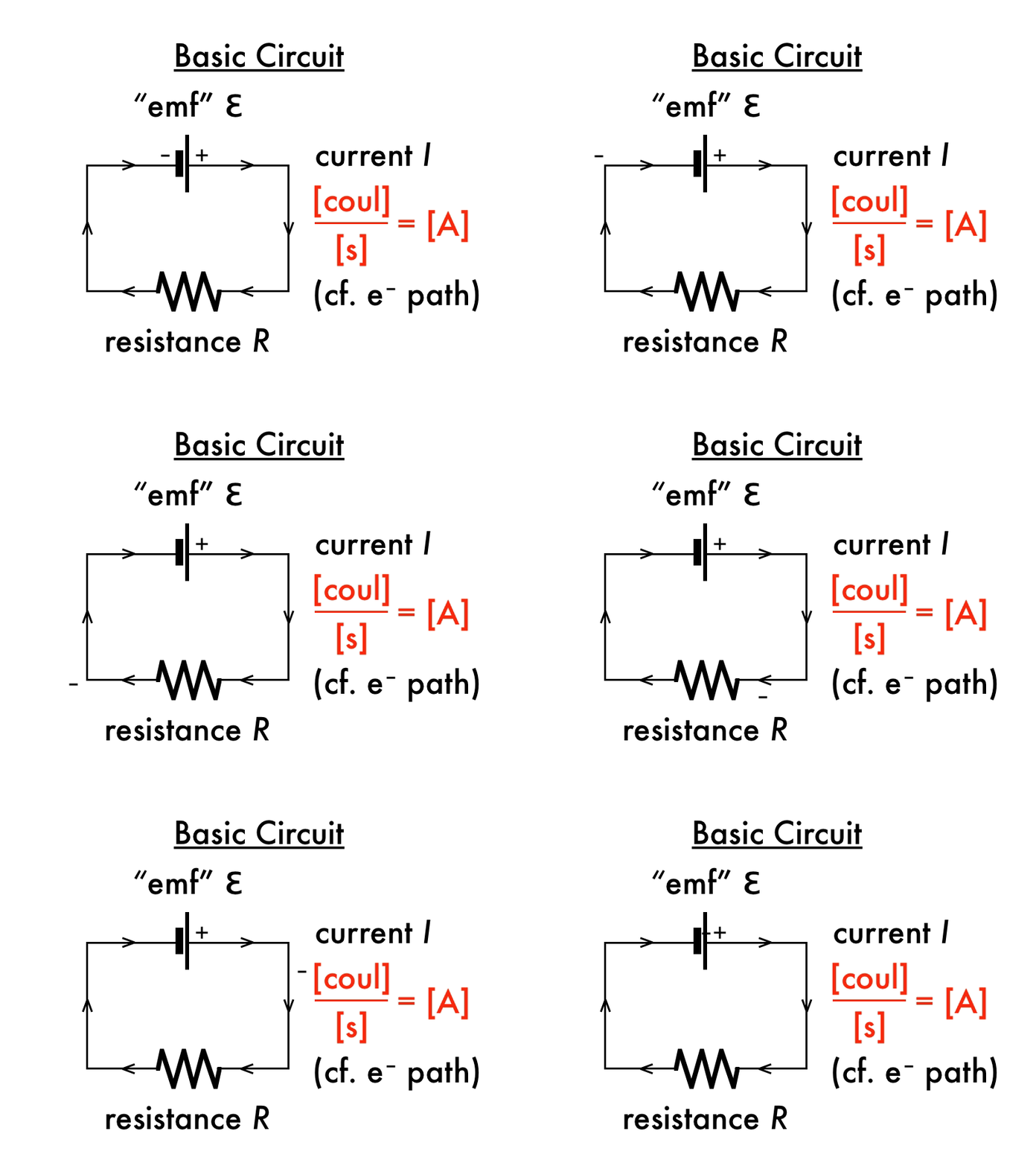
"I didn't quite understand what you meant by 'current flowing clockwise through this circuit, while the electrons actually circulate in the opposite counterclockwise direction through this circuit.' Does this mean that the negative charge (electrons) is going one direction and the positive charge (protons) is going the opposite direction?" (Almost; electrons are traveling in one direction around the circuit, and the lack of electrons (which makes a neutral object have a positive charge) travels around in the opposite direction. You can think of bumper-to-bumper traffic, where each car moves forward, but the gap between cars moves backwards down the freeway.)

"So the current moves in one direction?" (For the steady-state, direct current circuits (which we are considering here), the current keeps moving in one direction around the circuit, at a constant value. However, what is really going on is that electrons are going in the opposite direction of how we define currents, but that's a result of electrons arbitrarily being labeled as having a negative charge instead of positive charge.)

"This was very helpful. The circuits seem super-dangerous." (These were only dangerous not just because of the voltage differences, but because the resistances were low, making the resulting amounts of current very high.)

"I don't understand if short-circuiting is due to too much or too little resistance." (Too little. Even with a modest amount of voltage (∆V), completing a circuit with a low resistance object (metal, water, unprotected sweaty palms) will make the resistance (R) in the denominator in Ohm's law (I = ∆V/R) very small, making the current (I) very high, which is what can kill you.)

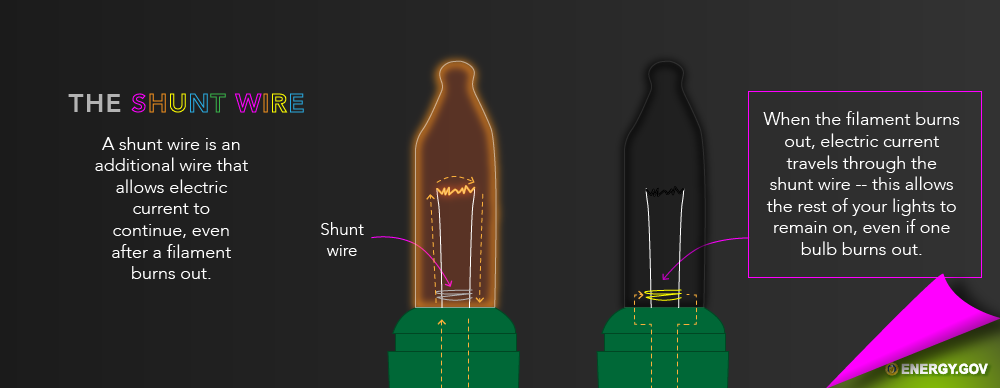
"Can you explain what happens when you are putting up your Christmas lights and one bulb is dead then the series of bulbs after it don't work." (If a bulb completely burns out ), then no current can pass through it (as its filament is broken), which prevents the rest of the bulbs from being lit, as the circuit is now "open." However, a newer "shunt" type of bulb has a backup path for current to pass through it even after the filament is broken, although you may notice the rest of the bulbs are a little dimmer afterwards.)

"I'm curious to how my portable charger works and what makes it so easy to charge as well as why it charges the phones so fast in addition to lasting so long to die off. I'm curious to know what materials they used, but of course I'm not going to dismantle it to see what's inside." (Most likely it contains a lithium-ion battery inside. And yes, good on deciding to not take it apart.)

"I am just a little confused on the stacking component of batteries (and even batteries in general). I understand there is a chemical reaction but how does that create a charge? Do batteries constantly have a charge and chemical reactions are happening inside the battery at all times?" (By "charge" let's make sure we're talking about actual electrons that flow, instead of "putting energy into" the battery. So chemical reactions occur in batteries by materials exchanging electrons (to fill or to empty their orbitals and bonds), releasing energy in the process. If the battery is part of a complete circuit, then electrons are free to flow through the rest of the circuit to return to the battery, and take part in further chemical reactions, releasing more energy, etc. Ideally, if the battery is disconnected from a circuit, then the chemical reactions will stop, because no more electrons are available to be exchanged.)

"It would be cool to make a battery for lab." (That sounds like chemistry to me. However, we'll be building a capacitor in lab this week, and taking a look at thermocouples for next week's lab, which can basically be thought of as temperature-dependent batteries.)