Showing posts with label blackbody. Show all posts

20200318

Online reading assignment: Kirchhoff's laws (SLO campus)

Astronomy 210, spring semester 2020
Cuesta College, San Luis Obispo, CA

Students have a weekly online reading assignment (hosted by SurveyMonkey.com), where they answer questions based on reading their textbook, material covered in previous lectures, opinion questions, and/or asking (anonymous) questions or making (anonymous) comments. Full credit is given for completing the online reading assignment before next week's lecture, regardless if whether their answers are correct/incorrect. Selected results/questions/comments are addressed by the instructor at the start of the following lecture.

The following questions were asked on reading textbook chapters and previewing presentations on Kirchhoff's laws.


Selected/edited responses are given below.

Describe something you found interesting from the assigned textbook reading or presentation preview, and explain why this was personally interesting for you.
"I found it interesting that the emission spectrum relates to the material we learned in class a few weeks ago about gaseous elements. Before, I was only aware that particular colors of light are exclusively emitted depending on the movement of electrons in an element. However, I now know light can be emitted as also a continuous or emission spectrum. I found this interesting because it did not occur to me that a star or even a rainbow might emit photons differently due to their specific spectrum types."

"I find the different spectra interesting. It interests me to know how different things put out different types of light and to learn the science behind it. I always knew that neon lights were different from normal lights, but understanding how they produce their colors is an experience!"

"The spectrum types are very interesting, albeit confusing, from reading about it on my own. It seems like something that will take some further explanation and repetition to get down, but I am interested in exploring it further as light is all around us."

"I enjoyed learning about the different spectra and what produces them. I only knew about the continuous spectrum, so learning about the other ones was very interesting."

"Something I found interesting was the spectra of the sun and stars. This was interesting to me because I didn't know how the spectra was made, and the process is very intriguing."

"I have always found the Doppler effect super-interesting. It is just such an interesting and curious effect. After reading this, it makes a lot more sense."

"The Doppler effect is interesting to me because you can interact and hear it everyday. I think it's really cool that a pitch of sound is determined by its wavelength."

"I really liked learning about the Doppler effect. I never really paid attention to the different pitches a horn makes as it is moving past someone. I think it is interesting that it changes depending on if the car is moving towards you or away from you."

Describe something you found confusing from the assigned textbook reading or presentation preview, and explain why this was personally confusing for you.
"I have a good understanding on the three different types of light spectrum; however, I seem to be struggling with correlating them to actual pictures of objects. When they are shown in the boxed diagrams it is easier to distinguish them, but I'm not sure how to transfer that over to real-life objects."

"I was having a little difficulty debating which things went with emission and absorption spectra, I think I might be getting them backwards, but I also might be right! Lol"

"The three kinds of spectra and their rules.It is hard for me to conceptualize things that I have not heard of before."

"The overview of Kirchhoff's laws in the textbook were too brief and vague."

"The blueshifts and redshifts confuse me because I do not understand the definitions given in the textbook."

"I found it interesting to learn about the Doppler effect but it was more difficult for me to understand. Seeing the wavelengths that a car sound makes when driving past you helped me better understand it since it was drawn out."

I believe Pluto should be a planet. (Original responses.)
Strongly disagree.   * [1]
Disagree.   ************ [12]
Neutral.   ************ [12]
Agree.   ******** [8]
Strongly Agree.   * [1]

I believe Pluto should be a planet. (This is a follow-up question.)
Strongly disagree.  **** [4]
Disagree.  ************* [13]
Neutral.  ********** [10]
Agree.  ***** [5]
Strongly Agree.  * [1]

Briefly explain your answer to the previous question (whether Pluto should be a planet).
"I don't disagree nor agree. I find that the neutral position is easier and shows that the decision of planet making is not mine."

"I agree it should be a planet because it has everything other planets have like being round."

"I agree Pluto should be a planet because it has all the same aspects other planets have like being round."

"It doesn't fit the new definition of what a planet is but lots of people who don't know that definition still call it a planet, so I'm fine with either or."

"I know now that Pluto should not be a planet. It just doesn't fit the criteria."

"I don't really have a strong opinion on whether Pluto should be a planet or not, but based off the evidence it doesn't seem like Pluto fits into the 'planet' category to well. Pluto's orbit and size differ a lot from all of the other planets, it really doesn't seem to fit in."

"After learning the guidelines for what constitutes a planet, it is clear that Pluto does not qualify as one. Though, I don't feel to strongly about it, I wouldn't mind seeing it make a comeback, though that would require a lot of changes in planet definitions."

"I'm neutral. I grew up knowing Pluto was a planet and then became a star, so for me Pluto will always be a planet at heart."

"I believe that if we found life or movement on Pluto we could possibly consider looking into it becoming a planet. However, like I previously said Pluto shouldn't become a planet because its not in the orbiting rings."

"I believe that if we found life or movement on Pluto we could maybe consider looking into it becoming a planet. However, like I previously said Pluto shouldn't become a planet because its not in the orbiting rings."

"Due to it being a body that orbits the sun and it's a dwarf planet."

"I understand why Pluto is no longer considered a planet, because it doesn't dominate its orbit, but since I grew up thinking it was a planet, it is hard for me to view it as anything different. it doesn't fit under the standards of being a planet after learning it doesn't dominate its orbit."

"Pluto should not be a planet because there is many other similar sized dwarf planets in the Kuiper belt that are not considered planets either."

"I do not think it's a planet. But I’m still neutral because I'm willing to listen to someone's views on why it is one."

"Pluto doesn't dominate its orbit so it can’t be a planet. Based off the three classifications for being a planet, Pluto meets all 3. It should be considered a planet, no matter how small it is."

"If Pluto could be a planet then so many others could be too. We would be back in a time with 1,500+ planets and more discovery would lead to more and more. Having a three-step classification narrows down the most important ones to watch."

"Since it was once a planet, I think that it should always be a planet. Although it is known as the dwarf planet, when I first learned about planets it was there, so I will always think it is still considered a planet."

"I don't believe that Pluto should be a planet, and redefining it as a dwarf planet was the correct choice. If it dominated its own orbit around the sun, and didn't come in so close to the moon, and then further than anything else."

"Pluto is too small and boring."

"According to the classifications that we learned about, it doesn't make sense to treat it as a planet."

"Pluto had a good run, we should give Makemake a chance at planethood."

"The classifications makes it a dwarf planet due to it not dominating its orbit."

"I believe Pluto should be a planet because it's more of a planet than Jupiter."

"I still do not believe Pluto should be considered a planet because it cannot expel objects from its own orbit. I believe this fact alone is convincing because asteroids are not considered planets for the same reason. All objects in space must be evaluated with the same set of IAU rules, meaning Pluto's failure to meet these criteria technically would imply it is not a planet."

"Well, I now know how planets are categorized and by following that Pluto is a dwarf planet."

"Pluto can't be a planet, because it does not dominate its own orbit. It fits all the other qualifications for being a planet, except for the fact that it doesn't dominate its own orbit. Therefore, it is considered a dwarf planet."

"The rules are too strict for being a planet."

"Pluto should not be a planet because it does not dominate its orbit, therefore it should be a dwarf planet based on the IAU classes and rules."

"I don't have much of a preference because the logical part of me sees why it's a dwarf planet because it doesn't hit all the criteria of being an independent planet but there's also a part of me that wants Pluto to belong with the other major planets in our system since the little guy is so far away and is already isolated."

Match the spectrum type with their appearance.
(Only correct responses shown.)
Rainbow containing all colors: continuous [85%]
Rainbow with thin black lines: absorption [76%]
Colored lines on a black background: emission [79%]
Given off by hot, dense object: continuous [70%]
Given off by hot, diffuse gas atoms: emission [67%]
Passing through cool, diffuse gas atoms: [52%]

Hot, molten metal produces a(n) __________ spectrum, which appears as a:
continuous; rainbow.  ********** [10]
emission; series of bright lines on a dark background.  ******* [7]
absorption; series of dark lines on a rainbow background.  ********* [9]
(Unsure/guessing/lost/help!)  ******* [7]

The sun produces a(n) __________ spectrum, which appears as a:
continuous; rainbow.  ******** [8]
emission; series of bright lines on a dark background.  ******* [7]
absorption; series of dark lines on a rainbow background.  ************* [13]
(Unsure/guessing/lost/help!)  ***** [5]

The lights atop the Fremont Theater in San Luis Obispo, CA, produces a(n) __________ spectrum, which appears as a:
continuous; rainbow.  *********** [11]
emission; series of bright lines on a dark background.  ************** [14]
absorption; series of dark lines on a rainbow background.  ****** [6]
(Unsure/guessing/lost/help!)  ** [2]

Your instructor produces a(n) __________ spectrum, which appears as a:
continuous; rainbow.  ******* [7]
emission; series of bright lines on a dark background.  *************** [15]
absorption; series of dark lines on a rainbow background.  *** [3]
(Unsure/guessing/lost/help!)  ******** [8]

The balrog from The Lord Of The Rings: The Fellowship Of The Ring produces a(n) __________ spectrum, which appears as a:
continuous; rainbow.  *** [3]
emission; series of bright lines on a dark background.  ***************** [17]
absorption; series of dark lines on a rainbow background.  **** [4]
(Unsure/guessing/lost/help!)  ********* [9]

Suppose you are standing on the sidewalk as a car, with its horn continuously on, passes by (video link). The loudness of the car horn:
starts loud, then gets quieter.  **** [4]
starts quiet, then gets louder.  ***** [5]
starts quiet, gets louder, then goes back down to quiet.  *********************** [23]
starts loud, gets quieter, then goes back up to loud.   [0]
(Unsure/guessing/lost/help!)  * [1]

Suppose you are standing on the sidewalk as a car, with its horn continuously on, passes by (video link, same as above). The pitch (high note/low note) of the car horn:
starts high, then drops lower.  ************* [13]
starts low, then goes higher.  **** [4]
starts low, goes higher, then drops back down to low.  ************ [12]
starts high, goes lower, then goes back up to high.   *** [3]
(Unsure/guessing/lost/help!)  * [1]

Ask the instructor an anonymous question, or make a comment. Selected questions/comments may be discussed in class.
"The spectrum picto-quiz was a bit challenging for me, can we find a way to go over these?"

"How do you differentiate between the different spectrums in terms of the examples that were given? I guess I'm still a little confused about their real-life applications and how each works."

"I was hoping you could provide a little more clarification on distinguishing what spectrum is being seen. I had trouble figuring out the ones that were different from the exact examples given when explaining what produces what spectra."

"I'm concerned on how learning the material more on my own will be with it all being online because the lectures were the most helpful with making me understand material."

"Are you happy going completely online? Do you think there is a chance of us maybe coming back to school if this all clears beforehand? I do NOT like all online at all." (I'm okay with it, but it is a lot of work (but I'm finally getting around to learning how to use Adobe Premiere Pro, which I've always wanted to do). As much as I would like us to return back to face-to-face classes before the end of this semester, I'm rather pessimistic about that happening.)

"Online is going to be different, but good." (I appreciate your optimism.)

"Have you ever taught this course online before? Pros and cons?" (No, this is my very first time. I'm having to learn a lot very quickly, it reminds me of when I first started teaching at Cuesta College.)

"I don't know if I'll be fine in an online class since I learn more face-to-face when you explain these things to us."

"I really appreciate the option of 'unsure/lost/guessing/help' on these questions, and I think its a fair choice for assignments like this. However, I think students have the tendency to guess an answer instead of choosing 'unsure/lost/guessing/help' in order to greatly increase their chances of getting lucky and getting points. This is just something that crossed my mind. I know you appreciate knowing if students genuinely don't understand a question or concept, so I am just wondering if this tendency might skew the feedback." (Everyone gets credit for answering a question, whether they get it correct, incorrect, or choose 'unsure/lost/guessing/help.' I think choosing 'unsure/lost/guessing/help' is actually a very honest way of students letting me know that we need to focus on certain topics in class.)

"Will there still be a tutor available for this class now that it is fully online?" (I've asked about that; still waiting to hear from the Student Success Center if tutors will be available online.)

"Thank you for your work in this difficult time." (You're welcome. Thank you all for being patient and willing to change over to learning online.)

"I hope you are staying healthy!" (You, too! #socialdistancing)

"Do you use Spectrum internet?" (Ironically, yes.)

20200317

Online reading assignment: Kirchhoff's laws (NC campus)

Astronomy 210, spring semester 2020
Cuesta College, San Luis Obispo, CA

Students have a weekly online reading assignment (hosted by SurveyMonkey.com), where they answer questions based on reading their textbook, material covered in previous lectures, opinion questions, and/or asking (anonymous) questions or making (anonymous) comments. Full credit is given for completing the online reading assignment before next week's lecture, regardless if whether their answers are correct/incorrect. Selected results/questions/comments are addressed by the instructor at the start of the following lecture.

The following questions were asked on reading textbook chapters and previewing presentations on Kirchhoff's laws.


Selected/edited responses are given below.

Describe something you found interesting from the assigned textbook reading or presentation preview, and explain why this was personally interesting for you.
"How heat can be measured by color. This was interesting to me because you only really think of 'red-hot.' Not much about any other colors."

"This was a rather confusing chapter..."

"The assigned textbook reading was interesting to me because I didn't understand the different forms of light before. I think it's interesting how there is a continuous spectrum, absorption spectrum, and an emission spectrum. I learned something new about light and it was interesting."

"Something I found out that was really interesting to me that I learned from the reading was the Doppler effect for sound and light. It was interesting learning that longer wave lenghths have low pitches and shorter wavelengths have higher pitches, and vice versa with light having the blueshift refer to shorter wavelengths of light and a redshift with longer light wavelengths."

"To learn why car horns sound different when they come towards you and pass you. It's something you don’t really think about much."

"I found the Doppler effect on light from stars interesting, I never knew the way they were moving affected the way we see them."

Describe something you found confusing from the assigned textbook reading or presentation preview, and explain why this was personally confusing for you.
"I didn’t really understand how stars and absorption relate to each other. I know that they start with continuous light from the center but that's where I stopped understanding."

"The Doppler effect, the explanation in the textbook was hard to follow."

"I originally found the stuff on the spectra confusing, because I had trouble distinguishing between the different types at first, but now I think I know them all."

"I do not understand how to really tell the different spectra of light-producing objects. I do not know what I am really looking for."

"Colors in general are hard for me to grasp. Being color deficient makes this lesson hard to learn visually."

I believe Pluto should be a planet. (Original responses.)
Strongly disagree.   *** [3]
Disagree.   ******* [7]
Neutral.   ********** [10]
Agree.   ***** [5]
Strongly Agree.   *** [3]

I believe Pluto should be a planet. (This is a follow-up question.)
Strongly disagree.  * [1]
Disagree.  ******** [8]
Neutral.  ***** [5]
Agree.  ** [2]
Strongly Agree.  [0]

Briefly explain your answer to the previous question (whether Pluto should be a planet).
"It has been considered a planet but I don’t think it really matters if it is or isn't."

"I still believe that Pluto should not be a planet. The IAU had a definition of planets that was too loose and Pluto doesn't fit the criteria."

"It doesn't dominate it's orbit, and it's smaller than our own moon. Pluto does have moons which I think makes a pretty good case for it, but not having enough mass to dominate it's orbit is important in hindsight."

"I don't feel any particular way. As long as we continue to study the planets and make scientific progress."

"I have no strong opinion."

"I don't think that Pluto should be a planet because it doesn't follow the guidelines to be considered a planet."

"The way they classify a planet is very sound."

"I think that Pluto still deserves to have the label as a planet because I think it would be a really cool planet to have in a solar system and it has all the qualities a planet needs besides being in charge of its own orbit."

"I don't feel as strongly that Pluto needs to be a planet. In addition, I agree that we needed better, standardized methods for organizing what is and isn't a planet."

"Now that I learned what defines a planet I now understand Pluto doesn't classify since it does not dominate its orbit."

"I know that Pluto does not classify as a planet with the new rules. But there is still some satisfaction/niceness to still calling Pluto a planet"

"It doesn't meet the criteria to be a planet."

"Due to the newer definition of what a planet is, Pluto just doesn't qualify, it doesn't dominate its orbit 3/14/2020"

"I'm still neutral because it honestly doesn’t matter to me. I understand why it's a dwarf planet now with it sharing its orbit but it doesn’t matter to me if Pluto is a planet or not."

"Pluto does not meet the criteria to classify as a normal planet because it does not clear its orbit."

Match the spectrum type with their appearance.
(Only correct responses shown.)
Rainbow containing all colors: continuous [94%]
Rainbow with thin black lines: absorption [75%]
Colored lines on a black background: emission [69%]
Given off by hot, dense object: continuous [75%]
Given off by hot, diffuse gas atoms: emission [75%]
Passing through cool, diffuse gas atoms: [75%]

Hot, molten metal produces a(n) __________ spectrum, which appears as a:
continuous; rainbow.  ********** [10]
emission; series of bright lines on a dark background.  ** [2]
absorption; series of dark lines on a rainbow background.  *[1]
(Unsure/guessing/lost/help!)  *** [3]

The sun produces a(n) __________ spectrum, which appears as a:
continuous; rainbow.  * [1]
emission; series of bright lines on a dark background.  ****** [6]
absorption; series of dark lines on a rainbow background.  ******** [8]
(Unsure/guessing/lost/help!)  * [1]

The lights atop the Fremont Theater in San Luis Obispo, CA, produces a(n) __________ spectrum, which appears as a:
continuous; rainbow.  **** [4]
emission; series of bright lines on a dark background.  ********* [9]
absorption; series of dark lines on a rainbow background.  ** [2]
(Unsure/guessing/lost/help!)  * [1]

Your instructor produces a(n) __________ spectrum, which appears as a:
continuous; rainbow.  **** [4]
emission; series of bright lines on a dark background.  ******* [7]
absorption; series of dark lines on a rainbow background.  *** [3]
(Unsure/guessing/lost/help!)  ** [2]

The balrog from The Lord Of The Rings: The Fellowship Of The Ring produces a(n) __________ spectrum, which appears as a:
continuous; rainbow.  ***** [5]
emission; series of bright lines on a dark background.  ***** [5]
absorption; series of dark lines on a rainbow background.  ** [2]
(Unsure/guessing/lost/help!)  **** [4]

Suppose you are standing on the sidewalk as a car, with its horn continuously on, passes by (video link). The loudness of the car horn:
starts loud, then gets quieter.  ** [2]
starts quiet, then gets louder.  ** [2]
starts quiet, gets louder, then goes back down to quiet.  *********** [11]
starts loud, gets quieter, then goes back up to loud.   [0]
(Unsure/guessing/lost/help!)  * [1]

Suppose you are standing on the sidewalk as a car, with its horn continuously on, passes by (video link, same as above). The pitch (high note/low note) of the car horn:
starts high, then drops lower.  ****** [6]
starts low, then goes higher.  [0]
starts low, goes higher, then drops back down to low.  ******* [7]
starts high, goes lower, then goes back up to high.   * [1]
(Unsure/guessing/lost/help!)  ** [2]

Ask the instructor an anonymous question, or make a comment. Selected questions/comments may be discussed in class.
"Do you think that making all classes go online was an overreaction? Like I went to work today, everything is still relatively normal in Paso Robles." (At this point everyone is going to come down with COVID-19; but social distancing is meant to stretch out the number of people who are sick at the same time (instead of letting everyone get sick at the same time). So, social distancing is the new norm, right now, for times like this. #flattenthecurve)

"I'm so lost with this chapter!"

"How do I take real situations measuring color and heat and apply it. All sources seem to be different. Is there a trick?" (I've posted a "spectra survival guide" video lecture on Canvas for that.)

"Will we find out what we got on our midterms online through Canvas since we aren't meeting in class anymore?" (Yes, although you can still see the midterm scores online on the old website.)

"What's your favorite part about space?" (Teaching about it, then watching students "get it.")

"How are we going to do lectures now that we are online and is it for the rest of the semester?" (I'll make videos and provide notes for the lectures, and make them available online on Canvas. All assignments (including a new discussion board) will be on Canvas as well, along with the quizzes and exams.)

"What's a blackbody spectrum and where is it mentioned? I don't remember seeing it." (It's a different name for a continuous spectrum (which is given off by hot, dense objects, which are also known as "blackbodies.")

20191204

Physics quiz question: changing emissivity of a brick

Physics 205A Quiz 7, fall semester 2019
Cuesta College, San Luis Obispo, CA

"Red bricks"
Ramesh NG
flic.kr/p/8TmkRf

A red brick has an emissivity of 0.93[*], and has a surface temperature of 270 K. Ignore conduction and convection heat transfers to/from the environment. If the brick were coated with aluminum paint such that its emissivity was lowered to 0.45, the rate of heat per time the brick _________ would decrease.
(A) radiates to the environment.
(B) absorbs from the environment.
(C) (Both of the above choices.)
(D) (Neither of the above choices.)

[*] thermoworks.com/emissivity-table.

Correct answer (highlight to unhide): (C)

The net power (rate of heat per time) radiated is given by:

Power = –e·σ·A·((Tobj)4 + (Tenv)4) = –e·σ·A·(Tobj)4e·σ·A·(Tenv)4,

where the first (negative) term corresponds to the rate of heat being removed (radiated) from the object, while the second (positive) term corresponds to the rate of heat being put into (absorbed) by the object (in order to be consistent with the ±Q convention for removing heat from (–) or putting heat into (+) a thermodynamic system).

As it is a factor common to both the radiation and absorption terms, lowering the emissivity value from 0.93 to 0.45 would then decrease both the rate of heat per time radiated to the environment and the rate of heat per time absorbed from the environment.

Sections 70854, 70855
Exam code: quiz07VlnC
(A) : 10 students
(B) : 5 students
(C) : 35 students
(D) : 1 student

Success level: 69%
Discrimination index (Aubrecht & Aubrecht, 1983): 0.52

Physics quiz archive: temperature, thermal equilibrium, heat transfers

Physics 205A Quiz 7, fall semester 2019
Cuesta College, San Luis Obispo, CA
Sections 70854, 70855
Exam code: quiz07VlnC


Sections 70854, 70855 results
0- 6 :   * [low = 3]
7-12 :   **********
13-18 :   **************
19-24 :   ******************* [mean = 18.9 +/- 6.2]
25-30 :   ******* [high = 30]

20191127

Online reading assignment: heat transfers

Physics 205A, fall semester 2019
Cuesta College, San Luis Obispo, CA

Students have a bi-weekly online reading assignment (hosted by SurveyMonkey.com), where they answer questions based on reading their textbook, material covered in previous lectures, opinion questions, and/or asking (anonymous) questions or making (anonymous) comments. Full credit is given for completing the online reading assignment before next week's lecture, regardless if whether their answers are correct/incorrect. Selected results/questions/comments are addressed by the instructor at the start of the following lecture.

The following questions were asked on reading textbook chapters and previewing a presentation on heat transfers.


Selected/edited responses are given below.

Describe what you understand from the assigned textbook reading or presentation preview. Your description (2-3 sentences) should specifically demonstrate your level of understanding.
"Heat can transfer in three different ways: conduction, convection, and radiation. Conduction is the transfer of heat energy by direct contact; convection is the movement of heat by actual motion of matter; radiation is the transfer of energy via electromagnetic waves."

"Conduction is a transfer of heat through an item, mainly thorough metals since they can conduct heat much better than wood or plastics. Radiation is another form of heat transfer, but from light, not through bulk movement or necessarily through objects."

"Thermal resistance of an object is related equal to the thickness divided by exposed surface area and the material-dependent conductivity. Heat can be transferred via conduction, convection, or radiation."

"In order to maximize thermal resistance, the wall/object needs to be as thick as possible, in order to reduce the amount of heat that passes through."

"Forced convection is the transport of thermal energy by a force like blowing, it does not just naturally circulate."

"Convection is heat transferred from bulk movement of fluids. Conduction where heat is directed through a material."

"Convection occurs when part of a fluid is warmed, it expands and its density decreases such that the cooler surrounding fluid, which now has a greater density, will push the warmer fluid upward because the cooler, denser fluid exerts a buoyant force on the warmer, less dense fluid. I also understand how light-colored objects reflect more radioactive waves and are less susceptible to absorbing heat through radiation than dark-colored objects, which absorb energy as heat through radiation of electromagnetic waves much better."

"One major understanding I have grasped from this presentation is that radiation is a two-way street indicating that an object good at absorbing heat will also be good at emitting heat; moreover, an object that is not good at absorbing heat would likewise be bad at emitting heat."

"The flow of heat moves differently based on certain aspects of an object or environment. For example, something that is the color black will absorb more heat quickly than something that is not the color black."

"I didn't get to it."

Describe what you found confusing from the assigned textbook reading or presentation preview. Your description (2-3 sentences) should specifically identify the concept(s) that you do not understand.
"I think I understood the concepts from the presentation preview. Just need to see more examples."

"I found it confusing that anyone would choose to use Q as a symbol for heat. I also don't know why the units are what they are for the Stefan-Boltzmann constant."

"I'm just having a bit of trouble uncovering the equations and their parts."

"The topics that seemed confusing from the reading were exactly how to apply the equations and laws to everything, and exactly what each variable means, for example Stefan’s law quantitatively describing power."

"Why do different materials absorb heat at different rates?"

"I do not understand what Stefan's law is and what the variables mean exactly. Why are blackbodies and silverbodies better at absorbing heat?"

"So if a black object takes in more heat and can emit more heat as compared to a white object, shouldn't the objects be the same temperature if they're in the same condition? But I know that black gets warmer than white, so it's confusing."

"I did not really understand what the units of e was or how it changed depending on the material of the object."

"Nothing too confusing, just conduction and the equations related to it."

"The formulas for Fourier's and Stefan's laws are a little scary."

In order to maximize the thermal resistance of these exterior walls, should the following parameters be minimized, maximized (or has no effect)?
(Only correct responses shown.)
insulation thickness d: maximize [83%]
insulation conductivity κ: minimize [66%]
Total surface area A exposed to the outdoors: minimize [66%]

In order to minimize the amount of heat flowing per time through these exterior walls, should the following parameters be minimized, maximized (or has no effect)?
(Only correct responses shown.)
temperature difference ∆T between indoors and outdoors: minimize [71%]
thermal resistance R of the walls: maximize [83%]

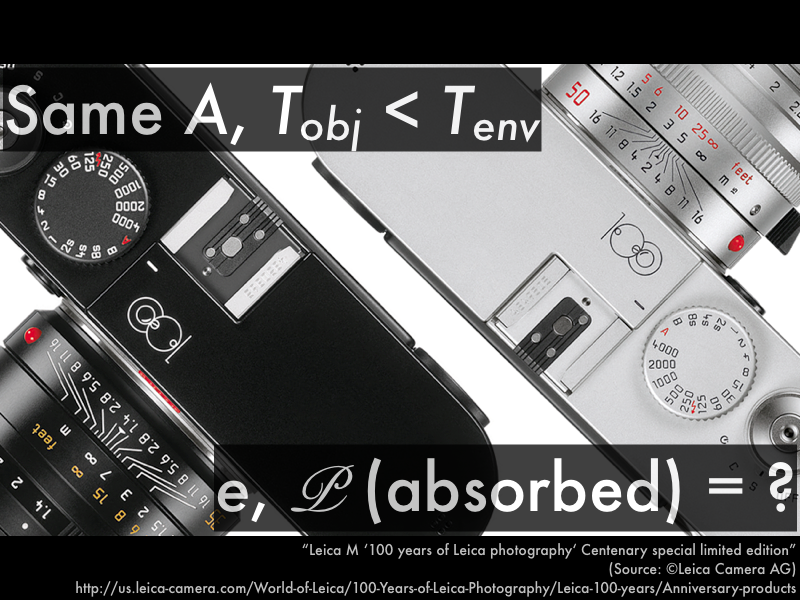
For these two Leica M cameras, if they are both cooler than the surrounding environment, both will begin to heat up by absorbing radiative heat (say, from the sun). The __________ model have a faster rate of heat absorbed per time.
black.  *************************** [27]
silver.  ** [2]
(There is a tie.)  ** [2]
(Unsure/guessing/lost/help!)  **** [4]

For these snowboarders, if they are warmer than the surrounding environment, they will begin to cool down by emitting radiative heat (say, to the overcast sky and the snowy landscape). The snowboarder wearing the __________ jacket will have a faster rate of heat radiated per time.
black.  ******************** [20]
silver.  ****** [6]
(There is a tie.)  **** [4]
(Unsure/guessing/lost/help!)  ***** [5]

Ask the instructor an anonymous question, or make a comment. Selected questions/comments may be discussed in class.
"This is an interesting area of physics that I'm glad we're getting to."

"This is starting to feel very chem-like."

"There seems to be a lot of information in these sections, I hope you will condense what we need to know in lecture!"

"There's a lot going on with Stefan's law, is there an easy way to remember the details?"

"Will the Physics 205B course be a similar pace to this course?" (The pace will be similar to the second-half of this course, about one chapter a week.)

"Is the thickness L from Fourier's law in the textbook the same as the thickness d used in the presentations? Are they interchangeable?" (Yes, and yes.)

"Will we generally be given the emissivity e for an object? Also, will we be given the Stefan-Boltzmann constant value on quizzes?" (Yes, and yes.)

"Sorry, the holidays are pretty hectic."

"Sorry P-dog, currently on vacayyy."

"Have a great Thanksgiving!"

20191122

Astronomy midterm question: comparing sizes, temperatures of same-luminosity stars

Astronomy 210 Midterm 2, fall semester 2019
Cuesta College, San Luis Obispo, CA

The following claim was made by a student on an astronomy exam[*]:
2881: If two stars have the same luminosity, the star with the lower temperature must be larger.
Discuss whether this claim is correct or incorrect, and how you know this. Explain using Wien's law, the Stefan-Boltzmann law and/or an H-R diagram.

[*] waiferx.blogspot.com/2009/05/astronomy-midterm-question-cooler.html.

Solution and grading rubric:
  • p:
    Correct. Discusses how the H-R diagram and/or the Stefan-Boltzmann law (luminosity is proportional to size × Temperature4) demonstrates that in order for a cooler star to have the same luminosity as a hotter star, its lower temperature must be compensated for by having a larger size; thus the claim by that student is correct.
  • r:
    Nearly correct (explanation weak, unclear or only nearly complete); includes extraneous/tangential information; or has minor errors.
  • t:
    Contains right ideas, but discussion is unclear/incomplete or contains major errors.
  • v:
    Limited relevant discussion of supporting evidence of at least some merit, but in an inconsistent or unclear manner. At least attempts to use Wien's law, the Stefan-Boltzmann law, and/or H-R diagram. May have argument based on the size of a star being dependent on luminosity and temperature.
  • x:
    Implementation/application of ideas, but credit given for effort rather than merit. Discussion not clearly based on Wien's law, the Stefan-Boltzmann law, and/or H-R diagram.
  • y:
    Irrelevant discussion/effectively blank.
  • z:
    Blank.
Grading distribution:
Section 70158
Exam code: midterm02Rf0w
p: 31 students
r: 1 student
t: 0 students
v: 1 student
x: 1 student
y: 0 students
z: 0 students

Section 70160
Exam code: midterm02T4qz
p: 16 students
r: 2 students
t: 0 students
v: 2 students
x: 2 students
y: 0 students
z: 0 students

A sample "p" response (from student 0809), using the Stefan-Boltzmann law:

A sample "p" response (from student 1234), using a Hertzsprung-Russell diagram:

A sample "p" response (from student 1278) using both the Stefan Boltzmann law and a Hertzsprung-Russell diagram:

A sample "x" response (from student 4000), appealing to concepts other than than of the Stefan-Boltzmann law:

20191024

Astronomy quiz question: A5 white dwarf vs. G5 supergiant

Astronomy 210 Quiz 5, fall semester 2019
Cuesta College, San Luis Obispo, CA

An A5 white dwarf has a ___________ than a G5 supergiant.
(A) brighter luminosity.
(B) larger size.
(C) hotter temperature.
(D) (Two of the above choices.)
(E) (All of the above choices.)
(F) (None of the above choices.)

Correct answer (highlight to unhide): (C)

An H-R diagram is provided with this quiz.


These stars are plotted on an H-R diagram below. The A5 white dwarf has a hotter temperature, but a dimmer luminosity and smaller size than the G5 supergiant.


Section 70158
Exam code: quiz05Sh0w
(A) : 2 students
(B) : 1 student
(C) : 20 students
(D) : 3 students
(E) : 2 students
(F) : 1 students

Success level: 70% (including partial credit for multiple-choice)
Discrimination index (Aubrecht & Aubrecht, 1983): 0.75

(Cf. a re-worded version of this same question: "A G5 supergiant has a ___________ than an A5 white dwarf.")

Astronomy quiz question: B5 main sequence star vs. M5 giant

Astronomy 210 Quiz 5, fall semester 2019
Cuesta College, San Luis Obispo, CA

A B5 main sequence star and an M5 giant could have the same:
(A) luminosity.
(B) size.
(C) temperature.
(D) (Two of the above choices.)
(E) (All of the above choices.)
(F) (None of the above choices.)

Correct answer (highlight to unhide): (A)

An H-R diagram is provided with this quiz.


These stars are plotted on an H-R diagram below. The B5 main sequence star has a smaller size and a hotter temperature than the M5 giant, but they could have the same luminosity.


Section 70158
Exam code: quiz05Sh0w
(A) : 22 students
(B) : 1 student
(C) : 0 students
(D) : 2 students
(E) : 1 student
(F) : 3 students

Success level: 77% (including partial credit for multiple-choice)
Discrimination index (Aubrecht & Aubrecht, 1983): 0.63

Astronomy quiz question: G5 supergiant vs. A5 white dwarf

Astronomy 210 Quiz 5, fall semester 2019
Cuesta College, San Luis Obispo, CA

A G5 supergiant has a ___________ than an A5 white dwarf.
(A) brighter luminosity.
(B) larger size.
(C) hotter temperature.
(D) (Two of the above choices.)
(E) (All of the above choices.)
(F) (None of the above choices.)

Correct answer (highlight to unhide): (D)

An H-R diagram is provided with this quiz.


These stars are plotted on an H-R diagram below. The G5 supergiant has a brighter luminosity, larger size, but a cooler temperature than the A5 white dwarf.


Section 70160
Exam code: quiz05NpRm
(A) : 1 student
(B) : 1 student
(C) : 0 students
(D) : 12 students
(E) : 6 students
(F) : 2 students

Success level: 56% (including partial credit for multiple-choice)
Discrimination index (Aubrecht & Aubrecht, 1983): 0.71

(Cf. a re-worded version of this same question: "An A5 white dwarf has a ___________ than a G5 supergiant.")

Astronomy quiz question: B5 supergiant vs. K5 main sequence star

Astronomy 210 Quiz 5, fall semester 2019
Cuesta College, San Luis Obispo, CA

A B5 supergiant and a K5 main sequence star could have the same:
(A) luminosity.
(B) size.
(C) temperature.
(D) (Two of the above choices.)
(E) (All of the above choices.)
(F) (None of the above choices.)

Correct answer (highlight to unhide): (F)

An H-R diagram is provided with this quiz.


These stars are plotted on an H-R diagram below. The B5 supergiant has a brighter luminosity, larger size, and a hotter temperature than the K5 main sequence star.


Section 70160
Exam code: quiz05NpRm
(A) : 5 students
(B) : 0 students
(C) : 0 students
(D) : 2 students
(E) : 1 student
(F) : 14 students

Success level: 66% (including partial credit for multiple-choice)
Discrimination index (Aubrecht & Aubrecht, 1983): 0.57

20191016

Online reading assignment: stellar parameters (SLO campus)

Astronomy 210, fall semester 2019
Cuesta College, San Luis Obispo, CA

Students have a weekly online reading assignment (hosted by SurveyMonkey.com), where they answer questions based on reading their textbook, material covered in previous lectures, opinion questions, and/or asking (anonymous) questions or making (anonymous) comments. Full credit is given for completing the online reading assignment before next week's lecture, regardless if whether their answers are correct/incorrect. Selected results/questions/comments are addressed by the instructor at the start of the following lecture.

The following questions were asked on reading textbook chapters and previewing presentations on parallax, distance, apparent magnitude, absolute magnitude, Wien's law and the Stefan-Boltzmann law, and a TED-Ed talk on stellar properties.


Selected/edited responses are given below.

Describe something you found interesting from the assigned textbook reading or presentation preview, and explain why this was personally interesting for you.
"I never really knew how brightness was measured, and it was cool to learn about."

"That stars can be much, much brighter than the sun."

"The way we can measure distance of stars using parallax is crazy!"

"How simply by using color spectra and basic parallax (trigonometry) ideas, we can determine sizes, distances, and temperatures of very distant stars."

"How the hotter stars are a blue color while the coolest stars are red. I initially assumed that the red stars would be hotter as we associate the color red with hot things. Now I know differently!"

"In astronomy, temperature is a number that relates to the average speed of a particle. I found it interesting because it's not defined as the term we use often."

"I'm glad to learn about Wien's law (how color of stars relate to their temperature). When we took the general astronomy knowledge test on the first day of class, I was completely lost on this subject."

"I found learning about stars to be really interesting, especially being able to tell the stars temperature by their colors."

"When looking at Wien's law, I found it very interesting that extremely cool stars colder than red give off infrared light, while extremely hot stars will give off ultraviolet light. It's weird to imagine extremely cool stars being infrared and non-visible. This makes me wonder if all stars were a visible temperature, how much different would the night sky look?"

Describe something you found confusing from the assigned textbook reading or presentation preview, and explain why this was personally confusing for you.
"I found the magnitude scale a bit confusing at first because my brain didn't like the switch of high negative numbers defining the brightest stars and high positive numbers defining the dimmer stars."

"Parallax, stellar parallax, and parsecs are a confusing set of concepts for me to wrap my head around. It is difficult for me to understand a visual representation of parallax."

"The math in the two laws for blackbody radiation. Seeing some examples will help."

"I found that the Stefan-Boltzmann law was confusing because I'm not to sure what luminosity means. It just seems way more complex than Wien's law."

"Stefan-Boltzmann law. I don't understand it completely."

"This week's assignment had A LOT of new terms and ideas. Each individual idea is relatively easy to grasp given enough time to think about it. The problem, for me, was that there were just too many new things to take in and digest. I don't think I clearly understood most of this weeks reading. And for the first time, the blogs didn't really help understand the topic at hand; up until now they usually have."

Explain how apparent magnitude and the absolute magnitude are defined differently.
"Apparent magnitude is how bright a star looks from Earth and absolute magnitude is how bright the star from 32.6 light years (10 parsecs) away."

"Apparent magnitude is the brightness of a star 'as is' seen by an observer on Earth without the compensation for distance. The absolute magnitude of a star is its observed brightness when moved to the 'fair comparison distance' of 10 parsecs away. Absolute magnitude helps us compare the actual brightness of stars."

Suppose the sun was moved to a distance of 10 parsecs away. As a result, its __________ magnitude would become dimmer.
absolute.  *********** [11]
apparent.  ************** [14]
(Both of the above choices.)  [0]
(Neither of the above choices.)  [0]
(Unsure/guessing/lost/help!)  * [1]

Rank the brightnesses of these stars (1 = brightest, 4 = dimmest; there are no ties), as seen from Earth.
(Only correct responses shown.)
1 (brightest): the sun, m = –27 [96%]
2: Canopus, m = –1 [92%]
3: Vega, m = 0 [88%]
4 (dimmest): Kapteyn's star, m = +9 [92%]

Rank the brightnesses of these stars (1 = brightest, 4 = dimmest; there are no ties), if relocated to 10 parsecs from Earth.
(Only correct responses shown.)
1 (brightest): Canopus, M = –3 [88%]
2: Vega, M = +0.5 [92%]
3: the sun, M = +5 [88%]
4 (dimmest): Kapteyn's star, M = +11 [92%]

Determine whether these stars get dimmer or brighter when relocated from their original positions to 10 parsecs from Earth.
(Only correct responses shown.)
The sun: gets dimmer [88%]
Canopus: gets brighter [88%]
Vega: gets dimmer [58%]
Kapteyn's star: gets dimmer [62%]

Rank the temperatures of these main sequence stars (1 = hottest, 4 = coolest; there are no ties).
(Only correct responses shown.)
Hottest: blue main sequence star [85%]
Second hottest: white main sequence star [85%]
Third hottest: yellow main sequence star [92%]
Coolest: red main sequence star [85%]

Rank the temperatures of these supergiant and dwarf stars (1 = hottest, 4 = coolest; there are no ties).
(Only correct responses shown.)
Hottest: blue supergiant [96%]
Second hottest: white dwarf [73%]
Third hottest: yellow supergiant [69%]
Coolest: red dwarf [88%]

Two stars (equally far away) have the same temperature, but one star is dimmer, and the other star is brighter. The __________ star will be larger in size.
less luminous.  **** [4]
more luminous.  ******************** [20]
(These stars would be the same size.)  * [1]
(Unsure/guessing/lost/help!)  * [1]

Two stars (equally far away) have the same brightness, but one star is cooler, and the other star is hotter. The __________ star will be larger in size.
cooler.  ************* [13]
hotter.  ****** [6]
(These stars would be the same size.)  *** [3]
(Unsure/guessing/lost/help!)  **** [4]

Ask the instructor an anonymous question, or make a comment. Selected questions/comments may be discussed in class.
"Just a little more explanations for star brightnesses."

"Just little clarification questions."

"This might be off-topic, but how come nebulae are cloudy-looking?" (They literally are clouds, which are dust and gases randomly strewn out in space without any structure, unless affected by a shockwave if a star explodes nearby, or gravity if enough stuff starts to clump together inside the nebula.)

"Are stars' temperatures harder to measure the further away they are from Earth?" (As long as you can see the star's color, you'll know how hot it is.)

"What determines the how hot a star burns? I though they, at least, start off with the same fuel (hydrogen)." (We'll cover fusion and how quickly stars "burn" hydrogen next week.)

"The other night, I was able to show off my astronomy knowledge to my friends who had asked what AM and PM stood for. I was able to explain the ante-meridian and post-meridian concept, and it was cool having the ability to share with them the reasoning behind it!"

"Do we get extra credit if we go to see the SOFIA aircraft telescope?" (No, but good for you to get that chance this weekend. Also: pics, or it didn't happen.)