Showing posts with label Earth. Show all posts

20200316

Astronomy midterm question: "sliced" moon rising with coming darkness

Astronomy 210 Midterm 1, spring semester 2020
Cuesta College, San Luis Obispo, CA

The following excerpt describes the rising of a crescent ("sliced") moon around sunset:
Darkness was coming slowly down, a cool cloak draped over them. Soon, a sliced moon began to rise as a wind rose.
Discuss whether or not this description is plausible for an observer in San Luis Obispo, CA, and how you know this. Support your answer using a diagram showing the positions of the sun, moon, Earth, and an observer on Earth.

[*] Mitchell Smith, Moonrise: Book Three of the Snowfall Trilogy, Tom Dougherty Associates (2004), p. 195.

Solution and grading rubric:
  • p:
    Correct. Complete diagram (with the sun, moon, and observer on Earth), and discusses one of the following reasons why this description would be implausible:
    1. waxing crescent moon is overhead at 3 PM, and rose six hours earlier at 9 AM; while waning crescent moon is overhead at 9 AM, and rose six hours earlier at 3 AM, such that neither of these crescent phase moons could be rising just after sunset; or
    2. the moon phase that would be rising around/at/after sunset (6 PM) would be the waxing gibbous moon, full moon or waning gibbous moon, such that no crescent phase moon could be rising after sunset.
  • r:
    Nearly correct (explanation weak, unclear or only nearly complete); includes extraneous/tangential information; or has minor errors. Diagram and/or explanation has minor errors.
  • t:
    Contains right ideas, but discussion is unclear/incomplete or contains major errors. Problems with either diagram or discussion.
  • v:
    Limited relevant discussion of supporting evidence of at least some merit, but in an inconsistent or unclear manner. At least attempts to draw a moon phase diagram and apply rise/overhead/set times.
  • x:
    Implementation/application of ideas, but credit given for effort rather than merit. Discussion not clearly based on a moon phase diagram.
  • y:
    Irrelevant discussion/effectively blank.
  • z:
    Blank.
Grading distribution:
Section 30674
Exam code: midterm01n7in
p: 15 students
r: 3 students
t: 4 students
v: 5 students
x: 0 students
y: 0 students
z: 0 students

Section 30676
Exam code: midterm01S7wY
p: 24 students
r: 2 students
t: 5 students
v: 9 students
x: 5 students
y: 0 students
z: 0 students

A sample "p" response (from student 2310):

Astronomy midterm question: Venus setting while Jupiter rising at night?

Astronomy 210 Midterm 1, spring semester 2020
Cuesta College, San Luis Obispo, CA

The following excerpt describes a night where Venus is setting while Jupiter is rising[*]:
Let me try to recall what has happened, the amusing and strange, and sad and terrible scenes witnessed in these last few days. On my first night at sea, I watched Venus slowly sinking into the sea, and Jupiter rising...
Discuss a plausible time (around sunset, midnight, or sunrise) that these two planets would be observed in San Luis Obispo, CA, and how you know this. Support your answer using a diagram showing the positions of the sun, Venus, Jupiter, Earth, and an observer on Earth.

[*] J.C., "Wrecked--A Week on Sable Island," The Canadian Methodist Magazine, vol. XV (January-June 1882), p. 73.

Solution and grading rubric:
  • p:
    Complete diagram and reasoning where observer on Earth must be at sunset to watch Venus (in an inner orbit) setting while Jupiter (in an inner orbit) rises in the east.
  • r:
    Nearly correct (explanation weak, unclear or only nearly complete); includes extraneous/tangential information; or has minor errors. Typically diagram and/or supporting argument is contradictory or incomplete.
  • t:
    Contains right ideas, but discussion is unclear/incomplete or contains major errors. Still has Venus in an inner orbit and Jupiter in an outer orbit around the sun.
  • v:
    Limited relevant discussion of supporting evidence of at least some merit, but in an inconsistent or unclear manner. Some attempt at diagram(s), but no clear indication of observer/horizon on Earth and/or placement of inner planets. Typically misplaces Venus and Jupiter in their relative inner/outer orbits around the sun, or has Venus and Jupiter orbiting Earth.
  • x:
    Implementation/application of ideas, but credit given for effort rather than merit.
  • y:
    Irrelevant discussion/effectively blank.
  • z:
    Blank.
Grading distribution:
Section 30674
Exam code: midterm01n7in
p: 14 students
r: 1 student
t: 6 students
v: 7 students
x: 1 student
y: 0 students
z: 1 student

Section 30676
Exam code: midterm01S7wY
p: 24 students
r: 0 students
t: 13 students
v: 6 students
x: 2 students
y: 0 students
z: 0 students

A sample "p" response (from student 2000):

Another sample "p" response (from student 2020):

One more sample "p" response (from student 5171):

20200220

Astronomy quiz archive: eclipses/history of astronomy

Astronomy 210 Quiz 2, spring semester 2020
Cuesta College, San Luis Obispo, CA

Section 30674, version 1
Exam code: quiz02n1xI


Section 30674
0- 8.0 :   ** [low = 6.0]
8.5-16.0 :   *****
16.5-24.0 :   ******* [mean = 23.8 +/- 9.0]
24.5-32.0 :   *********
32.5-40.0 :   ******* [high = 36.5]


Section 30676, version 1
Exam code: quiz02SnRl


Section 30676
0- 8.0 :   ** [low = 8.0]
8.5-16.0 :   *******
16.5-24.0 :   *************
24.5-32.0 :   ********* [mean = 24.8 +/- 9.2]
32.5-40.0 :   ************* [high = 40.0]

20191123

Astronomy midterm question: possible IAU classification of primordial black hole in Kuiper belt?

Astronomy 210 Midterm 2, fall semester 2019
Cuesta College, San Luis Obispo, CA

Consider the speculative statements below as factual:
Scientists think the gravitational pull of something in the outer solar system could be yanking Kuiper belt objects into strange orbits. This object is said to have a mass about 10 times that of Earth and an orbit around the sun 20 times farther out than Neptune's. A team of scientists led by Durham University claim it's a primordial black hole about the size and shape of a bowling ball.[*]
Based on the information given in this excerpt, discuss whether or not this "primordial black hole" could be considered a planet, and why. Explain using the International Astronomical Union classification scheme.

[*] Harry Pettit, "Mysterious Planet X May Be Black Hole That's '10 times Heavier than Earth but the Size of a Bowling ball' on Edge of Our Solar System" (September 30, 2019), thesun.co.uk/tech/10032900/planet-x-black-hole-solar-system/.

Solution and grading rubric:
  • p:
    Correct. Discusses IAU classification scheme to argue that this primordial black hole would meet each of the qualifications:
    1. orbits the sun directly (20 times farther out than Neptune's orbit);
    2. has a spherical shape (like a bowling ball);
    3. dominates its orbit (gravitationally pulling Kuiper belt objects into strange orbits);
    such that it should be classified as a planet.
  • r:
    Nearly correct (explanation weak, unclear or only nearly complete); includes extraneous/tangential information; or has minor errors. May have overlooked or misinterpreted the gravitational influence of this primordial black hole on Kuiper belt objects.
  • t:
    Contains right ideas, but discussion is unclear/incomplete or contains major errors. Explicitly lists IAU requirements, but does not apply them correctly/consistently.
  • v:
    Limited relevant discussion of supporting evidence of at least some merit, but in an inconsistent or unclear manner. Discussion based on garbled definitions of, or not based on proper or complete list of the IAU qualifications.
  • x:
    Implementation/application of ideas, but credit given for effort rather than merit. Discussion unrelated to the IAU classification scheme.
  • y:
    Irrelevant discussion/effectively blank.
  • z:
    Blank.
Grading distribution:
Section 70158
Exam code: midterm02Rf0w
p: 25 students
r: 8 students
t: 1 student
v: 0 students
x: 0 students
y: 0 students
z: 0 students

Section 70160
Exam code: midterm02T4qz
p: 15 students
r: 5 students
t: 1 student
v: 1 student
x: 0 students
y: 0 students
z: 0 students

A sample "p" response (from student 5622):

Another sample "p" response (from student 7890):

20191017

Astronomy quiz archive: solar system

Astronomy 210 Quiz 4, fall semester 2019
Cuesta College, San Luis Obispo, CA

Section 70158, version 1
Exam code: quiz04S3re


Section quiz04S3re
0- 8.0 :   * [low = 6.0]
8.5-16.0 :   ***
16.5-24.0 :   ******
24.5-32.0 :   ******* [mean = 26.5 +/- 8.6]
32.5-40.0 :   ************ [high = 36.5]

Section 70160, version 1
Exam code: quiz04NDme


Section 70160
0- 8.0 :   ** [low = 6.0]
8.5-16.0 :   ***
16.5-24.0 :   ****** [mean = 23.5 +/- 8.7]
24.5-32.0 :   ********
32.5-40.0 :   **** [high = 36.5]

20191008

Astronomy midterm question: 15 hour sunrise to moonrise work shift

Astronomy 210 Midterm 1, fall semester 2019
Cuesta College, San Luis Obispo, CA

While giving a tour to visitors, a family member recounted how her father worked on their tree farm[*]:
[Dorothy "Dot"] Lombard said her father worked several years on the tree farm before he bought the property in 1956. He loaded logs into his four-wheel drive skidder, cut away brush and took lengthy notes. He would work from sunrise to moonrise.
Discuss what phase the moon would have when rising to signal the end of an approximately 15 hour work shift that began at sunrise. Support your answer using a diagram showing the positions of the sun, moon, Earth, and an observer on Earth.

[*] Zack Peterson, "'This Is a Great Forest': German Contingent Travels to Reading, VT, to Tour Model Tree Farm," Valley News (June 23, 2013), vnews.com/Archives/2013/06/GermanForesters-zp-vn-062213.

Solution and grading rubric:
  • p:
    Correct. Complete diagram (with the sun, moon, and observer on Earth), and discusses:
    1. assuming sunrise at 6 AM, then end of a 15 hour work shift would be at 9 PM; and
    2. the moon that rises at 9 PM would be highest overhead six hours later, at 3 AM, corresponding to the waning gibbous moon.
  • r:
    Nearly correct (explanation weak, unclear or only nearly complete); includes extraneous/tangential information; or has minor errors. Diagram and/or explanation has minor errors. Understands that work shift would end at 9 PM, but subtracts six hours instead to find the moon phase that is setting at 9 PM instead of rising at 9 PM.
  • t:
    Contains right ideas, but discussion is unclear/incomplete or contains major errors. Problems with either diagram or discussion. Typically chooses waxing gibbous moon, which is directly overhead at 9 PM.
  • v:
    Limited relevant discussion of supporting evidence of at least some merit, but in an inconsistent or unclear manner. At least attempts to draw a moon phase diagram and apply rise/overhead/set times.
  • x:
    Implementation/application of ideas, but credit given for effort rather than merit. Discussion not clearly based on a moon phase diagram.
  • y:
    Irrelevant discussion/effectively blank.
  • z:
    Blank.
Grading distribution:
Section 70158
Exam code: midterm01Sw3e
p: 20 students
r: 7 students
t: 8 students
v: 1 students
x: 0 students
y: 0 students
z: 0 students

Section 70160
Exam code: midterm01N0dL
p: 4 students
r: 2 students
t: 11 students
v: 4 students
x: 1 student
y: 1 student
z: 0 students

A sample "p" response (from student 4320):

Astronomy midterm question: 12 hours between Mercury setting and Venus rising?

Astronomy 210 Midterm 1, fall semester 2019
Cuesta College, San Luis Obispo, CA

An astronomy question on an online discussion board was asked and answered[*]:
J.F.: Can an observer ever witness Mercury setting at the same time while Venus is rising?
rzfr: No, that is impossible. It will take about 12 hours between Mercury setting and Venus rising.
Discuss why it would take about 12 hours between Mercury setting and Venus rising for an observer in San Luis Obispo, CA, and how you know this. Support your answer using a diagram showing the positions of the sun, Mercury, Venus, Earth, and an observer on Earth.

[*] answers.yahoo.com/question/index?qid=20090328072648AALZoVS.

Solution and grading rubric:
  • p:
    Complete diagram and reasoning includes the following explanations for why there would be about 12 hours between Mercury setting and Venus rising:
    1. places observer on Earth at sunset to watch Mercury (in an inner orbit) setting in the west; and
    2. places observer on Earth at sunrise to watch Venus (in an inner orbit) rising in the east.
  • r:
    Nearly correct (explanation weak, unclear or only nearly complete); includes extraneous/tangential information; or has minor errors. Typically diagram is correct, but supporting argument is contradictory or incomplete. May have placed Mercury to rise at sunrise and placed Venus to set at sunset.
  • t:
    Contains right ideas, but discussion is unclear/incomplete or contains major errors. Still has Mercury and Venus along inner orbits around the sun.
  • v:
    Limited relevant discussion of supporting evidence of at least some merit, but in an inconsistent or unclear manner. Some attempt at diagram(s), but no clear indication of observer/horizon on Earth and/or placement of inner planets. Typically misplaces Mercury and Venus in their relative outer/inner orbits around the sun.
  • x:
    Implementation/application of ideas, but credit given for effort rather than merit.
  • y:
    Irrelevant discussion/effectively blank.
  • z:
    Blank.
Grading distribution:
Section 70158
Exam code: midterm01Sw3e
p: 20 students
r: 4 students
t: 5 students
v: 6 students
x: 0 students
y: 0 students
z: 1 student

Section 70160
Exam code: midterm01N0dL
p: 6 students
r: 5 students
t: 5 students
v: 7 students
x: 0 students
y: 0 students
z: 0 students

A sample "p" response (from student 1234):

20190912

Astronomy quiz archive: eclipses/history of astronomy

Astronomy 210 Quiz 2, fall semester 2019
Cuesta College, San Luis Obispo, CA

Section 70158, version 1
Exam code: quiz02SnPy


Section 70158
0- 8.0 :   * [low = 4.0]
8.5-16.0 :   *******
16.5-24.0 :   ****
24.5-32.0 :   ******** [mean = 28.1 +/- 9.8]
32.5-40.0 :   ***************** [high = 40.0]


Section 70160, version 1
Exam code: quiz02n4rN


Section 70160
0- 8.0 :   * [low = 8.0]
8.5-16.0 :   *
16.5-24.0 :   ********
24.5-32.0 :   ******* [mean = 25.8 +/- 7.4]
32.5-40.0 :   ***** [high = 40.0]

20190502

Astronomy midterm question: possible IAU classification of "cubewano" 
2014 MU69?

Astronomy 210 Midterm 2, spring semester 2019
Cuesta College, San Luis Obispo, CA

A "cubewano" is defined as a Kuiper belt object whose orbit around the sun is not gravitationally controlled by Neptune or other planets[*]. Discuss whether or not a "cubewano" such as 2014 MU69 (nicknamed "Ultima Thule," shown at right[**]) could be considered a dwarf planet, and why. Explain using the International Astronomical Union classification scheme.

[*] wiki.pe/Cubewano.
[**] nasa.gov/sites/default/files/thumbnails/image/ultima-thule-1-ca06_022219.png.

Solution and grading rubric:
  • p:
    Correct. Discusses IAU classification scheme to argue that 2014 MU69 would meet qualification I (orbits the sun directly), but with its irregular shape would not meet qualification II (rounded shape), and thus be classified as solar system debris. (Note that as a Kuiper belt object, 2014 MU69 does not meet qualification III (dominates its orbit), but this does not affect its solar system debris classification. But may instead interpret 2014 MU69's shape is "round enough" in order to conclude that it would be classified as a dwarf planet.)
  • r:
    Nearly correct (explanation weak, unclear or only nearly complete); includes extraneous/tangential information; or has minor errors.
  • t:
    Contains right ideas, but discussion is unclear/incomplete or contains major errors. Explicitly lists IAU requirements, but does not apply them correctly/consistently.
  • v:
    Limited relevant discussion of supporting evidence of at least some merit, but in an inconsistent or unclear manner. Discussion only tangentially related to the IAU classification scheme.
  • x:
    Implementation/application of ideas, but credit given for effort rather than merit. Discussion unrelated to the IAU classification scheme.
  • y:
    Irrelevant discussion/effectively blank.
  • z:
    Blank.
Grading distribution:
Section 30676
Exam code: midterm02SpsR
p: 27 students
r: 4 students
t: 5 students
v: 3 students
x: 2 students
y: 0 students
z: 0 students

A sample "p" response (from student 7563):

Astronomy midterm question: possible IAU classification of "twotino" 
2002 WC19?

Astronomy 210 Midterm 2, spring semester 2019
Cuesta College, San Luis Obispo, CA

A "twotino" is defined as a Kuiper belt object whose orbit around the sun is periodically perturbed by Neptune's gravity[*]. Discuss whether or not a "twotino" such as 
2002 WC19 (shown at right[**], as depicted by an artist) could be considered a dwarf planet, and why. Explain using the International Astronomical Union classification scheme.

[*] wiki.pe/Twotino.
[**] se-database.fandom.com/wiki/2002_WC19.

Solution and grading rubric:
  • p:
    Correct. Discusses IAU classification scheme to argue that 2002 WC19 would meet qualification I (orbits the sun directly), and appear to meet qualification II (rounded shape), but does not meet qualification III (dominates its orbit), it would be classified as a dwarf planet.
  • r:
    Nearly correct (explanation weak, unclear or only nearly complete); includes extraneous/tangential information; or has minor errors.
  • t:
    Contains right ideas, but discussion is unclear/incomplete or contains major errors. Explicitly lists IAU requirements, but does not apply them correctly/consistently.
  • v:
    Limited relevant discussion of supporting evidence of at least some merit, but in an inconsistent or unclear manner. Discussion only tangentially related to the IAU classification scheme.
  • x:
    Implementation/application of ideas, but credit given for effort rather than merit. Discussion unrelated to the IAU classification scheme.
  • y:
    Irrelevant discussion/effectively blank.
  • z:
    Blank.
Grading distribution:
Section 30674
Exam code: midterm02nwF7
p: 19 students
r: 1 student
t: 7 students
v: 4 students
x: 2 students
y: 0 students
z: 0 students

A sample "p" response (from student 2815):

20190327

Astronomy quiz archive: solar system

Astronomy 210 Quiz 4, spring semester 2019
Cuesta College, San Luis Obispo, CA

Section 30674, version 1
Exam code: quiz04n3Ni


Section quiz04n3Ni
0- 8.0 :  
8.5-16.0 :   * [low = 9.0]
16.5-24.0 :   *********
24.5-32.0 :   ************ [mean = 26.7 +/- 7.1]
32.5-40.0 :   ******** [high = 40.0]

Section 30676, version 1
Exam code: quiz04Si3n


Section 30676
0- 8.0 :  
8.5-16.0 :   ***** [low = 9.5]
16.5-24.0 :   ************
24.5-32.0 :   ************** [mean = 25.1 +/- 8.4]
32.5-40.0 :   ******** [high = 40.0]

20190315

Astronomy midterm question: waning gibbous moon with sun low in opposite sky?

Astronomy 210 Midterm 1, spring semester 2019
Cuesta College, San Luis Obispo, CA

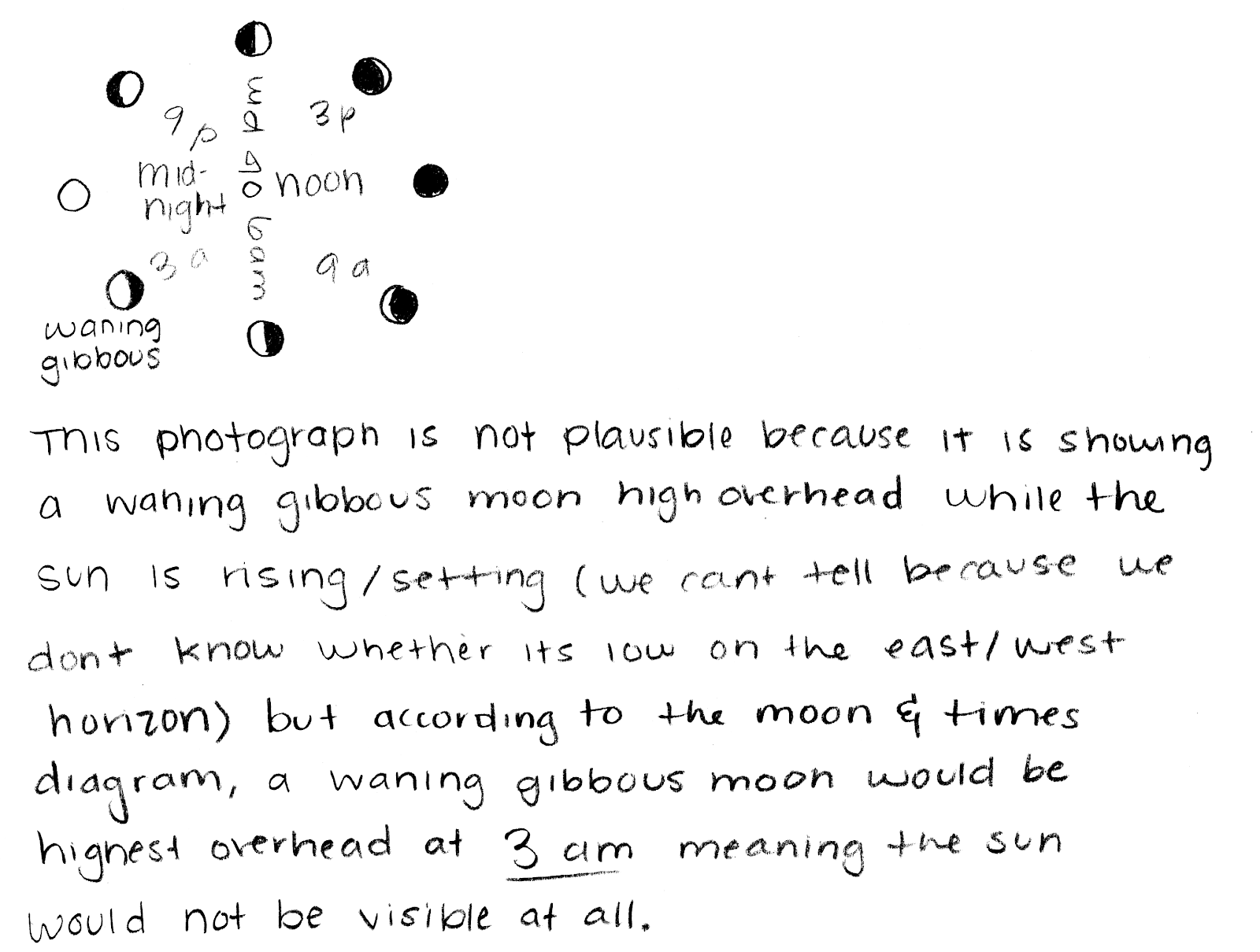
Shown at right is a photographic montage[*] of the moon, observed by a person on a sand dune, with the sun low in the sky somewhere beyond the right edge of the photograph. Discuss why this composition is not plausible. Support your answer using a diagram showing the positions of the sun, moon, Earth, and an observer on Earth.

[*] instagram.com/p/Bq0oQ9PHlK9.

Solution and grading rubric:
  • p:
    Complete diagram and reasoning, using one of the following explanations:
    1. identifies the moon as a waning gibbous (due to slightly more than the left side of the moon being illuminated), at or very nearly overhead at or just before 3 AM, which is inconsistent with the sky still illuminated by the sun "low in the sky" sometime during daylight hours (after 6 AM to before 6 PM); or
    2. identifies the moon as third quarter, which is overhead at 6 AM, argues that is too early for the sun to already be rising "low in the sky," but does not recognize the inconsistency in lighting; or
    3. recognizing that the moon as shown is illuminated from a light source from the left, which is inconsistent with the sun being low in the sky "somewhere beyond the right edge of the photograph."
  • r:
    Nearly correct (explanation weak, unclear or only nearly complete); includes extraneous/tangential information; or has minor errors. May make one of the following explanations:
    1. since this is just before sunset (without discussing possibility that this may be just after sunrise), argues how a waning gibbous moon would not be visible then until rising later at 9 PM, when it is dark; or
    2. misidentifies the moon as waxing gibbous, at or very nearly overhead at 9 PM, which is inconsistent with the sky still illuminated by the sun "low in the sky" sometime during daylight hours (after 6 AM to before 6 PM).
  • t:
    Contains right ideas, but discussion is unclear/incomplete or contains major errors. Primarily discusses waning crescent moon being overhead.
  • v:
    Limited relevant discussion of supporting evidence of at least some merit, but in an inconsistent or unclear manner. At least attempts to draw a moon phase diagram and apply rise/overhead/set times.
  • x:
    Implementation/application of ideas, but credit given for effort rather than merit. Discussion not clearly based on a moon phase diagram.
  • y:
    Irrelevant discussion/effectively blank.
  • z:
    Blank.
Grading distribution:
Section 30674
Exam code: midterm01NtwT
p: 27 students
r: 3 students
t: 1 student
v: 3 students
x: 0 students
y: 0 students
z: 1 student

Section 30676
Exam code: midterm01SFBk
p: 23 students
r: 11 students
t: 6 students
v: 3 students
x: 1 student
y: 0 students
z: 0 students

A sample "p" response (from student 2005), discussing that the sun would not be out in the sky when the waning gibbous moon is high overhead:

Another sample "p" response (from student 2517), observing that the wrong side of the moon is illuminated:

Another sample "p" response (from student 7563), making both arguments mentioned above:

A sample "r" response (from student 1377), only discussing how the waning gibbous moon would not be visible at sunset:

Another sample "r" response (from student 1106), instead identifying this as a waxing gibbous moon, which would not be high overhead during daylight hours:

Astronomy midterm question: Jupiter, not Venus low in the west at dawn

Astronomy 210 Midterm 1, spring semester 2019
Cuesta College, San Luis Obispo, CA

An astronomy question on an online discussion board was asked and answered[*]:
deanmajiet65: Just before dawn, I saw a planet in the sky in the west. Is it Jupiter or Venus?
Rich: It's not Venus. You were facing west, so that was Jupiter.
Discuss why this planet could not be Venus, and would have to be Jupiter for an observer in San Luis Obispo, CA, and how you know this. Support your answer using a diagram showing the positions of the sun, Venus, Jupiter, Earth, and an observer on Earth.

[*] answers.yahoo.com/question/index?qid=20090727104303AA5cFyR.

Solution and grading rubric:
  • p:
    Complete diagram and reasoning includes the following explanations for how it is possible for an observer on Earth to be able to see Jupiter, but not Venus in the west at dawn:
    1. places observer on Earth at dawn (or some time after midnight but before sunrise), with east and west horizons clearly indicated; and
    2. is able to place Jupiter (in an outer orbit) such that it is visible above the west horizon for this observer, and also indicates how Venus (in an inner orbit) can only be seen in the east horizon if it is visible at all at dawn.
  • r:
    Nearly correct (explanation weak, unclear or only nearly complete); includes extraneous/tangential information; or has minor errors. Typically diagram is correct, but supporting argument is contradictory or incomplete.
  • t:
    Contains right ideas, but discussion is unclear/incomplete or contains major errors. May have an observer at sunset instead of sunrise, and/or switched east/west horizons; but still has Jupiter and Venus along outer and inner orbits around the sun, respectively.
  • v:
    Limited relevant discussion of supporting evidence of at least some merit, but in an inconsistent or unclear manner. Some attempt at diagram(s), but no clear indication of observer/horizon on Earth and how placement of outer and inner planets would (or would not) be visible at dawn in the west. Typically misplaces Jupiter and Venus in their relative outer/inner orbits around the sun.
  • x:
    Implementation/application of ideas, but credit given for effort rather than merit.
  • y:
    Irrelevant discussion/effectively blank.
  • z:
    Blank.
Grading distribution:
Section 30674
Exam code: midterm01NtwT
p: 17 students
r: 3 students
t: 10 students
v: 4 students
x: 0 students
y: 1 student
z: 0 students

Section 30676
Exam code: midterm01SFBk
p: 26 students
r: 2 students
t: 9 students
v: 3 students
x: 2 students
y: 1 student
z: 1 student

A sample "p" response (from student 7563):

A sample "v" response (from student 1735), with both Venus and Jupiter as inner planets, and with east and west horizons switched for an observer on Earth, just before dawn:

20190221

Astronomy quiz archive: eclipses/history of astronomy

Astronomy 210 Quiz 2, spring semester 2019
Cuesta College, San Luis Obispo, CA

Section 30674, version 1
Exam code: quiz02nrNa


Section 30674
0- 8.0 :  
8.5-16.0 :   *** [low = 12.0]
16.5-24.0 :   *****
24.5-32.0 :   ***************** [mean = 29.2 +/- 7.6]
32.5-40.0 :   *********** [high = 40.0]


Section 30676, version 1
Exam code: quiz02Sn0W


Section 30676
0- 8.0 :  
8.5-16.0 :   ***** [low = 8.5]
16.5-24.0 :   ******
24.5-32.0 :   ************** [mean = 28.7 +/- 8.9]
32.5-40.0 :   ****************** [high = 40.0]

20181124

Astronomy midterm question: possible IAU classification of "rounded" 2006 RH120?

Astronomy 210 Midterm 2, fall semester 2018
Cuesta College, San Luis Obispo, CA

2006 RH120 (previously known as "6R10DB9") is an object that orbits the sun most of the time, but periodically is caught by Earth's gravity to make several loops around Earth, before returning back to its normal orbit around the sun:
Is 2006 RH120 a "second moon?" I'd call it a chunk of rock that orbits the sun almost all the time, spending only a few months orbiting Earth in 2006. It will make passes by us in 2028 and 2044 (at safe distances), and every twenty years or so after that. Eventually, it'll get caught for a few orbits around Earth again, and will almost certainly be ejected again, just as happened this time. 2006 RH120 quite likely got where it is as a result of being blasted off the surface of the moon by an impact.[*][**]
In the (unlikely) event that 2006 RH120 is found to have a rounded shape, discuss how it should be classified when it is in its usual orbit around the sun. Explain using the International Astronomical Union classification scheme.

[*] projectpluto.com/pluto/mpecs/6r1.htm.
[**] Illustration credit: Gregg Dinderman, skyandtelescope.com/astronomy-news/earths-other-moon/.

Solution and grading rubric:
  • p:
    Correct. Discusses IAU classification scheme to argue that 2006 RH120 when in its usual orbit around the sun would pass qualification I (orbits the sun directly), and with a presumably (however unlikely) rounded shape would pass qualification II (rounded shape), but as it is periodically captured by Earth's gravity 2006 RH120 does not dominate its orbit, and thus would presumably be classified as a dwarf planet.
  • r:
    Nearly correct (explanation weak, unclear or only nearly complete); includes extraneous/tangential information; or has minor errors.
  • t:
    Contains right ideas, but discussion is unclear/incomplete or contains major errors. Explicitly lists IAU requirements, but does not apply them correctly/consistently.
  • v:
    Limited relevant discussion of supporting evidence of at least some merit, but in an inconsistent or unclear manner. Discussion only tangentially related to the IAU classification scheme.
  • x:
    Implementation/application of ideas, but credit given for effort rather than merit. Discussion unrelated to the IAU classification scheme.
  • y:
    Irrelevant discussion/effectively blank.
  • z:
    Blank.
Grading distribution:
Section 70158
Exam code: midterm02SYnR
p: 29 students
r: 0 students
t: 0 students
v: 4 students
x: 0 students
y: 1 student
z: 1 student

Section 70160
Exam code: midterm02NdI0
p: 6 students
r: 2 students
t: 6 students
v: 3 students
x: 1 student
y: 0 students
z: 0 students

A sample "p" response (from student 4073):

20181004

Astronomy midterm question: crescent moon lower than the sun?

Astronomy 210 Midterm 1, fall semester 2018
Cuesta College, San Luis Obispo, CA

Shown at right is a photographic montage[*] of a crescent moon just above a mountain range, with the sun higher above the mountains, off to the left of the photograph. Discuss whether this composition is plausible or implausible for an observer in San Luis Obispo, CA, given the phase and position of the moon in the sky, and the time of day. Support your answer using a diagram showing the positions of the sun, moon, Earth, and an observer on Earth.

[*] instagram.com/p/BhZUQTFFHLw/.

Solution and grading rubric:
  • p:
    Complete diagram and reasoning, includes the following explanations:
    1. identifies the moon as a waning crescent, due to the left side of the moon being illuminated;
    2. identifies this moon as rising or setting ("just above a mountain range");
    3. since the waning crescent is highest overhead at 9 AM, then it rises at 3 AM (six hours earlier than 9 AM), which is before sunrise; and sets at 3 PM at (six hours later than 9 PM);
    4. since the sun is "a little higher [than the moon] above the mountains," this must be either a few hours after sunrise, or a few hours before sunset;
    and thus argues that the scene is implausible (as the sun cannot be above the horizon while waning crescent moon rises at 3 AM), or plausible (as the sun could be above the horizon while the waning crescent moon sets at 3 PM, although the horns of the moon would be pointing in the wrong direction, which would actually be another argument for implausibility.)
  • r:
    Nearly correct (explanation weak, unclear or only nearly complete); includes extraneous/tangential information; or has minor errors. At least discusses (1)-(3), recognizing waning crescent moon as either rising or setting.
  • t:
    Contains right ideas, but discussion is unclear/incomplete or contains major errors. Primarily discusses waning crescent moon being overhead.
  • v:
    Limited relevant discussion of supporting evidence of at least some merit, but in an inconsistent or unclear manner. At least attempts to draw a moon phase diagram and apply rise/overhead/set times.
  • x:
    Implementation/application of ideas, but credit given for effort rather than merit. Discussion not clearly based on a moon phase diagram.
  • y:
    Irrelevant discussion/effectively blank.
  • z:
    Blank.
Grading distribution:
Section 70158
Exam code: midterm01Sa1Y
p: 12 students
r: 9 students
t: 7 students
v: 8 students
x: 1 student
y: 0 students
z: 0 students

Section 70160
Exam code: midterm01n4mR
p: 1 student
r: 7 students
t: 7 students
v: 3 students
x: 1 student
y: 0 students
z: 0 students

A sample "p" response (from student 0423)

A sample "p" response (from student 7175)

Astronomy midterm question: earlier shift of Jupiter's rising time?

Astronomy 210 Midterm 1, fall semester 2018
Cuesta College, San Luis Obispo, CA

The following description of Jupiter was given in a science magazine[*]:
At the beginning of this month Jupiter rises around midnight. At the end of this month Jupiter rises around 10 PM.
Discuss how this earlier shift of Jupiter's rising time over the course of a month would be plausible for an observer in San Luis Obispo, CA, and how you know this. Support your answer using diagrams showing the positions of the sun, Jupiter, Earth, and an observer on Earth.

[*] Astronomical Notes," Scientific American, vol. 43 no. 235 (July 3, 1880), p. 11, books.google.com/books?id=6ok9AQAAIAAJ&dq.

Solution and grading rubric:
  • p:
    Complete diagram and reasoning includes the following explanations for an observer on Earth looking at Jupiter:
    1. Jupiter's position in its orbit around the sun is "ahead of" Earth's position in its orbit around the sun such that the observer on Earth at midnight is able to see Jupiter rising from the east horizon, and
    2. a few months later, Earth has "caught up" to Jupiter (but not yet at superior conjunction) such the observer on Earth will see Jupiter rising from the horizon at an earlier time.
  • r:
    Nearly correct (explanation weak, unclear or only nearly complete); includes extraneous/tangential information; or has minor errors. May have Jupiter highest overhead at midnight (at superior conjunction) for the earlier drawing, and then Earth slightly ahead of Jupiter for the later drawing such that Jupiter is overhead at 10 PM.
  • t:
    Contains right ideas, but discussion is unclear/incomplete or contains major errors. May have geocentric model of Jupiter orbiting Earth, or Earth staying still while Jupiter moves relative to Earth around sun, or observer/times on Earth are in wrong positions.
  • v:
    Limited relevant discussion of supporting evidence of at least some merit, but in an inconsistent or unclear manner. Some attempt at diagram(s), but no clear indication of observer/times on Earth and how relative motions of Earth and Jupiter would cause the earlier shift of Jupiter's rising time.
  • x:
    Implementation/application of ideas, but credit given for effort rather than merit.
  • y:
    Irrelevant discussion/effectively blank.
  • z:
    Blank.
Grading distribution:
Section 70158
Exam code: midterm01Sa1Y
p: 7 students
r: 11 students
t: 9 students
v: 8 students
x: 1 student
y: 1 student
z: 0 students

Section 70160
Exam code: midterm01n4mR
p: 1 student
r: 3 students
t: 5 students
v: 8 students
x: 2 students
y: 0 students
z: 0 students

A sample "p" response (from student 1999)

Another sample "p" response (from student 4008)

20180912

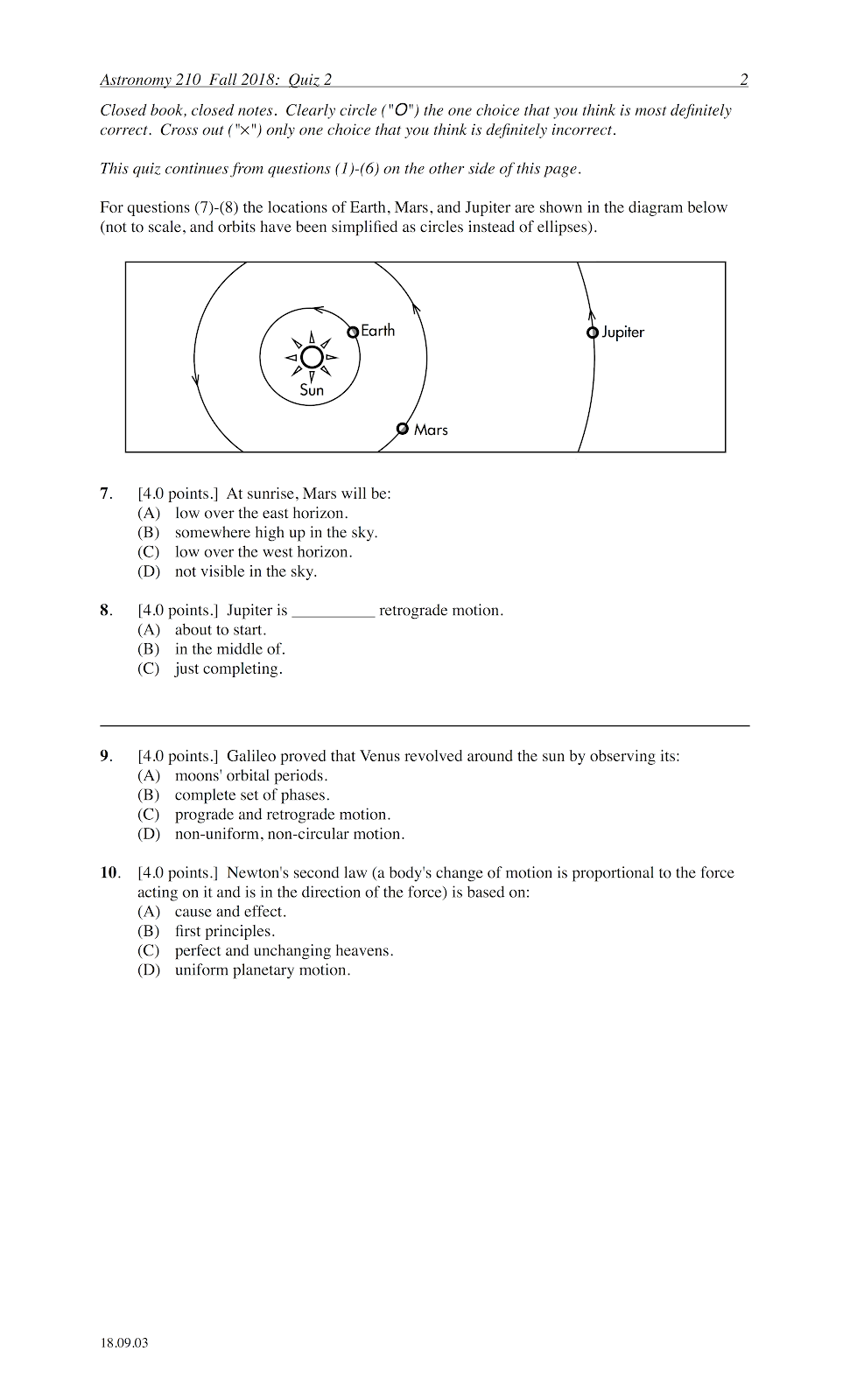
Astronomy quiz archive: eclipses/history of astronomy

Astronomy 210 Quiz 2, fall semester 2018
Cuesta College, San Luis Obispo, CA

Section 70158, version 1
Exam code: quiz02Sl3I


Section 70158
0- 8.0 :   * [low = 4.0]
8.5-16.0 :   ********
16.5-24.0 :   *******
24.5-32.0 :   ********* [mean = 24.8 +/- 9.6]
32.5-40.0 :   ********** [high = 40.0]


Section 70160, version 1
Exam code: quiz02N3r1


Section 70160
0- 8.0 :  
8.5-16.0 :   ******** [low = 12.0]
16.5-24.0 :   **** [mean = 19.3 +/- 6.8]
24.5-32.0 :   **** [high = 28.5]
32.5-40.0 :