
Showing posts with label Sun. Show all posts
Showing posts with label Sun. Show all posts
20211122
Sketchbook: low-mass stars
The sun introduces some other low-mass stars. Also, the sun's expressions pretty much sums up how I feel about things right now. Somehow I associate "low-mass" with "low-key."


20211118

20200316
Astronomy midterm question: "sliced" moon rising with coming darkness
Astronomy 210 Midterm 1, spring semester 2020
Cuesta College, San Luis Obispo, CA
The following excerpt describes the rising of a crescent ("sliced") moon around sunset:
[*] Mitchell Smith, Moonrise: Book Three of the Snowfall Trilogy, Tom Dougherty Associates (2004), p. 195.
Solution and grading rubric:
Section 30674
Exam code: midterm01n7in
p: 15 students
r: 3 students
t: 4 students
v: 5 students
x: 0 students
y: 0 students
z: 0 students
Section 30676
Exam code: midterm01S7wY
p: 24 students
r: 2 students
t: 5 students
v: 9 students
x: 5 students
y: 0 students
z: 0 students
A sample "p" response (from student 2310):
Cuesta College, San Luis Obispo, CA
The following excerpt describes the rising of a crescent ("sliced") moon around sunset:
Darkness was coming slowly down, a cool cloak draped over them. Soon, a sliced moon began to rise as a wind rose.Discuss whether or not this description is plausible for an observer in San Luis Obispo, CA, and how you know this. Support your answer using a diagram showing the positions of the sun, moon, Earth, and an observer on Earth.
[*] Mitchell Smith, Moonrise: Book Three of the Snowfall Trilogy, Tom Dougherty Associates (2004), p. 195.
Solution and grading rubric:
- p:
Correct. Complete diagram (with the sun, moon, and observer on Earth), and discusses one of the following reasons why this description would be implausible:- waxing crescent moon is overhead at 3 PM, and rose six hours earlier at 9 AM; while waning crescent moon is overhead at 9 AM, and rose six hours earlier at 3 AM, such that neither of these crescent phase moons could be rising just after sunset; or
- the moon phase that would be rising around/at/after sunset (6 PM) would be the waxing gibbous moon, full moon or waning gibbous moon, such that no crescent phase moon could be rising after sunset.
- r:
Nearly correct (explanation weak, unclear or only nearly complete); includes extraneous/tangential information; or has minor errors. Diagram and/or explanation has minor errors. - t:
Contains right ideas, but discussion is unclear/incomplete or contains major errors. Problems with either diagram or discussion. - v:
Limited relevant discussion of supporting evidence of at least some merit, but in an inconsistent or unclear manner. At least attempts to draw a moon phase diagram and apply rise/overhead/set times. - x:
Implementation/application of ideas, but credit given for effort rather than merit. Discussion not clearly based on a moon phase diagram. - y:
Irrelevant discussion/effectively blank. - z:
Blank.
Section 30674
Exam code: midterm01n7in
p: 15 students
r: 3 students
t: 4 students
v: 5 students
x: 0 students
y: 0 students
z: 0 students
Section 30676
Exam code: midterm01S7wY
p: 24 students
r: 2 students
t: 5 students
v: 9 students
x: 5 students
y: 0 students
z: 0 students
A sample "p" response (from student 2310):
Astronomy midterm question: Venus setting while Jupiter rising at night?
Astronomy 210 Midterm 1, spring semester 2020
Cuesta College, San Luis Obispo, CA
The following excerpt describes a night where Venus is setting while Jupiter is rising[*]:
[*] J.C., "Wrecked--A Week on Sable Island," The Canadian Methodist Magazine, vol. XV (January-June 1882), p. 73.
Solution and grading rubric:
Section 30674
Exam code: midterm01n7in
p: 14 students
r: 1 student
t: 6 students
v: 7 students
x: 1 student
y: 0 students
z: 1 student
Section 30676
Exam code: midterm01S7wY
p: 24 students
r: 0 students
t: 13 students
v: 6 students
x: 2 students
y: 0 students
z: 0 students
A sample "p" response (from student 2000):
Another sample "p" response (from student 2020):
One more sample "p" response (from student 5171):
Cuesta College, San Luis Obispo, CA
The following excerpt describes a night where Venus is setting while Jupiter is rising[*]:
Let me try to recall what has happened, the amusing and strange, and sad and terrible scenes witnessed in these last few days. On my first night at sea, I watched Venus slowly sinking into the sea, and Jupiter rising...Discuss a plausible time (around sunset, midnight, or sunrise) that these two planets would be observed in San Luis Obispo, CA, and how you know this. Support your answer using a diagram showing the positions of the sun, Venus, Jupiter, Earth, and an observer on Earth.
[*] J.C., "Wrecked--A Week on Sable Island," The Canadian Methodist Magazine, vol. XV (January-June 1882), p. 73.
Solution and grading rubric:
- p:
Complete diagram and reasoning where observer on Earth must be at sunset to watch Venus (in an inner orbit) setting while Jupiter (in an inner orbit) rises in the east. - r:
Nearly correct (explanation weak, unclear or only nearly complete); includes extraneous/tangential information; or has minor errors. Typically diagram and/or supporting argument is contradictory or incomplete. - t:
Contains right ideas, but discussion is unclear/incomplete or contains major errors. Still has Venus in an inner orbit and Jupiter in an outer orbit around the sun. - v:
Limited relevant discussion of supporting evidence of at least some merit, but in an inconsistent or unclear manner. Some attempt at diagram(s), but no clear indication of observer/horizon on Earth and/or placement of inner planets. Typically misplaces Venus and Jupiter in their relative inner/outer orbits around the sun, or has Venus and Jupiter orbiting Earth. - x:
Implementation/application of ideas, but credit given for effort rather than merit. - y:
Irrelevant discussion/effectively blank. - z:
Blank.
Section 30674
Exam code: midterm01n7in
p: 14 students
r: 1 student
t: 6 students
v: 7 students
x: 1 student
y: 0 students
z: 1 student
Section 30676
Exam code: midterm01S7wY
p: 24 students
r: 0 students
t: 13 students
v: 6 students
x: 2 students
y: 0 students
z: 0 students
A sample "p" response (from student 2000):
Another sample "p" response (from student 2020):
One more sample "p" response (from student 5171):
20200220
Astronomy quiz archive: eclipses/history of astronomy
Astronomy 210 Quiz 2, spring semester 2020
Cuesta College, San Luis Obispo, CA
Section 30674, version 1
Exam code: quiz02n1xI


Section 30674
Section 30676, version 1
Exam code: quiz02SnRl


Section 30676
Cuesta College, San Luis Obispo, CA
Section 30674, version 1
Exam code: quiz02n1xI
Section 30674
| 0- 8.0 : | ** [low = 6.0] |
| 8.5-16.0 : | ***** |
| 16.5-24.0 : | ******* [mean = 23.8 +/- 9.0] |
| 24.5-32.0 : | ********* |
| 32.5-40.0 : | ******* [high = 36.5] |
Section 30676, version 1
Exam code: quiz02SnRl
Section 30676
| 0- 8.0 : | ** [low = 8.0] |
| 8.5-16.0 : | ******* |
| 16.5-24.0 : | ************* |
| 24.5-32.0 : | ********* [mean = 24.8 +/- 9.2] |
| 32.5-40.0 : | ************* [high = 40.0] |
20200205
Astronomy quiz archive: stars/sun/seasons/moon phases
Astronomy 210 Quiz 1, spring semester 2020
Cuesta College, San Luis Obispo, CA
Section 30674, version 1
Exam code: quiz01N3ve


Section 30674
Section 30676, version 1
Exam code: quiz01s4L3


Section 30676
Cuesta College, San Luis Obispo, CA
Section 30674, version 1
Exam code: quiz01N3ve
Section 30674
| 0- 8.0 : | * [low = 6.0] |
| 8.5-16.0 : | **************** |
| 16.5-24.0 : | ********** [mean = 21.6 +/- 8.6] |
| 24.5-32.0 : | ************* |
| 32.5-40.0 : | **** [high = 40.0] |
Section 30676, version 1
Exam code: quiz01s4L3
Section 30676
| 0- 8.0 : | * [low = 8.0] |
| 8.5-16.0 : | **** |
| 16.5-24.0 : | *************** |
| 24.5-32.0 : | *********** [mean = 26.6 +/- 9.5] |
| 32.5-40.0 : | ************** [high = 40.0] |
20200118
Astronomy in-class activity: planet-hunting
Astronomy 210 In-class activity 6 v.20.01.14, spring semester 2020
Cuesta College, San Luis Obispo, CA
Students find their assigned groups of three to four students, and work cooperatively on an in-class activity worksheet to determine where in the sky each naked-eye planet will be observed on a given date (here, February 5, 2020).


Previous posts:
Cuesta College, San Luis Obispo, CA
Students find their assigned groups of three to four students, and work cooperatively on an in-class activity worksheet to determine where in the sky each naked-eye planet will be observed on a given date (here, February 5, 2020).
Previous posts:
- Astronomy in-class activity: planet-hunting
fall semester 2019 (August 29, 2019). - Astronomy in-class activity: planet-hunting
spring semester 2019 (February 6, 2019). - Astronomy in-class activity: planet-hunting
fall semester 2018 (August 28, 2018). - Astronomy in-class activity: planet-hunting
fall semester 2017 (September 6, 2017). - Astronomy in-class activity: planet-hunting
spring semester 2017 (February 1, 2017). - Astronomy in-class activity: planet-hunting
fall semester 2016 (August 31, 2016). - Astronomy in-class activity: planet-hunting
spring semester 2016 (February 4, 2016). - Astronomy in-class activity: planet-hunting
fall semester 2015 (September 3, 2015). - Astronomy in-class activity: planet-hunting
spring semester 2015 (February 4, 2015). - Astronomy in-class activity: planet-hunting
fall semester 2014 (September 3, 2014). - Astronomy in-class activity: planet-hunting
spring semester 2014 (February 6, 2014). - Astronomy in-class activity: planet-hunting
fall semester 2013 (September 5, 2013). - Astronomy in-class activity: planet-hunting
spring semester 2013 (February 6, 2013). - Astronomy in-class activity: planet-hunting
fall semester 2012 (September 6, 2012). - Astronomy in-class activity: planet-hunting
spring semester 2012 (February 2, 2012). Astronomy in-class activity: planet-hunting - Astronomy in-class activity: planet-hunting
spring semester 2011 (February 2, 2011). - Astronomy in-class activity: planet-hunting
fall semester 2010 (September 2, 2010). - Astronomy in-class activity: planet-hunting
spring semester 2010 (February 4, 2010).
fall semester 2011 (September 1, 2011).
20191024
Astronomy quiz archive: sun/spectra/star properties
Astronomy 210 Quiz 5, fall semester 2019
Cuesta College, San Luis Obispo, CA
Section 70158, version 1
Exam code: quiz05Sh0w


Section 70158
Section 70160, version 1
Exam code: quiz05NpRm


Section 70160
Cuesta College, San Luis Obispo, CA
Section 70158, version 1
Exam code: quiz05Sh0w
Section 70158
| 0- 8.0 : | |
| 8.5-16.0 : | *** [low = 10.0] |
| 16.5-24.0 : | * |
| 24.5-32.0 : | ********* [mean = 32.0 +/- 8.2] |
| 32.5-40.0 : | ******************* [high = 40.0] |
Section 70160, version 1
Exam code: quiz05NpRm
Section 70160
| 0- 8.0 : | |
| 8.5-16.0 : | * [low = 16.0] |
| 16.5-24.0 : | ********** |
| 24.5-32.0 : | ***** [mean = 26.0 +/- 7.5] |
| 32.5-40.0 : | ****** [high = 40.0] |
20191008
Astronomy midterm question: 15 hour sunrise to moonrise work shift
Astronomy 210 Midterm 1, fall semester 2019
Cuesta College, San Luis Obispo, CA
While giving a tour to visitors, a family member recounted how her father worked on their tree farm[*]:
[*] Zack Peterson, "'This Is a Great Forest': German Contingent Travels to Reading, VT, to Tour Model Tree Farm," Valley News (June 23, 2013), vnews.com/Archives/2013/06/GermanForesters-zp-vn-062213.
Solution and grading rubric:
Section 70158
Exam code: midterm01Sw3e
p: 20 students
r: 7 students
t: 8 students
v: 1 students
x: 0 students
y: 0 students
z: 0 students
Section 70160
Exam code: midterm01N0dL
p: 4 students
r: 2 students
t: 11 students
v: 4 students
x: 1 student
y: 1 student
z: 0 students
A sample "p" response (from student 4320):
Cuesta College, San Luis Obispo, CA
While giving a tour to visitors, a family member recounted how her father worked on their tree farm[*]:
[Dorothy "Dot"] Lombard said her father worked several years on the tree farm before he bought the property in 1956. He loaded logs into his four-wheel drive skidder, cut away brush and took lengthy notes. He would work from sunrise to moonrise.Discuss what phase the moon would have when rising to signal the end of an approximately 15 hour work shift that began at sunrise. Support your answer using a diagram showing the positions of the sun, moon, Earth, and an observer on Earth.
[*] Zack Peterson, "'This Is a Great Forest': German Contingent Travels to Reading, VT, to Tour Model Tree Farm," Valley News (June 23, 2013), vnews.com/Archives/2013/06/GermanForesters-zp-vn-062213.
Solution and grading rubric:
- p:
Correct. Complete diagram (with the sun, moon, and observer on Earth), and discusses:- assuming sunrise at 6 AM, then end of a 15 hour work shift would be at 9 PM; and
- the moon that rises at 9 PM would be highest overhead six hours later, at 3 AM, corresponding to the waning gibbous moon.
- r:
Nearly correct (explanation weak, unclear or only nearly complete); includes extraneous/tangential information; or has minor errors. Diagram and/or explanation has minor errors. Understands that work shift would end at 9 PM, but subtracts six hours instead to find the moon phase that is setting at 9 PM instead of rising at 9 PM. - t:
Contains right ideas, but discussion is unclear/incomplete or contains major errors. Problems with either diagram or discussion. Typically chooses waxing gibbous moon, which is directly overhead at 9 PM. - v:
Limited relevant discussion of supporting evidence of at least some merit, but in an inconsistent or unclear manner. At least attempts to draw a moon phase diagram and apply rise/overhead/set times. - x:
Implementation/application of ideas, but credit given for effort rather than merit. Discussion not clearly based on a moon phase diagram. - y:
Irrelevant discussion/effectively blank. - z:
Blank.
Section 70158
Exam code: midterm01Sw3e
p: 20 students
r: 7 students
t: 8 students
v: 1 students
x: 0 students
y: 0 students
z: 0 students
Section 70160
Exam code: midterm01N0dL
p: 4 students
r: 2 students
t: 11 students
v: 4 students
x: 1 student
y: 1 student
z: 0 students
A sample "p" response (from student 4320):
Astronomy midterm question: 12 hours between Mercury setting and Venus rising?
Astronomy 210 Midterm 1, fall semester 2019
Cuesta College, San Luis Obispo, CA
An astronomy question on an online discussion board was asked and answered[*]:
[*] answers.yahoo.com/question/index?qid=20090328072648AALZoVS.
Solution and grading rubric:
Section 70158
Exam code: midterm01Sw3e
p: 20 students
r: 4 students
t: 5 students
v: 6 students
x: 0 students
y: 0 students
z: 1 student
Section 70160
Exam code: midterm01N0dL
p: 6 students
r: 5 students
t: 5 students
v: 7 students
x: 0 students
y: 0 students
z: 0 students
A sample "p" response (from student 1234):
Cuesta College, San Luis Obispo, CA
An astronomy question on an online discussion board was asked and answered[*]:
J.F.: Can an observer ever witness Mercury setting at the same time while Venus is rising?Discuss why it would take about 12 hours between Mercury setting and Venus rising for an observer in San Luis Obispo, CA, and how you know this. Support your answer using a diagram showing the positions of the sun, Mercury, Venus, Earth, and an observer on Earth.
rzfr: No, that is impossible. It will take about 12 hours between Mercury setting and Venus rising.
[*] answers.yahoo.com/question/index?qid=20090328072648AALZoVS.
Solution and grading rubric:
- p:
Complete diagram and reasoning includes the following explanations for why there would be about 12 hours between Mercury setting and Venus rising:- places observer on Earth at sunset to watch Mercury (in an inner orbit) setting in the west; and
- places observer on Earth at sunrise to watch Venus (in an inner orbit) rising in the east.
- r:
Nearly correct (explanation weak, unclear or only nearly complete); includes extraneous/tangential information; or has minor errors. Typically diagram is correct, but supporting argument is contradictory or incomplete. May have placed Mercury to rise at sunrise and placed Venus to set at sunset. - t:
Contains right ideas, but discussion is unclear/incomplete or contains major errors. Still has Mercury and Venus along inner orbits around the sun. - v:
Limited relevant discussion of supporting evidence of at least some merit, but in an inconsistent or unclear manner. Some attempt at diagram(s), but no clear indication of observer/horizon on Earth and/or placement of inner planets. Typically misplaces Mercury and Venus in their relative outer/inner orbits around the sun. - x:
Implementation/application of ideas, but credit given for effort rather than merit. - y:
Irrelevant discussion/effectively blank. - z:
Blank.
Section 70158
Exam code: midterm01Sw3e
p: 20 students
r: 4 students
t: 5 students
v: 6 students
x: 0 students
y: 0 students
z: 1 student
Section 70160
Exam code: midterm01N0dL
p: 6 students
r: 5 students
t: 5 students
v: 7 students
x: 0 students
y: 0 students
z: 0 students
A sample "p" response (from student 1234):
20190912
Astronomy quiz archive: eclipses/history of astronomy
Astronomy 210 Quiz 2, fall semester 2019
Cuesta College, San Luis Obispo, CA
Section 70158, version 1
Exam code: quiz02SnPy


Section 70158
Section 70160, version 1
Exam code: quiz02n4rN


Section 70160
Cuesta College, San Luis Obispo, CA
Section 70158, version 1
Exam code: quiz02SnPy
Section 70158
| 0- 8.0 : | * [low = 4.0] |
| 8.5-16.0 : | ******* |
| 16.5-24.0 : | **** |
| 24.5-32.0 : | ******** [mean = 28.1 +/- 9.8] |
| 32.5-40.0 : | ***************** [high = 40.0] |
Section 70160, version 1
Exam code: quiz02n4rN
Section 70160
| 0- 8.0 : | * [low = 8.0] |
| 8.5-16.0 : | * |
| 16.5-24.0 : | ******** |
| 24.5-32.0 : | ******* [mean = 25.8 +/- 7.4] |
| 32.5-40.0 : | ***** [high = 40.0] |
20190827
Astronomy quiz archive: stars/sun/seasons/moon phases
Astronomy 210 Quiz 1, fall semester 2019
Cuesta College, San Luis Obispo, CA
Section 70158, version 1
Exam code: quiz01SLYc


Section 70158
Section 70160, version 1
Exam code: quiz01nGh7


Section 70160
Cuesta College, San Luis Obispo, CA
Section 70158, version 1
Exam code: quiz01SLYc
Section 70158
| 0- 8.0 : | * [low = 6.0] |
| 8.5-16.0 : | **************** |
| 16.5-24.0 : | ********** [mean = 21.6 +/- 8.6] |
| 24.5-32.0 : | ************* |
| 32.5-40.0 : | **** [high = 40.0] |
Section 70160, version 1
Exam code: quiz01nGh7
Section 70160
| 0- 8.0 : | *** [low = 8.0] |
| 8.5-16.0 : | ******* |
| 16.5-24.0 : | ******* [mean = 19.0 +/- 7.6] |
| 24.5-32.0 : | *** |
| 32.5-40.0 : | * [high = 36.0] |
20190817
Astronomy in-class activity: planet-hunting
Astronomy 210 In-class activity 6 v.19.08.17, fall semester 2019
Cuesta College, San Luis Obispo, CA
Students find their assigned groups of three to four students, and work cooperatively on an in-class activity worksheet to determine where in the sky each naked-eye planet will be observed on a given date (here, August 29, 2019).


Previous posts:
Cuesta College, San Luis Obispo, CA
Students find their assigned groups of three to four students, and work cooperatively on an in-class activity worksheet to determine where in the sky each naked-eye planet will be observed on a given date (here, August 29, 2019).
Previous posts:
- Astronomy in-class activity: planet-hunting
spring semester 2019 (February 6, 2019). - Astronomy in-class activity: planet-hunting
fall semester 2018 (August 28, 2018). - Astronomy in-class activity: planet-hunting
fall semester 2017 (September 6, 2017). - Astronomy in-class activity: planet-hunting
spring semester 2017 (February 1, 2017). - Astronomy in-class activity: planet-hunting
fall semester 2016 (August 31, 2016). - Astronomy in-class activity: planet-hunting
spring semester 2016 (February 4, 2016). - Astronomy in-class activity: planet-hunting
fall semester 2015 (September 3, 2015). - Astronomy in-class activity: planet-hunting
spring semester 2015 (February 4, 2015). - Astronomy in-class activity: planet-hunting
fall semester 2014 (September 3, 2014). - Astronomy in-class activity: planet-hunting
spring semester 2014 (February 6, 2014). - Astronomy in-class activity: planet-hunting
fall semester 2013 (September 5, 2013). - Astronomy in-class activity: planet-hunting
spring semester 2013 (February 6, 2013). - Astronomy in-class activity: planet-hunting
fall semester 2012 (September 6, 2012). - Astronomy in-class activity: planet-hunting
spring semester 2012 (February 2, 2012). Astronomy in-class activity: planet-hunting - Astronomy in-class activity: planet-hunting
spring semester 2011 (February 2, 2011). - Astronomy in-class activity: planet-hunting
fall semester 2010 (September 2, 2010). - Astronomy in-class activity: planet-hunting
spring semester 2010 (February 4, 2010).
fall semester 2011 (September 1, 2011).
20190411
Astronomy quiz archive: sun/spectra/star properties
Astronomy 210 Quiz 5, spring semester 2019
Cuesta College, San Luis Obispo, CA
Section 30674, version 1
Exam code: quiz05NiR0


Section 30674
Section 30676, version 1
Exam code: quiz05S4re


Section 30676
Cuesta College, San Luis Obispo, CA
Section 30674, version 1
Exam code: quiz05NiR0
Section 30674
| 0- 8.0 : | |
| 8.5-16.0 : | **** [low = 11.0] |
| 16.5-24.0 : | *********** |
| 24.5-32.0 : | ****** [mean = 26.2 +/- 8.7] |
| 32.5-40.0 : | ********** [high = 40.0] |
Section 30676, version 1
Exam code: quiz05S4re
Section 30676
| 0- 8.0 : | ** [low = 2.5] |
| 8.5-16.0 : | ** |
| 16.5-24.0 : | ******** |
| 24.5-32.0 : | *********** [mean = 27.6 +/- 9.2] |
| 32.5-40.0 : | *************** [high = 40.0] |
20190315
Astronomy midterm question: waning gibbous moon with sun low in opposite sky?
Astronomy 210 Midterm 1, spring semester 2019
Cuesta College, San Luis Obispo, CA
 Shown at right is a photographic montage[*] of the moon, observed by a person on a sand dune, with the sun low in the sky somewhere beyond the right edge of the photograph. Discuss why this composition is not plausible. Support your answer using a diagram showing the positions of the sun, moon, Earth, and an observer on Earth.
[*] instagram.com/p/Bq0oQ9PHlK9.
Solution and grading rubric:
Section 30674
Exam code: midterm01NtwT
p: 27 students
r: 3 students
t: 1 student
v: 3 students
x: 0 students
y: 0 students
z: 1 student
Section 30676
Exam code: midterm01SFBk
p: 23 students
r: 11 students
t: 6 students
v: 3 students
x: 1 student
y: 0 students
z: 0 students
A sample "p" response (from student 2005), discussing that the sun would not be out in the sky when the waning gibbous moon is high overhead: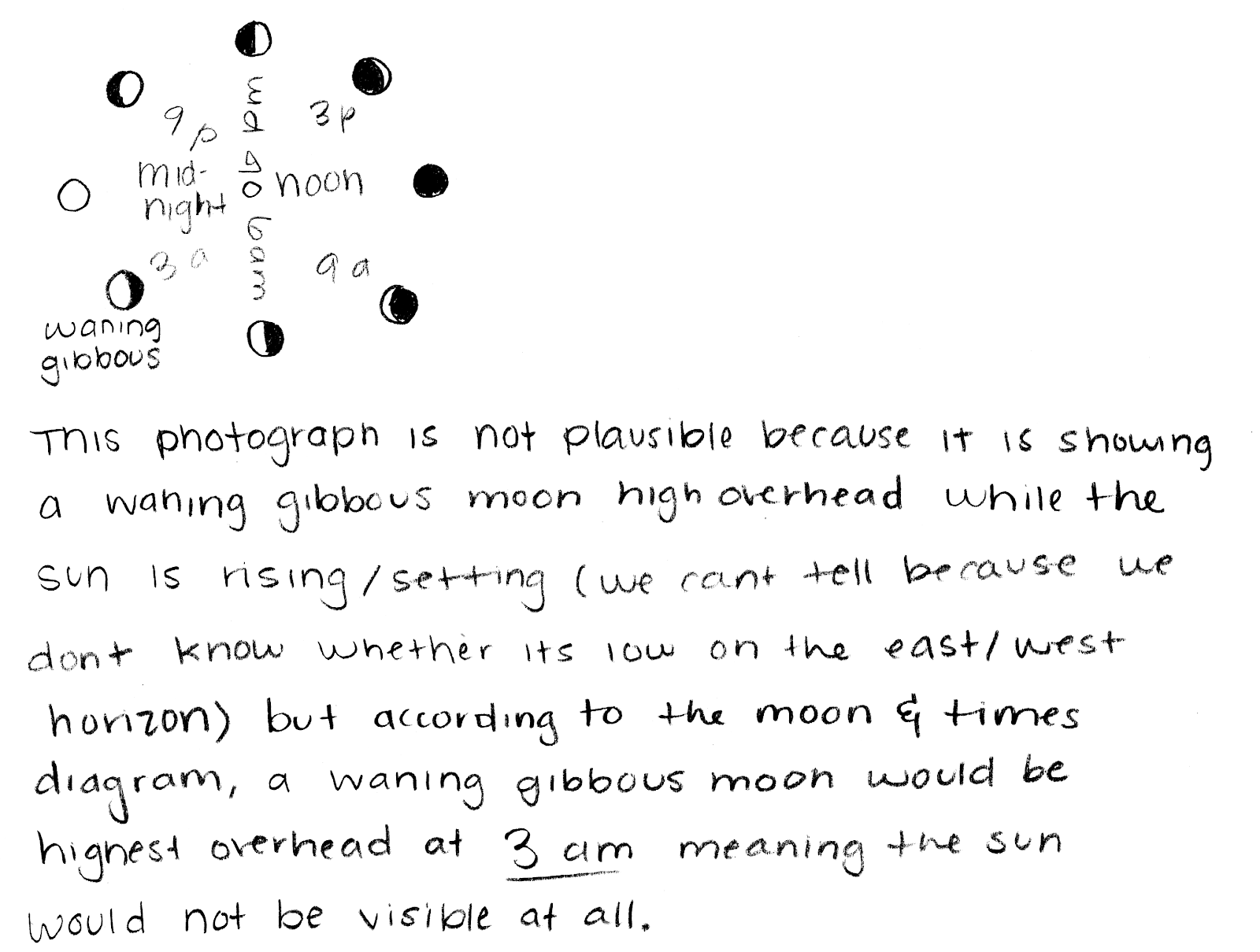
Another sample "p" response (from student 2517), observing that the wrong side of the moon is illuminated:
Another sample "p" response (from student 7563), making both arguments mentioned above:
A sample "r" response (from student 1377), only discussing how the waning gibbous moon would not be visible at sunset:
Another sample "r" response (from student 1106), instead identifying this as a waxing gibbous moon, which would not be high overhead during daylight hours:
Cuesta College, San Luis Obispo, CA
 Shown at right is a photographic montage[*] of the moon, observed by a person on a sand dune, with the sun low in the sky somewhere beyond the right edge of the photograph. Discuss why this composition is not plausible. Support your answer using a diagram showing the positions of the sun, moon, Earth, and an observer on Earth.
 [*] instagram.com/p/Bq0oQ9PHlK9.
Solution and grading rubric:
- p:
Complete diagram and reasoning, using one of the following explanations:- identifies the moon as a waning gibbous (due to slightly more than the left side of the moon being illuminated), at or very nearly overhead at or just before 3 AM, which is inconsistent with the sky still illuminated by the sun "low in the sky" sometime during daylight hours (after 6 AM to before 6 PM); or
- identifies the moon as third quarter, which is overhead at 6 AM, argues that is too early for the sun to already be rising "low in the sky," but does not recognize the inconsistency in lighting; or
- recognizing that the moon as shown is illuminated from a light source from the left, which is inconsistent with the sun being low in the sky "somewhere beyond the right edge of the photograph."
- r:
Nearly correct (explanation weak, unclear or only nearly complete); includes extraneous/tangential information; or has minor errors. May make one of the following explanations:- since this is just before sunset (without discussing possibility that this may be just after sunrise), argues how a waning gibbous moon would not be visible then until rising later at 9 PM, when it is dark; or
- misidentifies the moon as waxing gibbous, at or very nearly overhead at 9 PM, which is inconsistent with the sky still illuminated by the sun "low in the sky" sometime during daylight hours (after 6 AM to before 6 PM).
- t:
Contains right ideas, but discussion is unclear/incomplete or contains major errors. Primarily discusses waning crescent moon being overhead. - v:
Limited relevant discussion of supporting evidence of at least some merit, but in an inconsistent or unclear manner. At least attempts to draw a moon phase diagram and apply rise/overhead/set times. - x:
Implementation/application of ideas, but credit given for effort rather than merit. Discussion not clearly based on a moon phase diagram. - y:
Irrelevant discussion/effectively blank. - z:
Blank.
Section 30674
Exam code: midterm01NtwT
p: 27 students
r: 3 students
t: 1 student
v: 3 students
x: 0 students
y: 0 students
z: 1 student
Section 30676
Exam code: midterm01SFBk
p: 23 students
r: 11 students
t: 6 students
v: 3 students
x: 1 student
y: 0 students
z: 0 students
A sample "p" response (from student 2005), discussing that the sun would not be out in the sky when the waning gibbous moon is high overhead:
Another sample "p" response (from student 2517), observing that the wrong side of the moon is illuminated:
Another sample "p" response (from student 7563), making both arguments mentioned above:
A sample "r" response (from student 1377), only discussing how the waning gibbous moon would not be visible at sunset:
Another sample "r" response (from student 1106), instead identifying this as a waxing gibbous moon, which would not be high overhead during daylight hours:
Astronomy midterm question: Jupiter, not Venus low in the west at dawn
Astronomy 210 Midterm 1, spring semester 2019
Cuesta College, San Luis Obispo, CA
An astronomy question on an online discussion board was asked and answered[*]:
[*] answers.yahoo.com/question/index?qid=20090727104303AA5cFyR.
Solution and grading rubric:
Section 30674
Exam code: midterm01NtwT
p: 17 students
r: 3 students
t: 10 students
v: 4 students
x: 0 students
y: 1 student
z: 0 students
Section 30676
Exam code: midterm01SFBk
p: 26 students
r: 2 students
t: 9 students
v: 3 students
x: 2 students
y: 1 student
z: 1 student
A sample "p" response (from student 7563):
A sample "v" response (from student 1735), with both Venus and Jupiter as inner planets, and with east and west horizons switched for an observer on Earth, just before dawn:
Cuesta College, San Luis Obispo, CA
An astronomy question on an online discussion board was asked and answered[*]:
deanmajiet65: Just before dawn, I saw a planet in the sky in the west. Is it Jupiter or Venus?Discuss why this planet could not be Venus, and would have to be Jupiter for an observer in San Luis Obispo, CA, and how you know this. Support your answer using a diagram showing the positions of the sun, Venus, Jupiter, Earth, and an observer on Earth.
Rich: It's not Venus. You were facing west, so that was Jupiter.
[*] answers.yahoo.com/question/index?qid=20090727104303AA5cFyR.
Solution and grading rubric:
- p:
Complete diagram and reasoning includes the following explanations for how it is possible for an observer on Earth to be able to see Jupiter, but not Venus in the west at dawn:- places observer on Earth at dawn (or some time after midnight but before sunrise), with east and west horizons clearly indicated; and
- is able to place Jupiter (in an outer orbit) such that it is visible above the west horizon for this observer, and also indicates how Venus (in an inner orbit) can only be seen in the east horizon if it is visible at all at dawn.
- r:
Nearly correct (explanation weak, unclear or only nearly complete); includes extraneous/tangential information; or has minor errors. Typically diagram is correct, but supporting argument is contradictory or incomplete. - t:
Contains right ideas, but discussion is unclear/incomplete or contains major errors. May have an observer at sunset instead of sunrise, and/or switched east/west horizons; but still has Jupiter and Venus along outer and inner orbits around the sun, respectively. - v:
Limited relevant discussion of supporting evidence of at least some merit, but in an inconsistent or unclear manner. Some attempt at diagram(s), but no clear indication of observer/horizon on Earth and how placement of outer and inner planets would (or would not) be visible at dawn in the west. Typically misplaces Jupiter and Venus in their relative outer/inner orbits around the sun. - x:
Implementation/application of ideas, but credit given for effort rather than merit. - y:
Irrelevant discussion/effectively blank. - z:
Blank.
Section 30674
Exam code: midterm01NtwT
p: 17 students
r: 3 students
t: 10 students
v: 4 students
x: 0 students
y: 1 student
z: 0 students
Section 30676
Exam code: midterm01SFBk
p: 26 students
r: 2 students
t: 9 students
v: 3 students
x: 2 students
y: 1 student
z: 1 student
A sample "p" response (from student 7563):
A sample "v" response (from student 1735), with both Venus and Jupiter as inner planets, and with east and west horizons switched for an observer on Earth, just before dawn:
20190221
Astronomy quiz archive: eclipses/history of astronomy
Astronomy 210 Quiz 2, spring semester 2019
Cuesta College, San Luis Obispo, CA
Section 30674, version 1
Exam code: quiz02nrNa


Section 30674
Section 30676, version 1
Exam code: quiz02Sn0W


Section 30676
Cuesta College, San Luis Obispo, CA
Section 30674, version 1
Exam code: quiz02nrNa
Section 30674
| 0- 8.0 : | |
| 8.5-16.0 : | *** [low = 12.0] |
| 16.5-24.0 : | ***** |
| 24.5-32.0 : | ***************** [mean = 29.2 +/- 7.6] |
| 32.5-40.0 : | *********** [high = 40.0] |
Section 30676, version 1
Exam code: quiz02Sn0W
Section 30676
| 0- 8.0 : | |
| 8.5-16.0 : | ***** [low = 8.5] |
| 16.5-24.0 : | ****** |
| 24.5-32.0 : | ************** [mean = 28.7 +/- 8.9] |
| 32.5-40.0 : | ****************** [high = 40.0] |
Subscribe to:
Posts (Atom)