Showing posts with label pressure. Show all posts

20191104

Physics quiz question: pressure difference from climbing one floor

Physics 205A Quiz 5, fall semester 2019
Cuesta College, San Luis Obispo, CA

A wearable fitness tracker has an air pressure sensor[*]:
Your tracker is using an altimeter, which measures when air pressure decreases slightly. It adds one floor every time you increase your elevation by 10 feet [3.0 meters] while moving, which is the average distance between two floors.
(The density of air is ρair = 1.3 kg/m3.) An increase in elevation of 3.0 m experienced by this fitness tracker would correspond to a change in air pressure of:
(A) 4.2 Pa.
(B) 13 Pa.
(C) 38 Pa.
(D) 2.9×10⁴ Pa.

[*] Logan Strain, "How Accurate Is Fitbit? Here's What The Research Says About Fitbit Accuracy" (March 29, 2017), wearablezone.com/news/how-accurate-is-fitbit/.

Correct answer (highlight to unhide): (C)

For static fluids, the energy density relation between pressure difference ∆P and elevation change ∆y is given by:

0 = ∆P + ρair·g·∆y.

The difference in pressure ∆P for climbing one floor is then:

P = –ρair·g·∆y,

P = –ρair·g·(yfy0),

P = –(1.3 kg/m3)·(9.80 m/s2)·((+3.0 m) – (0 m)),

P = –(1.3 kg/m3)·(9.80 m/s2)·(+3.0 m),

P = –38.22 Pa,

such that the difference in pressure for climbing one floor (to two significant figures) is 38 Pa (the negative sign in the above calculation denotes that the air pressure decreased with increasing elevation).

(Response (A) is ρair·g/∆y; response (B) is ρair·g; and response (D) is ρwater·g·∆y.)

Sections 70854, 70855
Exam code: quiz05Gu1L
(A) : 6 students
(B) : 6 students
(C) : 34 students
(D) : 6 students

Success level: 65%
Discrimination index (Aubrecht & Aubrecht, 1983): 0.80

Physics quiz archive: rotations, torque, pressure, buoyancy, fluid flow

Physics 205A Quiz 5, fall semester 2019
Cuesta College, San Luis Obispo, CA
Sections 70854, 70855, version 1
Exam code: quiz05Gu1L


Sections 70854, 70855 results
0- 6 :   ** [low = 6]
7-12 :   *********
13-18 :   ***********
19-24 :   ***************** [mean = 19.8 +/- 6.3]
25-30 :   ************* [high = 27]

20191030

Online reading assignment: elasticity

Physics 205A, fall semester 2019
Cuesta College, San Luis Obispo, CA

Students have a bi-weekly online reading assignment (hosted by SurveyMonkey.com), where they answer questions based on reading their textbook, material covered in previous lectures, opinion questions, and/or asking (anonymous) questions or making (anonymous) comments. Full credit is given for completing the online reading assignment before next week's lecture, regardless if whether their answers are correct/incorrect. Selected results/questions/comments are addressed by the instructor at the start of the following lecture.

The following questions were asked on reading textbook chapters and previewing a presentation on elasticity.


Selected/edited responses are given below.

Describe what you understand from the assigned textbook reading or presentation preview. Your description (2-3 sentences) should specifically demonstrate your level of understanding.
"Tension is when you stretch something as opposed to compression when you squish something. Stress is the applying force to the object and strain is a measure of how the object/material responds."

"The two cases of elasticity, either with a tension force or a compression force. Tensile/compressive stress is the act of applying the force, whereas tensile/compressive strain is how the material behaves under tension/compression."

"When compressing a spring, or when it restores, the displacement of the spring is proportional to the force applied. Also, the tensile force is perpendicular to the area, and the shearing force is parallel with a surface."

"That k is the spring constant and x is the displacement of the spring from its unstrained length. The minus sign indicates that the restoring force always points in an opposite direction to the displacement of the spring from its length."

Describe what you found confusing from the assigned textbook reading or presentation preview. Your description (2-3 sentences) should specifically identify the concept(s) that you do not understand.
"Nothing is too confusing to grasp from the text. Just a few equations that are used in certain circumstances."

"Hooke's law. I don't understand how materials with a material-dependent Young's modulus (in units of pascals) that characterizes the response of the material to these stresses."

"Using Hooke's law, and why exactly strain is unitless."

"From the presentation preview I was first confused about the tensile stress example but upon another glance I was able to understand it. The stress causes the object to stretch to a limit that does not cause it to break."

"Putting the complex theories into practical world applications and making the connection to conceptualizing while using the equations correctly."

"The elastic deformation equation is a little confusing because I'm not sure about all the components and variables."

"I don't understand hardly anything, I don't know what the variables stand for."

What is the SI (Système International) unit for stress?
"N/m2."

"Pa."

Explain why strain is a unitless quantity.
"Strain is unitless because it is a proportion of two quantities with the same dimensions."

"It's a unitless quantity because it deals with the fractional change of length or volume."

"I am not sure."

"I don't know."

What is the SI (Système International) unit for Young's modulus?
"N/m2."

"Pa."

The __________ lengths of vertical suspension bridge cable are stretched by a greater amount ∆L from their original lengths.
shorter.   ***** [5]
longer.   **************************** [28]
(There is a tie.)   *** [3]
(Unsure/lost/guessing/help!)   ***** [5]

The __________ columns of 2×4s support the least amount of force.
narrower (two 2×4s).   ****************** [18]
wider (three 2×4s).   ******** [8]
(There is a tie.)   ********** [10]
(Unsure/lost/guessing/help!)   ***** [5]

Ask the instructor an anonymous question, or make a comment. Selected questions/comments may be discussed in class.
"Need some clearing up, book kind of went off the rails."

"Please go over these in class, I am confuuuuuused ):"

"I understand that Young's modulus is the ability of a material to withstand changes in length when under tension. Will this value always be provided for an individual material? Does it matter what the material is resting on... for example a piece of steel on concrete vs a wood table?" (Yes, the Young's modulus values will always be given for a problem (unless you need to solve for it); and no, it doesn't matter what the material (being tested) is resting on, provided that the supporting object is strong enough to handle whatever is being done to the material being tested.)

"Will we be doing a simple harmonic motion lab?" (Yes, for Lab 12.)

I don't have anything to say."

"Yay physics :)"

"I'm just enjoying the day."

"This irregular weather is killing me."

20191028

Online reading assignment: ideal fluid flow

Physics 205A, fall semester 2019
Cuesta College, San Luis Obispo, CA

Students have a bi-weekly online reading assignment (hosted by SurveyMonkey.com), where they answer questions based on reading their textbook, material covered in previous lectures, opinion questions, and/or asking (anonymous) questions or making (anonymous) comments. Full credit is given for completing the online reading assignment before next week's lecture, regardless if whether their answers are correct/incorrect. Selected results/questions/comments are addressed by the instructor at the start of the following lecture.

The following questions were asked on reading textbook chapters and previewing a presentation on ideal fluid flow.


Selected/edited responses are given below.

Describe what you understand from the assigned textbook reading or presentation preview. Your description (2-3 sentences) should specifically demonstrate your level of understanding.
"Fluid flow can be steady or unsteady. Velocity at any point is constant as time passes for a steady flow. Unsteady flow exists whenever the velocity at a point in the fluid changes as time passes. Fluids can also be compressible or incompressible, most being nearly incompressible. Fluid flow can be viscous or nonviscous. A viscous fluid does not flow readily but a non-viscous one, like water, does."

"Ideal fluid flow has the following characteristics; incompressible, laminar, and non-viscous. I understand how volume flow rate conservation law that comes from its incompressible nature uses the continuity equation. And how the energy density conservation law uses Bernoulli's equation."

"Fluid flow can be steady or unsteady; Unsteady flow exists whenever the velocity at a point in the fluid changed as time passes, Turbulent flow is an extreme kind of unsteady flow and occurs when there are sharp obstacles or bends in the path of a fast moving fluid. Fluid can be compressible or incompressible, fluid flow can be viscous or non-viscous."

"I understand that when an ideal fluid flows through a pipe with a widening cross sectional area, the velocity of the fluid will slow down, kinetic energy decreases and the pressure will increase. When an ideal fluid flows through a pipe with a narrowing cross sectional area, the velocity of the fluid will increase, kinetic energy is increases and the pressure will decrease."

"As the area decreases the fluid speed increases. when elevation decreases the fluid speed also increases. Bernoulli's equation relates the density, pressure, fluid speed and elevation at two separate points."

Describe what you found confusing from the assigned textbook reading or presentation preview. Your description (2-3 sentences) should specifically identify the concept(s) that you do not understand.
"I seemed to understand this subject, but completely differentiating between the properties of ideal fluid flow will need more practice. What seemed somewhat confusing or a little more review in class are volume flow conservation and energy density conservation, and exactly how to apply the continuity equation to volume flow rate conservation law and the Bernoulli's equation to energy density conservation law."

"Bernoulli's equation definitely seems ominous. I can see the relation between energy conservation and this topic. However, hopefully after the homework problems I'll be more comfortable with it."

"I am confused about when to use Bernoulli's equation and how the concepts of the work-energy theorem relates to this equation. I am confused by what is meant by how elevation changes the various variables as well."

"I don't understand when the pressure or density changes, or how to know when y changes, how that works with/ against the change in area. I dont understand how to calculate anything, lost :("

"I didn't quite understand Bernoulli’s equation. The equations itself looked very complicated and when the book didn’t really provide an example problem and I feel like I just learn better that way so maybe that’s why I feel like I didn’t understand how to use the equation."

"This chapter seemed to hold a mess of equations that I don't know when to use or how to use them; however, it seems similar to the set-up of our previous conservation equations in which we ignore one side of the equation and can determine whether each piece on the right side of the equation is increasing or decreasing."

"How Bernoulli's equation relates to the work-energy theorem."

"I don't understand anything yet."

What is the SI (Système International) unit for volume flow rate?
"m3/s."

Use a real friend to do this with you. Not an imaginary friend.
For an ideal fluid flowing through a pipe with a constant cross-sectional area, the volume flow rate ∆V/∆t:
decreases.   [0]
remains constant.   **************************************** [40]
increases.   **** [4]
(Unsure/lost/guessing/help!)   ** [2]

Use a real friend to do this with you. Not an imaginary friend.
For an ideal fluid flowing through a horizontal pipe with an increasing cross-sectional area, the volume flow rate ∆V/∆t:
decreases.   ************************* [25]
remains constant.   ********* [9]
increases.   ********** [10]
(Unsure/lost/guessing/help!)   ** [2]

Use a real friend to do this with you. Not an imaginary friend.
For an ideal fluid flowing through a horizontal pipe with a decreasing cross-sectional area, the volume flow rate ∆V/∆t:
decreases.   ********** [10]
remains constant.   ******* [7]
increases.   *************************** [27]
(Unsure/lost/guessing/help!)   ******* [2]

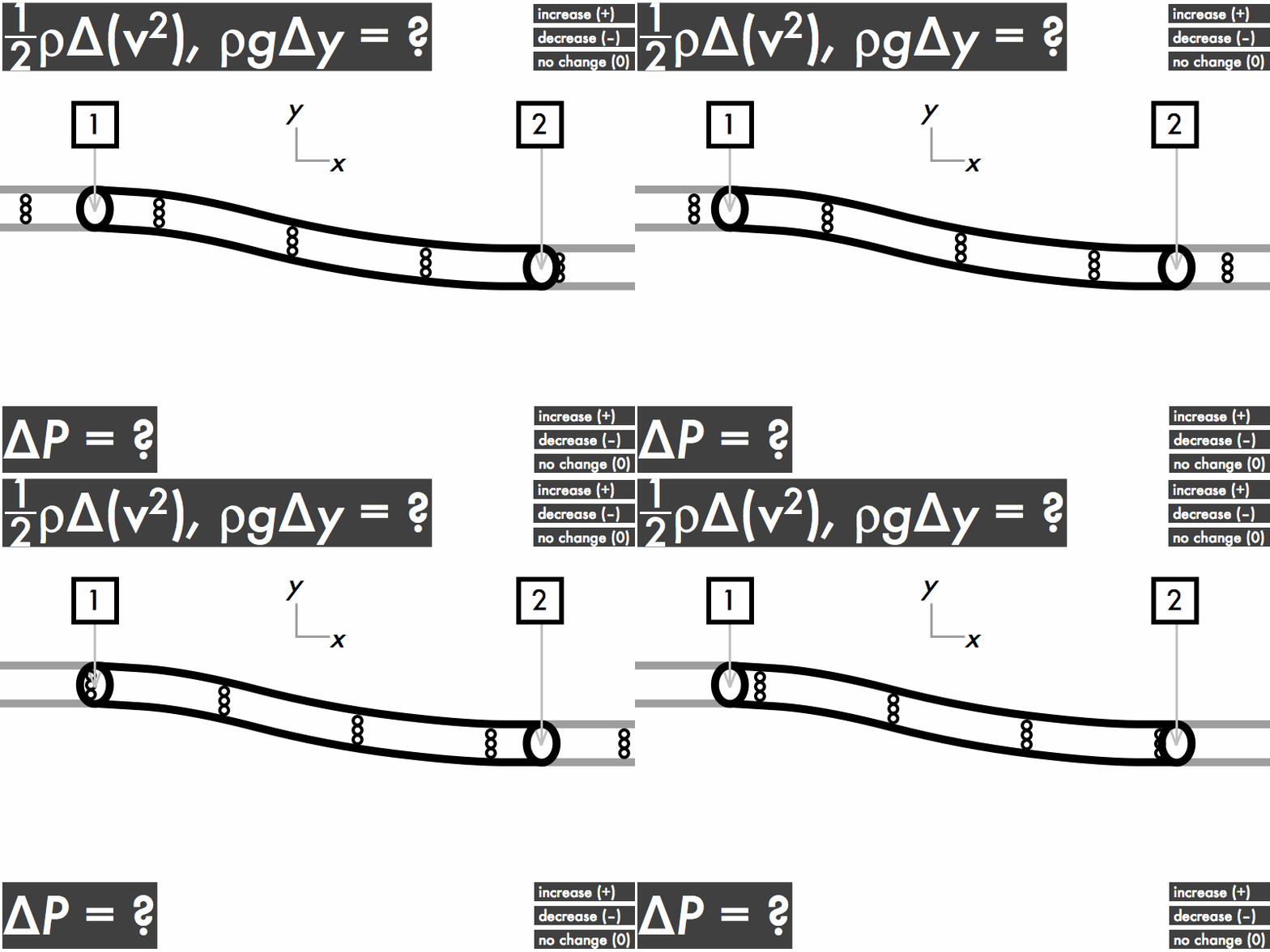
For an ideal fluid flowing through a pipe with a widening cross-sectional area, indicate the changes in each of fluid flow parameters.
(Only correct responses shown.)
(1/2)·ρ·∆(v2): decreases [54%]
ρ·g·∆y: no change [52%]
P: increases [33%]

For an ideal fluid flowing through a pipe with a narrowing cross-sectional area, indicate the changes in each of fluid flow parameters.
(Only correct responses shown.)
(1/2)·ρ·∆(v2): increases [57%]
ρ·g·∆y: no change [54%]
P: decreases [37%]

For an ideal fluid flowing through a descending pipe with a constant cross-sectional area, indicate the changes in each of fluid flow parameters.
(Only correct responses shown.)
(1/2)·ρ·∆(v2): no change [89%]
ρ·g·∆y: decreases [33%]
P: increases [74%]

Ask the instructor an anonymous question, or make a comment. Selected questions/comments may be discussed in class.
"If cross-sectional area is changing, do we assuming that particles are still moving in a straight line with no vertical deviation?" (Yes, if flow is laminar all the streamlines will be parallel to each other, either scrunching together or spacing apart without crossing. #whateveryoudodontcrossthestreams.)

"Great presentation GIFs. Super-helpful for understanding the material."

"Your drawings make everything better. shout out to visual learners."

"Go over these as you normally do, thank you!"

"Now you know why I don't want to be a physics major. I want to just live my life with plants and dirt."

20191023

Online reading assignment: fusion, nebulae, star cluster ages (SLO campus)

Astronomy 210, fall semester 2019
Cuesta College, San Luis Obispo, CA

Students have a weekly online reading assignment (hosted by SurveyMonkey.com), where they answer questions based on reading their textbook, material covered in previous lectures, opinion questions, and/or asking (anonymous) questions or making (anonymous) comments. Full credit is given for completing the online reading assignment before next week's lecture, regardless if whether their answers are correct/incorrect. Selected results/questions/comments are addressed by the instructor at the start of the following lecture.

The following questions were asked on reading textbook chapters and previewing presentations on fusion, nebulae, and star cluster ages.


Selected/edited responses are given below.

Describe something you found interesting from the assigned textbook reading or presentation preview, and explain why this was personally interesting for you.
"I'm excited to learn more about how fusion works. It just seems cool."

"How fusion only happens in the core of a star."

"I appreciated the cheerleader analogy, it actually really helped to be able to visualize what's happening at the sun's core."

"It is fascinating that lower-mass stars last longer than the current age of our universe, although it makes sense because, effectively, they are 'burning' slower."

"I thought it was funny that big stars burn out faster. For some reason reminded me of sumo wrestlers."

"Luminosity depends on mass for only main sequence stars--I thought that would apply for all stars."

"I just found how main sequence stars are ordered by mass, however the other stars (giants, super giants, and white dwarfs) aren't. It just caught my attention."

"That after a star runs out of hydrogen it dies :("

"It's amazing that there is so much matter in space, I thought it was just empty space."

"I thought the nebulae were super-cool (and super pretty). It's kinda weird to think about there being 'clouds' in space, I like it though."

"That nebulae are different colors due to the way photons interact with gas/dust."

"How the different components of nebulae determine their colors."

"I found that when there are a cluster of stars and when dust is around from the stars they turn into little planets around the star. This was interesting to me because when you look at the picture of the star cluster it just looks like a bunch of stars."

"Supernovae are interesting because they can 'kickstart' the formation of new stars."

"Star formation was one of the things I was most curious about coming into this class. It's interesting to learn about the process."

Describe something you found confusing from the assigned textbook reading or presentation preview, and explain why this was personally confusing for you.
"Fusion because there's big words and I am tired so my brains not really working if I'm being honest."

"I find the H-R diagram to be confusing at times. I think it has to do with the multitude of variables displayed. I thought I had it figured out last class, but then certain stars break from the mass-luminosity relationship. Conceptually that might have thrown me off some. My plan to further my understanding is to maybe ask for a walkthrough in class."

"I found the plotting of the other stars off the main-sequence a bit confusing because there's no correlation between their mass and luminosity."

"The main sequence lifetimes for different sizes of stars confused me for a little bit because I read it wrong when I first read it. At first I though the bigger stars would stick around the longest."

"Hydrostatic equilibrium and fusion."

"I'm not super-confused but would just like more practice with determining what is and isn't in a nebula."

"Learning about the different types of nebulae was a bit confusing for me. For the reflection nebula, it's hard for me to imagine how the cloud filters out the certain colors from the star hitting it. I don't understand how these nebulae behave differently in space based on their composition."

"The H-R diagram doesn't make sense to me, but I think I understand the house party model?"

"I don't understand the H-R diagram; specifically the turn-off point."

"It's all rather hard to grasp."

"Nothing in particular, what I read made sense to me. "

"I didn’t find anything confusing."

Rank the luminosities of these main-sequence stars (1 = brightest, 3 = dimmest). (There are no ties.)
(Only correct responses shown.)
Massive: brightest luminosity [100%]
Medium-mass (sunlike): medium luminosity [96%]
Low mass (red dwarf): dimmest luminosity [96%]

Rank the fusion rates of these main-sequence stars (1 = fastest, 3 = slowest). (There are no ties.)
(Only correct responses shown.)
Massive: fastest fusion rate [78%]
Medium-mass (sunlike): medium fusion rate [96%]
Low mass (red dwarf): slowest fusion rate [81%]

Fusion requires high temperatures in order for nuclei to move quickly enough to:
break heavy elements apart.  ***** [5]
create convection currents.  *** [3]
overcome gravity.  ** [2]
overcome repulsion.  *************** [15]
(Unsure/guessing/lost/help!)  ** [2]

Briefly explain why "cold fusion" (producing energy from hydrogen fusion at room temperature) would be implausible.
"Because it is much more effective at higher temperatures. The collisions between nuclei would not happen at room temperature."

"Fusion requires high pressure and temperatures. When pressure and temperatures are low, then hydrogen does not get squeezed as much and it moves too slowly to collide with one another."

"Because hydrogen can only be fused if it is moving very fast and under lots of pressure for enough force to overcome proton-proton repulsion."

"The amount of pressure required would be ridiculous."

Match the three different types of nebulae with their colors.
(Only correct responses shown.)
Emission: pink [93%]
Reflection: blue [93%]
Dark: brown/black [100%]

Match the three different types of nebulae with their composition.
(Only correct responses shown.)
Emission: hydrogen [96%]
Reflection: small dust particles [100%]
Dark: large dust particles [96%]

Rank the lifetimes of these main-sequence stars (1 = shortest, 3 = longest). (There are no ties.)
(Only correct responses shown.)
Massive: shortest main-sequence lifetime [67%]
Medium-mass (sunlike): medium main-sequence lifetime [96%]
Low mass (red dwarf): longest main-sequence lifetime [70%]

If there was an open invitation to a house party (no specific time given), when would you show up?
Early, or on time.  ***** [5]
When the most people should be there.  ********************* [21]
After most everyone has left.  * [1]

Ask the instructor an anonymous question, or make a comment. Selected questions/comments may be discussed in class.
"Why aren't the other types of stars ordered in terms of their masses on the H-R diagram?" (Because they're dying or dead stars that ran out of hydrogen in their cores.)

"I need more help on the H-R diagram and the mass and luminosity stuff."

"The H-R diagram is a little confusing to tell which stars have a higher/lower luminosity. From what I read the bottom stars have less right?" (Correct.)

"How do stars form from dust clouds? Or is it the hydrogen in the dust clouds that forms the stars? where does the dust come from in the first place?" (The universe started out with just hydrogen, which formed the first stars. Then after the stars fused hydrogen into other stuff, they they exploded, such that when subsequent stars can form (from the remaining unused hydrogen), planets can form around them from the "dust" that was produced from the previous generation.)

"My mind was blown when they said that there are more stars than grains of sand on Earth. That's insane! What's the method for counting all the grains of sand though?" (Count how many grains of sand in a handful; then estimate how many handfuls of sand there are...)

"So, when the Enterprise hides in a nebula from a Klingon warship (in the movie Star Trek II: The Wrath of Khan), wouldn't it be best for it to be a dark nebula, with the large clumpy dust particles? But then it shouldn't have looked like a big glowing cloud, right?" (You sound like you know way too much astronomy.)

"I found dark nebulas to be interesting. When I was thinking about it, the night sky is already dark. If you look at a long exposure photograph you could then see these dark clusters called dark nebulas. It's amazing that they are completely blocking a viewer on Earth from seeing some stars because of their thick dust clouds. My question is, can you see them with the naked eye, or only through photographs? I feel like I would have noticed a patch of the night sky missing by now." (There aren't any big dark nebulae close for us see them with the naked eye noticeably blocking stars, but if you do a time exposure so you can see faint, distant stars, you can make out a variety of dark nebulae that block out those really faint stars; those dark nebulae especially stand out with the Milky Way as a background.)

"Can a supernova be the birthplace of a black hole?" (It is, specifically a type II supernova.)

"Would you ever actually have a house party with your students to see who was truly honest about their answer on this assignment?" (That sounds like a science experiment to me.)

"You have any fun plans for Halloween?" (Mrs. P-dog and I celebrate Madonnaween.)

Online reading assignment: static fluids

Physics 205A, fall semester 2019
Cuesta College, San Luis Obispo, CA

Students have a bi-weekly online reading assignment (hosted by SurveyMonkey.com), where they answer questions based on reading their textbook, material covered in previous lectures, opinion questions, and/or asking (anonymous) questions or making (anonymous) comments. Full credit is given for completing the online reading assignment before next week's lecture, regardless if whether their answers are correct/incorrect. Selected results/questions/comments are addressed by the instructor at the start of the following lecture.

The following questions were asked on reading textbook chapters and previewing a presentation on static fluids.


Selected/edited responses are given below.

Describe what you understand from the assigned textbook reading or presentation preview. Your description (2-3 sentences) should specifically demonstrate your level of understanding.
"Mass density is mass of a substance divided by its volume."

"Pressure as force density is force divided by area. Pressure as energy density is energy divided by volume."

"The concept of pressure being force over surface area. As well as energy density conservation. If the surrounding pressure of an object increases then the ρ·g·∆y of the object will decrease and vice versa. As for the buoyant force, it's all dependent on the object's volume and the density of the fluid it is submerged in."

"That pressure and gravitational potential energy have an inverse relationship. So, for example, as a submarine goes further underwater in the y direction, its pressure increases while its gravitational potential energy decreases. The opposite is true for a balloon flying into the sky."

"In the example of a swimmer fully submerged underwater, I understand the application of Newton's first law in that all the forces acting on the swimmer balance out. This is given by the two forces of a downward weight force and upwards buoyant force balancing out."

Describe what you found confusing from the assigned textbook reading or presentation preview. Your description (2-3 sentences) should specifically identify the concept(s) that you do not understand.
"After going through the presentation preview, I was confused about the fluid density at first but then took another glance and realized that it is simply the kilograms divided by meters cubed because it is a 3D object it must be cubed."

"Something I didn't understand from the reading is pressure and depth in a static fluid. I don't understand the formula. I need an example of how to use it and what the variables mean."

"I was a little confused about the concept of buoyancy. I could definitely use some review of that equation."

"Archimedes' principle is a little confusing. When we draw our diagrams do we treat it as we would a normal force? Also, I feel like the book did a bad job at explaining some of this stuff. None of it seems too difficult by any means."

"The units and some equations that you use when looking at the problems. Hopefully will go over in class to clarify."

What is the numerical value for atmospheric pressure (Patm, at sea level), in units of Pa?
"101,325 Pa."

"1.013 × 10⁵ Pa, which is also 1 atm."

To three significant digits, what is the numerical value for the density of water, in units of kg/m3?
"1,000 kg/m3."

To two significant digits, what is the numerical value for the density of air (at 20° C), in units of kg/m3?
"1.2 kg/m3."

For the air pressure surrounding the balloon as it rises from ground level to the upper atmosphere, indicate the changes in each of the energy density forms of the atmosphere.
(Only correct responses shown.)
ρair·g·∆y: increases [61%]
P: decreases [56%]

For the water pressure that surrounded these cups as they were taken deep underwater, indicate the changes in each of the energy density forms of the water.
(Only correct responses shown.)
ρwater·g·∆y: decreases [44%]
P: increases [66%]

For the submerged diver floating underwater, Newton's __________ law applies, and the (downwards) weight force and (upwards) buoyant force on the diver are __________.
first; balanced.   ******************************** [32]
second; unbalanced.   ****** [6]
(Unsure/lost/guessing/help!)   *** [3]

Using ρ·g·V, the density of the __________ should be included in the calculation of the magnitude of the buoyant force on the diver.
diver.   *********** [11]
water.   *************************** [27]
(Unsure/lost/guessing/help!)   *** [3]

For the red ship (barely) afloat, Newton's __________ law applies, and its (downwards) weight force, the (downwards) oil platform's weight force, and the (upwards) buoyant force on the red ship are __________.
first; balanced.   **************************** [28]
second; unbalanced.   ********** [10]
(Unsure/lost/guessing/help!)   *** [3]

Using ρ·g·V, the density of __________ should be included in the calculation of the magnitude of the buoyant force on the red ship.
seawater.   *********************** [23]
air.   ** [2]
red ship.   ************ [12]
(Unsure/lost/guessing/help!)   **** [4]

Using ρ·g·V, the volume of the red ship's __________ should be included in the calculation of the magnitude of the buoyant force on the red ship.
underwater portion.   *********************** [23]
above water portion.   ** [2]
total volume, both underwater and above water.   ************* [13]
(Unsure/lost/guessing/help!)   [3]

Ask the instructor an anonymous question, or make a comment. Selected questions/comments may be discussed in class.
"Please go over these!"

"I would love if we could spend a generous amount of time calculating different pressures."

"Yikes! These were challenging for me. Hopefully I will feel better about this material after lecture."

"I do not understand the concept behind the red ship's buoyancy and I am having a hard time understanding the reasoning behind the formulas."

"Are we given the equations on the tests?" (Yes--you can see which equations were given on past quizzes and exams, so you wouldn't need to memorize those.)

20191022

Online reading assignment: fusion, nebulae, star cluster ages (NC campus)

Astronomy 210, fall semester 2019
Cuesta College, San Luis Obispo, CA

Students have a weekly online reading assignment (hosted by SurveyMonkey.com), where they answer questions based on reading their textbook, material covered in previous lectures, opinion questions, and/or asking (anonymous) questions or making (anonymous) comments. Full credit is given for completing the online reading assignment before next week's lecture, regardless if whether their answers are correct/incorrect. Selected results/questions/comments are addressed by the instructor at the start of the following lecture.

The following questions were asked on reading textbook chapters and previewing presentations on fusion, nebulae, and star cluster ages.


Selected/edited responses are given below.

Describe something you found interesting from the assigned textbook reading or presentation preview, and explain why this was personally interesting for you.
"The H-R diagram is great once you know how to read it."

"It was interesting to find out the luminosity, size and temperature for the stars using the H-R diagram."

"Big stars don't last as long as small ones, it makes sense but it just feel more right that because they're big it's a longer time for them to burn out."

"One thing I found interesting about main sequence stars is that the more massive they are, the more luminous they are."

"I had heard of nuclear fusion, but I didn't realize that was what fueled a star. It puts our efforts to replicate it here on Earth into perspective."

"Did not know that there were dust clouds in space that block out stars to where it looks like there is a black blotch."

"That there are different nebula as I was very vaguely informed on what one even was."

"Something that I found very interesting from this presentation was the notion of nebulas. Nebulas look like clouds in space but they serve a much larger purpose."

"How the reflection, emission, and dark nebula get their colors."

Describe something you found confusing from the assigned textbook reading or presentation preview, and explain why this was personally confusing for you.
"Something that I found personally confusing was the part where it talked about fusion, I was confused because the presentation doesn't really go into depth as to how it works. If you could explain it that would be great."

"Cold fusion, I just can't wrap my mind around it. Hydrogen and its isotopes at room temperature dissolve into a specific solid at such a high concentration a strong nuclear force occurs and boom, cold fusion?"

"Lifetime of stars?"

"Interstellar medium. I think I have the base idea about it but I would how we were able to find the interstellar dust in the vacuum of space."

"Is this a trick question? Everything’s confusing before you understand it 🤷‍♂️."

"I personally found all the reading to be a bit of an information overload and hope to have a lot of things clarified by next class."

Rank the luminosities of these main-sequence stars (1 = brightest, 3 = dimmest). (There are no ties.)
(Only correct responses shown.)
Massive: brightest luminosity [100%]
Medium-mass (sunlike): medium luminosity [100%]
Low mass (red dwarf): dimmest luminosity [100%]

Rank the fusion rates of these main-sequence stars (1 = fastest, 3 = slowest). (There are no ties.)
(Only correct responses shown.)
Massive: fastest fusion rate [71%]
Medium-mass (sunlike): medium fusion rate [100%]
Low mass (red dwarf): slowest fusion rate [71%]

Fusion requires high temperatures in order for nuclei to move quickly enough to:
break heavy elements apart.  ***** [5]
create convection currents.  **** [4]
overcome gravity.  ** [2]
overcome repulsion.  *** [3]
(Unsure/guessing/lost/help!)  [0]

Briefly explain why "cold fusion" (producing energy from hydrogen fusion at room temperature) would be implausible.
"Under low pressures and temperatures, hydrogen does not get squeezed very much, and moves too slowly, they won't collide with each other."

"Because nuclear fusion requires high temperatures to overcome the natural forces that normally prevent that kind of thing."

"Due to the fact that nuclei which are positively charge would not collided with each other but would repulse each other so the atoms could not create energy."

"Fusion can't happen in cold temperatures because protons are positively charged and repel each other."

"Have no clue."

"I'm not sure."

Match the three different types of nebulae with their colors.
(Only correct responses shown.)
Emission: pink [86%]
Reflection: blue [86%]
Dark: brown/black [93%]

Match the three different types of nebulae with their composition.
(Only correct responses shown.)
Emission: hydrogen [86%]
Reflection: small dust particles [71%]
Dark: large dust particles [71%]

Rank the lifetimes of these main-sequence stars (1 = shortest, 3 = longest). (There are no ties.)
(Only correct responses shown.)
Massive: shortest main-sequence lifetime [64%]
Medium-mass (sunlike): medium main-sequence lifetime [93%]
Low mass (red dwarf): longest main-sequence lifetime [57%]

If there was an open invitation to a house party (no specific time given), when would you show up?
Early, or on time.  ******** [8]
When the most people should be there.  ***** [5]
After most everyone has left.  * [1]

Ask the instructor an anonymous question, or make a comment. Selected questions/comments may be discussed in class.
"Does interstellar matter dust turn into a planet or a star? Both?" (Yes, either is possible.)

"I found this survey a bit difficult and could really use extra help."

"The picture of the nebulae are cool and I think we show see more of them."

"Nebulae have amazing colors."

"I love learning about stars! They're one of the most fascinating subjects in astronomy for me, given that our star is the only reason we're even alive."

20190410

Online reading assignment: fusion, nebulae, star cluster ages (SLO campus)

Astronomy 210, spring semester 2019
Cuesta College, San Luis Obispo, CA

Students have a weekly online reading assignment (hosted by SurveyMonkey.com), where they answer questions based on reading their textbook, material covered in previous lectures, opinion questions, and/or asking (anonymous) questions or making (anonymous) comments. Full credit is given for completing the online reading assignment before next week's lecture, regardless if whether their answers are correct/incorrect. Selected results/questions/comments are addressed by the instructor at the start of the following lecture.

The following questions were asked on reading textbook chapters and previewing presentations on fusion, nebulae, and star cluster ages.


Selected/edited responses are given below.

Describe something you found interesting from the assigned textbook reading or presentation preview, and explain why this was personally interesting for you.
"I find it interesting how many stars are out there and how they work. I don't understand how everything works, but it's great to know that there are people that care and share their learning with us to help us understand."

"I thought it was interesting about the weight of the layers in the sun being related to water in a swimming pool because that example helped me understand it."

"The cheerleader example for pressure and mass really helped."

"How you used cheerleaders as a representation for how more or less pressure on the core of a star produces more or less fusion and thus is brighter, or dimmer."

"The section on the star mass and luminosity relationship, because different types of stars have different relationships between mass, density, and luminosity."

"How there are only three true nebulae colors meaning there are a lot of fake pictures of space."

"I really liked reading about nebulae. I never knew there were more than one type, and apparently there are three."

"It was really cool to learn the reasons behind certain colors of nebulae. I didn't know that emission gave off a pinkish color, or that reflection was blue, but the example about cigarette smoke sometimes taking on the blue tint made sense."

"Learning more about how a star forms was quite interesting. They are such massive objects, its fascinating seeing how they started."

"Supernova shockwaves seem like an interesting subject to look into further."

"Pictures of cheerleaders. Just kidding. I really like the house party model, it's a great way to remember this! It was one of the easiest to remember models so far in class."

"I found your house party diagram very helpful in describing the different types of stars, it helps me visualize the subject better."

"Having been to lots of house parties I found the house party model to be the most interesting."

"I thought the house party analogy was very funny but also a good technique to help us remember information on the stars."

"I actually thought the house party model was helpful :P at first I was like how can this even relate to astronomy but then reading on I was like 'ohhhh.' Also, I was on Xbox as I was reading that and it just made the whole thing relatable."

Describe something you found confusing from the assigned textbook reading or presentation preview, and explain why this was personally confusing for you.
"The H-R diagram is kinda confusing to me."

"I found the H-R diagram to be confusing to me because I'm not sure how to use it."

"I'd like a deeper explanation of fusion, it's a lot."

"Fusion was actually really confusing for me. I don't really understand it, I think the book just confused me when I tried to read it."

"I was very confused about the proton-proton chain and CNO cycles."

"Hydrostatic equilibrium was a confusing concept, just because it seemed pretty complicated, but I feel like I can understand it if I just study the GIF animation a bit more."

"Fusion rates."

"Why are the masses all over the place for the non-main sequence stars?"

"Whether a nebula emits light itself, or is it reflecting light."

Rank the luminosities of these main-sequence stars (1 = brightest, 3 = dimmest). (There are no ties.)
(Only correct responses shown.)
Massive: brightest luminosity [90%]
Medium-mass (sunlike): medium luminosity [97%]
Low mass (red dwarf): dimmest luminosity [90%]

Rank the fusion rates of these main-sequence stars (1 = fastest, 3 = slowest). (There are no ties.)
(Only correct responses shown.)
Massive: fastest fusion rate [77%]
Medium-mass (sunlike): medium fusion rate [93%]
Low mass (red dwarf): slowest fusion rate [80%]

Fusion requires high temperatures in order for nuclei to move quickly enough to:
break heavy elements apart.  ***** [5]
create convection currents.  ***** [5]
overcome gravity.  *** [3]
overcome repulsion.  ************* [13]
(Unsure/guessing/lost/help!)  **** [4]

Briefly explain why "cold fusion" (producing energy from hydrogen fusion at room temperature) would be implausible.
"Because the hydrogen nuclei are both positive so they naturally repel each other. So they need to be hot to move fast such that they overcome their repulsion. The atomic nuclei have to come at each other with enough speed and temperature to break the repulsion. An object's temperature is just a measure of the overage speed with which its particles move. A high temperature ensures that collisions, between nuclei are violent and a high density ensures that there are enough collisions, to produce enough energy to keep the sun stable. Cold fusion is implausible because there needs to be heat in order to be collisions. "

Match the three different types of nebulae with their colors.
(Only correct responses shown.)
Emission: pink [90%]
Reflection: blue [87%]
Dark: brown/black [90%]

Match the three different types of nebulae with their composition.
(Only correct responses shown.)
Emission: hydrogen [83%]
Reflection: small dust particles [83%]
Dark: large dust particles [83%]

Rank the lifetimes of these main-sequence stars (1 = shortest, 3 = longest). (There are no ties.)
(Only correct responses shown.)
Massive: shortest main-sequence lifetime [90%]
Medium-mass (sunlike): medium main-sequence lifetime [93%]
Low mass (red dwarf): longest main-sequence lifetime [83%]

If there was an open invitation to a house party (no specific time given), when would you show up?
Early, or on time.  ****** [6]
When the most people should be there.  ************************ [24]
After most everyone has left.  [0]

Ask the instructor an anonymous question, or make a comment. Selected questions/comments may be discussed in class.
"Would it be possible to go over fusion in class? I don't really understand it."

"The textbook states that 'true stars' are powered by nuclear fusion. Is there such a thing as a 'false star?' the stars we see at night or is it a sun-like star but powered by something else?" (A "star" in general denotes something that emits light from its own energy source. The main-sequence stars (what we could consider as "true stars") fuse hydrogen in their cores to produce energy. Protostars aren't hot enough to fuse hydrogen, but they produce energy from their own gravitational contraction. Supergiants and giants produce energy from fusing stuff heavier than hydrogen.)

"I'd like a fair amount of lecture on these topics."

"Did you come up with the house party analogy yourself?" (Actually, yes.)

"The house party model was totally relatable. Thanks for that."

"What's the craziest party story you have from when you went to college?" (I don't really remember specific details. So maybe it really was a crazy party. #coolstorybro)

"What happens when a star explodes?" (We'll find out in next week's class.)

"With all the squeezing that takes place from a sun collapsing into black holes, and the pressure there being so immense, could there possibly be a new form of fusion taking place past the event horizon?" (Well, no one will every know what goes on within the event horizon.)

"If hydrogen is just one proton and no neutrons, but all protons 'hate each other,' how the heck can a molecular cloud be filled with proton-rich hydrogen, yet still 'self-start' by continually clumping together exponentially until it somehow pulls in even more stuff to create more complex structures? It just seems kinda contradictory." (Don't underestimate the power of the gravitational force. If a molecular cloud is cool enough that stuff moves slowly, and if it is large enough (light years across), then over time gravitational forces between everything will eventually pull the cloud in on itself to make a star (or planets).)

"Do you speak other languages?" (Is Hawaiian pidgin a language?)