Showing posts with label Bernoulli's equation. Show all posts

20191104

Physics quiz question: horizontal pipe with varying cross-sectional areas

Physics 205A Quiz 5, fall semester 2019
Cuesta College, San Luis Obispo, CA

Assume ideal fluid flow for water through this horizontal pipe with different cross-sectional areas.


The greatest pressure is at:
(A) point [1].
(B) point [2].
(C) point [3].
(D) (There is a tie.)

Correct answer (highlight to unhide): (B)

From applying the continuity equation:

A1·v1 = A2·v2 = A3·v3,

where the fluid volume flow rate is the same throughout each of these three sections of pipe. As the cross-sectional area of the pipe is smallest at point [3] and largest at point [2], then:

A3 < A1 < A2,

such that the speeds at each section of pipe can be ordered accordingly, where the fastest speed occurs where the cross-sectional area is the narrowest:

v2 < v1 < v3.

Then from Bernoulli's equation:

0 = ∆P + (1/2)·ρ·∆(v2) + ρ·g·∆y,

because the pipe is horizontal, then ∆y = 0, and we can neglect the last term, such that:

0 = ∆P + (1/2)·ρ·∆(v2).

Comparing points [1] and [2] gives us:

0 = P2P1 + (1/2)·ρ·((v2)2 – (v1)2),

P1 + (1/2)·ρ·(v1)2 = P2 + (1/2)·ρ·(v2)2,

and similarly comparing points [2] and [3] gives us:

0 = P3P2 + (1/2)·ρ·((v3)2 – (v2)2),

P2 + (1/2)·ρ·(v2)2 = P3 + (1/2)·ρ·(v3)2.

Thus we can now compare the pressure and (1/2)·ρ·v2 terms for all three points:

P1 + (1/2)·ρ·(v1)2 = P2 + (1/2)·ρ·(v2)2 = P3 + (1/2)·ρ·(v3)2,

where the location with the smallest (1/2)·ρ·v2 term would correspond to having the greatest pressure. Earlier, from the continuity equation, since v2 < v1 < v3, then:

P2 > P1 > P3,

such that location [3] (having the largest area and slowest speed) would have the greatest pressure.

Sections 70854, 70855
Exam code: quiz05Gu1L
(A) : 1 student
(B) : 35 students
(C) : 10 students
(D) : 6 students

Success level: 67%
Discrimination index (Aubrecht & Aubrecht, 1983): 0.66

Physics quiz archive: rotations, torque, pressure, buoyancy, fluid flow

Physics 205A Quiz 5, fall semester 2019
Cuesta College, San Luis Obispo, CA
Sections 70854, 70855, version 1
Exam code: quiz05Gu1L


Sections 70854, 70855 results
0- 6 :   ** [low = 6]
7-12 :   *********
13-18 :   ***********
19-24 :   ***************** [mean = 19.8 +/- 6.3]
25-30 :   ************* [high = 27]

20191028

Online reading assignment: ideal fluid flow

Physics 205A, fall semester 2019
Cuesta College, San Luis Obispo, CA

Students have a bi-weekly online reading assignment (hosted by SurveyMonkey.com), where they answer questions based on reading their textbook, material covered in previous lectures, opinion questions, and/or asking (anonymous) questions or making (anonymous) comments. Full credit is given for completing the online reading assignment before next week's lecture, regardless if whether their answers are correct/incorrect. Selected results/questions/comments are addressed by the instructor at the start of the following lecture.

The following questions were asked on reading textbook chapters and previewing a presentation on ideal fluid flow.


Selected/edited responses are given below.

Describe what you understand from the assigned textbook reading or presentation preview. Your description (2-3 sentences) should specifically demonstrate your level of understanding.
"Fluid flow can be steady or unsteady. Velocity at any point is constant as time passes for a steady flow. Unsteady flow exists whenever the velocity at a point in the fluid changes as time passes. Fluids can also be compressible or incompressible, most being nearly incompressible. Fluid flow can be viscous or nonviscous. A viscous fluid does not flow readily but a non-viscous one, like water, does."

"Ideal fluid flow has the following characteristics; incompressible, laminar, and non-viscous. I understand how volume flow rate conservation law that comes from its incompressible nature uses the continuity equation. And how the energy density conservation law uses Bernoulli's equation."

"Fluid flow can be steady or unsteady; Unsteady flow exists whenever the velocity at a point in the fluid changed as time passes, Turbulent flow is an extreme kind of unsteady flow and occurs when there are sharp obstacles or bends in the path of a fast moving fluid. Fluid can be compressible or incompressible, fluid flow can be viscous or non-viscous."

"I understand that when an ideal fluid flows through a pipe with a widening cross sectional area, the velocity of the fluid will slow down, kinetic energy decreases and the pressure will increase. When an ideal fluid flows through a pipe with a narrowing cross sectional area, the velocity of the fluid will increase, kinetic energy is increases and the pressure will decrease."

"As the area decreases the fluid speed increases. when elevation decreases the fluid speed also increases. Bernoulli's equation relates the density, pressure, fluid speed and elevation at two separate points."

Describe what you found confusing from the assigned textbook reading or presentation preview. Your description (2-3 sentences) should specifically identify the concept(s) that you do not understand.
"I seemed to understand this subject, but completely differentiating between the properties of ideal fluid flow will need more practice. What seemed somewhat confusing or a little more review in class are volume flow conservation and energy density conservation, and exactly how to apply the continuity equation to volume flow rate conservation law and the Bernoulli's equation to energy density conservation law."

"Bernoulli's equation definitely seems ominous. I can see the relation between energy conservation and this topic. However, hopefully after the homework problems I'll be more comfortable with it."

"I am confused about when to use Bernoulli's equation and how the concepts of the work-energy theorem relates to this equation. I am confused by what is meant by how elevation changes the various variables as well."

"I don't understand when the pressure or density changes, or how to know when y changes, how that works with/ against the change in area. I dont understand how to calculate anything, lost :("

"I didn't quite understand Bernoulli’s equation. The equations itself looked very complicated and when the book didn’t really provide an example problem and I feel like I just learn better that way so maybe that’s why I feel like I didn’t understand how to use the equation."

"This chapter seemed to hold a mess of equations that I don't know when to use or how to use them; however, it seems similar to the set-up of our previous conservation equations in which we ignore one side of the equation and can determine whether each piece on the right side of the equation is increasing or decreasing."

"How Bernoulli's equation relates to the work-energy theorem."

"I don't understand anything yet."

What is the SI (Système International) unit for volume flow rate?
"m3/s."

Use a real friend to do this with you. Not an imaginary friend.
For an ideal fluid flowing through a pipe with a constant cross-sectional area, the volume flow rate ∆V/∆t:
decreases.   [0]
remains constant.   **************************************** [40]
increases.   **** [4]
(Unsure/lost/guessing/help!)   ** [2]

Use a real friend to do this with you. Not an imaginary friend.
For an ideal fluid flowing through a horizontal pipe with an increasing cross-sectional area, the volume flow rate ∆V/∆t:
decreases.   ************************* [25]
remains constant.   ********* [9]
increases.   ********** [10]
(Unsure/lost/guessing/help!)   ** [2]

Use a real friend to do this with you. Not an imaginary friend.
For an ideal fluid flowing through a horizontal pipe with a decreasing cross-sectional area, the volume flow rate ∆V/∆t:
decreases.   ********** [10]
remains constant.   ******* [7]
increases.   *************************** [27]
(Unsure/lost/guessing/help!)   ******* [2]

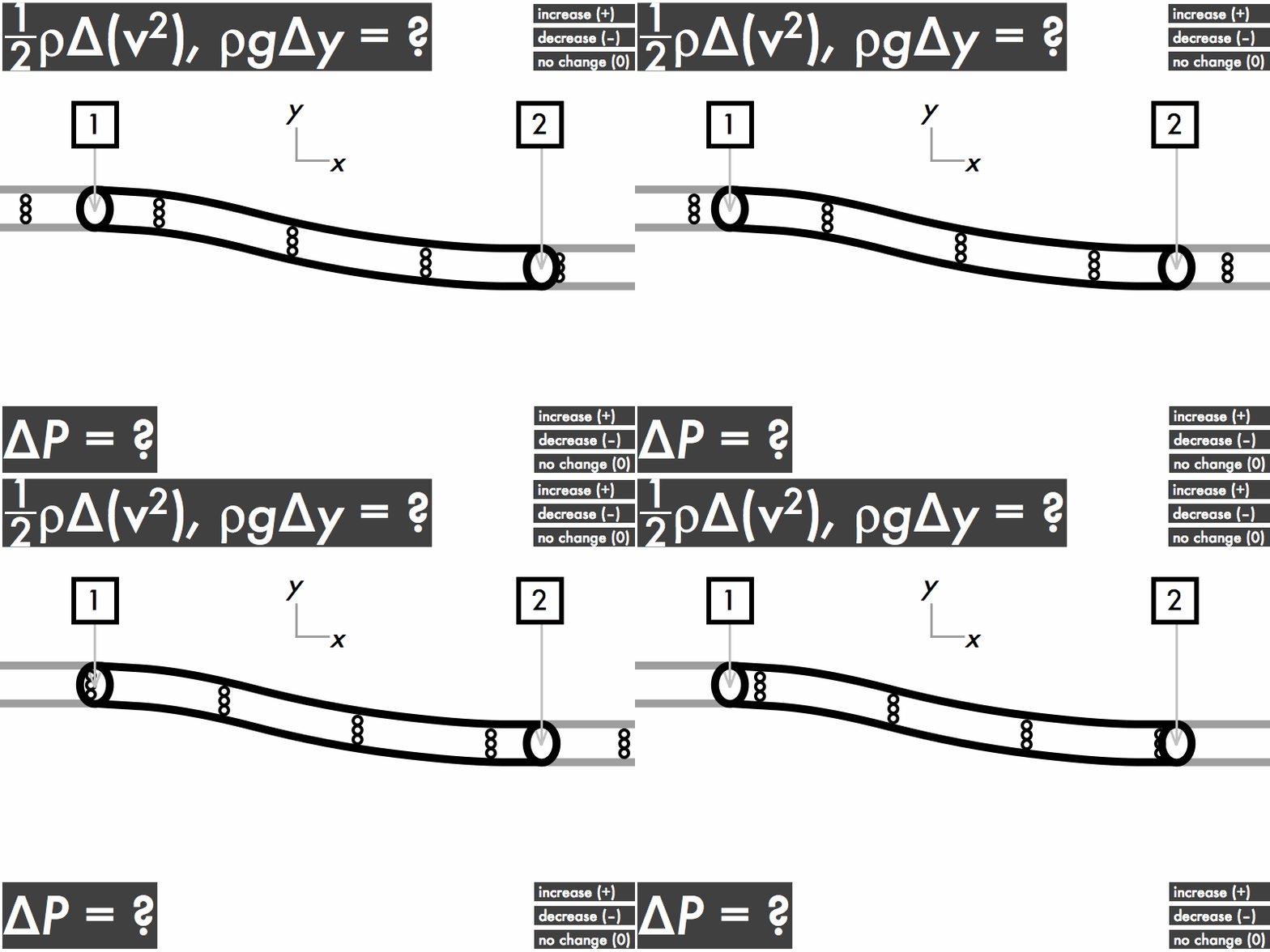
For an ideal fluid flowing through a pipe with a widening cross-sectional area, indicate the changes in each of fluid flow parameters.
(Only correct responses shown.)
(1/2)·ρ·∆(v2): decreases [54%]
ρ·g·∆y: no change [52%]
P: increases [33%]

For an ideal fluid flowing through a pipe with a narrowing cross-sectional area, indicate the changes in each of fluid flow parameters.
(Only correct responses shown.)
(1/2)·ρ·∆(v2): increases [57%]
ρ·g·∆y: no change [54%]
P: decreases [37%]

For an ideal fluid flowing through a descending pipe with a constant cross-sectional area, indicate the changes in each of fluid flow parameters.
(Only correct responses shown.)
(1/2)·ρ·∆(v2): no change [89%]
ρ·g·∆y: decreases [33%]
P: increases [74%]

Ask the instructor an anonymous question, or make a comment. Selected questions/comments may be discussed in class.
"If cross-sectional area is changing, do we assuming that particles are still moving in a straight line with no vertical deviation?" (Yes, if flow is laminar all the streamlines will be parallel to each other, either scrunching together or spacing apart without crossing. #whateveryoudodontcrossthestreams.)

"Great presentation GIFs. Super-helpful for understanding the material."

"Your drawings make everything better. shout out to visual learners."

"Go over these as you normally do, thank you!"

"Now you know why I don't want to be a physics major. I want to just live my life with plants and dirt."

20181105

Physics quiz archive: rotations, torque, pressure, buoyancy, fluid flow

Physics 205A Quiz 5, fall semester 2018
Cuesta College, San Luis Obispo, CA
Sections 70854, 70855, version 1
Exam code: quiz05Ro74


Sections 70854, 70855 results
0- 6 :  
7-12 :   ******** [low = 9]
13-18 :   **************
19-24 :   ************************* [mean = 19.6 +/- 5.2]
25-30 :   ***** [high = 30]

20181029

Online reading assignment: ideal fluid flow

Physics 205A, fall semester 2018
Cuesta College, San Luis Obispo, CA

Students have a bi-weekly online reading assignment (hosted by SurveyMonkey.com), where they answer questions based on reading their textbook, material covered in previous lectures, opinion questions, and/or asking (anonymous) questions or making (anonymous) comments. Full credit is given for completing the online reading assignment before next week's lecture, regardless if whether their answers are correct/incorrect. Selected results/questions/comments are addressed by the instructor at the start of the following lecture.

The following questions were asked on reading textbook chapters and previewing a presentation on ideal fluid flow.


Selected/edited responses are given below.

Describe what you understand from the assigned textbook reading or presentation preview. Your description (2-3 sentences) should specifically demonstrate your level of understanding.
"An ideal liquid is one that is in-compressible, non-viscous, and should undergo a laminar flow. The conservation laws regarding liquids allow us to determine several factors regarding liquids including volume and energy."

"The differences between compressible and non-compressible fluids which is kind of straight forward. Also the difference between non-viscous and viscous and between laminar and turbulent."

"An ideal fluid is incompressible, laminar, and non-viscous. Since it is incompressible, volume flow rate is conserved. Even when a pipe changes radius, the incompressibility of an ideal fluid means the same volume flowing in one end equals the same volume coming out the other end in the same time interval."

"I feel like I have a good grasp on the continuity equation. If the area of the 'in' is smaller than the area of the 'out,' then the speed will decrease on the way out. If the area for the 'in' is bigger than the 'out,' then the speed will increase on the way out."

"The volume flow rate of a fluid is defined to be the volume of fluid that is passing through a given cross sectional area per unit time. Because liquids are incompressible, any portion of liquid flowing through a pipe could change shape, but it must maintain the same volume. This is true even if the pipe changes diameter. In the diagram below [for the horizontal narrowing pipe] of liquid on the left changes shape as it enters a narrow section of pipe, but it maintains the same volume since liquids are incompressible."

"Sorry P-dog, but I'm still preparing for my art history midterm."

Describe what you found confusing from the assigned textbook reading or presentation preview. Your description (2-3 sentences) should specifically identify the concept(s) that you do not understand.
"I am kind of confused about Bernoulli's equation."

"I need help understanding Bernoulli's equation."

"I cannot seem to understand energy density conservation."

"I was confused why the equations have to balance out all the time."

"I need a better understanding of what each of the symbols represent in the equations. as well how to properly go about solving them."

"I found Bernoulli's equation a bit confusing. Mostly how gravitational potential energy density is affected by the cross-sectional area."

"I found the energy density conservation equations kind of confusing and would like to see examples of them worked out in lecture."

"Bernoulli's equation--I am not sure if the equation will always be balanced or if there are some cases where the right-hand side will not equal to 0."

"I think I understand why area and fluid speed increase, decrease, or are constant for given situations but I'm a little unsure when it comes to determining the values of each term in Bernoulli's equation. "

"I understand the difference between viscous and non-viscous liquids. I found everything else about this reading confusing."

"It all makes sense."

"I think I'm going to be okay right now."

What is the SI (Système International) unit for volume flow rate?
"m3/s."

"Cubic meters per second."

"kg/s?"

"m/s2?"

Use a real friend to do this with you. Not an imaginary friend.
For an ideal fluid flowing through a pipe with a constant cross-sectional area, the volume flow rate ∆V/∆t:
decreases.   [0]
remains constant.   *********************************************** [47]
increases.   ** [2]
(Unsure/lost/guessing/help!)   * [1]

Use a real friend to do this with you. Not an imaginary friend.
For an ideal fluid flowing through a horizontal pipe with an increasing cross-sectional area, the volume flow rate ∆V/∆t:
decreases.   ******************** [20]
remains constant.   *********************** [23]
increases.   ****** [6]
(Unsure/lost/guessing/help!)   * [1]

Use a real friend to do this with you. Not an imaginary friend.
For an ideal fluid flowing through a horizontal pipe with a decreasing cross-sectional area, the volume flow rate ∆V/∆t:
decreases.   ******* [7]
remains constant.   ********************* [21]
increases.   ********************* [21]
(Unsure/lost/guessing/help!)   * [1]

For an ideal fluid flowing through a pipe with a widening cross-sectional area, indicate the changes in each of fluid flow parameters.
(Only correct responses shown.)
(1/2)·ρ·∆(v2): decreases [58%]
ρ·g·∆y: no change [64%]
P: increases [52%]

For an ideal fluid flowing through a pipe with a narrowing cross-sectional area, indicate the changes in each of fluid flow parameters.
(Only correct responses shown.)
(1/2)·ρ·∆(v2): increases [54%]
ρ·g·∆y: no change [56%]
P: decreases [54%]

For an ideal fluid flowing through a descending pipe with a constant cross-sectional area, indicate the changes in each of fluid flow parameters.
(Only correct responses shown.)
(1/2)·ρ·∆(v2): no change [72%]
ρ·g·∆y: decreases [26%]
P: increases [18%]

Ask the instructor an anonymous question, or make a comment. Selected questions/comments may be discussed in class.
"When you say water is incompressible to some extent, is that referring to ice?" (And liquid water, as well. This is why hydraulics work, as well as intravenous drips and hypodermic injections--push in here, stuff on the other side pushes out.)

"Is the flow rate with an ideal fluid always constant with the in and out?" (Yes, as ideally the fluid would be incompressible.)

"A little lost on the potential changes in kinetic, gravitational, pressure changes for the this last pipe with what appears to be no change in cross-sectional area, but a decrease in gravitational energy density." (That sounds pretty good, though.)

"I am a little confused on the descending pipe question and whether the pressure increases or decreases." (The pressure will increase, as the gravitational potential energy density decreases.)

"This is very difficult."

"I would like to go over these laws more in class."

"I don't understand the variables, but I believe that I will understand the concepts once we clarify each variable."

"Doing good so far."

"How do you have time to read 60+ comments?" (If I ask 60+ students to make time to answer questions and/or make comments on the reading assignments, then I have to make time to read them all. #becarefulofwhatyouwishfor)

20171117

Physics quiz question: speed, pressure changes in horizontal, narrowing pipe

Physics 205A Quiz 5, fall semester 2017
Cuesta College, San Luis Obispo, CA

Water as it moves horizontally from [1]→[2] through a pipe with decreasing cross-sectional area. The radius of the pipe at point [1] is 0.10 m, and water enters point [1] with a speed of 0.25 m/s. Assume ideal fluid flow. As water flows from [1]→[2], the speed __________; while the pressure __________.
(A) remains constant; remains constant.
(B) remains constant; changes.
(C) changes; remains constant.
(D) changes; changes.

Correct answer (highlight to unhide): (D)

From applying the continuity equation:

A1·v1 = A2·v2,

because the diameter of the pipe narrows as it flows from [1]→[2], the cross-sectional area decreases (A1 > A2), such that the speed of the water increases:

v1 < v2.

Then from Bernoulli's equation:

0 = ∆P + (1/2)·ρ·∆(v2) + ρ·g·∆y,

the third term on the right-hand side is zero because there is no change in elevation (y1 = y2), while the second term on the right-hand side increases (as the speed increases along the pipe), thus the pressure must decrease. Thus both speed and pressure change as water flows from [1]→[2] through this pipe.

Sections 70854, 70855
Exam code: quiz05nWaW
(A) : 0 students
(B) : 6 students
(C) : 6 students
(D) : 36 students

Success level: 73%
Discrimination index (Aubrecht & Aubrecht, 1983): 0.29

20171113

Physics quiz archive: rotations, torque, pressure, buoyancy, fluid flow

Physics 205A Quiz 5, fall semester 2017
Cuesta College, San Luis Obispo, CA
Sections 70854, 70855, version 1
Exam code: quiz05nWaW


Sections 70854, 70855 results
0- 6 :  
7-12 :   ***** [low = 9]
13-18 :   ***************
19-24 :   ********************* [mean = 19.7 +/- 4.8]
25-30 :   ***** [high = 27]

20171106

Online reading assignment: ideal fluid flow

Physics 205A, fall semester 2017
Cuesta College, San Luis Obispo, CA

Students have a bi-weekly online reading assignment (hosted by SurveyMonkey.com), where they answer questions based on reading their textbook, material covered in previous lectures, opinion questions, and/or asking (anonymous) questions or making (anonymous) comments. Full credit is given for completing the online reading assignment before next week's lecture, regardless if whether their answers are correct/incorrect. Selected results/questions/comments are addressed by the instructor at the start of the following lecture.

The following questions were asked on reading textbook chapters and previewing a presentation on ideal fluid flow.


Selected/edited responses are given below.

Describe what you understand from the assigned textbook reading or presentation preview. Your description (2-3 sentences) should specifically demonstrate your level of understanding.
"This assigned reading was about dynamic fluids, or ideal fluid flow, as opposed to static fluids which we saw in a previous presentation."

"I can distinguish between viscous and non viscous, turbulent and laminar, and incompressible and compressible."

"Ideal fluids are incompressible, while water is to some extent. Air is not incompressible. water can undergo both, laminar flow and turbulent flow."

"Change in cross-sectional area affects the velocity of the water in a pipe. It's like the same concept of when spraying water and blocking the end to have stronger water flow."

"Area and velocity are inversely related to each other. Bernoulli's equation must remain balanced. Greek letter ρ is the density, and P is the pressure."

"As a pipe's radius changes, that means that the volume flowing at one end must still be equal to the volume coming out, but the speed of that fluid is affected by the change."

"An ideal fluid should undergo laminar flow, where the adjacent particles flow smoothly past each other, instead of undergoing turbulent flow, when particles swirl around in a chaotic manner."

"The fluid volume flow rate does not change even if the area in which the fluid is flowing through changes."

"A fluid speeds up as it moves from a large end to narrow end of a tube."

"I feel I have a loose understanding of volume flow conservation and energy density conservation."

"Even though I really skimmed the content, I feel like you make the information accessible and the new equations easy to use."

Describe what you found confusing from the assigned textbook reading or presentation preview. Your description (2-3 sentences) should specifically identify the concept(s) that you do not understand.
"Why does height differences matter (Δy) for pressure changes?"

"When talking about volume flow rate it's confusing as to why the flow going in is equal to flow going out."

"How is the volume flow rate connected to the continuity equation?"

"Bernoulli's equation."

"I think I am grasping the concepts, but I could definitely use some examples to make sure that I am correctly understanding Bernoulli's equation."

"Bernoulli's equation could be elaborated on more. I think I understand where the energy density transfers take place, but not 100% sure."

"This section seems very clear and straight forward. The GIF animations help a lot with visualizing the liquid and the energy/pressure going through the pipe."

"I feel like I understood most of it all. Maybe if a situation where a tube slightly gets smaller or larger over its length."

"I usually end up reading the chapter after class on monday when this happens between class and the lab."

What is the SI (Système International) unit for volume flow rate?
"m3/s."

"Cubic meters per second."

"Pa?"

"kg/s?"

Use a real friend to do this with you. Not an imaginary friend.
For an ideal fluid flowing through a pipe with a constant cross-sectional area, the volume flow rate ∆V/∆t:
decreases.   [0]
remains constant.   *************************************** [39]
increases.   *** [3]
(Unsure/lost/guessing/help!)   * [1]

Use a real friend to do this with you. Not an imaginary friend.
For an ideal fluid flowing through a horizontal pipe with an increasing cross-sectional area, the volume flow rate ∆V/∆t:
decreases.   **************** [16]
remains constant.   ************* [13]
increases.   ************* [13]
(Unsure/lost/guessing/help!)   * [1]

Use a real friend to do this with you. Not an imaginary friend.
For an ideal fluid flowing through a horizontal pipe with a decreasing cross-sectional area, the volume flow rate ∆V/∆t:
decreases.   ** [12]
remains constant.   ************** [14]
increases.   **************** [16]
(Unsure/lost/guessing/help!)   * [1]

For an ideal fluid flowing through a pipe with a widening cross-sectional area, indicate the changes in each of fluid flow parameters.
(Only correct responses shown.)
(1/2)·ρ·∆(v2): decreases [56%]
ρ·g·∆y: no change [70%]
P: increases [47%]

For an ideal fluid flowing through a pipe with a narrowing cross-sectional area, indicate the changes in each of fluid flow parameters.
(Only correct responses shown.)
(1/2)·ρ·∆(v2): increases [52%]
ρ·g·∆y: no change [63%]
P: decreases [47%]

For an ideal fluid flowing through a descending pipe with a constant cross-sectional area, indicate the changes in each of fluid flow parameters.
(Only correct responses shown.)
(1/2)·ρ·∆(v2): no change [74%]
ρ·g·∆y: decreases [44%]
P: increases [28%]

Ask the instructor an anonymous question, or make a comment. Selected questions/comments may be discussed in class.
"Review on how to use Bernoulli's equation in these applications."

"Examples with Bernoulli's equation?"

"Going over the above examples would be very helpful. They made little sense to me."

"What is an example of an ideal fluid like we would be judging in this case? Is water usually non-viscous and laminar?" (Not always, but in large enough pipes that don't have too many bends, water is approximated very well with laminar flow. Same with air, as long as it flows through ventilation ducts that are reasonably aerodynamic, it will also have laminar flow.)

"Why was Bernoulli's equation named after him?" (He was the first person to recognize that a moving fluid can transfer its gravitational potential energy and translational kinetic energy to and from pressure.)

"How long have you had a mustache?" (Probably longer than you've been alive.)