Showing posts with label penumbra. Show all posts

20200220

Astronomy quiz archive: eclipses/history of astronomy

Astronomy 210 Quiz 2, spring semester 2020
Cuesta College, San Luis Obispo, CA

Section 30674, version 1
Exam code: quiz02n1xI


Section 30674
0- 8.0 :   ** [low = 6.0]
8.5-16.0 :   *****
16.5-24.0 :   ******* [mean = 23.8 +/- 9.0]
24.5-32.0 :   *********
32.5-40.0 :   ******* [high = 36.5]


Section 30676, version 1
Exam code: quiz02SnRl


Section 30676
0- 8.0 :   ** [low = 8.0]
8.5-16.0 :   *******
16.5-24.0 :   *************
24.5-32.0 :   ********* [mean = 24.8 +/- 9.2]
32.5-40.0 :   ************* [high = 40.0]

20190912

Astronomy quiz archive: eclipses/history of astronomy

Astronomy 210 Quiz 2, fall semester 2019
Cuesta College, San Luis Obispo, CA

Section 70158, version 1
Exam code: quiz02SnPy


Section 70158
0- 8.0 :   * [low = 4.0]
8.5-16.0 :   *******
16.5-24.0 :   ****
24.5-32.0 :   ******** [mean = 28.1 +/- 9.8]
32.5-40.0 :   ***************** [high = 40.0]


Section 70160, version 1
Exam code: quiz02n4rN


Section 70160
0- 8.0 :   * [low = 8.0]
8.5-16.0 :   *
16.5-24.0 :   ********
24.5-32.0 :   ******* [mean = 25.8 +/- 7.4]
32.5-40.0 :   ***** [high = 40.0]

20190221

Astronomy quiz archive: eclipses/history of astronomy

Astronomy 210 Quiz 2, spring semester 2019
Cuesta College, San Luis Obispo, CA

Section 30674, version 1
Exam code: quiz02nrNa


Section 30674
0- 8.0 :  
8.5-16.0 :   *** [low = 12.0]
16.5-24.0 :   *****
24.5-32.0 :   ***************** [mean = 29.2 +/- 7.6]
32.5-40.0 :   *********** [high = 40.0]


Section 30676, version 1
Exam code: quiz02Sn0W


Section 30676
0- 8.0 :  
8.5-16.0 :   ***** [low = 8.5]
16.5-24.0 :   ******
24.5-32.0 :   ************** [mean = 28.7 +/- 8.9]
32.5-40.0 :   ****************** [high = 40.0]

20180927

Astronomy quiz question: January 20, 2019 total lunar eclipse

Astronomy 210 Quiz 3, spring semester 2016
Cuesta College, San Luis Obispo, CA

A total lunar eclipse will be visible for observers in San Luis Obispo, CA occur January 20, 2019[*]. During this total lunar eclipse, these observers would see:
(A) the moon, completely within Earth's shadow.
(B) the moon, completely illuminated by the sun.
(C) the moon completely blocking the sun.
(D) the sun, with part of it being blocked by the moon.
(E) the sun, with no part of it being blocked by the moon.

[*] timeanddate.com/eclipse/lunar/2019-january-21.

Correct answer (highlight to unhide): (A)

During a total lunar eclipse, the full moon will be completely within Earth's umbra, and would typically appear a very, very dark brown-red.

(If there is no lunar eclipse of any time, the full moon would be completely illuminated by the sun. During a partial lunar eclipse the full moon would have a dark shadow across part of it (assuming that is the extent of what is covered on the full moon), when only part of it (at most) would be within Earth's umbra.)

(The entire sun would be blocked by a new moon during a total solar eclipse, as seen by an observer located under the moon's umbra; only part of the sun would be blocked by a new moon (assuming that is the extent of what is covered by the moon) during a partial solar eclipse, where the observer is in the moon's penumbra.)

Section 70158
Exam code: quiz03zH0g
(A) : 25 students
(B) : 3 students
(C) : 2 students
(D) : 3 students
(E) : 3 students

Success level: 71% (including partial credit for multiple-choice)
Discrimination index (Aubrecht & Aubrecht, 1983): 0.40

Section 70160
Exam code: quiz03McC6
(A) : 10 students
(B) : 2 students
(C) : 4 students
(D) : 0 students
(E) : 0 students

Success level: 64% (including partial credit for multiple-choice)
Discrimination index (Aubrecht & Aubrecht, 1983): 0.60

20180912

Astronomy quiz archive: eclipses/history of astronomy

Astronomy 210 Quiz 2, fall semester 2018
Cuesta College, San Luis Obispo, CA

Section 70158, version 1
Exam code: quiz02Sl3I


Section 70158
0- 8.0 :   * [low = 4.0]
8.5-16.0 :   ********
16.5-24.0 :   *******
24.5-32.0 :   ********* [mean = 24.8 +/- 9.6]
32.5-40.0 :   ********** [high = 40.0]


Section 70160, version 1
Exam code: quiz02N3r1


Section 70160
0- 8.0 :  
8.5-16.0 :   ******** [low = 12.0]
16.5-24.0 :   **** [mean = 19.3 +/- 6.8]
24.5-32.0 :   **** [high = 28.5]
32.5-40.0 :  

20180215

Astronomy quiz question: phase during partial solar eclipse

Astronomy 210 Quiz 2, spring semester 2018
Cuesta College, San Luis Obispo, CA

A partial solar eclipse will be visible for observers in portions of South America and Antartica on February 15, 2018[*]. During this partial solar eclipse, the moon will be in its __________ phase.
(A) new.
(B) first quarter.
(C) full.
(D) third quarter.
(E) (Depends on the time of day.)

[*] timeanddate.com/eclipse/solar/2018-february-15.

Correct answer (highlight to unhide): (A)

During any type of solar eclipse, the moon is directly between the sun and Earth, and must be in its new phase.

Section 30674
Exam code: quiz02npP4
(A) : 15 students
(B) : 6 students
(C) : 3 students
(D) : 0 students
(E) : 0 students

Success level: 66% (including partial credit for multiple-choice)
Discrimination index (Aubrecht & Aubrecht, 1983): 0.63

Section 30676
Exam code: quiz02sn4E
(A) : 21 students
(B) : 4 students
(C) : 11 students
(D) : 4 students
(E) : 0 students

Success level: 54% (including partial credit for multiple-choice)
Discrimination index (Aubrecht & Aubrecht, 1983): 0.91

Astronomy quiz archive: eclipses/history of astronomy

Astronomy 210 Quiz 2, fall semester 2017
Cuesta College, San Luis Obispo, CA

Section 70158, version 1
Exam code: quiz02Sdi3


Section 70158
0- 8.0 :   ** [low = 3.0]
8.5-16.0 :   ********
16.5-24.0 :   ****************** [mean = 22.0 +/- 7.8]
24.5-32.0 :   ***********
32.5-40.0 :   ***** [high = 36.5]


Section 70160, version 1
Exam code: quiz02NoL4


Section 70160
0- 8.0 :   * [low = 6.5]
8.5-16.0 :   ******
16.5-24.0 :   *********** [mean = 23.3 +/- 8.4]
24.5-32.0 :   ******
32.5-40.0 :   ***** [high = 40.0]

20171005

Astronomy quiz question: not being able to see the July 27, 2018 total lunar eclipse

Astronomy 210 Quiz 3, fall semester 2017
Cuesta College, San Luis Obispo, CA

A total lunar eclipse will occur on July 27, 2018[*]. During this event, observers in San Luis Obispo, CA will not be able to see it because:
(A) the moon will be too far away.
(B) the moon's orbit will be too tilted.
(C) the moon will have the wrong phase.
(D) it will be daytime in San Luis Obispo, CA.

[*] timeanddate.com/eclipse/lunar/2018-july-27.

Correct answer (highlight to unhide): (D)


When the moon is completely within Earth's umbra, then it will appear very, very dark brown-red during a total lunar eclipse. Everyone on the night side of Earth will be able to see this occur simultaneously; while everyone on the day side of Earth will not be able to see this, as they will on the side of Earth facing away from the moon. (The total lunar eclipse shown above depicts the near-opposite of the July 27, 2018 total lunar eclipse, where observers in North and South America are on the night side of Earth and are able to see the total lunar eclipse, while observers in Europe and Africa are on the day slide of Earth and are not able to this total lunar eclipse.)

Section 70158
Exam code: quiz03S3ir
(A) : 1 student
(B) : 10 students
(C) : 1 student
(D) : 32 students

Success level: 73% (including partial credit for multiple-choice)
Discrimination index (Aubrecht & Aubrecht, 1983): 0.73

Section 70160
Exam code: quiz03Ni5t
(A) : 1 student
(B) : 13 students
(C) : 6 students
(D) : 11 students

Success level: 39% (including partial credit for multiple-choice)
Discrimination index (Aubrecht & Aubrecht, 1983): 0.21

20170921

Astronomy quiz archive: eclipses/history of astronomy

Astronomy 210 Quiz 2, spring semester 2018
Cuesta College, San Luis Obispo, CA

Section 30674, version 1
Exam code: quiz02npP4


Section 30674
0- 8.0 :   * [low = 6.0]
8.5-16.0 :   *
16.5-24.0 :   ********
24.5-32.0 :   ****** [mean = 27.0 +/- 9.2]
32.5-40.0 :   ******** [high = 40.0]


Section 30676, version 1
Exam code: quiz02sn4E


Section 30676
0- 8.0 :  
8.5-16.0 :   *********** [low = 8.5]
16.5-24.0 :   **********
24.5-32.0 :   ******** [mean = 24.1 +/- 9.3]
32.5-40.0 :   *********** [high = 40.0]

20170220

Astronomy quiz question: August 2017 partial solar eclipse in San Luis Obispo, CA

Astronomy 210 Quiz 2, spring semester 2017
Cuesta College, San Luis Obispo, CA

A total solar eclipse will occur on August 21, 2017 for many observers in the United States[*]. During this event, observers San Luis Obispo, CA will only see a partial solar eclipse[**], because they will be located in:
(A) the moon's umbra.
(B) the moon's penumbra.
(C) the moon's negative shadow.
(D) Earth's umbra.
(E) Earth's penumbra.

[*] eclipse.gsfc.nasa.gov/SEgoogle/SEgoogle2001/SE2017Aug21Tgoogle.html.
[**] timeanddate.com/eclipse/in/usa/san-luis-obispo?iso=20170821.

Correct answer: (B)

An observer in the moon's penumbra will see a partial solar eclipse, while an observer in the moon's umbra will see a total solar eclipse. (The "negative shadow" refers to the antumbra of the moon.)

Section 30674
Exam code: quiz02n1hT
(A) : 2 students
(B) : 17 students
(C) : 0 students
(D) : 2 students
(E) : 2 students

Success level: 76% (including partial credit for multiple-choice)
Discrimination index (Aubrecht & Aubrecht, 1983): 0.38

Section 30676
Exam code: quiz02sNoO
(A) : 3 students
(B) : 28 students
(C) : 1 student
(D) : 3 students
(E) : 7 students

Success level: 69% (including partial credit for multiple-choice)
Discrimination index (Aubrecht & Aubrecht, 1983): 0.64

20170217

Astronomy quiz archive: eclipses/history of astronomy

Astronomy 210 Quiz 2, spring semester 2017
Cuesta College, San Luis Obispo, CA

Section 30674, version 1
Exam code: quiz02n1hT

Section 30674
0- 8.0 :  
8.5-16.0 :  
16.5-24.0 :   ****** [low = 20.0]
24.5-32.0 :   ********* [mean = 29.1 +/- 5.6]
32.5-40.0 :   ******** [high = 40.0]


Section 30676, version 1
Exam code: quiz02sNoO

Section 30676
0- 8.0 :   * [low = 8.0]
8.5-16.0 :   *******
16.5-24.0 :   ***********
24.5-32.0 :   ********* [mean = 24.5 +/- 7.8]
32.5-40.0 :   ********* [high = 40.0]

20160917

Astronomy quiz question: September 16, 2016 partial lunar eclipse

Astronomy 210 Quiz 2, fall semester 2016
Cuesta College, San Luis Obispo, CA

A partial lunar eclipse will occur on September 16, 2016.[*] Observers in New Delhi, India will be able to see this eclipse while it happens, because they will be located:
(A) on Earth's daylight side.
(B) on Earth's night side.
(C) in the moon's penumbra.
(D) in the moon's negative shadow.
(E) in the moon's umbra.

[*] eclipsewise.com/oh/oh-figures/ec2016-Fig04.pdf.

Correct answer (highlight to unhide): (B)

For a partial lunar eclipse, the full moon is partially in both the umbra and in the penumbra shadow zones of Earth. All observers on the night side of Earth would be able to see the full moon during this partial lunar eclipse; however, observers on the daylight side of Earth would not.

(Observers in any of the moon's shadow zones (the umbra, penumbra, or "negative shadow" (antumbra)) during any type of lunar eclipse would then be located somewhere behind the dark side of the moon!)

Section 70158
Exam code: quiz02sr7Y
(A) : 4 students
(B) : 12 students
(C) : 18 students
(D) : 2 students
(E) : 4 students

Success level: 34% (including partial credit for multiple-choice)
Discrimination index (Aubrecht & Aubrecht, 1983): 0.55

Section 70160
Exam code: quiz02nYNy
(A) : 3 students
(B) : 3 students
(C) : 16 students
(D) : 6 students
(E) : 4 students

Success level: 16% (including partial credit for multiple-choice)
Discrimination index (Aubrecht & Aubrecht, 1983): 0.22

20160916

Astronomy quiz archive: eclipses/history of astronomy

Astronomy 210 Quiz 2, fall semester 2016
Cuesta College, San Luis Obispo, CA

Section 70158, version 1
Exam code: quiz02sr7Y


Section 70158
0- 8.0 :   *** [low = 2.0]
8.5-16.0 :   *********
16.5-24.0 :   ****** [mean = 23.3 +/- 8.7]
24.5-32.0 :   ***************
32.5-40.0 :   ******** [high = 33.0]


Section 70160, version 1
Exam code: quiz02nYNy


Section 70160
0- 8.0 :   *** [low = 4.0]
8.5-16.0 :   *******
16.5-24.0 :   ******** [mean = 20.3 +/- 8.2]
24.5-32.0 :   *************
32.5-40.0 :   * [high = 36.5]

20160304

Astronomy quiz question: March 23, 2016 penumbral lunar eclipse

Astronomy 210 Quiz 3, spring semester 2016
Cuesta College, San Luis Obispo, CA

Before sunrise on the morning of March 23, 2016, the moon will pass inside Earth's penumbra for observers in San Luis Obispo, CA[*]. These observers will see:
(A) a dark shadow across part of a full moon.
(B) a very, very dark brown-red full moon.
(C) a full moon slightly dimmer than usual.
(D) only part of the sun blocked by a new moon.
(E) the entire sun blocked by a new moon.
(F) a new moon not large enough to entirely block the sun while in front of it.

[*] timeanddate.com/eclipse/lunar/2016-march-23.

Correct answer (highlight to unhide): (C)

When the moon is completely within Earth's penumbra, it is still illuminated by some of the sun's light, and will be only slightly dimmer (but usually not noticeably dimmer, to the naked eye) than a regular full moon.

(The full moon would appear a very, very dark brown-red during a total lunar eclipse, when it is completely within Earth's umbra; and the full moon would have a dark shadow across part of it (assuming that is the extent of what is covered on the full moon) during a partial lunar eclipse, when only part of it (at most) would be within Earth's umbra.)

(The entire sun would be blocked by a new moon during a total solar eclipse, as seen by an observer located under the moon's umbra; only part of the sun would be blocked by a new moon (assuming that is the extent of what is covered by the moon) during a partial solar eclipse, where the observer is in the moon's penumbra; and a new moon not large enough to entirely block the sun while in front of it would be seen during an annular solar eclipse, where the observer is in the moon's antumbra (in this class, called the "negative shadow").)

Section 30674
Exam code: quiz03n0V4
(A) : 5 students
(B) : 5 students
(C) : 1 student
(D) : 5 students
(E) : 3 students
(F) : 1 student

Success level: 8% (including partial credit for multiple-choice)
Discrimination index (Aubrecht & Aubrecht, 1983): 0.17

Section 30676
Exam code: quiz03s4rA
(A) : 12 students
(B) : 9 students
(C) : 12 students
(D) : 9 students
(E) : 3 students
(F) : 3 students

Success level: 28% (including partial credit for multiple-choice)
Discrimination index (Aubrecht & Aubrecht, 1983): 0.36

20160218

Astronomy quiz archive: eclipses/history of astronomy

Astronomy 210 Quiz 2, spring semester 2016
Cuesta College, San Luis Obispo, CA

Section 30674, version 1
Exam code: quiz02NAwL


Section 30674
0- 8.0 :   *** [low = 4.5]
8.5-16.0 :   ********** [mean = 15.9 +/- 7.2]
16.5-24.0 :   *****
24.5-32.0 :   ** [high = 32.0]
32.5-40.0 :  


Section 30676, version 1
Exam code: quiz02sL4g


Section 30676
0- 8.0 :   **** [low = 4.0]
8.5-16.0 :   ***************
16.5-24.0 :   **************** [mean = 19.7 +/- 7.4]
24.5-32.0 :   **************
32.5-40.0 :   * [high = 32.5]

20150919

Astronomy quiz question: next full moon after total lunar eclipse

Astronomy 210 Quiz 2, fall semester 2015
Cuesta College, San Luis Obispo, CA

Observers in San Luis Obispo, CA will see a total lunar eclipse in the evening of September 27, 2015.[*][**] There will not be a total lunar eclipse in the following month because:
(A) the moon always keeps the same side facing Earth.
(B) the moon's orbit around Earth is tilted.
(C) the moon's orbit is not a perfect circle.
(D) Earth's axis precesses over a 23,000 year cycle.

[*] timeanddate.com/eclipse/lunar/2015-september-28.
[**] eclipse.gsfc.nasa.gov/LEplot/LEplot2001/LE2015Sep28T.pdf.

Correct answer (highlight to unhide): (B)

When the moon is full and the moon's orbit is seen edge-on from the sun's perspective, there will be a total eclipse as the moon passes completely behind Earth, in Earth's umbral shadow. However, the moon's orbit will typically change its tilt such the subsequent full moon will no longer pass directly behind Earth, being either too high or low to pass into Earth's umbral shadow, making it just a regular full moon instead of a total lunar eclipse.


Response (A) explains why the near side of the moon appears to be constant; response (C) explains why some solar eclipses are annular rather than total; and response (D) is the reason why Polaris will not always be the pole star.

Section 70158
Exam code: quiz02s5Sz
(A) : 3 students
(B) : 25 students
(C) : 13 students
(D) : 1 student

Success level: 63% (including partial credit for multiple-choice)
Discrimination index (Aubrecht & Aubrecht, 1983): 0.83

Section 70160
Exam code: quiz02Nnz2
(A) : 0 students
(B) : 16 students
(C) : 13 students
(D) : 0 students

Success level: 57% (including partial credit for multiple-choice)
Discrimination index (Aubrecht & Aubrecht, 1983): 0.75

20150917

Astronomy quiz archive: eclipses/history of astronomy

Astronomy 210 Quiz 2, fall semester 2015
Cuesta College, San Luis Obispo, CA

Section 70158, version 1
Exam code: quiz02s5Sz


Section 70158
0- 8.0 :  
8.5-16.0 :   ********** [low = 8.5]
16.5-24.0 :   *********** [mean = 23.1 +/- 8.2]
24.5-32.0 :   **************
32.5-40.0 :   ******* [high = 40.0]


Section 70160, version 1
Exam code: quiz02Nnz2


Section 70160
0- 8.0 :  
8.5-16.0 :   ******* [low = 9.0]
16.5-24.0 :   ********* [mean = 23.5 +/- 7.7]
24.5-32.0 :   ********
32.5-40.0 :   ***** [high = 36.0]

20150308

Astronomy quiz archive: eclipses/history of astronomy

Astronomy 210 Quiz 2, spring semester 2015
Cuesta College, San Luis Obispo, CA

Section 30674, version 1
Exam code: quiz02n4S7


Section 30674
0- 8.0 :  
8.5-16.0 :   *** [low = 11.0]
16.5-24.0 :   *************
24.5-32.0 :   ************** [mean = 26.2 +/- 7.7]
32.5-40.0 :   ********** [high = 40.0]


Section 30676, version 1
Exam code: quiz05s7yK


Section 30676
0- 8.0 :  
8.5-16.0 :   *** [low = 12.0]
16.5-24.0 :   **********
24.5-32.0 :   **************** [mean = 28.8 +/- 7.7]
32.5-40.0 :   ****************** [high = 40.0]

20141005

Astronomy quiz question: position of moon during October 2014 total lunar eclipse

Astronomy 210 Quiz 3, fall semester 2014
Cuesta College, San Luis Obispo, CA

Observers in San Luis Obispo, CA will see a total lunar eclipse in October 2014.[*] During the total lunar eclipse, the moon will be located in:
(A) the moon's umbra.
(B) the moon's penumbra.
(C) the moon's negative shadow.
(D) Earth's umbra.
(E) Earth's penumbra.

[*] http://eclipse.gsfc.nasa.gov/OH/OHfigures/OH2014-Fig03.pdf.

Correct answer (highlight to unhide): (D)

During a total lunar eclipse, light from the sun that illuminate the full moon would be completely blocked by Earth, when the moon is completely within Earth's "complete shadow," or its umbra. (Note that since the textbook shows but does not specifically name the moon's antumbra, it is referred to as the moon's "negative shadow" for the purposes of discussion in this class.)


Section 70158
Exam code: quiz03s8tE
(A) : 5 students
(B) : 2 students
(C) : 2 students
(D) : 23 students
(E): 7 students

Success level: 57% (including partial credit for multiple-choice)
Discrimination index (Aubrecht & Aubrecht, 1983): 0.81

Section 70160
Exam code: quiz03n6n4
(A) : 5 students
(B) : 4 students
(C) : 1 student
(D) : 19 students
(E): 5 students

Success level: 57% (including partial credit for multiple-choice)
Discrimination index (Aubrecht & Aubrecht, 1983): 0.49

20140918

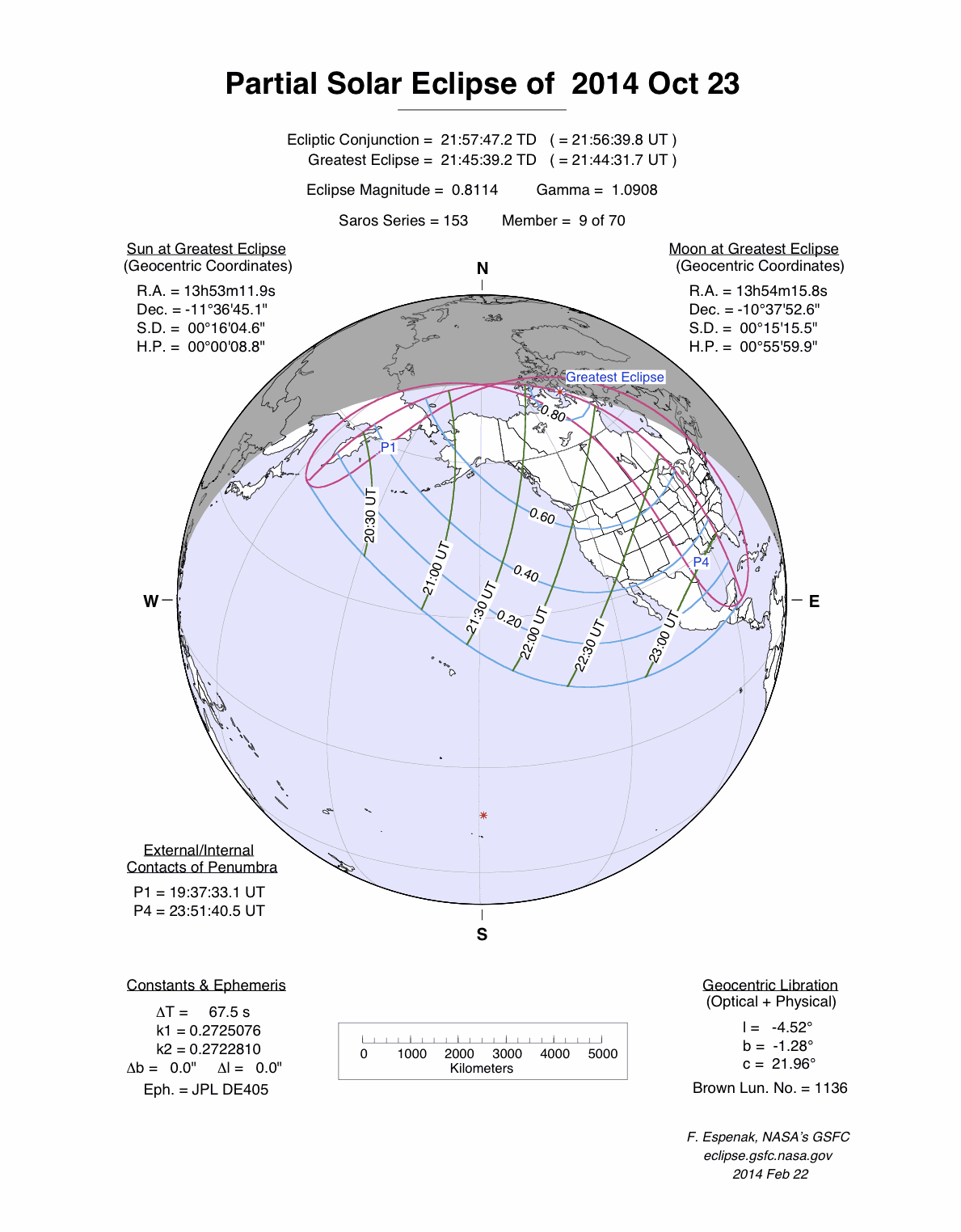
Astronomy quiz question: October 2014 total lunar eclipse and partial solar eclipse

Astronomy 210 Quiz 2, fall semester 2014
Cuesta College, San Luis Obispo, CA

Observers in San Luis Obispo, CA will see a total lunar eclipse followed by a partial solar eclipse, both occurring in October 2014.[*][**] The total lunar eclipse would occur a few __________ before the partial solar eclipse.
(A) minutes.
(B) hours.
(C) days.
(D) weeks.

[*] eclipse.gsfc.nasa.gov/OH/OHfigures/OH2014-Fig03.pdf.
[*] eclipse.gsfc.nasa.gov/SEplot/SEplot2001/SE2014Oct23P.GIF.

Correct answer (highlight to unhide): (D)

The total lunar eclipse occurs when the moon is in its full phase (such that the moon will be in Earth's umbra); while for the partial solar eclipse the moon is in its new phase (such that observers on Earth are located in the moon's penumbra.) Since these two eclipses will occur within the same month, these must be consecutive full and new phases, which is approximately two weeks between these phases.

Section 70158
Exam code: quiz02n3w7
(A) : 8 students
(B) : 11 students
(C) : 6 students
(D) : 17 students

Success level: 41% (including partial credit for multiple-choice)
Discrimination index (Aubrecht & Aubrecht, 1983): 0.62

Section 70160
Exam code: quiz02k3pL
(A) : 4 students
(B) : 2 students
(C) : 7 students
(D) : 21 students

Success level: 64% (including partial credit for multiple-choice)
Discrimination index (Aubrecht & Aubrecht, 1983): 0.44