Cuesta College, San Luis Obispo, CA
Sections 30882, 30883, version 1
Exam code: quiz03Cv1d


Sections 30882, 30883 results
| 0- 6 : | |
| 7-12 : | |
| 13-18 : | **** [low = 15] |
| 19-24 : | *************** |
| 25-30 : | *************** [mean = 24.2 +/- 4.2] [high = 30] |
| 0- 6 : | |
| 7-12 : | |
| 13-18 : | **** [low = 15] |
| 19-24 : | *************** |
| 25-30 : | *************** [mean = 24.2 +/- 4.2] [high = 30] |

"I understand that if two sound speakers are wired the same, then they will be in phase which results in constructive interference and the sound will be louder. If they are not wired the same, then they will be out of phase which results in destructive interference and a more quiet sound."
"If two waves are in phase and have a whole length difference, they will produce constructive interference. If the waves are out of phase or have a half wavelength difference, destructive interference is produced."
"The principle of linear superposition states that the resultant disturbance is the sum of the disturbances from the individual waves. I also understand that interference alters the brightness of light and loudness of sound."
"This paragraph from the presentation helped me understand the basics: 'Here we have two speakers, which are our sources of two sound waves. Since they are plugged into the same frequency source, they will generate sound waves of the same frequency f (which is depends only on the source), same speed v (which depends only on the medium), and thus the same wavelength λ (which depends on both f and v). If the speakers are wired the same way--red and black wires to red and black plugs--then they will oscillate in phase, with both speaker cones moving forward and backwards in unison.'"
"I understood the in-phase and out-of-phase part, and how to tell the difference. I also understood what is constructive and destructive."
"The way two wave sources are emitted determines whether the resulting wave will be constructive or deconstructive. In-phase waves have the same velocity, wavelength, and frequency, also in-phase waves are traveling in the same direction and can form a constructive of bigger resulting wave. Out-Phase waves do not align crest to trough and they do not have the same velocity, frequency or wavelength and the resulting wave is smaller or no wave."
"My primary take-away from this set of slides is the difference between constructive interference (music playing from the neighbor's stereo), and destructive interference (silence, or quieted volume). When the crests and troughs of the two wavelengths line up, constructive interference occurs; however, if those wavelengths are not aligned, destructive interference takes place."
"There was not much that I understood from this presentation."
"I need a little more detail about when the interfering wave examples have a whole wavelength path length difference or half-wavelength path length difference."
"Completely grasping the constructive/destructive conditions flowchart."
"I found the flowchart of constructive/destructive conditions to be overwhelming especially because I don't fully understand the solid lines vs. the dashed lines. I could also use a bit of clarification on what path difference is."
"I would like a little more understand on phase differences. As well as how path length difference works."
"At first, the path length difference was confusing to understand because I did not comprehend the equations. However, after seeing some visual examples, I now understand and can observe whether a wave will be constructive or destructive."
"The difference between constructive and destructive seemed confusing. Its relationship with waves was easier to understand with the diagrams."
"I found a lot confusing with these concepts. I don't understand the difference between constructive and destructive waves. I also don't how changing the distance makes the two so different. I am also confused what they are considered when the waves are in unison, but the distance is changed."
"How does this work for radio waves? Please give examples of constructive, destructive and non-coherent sources. The book only uses visible light as an example."
"This isn't very confusing to me."

1: in phase sources [91%]; whole wavelength path difference [74%]; constructive [97%]
2: in phase sources [14%]; half wavelength path difference [86%]; destructive [89%]
3: in phase sources [86%]; whole wavelength path difference [77%]; constructive [89%]
4: out of phase sources [86%]; whole wavelength path difference [40%]; destructive [94%]
5: out of phase sources [23%]; half wavelength path difference [49%]; constructive [86%]
6: out of phase sources [89%]; whole wavelength path difference [54%]; destructive [97%]
"Finally lenses are over. I don't wear glasses so it was a difficult set of chapters." (I'm not so sure that this topic was any easier for student who do wear corrective optics.)
"When you change the volume on a stereo how is more sound produced? Are more sound waves generated?" (Well, "more" in the sense that the speaker cone moves in and out with a larger range of motion (larger amplitude), so more air is pushed in and out, and a greater range of pressure fluctuations result.)
"What does m stand for in the constructive/destructive conditions equation?" (Any whole positive/negative number (0, ±1, ±2, etc.).)
"Why in the world could I not find anything about path length differences?"
"May we review situation #5 specifically?"
"I just need a brief discussion about these ideas and I think I will be good on this topic."
"The wave interference problems don't seem too difficult, just need some practice."
"In that case given the two sources had the same total length and each crest and trough matched, I assumed there would be no length difference; yet, that was not an option?" (A case where there is no path length difference is the covered under the case of having a path length difference of a whole (number) of wavelengths, in this case the whole number would be zero.)
"If two sound waves are not exactly a half-wavelength off from each other, would there still be destructive interference?" (Yes, but they would not completely cancel each other out. The resulting loudness would be quieter than a single wave, but not completely quiet.)
"Will we be using noise-canceling headphones?" (That is a great application of destructive interference, but no. You can always purchase a set for yourself, though.)
"I was confused about coherent and non-coherent light sources of light. What makes a laser coherent compared to light bulbs which are incoherent?" (Basically, the light from a laser has a constant amplitude, single wavelength that starts off with a definite phase, while light from an incandescent bulb is a range of different wavelengths that can vary in amplitude and phase. It's a bit more complicated than that, but for our purposes we'll start from this working definition.)
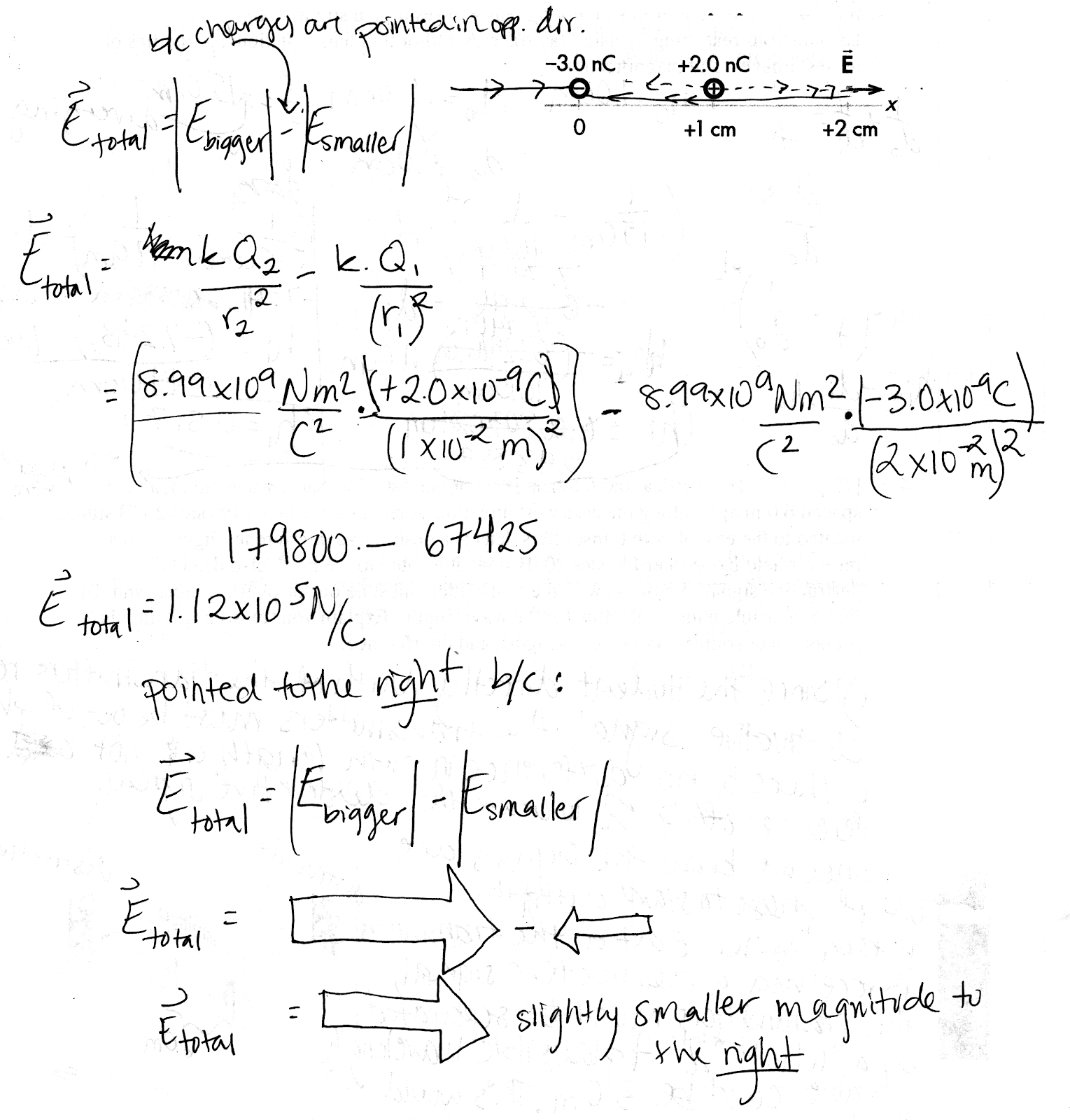
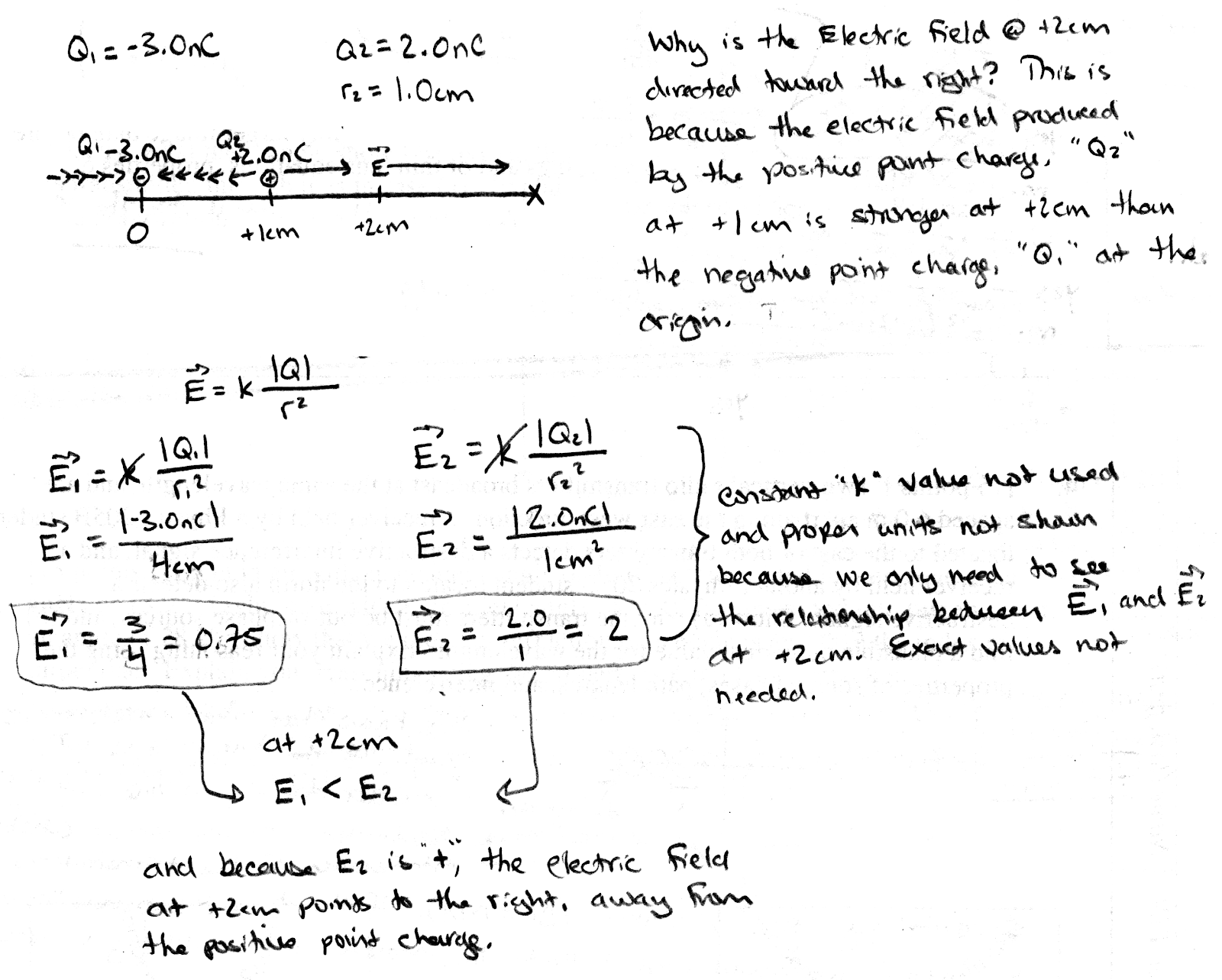
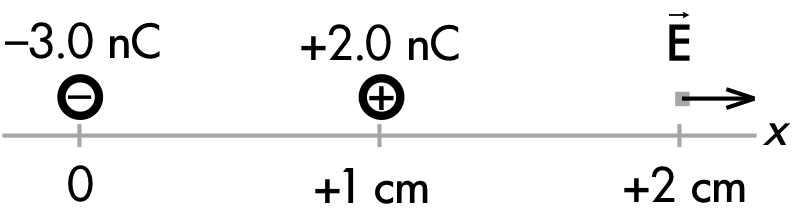 A –3.0 nC point charge is held at the origin, and +2.0 nC point charge is held at x = +1 cm. Discuss why the electric field at x = +2 cm is directed to the right. Explain your reasoning using properties of electric forces, fields, and vector superposition.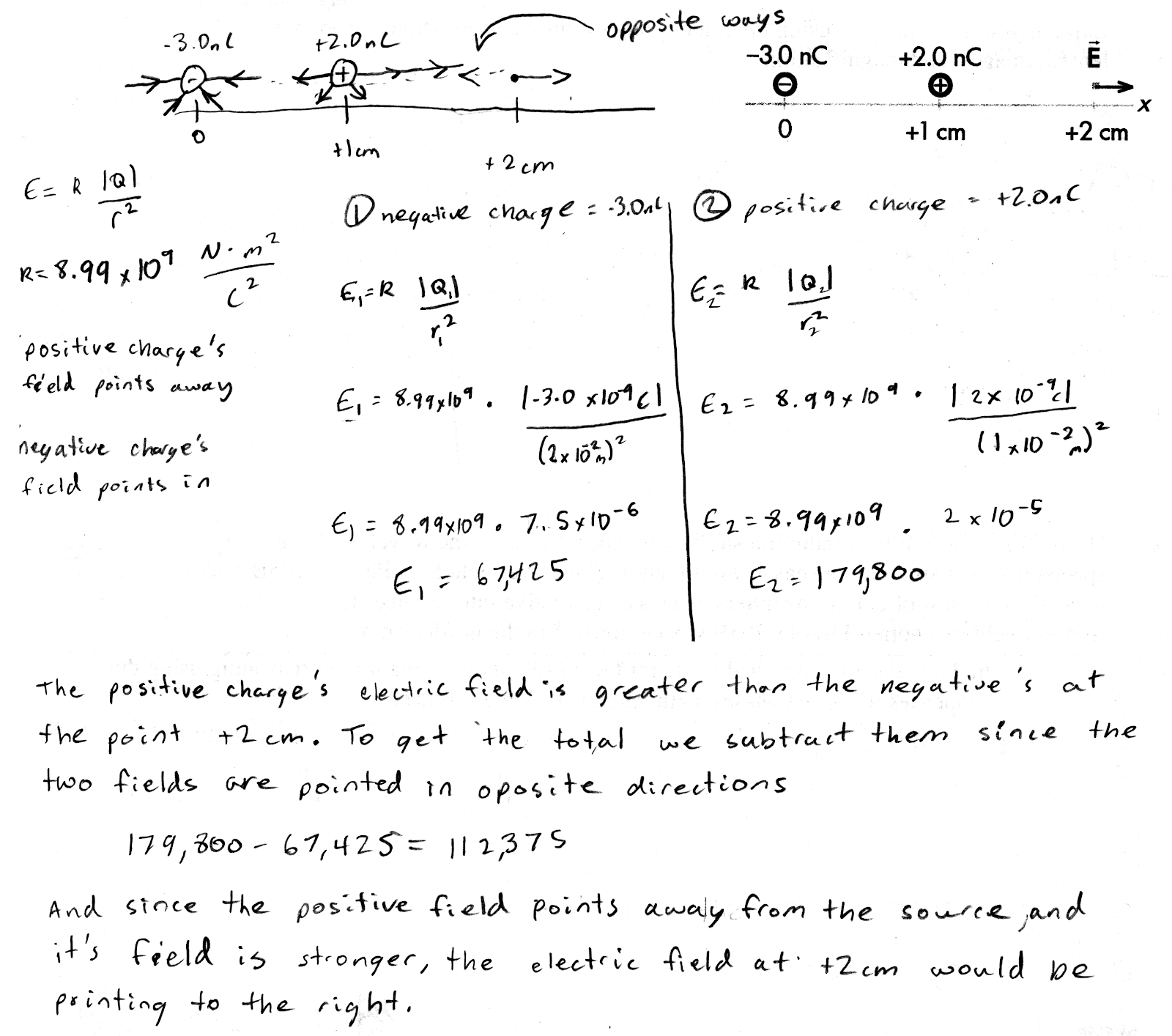


| 0- 6 : | ** [low = 3] |
| 7-12 : | ** |
| 13-18 : | ********* |
| 19-24 : | ***************** [mean = 21.5 +/- 6.0] |
| 25-30 : | ************ [high = 30] |
"The principle of linear superposition, states that the resultant disturbance is the sum of the disturbances from the individual waves, which can be constructive or destructive interference."
"Two waves combine when they arrive at the same point. They reinforce each other during constructive interference or cancel each other through destructive interference."
"If two waves constructively interfere, their crests and troughs line up creating a bigger wave. In contrast, if two waves destructively interfere, the crests and troughs are contrary and they cancel out each other. Also whether two waves are constructive or destructive not only depends on the source phases of the waves, but also on the path length difference."
"I like how visual this lecture was. It seemed much easier to comprehend seeing the waves and the differences in their peaks and troughs which then made it easier to understand that when they align they are constructive and when they do not they are destructive."
"In phase sources result in constructive interference and out of phase sources result in destructive interference. For two in phase sources, if one wave travels a whole wavelength longer than the other, then constructive interference occurs; if instead one wave is a half wavelength longer than the other, then destructive interference occurs. Out of phase sources have an opposite result."
"The mathematical equations regarding the conditions; I would like those to be explained in-depth."
"The equations are confusing. Applying things to the diagrams needs more elaboration."
"This section is pretty straightforward."
"No questions today but I think I am going to like this section."
"I think I understand this section but I feel like I'm missing something."
1: in phase sources [85%]; whole wavelength path difference [62%]; constructive [91%]
2: in phase sources [35%]; half wavelength path difference [74%]; destructive [85%]
3: in phase sources [76%]; whole wavelength path difference [71%]; constructive [85%]
4: out of phase sources [79%]; whole wavelength path difference [38%]; destructive [85%]
5: out of phase sources [35%]; half wavelength path difference [71%]; constructive [79%]
6: out of phase sources [82%]; whole wavelength path difference [62%]; destructive [88%]
"I need to better understand the source phase and path length differences. I will go over the presentation preview to better understand when a wave is considered to be constructive or destructive when the sources are out of phase."
"Okay, it was going smoothly up until the in phase and out of phase questions."
"I am not so sure about in phase vs out of phase sources so some clarification on that would be helpful."
"I'm a little confused on constructive/destructive differences. How can waves be in phase when one travels one-half of a wavelength longer than the other? I think I've only half got this concept down." ("In phase" or "out of phase" refers to how the two waves start off in relation to each other; either they both start off making crests (or troughs) together, so these two sources are said to be "in phase" with each other (regardless of how their waves travel after that); or one source makes a crest while the other source makes a trough (or vice versa), so these two sources are said to be "out of phase" with each other (regardless of how their waves travel after that).)
"I love the double-slit experiment! To me it's where what we think we know about the universe really starts to lose footing!" (We'll get there next week. #toosoon.)
 A –3 nC point charge is held at x = 0, such that there is an electric field at x = +4 cm. In order to have no electric field magnitude at x = +4 cm, discuss whether the amount of positive charge to be placed at x = +1 cm should be less than, greater than, or equal to 3 nC. Explain your reasoning using properties of electric forces, fields, and vector superposition.


| 0- 6 : | |
| 7-12 : | ** [low = 9] |
| 13-18 : | **** |
| 19-24 : | ************ [mean = 23.3 +/- 4.9] |
| 25-30 : | ************** [high = 30] |
"When two light waves arrive the same point they combine. they can reinforce each other during constructive interference, or cancel each other through destructive interference."
"With constructive interference the waves are in sync and reinforce each other and with destructive interference the waves cancel each other out. There are also different types of source phases and path length differences that can affect whether a wave is constructive or destructive."
"I understand that when sound waves troughs and crests line up (move in unison) there is constructive interference. On the other hand, when the troughs and crests don't line up (out of unison) there is destructive interference."
"I found distinguishing between in phase and out of phase sources slightly confusing. I'm not entirely sure whether a wave is considered to be constructive or destructive when the sources are out of phase. I just need some examples and I think I'll be able to figure it out."
"I don't understand the source phase and path length differences."
"I don't understand how to determine the path length differences."
"I have a good understanding of this material. Maybe some in-class examples of constructive and destructive interference would be helpful."
"I didn't find anything really confusing this lesson."
1: in phase sources [92%]; whole wavelength path difference [96%]; constructive [92%]
2: in phase sources [63%]; half wavelength path difference [96%]; destructive [92%]
3: in phase sources [83%]; whole wavelength path difference [83%]; constructive [92%]
4: out of phase sources [83%]; whole wavelength path difference [67%]; destructive [88%]
5: out of phase sources [42%]; half wavelength path difference [63%]; constructive [83%]
6: out of phase sources [92%]; whole wavelength path difference [42%]; destructive [88%]
"Are you enjoying the Olympics?" (Only while watching Mrs. P-dog's cousin compete in slopestyle and big air snowboarding.)
I think I got these diagrams...but sometimes I think I understand something and it later turns out that I'm entirely wrong."
"Lab due next Monday?" (No school next Monday. So, they're due next next Monday.)
 An unspecified amount of charge q moves to the right in a uniform magnetic field that is present everywhere, and experiences a force up along this page. Discuss how there can be two possible directions for the magnetic field, and how those directions depend on the sign of the moving charge. Explain your reasoning using the properties of magnetic fields and forces.

 Two point charges are held at fixed locations at x = –2 cm and at x = +2 cm. The charge located at x = –2 cm is negatively charged, and the charge located at x = +2 cm is positively charged. Discuss why it is not possible for the electric field at the origin to be zero, for any possible numerical values (equal or unequal) for these two charges. Explain your reasoning using properties of electric forces, fields, and vector superposition.


| 0- 6 : | |
| 7-12 : | * [low = 9] |
| 13-18 : | ***************** |
| 19-24 : | ******** [mean = 18.6 +/- 4.4] |
| 25-30 : | ** [high = 27] |
 Two straight wires carry equal amounts of current, crossing perpendicular to each other in the plane of the page. Discuss why the direction of the total magnetic field at the location shown points out of the page. Show your work and explain your reasoning using the properties of magnetic fields, and superposition.
 Two point charges are held at fixed locations. A +5 nC charge is at the origin, and a second –1 nC charge is at x = +4 cm. Discuss why the magnitude of the electric field at x = +2 cm is less than the magnitude of the electric field at x = +3 cm. Show your work and explain your reasoning using properties of electric forces, fields, and vector superposition.


| 0- 6 : | ** [low = 6] |
| 7-12 : | *********** |
| 13-18 : | ****** |
| 19-24 : | *************** [mean = 18.8 +/- 7.2] |
| 25-30 : | ****** [high = 30] |
 Two point charges are held at fixed locations. An unknown charge is at the origin, and a –4.0 µC charge is at x = +0.20 m. The electric field at x = +0.10 m points to the right and has a magnitude of 1.8✕105 N/C. Determine the sign (±) and amount of the unknown charge (in either coulombs or µC) that is located at the origin. Show your work and explain your reasoning using properties of electric forces, fields, and vector superposition.

 Two point charges are held at fixed locations. A +8 nC charge is at the origin, and a second –4 nC charge is at x = +2 cm. The electric field at x = +4 cm is measured. The charge at the origin is then changed to +4 nC, and the electric field at x = +4 cm is again measured. Discuss why the second case has a greater electric field magnitude at x = +4 cm. Explain your reasoning using properties of electric forces, fields, and vector superposition.


| 0- 6 : | ****** [low = 0] |
| 7-12 : | ***** |
| 13-18 : | ****************** [mean = 16.7 +/- 7.2] |
| 19-24 : | *********** |
| 25-30 : | **** [high = 30] |
 Two long straight wires carry currents, both outwards perpendicular to the plane of this page. The left wire (located at x = 0) carries twice as much current as the right wire (located at x = +0.20 m). The magnitude of the total magnetic field at x = +0.30 m is 8.0×10⁻⁷ T.


