Cuesta College, San Luis Obispo, CA
Sections 30882, 30883, version 1
Exam code: quiz07SGnD


Sections 30882, 30883 results
| 0- 6 : | * [low = 6] |
| 7-12 : | **** |
| 13-18 : | *********** |
| 19-24 : | ************* [mean = 20.3 +/- 5.9] |
| 25-30 : | ******* [high = 30] |
| 0- 6 : | * [low = 6] |
| 7-12 : | **** |
| 13-18 : | *********** |
| 19-24 : | ************* [mean = 20.3 +/- 5.9] |
| 25-30 : | ******* [high = 30] |
"Whether it's stable or unstable, a nucleus always contains a set number of positively-charged protons and neutrally-charged neutrons. Neutrons and protons can be turned into each other to bring stability."
"Radiation is produced from an unstable isotope trying to become stable. If an isotope has too many protons or neutrons to be stable, it has multiple ways to compensate and become stable, all of which produce a different form of radiation."
"Neutrons help keep protons in the nucleus together. I also understood a little about decays."
"The key to stability for all atomic nuclei is being able to keep the protons in the nucleus together. A nucleus with more than 83 protons will always be unstable."
"Having a similar ratio of neutrons to protons makes the nucleus stable. Having more than 83 protons makes the element unstable. There is a force that sticks the protons and neutrons together in the nucleus if the number of protons and neutrons are about the same."
"A strong force holds a nucleus together. When the ratio of protons and neutrons is too uneven, the forces in the nucleus are unstable and fission or decay will occur to balance it. Radioactive decay involves emissions from the nuclei. It can change protons into neutrons and vice versa."
"I think I understand the basic concepts of the nucleus wanting to be more stable. If there are too many protons, they and some neutrons can be ejected to get equal to or below 83 protons. If there are too many protons to neutrons, then electrons can be eaten by the protons to turn them into neutrons. If there are too many neutrons to protons, then electrons can be spit out of neutrons, resulting in more protons."
"I understand the chemistry side of the concepts."
"It's a bit confusing thinking about a half-life of a radioactive isotope. For example, if you have 10 grams of a radioactive isotope and it has a half-life of 10 years, why does it take 10 years for that radiation to be emitted and for half of the isotopes to become stable? Why do the individual isotopes release their radiation at different times?"
"Stability versus instability."
"Can you please talk a little bit more on how to stabilize an unstable atom?"
"Working with the different radioactive decays."
"While the rules are presented clearly, I still find it hard to determine what type of decay unstable nuclei will undergo."
"Not confident on which process turns protons to neutrons, and vice versa."
"What types of decay lose protons versus gaining them."
"I'm confused on the electron capture process. An electron is eaten, but why are protons decreased and neutrons increased?"
"Gamma decay is confusing since it is different from the other decays."
"The decay processes were a lot to remember. Maybe more explanations on electron capture with the processes would be helpful in lecture."
"Nothing, I love this chapter."
"The total number of protons and neutrons in an atomic nucleus."
"The nucleon number is essentially the mass number of an atom. It is calculated by adding the number of protons and neutrons together. Electrons are not involved because their mass is negligible and therefor not required."
"Z + N = A."
α decay: decrease. [78%]
β– decay: increase. [63%]
β+ decay: decrease. [50%]
electron capture: decrease. [25%]
γ decay: does not change. [69%]
α decay: decrease. [65%]
β– decay: decrease. [59%]
β+ decay: increase. [59%]
electron capture: increase. [28%]
γ decay: does not change. [69%]
α decay: no p/n conversion. [50%]
β– decay: n → p. [66%]
β+ decay: p → n. [63%]
electron capture: p → n. [22%]
γ decay: no p/n conversion. [59%]
"This is so fun because we are learning the same thing in chemistry right now! Just before doing this homework, I learned what alpha, beta and gamma rays are that are emitted from the nucleus of an atom. Whoa!"
"Not gonna lie, this section made my brain hurt..."
"I would like to see more real life examples of how decay is applied."
"I liked the information about smoke alarms! Very important/relevant to me!"
"The concept of electron capture confused me a little bit, mostly because I don't recall learning about it in chemistry." (Chemistry teachers seem to not want to talk about electron capture, for some reason.)
"YOU MUST MAKE QUIZ 6 REALLY EASY OR RISK DOOMING US ALL!" (Physics 205B: Endgame.)
"Excited for our midterm!"


| 0- 6 : | ***** [low = 3] |
| 7-12 : | ****** |
| 13-18 : | ******** [mean = 16.2 +/- 7.7] |
| 19-24 : | ******** |
| 25-30 : | **** [high = 30] |
"The atomic number represents the total amount of protons. The nucleon number represents the combined number of protons and neutrons. The number of neutrons can be determined by having the nucleon number minus the atomic number."
"The different decays all achieve stability through different means. Some expel particles while other transform particles into other ones."
"The key to stability is being able to keep the protons in the nucleus together. Alpha decay is how a nucleus with excess protons achieves a more stable configuration. Beta-minus decay is how a nucleus with excess neutrons achieves a more stable configuration. Beta-plus decay is how a nucleus that is neutron deficient achieves a more stable configuration. Gamma decay is how a nucleus achieves a more stable configuration, but not because it has too many protons, or the wrong ratio of protons to neutrons."
"For all atomic nuclei the key to stability is being able to keep the protons in the nucleus together. Also, having a certain number of neutrons in the nucleus will decrease the proton-proton repulsion."
"For all atomic nuclei, to have stability they have to keep the protons in the nucleus together, in spite of them all repelling each other. They need to have the proper ratio of neutrons, approximately equal to or slightly greater than the number of protons. More than 83 protons would automatically make the nucleus unstable."
"Stability conditions. A nucleus with more than 83 protons will always be unstable. Neutrons help to balance out proton to proton repulsion so it's necessary to have more neutrons than protons in a nucleus in order to be stabilized. The different decay processes we are learning about are used by nuclei to help them reach stable conditions depending on what makes them unstable to begin with."
"Radioactive decay occurs in four ways. If a nucleus has more than 83 protons, it will emit He to decrease p and n equally (alpha particles). If protons are significantly less than neutrons, neutrons will be converted to protons, releasing antineutrinos and electrons (Β– particles). If protons are more numerous than neutrons, protons will be converted to neutrons, releasing positrons (Β+ particles) and neutrinos. Nuclei become excited after decay and will release photons to 'calm down' (gamma particles)."
"This is pretty basic chemistry stuff, it doesn't seem to be a problem."
"The different types of decay--from a problem-solving perspective it would just be nice to see some different examples going through how to sort each type of decay."
"Most of this was a good refresher on decay and specifically all of the types of it that I learned in the tail-end of my general chemistry series last year."
"I don't understand the difference between a nucleus that is stable or unstable."
"Electron capture and the 'swallowing' thing. And also a bit of gamma decay."
"I like radioactive decay."
"I am having a harder time with gamma (γ) decay. I will do more research to clarify the topic but for right now I'm not grasping it."
"I feel like electron capture was passed over too quickly, I don't really understand what happens."
"What is a neutrino and can it be positive or negative?"
"Outside of confusing the different decay processes this is thankfully review from other classes. "
"It is the total number of protons and neutrons inside the atomic nucleus."
"The nucleon number is the total number of nucleons (protons and electrons), such that the number of neutrons is the difference between the nucleon number and atomic number."
"Not there yet."
α decay: decrease. [77%]
β– decay: increase. [77%]
β+ decay: decrease. [77%]
electron capture: decrease. [38%]
γ decay: does not change. [69%]
α decay: decrease. [69%]
β– decay: decrease. [65%]
β+ decay: increase. [65%]
electron capture: increase. [19%]
γ decay: does not change. [65%]
α decay: no p/n conversion. [62%]
β– decay: n → p. [73%]
β+ decay: p → n. [69%]
electron capture: p → n. [35%]
γ decay: no p/n conversion. [69%]
"Quiz 6 is going to be awful...I have such a hard time with the right-hand rules and flux laws."
"This seems like it is going to be the most interesting section to date!"
"I think I'll like this chapter a lot better than the previous ones!"
"Could we go over electron capture?"


| 0- 6 : | **** [low = 0] |
| 7-12 : | ************** [mean = 10.5 +/- 6.1] |
| 13-18 : | ***** |
| 19-24 : | * |
| 25-30 : | * [high = 27] |
"A nucleus must have just the right ratio of protons to neutrons or the atom becomes unstable."
"Nucleus, protons, neutrons, electrons...yeah I got this"
"Did not get to it"
"I understood that when there is not the correct ratios of protons to neutrons that the atom will turn a proton into a neutron or vice versa. There are a few different types of decay: alpha, beta (+), beta (–), and gamma."
"Decay occurs as a nucleus attempts to become more stable. A proper balance of protons and neutrons is necessary for stability. If balance is not maintained, protons may be transformed into neutrons (or vice versa), or proton/neutron couples can be released."
"The reason nuclei are unstable are due to the unfavorable ratio of protons to neutrons. The charges and forces protons carry are too much for the nuclei too handle if out of proportion."
"A nucleus containing more than 83 protons is unstable. If there are more neutrons than protons or the same amount then there is stability."
"Greater than 83 protons means unstable nuclei no matter how many neutrons. Having approximately the same number of protons as neutrons will make the nucleus stable."
"I have covered some of this in chemistry, so I know some of it but not well."
"The nucleus of an atom is composed of nucleons, that is, protons and neutrons. Radioactive decay occurs to lower the nucleus' energy state through a shift in the configuration/numbers of nucleons or when rays are released. There are five different types of radioactive decay: alpha, beta-positive, beta-negative, electron capture, and gamma."
"I understand the composition of an atom as well as the various types of decay because I have learned it before in my physics class. Alpha and gamma decay is very solid in my mind."
"I understand that alpha particles are decay that are equivalent to a helium atom flying off, thus changing the element overall to two less protons and two less neutrons. A beta particle or decay is where the radioactive material becomes a different element by gaining or losing a proton."BR>
"There are different ways for radioactive material to decay. I never knew protons could be emitted or change to neutrons and back"
"Nuclear instability is the result of an improper ratio of neutrons to protons in a nucleus. The nucleus will then emit several different types of particles in order to achieve a more stable state, depending on the number of each to begin with. The three types of decay are: alpha decay (He nucleus) Beta minus (n->p + e–) beta plus (p->n + e+) and gamma (decay->photon)."
"I understand that nuclei stable or unstable have a set of positive charged protons and neutrally charged neutrons and that from chemistry, the periodic table and how to read a specific element from the table. I also understand now that as a radioactive decay process occurs, a nucleus with an unstable configuration always seeks a more stable configuration."
"For all atomic nuclei, big and small, the key to stability is being able to keep the protons in the nucleus together. A nucleus containing more than 83 protons will always be unstable, no matter how many neutrons there are."
"Mixing up the different kinds of decay. As in which are alpha, beta, and so on."
"On the homework problems for the half-life and exponential problems those were a tiny bit confusing because it wasn't clear to me that R0 is the original rate of decay. So, doing those problems shed some light on that."
"he strong force. I understand how it is applied in the class notes for neutron balance, but what makes it different from electromagnetic force?"
"I don't really find it confusing, but I found it I retesting that neutrons and protons switch back and forth into each other inside a nucleus. I always thought they were the same 100% of the time."
"How the ratio of protons to neutrons effects the stability of the nucleus."
"I didn't understand either of the beta decays."
"Beta positive versus beta negative decay. I could benefit from some examples in class of that and also when the nucleus swallows an neutron."
"I do not understand how the neutrons hold the protons together in a nuclide in almost a 1:1 ratio up until 20 protons and then start having to dramatically increase the number of neutrons per proton."
"That protons can be turned into neutrons; I thought the protons were what made a particular element a particular element."
"Electron capture."
"Parts about different processes that unstable nuclei can undergo to achieve stable configurations. This material is very interesting, but a little difficult to understand in terms of how they all apply in a physics sense."
"I understand how you tell if a nucleus is stable or unstable, but could use a little help in determining what it would take to make it stable."
"Trying to identify the processes that increase or decrease or do not change protons into neutrons."
"Not much."
"Nada."
"The nucleon number is also the 'mass number,' and it can be found in the top left corner of each elements box on the periodic table. It is the number of protons and neutron in an atom."
"The total number of protons and electrons."
"Nucleon number is noted as 'A', neutrons = A – Z(atomic number, or the number of protons)."
α decay: decrease. [87%]
β– decay: increase. [65%]
β+ decay: decrease. [70%]
electron capture: decrease. [17%]
γ decay: does not change. [78%]
α decay: decrease. [57%]
β– decay: decrease. [83%]
β+ decay: increase. [78%]
electron capture: increase. [22%]
γ decay: does not change. [83%]
α decay: no p/n conversion. [70%]
β– decay: n → p. [87%]
β+ decay: p → n. [70%]
electron capture: p → n. [26%]
γ decay: no p/n conversion. [83%]
"Is my smoke detector giving off harmful radiation?" (Only if you crack it open.)
"What causes the emission of positrons or electrons when protons or neutrons transform into each other?" (Charge and mass must be conserved. Also a neutron is just a proton with an electron added to it. Weird, huh?)
"A neutron walked into a bar and asked, 'how much for a gin and tonic?' the bartender said, For you, no charge.'" (#rimshot)
"Wouldn't electron capture simply balance the charge of the entire atom, and not affect the nucleus?" (It might make the atom ionized, as it would lose an electron, and definitely affect the nucleus it turning a proton into a neutron.)
"Protons and neutrons make up the nucleus. Greater than 83 protons, more protons than neutrons, or excess neutrons create instability. This can be stabalized in a few ways: alpha, beta minus, beta plus, and gamma decay."
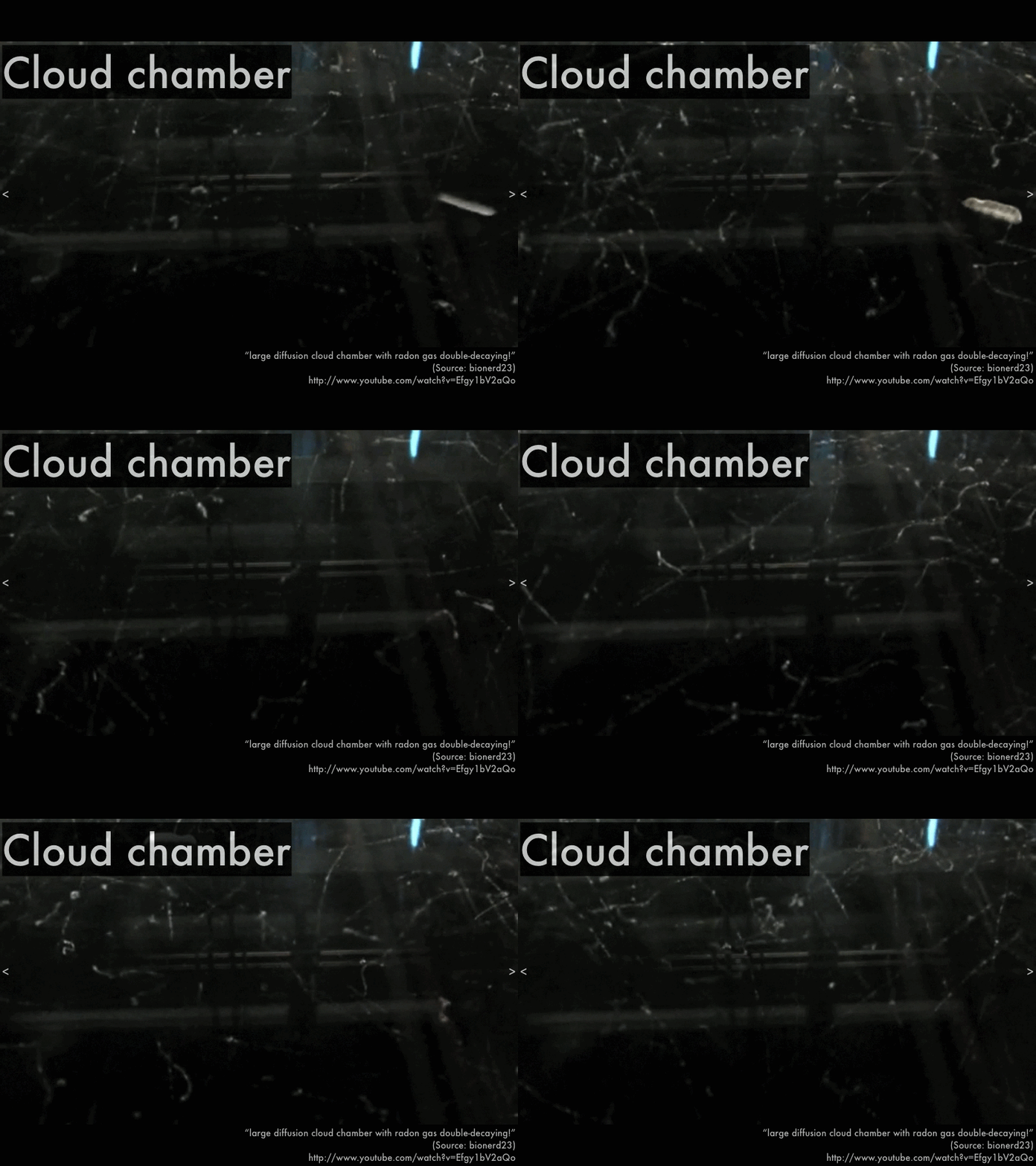
"Contrails in a cloud chamber, produced by natural background radioactive decay particles passing through cold, alcohol-saturated air. Radioactive particles from natural background decays zing around all the time, whether or not the air just so happens to be cold and alcohol-saturated."
"We cannot count radio active atoms we can only count how many decayed atoms there are. Atoms decay randomly but we are able to give each isotope a half-life based on the number of daughters it produces during a period of time."
"The neutrons in the nucleus of an atom help to mitigate the repulsion forces the protons exert on themselves and helps keep the nucleus intact (strong force). A nucleus of an atom is stable only when the number of protons is slightly lower than or equal to the number of neutrons; if these conditions are not met, then the atom will undergo some sort of decay to stabilize the nucleus."
"What I was able to gather from the reading is that the 'backbone' of an atomic nuclei are the neutrons within the nucleus. As I learned in chemistry last semester (physics has made me question how much I can rely on what I learned) the number of protons in an atom is equal to the amount of neutrons (I say this reluctantly now). So even while protons repel from each other, the neutrons within the nucleus sort of balance out this repulsion so that the atomic nuclei itself can remain whole. Until there are 83 protons in which the amount of repulsion within the nuclei despite the amount of neutrons will subsequently result in an unstable nucleus. I know I'm talking about stuff that doesn't directly regard physics, however, I've been trying to dive into the chemistry we have been talking about because I'm realizing now that my chemistry class was even more basic than I had originally thought."
"What keeps together the nucleus in an atom is the attraction between the protons and the neutrons and the ratio of them is important (because neutrons turn into protons and vice versa WHAAAT!). When there are more than 83 protons than normal then alpha radiation occurs. When there are more protons in the ratio then beta minus occurs while a bunch more neutrons in the ratio causes beta plus radiation. After a nucleus returns from an excited state they still may have to much energy which they may release through gamma radiation."
"It makes sense, but HOW. Magic repulsion and stickiness?"
"This presentation went very well. I really thought this presentation helped a lot, it even helped me understand whats going on in chemistry better thanks!"
"I am confused on how the electron capture is calculated. I don't know how to determine the number of protons or neutrons in the electron capture."
"What I found confusing about the reading is how the heck does a proton turn into a neutron and vice versa! More importantly how the heck is a neutron 'intrinsically' unstable!!! Physics is making me question the very little amount of things I know about chemistry."
"I'm mostly confused about the strong force that nucleons exert on each other that sticks them together. If a neutron has no charge...how can they possibly be attracted to anything? Or is this just something that isn't quite understood yet?"
"Nothing. I've got this chemistry on lock!"
"The nucleon number denotes the total number of nucleons (protons and electrons), such that the number of neutrons is the difference between the nucleon number and atomic number."
"The total number of protons and neutrons. Z + N = A."
α decay: decrease. [80%]
β– decay: increase. [74%]
β+ decay: decrease. [66%]
electron capture: decrease. [34%]
γ decay: does not change. [71%]
α decay: decrease. [77%]
β– decay: decrease. [69%]
β+ decay: increase. [71%]
electron capture: increase. [26%]
γ decay: does not change. [74%]
α decay: no p/n conversion. [77%]
β– decay: n → p. [77%]
β+ decay: p → n. [74%]
electron capture: p → n. [29%]
γ decay: no p/n conversion. [80%]
"This stuff is basically alchemy. That's so awesome!"
"This antimatter electron twin stuff is freaky. Somebody should have Antman jump into a positron annihalating an electron and see which universe he ends up in."
"I need to start showing up to class again. I'm losing patience with this semester. Thank God we have three weeks left."


| 0- 6 : | **** [low = 3] |
| 7-12 : | ****** |
| 13-18 : | ************* |
| 19-24 : | ****** [mean = 18.4 +/- 7.8] |
| 25-30 : | *********** [high = 30] |
"There are different types of radioactive decay, which affect the chemistry of an element differently. The more protons there are (as well as neutrons) the stronger the nucleus tries to hold together (and these protons and neutrons are 'transforming' into each other which contributes to this strong force). For alpha decay, a helium atom is ejected from the nucleus. Beta negative: a neutron is transformed into a proton and an electron. For beta positive: a positron is emitted (an electron with a positive charge)."
"The joy of radioactivity. An atomic nucleus will always try to achieve stability if it has too many protons (more than 83), too few protons, or too many neutrons. Ironically, neutrons themselves are unstable and constantly switch back and forth between neutrons or protons. So in order to achieve stability they must eject neutrons/protons if they have too many protons, an event called alpha decay. Transforming neutrons into protons, if it's got too many neutrons, called beta- decay, this has the added benefit of emitting an electron and neutrino. Then there's beta+ decay if a nucleus has too few neutrons, by converting protons into neutrons, and releasing a positron and neutrino. Finally, if the nucleus still has excess energy, it is emitted in the form of gamma rays, known as gamma decay."
"Beta- decay turns neutrons into protons and beta+ does the opposite. They do this because a nucleus is trying to maintain a stable ratio of protons to neutrons, and this is some of the couple ways that it can be done."
"Nothing, this was my favorite part of general chemistry."
"This class suddenly seems to be getting into chemistry."
"Honestly its hard to pinpoint one part that's confusing, it's all rather confusing at this point."
"What is electron capture? Why can there be more neutrons but never more protons?"
"I don't understand how the protons change into neutrons or neutrons change into protons."
"I understand the 'sticky' strong force that keeps protons and neutrons together and thus a nucleus stable, but it's kinda weird to all of a sudden be talking about a totally different kind of force."
"I don't know what nucleon number is or how to calculate it."
"It's the total number of protons and neutrons in the nucleus of an atom."
α decay: decrease. [68%]
β– decay: increase. [62%]
β+ decay: decrease. [71%]
electron capture: decrease. [32%]
γ decay: does not change. [59%]
α decay: decrease. [62%]
β– decay: decrease. [65%]
β+ decay: increase. [68%]
electron capture: increase. [42%]
γ decay: does not change. [56%]
α decay: no p/n conversion. [53%]
β– decay: n → p. [68%]
β+ decay: p → n. [68%]
electron capture: p → n. [44%]
γ decay: no p/n conversion. [56%]
"Studying or not studying, reading or not reading, same scores on quizzes. I would prefer more explanations before I read." (Let's try testing one more independent variable--asking questions in office hours, or not asking questions in office hours.)
"What would you say is the most important equation or equations to focus on for our midterm next week?" (All of them. Or none of them. What I mean to say is that you should be able to explain how to use equations to explain your answers, as I already know you can all plug-and-chug equations.)
"This stuff is nonsense. Yet very fun to think about."
"Thanks for your diligence for all your help."
"I'm working 40 hours a week I think work and school are both getting difficult. I'm trying my best to push through and earn a good grade in this class."


| 0- 6 : | |
| 7-12 : | *** [low = 12] |
| 13-18 : | **************** |
| 19-24 : | ************ [mean = 20.4 +/- 5.4] |
| 25-30 : | ******* [high = 30] |


| 0- 6 : | ** [low = 0] |
| 7-12 : | **** |
| 13-18 : | ************* [mean = 18.4 +/- 7.2] |
| 19-24 : | ***** |
| 25-30 : | ******** [high = 30] |


 0- 6 :

 7-12 :

13-18 : **  [low = 18]

19-24 : *****  [mean = 22.5 +/- 3.6]

25-30 : **  [high = 27]

