Showing posts with label path difference. Show all posts

20200312

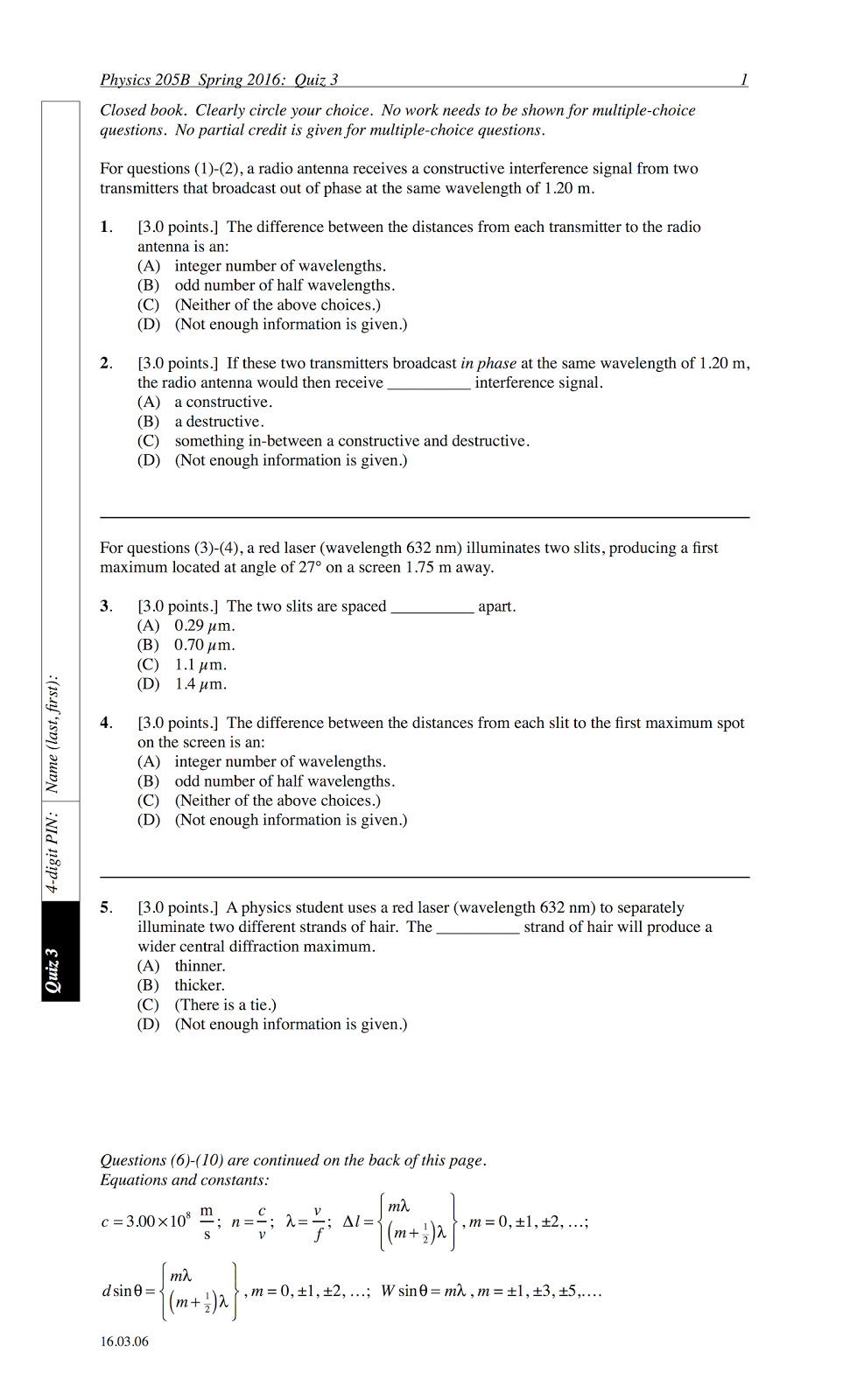
Physics quiz archive: interference, electrostatics

Physics 205B Quiz 3, spring semester 2020
Cuesta College, San Luis Obispo, CA
Sections 30882, 30883, version 1
Exam code: quiz03Cv1d


Sections 30882, 30883 results
0- 6 :  
7-12 :  
13-18 :   **** [low = 15]
19-24 :   ***************
25-30 :   *************** [mean = 24.2 +/- 4.2] [high = 30]

20190405

Physics midterm question: destructively interfering out-of-phase radio transmitters

Physics 205B Midterm 1, spring semester 2019
Cuesta College, San Luis Obispo, CA

Two vertical radio transmitters broadcast at the same wavelength, and are spaced 6.0 m apart along the east-west direction. A receiver held by a Physics 205B student located to the east of both transmitters detects a destructive interference signal, and a receiver held by another Physics 205B student located to the north also detects a destructive signal. Show (a) why the transmitters must be out-of-phase sources, and (b) find a plausible numerical value for the wavelength. Explain your reasoning using the properties of source phases, path lengths, and interference.

Solution and grading rubric:
  • p:
    Correct. Discusses/demonstrates:
    1. that the radio transmitters are out of phase, as there is no path length difference for the student located to the north, and destructive interference (as is the case here) can only occur if the sources are out of phase; and
    2. for the student located to the east, for these out of phase sources to interfere destructively the path length difference must be a whole number of wavelengths, and since the path length difference is 6.0 m, plausible (non-zero) wavelength values would be 6.0 m, 3.0 m, 1.5 m, etc.
  • r:
    As (p), but argument indirectly, weakly, or only by definition supports the statement to be proven, or has minor inconsistencies or loopholes.
  • t:
    Nearly correct, but argument has conceptual errors, or is incomplete. At least discusses why (1) transmitters are out of phase, but (2) does not use the correct destructive interference condition (whole number of wavelengths) for out of phase sources for the student located to the east.
  • v:
    Limited relevant discussion of supporting evidence of at least some merit, but in an inconsistent or unclear manner. Some garbled attempt at discussing source phases, path lengths, and interference.
  • x:
    Implementation/application of ideas, but credit given for effort rather than merit. Approach other than that of discussing source phases, path lengths, and interference.
  • y:
    Irrelevant discussion/effectively blank.
  • z:
    Blank.
Grading distribution:
Sections 30882, 30883
Exam code: midterm01Ft6G
p: 13 students
r: 4 students
t: 13 students
v: 12 students
x: 0 students
y: 0 students
z: 0 students

A sample "p" response (from student 5250), identifying the correct path length difference condition for two sources that are out of phase:

Another sample "p" response (from student 1810), with a graphical representation of the interfering waves:

20190313

Physics quiz archive: interference, electrostatics

Physics 205B Quiz 3, spring semester 2019
Cuesta College, San Luis Obispo, CA
Sections 30882, 30883, version 1
Exam code: quiz03b3Am


Sections 30882, 30883 results
0- 6 :   ** [low = 3]
7-12 :   **
13-18 :   *********
19-24 :   ***************** [mean = 21.5 +/- 6.0]
25-30 :   ************ [high = 30]

20180324

Physics midterm question: second maxima angles not possible

Physics 205B Midterm 1, spring semester 2018
Cuesta College, San Luis Obispo, CA

A green laser (wavelength 550 nm) illuminates a grating with a unknown spacing between adjacent slits, producing an interference pattern with a first maxima angles of ±32°. (Drawing is not to scale.) Discuss why it is not possible for second maxima angles to be produced by this grating. Explain your reasoning using the properties of source phases, path lengths, and interference.

Solution and grading rubric:
  • p:
    Correct. Discusses/demonstrates that the second maxima angle is not possible, by:
    1. solving for the spacing d between grating slits, given the first maxima angle and the wavelength λ of the laser; then
    2. solving for the second maxima angle results in a domain error for the inverse sine function, and interprets this as meaning that the there is no defined second maxima angle.
    (It is possible to use d = λ/sin(32°) from the first maxima equation and insert it into the second equation without explicitly numerically solving for d, such that θ = sin−1(2/sin(32°) for the second maxima angle results in a domain error.)
  • r:
    As (p), but argument indirectly, weakly, or only by definition supports the statement to be proven, or has minor inconsistencies or loopholes. Typically has math errors.
  • t:
    Nearly correct, but argument has conceptual errors, or is incomplete. Uses minima equation and/or compounded math errors.
  • v:
    Limited relevant discussion of supporting evidence of at least some merit, but in an inconsistent or unclear manner. Some garbled attempt at applying properties of source phases, path lengths, and interference.
  • x:
    Implementation/application of ideas, but credit given for effort rather than merit. No clear attempt at applying properties of source phases, path lengths, and interference.
  • y:
    Irrelevant discussion/effectively blank.
  • z:
    Blank.
Grading distribution:
Sections 30882, 30883
Exam code: midterm01cVdP
p: 29 students
r: 2 students
t: 3 students
v: 1 student
x: 0 students
y: 0 students
z: 0 students

A sample "p" response (from student 1929):

Another sample "p" response (from student 3481):

20180307

Physics quiz archive: interference, electrostatics

Physics 205B Quiz 3, spring semester 2018
Cuesta College, San Luis Obispo, CA
Sections 30882, 30883, version 1
Exam code: quiz03Ch4R


Sections 30882, 30883 results
0- 6 :  
7-12 :   ** [low = 9]
13-18 :   ****
19-24 :   ************ [mean = 23.3 +/- 4.9]
25-30 :   ************** [high = 30]

20170601

Physics final exam problem: destructive interference angles in one quadrant

Physics 205B Final Exam, spring semester 2017
Cuesta College, San Luis Obispo, CA

Two vertical radio transmitters broadcast in phase at the same wavelength of 1.2 m, and are spaced a certain apart along the east-west direction. A Physics 205B student holding a receiver starts from due south of the transmitters, and detects three different locations with destructive interference signals before finally reaching due east of the transmitters. Determine a plausible separation distance (in m) between the transmitters. Explain your reasoning using the properties of source phases, path lengths, and interference.

Solution and grading rubric:
  • p:
    Correct. Discusses/demonstrates that three minima locations will be found in the range θ = 0° (due south) to 90° (due west) by using one of two approaches:
    1. using the destructive interference condition d⋅sinθ = (m + 1/2)⋅λ, where m = 0, 1, 2, ..., finds a plausible separation distance d such that the third minima (m = 2) will be within θ = 90°, but the fourth minima (m = 3) is outside of θ = 90° (i.e., 3.0 m ≤ d ≤ 4.8 m); or
    2. using the constructive interference condition d⋅sinθ = m⋅λ, where m = 0, 1, 2, ..., finds the separation distance d such that the third maxima (m = 3) will be at θ = 90°; which allows for the m = 0, 1, and 2 minima to exist within that range (i.e., d = 3.6 m).
  • r:
    Nearly correct, but includes minor math errors. May have claimed equally spaced minima angles at θ = 30°, 60° and 90° to find a plausible separation distance d using θ = 30° for the first minima angle.
  • t:
    Nearly correct, but approach has conceptual errors, and/or major/compounded math errors.
  • v:
    Implementation of right ideas, but in an inconsistent, incomplete, or unorganized manner. Garbled attempt at applying properties of source phases, path lengths, and interference.
  • x:
    Implementation of ideas, but credit given for effort rather than merit. No clear attempt at applying properties of source phases, path lengths, and interference.
  • y:
    Irrelevant discussion/effectively blank.
  • z:
    Blank.
Grading distribution:
Sections 30882, 30883
Exam code: finalmR3x
p: 3 students
r: 4 students
t: 6 students
v: 7 students
x: 4 students
y: 2 students
z: 0 students

A sample "p" response (from student 0428), finding the maximum possible separation distance:

20170325

Physics midterm question: comparing first and second maxima angles

Physics 205B Midterm 1, spring semester 2017
Cuesta College, San Luis Obispo, CA

A green laser (wavelength 550 nm) illuminates a compact disc (CD) disk with a track spacing of 1.6 µm[*], producing a set of maxima spots at certain angles. (Drawing is not to scale.) Discuss why the second maxima angle is not exactly twice the first maxima angle. Explain your reasoning using trigonometry, the properties of source phases, path lengths, and interference.

[*] en.wikipedia.org/wiki/File:Comparison_CD_DVD_HDDVD_BD.svg

Solution and grading rubric:
  • p:
    Correct. The second maxima angle is not exactly twice the first maxima angle, because given spacing d between tracks and the wavelength λ of the laser, from the maxima equation d·sinθ = m·λ the first maxima angle θ1 = sin–1(1·λ/d), and the second maxima angle θ2 = sin–1(2·λ/d), which is slightly more than twice θ1.
  • r:
    As (p), but argument indirectly, weakly, or only by definition supports the statement to be proven, or has minor inconsistencies or loopholes. May have solved for second minima angle instead of second maxima angle.
  • t:
    Nearly correct, but argument has conceptual errors, or is incomplete. At least has first maxima angle, or sets up work that would eventually result in finding and comparing first maxima angle with the second maxima angle.
  • v:
    Limited relevant discussion of supporting evidence of at least some merit, but in an inconsistent or unclear manner. Some garbled attempt at applying trigonometry, properties of source phases, path lengths, and interference.
  • x:
    Implementation/application of ideas, but credit given for effort rather than merit. No clear attempt at applying trigonometry, properties of source phases, path lengths, and interference. Focus on constructing triangles with CD-to-screen distance and spacing along screen distance to find angles, rather than appealing to properties of constructive interference along certain angles.
  • y:
    Irrelevant discussion/effectively blank.
  • z:
    Blank.
Grading distribution:
Sections 30882, 30883
Exam code: midterm01AhC4
p: 17 students
r: 2 students
t: 5 students
v: 1 student
x: 5 students
y: 0 students
z: 0 students

A sample "p" response (from student 2420):

20170314

Physics quiz question: interference from two in-phase radio transmitters

Physics 205B Quiz 3, spring semester 2017
Cuesta College, San Luis Obispo, CA

A radio antenna receives signals from two in-phase transmitters at the same wavelength of 30 m. This diagrams is not drawn to scale. The radio antenna receives __________ interference signal.
(A) a constructive.
(B) a destructive.
(C) something in-between a constructive and destructive.
(D) (Not enough information is given.)

Correct answer (highlight to unhide): (B)

Radio waves from the transmitter at x = 0 travel 45 m to get to the receiver. Radio waves from the transmitter at x = +180 m travel 135 m to get to the receiver. The path length difference ∆l is 135 m – 45 m = 90 m, which is (90 m)/(30 m) = three times the wavelength of 30 m. Since there is a whole number (here, 3) wavelength path length difference, the receiving antenna detects constructive interference from these two in-phase transmitters.

Sections 30882, 30883
Exam code: quiz03d3St
(A) : 11 students
(B) : 15 students
(C) : 2 students
(D) : 0 students

Success level: 39%
Discrimination index (Aubrecht & Aubrecht, 1983): 0.12

20170311

Physics quiz archive: interference, electrostatics

Physics 205B Quiz 3, spring semester 2017
Cuesta College, San Luis Obispo, CA
Sections 30882, 30883, version 1
Exam code: quiz03d3St


Sections 30882, 30883 results
0- 6 :  
7-12 :   * [low = 9]
13-18 :   *****************
19-24 :   ******** [mean = 18.6 +/- 4.4]
25-30 :   ** [high = 27]

20160327

Physics midterm question: increasing DVD (grating) to screen distance

Physics 205B Midterm 1, spring semester 2016
Cuesta College, San Luis Obispo, CA

A red laser (wavelength 632 nm) illuminates a transparent DVD (digital videodisc) with a track spacing[*] of 740 nm, producing a central and two first maxima spots on a screen (drawing at right is not to scale). While the positions of the laser and the screen are kept constant, the DVD is moved slightly to the left, closer to the laser (and farther from the screen). Discuss why the spacing of the maxima spots as measured along the screen will change as a result. Explain your reasoning using trigonometry, the properties of source phases, path lengths, and interference.

[*] en.wikipedia.org/wiki/File:Comparison_CD_DVD_HDDVD_BD.svg

Solution and grading rubric:
  • p:
    Correct. Proves that the spacing of the maxima spots on the screen would increase because:
    1. the spacing d between tracks, the wavelength λ of the laser would not be affected, such that the θ angle of the first maxima would also not be affected, and;
    2. from trigonometry (or properties of similar right triangles), as the θ angle of the first maxima remains constant, as the horizontal (adjacent) right triangle leg increases, the vertical (opposite) leg must increase.
  • r:
    As (p), but argument indirectly, weakly, or only by definition supports the statement to be proven, or has minor inconsistencies or loopholes.
  • t:
    Nearly correct, but argument has conceptual errors, or is incomplete.
  • v:
    Limited relevant discussion of supporting evidence of at least some merit, but in an inconsistent or unclear manner. Some garbled attempt at applying trigonometry, properties of source phases, path lengths, and interference.
  • x:
    Implementation/application of ideas, but credit given for effort rather than merit. No clear attempt at applying trigonometry, properties of source phases, path lengths, and interference.
  • y:
    Irrelevant discussion/effectively blank.
  • z:
    Blank.
Grading distribution:
Sections 30882, 30883
Exam code: midterm01rx1C
p: 21 students
r: 0 students
t: 11 students
v: 7 students
x: 4 students
y: 0 students
z: 0 students

A sample "p" response (from student 7399):

20160311

Physics quiz archive: interference, electrostatics

Physics 205B Quiz 3, spring semester 2016
Cuesta College, San Luis Obispo, CA
Sections 30882, 30883, version 1
Exam code: quiz03Ccf7


Sections 30882, 30883 results
0- 6 :   ** [low = 6]
7-12 :   ***********
13-18 :   ******
19-24 :   *************** [mean = 18.8 +/- 7.2]
25-30 :   ****** [high = 30]

20150624

Physics final exam problem: interference of two in-phase Wi-Fi antennae

Physics 205B Final Exam, spring semester 2015
Cuesta College, San Luis Obispo, CA

Cf. Giambattista/Richardson/Richardson, Physics, 2/e, Problem 25.31

"Wifi"
Jason Cole
youtu.be/6hcK9B4HHY8

A commercially available wireless router[*] broadcasts at a 0.12 m wavelength from two vertical antennae spaced 0.18 m apart. Assume that the two antennae are in phase. Determine how many destructive interference (minima) directions there will be (if any) in the 360° range of all possible directions. Show your work and explain your reasoning using the properties of source phases, path lengths, and interference.

[*] Linksys WRT54GL wireless router, 802.11b channel 1 (2412 MHz), overall width 200 mm, downloads.linksys.com/downloads/WRT54GL_V11_DS_NC-WEB,0.pdf

Solution and grading rubric:
  • p:
    Correct. Approximates two in-phase antennae as a double slit, and equates path length difference approximation d⋅sinθ with destructive interference (minima) condition for in-phase sources to find θ = 19° and 90° as measured counterclockwise from the θ = 0° south direction, such that there are six unique directions of destructive interference in the 360° range of all possible directions. Okay if minima directions in the south-east quadrant are not correctly mapped via symmetry to find all minima directions, if at least the two unique θ = 19° and 90° directions in the southeast quadrant are found.
  • r:
    Nearly correct, but includes minor math errors. Only specifically searches over the cardinal directions, and finds of these that only east and west have destructive interference.
  • t:
    Nearly correct, but approach has conceptual errors, and/or major/compounded math errors.
  • v:
    Implementation of right ideas, but in an inconsistent, incomplete, or unorganized manner.
  • x:
    Implementation of ideas, but credit given for effort rather than merit. No clear attempt at applying path length differences and interference.
  • y:
    Irrelevant discussion/effectively blank.
  • z:
    Blank.
Grading distribution:
Sections 30882, 30883
Exam code: finalLd0c
p: 4 students
r: 13 students
t: 5 students
v: 11 students
x: 4 students
y: 3 students
z: 3 students

20150329

Physics midterm question: interference of out-of-phase radio transmitters

Physics 205B Midterm 1, spring semester 2015
Cuesta College, San Luis Obispo, CA

Cf. Giambattista/Richardson/Richardson, Physics, 2/e, Example 25.1, Problem 25.1

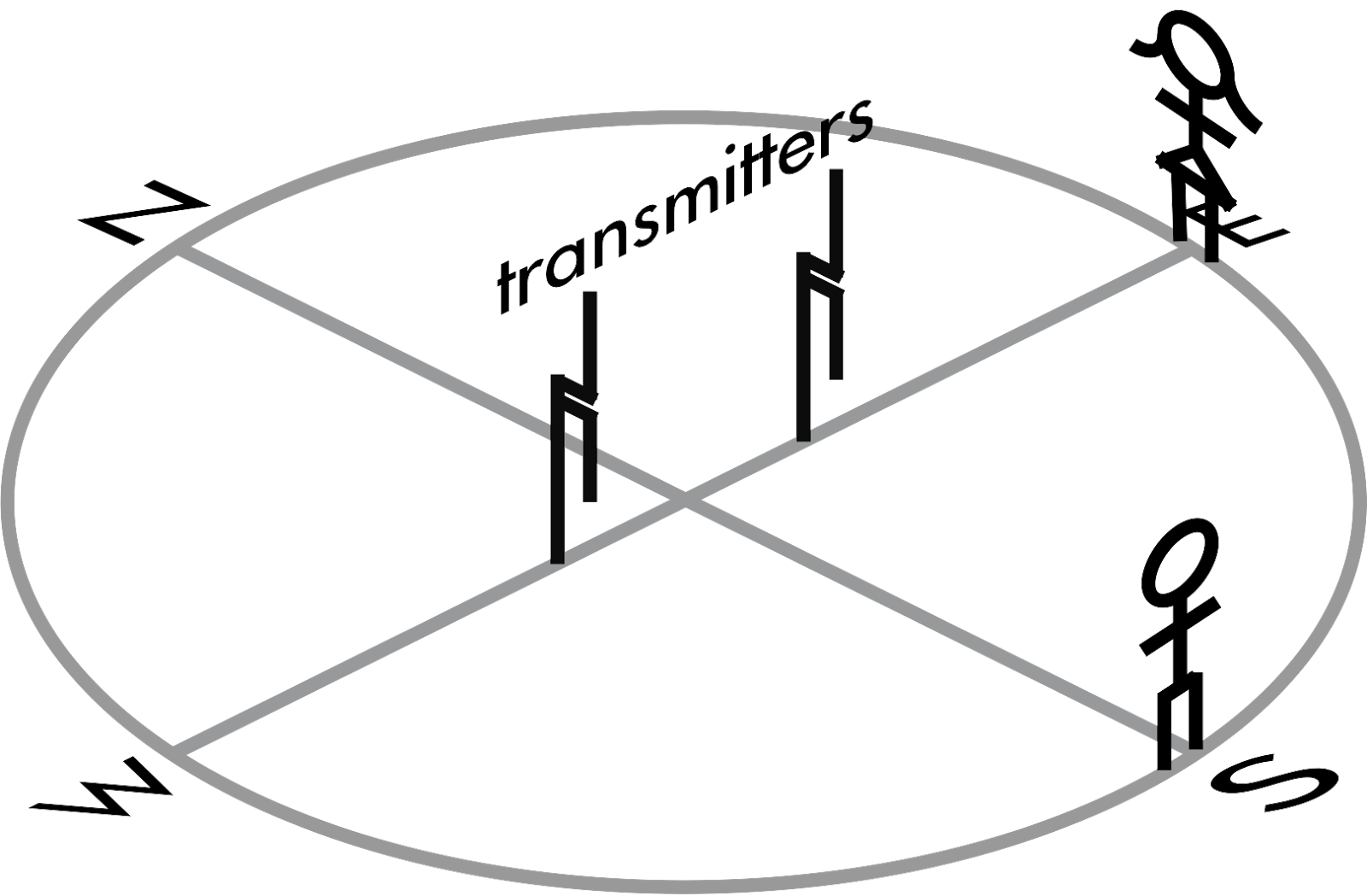
Two vertical radio transmitters broadcast at the same wavelength of 1.2 m, and are spaced 4.8 m apart along the east-west direction. A receiver held by a Physics 205B student located to the east of both transmitters detects a destructive interference signal. Discuss whether a receiver held by another Physics 205B student located to the south will detect a constructive, destructive, or something in-between a constructive and destructive signal. Explain your reasoning using the properties of source phases, path lengths, and interference.
Solution and grading rubric:
  • p:
    Correct. Discusses/demonstrates:
    1. that the radio transmitters are out of phase, as the difference in path lengths to the student located to the east is four times the wavelength, which would be constructive interference for in phase sources, but destructive interference (as is the case here) for out of phase sources;
    2. there is zero difference in path lengths to the student located to the south, which means that the out of phase sources will interfere destructively in that direction as well.
  • r:
    As (p), but argument indirectly, weakly, or only by definition supports the statement to be proven, or has minor inconsistencies or loopholes. At least discusses how (1) transmitters are out of phase, but does not sufficiently explain (2) the destructive interference for the south receiver.
  • t:
    Nearly correct, but argument has conceptual errors, or is incomplete. Only (1) or (2) is complete, typically understands that difference in path lengths to the south receiver is zero.
  • v:
    Limited relevant discussion of supporting evidence of at least some merit, but in an inconsistent or unclear manner. Some garbled attempt at discussing source phases, path lengths, and interference.
  • x:
    Implementation/application of ideas, but credit given for effort rather than merit. Approach other than that of discussing source phases, path lengths, and interference.
  • y:
    Irrelevant discussion/effectively blank.
  • z:
    Blank.
Grading distribution:
Sections 30882, 30883
Exam code: midterm01p34K
p: 20 students
r: 7 students
t: 13 students
v: 7 students
x: 0 student
y: 0 students
z: 0 student

A sample "p" response (from student 5425):

A sample "t" response (from student 1107):

20150314

Physics quiz archive: interference, electrostatics

Physics 205B Quiz 3, spring semester 2015
Cuesta College, San Luis Obispo, CA
Sections 30882, 30883, version 1
Exam code: quiz03wJnb


Sections 30882, 30883 results
0- 6 :   ****** [low = 0]
7-12 :   *****
13-18 :   ****************** [mean = 16.7 +/- 7.2]
19-24 :   ***********
25-30 :   **** [high = 30]

20140529

Physics final exam question: shifting interfering transmitters

Physics 205B Final Exam, spring semester 2014
Cuesta College, San Luis Obispo, CA

Cf. Giambattista/Richardson/Richardson, Physics, 2/e, Problem 25.1

A radio antenna receives a constructive interference signal from two transmitters that broadcast in phase at the same wavelength. Discuss why the radio antenna will still receive a constructive interference signal if one transmitter were moved one-half of a wavelength closer to the radio antenna, while the other transmitter was moved one-half of a wavelength farther from the radio antenna. Explain your reasoning by using the properties of waves and interference.

Solution and grading rubric:
  • p:
    Correct. Shows either by a diagram or explicit demonstration of how Δl = |l1l2| is a whole number of wavelengths (where l1' = l1 + λ/2 and l2' = l2 – λ/2 results in Δl' still being equal to a whole number of wavelengths) that constructive interference still results.
  • r:
    As (p), but argument indirectly, weakly, or only by definition supports the statement to be proven, or has minor inconsistencies or loopholes.
  • t:
    Nearly correct, but argument has conceptual errors, or is incomplete.
  • v:
    Limited relevant discussion of supporting evidence of at least some merit, but in an inconsistent or unclear manner. Some attempt at using interference, phase/path lengths differences.
  • x:
    Implementation/application of ideas, but credit given for effort rather than merit.
  • y:
    Irrelevant discussion/effectively blank.
  • z:
    Blank.
Grading distribution:
Sections 30882, 30883
Exam code: finalEL7a
p: 20 students
r: 3 students
t: 7 students
v: 4 students
x: 1 student
y: 0 students
z: 0 students

A sample "p" response (from student 0001), using the path-length difference equation:

Another sample "p" response (from student 0007), using a diagram:

Another sample "p" response (from student 7810), using both the path-length difference equation and a diagram:

20140329

Physics midterm question: moving interfering transmitters back from receiver

Physics 205B Midterm 1, spring semester 2014
Cuesta College, San Luis Obispo, CA

Cf. Giambattista/Richardson/Richardson, Physics, 2/e, Problem 25.1

A radio antenna receives a destructive interference signal from two transmitters that broadcast in phase at the same wavelength. Discuss why the radio antenna will still receive a destructive interference signal if both of the two transmitters are each moved one-half of a wavelength farther away from their current distances from the radio antenna. Explain your reasoning by using the properties of waves and interference.

Solution and grading rubric:
  • p:
    Correct. Recognizes that (a) the two waves from in phase sources interfere destructively, so the path length difference ∆l = (m + 1/2)∙λ, and (b) demonstrates by either drawings or explicit math how extending both paths by half a wavelength will not affect the path length difference, thus the interference will still be destructive as stated.
  • r:
    As (p), but argument indirectly, weakly, or only by definition supports the statement to be proven, or has minor inconsistencies or loopholes. Typically recognizes that ∆l will not be affected by moving both transmitters by half a wavelength, but does not explicitly demonstrate how this is so.
  • t:
    Nearly correct, but argument has conceptual errors, or is incomplete.
  • v:
    Limited relevant discussion of supporting evidence of at least some merit, but in an inconsistent or unclear manner.
  • x:
    Implementation/application of ideas, but credit given for effort rather than merit.
  • y:
    Irrelevant discussion/effectively blank.
  • z:
    Blank.
Grading distribution:
Sections 30882, 30883
Exam code: midterm01b0w7
p: 14 students
r: 14 students
t: 11 students
v: 1 student
x: 1 student
y: 0 students
z: 0 students

A sample "p" response (from student 5297):

Another sample "p" response (from student 3420):

20140313

Physics quiz question: minimum possible path length

Physics 205B Quiz 3, spring semester 2014
Cuesta College, San Luis Obispo, CA

Cf. Giambattista/Richardson/Richardson, Physics, 2/e, Problem 25.1

A radio antenna receives a constructive interference signal from two transmitters that broadcast in phase at the same wavelength of 420 m. The distance from the first transmitter to the radio antenna is 800 m. The minimum possible distance from the second transmitter to the radio antenna is:
(A) 240 m.
(B) 380 m.
(C) 420 m.
(D) 800 m.

Correct answer (highlight to unhide): (B)

For in phase sources, the condition for constructive interference is given by:

l = m·λ,

where the difference in path lengths is ∆l = l1l2, and solving for l2 yields:

l2 = l1m·λ,

To find the minimum (positive-definite) possible value for l2, we put in progressively larger (positive) values for m = 0, +1, +2, +3, ..., such that:

l2 = (800 m) – m·(420 m) = 800 m, 380 m,

of which 380 m is the minimum possible distance from the second transmitter to the receiving radio antenna. (Plugging in negative values for m would result in other possible distances from the second transmitter to the receiving radio antenna greater than 800 m.)

(Response (A) is λ/2; response (C) is λ; response (D) is the second smallest possible distance from the second transmitter to the receiving radio antenna.)

Sections 30882, 30883
Exam code: quiz03cDvD
(A) : 2 students
(B) : 19 students
(C) : 12 students
(D) : 7 students

Success level: 48%
Discrimination index (Aubrecht & Aubrecht, 1983): 0.45

20140312

Physics quiz archive: interference, electrostatics

Physics 205B Quiz 3, spring semester 2014
Cuesta College, San Luis Obispo, CA
Sections 30882, 30883, version 1
Exam code: quiz03cDvD


Sections 30882, 30883 results
0- 6 :
7-12 : *** [low = 9]
13-18 : *******************
19-24 : ************* [mean = 19.7 +/- 5.0]
25-30 : ***** [high = 30]

20130314

Physics quiz question: wavelength for destructively interfering radio transmitters

Physics 205B Quiz 3, spring semester 2013
Cuesta College, San Luis Obispo, CA

Cf. Giambattista/Richardson/Richardson, Physics, 2/e, Problem 25.3

A radio antenna receives a destructive interference signal from two transmitters, one located 750 m away, and the other located 890 m away. The two transmitters broadcast in phase at the same wavelength. The maximum value for the wavelength broadcast by the two transmitters is:
(A) 70 m.
(B) 140 m.
(C) 210 m.
(D) 280 m.

Correct answer (highlight to unhide): (D)

For in phase sources, the condition for destructive interference is given by:

l = (m + 1/2)·λ,

where the difference in path lengths is ∆l = 890 m - 750 m = 140 m, and solving for λ yields:

140 m = (m + 1/2)·λ,

λ = (140 m)/(m + 1/2).

To find the maximum possible value for λ, we set m = 0, and:

λ = (140 m)/((0) + 1/2) = 2·(140 m) = 280 m.

(Response (A) is ∆l/2; response (B) is ∆l; and response (C) is (3/2)·∆l.)

Section 30882
Exam code: quiz03rD1o
(A) : 3 students
(B) : 12 students
(C) : 5 students
(D) : 12 students

Success level: 37%
Discrimination index (Aubrecht & Aubrecht, 1983): 0.47

20130313

Physics quiz archive: interference, electrostatics

Physics 205B Quiz 3, spring semester 2013
Cuesta College, San Luis Obispo, CA
Section 30882, version 1
Exam code: quiz03rD1o


Section 30882 results
0- 6 :
7-12 : ****** [low = 9]
13-18 : ********
19-24 : ************* [mean = 19.9 +/- 5.5]
25-30 : ***** [high = 30]