Showing posts with label radio waves. Show all posts

20200211

Physics quiz question: comparing blue, yellow laser frequencies

Physics 205B Quiz 1, spring semester 2020
Cuesta College, San Luis Obispo, CA

"laser3.jpg"
©CrystaLaser
https://www.crystalaser.com/new/yellowlaser.html

Blue laser light has a wavelength of 445 nm light in air, while yellow laser light has a wavelength of 594 nm in air. The __________ laser light has a higher frequency in air.
(A) blue.
(B) yellow.
(C) (There is a tie.)
(D) (Not enough information is given.)

Correct answer (highlight to unhide): (A)

Wave speed v depends on the properties of the medium. Frequency f depends on the properties of the source. These two parameters can be varied independently of each other.

The wavelength λ is the parameter dependent on both of the independent parameters:

λ = v/f.

Since the two laser light colors have the same speed v (as they travel through the same medium), then because of their different frequencies, they will have have different λ wavelengths (as this parameter depends on both the wave source and the properties of the medium):

λ1 = v1/f1,

λ2 = v2/f2,

where λ1 < λ2, as blue light (here, λ1) has a much shorter wavelength than yellow light (here, λ2). Since v1 = v2 (as both forms of laser light travel through the air), then f1 > f2, and thus blue laser light has a higher frequency than yellow laser light.

Sections 30882, 30883
Exam code: quiz01PxP7
(A) : 22 students
(B) : 8 students
(C) : 5 students
(D) : 0 students

Success level: 63%
Discrimination index (Aubrecht & Aubrecht, 1983): 0.67

20190405

Physics midterm question: destructively interfering out-of-phase radio transmitters

Physics 205B Midterm 1, spring semester 2019
Cuesta College, San Luis Obispo, CA

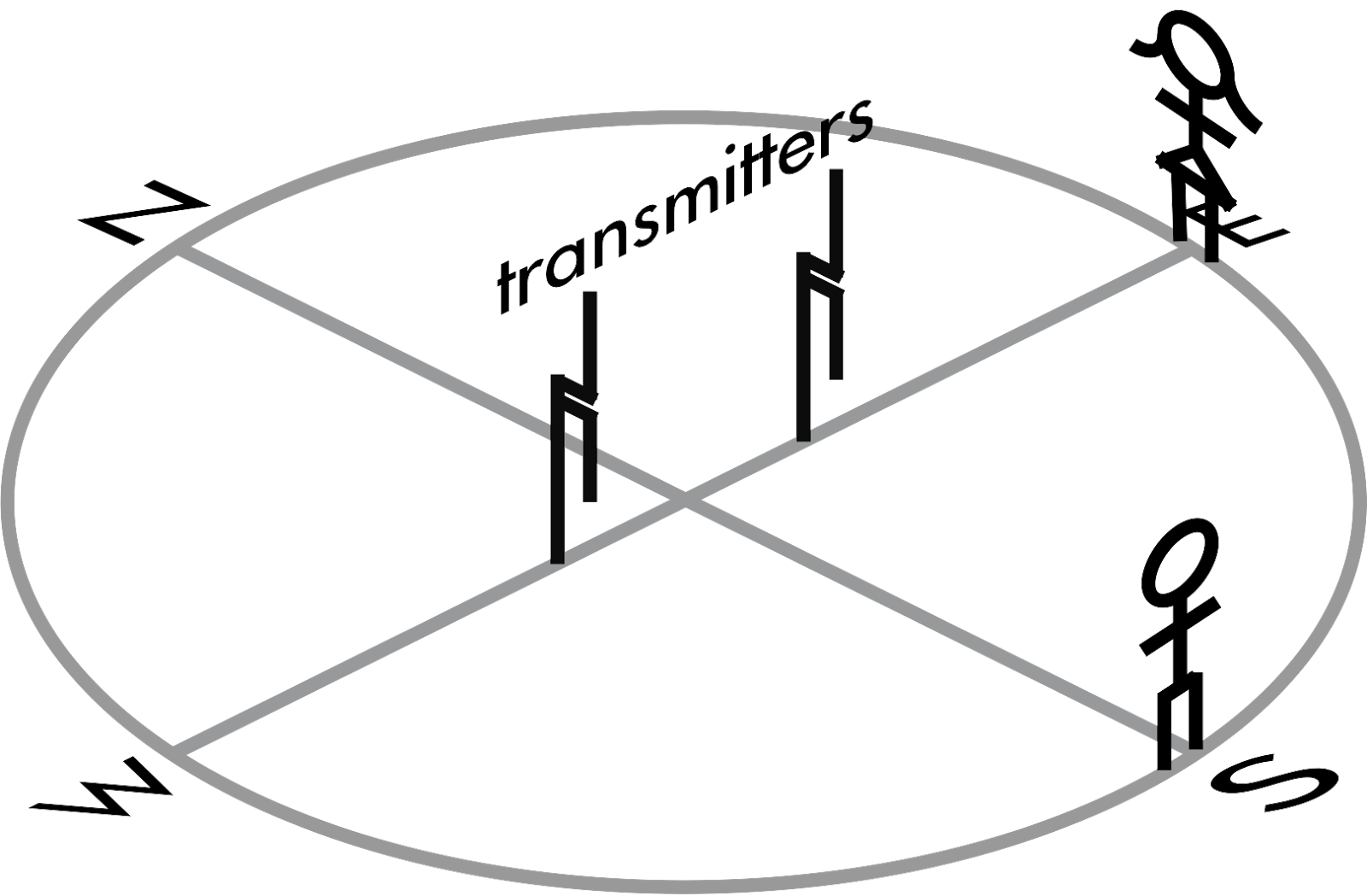
Two vertical radio transmitters broadcast at the same wavelength, and are spaced 6.0 m apart along the east-west direction. A receiver held by a Physics 205B student located to the east of both transmitters detects a destructive interference signal, and a receiver held by another Physics 205B student located to the north also detects a destructive signal. Show (a) why the transmitters must be out-of-phase sources, and (b) find a plausible numerical value for the wavelength. Explain your reasoning using the properties of source phases, path lengths, and interference.

Solution and grading rubric:
  • p:
    Correct. Discusses/demonstrates:
    1. that the radio transmitters are out of phase, as there is no path length difference for the student located to the north, and destructive interference (as is the case here) can only occur if the sources are out of phase; and
    2. for the student located to the east, for these out of phase sources to interfere destructively the path length difference must be a whole number of wavelengths, and since the path length difference is 6.0 m, plausible (non-zero) wavelength values would be 6.0 m, 3.0 m, 1.5 m, etc.
  • r:
    As (p), but argument indirectly, weakly, or only by definition supports the statement to be proven, or has minor inconsistencies or loopholes.
  • t:
    Nearly correct, but argument has conceptual errors, or is incomplete. At least discusses why (1) transmitters are out of phase, but (2) does not use the correct destructive interference condition (whole number of wavelengths) for out of phase sources for the student located to the east.
  • v:
    Limited relevant discussion of supporting evidence of at least some merit, but in an inconsistent or unclear manner. Some garbled attempt at discussing source phases, path lengths, and interference.
  • x:
    Implementation/application of ideas, but credit given for effort rather than merit. Approach other than that of discussing source phases, path lengths, and interference.
  • y:
    Irrelevant discussion/effectively blank.
  • z:
    Blank.
Grading distribution:
Sections 30882, 30883
Exam code: midterm01Ft6G
p: 13 students
r: 4 students
t: 13 students
v: 12 students
x: 0 students
y: 0 students
z: 0 students

A sample "p" response (from student 5250), identifying the correct path length difference condition for two sources that are out of phase:

Another sample "p" response (from student 1810), with a graphical representation of the interfering waves:

20190212

Physics quiz question: Google's Project Soli wavelengths

Physics 205B Quiz 1, spring semester 2019
Cuesta College, San Luis Obispo, CA

"Welcome to Project Soli"
Google ATAP
youtu.be/0QNiZfSsPc0

Google's Project Soli[*] is developing a sensor that detects hand gestures using radio waves, with frequencies between 57 GHz to 64 GHz in air. In air, the 57 GHz radio wave has __________ wavelength compared to the 64 GHz radio wave.
(A) a shorter.
(B) a longer.
(C) the same.
(D) (Not enough information is given.)

[*] rarstechnica.com/gadgets/2019/01/googles-project-soli-radar-gesture-chip-isnt-dead-gets-fcc-approval/.

Correct answer (highlight to unhide): (B)

Wave speed v depends on the properties of the medium. Frequency f depends on the properties of the source. These two parameters can be varied independently of each other.

The wavelength λ is the parameter dependent on both of the independent parameters:

λ = v/f.

Since the two radio waves have the same speed v (as they travel through the same medium), then because of their different frequencies, they will have have different λ wavelengths (as this parameter depends on both the wave source and the properties of the medium):

λ1 = v1/f1,

λ2 = v2/f2,

where v1 = v2 (as both waves travel through air). With f1 = 57 GHz being lower than f2 = 64 GHz, then λ1 > λ2, and so the 57 GHz radio wave has the longer wavelength.

Sections 30882, 30883
Exam code: quiz01aN7u
(A) : 6 students
(B) : 28 students
(C) : 2 students
(D) : 1 student

Success level: 76%
Discrimination index (Aubrecht & Aubrecht, 1983): 0.63

20180121

Physics quiz question: comparing emerald, turpentine wavelengths

Physics 205B Quiz 1, spring semester 2016
Cuesta College, San Luis Obispo, CA

Light of wavelength 480 nm in turpentine (index of refraction 1.472) is transmitted into emerald (index of refraction of 1.576).[*]

The wavelength of this light in emerald is __________ 480 nm.
(A) less than.
(B) equal to.
(C) greater than.
(D) (Not enough information is given.)

[*] physics.info/refraction/.

Correct answer (highlight to unhide): (A)

The relationship between the index of refraction n of a medium and the speed of light v traveling through that medium is given by:

n = c/v,

where c is the speed of light in vacuum. Since turpentine has a smaller index of refraction n1 than the index of refraction n2 of emerald, then:

n1 < n2,

(c/v1) < (c/v2),

v2 < v1,

and thus light travels with a slower speed through emerald than it does through turpentine.

The wavelength λ of light is a parameter dependent on both the wave speed v (which depends on the medium), and the frequency f (which depends on the source):

λ = v/f.

Since light that initially travels through turpentine then passes into emerald, then the frequency of this light remains constant as it comes from same given source, as this value does not depend on the medium. Then the frequency of this light f1 in turpentine must be equal to the frequency of this light f2 in emerald, such that:

f1 = f2,

(v11) = (v22),

and since v2 < v1, then λ2 < λ1, and the wavelength λ2 in emerald will be shorter than 480 nm, the wavelength of light in turpentine.

Section 30882, 30883
Exam code: quiz01sN0w
(A) : 38 students
(B) : 2 students
(C) : 2 students
(D) : 0 students

Success level: 87%
Discrimination index (Aubrecht & Aubrecht, 1983): 0.57

20170601

Physics final exam problem: destructive interference angles in one quadrant

Physics 205B Final Exam, spring semester 2017
Cuesta College, San Luis Obispo, CA

Two vertical radio transmitters broadcast in phase at the same wavelength of 1.2 m, and are spaced a certain apart along the east-west direction. A Physics 205B student holding a receiver starts from due south of the transmitters, and detects three different locations with destructive interference signals before finally reaching due east of the transmitters. Determine a plausible separation distance (in m) between the transmitters. Explain your reasoning using the properties of source phases, path lengths, and interference.

Solution and grading rubric:
  • p:
    Correct. Discusses/demonstrates that three minima locations will be found in the range θ = 0° (due south) to 90° (due west) by using one of two approaches:
    1. using the destructive interference condition d⋅sinθ = (m + 1/2)⋅λ, where m = 0, 1, 2, ..., finds a plausible separation distance d such that the third minima (m = 2) will be within θ = 90°, but the fourth minima (m = 3) is outside of θ = 90° (i.e., 3.0 m ≤ d ≤ 4.8 m); or
    2. using the constructive interference condition d⋅sinθ = m⋅λ, where m = 0, 1, 2, ..., finds the separation distance d such that the third maxima (m = 3) will be at θ = 90°; which allows for the m = 0, 1, and 2 minima to exist within that range (i.e., d = 3.6 m).
  • r:
    Nearly correct, but includes minor math errors. May have claimed equally spaced minima angles at θ = 30°, 60° and 90° to find a plausible separation distance d using θ = 30° for the first minima angle.
  • t:
    Nearly correct, but approach has conceptual errors, and/or major/compounded math errors.
  • v:
    Implementation of right ideas, but in an inconsistent, incomplete, or unorganized manner. Garbled attempt at applying properties of source phases, path lengths, and interference.
  • x:
    Implementation of ideas, but credit given for effort rather than merit. No clear attempt at applying properties of source phases, path lengths, and interference.
  • y:
    Irrelevant discussion/effectively blank.
  • z:
    Blank.
Grading distribution:
Sections 30882, 30883
Exam code: finalmR3x
p: 3 students
r: 4 students
t: 6 students
v: 7 students
x: 4 students
y: 2 students
z: 0 students

A sample "p" response (from student 0428), finding the maximum possible separation distance:

20170325

Physics midterm question: Boeing E-6A tail cable antenna reception

Physics 205B Midterm 1, spring semester 2017
Cuesta College, San Luis Obispo, CA

An airplane has a horizontal receiving antenna trailing behind it[*]. It can fly over a transmitting antenna that is aligned horizontally east-west. Discuss whether the airplane will receive more signal while flying over the transmitting antenna in the north-south direction (as shown here), or while flying over the transmitting antenna in the east-west direction, or if there is a tie. Explain your reasoning using the properties of light and polarization.

[*] fas.org/nuke/guide/usa/c3i/e-6.htm.

Solution and grading rubric:
  • p:
    Correct. Discusses/demonstrates that signal will be received by the airplane receiving antenna as it flies east-west over the transmitter, and no signal will be received as it flies north-south, because:
    1. the east-west transmitter will emit a transverse wave straight upward that has the same east-west polarization as the antenna orientation (also along the north and south directions at ground level);
    2. a receiving antenna will best pick up a transverse radio wave when its orientation matches the polarization of the radio wave, and pick up no signal when its orientation is perpendicular to the polarization of the radio wave.
  • r:
    As (p), but argument indirectly, weakly, or only by definition supports the statement to be proven, or has minor inconsistencies or loopholes. May have a "T" at the end of the cable trailing the aircraft, such that its receiving orientation is parallel to its wings instead of parallel to its fuselage.
  • t:
    Nearly correct, but argument has conceptual errors, or is incomplete. Typically only explanation for (1) is complete, but not (2).
  • v:
    Limited relevant discussion of supporting evidence of at least some merit, but in an inconsistent or unclear manner. Some garbled attempt at applying the properties of light (radio waves) and polarization.
  • x:
    Implementation/application of ideas, but credit given for effort rather than merit. No clear attempt at applying the properties of light (radio waves) and polarization.
  • y:
    Irrelevant discussion/effectively blank.
  • z:
    Blank.
Grading distribution:
Sections 30882, 30883
Exam code: midterm01AhC4
p: 16 students
r: 3 students
t: 5 students
v: 5 students
x: 1 student
y: 0 students
z: 0 student

A sample "p" response (from student 6969):

20170314

Physics quiz question: interference from two in-phase radio transmitters

Physics 205B Quiz 3, spring semester 2017
Cuesta College, San Luis Obispo, CA

A radio antenna receives signals from two in-phase transmitters at the same wavelength of 30 m. This diagrams is not drawn to scale. The radio antenna receives __________ interference signal.
(A) a constructive.
(B) a destructive.
(C) something in-between a constructive and destructive.
(D) (Not enough information is given.)

Correct answer (highlight to unhide): (B)

Radio waves from the transmitter at x = 0 travel 45 m to get to the receiver. Radio waves from the transmitter at x = +180 m travel 135 m to get to the receiver. The path length difference ∆l is 135 m – 45 m = 90 m, which is (90 m)/(30 m) = three times the wavelength of 30 m. Since there is a whole number (here, 3) wavelength path length difference, the receiving antenna detects constructive interference from these two in-phase transmitters.

Sections 30882, 30883
Exam code: quiz03d3St
(A) : 11 students
(B) : 15 students
(C) : 2 students
(D) : 0 students

Success level: 39%
Discrimination index (Aubrecht & Aubrecht, 1983): 0.12

20170123

Physics quiz question: comparing FM, AM radio wavelengths

Physics 205B Quiz 1, spring semester 2013
Cuesta College, San Luis Obispo, CA

Cf. Giambattista/Richardson/Richardson, Physics, 2/e, Conceptual Question 23.7

"Under the radio towers on Capitol Hill"
Matthew Rutledge
flic.kr/p/5JTuuF

FM radio station KCBX broadcasts at 90.1 MHz, while AM radio station KVEC broadcasts at 920 kHz[*]. Radio signals from station __________ have a longer wavelength in air.
(A) KCBX.
(B) KVEC.
(C) (There is a tie.)
(D) (Not enough information given.)

[*] radio-locator.com/cgi-bin/locate?select=city&city=San+Luis+Obispo&state=CA.

Correct answer (highlight to unhide): (B)

Wave speed v depends on the properties of the medium. Frequency f depends on the properties of the source. These two parameters can be varied independently of each other.

The wavelength λ is the parameter dependent on both of the independent parameters:

λ = v/f.

Since the two radio waves have the same speed v (as they travel through the same medium), then because of their different frequencies, they will have have different λ wavelengths (as this parameter depends on both the wave source and the properties of the medium):

λ1 = v1/f1,

λ2 = v2/f2,

where v1 = v2 (as both waves travel through air). Because KCBX (here, station 1) has a much higher frequency than KVEC (here, station 2), then f1 > f2, and thus λ1 < λ2, and so KVEC broadcasts radio waves with the longer wavelength.

Section 30882
Exam code: quiz01b3Es
(A) : 16 students
(B) : 18 students
(C) : 1 student
(D) : 0 students

Success level: 54%
Discrimination index (Aubrecht & Aubrecht, 1983): 0.45

20160327

Physics midterm question: reception from an electric dipole antenna

Physics 205B Midterm 1, spring semester 2016
Cuesta College, San Luis Obispo, CA

A radio transmitter broadcasts using a horizontal electric dipole antenna mounted along the north-south direction. A Physics 205B student holding a vertical receiver is located to the west of the transmitter, and walks to the south of the transmitter. Discuss whether the signal (if any) received by the Physics 205B student will increase, decrease, or not change as she walks from west to south. Explain your reasoning using the properties of light and polarization.

Solution and grading rubric:
  • p:
    Correct. Discusses/demonstrates that no signal will be received by the Physics 205B student's vertical receiving antenna as she walks from west of to the south of the horizontal north-south transmitting antenna because:
    1. her vertical antenna cannot receive a horizontally polarized radio signal emitted by the transmitting antenna to the west, and;
    2. the transmitting antenna does not broadcast any signal to the south, along its antenna axis.
  • r:
    As (p), but argument indirectly, weakly, or only by definition supports the statement to be proven, or has minor inconsistencies or loopholes. Typically only explanation for (1) is complete, but not (2).
  • t:
    Nearly correct, but argument has conceptual errors, or is incomplete. Typically only explanation for (2) is complete, but not (1).
  • v:
    Limited relevant discussion of supporting evidence of at least some merit, but in an inconsistent or unclear manner. Some garbled attempt at applying the properties of light (radio waves) and polarization.
  • x:
    Implementation/application of ideas, but credit given for effort rather than merit. No clear attempt at applying the properties of light (radio waves) and polarization.
  • y:
    Irrelevant discussion/effectively blank.
  • z:
    Blank.
Grading distribution:
Sections 30882, 30883
Exam code: midterm01rx1C
p: 25 students
r: 8 students
t: 8 students
v: 2 students
x: 0 students
y: 0 students
z: 0 student

A sample "p" response (from student 2468):

A sample "t" response (from student 0558):

20151215

Astronomy quiz question: interstellar gas and dust in the Milky Way

Astronomy 210 Quiz 7, fall semester 2015
Cuesta College, San Luis Obispo, CA

Interstellar gas and dust in the Milky Way prevents most of its __________ from being visible from Earth.
(A) stars.
(B) dark matter.
(C) radio waves.
(D) neighboring galaxies.

Correct answer (highlight to unhide): (A)

Interstellar gas and dust blocks visible light from stars, while typically not affecting longer wavelength forms of light such as radio waves. Dark matter is not visible already, and clear views of our neighboring galaxies can be seen above and below the gas and dust in the disk of the Milky Way.

Section 70158
Exam code: quiz07srrH
(A) : 32 students
(B) : 1 student
(C) : 0 students
(D) : 6 students

Success level: 83% (including partial credit for multiple-choice)
Discrimination index (Aubrecht & Aubrecht, 1983): 0.62

Section 70160
Exam code: quiz07nM0r
(A) : 18 students
(B) : 1 student
(C) : 1 student
(D) : 6 students

Success level: 75% (including partial credit for multiple-choice)
Discrimination index (Aubrecht & Aubrecht, 1983): 0.64

20150624

Physics final exam problem: interference of two in-phase Wi-Fi antennae

Physics 205B Final Exam, spring semester 2015
Cuesta College, San Luis Obispo, CA

Cf. Giambattista/Richardson/Richardson, Physics, 2/e, Problem 25.31

"Wifi"
Jason Cole
youtu.be/6hcK9B4HHY8

A commercially available wireless router[*] broadcasts at a 0.12 m wavelength from two vertical antennae spaced 0.18 m apart. Assume that the two antennae are in phase. Determine how many destructive interference (minima) directions there will be (if any) in the 360° range of all possible directions. Show your work and explain your reasoning using the properties of source phases, path lengths, and interference.

[*] Linksys WRT54GL wireless router, 802.11b channel 1 (2412 MHz), overall width 200 mm, downloads.linksys.com/downloads/WRT54GL_V11_DS_NC-WEB,0.pdf

Solution and grading rubric:
  • p:
    Correct. Approximates two in-phase antennae as a double slit, and equates path length difference approximation d⋅sinθ with destructive interference (minima) condition for in-phase sources to find θ = 19° and 90° as measured counterclockwise from the θ = 0° south direction, such that there are six unique directions of destructive interference in the 360° range of all possible directions. Okay if minima directions in the south-east quadrant are not correctly mapped via symmetry to find all minima directions, if at least the two unique θ = 19° and 90° directions in the southeast quadrant are found.
  • r:
    Nearly correct, but includes minor math errors. Only specifically searches over the cardinal directions, and finds of these that only east and west have destructive interference.
  • t:
    Nearly correct, but approach has conceptual errors, and/or major/compounded math errors.
  • v:
    Implementation of right ideas, but in an inconsistent, incomplete, or unorganized manner.
  • x:
    Implementation of ideas, but credit given for effort rather than merit. No clear attempt at applying path length differences and interference.
  • y:
    Irrelevant discussion/effectively blank.
  • z:
    Blank.
Grading distribution:
Sections 30882, 30883
Exam code: finalLd0c
p: 4 students
r: 13 students
t: 5 students
v: 11 students
x: 4 students
y: 3 students
z: 3 students

20150329

Physics midterm question: interference of out-of-phase radio transmitters

Physics 205B Midterm 1, spring semester 2015
Cuesta College, San Luis Obispo, CA

Cf. Giambattista/Richardson/Richardson, Physics, 2/e, Example 25.1, Problem 25.1

Two vertical radio transmitters broadcast at the same wavelength of 1.2 m, and are spaced 4.8 m apart along the east-west direction. A receiver held by a Physics 205B student located to the east of both transmitters detects a destructive interference signal. Discuss whether a receiver held by another Physics 205B student located to the south will detect a constructive, destructive, or something in-between a constructive and destructive signal. Explain your reasoning using the properties of source phases, path lengths, and interference.

Solution and grading rubric:
  • p:
    Correct. Discusses/demonstrates:
    1. that the radio transmitters are out of phase, as the difference in path lengths to the student located to the east is four times the wavelength, which would be constructive interference for in phase sources, but destructive interference (as is the case here) for out of phase sources;
    2. there is zero difference in path lengths to the student located to the south, which means that the out of phase sources will interfere destructively in that direction as well.
  • r:
    As (p), but argument indirectly, weakly, or only by definition supports the statement to be proven, or has minor inconsistencies or loopholes. At least discusses how (1) transmitters are out of phase, but does not sufficiently explain (2) the destructive interference for the south receiver.
  • t:
    Nearly correct, but argument has conceptual errors, or is incomplete. Only (1) or (2) is complete, typically understands that difference in path lengths to the south receiver is zero.
  • v:
    Limited relevant discussion of supporting evidence of at least some merit, but in an inconsistent or unclear manner. Some garbled attempt at discussing source phases, path lengths, and interference.
  • x:
    Implementation/application of ideas, but credit given for effort rather than merit. Approach other than that of discussing source phases, path lengths, and interference.
  • y:
    Irrelevant discussion/effectively blank.
  • z:
    Blank.
Grading distribution:
Sections 30882, 30883
Exam code: midterm01p34K
p: 20 students
r: 7 students
t: 13 students
v: 7 students
x: 0 student
y: 0 students
z: 0 student

A sample "p" response (from student 5425):

A sample "t" response (from student 1107):

20140313

Physics quiz question: minimum possible path length

Physics 205B Quiz 3, spring semester 2014
Cuesta College, San Luis Obispo, CA

Cf. Giambattista/Richardson/Richardson, Physics, 2/e, Problem 25.1

A radio antenna receives a constructive interference signal from two transmitters that broadcast in phase at the same wavelength of 420 m. The distance from the first transmitter to the radio antenna is 800 m. The minimum possible distance from the second transmitter to the radio antenna is:
(A) 240 m.
(B) 380 m.
(C) 420 m.
(D) 800 m.

Correct answer (highlight to unhide): (B)

For in phase sources, the condition for constructive interference is given by:

l = m·λ,

where the difference in path lengths is ∆l = l1l2, and solving for l2 yields:

l2 = l1m·λ,

To find the minimum (positive-definite) possible value for l2, we put in progressively larger (positive) values for m = 0, +1, +2, +3, ..., such that:

l2 = (800 m) – m·(420 m) = 800 m, 380 m,

of which 380 m is the minimum possible distance from the second transmitter to the receiving radio antenna. (Plugging in negative values for m would result in other possible distances from the second transmitter to the receiving radio antenna greater than 800 m.)

(Response (A) is λ/2; response (C) is λ; response (D) is the second smallest possible distance from the second transmitter to the receiving radio antenna.)

Sections 30882, 30883
Exam code: quiz03cDvD
(A) : 2 students
(B) : 19 students
(C) : 12 students
(D) : 7 students

Success level: 48%
Discrimination index (Aubrecht & Aubrecht, 1983): 0.45

20140214

Physics quiz question: wavelength of changed frequency radio station

Physics 205B Quiz 1, spring semester 2014
Cuesta College, San Luis Obispo, CA

Cf. Giambattista/Richardson/Richardson, Physics, 2/e, Conceptual Question 23.7

FM radio station KCPR broadcasts at 91.3 MHz. The closest unused FM frequency for this area[*] is at 91.9 MHz. If KCPR were instead to broadcast at 91.9 MHz, its wavelength would be __________ compared to broadcasting at 91.3 MHz.
(A) shorter than.
(B) the same as.
(C) longer than.
(D) (Not enough information given.)

[*] radio-locator.com/cgi-bin/vacant?select=city&city=San%20Luis%20Obispo&state=CA.

Correct answer (highlight to unhide): (A)

Wavelength λ depends on both the speed v and frequency f:

λ = v/f.

Since the speed of radio waves depends only on the medium (air), and is independent of changes in frequency (ignoring negligible dispersion effects), an increase in frequency would result in a decrease in wavelength.

Sections 30882, 30883
Exam code: quiz01ksB4
(A) : 30 students
(B) : 3 students
(C) : 7 students
(D) : 0 students
(No response) : 1 student

Success level: 73%
Discrimination index (Aubrecht & Aubrecht, 1983): 0.70

20130314

Physics quiz question: wavelength for destructively interfering radio transmitters

Physics 205B Quiz 3, spring semester 2013
Cuesta College, San Luis Obispo, CA

Cf. Giambattista/Richardson/Richardson, Physics, 2/e, Problem 25.3

A radio antenna receives a destructive interference signal from two transmitters, one located 750 m away, and the other located 890 m away. The two transmitters broadcast in phase at the same wavelength. The maximum value for the wavelength broadcast by the two transmitters is:
(A) 70 m.
(B) 140 m.
(C) 210 m.
(D) 280 m.

Correct answer (highlight to unhide): (D)

For in phase sources, the condition for destructive interference is given by:

l = (m + 1/2)·λ,

where the difference in path lengths is ∆l = 890 m - 750 m = 140 m, and solving for λ yields:

140 m = (m + 1/2)·λ,

λ = (140 m)/(m + 1/2).

To find the maximum possible value for λ, we set m = 0, and:

λ = (140 m)/((0) + 1/2) = 2·(140 m) = 280 m.

(Response (A) is ∆l/2; response (B) is ∆l; and response (C) is (3/2)·∆l.)

Section 30882
Exam code: quiz03rD1o
(A) : 3 students
(B) : 12 students
(C) : 5 students
(D) : 12 students

Success level: 37%
Discrimination index (Aubrecht & Aubrecht, 1983): 0.47

20130212

Physics quiz question: comparing radio wave speeds

Physics 205B Quiz 1, spring semester 2013
Cuesta College, San Luis Obispo, CA

Cf. Giambattista/Richardson/Richardson, Physics, 2/e, Conceptual Question 23.7

"Under the radio towers on Capitol Hill"
Matthew Rutledge
flic.kr/p/5JTuuF

FM radio station KCBX broadcasts at 90.1 MHz, while AM radio station KVEC broadcasts at 920 kHz[*]. Radio signals from station __________ travel with a faster speed in air.
(A) KCBX.
(B) KVEC.
(C) (There is a tie.)
(D) (Not enough information given.)

[*] radio-locator.com/cgi-bin/locate?select=city&city=San+Luis+Obispo&state=CA.

Correct answer (highlight to unhide): (C)

Wave speed v depends on the properties of the medium. Frequency f depends on the properties of the source. These two parameters can be varied independently of each other.

The wavelength λ is the parameter dependent on both of the independent parameters:

λ = v/f.

The radio waves from these two stations must have the same speed v, as they travel through the same medium. However, they can have different f frequencies (as this parameter depends only the wave source), and thus must also have different λ wavelengths (as this parameter depends on both the wave source and the properties of the medium).

Section 30882
Exam code: quiz01b3Es
(A) : 6 students
(B) : 9 students
(C) : 19 students
(D) : 1 student

Success level: 51%
Discrimination index (Aubrecht & Aubrecht, 1983): 0.05

Physics quiz question: reception from dipole antenna

Physics 205B Quiz 1, spring semester 2013
Cuesta College, San Luis Obispo, CA

Cf. Giambattista/Richardson/Richardson, Physics, 2/e, Multiple-Choice Question 22.1

A radio station is located due north of your location. It uses an electric dipole antenna oriented east-west. In order to maximize reception of this broadcast at your location, you need to orient an electric dipole receiving antenna:
(A) vertically.
(B) horizontally north-south.
(C) horizontally east-west.
(D) (No reception is possible using an electric dipole antenna.)

Correct answer (highlight to unhide): (C)

This electric dipole antenna will broadcast radio signals in directions perpendicular to its orientation, and none along its ends. Since the antenna is oriented east-west and located north of the receiving antenna, then east-west horizontally polarized radio waves will be received at your location.

Section 30882
Exam code: quiz01b3Es
(A) : 4 students
(B) : 1 student
(C) : 29 students
(D) : 1 student

Success level: 83%
Discrimination index (Aubrecht & Aubrecht, 1983): 0.26

20121123

Astronomy quiz question: mapping Milky Way spiral arms

Astronomy 210 Quiz 6, fall semester 2012
Cuesta College, San Luis Obispo, CA

__________ is/are evidence that spiral arms extend across the entire Milky Way disk.
(A) Positions of massive main sequence stars.
(B) Radio waves emitted from cold hydrogen gas clouds.
(C) Globular cluster positions.
(D) The Doppler effect.

Correct answer: (B)

Radio waves are relatively unaffected by interstellar gas and dust, and enable the locations of cold hydrogen gas clouds in most of the Milky Way to be mapped. Positions of massive main sequence stars can only give an indication of spiral arms immediately adjacent to the spur the sun is located in; and globular cluster positions are used to determine the location of the Milky Way.

Section 70158
Exam code: quiz06Sl4m
(A) : 9 students
(B) : 4 students
(C) : 13 students
(D) : 4 students

Success level: 19% (including partial credit for multiple-choice)
Discrimination index (Aubrecht & Aubrecht, 1983): 0.38

20120705

Presentation: electromagnetic radiation

Are you familiar with the movie Encino Man? This movie, while probably not award-winning, is at least a Generation Y-defining movie that you have probably watched countless times on basic cable. We'll see how this movie is going to help us understand an apparent paradox of light...

...or more precisely, electromagnetic radiation. (N.b. this is an expanded version of an introductory physics electromagnetic waves presentation.)

First, consider all types of "light."

The electromagnetic spectrum encompasses all types of "light," here listed from short to long wavelengths. Notice that visible light is only a very small portion of the entire electromagnetic spectrum, which we perceive as colors. T he vast majority of the electromagnetic spectrum is invisible to our eyes, but we can detect their presence indirectly with certain instruments, or even different parts of our bodies. (When discussing all types of "light," we'll use "electromagnetic radiation," as often "light" refers only to visible light.) Let's introduce these types of light...oops, electromagnetic radiation, from short to long wavelength.

Hulk smash, well, because of being exposed to gamma rays. More scientifically, gamma rays are the shortest wavelength form of electromagnetic radiation, and a single gamma ray photon is the most energetic and dangerous to be exposed to. The progression of our discussion is introduce longer and longer wavelengths of electromagnetic radiation, which will be comprised of lower and lower energy photons. This form of electromagnetic radiation cannot be seen by our eyes, but can certainly cause damage to molecules, especially those in our bodies, so while exposure to gamma rays may not cause you to transform into the Hulk, it may cause irreparable damage to your cells.

Slightly longer in wavelength, and lower in photon energy are x-rays, which again cannot be seen by our eyes (well, maybe for Superman), but can be made visible with special devices or certain materials. Note that tissue is relatively transparent to x-rays, while bone, and especially metals are opaque. (What is that thing in this person's nose?)

Still longer in wavelength on the electromagnetic spectrum, we still cannot directly "see" ultraviolet, but can detect it with special devices, or in this case, materials that react in certain ways to being ultraviolet exposure, such as our skin, or this Milky WayTM candy bar.

"Who was Count Dooku's Jedi Mentor?"

So either children are supposed be Star Wars trivia experts, or have to go to a nightclub with "blacklights" in order to answer this correctly... (Video link: "090529-1090772.")

Then slightly longer in wavelength on the electromagnetic spectrum is visible light, the only type of "light" we can directly see with our eyes. (What is this person looking at?)

Slightly longer in wavelength along the electromagnetic spectrum, we're back again to types of "light" we cannot directly see with our eyes--in this case, infrared, also known as "heat waves," which our eyes cannot directly see (but we can indirectly feel), but certain devices allow us to "see" in the infrared. (Video link: "infrared heat cam.")

The longest wavelengths along the electromagnetic spectrum are collectively known as radio waves, which are subdivided into microwave, TV, FM and AM bands depending on the type of device used to send and receive these forms of electromagnetic radiation.

Second, let's further explore the different terms we've been using to describe electromagnetic radiation--wavelengths and photons.

Electromagnetic radiation can be described as having wave properties--it can be thought of as spreading out in all directions from a source, much like circular ripples from a rock thrown in a pond. Different types of electromagnetic radiation wavelengths merely have different spacings between their ripples as they spread out through space. Keep in mind that this is a very crude visualization of this behavior, but an effective one nonetheless.

Electromagnetic radiation can also be described as having particle properties--it can be thought of on the smallest scale as packets of energy traveling through space--these are photons. Different types of electromagnetic radiation photons merely have different energies, and some are less energetic or more energetic (and potentially hazardous to you). Yes, this is also a very crude visualization of this behavior, but we have to give Trekkies equal time as Star Wars fanboys and fangirls.

So this leads us to a key question: how can electromagnetic radiation--"light"--be both a wave, and a particle. This graphic here (an "ambigram") is one perhaps an oversimplification of how this can simultaneously have two mutually exclusive properties, but let's delve into the wave-particle duality next.

Third, wave-particle duality, in terms of the movie Encino Man.

For those of you who somehow haven't seen this movie, let's recap. Sean Astin and Pauly Shore are high schoolers who discover a caveman (Brendan Fraser) frozen in ice. The caveman is unfrozen, and just doesn't understand the modern world. Hijinks ensue.

Let's think about updating this movie--suppose caveman is found and unfrozen behind our school. You want to take him for a ride in your car, but he freaks out. "It's okay, it's just a car--see, caaaar," you reassure him, but he freaks out at a truck parked next to your car. "Yes, that's kind of like a car, too," you generalize, "see--made of metal, tire, windows. Car, car, car." You take him out to the nearby road, and let him watch traffic for a while, and he gets what a "car" is.

Then you point to a bird flying overhead, and tell him, "see, bird--biiiird." And he says, "I'm not a dumbass, I know what a bird is, I just didn't know your word for it." Apparently the caveman is also picking up on sarcasm.

So now you want more hijinks, and decide to take the caveman to Disneyland. Somehow you get him through airport security without him having a valid ID, and he's waiting at the gate, and he's looking out through the window at the runway, and he's looking, he says, "car." It's the biggest car he's ever seen, and not only that, he starts watching as it goes by and then right up into the air, and he says, "bird!" "Car-bird!"

But the caveman is not watching something that is both a "car" and a "bird," but an airplane, which has the attributes of a car (made of metal, with tires and windows) and attributes of a bird (flying in the sky).

So think about the car-bird duality of airplanes. An airplane is not merely a car, nor a bird, but shares attributes of both a car and a bird, which only seem mutually exclusive until we imaging wrapping our minds around experiencing an airplane for the first time.

And now think about the wave-particle duality of electromagnetic radiation. Light is not merely a wave, nor a bird, but shares attributes of both a wave and a particle, which only seem mutually exclusive until we try wrapping our minds around the nature of light for the first time.

When you wonder about wave-particle duality works, think about car-bird duality.

20120422

Astronomy quiz question: interstellar hydrogen hyperfine lines

Astronomy 210 Quiz 6, spring semester 2012
Cuesta College, San Luis Obispo, CA

Radio waves emitted from cold hydrogen gas clouds provides evidence of:
(A) spiral arms extending across the entire Milky Way disk.
(B) the central supermassive black hole.
(C) dark matter.
(D) unequal amounts of matter and antimatter.

Correct answer: (A)

Radio waves are relatively unaffected by interstellar gas and dust, and enable the locations of cold hydrogen gas clouds in most of the Milky Way to be mapped.

Section 30674
Exam code: quiz06niLl
(A) : 16 students
(B) : 5 students
(C) : 5 students
(D) : 4 students

"Success level": 53% (including partial credit for multiple-choice)
Discrimination index (Aubrecht & Aubrecht, 1983): 0.44