Showing posts with label concave mirror. Show all posts

20130316

Astronomy midterm question: best kind of telescope for a beginner?

Astronomy 210 Midterm 1, spring semester 2013
Cuesta College, San Luis Obispo, CA

[20 points.] An astronomy question on an online discussion board(*) was asked and answered:
Kasey: What is the best kind of telescope for a beginner? I want something you can see a lot of things with.
Larry454: You mentioned that you want to be able to see a lot of things. Most astronomical targets are not hard to see because they are too small, they are hard to see because they are too dim. So this means you want a large diameter telescope.
Discuss why this telescope purchasing advice is correct, and the criteria used in your decision. Support your answer using the properties of telescopes and telescope powers.

*Adapted from: http://answers.yahoo.com/question/index?qid=20101126084506AAu2hxx.

Solution and grading rubric:
  • p = 20/20:
    Correct. Discusses how diameter of primary mirror determines the light-gathering power, such that a large diameter mirror would result in making dimmer objects brighter. May also discuss other powers as well (resolving power, magnyfing power).
  • r = 16/20:
    Nearly correct (explanation weak, unclear or only nearly complete); includes extraneous/tangential information; or has minor errors.
  • t = 12/20:
    Contains right ideas, but discussion is unclear/incomplete or contains major errors.
  • v = 8/20:
    Limited relevant discussion of supporting evidence of at least some merit, but in an inconsistent or unclear manner.
  • x = 4/20:
    Implementation/application of ideas, but credit given for effort rather than merit.
  • y = 2/20:
    Irrelevant discussion/effectively blank.
  • z = 0/20:
    Blank.
Grading distribution:
Section 30674
Exam code: midterm01n4sT
p: 29 students
r: 1 student
t: 1 student
v: 0 students
x: 0 students
y: 0 students
z: 0 students

Section 30676
Exam code: midterm01sAb1
p: 44 students
r: 1 student
t: 1 student
v: 0 students
x: 0 students
y: 0 students
z: 0 students

A sample "p" response (from student 1934):

Another sample "p" response (from student 3792):

20121013

Astronomy midterm question: better telescope choice

Astronomy 210 Midterm 1, fall semester 2012
Cuesta College, San Luis Obispo, CA

[20 points.] An astronomy question on an online discussion board(*) was asked and answered:
Mr. Dingo: Which [telescope] has [the brightest image], best detail, [and] magnification?

     FunScope™ [Tabletop] Reflector

          [76 mm diameter mirror, 300 mm long tube, f = 10 mm eyepiece]
     Orion™ SkyScanner® Reflector

          [100 mm diameter mirror, 400 mm long tube, f = 20 mm eyepiece]
Mark H: ...the answer is the [SkyScanner®].
Discuss whether you agree or disagree with this answer, and the criteria used in your decision. Support your answer using the properties of telescopes and telescope powers.

*Source: http://answers.yahoo.com/question/index?qid=20100516131920AAPZR2i.

Solution and grading rubric:
  • p = 20/20:
    Correct. Discusses how diameter of primary mirror determines the light-gathering power and resolving power, such that the larger diameter mirror of the Orion™ SkyScanner® would result in brighter, more finely resolved images. Also discusses how the primary focal length and eyepiece supplied with this telescope would result in lower magnification than the primary focal length and eyepiece supplied with the FunScope™, although this is a less important consideration in purchasing a telescope than the light-gathering and resolving power.
  • r = 16/20:
    Nearly correct (explanation weak, unclear or only nearly complete); includes extraneous/tangential information; or has minor errors. As (p), but two of three telescope powers is correct, while discussion of third telescope power is problematic.
  • t = 12/20:
    Contains right ideas, but discussion is unclear/incomplete or contains major errors. Problematic discussion of two telescope powers, while third is complete/correct; or complete/correct discussion of two telescope powers, while discussion of third telescope power is omitted.
  • v = 8/20:
    Limited relevant discussion of supporting evidence of at least some merit, but in an inconsistent or unclear manner. At least discusses some connection between telescope parameters and telescope power.
  • x = 4/20:
    Implementation/application of ideas, but credit given for effort rather than merit. Does not discuss connection between telescope parameters and telescope powers.
  • y = 2/20:
    Irrelevant discussion/effectively blank.
  • z = 0/20:
    Blank.
Grading distribution:
Section 70158
Exam code: midterm01sLa6
p: 6 students
r: 13 students
t: 16 students
v: 2 students
x: 2 students
y: 0 students
z: 0 students

Grading distribution:
Section 70160
Exam code: midterm01n4rN
p: 9 students
r: 7 students
t: 0 students
v: 11 students
x: 3 students
y: 0 students
z: 0 students

A sample "p" response (from student 8669):

20120707

Presentation: telescope powers

Ever consider buying a telescope, or least dreamt about one day owning one?

After looking through a typical commercial telescope catalog, your eyes begin to glaze over as they all start looking the same. What makes one telescope better than another? What do you look for when you compare telescopes? (Video link: "110212-1220312.")

We'll be looking at three powers that "rate" a telescope, and the factors that go into each of these three powers.

Before we do all that, let's talk about three key parameters to measure or to look up when you take a look at a telescope.
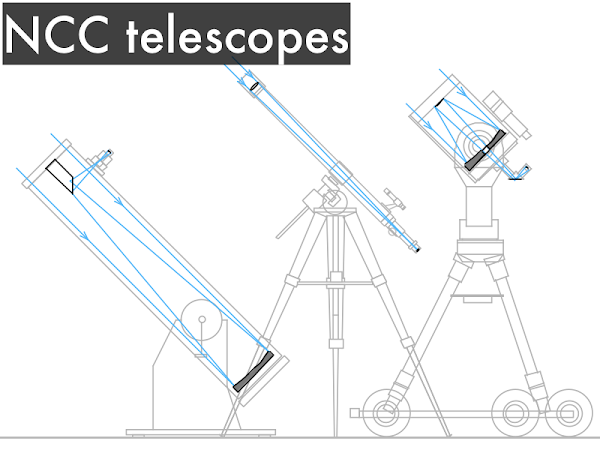
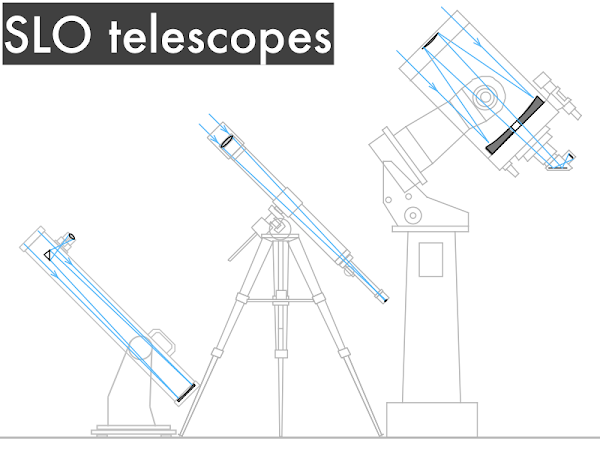
Telescopes come in all shapes and sizes, and indeed for the subsequent in-class activity you will be working in groups to measure actual refracting and reflecting telescopes set in up in class today, and ranking them in terms of the three telescope powers.

Let's consider three measurements that you will need to make or to look up for each of these telescopes--diameter D, primary focal length fprimary, and eyepiece focal length feyepiece.

If the telescope has a lens in front, then it is a refractor, and you would need to measure the diameter of this lens (in cm).

If the telescope has a mirror in back (it may or many not have a glass plate in front), then it is a reflector, and you would need to measure the diameter of this mirror (in cm).

The next measurement is the primary focal length fprimary of the lens, and if the telescope is a refractor is the distance (in cm) after the lens that the light will be brought to a focus. This is approximately the length of the tube.

If the telescope is a refractor, then the primary focal length fprimary of the mirror is the distance (in cm) after the mirror that the light will be brought to a focus. This is approximately the either length of the tube, or twice the length of the tube, depending on the geometry of secondary mirrors within the telescope.

The last measurement is the eyepiece focal length feyepiece, and is printed somewhere on the eyepiece itself (in mm).

Now let's see how these three measurements are used to determine how powerful (or not) a telescope can be.

First, light-gathering power, which allows a telescope to make faint images as bright as possible.

Light-gathering power is how much light can be collected by a telescope, and more is better. This is simply related to the area of the primary lens or mirror, and a larger area will collect more light, making resulting images as bright as possible.

The lens used in the Lick Observatory near San Jose, CA is 36" in diameter, and is close to the largest refracting lens ever made. Lenses like these are no longer typically made, even though they have large light-gathering powers, due to their weight and cost.

This is a large primary mirror used for the VISTA telescope in Chile, over four meters in diameter. Note that mirrors weigh less and are cheaper to manufacture than comparable-size refracting lens, so maximizing light-gathering power in modern astronomical research telescopes involves constructing large mirrors like this, rather than lenses.

Second, resolving power, which allows a telescope to make out fine details in its images.

This can very crudely be considered a triangulation problem, so a large diameter lens or mirror will resolve small features.

This is the Thirty-Meter Telescope that is currently planned for atop Mauna Kea, HI. Note that it achieves a large light-gathering power by virtue of the collectively large area of its mirror segments, and it also has a large resolving power from its large end-to-end diameter. This telescope is going to be awesome, but it is going to be very expensive.

There is a hack of sorts to maximize resolving power without having to maximize light-gathering power, if you want to look at the fine details of already very bright objects. This is an interferometer, where two small telescopes are spread out at a certain distance from each other. Spreading them out does not improve their collective light-gathering power, but it makes them behave as though they were two fragments of a much larger diameter mirror, which improves their resolving power. Yes, there is a lot of light "missing" from this "fragmented" mirror, but it is a cheap but effective way to maximize resolving power, given a limited amount of mirror area.

The "interference" of an interferometer is where the light collected simultaneously by both mirrors must be physically combined in real-time to a single image, so there is a practical limit to how far apart these telescopes can be placed. Here is the Keck Observatory atop Mauna Kea, HI, which was previously once the largest single reflector in the world, but now with a twin constructed next to it, can now improve its resolving power as well.

Third, magnifying power, which makes an image as large as possible.

But first, a clip on why of all the three telescope powers, magnifying power is the least important, behind resolving power, and light-gathering power, from an episode of Futurama (20th Century Fox Television, 2011).
Zapp Brannigan: "Magnify that Death Sphere. [Image on screen zooms in on the Death Sphere.] Why is it still blurry?"
Kif Krocker: "It's all the resolution we have. Making it bigger doesn't make it clearer."
Zapp: "It does on CSI: Miami!"
Kif: (Sighs.)
So here (as usual) the writers on Futurama get the science right--light-gathering power and resolving power gets you images that are only so bright, and with so much detail. Magnification just enlarges the images after the fact, so you may just be getting larger pictures of dim, fuzzy images if there wasn't much light-gathering power and resolving power to begin with.

That said, if you have maximized your light-gathering power and resolving power (with a large diameter, or large effective diameter primary lens/mirror), then the magnification depends on the focal length or your primary lens or mirror, which we have seen is the distance after the lens or mirror that light will be brought to a focus. The magnifying power of a telescope is the primary focal length (some factor times the tube length) divided by the eyepiece focal length.

Maximizing the magnifying power of a telescope is then a matter of having a primary lens or mirror with a long focal length...

...used with an eyepiece (here on the back of the Lick Observatory refractor) with a short focal length.


So now let's break up into groups for our in-class activity, and start measuring these telescopes, so they can be ranked in terms of these three telescope powers.

20120310

Astronomy midterm question: "good beginner telescope" size

Astronomy 210 Midterm 1, spring semester 2012
Cuesta College, San Luis Obispo, CA

[20 points.] An astronomy question on an online discussion board(*) was asked and answered:
ahriik: What is a good telescope for a beginner? I want to get into astronomy, so I believe a telescope is essential.
eri:[F]or a good beginner telescope; the most important factor is the size of the primary mirror... There's not much point in investing in a telescope if the primary mirror diameter is less than 4.5", and the bigger the better...
Discuss reasons why "there's not much point in investing" in a small diameter telescope. Support your answer using the properties of telescope parameters and telescope powers.

*Source: http://answers.yahoo.com/question/index;_ylt=ArVtg7r0DwT2ZpjF5GpF2_sjzKIX;_ylv=3?qid=20100520162052AASAINW.

Solution and grading rubric:
  • p = 20/20:
    Correct. Discusses how diameter of primary lens/mirror determines the light-gathering power and resolving power, such that a large diameter lens/mirror would result in bright, finely resolved images worth magnifying.
  • r = 16/20:
    Nearly correct (explanation weak, unclear or only nearly complete); includes extraneous/tangential information; or has minor errors. Discusses how diameter affects either light-gathering power or resolving power, other diameter/power discussion incomplete.
  • t = 12/20:
    Contains right ideas, but discussion is unclear/incomplete or contains major errors. Problematic discussion of how diameter is related to either light-gathering power or resolving power.
  • v = 8/20:
    Limited relevant discussion of supporting evidence of at least some merit, but in an inconsistent or unclear manner. At least discusses some connection between telescope parameters and telescope power.
  • x = 4/20:
    Implementation/application of ideas, but credit given for effort rather than merit. Does not discuss connection between telescope parameters and telescope powers.
  • y = 2/20:
    Irrelevant discussion/effectively blank.
  • z = 0/20:
    Blank.
Grading distribution:
Section 30674
Exam code: midterm01neE7
p: 18 students
r: 14 students
t: 0 students
v: 1 student
x: 0 students
y: 0 students
z: 0 students

Section 30676
Exam code: midterm01s0Be
p: 21 students
r: 15 students
t: 1 student
v: 3 students
x: 1 student
y: 1 student
z: 0 students

A sample "p" response (from student 4490):
Another sample "p" response (from student 0010):

20120225

Astronomy quiz question: reflector versus refractor costs

Astronomy 210 Quiz 3, spring semester 2012
Cuesta College, San Luis Obispo, CA

Large optical telescopes are reflectors rather than refractors because mirrors:
(A) are much easier to clean than lenses.
(B) are unaffected by light pollution, compared to lenses.
(C) can be used with different eyepieces, unlike lenses.
(D) can be made of lower quality materials than those used for lenses.

Correct answer: (D)

Since light must pass through a lens, the material must be internally flawless, in contrast to a reflector, where only the surface needs to be flawless.

Section 30676
Exam code: quiz03SL3w
(A) : 2 students
(B) : 14 students
(C) : 7 students
(D) : 16 students

Success level: 43% (including partial credit for multiple-choice)
Discrimination index (Aubrecht & Aubrecht, 1983): 0.60

20080820

Discovering real and virtual images

080724-1040074
http://www.flickr.com/photos/waiferx/2766109677/
Originally uploaded by Waifer X

Discovering a real image and a virtual image from a concave mirror. Reuben H. Fleet Science Center, San Diego, CA.

20060719

There is a spoon...image!


"The Matrix" (Warner Bros., 1999)
Excerpt from http://www.slate.com/id/2145696/

Physics 8B learning goal Q2.3

Depending on whether the convex or concave side of the spoon is viewed (and for the concave side, whether the object is inside of or outside of the focal point), an upright virtual image or an inverted real image is seen.