Showing posts with label infrared. Show all posts

20191127

Online reading assignment: heat transfers

Physics 205A, fall semester 2019
Cuesta College, San Luis Obispo, CA

Students have a bi-weekly online reading assignment (hosted by SurveyMonkey.com), where they answer questions based on reading their textbook, material covered in previous lectures, opinion questions, and/or asking (anonymous) questions or making (anonymous) comments. Full credit is given for completing the online reading assignment before next week's lecture, regardless if whether their answers are correct/incorrect. Selected results/questions/comments are addressed by the instructor at the start of the following lecture.

The following questions were asked on reading textbook chapters and previewing a presentation on heat transfers.


Selected/edited responses are given below.

Describe what you understand from the assigned textbook reading or presentation preview. Your description (2-3 sentences) should specifically demonstrate your level of understanding.
"Heat can transfer in three different ways: conduction, convection, and radiation. Conduction is the transfer of heat energy by direct contact; convection is the movement of heat by actual motion of matter; radiation is the transfer of energy via electromagnetic waves."

"Conduction is a transfer of heat through an item, mainly thorough metals since they can conduct heat much better than wood or plastics. Radiation is another form of heat transfer, but from light, not through bulk movement or necessarily through objects."

"Thermal resistance of an object is related equal to the thickness divided by exposed surface area and the material-dependent conductivity. Heat can be transferred via conduction, convection, or radiation."

"In order to maximize thermal resistance, the wall/object needs to be as thick as possible, in order to reduce the amount of heat that passes through."

"Forced convection is the transport of thermal energy by a force like blowing, it does not just naturally circulate."

"Convection is heat transferred from bulk movement of fluids. Conduction where heat is directed through a material."

"Convection occurs when part of a fluid is warmed, it expands and its density decreases such that the cooler surrounding fluid, which now has a greater density, will push the warmer fluid upward because the cooler, denser fluid exerts a buoyant force on the warmer, less dense fluid. I also understand how light-colored objects reflect more radioactive waves and are less susceptible to absorbing heat through radiation than dark-colored objects, which absorb energy as heat through radiation of electromagnetic waves much better."

"One major understanding I have grasped from this presentation is that radiation is a two-way street indicating that an object good at absorbing heat will also be good at emitting heat; moreover, an object that is not good at absorbing heat would likewise be bad at emitting heat."

"The flow of heat moves differently based on certain aspects of an object or environment. For example, something that is the color black will absorb more heat quickly than something that is not the color black."

"I didn't get to it."

Describe what you found confusing from the assigned textbook reading or presentation preview. Your description (2-3 sentences) should specifically identify the concept(s) that you do not understand.
"I think I understood the concepts from the presentation preview. Just need to see more examples."

"I found it confusing that anyone would choose to use Q as a symbol for heat. I also don't know why the units are what they are for the Stefan-Boltzmann constant."

"I'm just having a bit of trouble uncovering the equations and their parts."

"The topics that seemed confusing from the reading were exactly how to apply the equations and laws to everything, and exactly what each variable means, for example Stefan’s law quantitatively describing power."

"Why do different materials absorb heat at different rates?"

"I do not understand what Stefan's law is and what the variables mean exactly. Why are blackbodies and silverbodies better at absorbing heat?"

"So if a black object takes in more heat and can emit more heat as compared to a white object, shouldn't the objects be the same temperature if they're in the same condition? But I know that black gets warmer than white, so it's confusing."

"I did not really understand what the units of e was or how it changed depending on the material of the object."

"Nothing too confusing, just conduction and the equations related to it."

"The formulas for Fourier's and Stefan's laws are a little scary."

In order to maximize the thermal resistance of these exterior walls, should the following parameters be minimized, maximized (or has no effect)?
(Only correct responses shown.)
insulation thickness d: maximize [83%]
insulation conductivity κ: minimize [66%]
Total surface area A exposed to the outdoors: minimize [66%]

In order to minimize the amount of heat flowing per time through these exterior walls, should the following parameters be minimized, maximized (or has no effect)?
(Only correct responses shown.)
temperature difference ∆T between indoors and outdoors: minimize [71%]
thermal resistance R of the walls: maximize [83%]
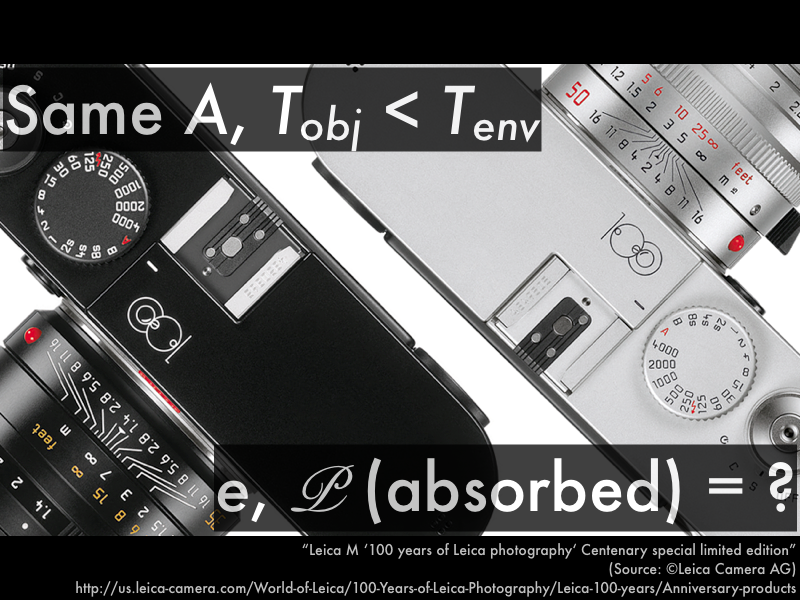
For these two Leica M cameras, if they are both cooler than the surrounding environment, both will begin to heat up by absorbing radiative heat (say, from the sun). The __________ model have a faster rate of heat absorbed per time.
black.  *************************** [27]
silver.  ** [2]
(There is a tie.)  ** [2]
(Unsure/guessing/lost/help!)  **** [4]

For these snowboarders, if they are warmer than the surrounding environment, they will begin to cool down by emitting radiative heat (say, to the overcast sky and the snowy landscape). The snowboarder wearing the __________ jacket will have a faster rate of heat radiated per time.
black.  ******************** [20]
silver.  ****** [6]
(There is a tie.)  **** [4]
(Unsure/guessing/lost/help!)  ***** [5]

Ask the instructor an anonymous question, or make a comment. Selected questions/comments may be discussed in class.
"This is an interesting area of physics that I'm glad we're getting to."

"This is starting to feel very chem-like."

"There seems to be a lot of information in these sections, I hope you will condense what we need to know in lecture!"

"There's a lot going on with Stefan's law, is there an easy way to remember the details?"

"Will the Physics 205B course be a similar pace to this course?" (The pace will be similar to the second-half of this course, about one chapter a week.)

"Is the thickness L from Fourier's law in the textbook the same as the thickness d used in the presentations? Are they interchangeable?" (Yes, and yes.)

"Will we generally be given the emissivity e for an object? Also, will we be given the Stefan-Boltzmann constant value on quizzes?" (Yes, and yes.)

"Sorry, the holidays are pretty hectic."

"Sorry P-dog, currently on vacayyy."

"Have a great Thanksgiving!"

20181128

Online reading assignment: heat transfers

Physics 205A, fall semester 2018
Cuesta College, San Luis Obispo, CA

Students have a bi-weekly online reading assignment (hosted by SurveyMonkey.com), where they answer questions based on reading their textbook, material covered in previous lectures, opinion questions, and/or asking (anonymous) questions or making (anonymous) comments. Full credit is given for completing the online reading assignment before next week's lecture, regardless if whether their answers are correct/incorrect. Selected results/questions/comments are addressed by the instructor at the start of the following lecture.

The following questions were asked on reading textbook chapters and previewing a presentation on heat transfers.


Selected/edited responses are given below.

Describe what you understand from the assigned textbook reading or presentation preview. Your description (2-3 sentences) should specifically demonstrate your level of understanding.
"This reading covers transfers of heat. Convection, where heat is transferred by the movement of a fluid. Conduction, where heat is transferred through a material directly. Radiation, where heat is traveled through electromagnetic waves and a look into their applications."

"I learned that conduction is heat transferred through solid objects, convection through fluids, and radiation in the form of light. I also learned that power is measured as the amount of energy transferred per time."

"Fourier's law of conduction seems sort of alright. Power is proportional to the temperature difference ∆T and inversely proportional to thermal resistance R, which itself is proportional to thickness of the material, and inversely proportional to its resistivity and area."

"By increasing the thickness or decreasing the Area of an a wall (material), you decrease heat flow. Heat is conducted based on the modules bouncing around (molecular energy). Metals have more free electrons, which increases this bobbling around (increasing heat conduction). I get that Q is inversely proportional to thickness/length. Also, radiation doesn't require a material medium."

"How different colors (or materials) like the blackbody and the silverbody both absorb and radiate heat differently."

"I understand how to apply Fourier's and Stefan's law to real life scenarios, but not mathematically."

"I wouldn't say I understand this chapter completely. I'm hoping class will resolve this feeling."

Describe what you found confusing from the assigned textbook reading or presentation preview. Your description (2-3 sentences) should specifically identify the concept(s) that you do not understand.
"I have never been exposed to the equations that are involved with the different heat exchanges, so of course they will begin to make more sense once I start using them more."

"In particular I don't fully understand thermal resistance."

"I think some of the equations used for each concept might be a bit confusing for me. Other than that I think learning it in class will reinforce the idea."

"Blackbody, silverbody, and radiation were confusing, but now I am fine."

"Kind of confused by radiation. I thought black things heated up fast...but I didn't know they loose heat fast too? Also I think it would be good to see a Stefan's law problem worked out, there's a lot of symbols in there."

"I didn't quite understand Stefan's law and would greatly benefit from an overview of it in lecture."

"The calculations."

"I understood all of the concepts in this section."

In order to maximize the thermal resistance of these exterior walls, should the following parameters be minimized, maximized (or has no effect)?
(Only correct responses shown.)
insulation thickness d: maximize [88%]
insulation conductivity κ: minimize [69%]
Total surface area A exposed to the outdoors: minimize [79%]

In order to minimize the amount of heat flowing per time through these exterior walls, should the following parameters be minimized, maximized (or has no effect)?
(Only correct responses shown.)
temperature difference ∆T between indoors and outdoors: minimize [74%]
thermal resistance R of the walls: maximize [77%]

For these two Leica M cameras, if they are both cooler than the surrounding environment, both will begin to heat up by absorbing radiative heat (say, from the sun). The __________ model have a faster rate of heat absorbed per time.
black.  ********************************** [34]
silver.  ** [2]
(There is a tie.)  * [1]
(Unsure/guessing/lost/help!)  ** [2]

For these snowboarders, if they are warmer than the surrounding environment, they will begin to cool down by emitting radiative heat (say, to the overcast sky and the snowy landscape). The snowboarder wearing the __________ jacket will have a faster rate of heat radiated per time.
black.  ******************** [20]
silver.  **************** [16]
(There is a tie.)  * [1]
(Unsure/guessing/lost/help!)  ** [2]

Ask the instructor an anonymous question, or make a comment. Selected questions/comments may be discussed in class.
"How about more examples of blackbody and silverbody applicable to global warming and the similarities and differences to the albedo effect?"

"Interesting presentation today, I enjoyed it!"

"Heat transfers are 'cool!' If I'm snowboarding in white I will reflect more light but since silverbodies are bad at emitting heat, could I then stay warmer than the dude in all black since blackbodies emit heat better?" (Yes, for a cloudy day, or at night, or in a cave, or whenever absorbing heat from the sun or other sources (like a fireplace) is not a factor.)

20171205

Online reading assignment: heat transfers

Physics 205A, fall semester 2017
Cuesta College, San Luis Obispo, CA

Students have a bi- weekly online reading assignment (hosted by SurveyMonkey.com), where they answer questions based on reading their textbook, material covered in previous lectures, opinion questions, and/or asking (anonymous) questions or making (anonymous) comments. Full credit is given for completing the online reading assignment before next week's lecture, regardless if whether their answers are correct/incorrect. Selected results/questions/comments are addressed by the instructor at the start of the following lecture.

The following questions were asked on reading textbook chapters and previewing a presentation on heat transfers.


Selected/edited responses are given below.

Describe what you understand from the assigned textbook reading or presentation preview. Your description (2-3 sentences) should specifically demonstrate your level of understanding.
"I understand that the difference in colors changes the amount of radiative heat that is absorbed."

"I understand the three forms of heat transfers: conduction, convection, and radiation."

"The power through a wall is proportional to the temperature difference.As per the zeroth law of thermodynamics, heat flows from high to low temperatures!"

"Convection is the process of fluids carrying heat and conduction is heat passing directly through an object. The power of heat is stronger with a greater change in temperature and minimal resistance. Radiation is energy carried by electromagnetic waves."

"The first thing I learned is that heating chocolate bunnies is extremely funny for some reason. I also learned that convection, conduction and radiation are types of heat transfers that transport heat. Convection uses circulating air, conduction transfers through an object and radiation is in the form of light."

"There are different types of heat transfers conduction, convection and radiation. In conduction, heat is transferred through an object, e.g. when your mom says don’t touch the stove because it’s hot but you really want that mac-n-cheese and you touch it anyway and burn yourself on the stove. In convection, heat transfers with the circulation of air, e.g. old fashioned radiator it takes in cool air at the bottom and produces hot air through the top. In radiation heat is transported in the form of light, e.g. soaking in the sun on a nice beach day (I miss summer)."

"Conduction is when heat is transferred through an object; convection is when heat is circulated in the air; radiation is when heat is transferred as light."

"Insulation thickness makes it more resistant to heat. The conductivity is the opposite, transferring heat faster through the material."

"I have noted and understand the differences between convection, conduction, and radiation. Blackbodies are good absorbers and therefore are good emitters. Emissivity is a dimensionless number between 0 and 1 that is the ratio of the energy an object actually radiates to what it would radiate."

"Black absorbs; white reflects."

Describe what you found confusing from the assigned textbook reading or presentation preview. Your description (2-3 sentences) should specifically identify the concept(s) that you do not understand.
"I found the equations confusing."

"Fourier's law confuses me."

"I am a little confused about conductivity and how it affects thermal resistance. Im sure once its explained in class it will be much clearer."

"I haven't given myself quite enough time to figure out what exactly don't understand because everything seems a little confusing. I do think that maybe i'd like to better understand thermal resistance."

"All and all in made sense. The part that somewhat got confusing was the formulas. More specifically with the applications. What each of the variables mean."

"I found Stepfan's law more confusing. I would appreciate some review on how this works."

"Colors affecting radiative absorption?"

In order to maximize the thermal resistance of these exterior walls, should the following parameters be minimized, maximized (or has no effect)?
(Only correct responses shown.)
insulation thickness d: maximize [82%]
insulation conductivity κ: minimize [64%]
Total surface area A exposed to the outdoors: minimize [61%]

In order to minimize the amount of heat flowing per time through these exterior walls, should the following parameters be minimized, maximized (or has no effect)?
(Only correct responses shown.)
temperature difference ∆T between indoors and outdoors: minimize [63%]
thermal resistance R of the walls: maximize [72%]

For these two Leica M cameras, if they are both cooler than the surrounding environment, both will begin to heat up by absorbing radiative heat (say, from the sun). The __________ model have a faster rate of heat absorbed per time.
black.  *************************** [27]
silver.  **** [4]
(There is a tie.)  [0]
(Unsure/guessing/lost/help!)  ** [2]

For these snowboarders, if they are warmer than the surrounding environment, they will begin to cool down by emitting radiative heat (say, to the overcast sky and the snowy landscape). The snowboarder wearing the __________ jacket will have a faster rate of heat radiated per time.
black.  ****************** [18]
silver.  *********** [11]
(There is a tie.)  ** [2]
(Unsure/guessing/lost/help!)  ** [2]

Ask the instructor an anonymous question, or make a comment. Selected questions/comments may be discussed in class.
"Everything progressively gets more interesting. I'm excited for Physics 205B!"

"As a welder I work with heat quite a bit."

"Is the zeroth law of thermodynamic is the equilibrium of temperatures?" (Yes. Surprisingly, it is not a trivial law.)

"Does heat always flow from high temperatures to low temperatures?" (Yes, all by itself. However, if you want heat to flow from low temperatures to high temperatures (in order to cool down your refrigerator, or use air conditioning to cool down your house), then you will need to spend energy in the form of work to move heat "opposite of the way it wants to go." Also heat pumps will move heat from low temperatures to high temperatures in order to extract energy from the cool environment to heat your house, but this again requires you to spend energy in the form of work to move heat "opposite of the way it wants to go.")

"You know me just a run down of the formulas would be greatttttt." (Mmmmkay.)

20161130

Online reading assignment: heat transfers

Physics 205A, fall semester 2016
Cuesta College, San Luis Obispo, CA

Students have a bi- weekly online reading assignment (hosted by SurveyMonkey.com), where they answer questions based on reading their textbook, material covered in previous lectures, opinion questions, and/or asking (anonymous) questions or making (anonymous) comments. Full credit is given for completing the online reading assignment before next week's lecture, regardless if whether their answers are correct/incorrect. Selected results/questions/comments are addressed by the instructor at the start of the following lecture.

The following questions were asked on reading textbook chapters and previewing a presentation on heat transfers.


Selected/edited responses are given below.

Describe what you understand from the assigned textbook reading or presentation preview. Your description (2-3 sentences) should specifically demonstrate your level of understanding.
"Heat resistance correlates to the thickness, surface area and the conductivity constant for that object type. Blackbody objects absorb and radiate heat very well, while silverbody objects reflect heat very well, while not absorbing well at all."

"Power through a wall is proportional to the temperature difference ∆T on either side, and inversely proportional to the thermal resistance R of the object, which is a measure of how difficult it is for heat to flow per time through it: R = d/(κ·A)."

"I understood most of the formulas and concepts. It is cool to see they physics behind things that I already know."

Describe what you found confusing from the assigned textbook reading or presentation preview. Your description (2-3 sentences) should specifically identify the concept(s) that you do not understand.
"The concept of different emissivity colors (silver vs. black) absorbing different amounts of radiation."

"I'm interested in seeing more applications of the numbers and how they can be used in the real world."

"I could use some help understanding how to apply these concepts."

"The equation for radiation is pretty confusing to me. I am sure that I could get it down with a few examples in class, but it is hard to picture solving for right now."

"Not really sure if R is like insulation in that we'd want to increase it to retain heat."

"Stefan's law is a jumbled mess and I want no part of it."

"How can an object be good at absorbing heat and emitting heat at the same time?"

"Not much, to be honest."

In order to maximize the thermal resistance of these exterior walls, should the following parameters be minimized, maximized (or has no effect)?
(Only correct responses shown.)
insulation thickness d: maximize [81%]
insulation conductivity κ: minimize [64%]
Total surface area A exposed to the outdoors: minimize [57%]

In order to minimize the amount of heat flowing per time through these exterior walls, should the following parameters be minimized, maximized (or has no effect)?
(Only correct responses shown.)
temperature difference ∆T between indoors and outdoors: minimize [64%]
thermal resistance R of the walls: maximize [71%]

For these two Leica M cameras, if they are both cooler than the surrounding environment, both will begin to heat up by absorbing radiative heat (say, from the sun). The __________ model have a faster rate of heat absorbed per time.
black.  ******************************** [32]
silver.  *** [3]
(There is a tie.)  *** [3]
(Unsure/guessing/lost/help!)  **** [4]

For these snowboarders, if they are warmer than the surrounding environment, they will begin to cool down by emitting radiative heat (say, to the overcast sky and the snowy landscape). The snowboarder wearing the __________ jacket will have a faster rate of heat radiated per time.
black.  ***************** [17]
silver.  ***************** [17]
(There is a tie.)  **** [4]
(Unsure/guessing/lost/help!)  **** [4]

Ask the instructor an anonymous question, or make a comment. Selected questions/comments may be discussed in class.
"Can insulation hold in all of the heat without it transferring? Is it possible for heat (or cold) to be trapped by an insulator and never transfer the energy?" (Only if the thermal conductivity κ = 0. Realistically you can try to get a very small κ value to minimize the rate of heat conducted through, but even a trickle of heat will add up over a long enough time.)

"Why is the amount of heat lost through the object referred to as power?" (The rate of heat conducted per time is in units of joules/second or watts--which is the equivalent of power, which is generally any rate of energy per time.)

"So, if I have earned all the homework points that I can, if I miss a homework assignment from now on does that mean I would go down in points? Or would I still keep the maximum amount of points that I have gotten?" (You can never go down in points. If you have already reached that maximum amount of homework points already, then you've earned the right to not do any more homework for the rest of the semester.)

"What's with the fancy cursive variable symbols?" (After going through the Roman and Greek alphabets, all we have left are script letters.)

"Would the black jacket be more effective at retaining heat because it's good at absorbing it?" (A black jacket would be efficient at absorbing heat, if it's sunny outside. But radiation is a two-way street; a black jacket would be efficient at radiating heat, in the dark. So you would go through huge temperature swings during the day and night. If you wore a white jacket, you would not be efficient at absorbing heat from the sun, but then you would also not be efficient at radiating heat at night either, so you would have less temperature variation during the day and night. Perhaps you could wear a dark and light-colored reversible jacket that you could wear as needed depending your environment and need to stay warm (or cool off).)

20151202

Online reading assignment: heat transfers

Physics 205A, fall semester 2015
Cuesta College, San Luis Obispo, CA

Students have a bi-weekly online reading assignment (hosted by SurveyMonkey.com), where they answer questions based on reading their textbook, material covered in previous lectures, opinion questions, and/or asking (anonymous) questions or making (anonymous) comments. Full credit is given for completing the online reading assignment before next week's lecture, regardless if whether their answers are correct/incorrect. Selected results/questions/comments are addressed by the instructor at the start of the following lecture.

The following questions were asked on reading textbook chapters and previewing a presentation on heat transfers.


Selected/edited responses are given below.

Describe what you understand from the assigned textbook reading or presentation preview. Your description (2-3 sentences) should specifically demonstrate your level of understanding.
"I clearly understand the heat transfers of convection, conduction and radiation. I also understand the difference between blackbody, which is good at absorbing heat and emitting heat. Where as silver body is good at reflecting light but poor at absorbing heat."

"I understand that heat conduction is where heat is transferred through an object. Also, that convection is the transport of heat via circulating air. And that radiation is where heat is transported in the form of light."

"Conduction is heat transferred through an object. Power is the measurement of this transferred heat per unit time. Expressed either in joules/second or watts. Resistance is the measurement of how difficult this transfer of heat is. It is proportional to the materials thickness. Convection is the transfer of heat through masses of moving air. Radiation is the transfer of hear through light. Objects that are good at absorbing radiation heat must also be good at emitting or radiating heat."

"Not much."

Describe what you found confusing from the assigned textbook reading or presentation preview. Your description (2-3 sentences) should specifically identify the concept(s) that you do not understand.
"Stefan's law. I understand what the law is, I'm just unclear about using it in a problem."

"No specific confusion yet, though I'm expecting to run into more after class discussion and examples."

"The only concepts I don't understand are the equations themselves. Everything else is a matter of practice. The concepts can be a little confusing, but I understand the basics."

"The language in describing the concepts is frustrating."

"I'm confused about the whole online presentation. There is a lot of equations with a whole bunch of variables that it is making it impossible to understand."

"What the constants represent in these equations and why they're important. Why does power use κ and convection use σ?"

In order to maximize the thermal resistance of these exterior walls, should the following parameters be minimized, maximized (or has no effect)?
(Only correct responses shown.)
insulation thickness d: maximize [89%]
insulation conductivity κ: minimize [67%]
Total surface area A exposed to the outdoors: minimize [77%]

In order to minimize the amount of heat flowing per time through these exterior walls, should the following parameters be minimized, maximized (or has no effect)?
(Only correct responses shown.)
temperature difference ∆T between indoors and outdoors: minimize [75%]
thermal resistance R of the walls: maximize [84%]

For these two Leica M cameras, if they are both cooler than the surrounding environment, both will begin to heat up by absorbing radiative heat (say, from the sun). The __________ model have a faster rate of heat absorbed per time.
black.  ********************************************** [46]
silver.  **** [4]
(There is a tie.)  *** [3]
(Unsure/guessing/lost/help!)  **** [4]

For these snowboarders, if they are warmer than the surrounding environment, they will begin to cool down by emitting radiative heat (say, to the overcast sky and the snowy landscape). The snowboarder wearing the __________ jacket will have a faster rate of heat radiated per time.
black.  *********************************** [35]
silver.  ***************** [17]
(There is a tie.)  *** [3]
(Unsure/guessing/lost/help!)  ** [2]

Ask the instructor an anonymous question, or make a comment. Selected questions/comments may be discussed in class.
"I am confused why black releases heat faster but absorbs heat fast as well. How could this happen?" (Radiation/absorption is a two-way street. It would be very odd for a material to absorb heat, but not be able to radiate heat. That material would basically start absorbing all the heat in the universe yet not be able to re-release it, thus becoming infinitely hot, while the rest of the universe reaches absolute zero. So it's a good thing that a blackbody is an efficient radiator as well as being an efficient absorber.)

"Why would they paint the entire SR-71 Blackbird black if it causes the entire object to absorb heat quicker? Wouldn't it be more effective to only paint the area around the engines black to radiate heat and the rest silver to resist an increase in temperature?" (That would be true if the engines were the only hot part of the SR-71 Blackbird and that heating up from absorbing sunlight were important factors, but due to how fast it flies, the amount of air continuously ramming into it heats the whole aircraft up such that radiating heat from all of its black-painted surfaces is the only way to make sure the entire thing doesn't fall apart from melting.)

"Why do snowboarders and skiers wear tinted goggles?" (Bigger question: why do snowboarders take smoke breaks right in the middle of a run? #whatsupwiththat)

"Are we going to have to test our calligraphy skills and write that fancy script "P" every time we use Fourier's law or Stefan's law?" (Yes, unless you promise not to confuse "power P" with "pressure P," momentum "p," or "density ρ.")

"The melting chocolate bunnies was somewhat disturbing."

"Starting to wreck this class! #yolo"

20141202

Online reading assignment: heat transfers

Physics 205A, fall semester 2014
Cuesta College, San Luis Obispo, CA

Students have a weekly online reading assignment (hosted by SurveyMonkey.com), where they answer questions based on reading their textbook, material covered in previous lectures, opinion questions, and/or asking (anonymous) questions or making (anonymous) comments. Full credit is given for completing the online reading assignment before next week's lecture, regardless if whether their answers are correct/incorrect. Selected results/questions/comments are addressed by the instructor at the start of the following lecture.

The following questions were asked on reading textbook chapters and previewing a presentation on heat transfers.


Selected/edited responses are given below.

Describe what you understand from the assigned textbook reading or presentation preview. Your description (2-3 sentences) should specifically demonstrate your level of understanding.
"Conduction is heat transferred through an object, convection is heat circulating through the air, and radiation is heat transported through light."

"It makes sense that heat per time flows from high to low and is inversely proportional to thermal resistance, and proportional to the difference in temperature. The lava lamp made sense to me about the globules moving upwards because the light bulb is at the bottom, and then they come back down because they are wax and they cool down and increase their density which brings them back down."

"I don't understand anything from the reading."

Describe what you found confusing from the assigned textbook reading or presentation preview. Your description (2-3 sentences) should specifically identify the concept(s) that you do not understand.
"The idea of 'radiation.' When I think of this, I think of heat being radiated directly off a surface, such a heat from a spacecraft going into space. But it seems that radiation in this context only refers to heat transfer in the form of light."

"I found emissivity confusing and why e = 0 or why e = 1 and what the constant in the equation for Stefan's law is when we are told what emissivity equals depending on whether it is a blackbody or silverbody."

"Possibly all of the material. I was unable to get to the reading, so I am not completely sure."

"I believe I have understood everything!"

In order to maximize the thermal resistance of these exterior walls, should the following parameters be minimized, maximized (or has no effect)?
(Only correct responses shown.)
insulation thickness d: maximize [80%]
insulation conductivity κ: minimize [52%]
Total surface area A exposed to the outdoors: minimize [59%]

In order to minimize the amount of heat flowing per time through these exterior walls, should the following parameters be minimized, maximized (or has no effect)?
(Only correct responses shown.)
temperature difference ∆T between indoors and outdoors: minimize [70%]
thermal resistance R of the walls: maximize [67%]

For these two Leica M cameras, if they are both cooler than the surrounding environment, both will begin to heat up by absorbing radiative heat (say, from the sun). The __________ model have a faster rate of heat absorbed per time.
black.  ******************************************** [44]
silver.  ** [2]
(There is a tie.)  ** [2]
(Unsure/guessing/lost/help!)  ****** [6]

For these snowboarders, if they are warmer than the surrounding environment, they will begin to cool down by emitting radiative heat (say, to the overcast sky and the snowy landscape). The snowboarder wearing the __________ jacket will have a faster rate of heat radiated per time.
black.  ************************** [26]
silver.  ************ [12]
(There is a tie.)  ***** [5]
(Unsure/guessing/lost/help!)  *********** [11]

Ask the instructor an anonymous question, or make a comment. Selected questions/comments may be discussed in class.
"Stefan's law looks like one giant cluster of confusion to me." (I will try to unconfuse it for you.)

"Where is there an additional negative sign in Stefan's law?" (In order to make this equation consistent with heat being added to an object when it absorbs light (positive heat flow), and heat being removed from an object when it emits light (negative heat flow).)

"Is power in watts defined the same as electrical watts? (Like, my hair dryer is 1,875 watts, are they the same?)" (Yes, watts measures the output of joules of energy per time. So compare the forced convection heat output of your hair dryer to the radiative output of say, a 100 watt light bulb! Hair gotta dry.)

"Why does color affect absorption so much?" (A silverbody has surface atoms and bonds with few available electron energy level spacings to absorb or give off photons, so there is no way to readily convert light into thermal energy, but this also means that there is no way to readily convert thermal energy into light. A blackbody has surface atoms and bonds with many available electron energy level spacings that can absorb or emit photons, so it can readily convert light into thermal energy, and also readily convert thermal energy into light.)

"Damn, I need to go snowboarding again." (Just don't be one of those snowboarders that sits down in the middle of the run for a smoke break. I hate those guys.)

20141201

Physics presentation: heat transfers

Oh, chocolate bunny, how do I love thee? Let me count the ways: conduction, convection, radiation. (Video link: "Chocolade Haas (Chocolate Bunny)."

In a previous presentation, we considered what happens to an object when heat is transferred into, or out of it. Here we will look more closely at the transfers themselves, that is, how thermal energy is transferred.

First, conduction, where heat is transferred through an object.

This house is shown in visible wavelengths on the left side of the image, and in infrared wavelengths on the right side of the image, where we can see that while the walls of the house are not allowing much heat to pass through them, there is quite a bit heat exiting the house through the windows.

The power (amount of heat conducted per time, in units of joules/second, or watts) through a wall is proportional to the temperature difference ∆T on either side (as per the zeroth law of thermodynamics, heat flows from high to low temperatures), and inversely proportional to the thermal resistance R of the object, which is a measure of how difficult it is for heat to flow per time through it:

R = d/(κ·A),

where the resistance is proportional to the thickness d of the material, and inversely proportional to the exposed surface area A and the material-dependent conductivity κ (lower-case Greek letter "kappa," in units of watts/m·K), which characterizes how well this material allows (or does not allow) heat to flow through it.

In order to minimize the amount of heat flowing per time through these exterior walls, the thermal resistance R of the insulation installed should be maximized--by having a large or small conductivity κ value? A small or large insulation thickness d? Should the walls be constructed with a small or large surface area A?

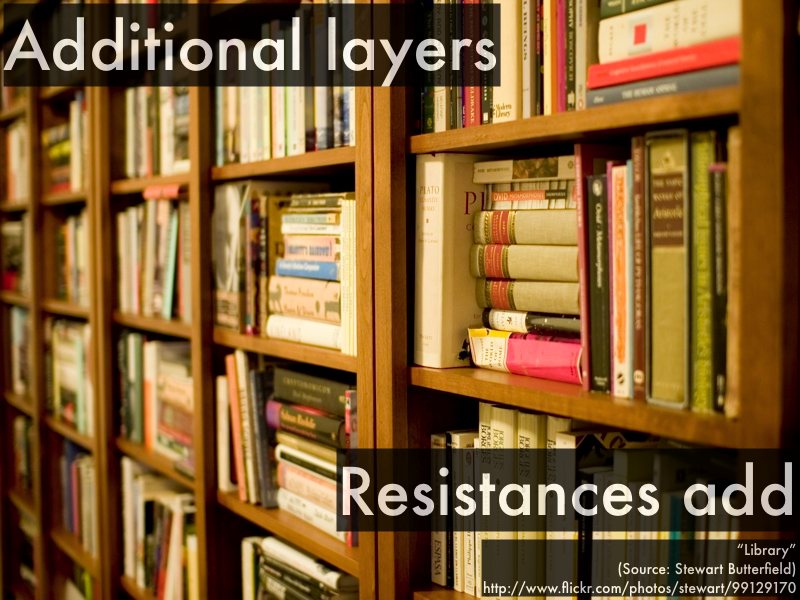
If an additional layer is added to existing insulation, such as this wall-spanning bookcase full of books, then the overall thermal resistance of the bookcase and insulation layer in the wall would be the sum of their individual resistances:

Rtotal = Rwall + Rbooks,

Rtotal = (dwall/(κwall·Awall)) + (dbooks/(κbooks·Abooks)),

where presumably the shared area A of the wall and the bookcase is the same value, but they have different d thicknesses and κ conductivities. The resulting power (heat flow per time) through the book layer and wall insulation is then:

Power = (heat flow)/time = ∆T/Rtotal.

Second, convection, the transport of heat via circulating air. We will just discuss this qualitatively, in contrast to conduction and later, radiation.

Natural convection is where a fluid (liquid or gaseous) will circulate and transport thermal energy from a high temperature to a low temperature region (again, the zeroth law of thermodynamics). In this lava lamp, there is a light bulb heating up these wax globules from below. As the wax globules heat up and expand, their density decreases relative to the clear solvent, and subsequently rise upwards. At the top of the lava lamp, the wax globules cool down and contract, such that their density increases relative to the clear solvent, and subsequently begin to sink. Notice that thermal energy is not being conducted from bottom to top through a static substance, it is being "carried" within the rising globules. (Video link: "080913-1050512.")

You can also transport thermal energy via forced convection, where instead of the fluid circulating naturally due to relative changes in buoyancy, it is forced to carry off thermal energy, typically by blowing across the surface of hot soup.

Third, radiation, where heat is transported in the form of light.

Stefan's law of radiation quantitatively describes the power, or net amount of heat transferred in the form of light to/from an object, which is depends on the difference of the fourth powers of the object's surrounding environment temperature and the temperature of the object itself (in kelvin), the total surface area A of the object, and the emissivity e of the object. Note the obligatory numerical constant σ.

In order to be consistent with all the other definitions of heat flow in this course, a negative sign must be put in to the version of the equation that is given in your textbook. Since a positive heat flow per time is energy being put into the object from the environment, this occurs if the temperature Tenv of the surrounding environment is greater than the object's temperature Tobj. A negative heat flow per time is energy being taken from the object out to the environment, so the temperature Tenv of the surrounding environment must be less than the object's Tobj temperature.

A blackbody is an object that is good at absorbing heat transferred in the form of light. But radiation is a two-way street, so an object that is good at absorbing heat will also be good at emitting heat. This is why objects that are meant to cool off efficiently by radiating (or heat up efficiently by absorbing) light are painted black--here, the entire surface of this SR-71 Blackbird. A perfect blackbody has an emissivity e = 1.

In contrast, a silverbody is an object that is good at reflecting light (and poor at absorbing heat in the form of light). Again, radiation is a two-way street, so an object that is poor at absorbing heat will also be poor at emitting heat. Here this early NASA communication satellite will efficiently reflect light, but will also be very inefficient at radiating heat should it get too hot. A perfect silverbody has an emissivity e = 0.

For these two Leica M cameras, if they are both cooler than the surrounding environment, both will begin to heat up by absorbing radiative heat (say, from the sun). Which will have a faster rate of heat absorbed per time--the black model, or the silver model?

For these snowboarders, if they are warmer than the surrounding environment, they will begin to cool down by emitting radiative heat (say, to the overcast sky and the snowy landscape). Which snowboarder will have a faster rate of heat radiated per time--the snowboarder with the black jacket, or the white jacket?