Showing posts with label Pascal's principle. Show all posts

20191104

Physics quiz question: pressure difference from climbing one floor

Physics 205A Quiz 5, fall semester 2019
Cuesta College, San Luis Obispo, CA

A wearable fitness tracker has an air pressure sensor[*]:
Your tracker is using an altimeter, which measures when air pressure decreases slightly. It adds one floor every time you increase your elevation by 10 feet [3.0 meters] while moving, which is the average distance between two floors.
(The density of air is ρair = 1.3 kg/m3.) An increase in elevation of 3.0 m experienced by this fitness tracker would correspond to a change in air pressure of:
(A) 4.2 Pa.
(B) 13 Pa.
(C) 38 Pa.
(D) 2.9×10⁴ Pa.

[*] Logan Strain, "How Accurate Is Fitbit? Here's What The Research Says About Fitbit Accuracy" (March 29, 2017), wearablezone.com/news/how-accurate-is-fitbit/.

Correct answer (highlight to unhide): (C)

For static fluids, the energy density relation between pressure difference ∆P and elevation change ∆y is given by:

0 = ∆P + ρair·g·∆y.

The difference in pressure ∆P for climbing one floor is then:

P = –ρair·g·∆y,

P = –ρair·g·(yfy0),

P = –(1.3 kg/m3)·(9.80 m/s2)·((+3.0 m) – (0 m)),

P = –(1.3 kg/m3)·(9.80 m/s2)·(+3.0 m),

P = –38.22 Pa,

such that the difference in pressure for climbing one floor (to two significant figures) is 38 Pa (the negative sign in the above calculation denotes that the air pressure decreased with increasing elevation).

(Response (A) is ρair·g/∆y; response (B) is ρair·g; and response (D) is ρwater·g·∆y.)

Sections 70854, 70855
Exam code: quiz05Gu1L
(A) : 6 students
(B) : 6 students
(C) : 34 students
(D) : 6 students

Success level: 65%
Discrimination index (Aubrecht & Aubrecht, 1983): 0.80

20181106

Physics quiz question: "10 bar" depth underwater

Physics 205A Quiz 5, fall semester 2018
Cuesta College, San Luis Obispo, CA

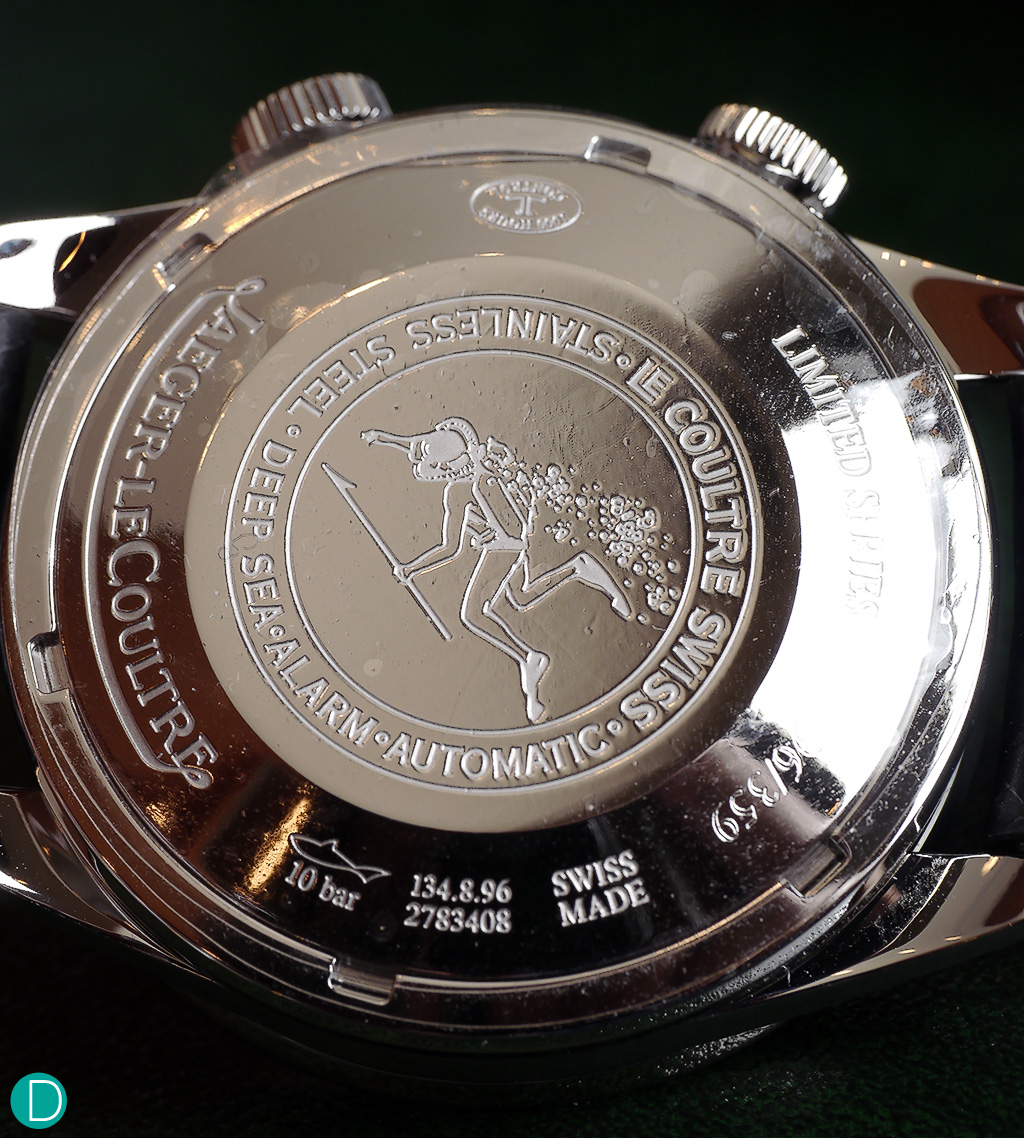
"JLC Tribute to Deep Sea Alarm, caseback"
Peter Chong, Deployant
deployant.com/wp-content/uploads/2014/03/jlc-deepsea-back.jpg

A diving watch claims to have a waterproof rating of 
"10 bar," meaning that it can be safely submerged to withstand an increase of 1.0×10⁶ Pa of pressure compared to that at the surface.[*]

Starting from the surface, this watch would need to be taken __________ downwards into fresh water to experience a pressure increase of 1.0×10⁶ Pa. (ρwater = 1.0×10³ kg/m3.)
(A) 10 m.
(B) 1.0×10² m.
(C) 7.8×10⁴ m.
(D) 1.0×10⁵ m.

[*] deployant.com/comparative-review-jlc-memovox-deep-sea-vulcain-nautical-seventies-part-1-2/.

Correct answer (highlight to unhide): (B)

For static fluids, the energy density relation between pressure difference ∆P and difference in depth ∆y is given by:

0 = ∆P + ρwater·g·∆y.

Since the difference in pressure ∆P = 1.0×10⁶ Pa, then the depth in water beneath the surface can be solved for:

–ρwater·g·∆y = ∆P,

y = –∆P/(ρwater·g) = –(1.0×10⁶ Pa)/((1.0×103 kg/m3)·(9.80 m/s2)),

y = –102.0408163265... m,

where the negative sign is understood as the depth below the surface of the water, and to two significant figures, this depth is 1.0×10² m.

(Response (A) is Patm/(ρ·g); response (C) is –∆P/(ρair·g); while response (D) –∆P/g.)

Sections 70854, 70855
Exam code: quiz05Ro74
(A) : 7 students
(B) : 34 students
(C) : 5 students
(D) : 6 students

Success level: 65%
Discrimination index (Aubrecht & Aubrecht, 1983): 0.63

20171117

Physics quiz question: water pressure at bottom of graduated cylinder

Physics 205A Quiz 5, fall semester 2017
Cuesta College, San Luis Obispo, CA

A graduated cylinder is filled with 10 cm of water. The top of the water level is exposed to atmospheric pressure (Patm = 101.3 kPa). The density of water is ρwater = 1.00×10³ kg/m3. The water pressure at the bottom of graduated cylinder is:
(A) 1.0×10² Pa.
(B) 9.8×10² Pa.
(C) 1.003×10⁵ Pa.
(D) 1.023×10⁵ Pa.

Correct answer (highlight to unhide): (D)

For static fluids, the energy density relation between pressure and changes in elevation is given by:

0 = ∆P + ρ·g·∆y,

0 = (PbottomPtop) + ρwater·g·(ybottomytop),

where the air pressure at the water surface at the top of the graduated cylinder is 101.3 kPa = 1.013×10⁵ Pa, such that:

Pbottom = Ptop – ρwater·g·(ybottomytop),

Pbottom = 1.013×10⁵ Pa – (1.00×10³ kg/m3)·(9.80 m/s2)·((–0.10 m) – (0 m)),

Pbottom = 1.013×10⁵ Pa – 0.0098×10⁵ Pa = 1.023×10⁵ Pa.

(Response (A) is ρwater·∆y; response (B) is ρwater·g·∆y, which is the relative pressure difference between the top and bottom of the water in the graduated cylinder; response (C) is Ptop + ρwater·g·(ybottomytop).)

Sections 70854, 70855
Exam code: quiz05nWaW
(A) : 2 students
(B) : 11 students
(C) : 15 students
(D) : 21 students

Success level: 43%
Discrimination index (Aubrecht & Aubrecht, 1983): 0.28

20161118

Physics quiz question: Samsung Galaxy S7 pressure difference underwater

Physics 205A Quiz 5, fall semester 2016
Cuesta College, San Luis Obispo, CA

"Samsung Galaxy S7 Edge review"
Gareth Beavis
techradar.com/reviews/phones/mobile-phones/samsung-galaxy-s7-edge-1315189/review/11

A Samsung Galaxy S7 smartphone is claimed to be "water-resistant in up to 1.5 m of water for up to 30 minutes."[*] (ρwater = 1.0×10³ kg/m3; Patm = 101.3 kPa.) The difference in pressure between atmospheric pressure and 1.5 m underwater is:
(A) 1.5×10³ Pa.
(B) 1.5×10⁴ Pa.
(C) 8.7×10⁴ Pa.
(D) 1.16×10⁵ Pa.

[*] samsung.com/us/support/answer/ANS00047867/.

Correct answer (highlight to unhide): (B)

For static fluids, the energy density relation between pressure difference ∆P and difference in depth ∆y is given by:

0 = ∆P + ρ·g·∆y.

The difference in pressure ∆P between atmospheric pressure (at the surface of the water) and 1.5 m below the surface:

P = –ρ·g·∆y,

P = –ρ·g·(y(–1.5 m)y(0)),

P = –(1.0×10³ kg/m3)·(9.80 m/s2·((–1.5 m) – (0)),

P = +14,700 Pa,

such that the difference in pressure between atmospheric pressure and 1.5 m underwater (to two significant figures) is 1.5×10⁴ Pa.

(Response (A) is ρ·∆y; response (D) is the absolute pressure 1.5 m underwater; while response (C) is the pressure difference subtracted from atmospheric pressure.)

Sections 70854, 70855, 73320
Exam code: quiz05b0oM
(A) : 18 students
(B) : 19 students
(C) : 12 students
(D) : 6 students

Success level: 35%
Discrimination index (Aubrecht & Aubrecht, 1983): 0.36

20151121

Physics quiz question: Mt. Whitney vs. Badwater Basin pressure difference

Physics 205A Quiz 5, fall semester 2015
Cuesta College, San Luis Obispo, CA

"Ain't no mountain high enough!"
Christine
flic.kr/p/h9k5r4

The highest and lowest points[*] in the 48 contiguous states of the U.S are Mt. Whitney (4,421 m above sea level) and Badwater Basin (85 m below sea level). Assume that the variation of gravitational constant g and the density of air (ρair = 1.3 kg/m3) with elevation is negligible. The air pressure on top of Mt. Whitney is __________ less than the air pressure in Badwater Basin.
(A) 6.6×10² Pa.
(B) 4.5×10⁴ Pa.
(C) 5.3×10⁴ Pa.
(D) 1.024×10⁵ Pa.

[*] wki.pe/Extreme_points_of_the_United_States.

Correct answer (highlight to unhide): (C)

For static fluids, the energy density relation between pressure difference ∆P and elevation change ∆y is given by:

0 = ∆P + ρ·g·∆y.

The difference in pressure ∆P between Mt. Whitney and Badwater Basin is then:

P = –ρ·g·∆y,

P = –ρ·g·(yWhitneyyBadwater),

P = –(1.3 kg/m3)·(9.80 m/s2)·((+4,421 m) – (–85 m)),

P = –(1.3 kg/m3)·(9.80 m/s2)·(+4,506 m),

P = –57,406.44 Pa,

such that the difference in pressure between Mt. Whitney and Badwater Basin (to two significant figures) is 5.7×10⁴ Pa (the negative sign in the above calculation denotes that the air pressure at Mt. Whitney is less than the air pressure in Badwater Basin).

(Response (A) is ρ·g·(yWhitney/yBadwater); response (B) is the absolute air pressure atop Mt. Whitney; and response (D) is the absolute air pressure in Badwater Basin.)

Sections 70854, 70855, 73320
Exam code: quiz05bL8D
(A) : 17 students
(B) : 0 students
(C) : 43 students
(D) : 5 students

Success level: 66%
Discrimination index (Aubrecht & Aubrecht, 1983): 0.63

20141111

Physics quiz question: Costa Concordia ledge water pressure

Physics 205A Quiz 5, fall semester 2014
Cuesta College, San Luis Obispo, CA

Cf. Giambattista/Richardson/Richardson, Physics, 2/e, Problem 9.13

"Costa Concordia 5"
paolodefalco75
commons.wikimedia.org/wiki/File:Costa_Concordia_5.jpg

In January 13, 2012 the cruise ship Costa Concordia grounded and partially capsized, resting half-submerged on an underwater ledge, with 32 lives lost.[*] The ledge that the Costa Concordia rested on was 20 m below sea level. (Approximate the density of sea water as ρwater = 1.0 ×10³ kg/m3, and Patm = 101.3 kPa.) The water pressure at that depth is:
(A) 2.0×10³ Pa.
(B) 9×10⁴ Pa.
(C) 2.0×10⁵ Pa.
(D) 3.0×10⁵ Pa.

[*] wiki.pe/Costa_Concordia_disaster.

Correct answer (highlight to unhide): (D)

For static fluids, the energy density relation between pressure and changes in elevation is given by:

0 = ∆P + ρ·g·∆y,

0 = (PledgePsea level) + ρ·g·(yledgeysea level),

where the water pressure at sea level is 101.3 kPa = 1.013×10⁵ Pa, such that:

Pledge = Psea level – ρ·g·(y ledge ysea level),

P ledge = 1.013×10⁵ Pa – (1.0 ×10³ kg/m3)·(9.80 m/s2)·(– 20 m – 0 m),

Pledge = 1.013×10⁵ Pa + 1.96×10⁵ Pa = 2.97×10⁵ Pa,

which is 3.0 ×10⁵ Pa, to two significant figures.

(Response (C) is ρ·g·∆y, which is the difference in pressure between sea level and the underwater ledge depth; response (B) is Psea level – ρ·g·∆y; response (A) is Psea level·∆y/ρ.)

Sections 70854, 70855, 73320
Exam code: quiz05mRp4
(A) : 18 students
(B) : 5 students
(C) : 33 students
(D) : 7 students

Success level: 11%
Discrimination index (Aubrecht & Aubrecht, 1983): 0.37

20131123

Physics quiz question: air pressure in Krubera Cave

Physics 205A Quiz 5, fall semester 2013
Cuesta College, San Luis Obispo, CA

Cf. Giambattista/Richardson/Richardson, Physics, 2/e, Problem 9.19(a)

The entrance to Krubera Cave[*] in the Abkhazia region of Georgia is 2,256 m above sea level. It is the deepest known cave, explored to a depth of 2,197 m from its entrance. Assuming that the gravitational constant g and the density of air do not vary with elevation, the air pressure at the deepest explored point in Krubera Cave is __________ the air pressure at sea level.
(A) less than.
(B) equal to.
(C) greater than.
(D) (Not enough information is given.)

[*] Source: wki.pe/Krubera_Cave.

Correct answer (highlight to unhide): (A)

For static fluids, the energy density relation between pressure and changes in elevation is given by:

0 = ∆P + ρ·g·∆y,

0 = (Pdeepest pointPsea level) + ρ·g·(ydeepest pointysea level),

where the air pressure at sea level is 101.3 kPa = 1.013×10⁵ Pa, such that:

Pdeepest point = Psea level – ρ·g·(ydeepest pointysea level).

Since the entrance to Krubera Cave is 2,256 m above sea level, and the deepest explored point is 2,197 m below the entrance, the deepest explored point in Krubera Cave is 2,256 m – 2,197 m = 59 m above sea level, making the quantity (ydeepest pointysea level) positive, and thus the pressure in the deepest explored point in Krubera Cave is slightly less than the air pressure at sea level (with the above assumptions).

Sections 70854, 70855, 73320
Exam code: quiz05LuF7
(A) : 28 students
(B) : 6 students
(C) : 27 students
(D) : 0 students

Success level: 46%
Discrimination index (Aubrecht & Aubrecht, 1983): 0.43

20121109

Physics quiz question: Caliente Mountain air pressure

Physics 205A Quiz 5, fall semester 2012
Cuesta College, San Luis Obispo, CA

"CalienteMountain"
Atandrus
wki.pe/File:CalienteMountain.JPG

The summit of Caliente Mountain (1,556 m above sea level), near New Cuyama, is the highest point in San Luis Obispo county[*]. Assume that the variation of gravitational constant g and the density of air ρair = 1.3 kg/m3 with elevation is negligible. (Patm = 101.3 kPa.) The air pressure at the summit is:
(A) 2.0×10⁴ Pa.
(B) 8.1×10⁴ Pa.
(C) 1.2×10⁵ Pa.
(D) 1.6×10⁶ Pa.

[*] wki.pe/Caliente_Mountain.

Correct answer (highlight to unhide): (B)

For static fluids, the energy density relation between pressure and changes in elevation is given by:

0 = ∆P + ρ·g·∆y,

0 = (PCalientePsea level) + ρair·g·(yCalienteysea level),

where the air pressure at sea level is 101.3 kPa = 1.013×10⁵ Pa, such that:

PCaliente = Psea level – ρair·g·(yCalienteysea level),

PCaliente = 1.013×10⁵ Pa – (1.3 kg/m3)·(9.80 m/s2)·((+1,556 m) – (0 m)),

PCaliente = 1.013×10⁵ Pa – 0.20×10⁵ Pa = 0.81×10⁵ Pa = 8.1×10⁴ Pa.

(Response (A) is ρair·g·∆y, which is the relative pressure decrease between sea level and Caliente Mountain; response (C) is Psea level + ρair·g·(yCalienteysea level); response (D) is (1/2)·ρair·(∆y)2.)

Sections 70854, 70855
Exam code: quiz05L4mN
(A) : 24 students
(B) : 15 students
(C) : 3 students
(D) : 10 students

Success level: 29%
Discrimination index (Aubrecht & Aubrecht, 1983): 0.39

20081109

Physics quiz question: manometer

Physics 205A Quiz 5, Fall Semester 2008
Cuesta College, San Luis Obispo, CA

Cf. Giambattista/Richardson/Richardson, Physics, 1/e, Problem 9.24

A water manometer is attached to a flask containing a gas, where the other end is open to the atmosphere.

[3.0 points.] How does the pressure of the gas inside the flask compare to atmospheric pressure?
(A) P_flask = P_atm.
(B) P_flask > P_atm.
(C) P_flask < P_atm.
(D) (Not enough information is given to determine this.)

Correct answer: (C)

The manometer water level will be lower on the side that is at lower pressure, thus P_flask < P_atm. If the water levels were the same in either side of the U-tube, then P_flask = P_atm. If the water level was higher on the side of the U-tube open to the atmosphere, then P_flask > P_atm.

Student responses
Sections 70854, 70855
(A) : 2 students
(B) : 7 students
(C) : 31 student
(D) : 1 student

"Difficulty level": 75%
Discrimination index (Aubrecht & Aubrecht, 1983): 0.15

[3.0 points.] How does the pressure at point [1] compare to the pressure at point [2]?
(A) P_1 = P_2.
(B) P_1 > P_2.
(C) P_1 < P_2.
(D) (Not enough information is given to determine this.)

Correct answer: (A)

According to Pascal's principle, "same fluid, same level, same pressure." In fact, P_1 = P_2 = P_atm.

Student responses
Sections 70854, 70855
(A) : 30 students
(B) : 6 students
(C) : 5 students
(D) : 0 students

"Difficulty level": 73%
Discrimination index (Aubrecht & Aubrecht, 1983): 0.20