Showing posts with label heliocentrism. Show all posts

20200316

Astronomy midterm question: Venus setting while Jupiter rising at night?

Astronomy 210 Midterm 1, spring semester 2020
Cuesta College, San Luis Obispo, CA

The following excerpt describes a night where Venus is setting while Jupiter is rising[*]:
Let me try to recall what has happened, the amusing and strange, and sad and terrible scenes witnessed in these last few days. On my first night at sea, I watched Venus slowly sinking into the sea, and Jupiter rising...
Discuss a plausible time (around sunset, midnight, or sunrise) that these two planets would be observed in San Luis Obispo, CA, and how you know this. Support your answer using a diagram showing the positions of the sun, Venus, Jupiter, Earth, and an observer on Earth.

[*] J.C., "Wrecked--A Week on Sable Island," The Canadian Methodist Magazine, vol. XV (January-June 1882), p. 73.

Solution and grading rubric:
  • p:
    Complete diagram and reasoning where observer on Earth must be at sunset to watch Venus (in an inner orbit) setting while Jupiter (in an inner orbit) rises in the east.
  • r:
    Nearly correct (explanation weak, unclear or only nearly complete); includes extraneous/tangential information; or has minor errors. Typically diagram and/or supporting argument is contradictory or incomplete.
  • t:
    Contains right ideas, but discussion is unclear/incomplete or contains major errors. Still has Venus in an inner orbit and Jupiter in an outer orbit around the sun.
  • v:
    Limited relevant discussion of supporting evidence of at least some merit, but in an inconsistent or unclear manner. Some attempt at diagram(s), but no clear indication of observer/horizon on Earth and/or placement of inner planets. Typically misplaces Venus and Jupiter in their relative inner/outer orbits around the sun, or has Venus and Jupiter orbiting Earth.
  • x:
    Implementation/application of ideas, but credit given for effort rather than merit.
  • y:
    Irrelevant discussion/effectively blank.
  • z:
    Blank.
Grading distribution:
Section 30674
Exam code: midterm01n7in
p: 14 students
r: 1 student
t: 6 students
v: 7 students
x: 1 student
y: 0 students
z: 1 student

Section 30676
Exam code: midterm01S7wY
p: 24 students
r: 0 students
t: 13 students
v: 6 students
x: 2 students
y: 0 students
z: 0 students

A sample "p" response (from student 2000):

Another sample "p" response (from student 2020):

One more sample "p" response (from student 5171):

20200220

Astronomy quiz question: morning star Venus?

Astronomy 210 Quiz 2, spring semester 2020
Cuesta College, San Luis Obispo, CA

The locations of Mercury, Venus, and Earth are shown in the diagram below (not to scale, and orbits have been simplified as circles instead of ellipses).


At sunrise, Venus will be:
(A) low over the east horizon.
(B) somewhere high up in the sky.
(C) low over the west horizon.
(D) not visible in the sky.

Correct answer (highlight to unhide): (A)
If a line is drawn from Earth to the sun, the observer at sunrise (6 AM) is located perpendicular to that line.


Everything above that line would be above the horizon, such that Venus will be visible at sunrise, low over the east horizon.

Section 30676
Exam code: quiz02SnRl
(A) : 20 students
(B) : 2 students
(C) : 8 students
(D) : 14 students

Success level: 48% (including partial credit for multiple-choice)
Discrimination index (Aubrecht & Aubrecht, 1983): 0.60

Astronomy quiz archive: eclipses/history of astronomy

Astronomy 210 Quiz 2, spring semester 2020
Cuesta College, San Luis Obispo, CA

Section 30674, version 1
Exam code: quiz02n1xI


Section 30674
0- 8.0 :   ** [low = 6.0]
8.5-16.0 :   *****
16.5-24.0 :   ******* [mean = 23.8 +/- 9.0]
24.5-32.0 :   *********
32.5-40.0 :   ******* [high = 36.5]


Section 30676, version 1
Exam code: quiz02SnRl


Section 30676
0- 8.0 :   ** [low = 8.0]
8.5-16.0 :   *******
16.5-24.0 :   *************
24.5-32.0 :   ********* [mean = 24.8 +/- 9.2]
32.5-40.0 :   ************* [high = 40.0]

Astronomy quiz question: evening star Venus?

Astronomy 210 Quiz 2, spring semester 2020
Cuesta College, San Luis Obispo, CA

The locations of Mercury, Venus, and Earth are shown in the diagram below (not to scale, and orbits have been simplified as circles instead of ellipses).


At sunset, Venus will be:
(A) low over the east horizon.
(B) somewhere high up in the sky.
(C) low over the west horizon.
(D) not visible in the sky.

Correct answer (highlight to unhide): (D)

If a line is drawn from Earth to the sun, the observer at sunset (6 PM) is located perpendicular to that line.


Everything below that line would be below the horizon, such that Venus will not be visible at sunset.

Section 30674
Exam code: quiz02n1xI
(A) : 5 students
(B) : 3 students
(C) : 5 students
(D) : 18 students

Success level: 59% (including partial credit for multiple-choice)
Discrimination index (Aubrecht & Aubrecht, 1983): 0.88

20191008

Astronomy midterm question: 12 hours between Mercury setting and Venus rising?

Astronomy 210 Midterm 1, fall semester 2019
Cuesta College, San Luis Obispo, CA

An astronomy question on an online discussion board was asked and answered[*]:
J.F.: Can an observer ever witness Mercury setting at the same time while Venus is rising?
rzfr: No, that is impossible. It will take about 12 hours between Mercury setting and Venus rising.
Discuss why it would take about 12 hours between Mercury setting and Venus rising for an observer in San Luis Obispo, CA, and how you know this. Support your answer using a diagram showing the positions of the sun, Mercury, Venus, Earth, and an observer on Earth.

[*] answers.yahoo.com/question/index?qid=20090328072648AALZoVS.

Solution and grading rubric:
  • p:
    Complete diagram and reasoning includes the following explanations for why there would be about 12 hours between Mercury setting and Venus rising:
    1. places observer on Earth at sunset to watch Mercury (in an inner orbit) setting in the west; and
    2. places observer on Earth at sunrise to watch Venus (in an inner orbit) rising in the east.
  • r:
    Nearly correct (explanation weak, unclear or only nearly complete); includes extraneous/tangential information; or has minor errors. Typically diagram is correct, but supporting argument is contradictory or incomplete. May have placed Mercury to rise at sunrise and placed Venus to set at sunset.
  • t:
    Contains right ideas, but discussion is unclear/incomplete or contains major errors. Still has Mercury and Venus along inner orbits around the sun.
  • v:
    Limited relevant discussion of supporting evidence of at least some merit, but in an inconsistent or unclear manner. Some attempt at diagram(s), but no clear indication of observer/horizon on Earth and/or placement of inner planets. Typically misplaces Mercury and Venus in their relative outer/inner orbits around the sun.
  • x:
    Implementation/application of ideas, but credit given for effort rather than merit.
  • y:
    Irrelevant discussion/effectively blank.
  • z:
    Blank.
Grading distribution:
Section 70158
Exam code: midterm01Sw3e
p: 20 students
r: 4 students
t: 5 students
v: 6 students
x: 0 students
y: 0 students
z: 1 student

Section 70160
Exam code: midterm01N0dL
p: 6 students
r: 5 students
t: 5 students
v: 7 students
x: 0 students
y: 0 students
z: 0 students

A sample "p" response (from student 1234):

20190912

Astronomy quiz question: morning star Jupiter?

Astronomy 210 Quiz 2, fall semester 2019
Cuesta College, San Luis Obispo, CA

The locations of Earth, Jupiter, and Saturn are shown in the diagram below (not to scale, and orbits have been simplified as circles instead of ellipses).


At sunrise, Jupiter will be:
(A) low over the east horizon.
(B) somewhere high up in the sky.
(C) low over the west horizon.
(D) not visible in the sky.

Correct answer (highlight to unhide): (D)

If a line is drawn from Earth to the sun, the observer at sunrise (6 AM) is located perpendicular to that line.


Everything below that line would be below the horizon, such that Jupiter will not be visible at sunrise.

Section 70158
Exam code: quiz02SnPy
(A) : 7 students
(B) : 3 students
(C) : 4 students
(D) : 20 students

Success level: 60% (including partial credit for multiple-choice)
Discrimination index (Aubrecht & Aubrecht, 1983): 0.89

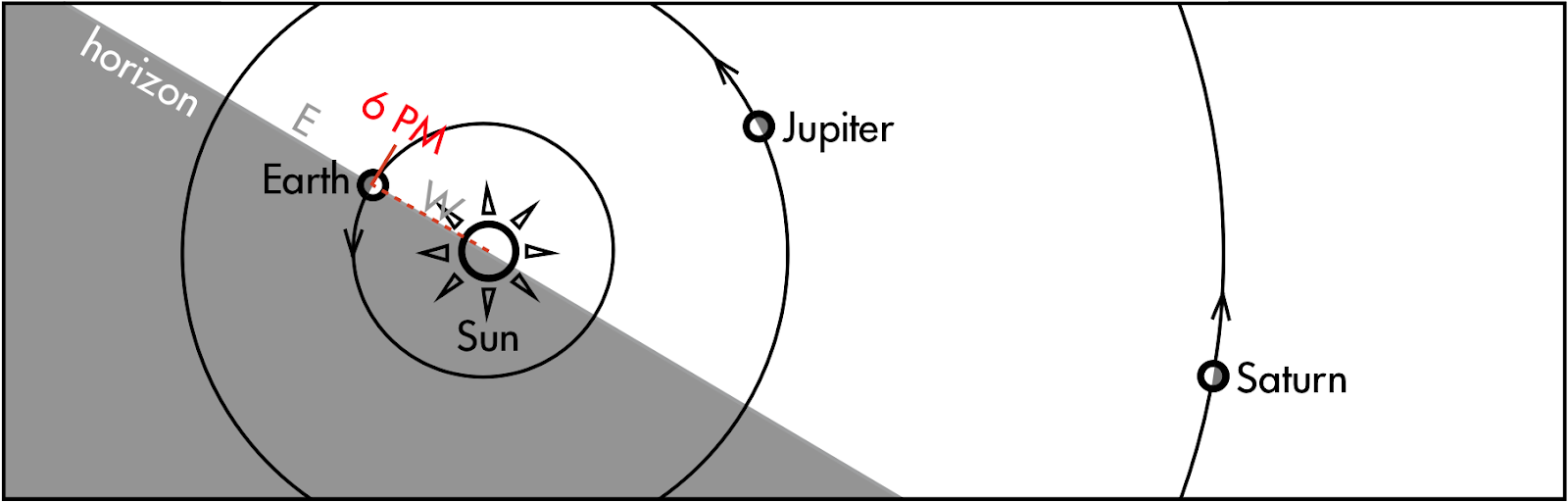
Astronomy quiz question: evening star Saturn?

Astronomy 210 Quiz 2, spring semester 2019
Cuesta College, San Luis Obispo, CA

The locations of Earth, Jupiter, and Saturn are shown in the diagram below (not to scale, and orbits have been simplified as circles instead of ellipses).


At sunset, Saturn will be:
(A) low over the east horizon.
(B) somewhere high up in the sky.
(C) low over the west horizon.
(D) not visible in the sky.

Correct answer (highlight to unhide): (C)

If a line is drawn from Earth to the sun, the observer at sunset (6 PM) is located perpendicular to that line.


Everything above that line would be above the horizon, such that Saturn will be visible at sunset, and be located low over the west horizon (above the sun setting in the west).

Section 70160
Exam code: quiz02n4rN
(A) : 5 students
(B) : 0 students
(C) : 14 students
(D) : 3 students

Success level: 66% (including partial credit for multiple-choice)
Discrimination index (Aubrecht & Aubrecht, 1983): 0.17

Astronomy quiz archive: eclipses/history of astronomy

Astronomy 210 Quiz 2, fall semester 2019
Cuesta College, San Luis Obispo, CA

Section 70158, version 1
Exam code: quiz02SnPy


Section 70158
0- 8.0 :   * [low = 4.0]
8.5-16.0 :   *******
16.5-24.0 :   ****
24.5-32.0 :   ******** [mean = 28.1 +/- 9.8]
32.5-40.0 :   ***************** [high = 40.0]


Section 70160, version 1
Exam code: quiz02n4rN


Section 70160
0- 8.0 :   * [low = 8.0]
8.5-16.0 :   *
16.5-24.0 :   ********
24.5-32.0 :   ******* [mean = 25.8 +/- 7.4]
32.5-40.0 :   ***** [high = 40.0]

20190315

Astronomy midterm question: Jupiter, not Venus low in the west at dawn

Astronomy 210 Midterm 1, spring semester 2019
Cuesta College, San Luis Obispo, CA

An astronomy question on an online discussion board was asked and answered[*]:
deanmajiet65: Just before dawn, I saw a planet in the sky in the west. Is it Jupiter or Venus?
Rich: It's not Venus. You were facing west, so that was Jupiter.
Discuss why this planet could not be Venus, and would have to be Jupiter for an observer in San Luis Obispo, CA, and how you know this. Support your answer using a diagram showing the positions of the sun, Venus, Jupiter, Earth, and an observer on Earth.

[*] answers.yahoo.com/question/index?qid=20090727104303AA5cFyR.

Solution and grading rubric:
  • p:
    Complete diagram and reasoning includes the following explanations for how it is possible for an observer on Earth to be able to see Jupiter, but not Venus in the west at dawn:
    1. places observer on Earth at dawn (or some time after midnight but before sunrise), with east and west horizons clearly indicated; and
    2. is able to place Jupiter (in an outer orbit) such that it is visible above the west horizon for this observer, and also indicates how Venus (in an inner orbit) can only be seen in the east horizon if it is visible at all at dawn.
  • r:
    Nearly correct (explanation weak, unclear or only nearly complete); includes extraneous/tangential information; or has minor errors. Typically diagram is correct, but supporting argument is contradictory or incomplete.
  • t:
    Contains right ideas, but discussion is unclear/incomplete or contains major errors. May have an observer at sunset instead of sunrise, and/or switched east/west horizons; but still has Jupiter and Venus along outer and inner orbits around the sun, respectively.
  • v:
    Limited relevant discussion of supporting evidence of at least some merit, but in an inconsistent or unclear manner. Some attempt at diagram(s), but no clear indication of observer/horizon on Earth and how placement of outer and inner planets would (or would not) be visible at dawn in the west. Typically misplaces Jupiter and Venus in their relative outer/inner orbits around the sun.
  • x:
    Implementation/application of ideas, but credit given for effort rather than merit.
  • y:
    Irrelevant discussion/effectively blank.
  • z:
    Blank.
Grading distribution:
Section 30674
Exam code: midterm01NtwT
p: 17 students
r: 3 students
t: 10 students
v: 4 students
x: 0 students
y: 1 student
z: 0 students

Section 30676
Exam code: midterm01SFBk
p: 26 students
r: 2 students
t: 9 students
v: 3 students
x: 2 students
y: 1 student
z: 1 student

A sample "p" response (from student 7563):

A sample "v" response (from student 1735), with both Venus and Jupiter as inner planets, and with east and west horizons switched for an observer on Earth, just before dawn:

20190223

Astronomy quiz question: morning star Venus?

Astronomy 210 Quiz 2, spring semester 2019
Cuesta College, San Luis Obispo, CA

The locations of Venus, Earth, and Mars are shown in the diagram below (not to scale, and orbits have been simplified as circles instead of ellipses).


At sunset, Venus will be:
(A) low over the east horizon.
(B) somewhere high up in the sky.
(C) low over the west horizon.
(D) not visible in the sky.

Correct answer (highlight to unhide): (D)

If a line is drawn from Earth to the sun, the observer at sunrise (6 AM) is located perpendicular to that line.


Everything below that line would be below the horizon, such that Venus will not be visible at sunrise.

Section 30674
Exam code: quiz02nrNa
(A) : 8 students
(B) : 4 students
(C) : 3 students
(D) : 21 students

Success level: 60% (including partial credit for multiple-choice)
Discrimination index (Aubrecht & Aubrecht, 1983): 0.70

Astronomy quiz question: morning star Mars?

Astronomy 210 Quiz 2, spring semester 2019
Cuesta College, San Luis Obispo, CA

The locations of Venus, Earth, and Mars are shown in the diagram below (not to scale, and orbits have been simplified as circles instead of ellipses).


At sunrise, Mars will be:
(A) low over the east horizon.
(B) somewhere high up in the sky.
(C) low over the west horizon.
(D) not visible in the sky.

Correct answer (highlight to unhide): (C)

If a line is drawn from Earth to the sun, the observer at sunrise (6 AM) is located perpendicular to that line.


Everything above that line would be above the horizon, such that Mars will be visible at sunrise, and be located low over the west horizon (the direction opposite from the sun rising from the east).

Section 30676
Exam code: quiz02Sn0W
(A) : 8 students
(B) : 4 students
(C) : 24 students
(D) : 7 students

Success level: 59% (including partial credit for multiple-choice)
Discrimination index (Aubrecht & Aubrecht, 1983): 0.64

20190221

Astronomy quiz archive: eclipses/history of astronomy

Astronomy 210 Quiz 2, spring semester 2019
Cuesta College, San Luis Obispo, CA

Section 30674, version 1
Exam code: quiz02nrNa


Section 30674
0- 8.0 :  
8.5-16.0 :   *** [low = 12.0]
16.5-24.0 :   *****
24.5-32.0 :   ***************** [mean = 29.2 +/- 7.6]
32.5-40.0 :   *********** [high = 40.0]


Section 30676, version 1
Exam code: quiz02Sn0W


Section 30676
0- 8.0 :  
8.5-16.0 :   ***** [low = 8.5]
16.5-24.0 :   ******
24.5-32.0 :   ************** [mean = 28.7 +/- 8.9]
32.5-40.0 :   ****************** [high = 40.0]

20181004

Astronomy midterm question: earlier shift of Jupiter's rising time?

Astronomy 210 Midterm 1, fall semester 2018
Cuesta College, San Luis Obispo, CA

The following description of Jupiter was given in a science magazine[*]:
At the beginning of this month Jupiter rises around midnight. At the end of this month Jupiter rises around 10 PM.
Discuss how this earlier shift of Jupiter's rising time over the course of a month would be plausible for an observer in San Luis Obispo, CA, and how you know this. Support your answer using diagrams showing the positions of the sun, Jupiter, Earth, and an observer on Earth.

[*] Astronomical Notes," Scientific American, vol. 43 no. 235 (July 3, 1880), p. 11, books.google.com/books?id=6ok9AQAAIAAJ&dq.

Solution and grading rubric:
  • p:
    Complete diagram and reasoning includes the following explanations for an observer on Earth looking at Jupiter:
    1. Jupiter's position in its orbit around the sun is "ahead of" Earth's position in its orbit around the sun such that the observer on Earth at midnight is able to see Jupiter rising from the east horizon, and
    2. a few months later, Earth has "caught up" to Jupiter (but not yet at superior conjunction) such the observer on Earth will see Jupiter rising from the horizon at an earlier time.
  • r:
    Nearly correct (explanation weak, unclear or only nearly complete); includes extraneous/tangential information; or has minor errors. May have Jupiter highest overhead at midnight (at superior conjunction) for the earlier drawing, and then Earth slightly ahead of Jupiter for the later drawing such that Jupiter is overhead at 10 PM.
  • t:
    Contains right ideas, but discussion is unclear/incomplete or contains major errors. May have geocentric model of Jupiter orbiting Earth, or Earth staying still while Jupiter moves relative to Earth around sun, or observer/times on Earth are in wrong positions.
  • v:
    Limited relevant discussion of supporting evidence of at least some merit, but in an inconsistent or unclear manner. Some attempt at diagram(s), but no clear indication of observer/times on Earth and how relative motions of Earth and Jupiter would cause the earlier shift of Jupiter's rising time.
  • x:
    Implementation/application of ideas, but credit given for effort rather than merit.
  • y:
    Irrelevant discussion/effectively blank.
  • z:
    Blank.
Grading distribution:
Section 70158
Exam code: midterm01Sa1Y
p: 7 students
r: 11 students
t: 9 students
v: 8 students
x: 1 student
y: 1 student
z: 0 students

Section 70160
Exam code: midterm01n4mR
p: 1 student
r: 3 students
t: 5 students
v: 8 students
x: 2 students
y: 0 students
z: 0 students

A sample "p" response (from student 1999)

Another sample "p" response (from student 4008)

20180913

Astronomy quiz question: morning star Mars?

Astronomy 210 Quiz 2, fall semester 2018
Cuesta College, San Luis Obispo, CA

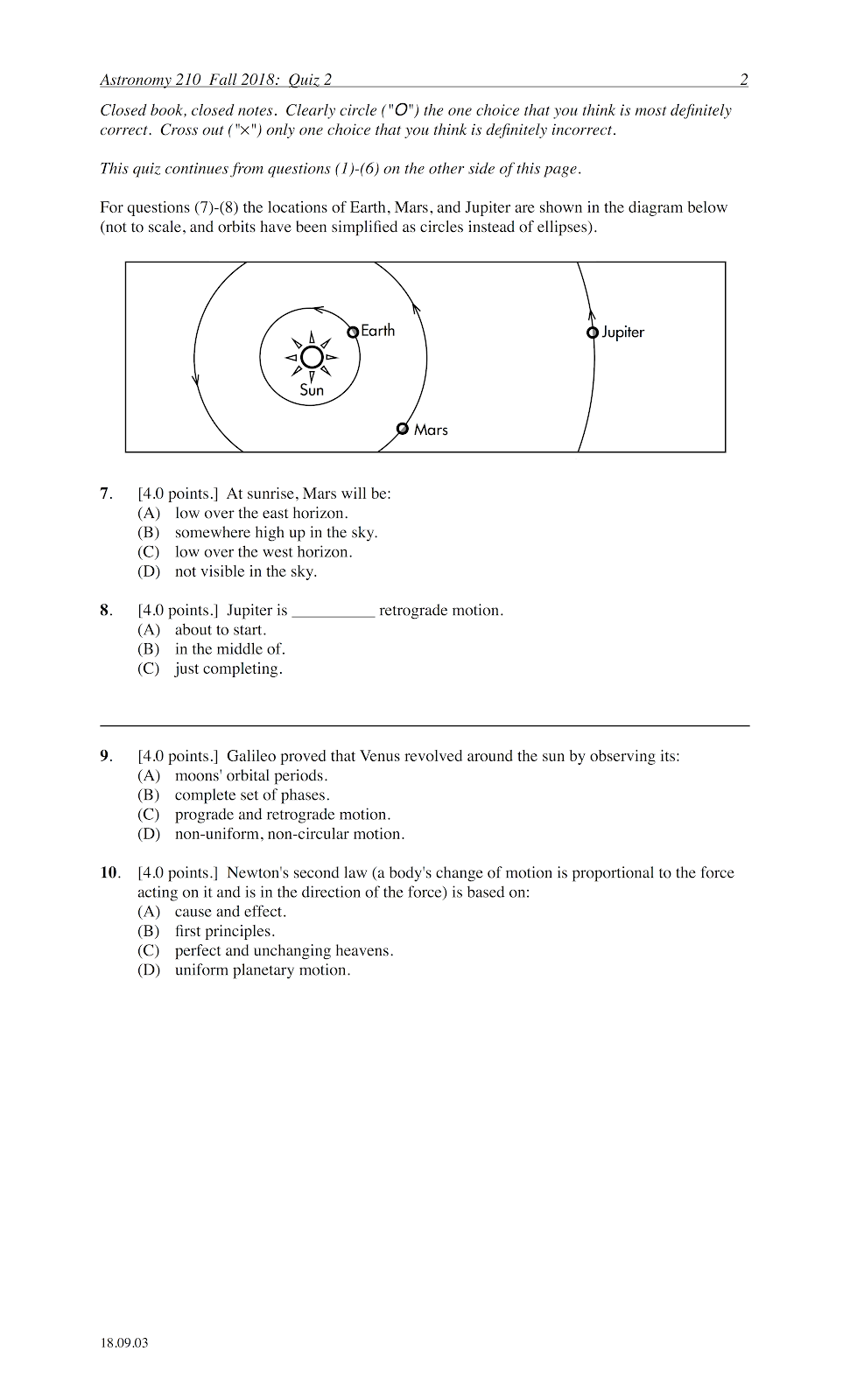
The locations of Earth, Mars, and Jupiter are shown in the diagram below (not to scale, and orbits have been simplified as circles instead of ellipses).


At sunrise, Mars will be:
(A) low over the east horizon.
(B) somewhere high up in the sky.
(C) low over the west horizon.
(D) not visible in the sky.

Correct answer (highlight to unhide): (D)

If a line is drawn from Earth to the sun, the observer at sunrise (6 AM) is located perpendicular to that line.


Everything below that line would be below the horizon, such that Mars is not visible at sunrise. (Note that Jupiter will also not be visible at sunrise.)

Section 70158
Exam code: quiz02Sl3I
(A) : 7 students
(B) : 3 students
(C) : 4 students
(D) : 22 students

Success level: 62% (including partial credit for multiple-choice)
Discrimination index (Aubrecht & Aubrecht, 1983): 0.80

Section 70160
Exam code: quiz02N3r1
(A) : 6 students
(B) : 2 students
(C) : 4 students
(D) : 4 students

Success level: 26% (including partial credit for multiple-choice)
Discrimination index (Aubrecht & Aubrecht, 1983): 0.75

Astronomy quiz question: Jupiter's retrograde motion

Astronomy 210 Quiz 2, fall semester 2018
Cuesta College, San Luis Obispo, CA

The locations of Earth, Mars, and Jupiter are shown in the diagram below (not to scale, and orbits have been simplified as circles instead of ellipses).


Jupiter is __________ retrograde motion.
(A) about to start.
(B) in the middle of.
(C) just completing.

Correct answer (highlight to unhide): (C)


Retrograde motion occurs for Jupiter when the sun, Earth, and Jupiter are aligned (Mars in opposition). Drawing in lines from the sun to Earth and the sun to Jupiter indicates that Earth (which travels faster along its inner orbit), has already overtaken Jupiter (which travels slower along its outer orbit), thus Jupiter has already completed its retrograde motion.

Section 70158
Exam code: quiz02Sl3I
(A) : 18 students
(B) : 7 students
(C) : 11 students

Success level: 32% (including partial credit for multiple-choice)
Discrimination index (Aubrecht & Aubrecht, 1983): 0.40

Section 70160
Exam code: quiz02N3r1
(A) : 6 students
(B) : 7 students
(C) : 3 students

Success level: 20% (including partial credit for multiple-choice)
Discrimination index (Aubrecht & Aubrecht, 1983): 0.25


(Animation from marsprogram.jpl.nasa.gov)

20180912

Astronomy quiz archive: eclipses/history of astronomy

Astronomy 210 Quiz 2, fall semester 2018
Cuesta College, San Luis Obispo, CA

Section 70158, version 1
Exam code: quiz02Sl3I


Section 70158
0- 8.0 :   * [low = 4.0]
8.5-16.0 :   ********
16.5-24.0 :   *******
24.5-32.0 :   ********* [mean = 24.8 +/- 9.6]
32.5-40.0 :   ********** [high = 40.0]


Section 70160, version 1
Exam code: quiz02N3r1


Section 70160
0- 8.0 :  
8.5-16.0 :   ******** [low = 12.0]
16.5-24.0 :   **** [mean = 19.3 +/- 6.8]
24.5-32.0 :   **** [high = 28.5]
32.5-40.0 :  

20180310

Astronomy midterm question: Saturn high overhead at sunrise, then eventually at midnight?

Astronomy 210 Midterm 1, spring semester 2018
Cuesta College, San Luis Obispo, CA

The following explanation was given on an online discussion board[*]:
Say Saturn is overhead at sunrise. After a few months, Earth will have moved faster in its orbit than Saturn such that Saturn will then be visible overhead at midnight.
Discuss why this answer is correct for an observer in San Luis Obispo, CA, and how you know this. Support your answer using diagrams showing the positions of the sun, Saturn, Earth, and an observer on Earth.

[*] answers.yahoo.com/question/index?qid=20180302021141AAdHysp.

Solution and grading rubric:
  • p:
    Complete diagram and reasoning includes the following explanations for an observer on Earth looking at Saturn:
    1. Saturn's position in its orbit around the sun is "ahead of" Earth's position in its orbit around the sun such that the observer on Earth at sunrise is able to see Saturn overhead; and
    2. a few months later, Earth has "caught up" to Saturn and they are (approximately) "lined up" with the sun (superior conjunction), such that the observer on Earth at midnight is able to see Saturn overhead.
  • r:
    Nearly correct (explanation weak, unclear or only nearly complete); includes extraneous/tangential information; or has minor errors. Draws both diagrams: one correct, the other with slight errors.
  • t:
    PContains right ideas, but discussion is unclear/incomplete or contains major errors. Draws both diagrams with errors; or has one diagram correct, the other missing/problematic.
  • v:
    Limited relevant discussion of supporting evidence of at least some merit, but in an inconsistent or unclear manner. Some attempt at one diagram, with errors; the other is missing or effectively missing.
  • x:
    Implementation/application of ideas, but credit given for effort rather than merit.
  • y:
    Irrelevant discussion/effectively blank.
  • z:
    Blank.
Grading distribution:
Section 30674
Exam code: midterm01nND4
p: 11 students
r: 2 students
t: 8 students
v: 2 student
x: 2 students
y: 0 students
z: 0 students

A sample "p" response (from student 4387):

20180215

Astronomy quiz question: planets visible at sunset?

Astronomy 210 Quiz 2, spring semester 2018
Cuesta College, San Luis Obispo, CA

The locations of Saturn, Earth, and Jupiter are shown in the diagram below (not to scale, and orbits have been simplified as circles instead of ellipses).


Which planet(s) will be visible at sunset?
(A) Saturn.
(B) Jupiter.
(C) (Both of the above choices.)
(D) (Neither of the above choices.)

Correct answer (highlight to unhide): (C)

If a line is drawn from Earth to the sun, the observer at sunset (6 PM) is located perpendicular that line. Since Saturn and Jupiter are both above that horizon line, they will both be visible at that time, where Saturn would be low over the east horizon, and Jupiter would be low over the west horizon.)


Section 30676
Exam code: quiz02sn4E
(A) : 17 students
(B) : 4 students
(C) : 13 students
(D) : 6 students

Success level: 35% (including partial credit for multiple-choice)
Discrimination index (Aubrecht & Aubrecht, 1983): 0.45

Astronomy quiz question: planets visible at midnight?

Astronomy 210 Quiz 2, spring semester 2018
Cuesta College, San Luis Obispo, CA

The locations of Saturn, Earth, and Jupiter are shown in the diagram below (not to scale, and orbits have been simplified as circles instead of ellipses).


Which planet(s) will be visible at midnight?
(A) Saturn.
(B) Jupiter.
(C) (Both of the above choices.)
(D) (Neither of the above choices.)

Correct answer (highlight to unhide): (A)

If a line is drawn from Earth to the sun, the observer at midnight (12 AM) is located along that line, in the middle of the night side of Earth. Since Saturn is above that horizon line, it will be visible at that time, and would be located somewhere high in the sky. (Since Jupiter is below that horizon line, it would not be visible at midnight.)


Section 30674
Exam code: quiz02npP4
(A) : 18 students
(B) : 2 students
(C) : 3 students
(D) : 1 student

Success level: 77% (including partial credit for multiple-choice)
Discrimination index (Aubrecht & Aubrecht, 1983): 0.09

Astronomy quiz archive: eclipses/history of astronomy

Astronomy 210 Quiz 2, fall semester 2017
Cuesta College, San Luis Obispo, CA

Section 70158, version 1
Exam code: quiz02Sdi3


Section 70158
0- 8.0 :   ** [low = 3.0]
8.5-16.0 :   ********
16.5-24.0 :   ****************** [mean = 22.0 +/- 7.8]
24.5-32.0 :   ***********
32.5-40.0 :   ***** [high = 36.5]


Section 70160, version 1
Exam code: quiz02NoL4


Section 70160
0- 8.0 :   * [low = 6.5]
8.5-16.0 :   ******
16.5-24.0 :   *********** [mean = 23.3 +/- 8.4]
24.5-32.0 :   ******
32.5-40.0 :   ***** [high = 40.0]