Showing posts with label Lorentz force. Show all posts

20190510

Physics midterm question: stationary loop near constant current wire

Physics 205B Midterm 2, spring semester 2019
Cuesta College, San Luis Obispo, CA

A square metal loop of resistance R is held stationary near a wire that carries a constant amount of current. Discuss whether or not there will be any induced current in the square metal loop, and explain why. Explain your reasoning using the properties of magnetic fields, forces, motional emf, Faraday's law and Lenz's law.

Solution and grading rubric:
  • p:
    Correct. Explains how there would be no induced current in the square loop of wire because:
    1. from RHR2, the direction of current in the straight wire creates a magnetic field at the location of the square loop points into the page, creating a magnetic flux through the square loop that points into the page; and
    2. since the current in the straight wire is constant, the magnetic field it creates at the location of the square loop will have a constant magnitude (along with its constant direction), such that there is a constant, unchanging magnetic flux (magnitude and direction) through the square loop; so
    3. from Faraday's law and Lenz's law, since there is no change in magnetic flux through the square loop, there will be no induced emf and no induced current in the square loop.
    (May instead use RHR1 and discuss how the fictitious positive charges in each segment of the square loop are stationary with respect to the magnetic field of the wire, such that there is no force exerted on them to create an induced current.)
  • r:
    As (p), but argument indirectly, weakly, or only by definition supports the statement to be proven, or has minor inconsistencies or loopholes:
    1. did not clearly indicate the direction of the magnetic field/flux through the square loop; or
    2. argues that there is no induced current in the square loop because there is no magnetic flux through the square loop (when there is a magnetic flux through the square loop, but it is constant); or
    3. argues that there is an induced current in the square loop even though the magnetic flux through the square loop is constant.
  • t:
    Nearly correct, but argument has conceptual errors, or is incomplete.
  • v:
    Limited relevant discussion of supporting evidence of at least some merit, but in an inconsistent or unclear manner. Some attempt at applying properties of magnetic fields, forces, motional emf, Faraday's law and Lenz's law.
  • x:
    Implementation of ideas, but credit given for effort rather than merit. No clear attempt at systematically applying properties of magnetic fields, forces, motional emf, Faraday's law and Lenz's law.
  • y:
    Irrelevant discussion/effectively blank.
  • z:
    Blank.
Grading distribution:
Sections 30882, 30883
Exam code: midterm02u7aH
p: 14 students
r: 15 students
t: 4 students
v: 3 students
x: 5 students
y: 0 students
z: 0 students

A sample "p" response (from student 0691):

Another sample "p" response (from student 4692):

20180505

Physics midterm question: loop entering, leaving magnetic field

Physics 205B Midterm 2, spring semester 2018
Cuesta College, San Luis Obispo, CA

Within a certain region (shown in gray) there is an external uniform magnetic field, and the magnetic field is zero everywhere outside of this region. A square metal loop of resistance R moves with constant velocity as it enters, then exits this magnetic field region. Discuss why the induced current flows in one direction around the loop as it enters the magnetic field region, then flows in the other direction around the loop as it exits the magnetic field region. Explain your reasoning using the properties of magnetic fields, forces, motional emf, Faraday's law and Lenz's law.


Solution and grading rubric:
  • p:
    Correct. Explains how the induced current flows in one direction around the loop and in the other direction around the loop as it (a) enters and (b) exits the external magnetic field by using:
    1. RHR1, where the velocity direction of the loop (downwards) and external magnetic field direction (pointing into the page) result in a force on the fictitious positive charges to the right in both cases (a)-(b), but only in the horizontal portion of the loop that is inside the magnetic field, thus resulting in an induced current that is counterclockwise in (a) and clockwise in (b); or
    2. Faraday's law and Lenz's law, where moving the loop downwards would increase the magnetic flux going into the page through the loop in (a), and decreasing the magnetic flux going into the page through the loop in (b); and from Lenz's law, these changes in the magnetic flux through the loop will be "fought" by an induced current that must be flowing counterclockwise in (a), and clockwise in (b).
  • r:
    As (p), but argument indirectly, weakly, or only by definition supports the statement to be proven, or has minor inconsistencies or loopholes. Directions of induced current are clockwise in (a), and counterclockwise in (b), but otherwise still systematically applies RHR1 or Faraday's law and Lenz's law.
  • t:
    Nearly correct, but argument has conceptual errors, or is incomplete.
  • v:
    Limited relevant discussion of supporting evidence of at least some merit, but in an inconsistent or unclear manner. Some attempt at applying properties of magnetic fields, forces, motional emf, Faraday's law and Lenz's law.
  • x:
    Implementation of ideas, but credit given for effort rather than merit. No clear attempt at systematically applying properties of magnetic fields, forces, motional emf, Faraday's law and Lenz's law.
  • y:
    Irrelevant discussion/effectively blank.
  • z:
    Blank.
Grading distribution:
Sections 30882, 30883
Exam code: midterm02iFtW
p: 12 students
r: 12 students
t: 1 student
v: 5 students
x: 4 students
y: 0 students
z: 0 students

A sample "p" response (from student 1712):

Another sample "p" response (from student 1929):

20170602

Physics final exam question: induced current in loops surrounding vertical wire

Physics 205B Final Exam, spring semester 2017
Cuesta College, San Luis Obispo, CA


A vertical wire has a decreasing amount of current flowing upwards. Circular metal loops (of resistance R) oriented flat along the north-south direction are held by four different observers. Determine which observer (if any) will have a coil with an induced counterclockwise current, as seen in this perspective. Explain your reasoning using the properties of magnetic fields, forces, motional emf, Faraday's law and Lenz's law.

Solution and grading rubric:
  • p:
    Correct. Determines that only the north observer will experience a counterclockwise induced current, by discussing:
    1. right-hand rule 2, where the thumb runs along a straight current-carrying wire, and fingers curled around the wire give the direction of the magnetic field surrounding the wire; and
    2. from Faraday's law, the east and west observers have coils that will not receive any magnetic flux from the wire's current, so they will not observe any induced current in their coils; while the north and south observers have coils that are oriented to receive the changing magnetic flux from the wire's decreasing current, so they will observe an induced current in their coils; and
    3. from Lenz's law (and right-hand rule 3), only the north observer will experience a counterclockwise induced current to counter the decreasing flux that points east-to-west through it (while the south observer will experience a clockwise induced current to counter the decreasing flux that points west-to-east through it).
  • r:
    As (p), but argument indirectly, weakly, or only by definition supports the statement to be proven, or has minor inconsistencies or loopholes. Correctly discusses (1)-(2), but has problems with discussing (3): typically may not have explicitly discussed why the magnetic field of the induced current in the north observer's loop must point in the same direction as the (decreasing) magnetic field from the wire, or determines that the south observer's coil will have a counterclockwise induced current.
  • t:
    Nearly correct, but argument has conceptual errors, or is incomplete. At least some attempt at using magnetic forces and/or magnetic flux. Correctly discusses (1)-(2), but discussion of (3) is incomplete or missing.
  • v:
    Limited relevant discussion of supporting evidence of at least some merit, but in an inconsistent or unclear manner. Some garbled attempt at applying theproperties of magnetic fields, forces, motional emf, Faraday's law and Lenz's law.
  • x:
    Implementation of ideas, but credit given for effort rather than merit. No clear attempt at applying the properties of magnetic fields, forces, motional emf, Faraday's law and Lenz's law.
  • y:
    Irrelevant discussion/effectively blank.
  • z:
    Blank.
Grading distribution:
Sections 30882, 30883
Exam code: finalmR3x
p: 1 student
r: 11 students
t: 2 students
v: 11 students
x: 1 student
y: 0 students
z: 0 students

A sample "p" response (from student 7117):

20170507

Physics midterm question: moving loop inducing current in stationary loop

Physics 205B Midterm 2, spring semester 2017
Cuesta College, San Luis Obispo, CA

A moveable circular metal loop with a constant counterclockwise current (from an ideal emf source, not shown) partially overlaps a stationary square metal loop of resistance R. In order to create a counterclockwise induced current in the square loop, discuss whether the circular loop should be moved to the left or moved to the right (or if it is not possible to induce a counterclockwise current in the square loop). Explain your reasoning using the properties of magnetic fields, forces, motional emf, Faraday's law and Lenz's law.

Solution and grading rubric:
  • p:
    Correct. Explains how a counterclockwise current can be induced in the square loop by moving the circular loop to the right (and/or the square loop to the left) by discussing:
    1. the counterclockwise current in the circular loop creates a magnetic field that points out of the page everywhere within it, creating a magnetic flux that points out of the page in the overlapping region of the two loops; and
    2. moving the circular loop to the right means that the overlapping portion of the two loops will decrease in area, decreasing the outwards magnetic flux; and
    3. from Lenz's law this change in magnetic flux will through the square loop will be "fought" by an increasing outwards magnetic flux created by a counterclockwise current induced in the square loop.
  • (May also or instead discuss the weaker magnetic field and flux outside of the circular loop, and/or using RHR1 to show that fictitious positive charges in the right-hand side of the square loop will experience an upwards force exerted by the circular loop's magnetic field as the circular loop moves to the right (equivalently meaning that the square loop would be moving to the left, relative to the circular loop).
  • r:
    As (p), but argument indirectly, weakly, or only by definition supports the statement to be proven, or has minor inconsistencies or loopholes.
  • t:
    Nearly correct, but argument has conceptual errors, or is incomplete. At least recognizes direction of the circular loop's magnetic flux, but misapplies Lenz's law to determine direction of induced current in the square loop and/or direction that the circular loop must be moved.
  • v:
    Limited relevant discussion of supporting evidence of at least some merit, but in an inconsistent or unclear manner. Some attempt at applying properties of magnetic fields, forces, motional emf, Faraday's law and Lenz's law. May say that this (static) outwards flux could be counteracted with the square loop's inwards flux, corresponding to a clockwise current, such that a counterclockwise current is not possible.
  • x:
    Implementation of ideas, but credit given for effort rather than merit. Approach other than that of applying properties of magnetic fields, forces, motional emf, Faraday's law and Lenz's law.
  • y:
    Irrelevant discussion/effectively blank.
  • z:
    Blank.
Grading distribution:
Sections 30882, 30883
Exam code: midterm02GruT
p: 4 students
r: 5 student
t: 10 students
v: 7 students
x: 3 students
y: 0 students
z: 0 students

A sample "p" response (from student 1921):

Another sample "p" response (from student 7117):

20160508

Physics midterm question: loop descending into uniform magnetic field

Physics 205B Midterm 2, spring semester 2016
Cuesta College, San Luis Obispo, CA

A square metal loop of resistance R (seen edge-on) is dragged down into a region with an external magnetic field that points into the plane of this page. Discuss why there will be no induced current in the loop while it enters into this region. Explain your reasoning using the properties of magnetic fields, forces, motional emf, Faraday's law and Lenz's law.

Solution and grading rubric:
  • p:
    Correct. Explains how there is no induced current in the loop using at least one of two similar arguments:
    1. plane of square metal loop is parallel to the magnetic field, such that there is zero magnetic flux through the loop, and since the magnetic flux is constantly zero, then there is no induced emf, and thus no induced current in the loop; or
    2. from using RHR1, the force on the fictitious positive charges in the square metal loop is to the right (in the +x direction), such that for the section of the loop closest to the viewer, this would induce a counterclockwise current (as viewed down into the magnetic field, along the −y direction), but in the section of the loop farthest from the view, a clockwise current is induced, such that there will be no (net) induced current in the loop.
  • r:
    As (p), but argument indirectly, weakly, or only by definition supports the statement to be proven, or has minor inconsistencies or loopholes.
  • t:
    Nearly correct, but argument has conceptual errors, or is incomplete.
  • v:
    Limited relevant discussion of supporting evidence of at least some merit, but in an inconsistent or unclear manner. Some attempt at applying properties of magnetic fields, forces, motional emf, Faraday's law and Lenz's law.
  • x:
    Implementation of ideas, but credit given for effort rather than merit. Approach other than that of applying properties of magnetic fields, forces, motional emf, Faraday's law and Lenz's law.
  • y:
    Irrelevant discussion/effectively blank.
  • z:
    Blank.
Grading distribution:
Sections 30882, 30883
Exam code: midterm02Mc4s
p: 17 students
r: 7 student
t: 5 students
v: 10 students
x: 3 students
y: 0 students
z: 0 students

A sample "p" response (from student 1614), discussing the Lorentz force exerted on fictitious positive charges in the top and bottom segments of the wire loop:

A sample "p" response (from student 3214), using both the Lorentz force, and also applying Lenz's law to the changing flux through the wire loop:

20150517

Physics midterm question: moving loop through opposing magnetic fields

Physics 205B Midterm 2, spring semester 2015
Cuesta College, San Luis Obispo, CA

Cf. Giambattista/Richardson/Richardson, Physics, 2/e, Example 20.1, Conceptual Example 20.5

A square metal loop of resistance R is dragged from a region with an external magnetic field that points into the plane of this page, to a region with an external magnetic field that points out of the plane of this page. The magnitudes of the magnetic fields in these two regions are the same, only their directions differ. Discuss why the induced current in the loop while it is passing from one region to the other will be clockwise in direction. Explain your reasoning using the properties of magnetic fields, forces, motional emf, Faraday's law and Lenz's law.

Solution and grading rubric:
  • p:
    Correct. Discusses/demonstrates that current induced in the square must be clockwise using either (or both) of the following (equivalent) arguments:
    1. right-hand rule 1 to show that the force on fictitious positive charges in the top of the square loop point to the right, while the force on the bottom points to left, resulting in a clockwise flow; or
    2. Faraday's (and Lenz's) law to the changing external magnetic flux through the square loop--as it moves downwards, the flux pointing into the page decreases (while the flux pointing out of the page increases), such that the current induced in the square loop must be clockwise in order to provide a counteracting flux that points into the page.
  • r:
    As (p), but argument indirectly, weakly, or only by definition supports the statement to be proven, or has minor inconsistencies or loopholes.
  • t:
    Nearly correct, but argument has conceptual errors, or is incomplete. At least some attempt at using magnetic forces and/or magnetic flux.
  • v:
    Limited relevant discussion of supporting evidence of at least some merit, but in an inconsistent or unclear manner.
  • x:
    Implementation of ideas, but credit given for effort rather than merit. Approach other than that of applying properties of magnetic fields, forces, motional emf, Faraday's law and Lenz's law.
  • y:
    Irrelevant discussion/effectively blank.
  • z:
    Blank.
Grading distribution:
Sections 30882, 30883
Exam code: midterm02m3tR
p: 31 students
r: 1 student
t: 11 students
v: 4 students
x: 0 students
y: 0 students
z: 0 students

A sample "p" response (from student 0550), discussing the Lorentz force exerted on fictitious positive charges in the top and bottom segments of the wire loop:

A sample "p" response (from student 8167), using both the Lorentz force, and also applying Lenz's law to the changing flux through the wire loop:

20140511

Physics midterm question: loops at edge of magnetic field

Physics 205B Midterm 2, spring semester 2014
Cuesta College, San Luis Obispo, CA

Cf. Giambattista/Richardson/Richardson, Physics, 2/e, Example 20.1, Problem 20.1

Within a certain region there is an external uniform magnetic field, and the magnetic field is zero everywhere outside of this region. Two square metal loops of the same area, and same resistance R each move with the same constant speed, but in different directions. Discuss why the loop that moves in the +y direction has more induced current than the loop that moves in the +x direction (at the instant both loops are halfway out of the magnetic field region). Explain your reasoning using the properties of magnetic fields, forces, motional emf, Faraday's law and Lenz's law.

Solution and grading rubric:
  • p:
    Correct. Applies Faraday's (and Lenz's) law to the changing/constant external magnetic flux through the loops: the upwards moving loop has a changing (decreasing) external magnetic flux through it, so it will have an induced current in it; while the loop moving to the right will have a constant external magnetic flux, so there is not induced current in it. Or may argue using right-hand rule 1 to show that the upwards loop will have a net clockwise current due to the magnetic force on fictitious positive charges in its bottom section, while the loop moving to the right will not have a net current due to the magnetic force on the fictitious positive charges on its side sections both pointing upwards.
  • r:
    As (p), but argument indirectly, weakly, or only by definition supports the statement to be proven, or has minor inconsistencies or loopholes.
  • t:
    Nearly correct, but argument has conceptual errors, or is incomplete.
  • v:
    Limited relevant discussion of supporting evidence of at least some merit, but in an inconsistent or unclear manner. Some attempt at using right-hand rules, magnetic fields, forces, currents, flux, Faraday's (and Lenz's) law, induced emf and induced current.
  • x:
    Implementation of ideas, but credit given for effort rather than merit.
  • y:
    Irrelevant discussion/effectively blank.
  • z:
    Blank.
Grading distribution:
Sections 30882, 30883
Exam code: midterm02iF47
p: 27 students
r: 7 students
t: 5 students
v: 1 student
x: 0 students
y: 0 students
z: 0 students

A sample "p" response (from student 0007), with a graphical approach to Faraday's and Lenz's laws:

Another sample "p" response (from student 7979), instead discussing the effect of magnetic forces on the fictitious positive charges in the loops:

20110606

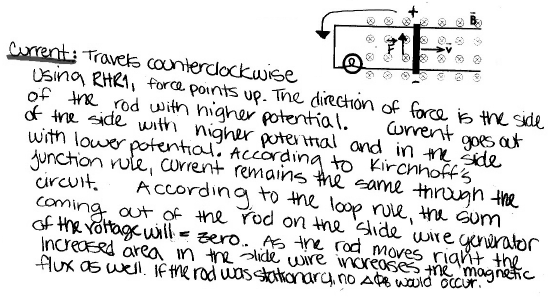
Physics final exam question: slide-rail generator

Physics 205B Final Exam, spring semester 2011
Cuesta College, San Luis Obispo, CA

Cf. Giambattista/Richardson/Richardson, Physics, 2/e, Problem 20.5

A conducting rod in a uniform external magnetic field slides on top of metal rails, which are connected to a light bulb to form a complete circuit. Determine the direction of the current (clockwise or counterclockwise) through the circuit if the rod is moved to the right at constant speed. Explain your reasoning using the properties of circuits, right-hand rules, Faraday's law and/or Lenz's law.

Solution and grading rubric:
  • p:
    Correct. Applies RHR2 to determine direction of force on positive charges in moving rod, which results in a counterclockwise current in the loop. Or uses Faraday's law and Lenz's law to determine that the increasing flux through the loop into the page must be counteracted, and uses RHR3 to determine the direction (counterclockwise) of the induced current in the loop.
  • r:
    As (p), but argument indirectly, weakly, or only by definition supports the statement to be proven, or has minor inconsistencies or loopholes. May have direction/sign wrong in RHR2/flux/F's law/L's law/RHR3 process.
  • t:
    Nearly correct, but argument has conceptual errors, or is incomplete. Few missing pieces, but still demonstrates RHR2/flux/F's law/L's law/RHR3 process.
  • v:
    Limited relevant discussion of supporting evidence of at least some merit, but in an inconsistent or unclear manner.
  • x:
    Implementation/application of ideas, but credit given for effort rather than merit.
  • y:
    Irrelevant discussion/effectively blank.
  • z:
    Blank.

Grading distribution:
Section 30882
Exam code: finalv0L7
p: 5 students
r: 0 students
t: 1 student
v: 1 student
x: 0 students
y: 1 student
z: 0 students

A sample "p" response (from student 9904):

20110520

Physics midterm question: charge moving near two magnets

Physics 205B Midterm 2, spring semester 2011
Cuesta College, San Luis Obispo, CA

Cf. Giambattista/Richardson/Richardson, Physics, 2/e, Problem 18.65

A positive charge moves near two identical bar magnets such that the magnetic force on it is to the right (in the +x direction). Determine (a) the direction of the magnetic field at the location of the charge, and (b) the direction of the velocity of the charge. Show your work and explain your reasoning.

Solution and grading rubric:
  • p:
    Correct. Determines (a) the magnetic field at the location of the positive charge knowing how magnetic field lines behave at the respective poles of the magnets, then (b) uses RHR1 to determine the direction of the charge's velocity, given the directions of the magnetic field and the force exerted on the charge.
  • r:
    Nearly correct, but includes minor math errors. Direction of one of the vectors in (a)-(b) is reversed.
  • t:
    Nearly correct, but approach has conceptual errors, and/or major/compounded math errors. Problems with reversing directions of both vectors in (a)-(b), but understands direction of magnetic field lines and RHR1.
  • v:
    Implementation of right ideas, but in an inconsistent, incomplete, or unorganized manner. May involve currents and/or RHR2, RHR3, etc.
  • x:
    Implementation of ideas, but credit given for effort rather than merit.
  • y:
    Irrelevant discussion/effectively blank.
  • z:
    Blank.

Grading distribution:
Section 30882
Exam code: midterm02H3nR
p: 6 students
r: 1 student
t: 0 students
v: 1 student
x: 0 students
y: 0 students
z: 0 students

A sample "p" response (from student 3773):

20100603

Physics final exam question: magnetic force of wire on moving charge

Physics 205B Final Exam, spring semester 2010
Cuesta College, San Luis Obispo, CA

Cf. Giambattista/Richardson/Richardson, Physics, 2/e, Problems 19.65, 19.66

A positive charge q moves upwards in the presence of a current-carrying straight wire coming out of the plane of this page. Determine the direction of the wire's magnetic field at the location of the charge, and the resulting magnetic force on the charge. Explain your reasoning using the properties of magnetic fields and forces.

Solution and grading rubric:
  • p:
    Correct. Applies RHR2 to the wire (thumb out of page, fingers curling counterclockwise in the plane of the page) to find that B field is to the right in the plane of the page at the location of the positive charge. Then applies RHR1 to the charge (thumb up along plane of the page, index finger to the right in the plane of the page, middle finger into the page) to find that the force on the charge is into the page.
  • r:
    As (p), but argument indirectly, weakly, or only by definition supports the statement to be proven, or has minor inconsistencies or loopholes. Has at least only one RHR completely correct.
  • t:
    Nearly correct, but argument has conceptual errors, or is incomplete.
  • v:
    Limited relevant discussion of supporting evidence of at least some merit, but in an inconsistent or unclear manner.
  • x:
    Implementation/application of ideas, but credit given for effort rather than merit.
  • y:
    Irrelevant discussion/effectively blank.
  • z:
    Blank.

Grading distribution:
Section 31988
p: 3 students
r: 5 students
t: 4 students
v: 0 students
x: 0 students
y: 0 students
z: 0 students

A sample "p" response (from student 1987):

20100423

Physics quiz question: charge moving through magnetic field

Physics 205B Quiz 6, Spring Semester 2010
Cuesta College, San Luis Obispo, CA

[Version 1]

Consider an electron moving to the right at a through a uniform magnetic field. Increasing the speed of the electron (along the same direction) would __________ the magnitude of the magnetic force exerted on it.
(A) decrease.
(B) have no effect on.
(C) increase.
(D) (Not enough information is given.)

Correct answer: (C)

The magnetic force exerted on a moving charge is given by:

F_B = q*v*B*sin(theta),

where the angle between the charge velocity, and the magnetic field is 90 degrees, such that sin(theta) = 1, thus:

F_B = q*v*B.

Increasing the speed of the electron would increase the magnitude of the magnetic force on the electron.

Student responses
Section 31988
(A) : 3 students
(B) : 0 students
(C) : 5 students
(D) : 0 students

[Version 2]

Decreasing the speed of the electron (along the same direction) would __________ the magnitude of the magnetic force exerted on it.
(A) decrease.
(B) have no effect on.
(C) increase.
(D) (Not enough information is given.)

Correct answer: (A)

Student responses
Section 31988
(A) : 1 student
(B) : 1 student
(C) : 3 students
(D) : 0 students

Success level: 46%
Discrimination index (Aubrecht & Aubrecht, 1983): 0.75