Showing posts with label magnetic field. Show all posts

20190510

Physics midterm question: stationary loop near constant current wire

Physics 205B Midterm 2, spring semester 2019
Cuesta College, San Luis Obispo, CA

A square metal loop of resistance R is held stationary near a wire that carries a constant amount of current. Discuss whether or not there will be any induced current in the square metal loop, and explain why. Explain your reasoning using the properties of magnetic fields, forces, motional emf, Faraday's law and Lenz's law.

Solution and grading rubric:
  • p:
    Correct. Explains how there would be no induced current in the square loop of wire because:
    1. from RHR2, the direction of current in the straight wire creates a magnetic field at the location of the square loop points into the page, creating a magnetic flux through the square loop that points into the page; and
    2. since the current in the straight wire is constant, the magnetic field it creates at the location of the square loop will have a constant magnitude (along with its constant direction), such that there is a constant, unchanging magnetic flux (magnitude and direction) through the square loop; so
    3. from Faraday's law and Lenz's law, since there is no change in magnetic flux through the square loop, there will be no induced emf and no induced current in the square loop.
    (May instead use RHR1 and discuss how the fictitious positive charges in each segment of the square loop are stationary with respect to the magnetic field of the wire, such that there is no force exerted on them to create an induced current.)
  • r:
    As (p), but argument indirectly, weakly, or only by definition supports the statement to be proven, or has minor inconsistencies or loopholes:
    1. did not clearly indicate the direction of the magnetic field/flux through the square loop; or
    2. argues that there is no induced current in the square loop because there is no magnetic flux through the square loop (when there is a magnetic flux through the square loop, but it is constant); or
    3. argues that there is an induced current in the square loop even though the magnetic flux through the square loop is constant.
  • t:
    Nearly correct, but argument has conceptual errors, or is incomplete.
  • v:
    Limited relevant discussion of supporting evidence of at least some merit, but in an inconsistent or unclear manner. Some attempt at applying properties of magnetic fields, forces, motional emf, Faraday's law and Lenz's law.
  • x:
    Implementation of ideas, but credit given for effort rather than merit. No clear attempt at systematically applying properties of magnetic fields, forces, motional emf, Faraday's law and Lenz's law.
  • y:
    Irrelevant discussion/effectively blank.
  • z:
    Blank.
Grading distribution:
Sections 30882, 30883
Exam code: midterm02u7aH
p: 14 students
r: 15 students
t: 4 students
v: 3 students
x: 5 students
y: 0 students
z: 0 students

A sample "p" response (from student 0691):

Another sample "p" response (from student 4692):

20190501

Physics quiz archive: magnetism, induction

Physics 205B Quiz 6, spring semester 2019
Cuesta College, San Luis Obispo, CA
Sections 30882, 30883, version 1
Exam code: quiz06riQ1


Sections 30882, 30883 results
0- 6 :  
7-12 :   ***** [low = 9]
13-18 :   ********
19-24 :   ************** [mean = 21.4 +/- 5.5]
25-30 :   *********** [high = 30]

20190424

Online reading assignment: flux laws & devices

Physics 205B, spring semester 2019
Cuesta College, San Luis Obispo, CA

Students have a bi-weekly online reading assignment (hosted by SurveyMonkey.com), where they answer questions based on reading their textbook, material covered in previous lectures, opinion questions, and/or asking (anonymous) questions or making (anonymous) comments. Full credit is given for completing the online reading assignment before next week's lecture, regardless if whether their answers are correct/incorrect. Selected results/questions/comments are addressed by the instructor at the start of the following lecture.

The following questions were asked on reading textbook chapters and previewing presentations on flux laws and devices.


Selected/edited responses are given below.

Describe what you understand from the assigned textbook reading or presentation preview. Your description (2-3 sentences) should specifically demonstrate your level of understanding.
"Magnetic flux (ΦB) is the product of the magnetic field magnitude B and area A. Units of T·m2 or webers."

"Magnetic flux is the product of the magnetic field magnitude and the area. Faraday's law states that an electromagnetic field (emf) occurs in a wire loop while the magnetic flux changes through the wire, while if the magnetic flux is constant, or unchanging, then there is no induced emf in the wire meaning that in order to produce an emf, then the magnetic flux must have changed. Lenz's law shows that the direction of current must oppose the magnetic flux."

"Magnetic flux increases with more external magnetic field lines pass through the area of an object. Lenz's law explains that the magnetic field, created by the induced current, points in the opposite direction of the external magnetic field lines that cause a change in magnetic flux."

"Magnetic flux is the product of magnetic field magnitude and area. Faraday's law says that an induced emf occurs when the magnetic flux going through a circuit area changes."

"If flux is constant then there is no induced emf, and in order to induce an emf in a wire loop the magnetic flux must change."

"This section covered Faraday's law and Lenz's law and their connections to magnetic flux. Magnetic flux deals with the magnetic field and the enclosed loop area it passes through. Faraday's law says that in order to induce an emf in a wire loop, the magnetic flux must be changed. Lenz's law says the induced current always opposes change."

"Transformers increase or decrease voltage and current. They are changed by the magnetic fields surrounding them. The amount of coils in them have an effect."

"Transformers are used to step-down or step-up voltage and current into another circuit by the property of induction. This is a very useful property in electric engineering and everyday appliances. Inducing current with reduced or increased voltage can be applied to several different appliances and components."

Describe what you found confusing from the assigned textbook reading or presentation preview. Your description (2-3 sentences) should specifically identify the concept(s) that you do not understand.
"I'm barely getting the RHR1 and LHR1 so I'm doing my best to keep up with this new stuff."

"Lenz's law."

"I do not really understand transformers at all and could use clarification on magnetic flux and how to use Faraday's law."

"Lenz's law and how RHR3 is applied to these cases or how the magnetic field will affect the magnetic flux. I don't really understand the brick example (of inertia) in your presentation."

"The section on Lenz's law. I do not understand how the current and magnetic field work to oppose magnetic flux change. Seems to be a lot going on."

"Transformers and the step-up/step-down concept. I don't really get why there are coils with different amount of turns and how these effect each other. I want to know how all this stuff works because it has real-life applications but its not clicking for me."

"I was pretty confused by most of this section, but the part that really threw me for a loop (no pun intended) was the whole part about transformers. That really made no sense to me and I have no idea what the parts are doing."

"The equations were confusing. The examples explained a lot, but might need more clarification in lecture tomorrow."

"Equations."

"I didn't really get what each term means and how to use them."

State/describe the symbol used for magnetic flux, and give its SI units.
"Phi with a 'B' subscript, units are [Wb] or [T·m2]."

"Symbol: ΦB. SI unit the weber (Wb), or in derived units: volt seconds)."

"The symbol is like an O with a vertical line through it, with subscript B, and is measured in SI unit webers (Wb)."

"It kind of looks like Mike Wazowski from Monsters Inc. It's in Teslas·meters2. So fancy."

"Not sure."

For each situation involving magnetic flux and a wire loop, determine whether or not there would be an induced current in the loop.
(Only correct responses shown.)
Constant zero magnetic flux: no induced current in loop [84%]
Constant non-zero magnetic flux: no induced current in loop. [52%]
Magnetic flux increasing in strength: induced current in loop. [84%]
Magnetic flux decreasing in strength: induced current in loop. [61%]

For an ideal transformer that "steps-down" voltage from its primary coils at 120 V to its secondary coils at 2.1 V, determine what happens to the current and to the power from its primary coils to its secondary coils.
(Only correct responses shown.)
Current: stepped-up (increases). [23%]
Power: no change. [16%]

For an ideal transformer that "steps-up" voltage from its primary coils at 1.5 V to its secondary coils at 220 V, determine what happens to the current and to the power from its primary coils to its secondary coils.
(Only correct responses shown.)
Current: stepped-down (decreases). [39%]
Power: no change. [16%]

Explain why a transformer that has the same number of primary coils and number of secondary coils would not be useful.
"Transformers are designed to transform voltages, if the primary and secondary coils have the same number of turns, it's not doing its one job because the voltages won't be different."

"The difference of them is related to the ratio of secondary coil to primary coil. If you have the same amount of turns in the coils you won't transform anything, but instead lose energy in the process of heat."

"The primary and secondary coil with the same number of coils is not useful. because transformer with different number of coils allow voltages to be stepped-down or stepped-up, and same number can not."

"I would love to be able to tell you that... But I can't. Give me some time listening in class and it will probably make sense to me, but until then, I got nothing."

Ask the instructor an anonymous question, or make a comment. Selected questions/comments may be discussed in class.
"Not going to lie, this section is dense."

"Not the best section for me. I am pretty confused with the multiple coils and their effect on each other. A real life example would help a lot."

"I'm not quite understanding the second part of this section involving the transformers."

"I found the concept of voltage step-up and step-down confusing. If the primary coil has a greater number of rotations than the secondary coil, then the voltage between the primary and secondary drops. So then if a trickle of current flows through the primary how does this current step up to a large value of current in the secondary?" (Energy must be conserved, or rather power (energy transferred per time) must be conserved. So the power going in (current times voltage) must equal the power going out (current times voltage). So if the current in the primary coil is small, and gets "stepped up" to a large current in the secondary coil, then the voltage must compensate, so the voltage gets "stepped down" to a smaller value in the secondary coil.)

20190422

Online reading assignment: generators

Physics 205B, spring semester 2019
Cuesta College, San Luis Obispo, CA

Students have a bi-weekly online reading assignment (hosted by SurveyMonkey.com), where they answer questions based on reading their textbook, material covered in previous lectures, opinion questions, and/or asking (anonymous) questions or making (anonymous) comments. Full credit is given for completing the online reading assignment before next week's lecture, regardless if whether their answers are correct/incorrect. Selected results/questions/comments are addressed by the instructor at the start of the following lecture.

The following questions were asked on reading textbook chapters and previewing presentations on generators.


Selected/edited responses are given below.

Describe what you understand from the assigned textbook reading or presentation preview. Your description (2-3 sentences) should specifically demonstrate your level of understanding.
"A moving charge feels force from a magnetic field, the direction of which can be determined using the RHR1 or the LHR1 depending on the sign of the charge. A stationary charge does not feel the force from a magnetic field."

"How motion can be converted into electrical current. I know that single-pass generators have to be reset, but continuous generators do not."

"Single-pass generators can only be used once before being reset, while continuous can continuously provide electricity without a need for being reset. Motional emf requires a rod in motion to generate emf."

"Single-pass generators are those which can be used once and then have to be reset. In order to reset these systems you have to bring them back in the opposite direction which will create a motional emf and current but with opposite polarity."

"When a rod moves through a magnetic field the electrons within the rod experience a force and the rod becomes positively charged on one end and negatively charged on the other, and that is how it becomes a battery."

"I seem to have a pretty decent understanding of how a generator works."

Describe what you found confusing from the assigned textbook reading or presentation preview. Your description (2-3 sentences) should specifically identify the concept(s) that you do not understand.
"Where do I start, I'm really having a hard time trying to figure out how to use the hand symbols such as 'Hidden Dragon, Crouching Tiger.' I don't really understand how do you use the field model."

"How to orient my hand to not snap my wrist."

"RHR2 and RHR3."

"Motional emf and electric energy. I do not understand how to use the right-hand rule to find the direction of force."

"I don't know what 'motional emf' means. And I don't understand the right-hand rules either."

"Pretty confused on how to use the right-hand rule to find the direction of the force from a single-use generator."

"Overall, this whole chapter is really confusing. It's taking me a long time to get the hang of it."

"I was confused by the rail and hoop-drag generators."

"I don't understand the differences or main parts of the examples of single-use generators. It felt like I was reading gibberish."

"I think I would just need some explanation and demonstration of the different generators to get a better grasp on what they actually do and how they work. Other than that, I felt like this wasn't too hard to wrap my head around."

"I am not quite sure how changing the area of a coil can induce an emf."

A metal rod moves to the right along a magnetic field that points into the page. The direction of the magnetic force on (fictitious) positive charges in the rod is:
up ↑.  ************* [13]
down ↓.  ********** [10]
left ←.  [0]
right →.  ****** [6]
into the page ⊗.  ** [2]
out of the page ⊙.  * [1]
(No direction, as this quantity is zero.)  * [1]
(Unsure/guessing/lost/help!)  *** [3]

A metal rod pivoted at one end rotates counterclockwise in a magnetic field that points out of the page. The direction of the magnetic force on (fictitious) positive charges in the rod is:
in towards the center of rotation.  ******** [8]
out away from the center of rotation  ***************** [17]
into the page ⊗.  * [1]
out of the page ⊙.  ** [2]
(No direction, as this quantity is zero.)  [0]
(Unsure/guessing/lost/help!)  ******** [8]

Explain what a generator is supposed to "generate."
"A potential difference."

"An electrical current."

"A generator coverts mechanical energy (usually rotational) into electricity (emf)."

"Generators generate a motional electromotive force and current."

Explain the meaning of "motional" in the term "motional emf."
"Well, the moving bar is a source of an electromotive force, called motional emf. An emf is generated by the motion of the bar. "

"When a rod is moved through a magnetic field in order to gain a charge. The motion and magnetic field causes the rod to have electrons (and the fictitious positive charges) moved to one side which essentially creates a battery."

"The moving bar is the motional part that generates emf."

"The bar has to stay in motion!"

"I don't understand what this means."

Ask the instructor an anonymous question, or make a comment. Selected questions/comments may be discussed in class.
"When using RHR1, does the force (represented by the middle finger) point out the way your finger tip is pointing. Or does the force point in towards your palm?" (For positive charges, the force on it points the way your middle finger tip points, out away from your palm.)"

"I could use more help on the right-hand rules."

"Generators are interesting because they turn mechanical energy into electricity."

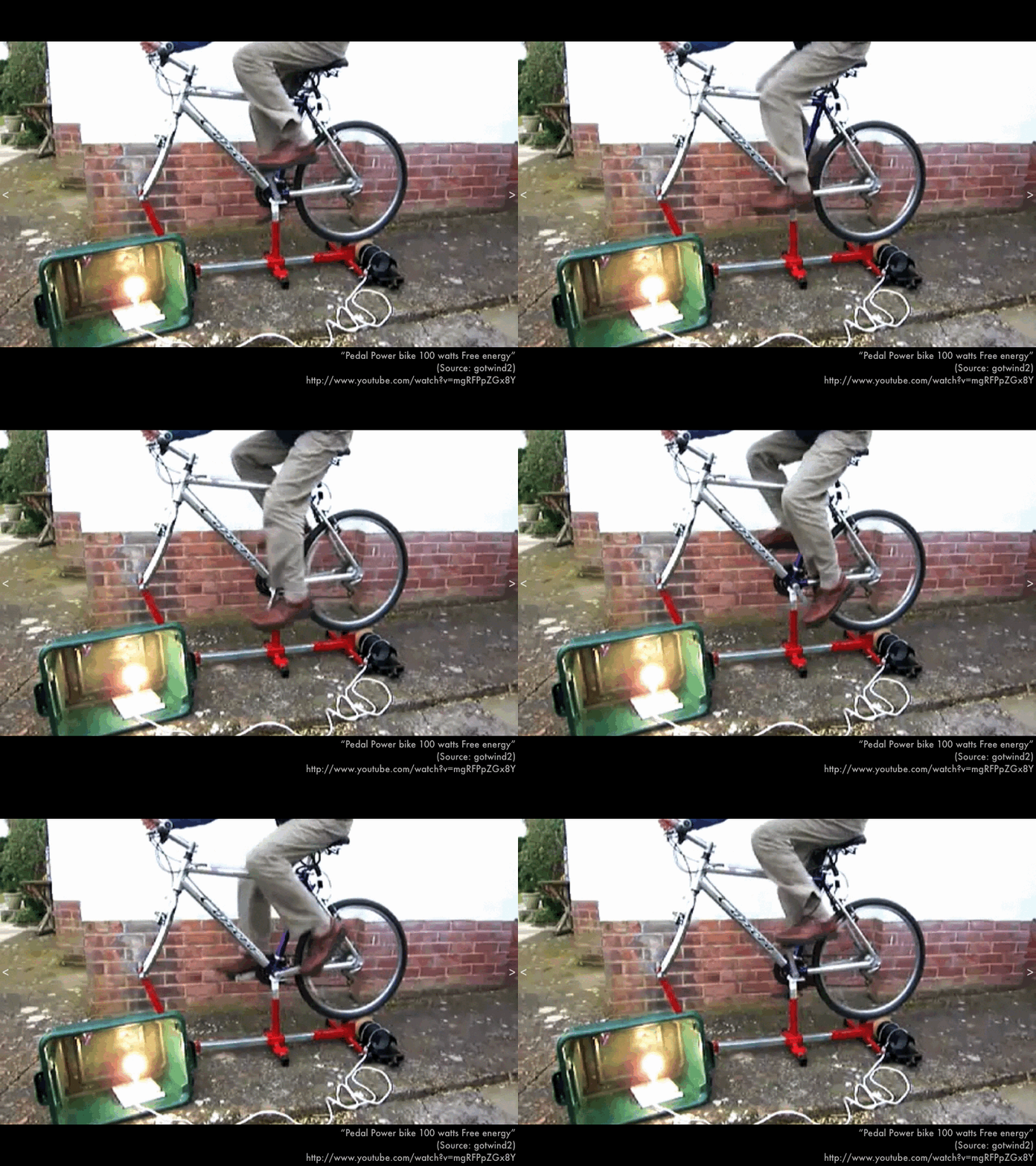
"Seeing the man on the bicycle-driven generator took me back to my childhood days when I was watching Pokémon. I remember an episode where a man was generating power by using a stationary bicycle. On another note, I need to do more research to understand this topic."

"I need to study."

"I think I know why you're so ecstatic about the zombie apocalypse. You either know when it's going to happen or you will bring it about, but you won't tell us. You may tread on thin ice if you make light of a serious topic." (I am the Night King. #winteriscoming #whatisdeadmayneverdie)

20190417

Online reading assignment: magnetic fields of current-carrying wires and loops

Physics 205B, spring semester 2019
Cuesta College, San Luis Obispo, CA

Students have a bi-weekly online reading assignment (hosted by SurveyMonkey.com), where they answer questions based on reading their textbook, material covered in previous lectures, opinion questions, and/or asking (anonymous) questions or making (anonymous) comments. Full credit is given for completing the online reading assignment before next week's lecture, regardless if whether their answers are correct/incorrect. Selected results/questions/comments are addressed by the instructor at the start of the following lecture.

The following questions were asked on reading textbook chapters and previewing presentations on magnetic fields of current-carrying wires and loops.


Selected/edited responses are given below.

Describe what you understand from the assigned textbook reading or presentation preview. Your description (2-3 sentences) should specifically demonstrate your level of understanding.
"Magnetic force is attractive if the ends of the source magnet and test magnet face each other with the opposite poles, and repulsive if it ends of the source magnets and test magnet see each other with the same poles. Magnetic field lines are everywhere and the point out from the north end of a source magnet."

"A circle with an × going through it (⊗) is a vector going into the the page ('innie'). A circle with a dot in the center (⊙) is a vector coming out of the page ('outie')."

"What the fingers represent in the first right-hand rule, and how to position them. I also understand that source objects create a magnetic field, which in turn effects a test object."

"I think that I have a pretty good grasp on the basic concepts of magnets and how they interact with each other. After last class, I now understand the first right-hand rule, and I think that I have a slight grasp on the other hand rules, but I know that after we talk about them in class I will fully understand them."

"The first right-hand rule is used to see where the force on the test charge is pointing based on the direction of the B field and the angle of the velocity v. We now see the crouching tiger in its natural habitat."

"I now know how to use the 'Crouching Tiger, Hidden Dragon' right-hand rule signs."

"In the two-step model of magnetism, the source object creates a magnetic B field everywhere around it, and then it's the field that exerts a force on the test object."

"How to use the first right-hand rule in order to find the direction of magnetic field forces. From the other right-hand rules, for a circular loop of wire the fingers curl in the direction of the current and for the straight section of wire the fingers curl in the direction of the magnetic field."

"That RHR2 is used when current is flowing in a straight wire), and models a circular magnetic field around the wire. RHR3 is used when for circular current-carrying wire, and it models the closed circular magnetic fields created around the loop."

"The second and third right-hand rules determine the direction of the magnetic field by current-carrying wires. Current traveling through a wire loop creates a magnetic field within its diameter that get stronger with more loops. "

"We use RHR2 to determine the direction of the field lines for a straight current-carrying wire, and we use RHR3 to determine the direction of the field lines for a circular loop of current-carrying wire."

"That I should use RHR2 and RHR3 to determine the direction of the magnetic field that the source loop/ wire creates. I understood that I should use RHR1 to determine the direction of the force exerted by the magnetic field. "

"For an infinitely long, straight wire the magnetic field will be stronger near the wire where the r is small. Also the magnetic field outside a solenoid is not constant and is weaker than the interior field."

"How a current-carrying wire also produces its own field. A long straight wire produces its own field, as does a circular loop, as does a solenoid."

Describe what you found confusing from the assigned textbook reading or presentation preview. Your description (2-3 sentences) should specifically identify the concept(s) that you do not understand.
"How the direction of the magnetic force on a magnet's north pole is along the direction of the magnetic field lines and the force of a magnet's south pole is directed against the direction of magnetic field lines. As well as how to tell when to use 'Crouching Tiger and Hidden Dragon.'"

"I'm confused on the right-hand rules because its hard to see them in all the different scenarios on paper and try to figure them out in real life."

"How the second and third right-hand rules work."

"I just don't understand why B is the curled fingers for the second right-hand rule."

"I need a bit more help on using the new right-hand rules RHR2 and RHR3."

"Solenoids and circular loops. RHR2 and RHR3. I understood RHR1 in class, so I will pay attention tomorrow."

"I would benefit from more discussion on the field models and problems with those concepts."

"I don't have any immediate concerns, I'd just like to practice the rules and go over examples in class like we always do. What are the requirements of an object being a source object versus a test object? Is this something we'll cover? That seems like it would be interesting!"

"I'm confused on a little bit of everything."

State/describe the symbol used for the "permeability of free space," and give its SI units.
"Symbol: µ0. SI unit = [T·m/A]."

"m·kg/(s·A)2."

"Henries per meter."

"Webers per ampere-meter."

"No clue."

State whether it is possible or not possible for the following pairs of objects to exert magnetic forces on each other.
(Only correct responses shown.)
The ends of two bar magnets: possible [67%]
The end of a bar magnet, and a stationary charge: not possible [30%]
The end of a bar magnet, and a moving charge: possible [79%]
Current flowing through a wire, and a stationary charge: not possible [39%]
Current flowing through a wire, and a moving charge: possible [70%]
Current flowing through a wire, and another wire with current in it: possible [55%]

For the magnetic field created by current in a long straight wire, indicate which right-hand finger(s) point along which directions.
(Only correct responses shown.)
Current I in long straight wire: thumb [88%]
Magnetic field B: curled fingers [88%]

For the magnetic field created by a current in a circular loop of wire, indicate which right-hand finger(s) point along which directions.
(Only correct responses shown.)
Current I in circular loop of wire wire: curled fingers [82%]
Magnetic field B: thumb [82%]

Explain the similarities/differences between a circular current loop, and a solenoid.
"A current loop is kinda self explanatory, current following through a closed loop. A solenoid is a coiled wire with multiple current loops stacked together."

"A circular current loop electricity creates a magnetic field which is more concentrated in the center of the loop than outside the loop, while stacking multiple loops concentrates the field even more which makes it a solenoid. Both serve to create a magnetic field within their diameter by current flowing around, however solenoids are stronger fields due to more loops stacked on each other."

"A solenoid is a bunch of parallel loops."

"I don't know the difference. I Googled it and it says that a solenoid is a cylindrical coil of wire acting as a magnet when carrying electric current. A circular current loop creates a magnetic field which is more concentrated in the center of the loop than outside the loop. but that doesn't really do me any good. I still don't understand."

"I'm honestly not sure about the similarities/differences between a circular current loop and a solenoid."

Ask the instructor an anonymous question, or make a comment. Selected questions/comments may be discussed in class.
"So. Why does the current split to a 10 ohm light bulbs and a 8 ohm light bulb in parallel? Why not all of the current just going through the 8 ohm light bulb considering it's less resistance?" (Yes, more of the current will go through the 8 ohm light bulb (56%) and less will go through the 10 ohm light bulb (44%), and you should work out how much goes through each light bulb--there are no "all or nothing" shortcuts, unless one of the light bulbs has zero, or an infinite resistance.)

"I'd like to get a explanation on the solenoid and circular current loop. Based from what I understood, theres no particular differences between solenoid and current loop. So, I'd like something to explain their differences." (Yes, there is no substantive difference between them other than the solenoid a stack of many circular current loops.)

"Looks like I'll be doing Khan Academy this weekend."

20190416

Physics quiz archive: magnetism, induction

Physics 205B Quiz 6, spring semester 2018
Cuesta College, San Luis Obispo, CA
Sections 30882, 30883, version 1
Exam code: quiz06Av3g


Sections 30882, 30883 results
0- 6 :   * [low = 6]
7-12 :  
13-18 :   ************
19-24 :   ******************* [mean = 20.1 +/- 4.2]
25-30 :   ** [high = 27]

20190415

Online reading assignment: magnets, magnetism, and magnetic forces from fields

Physics 205B, spring semester 2019
Cuesta College, San Luis Obispo, CA

Students have a bi-weekly online reading assignment (hosted by SurveyMonkey.com), where they answer questions based on reading their textbook, material covered in previous lectures, opinion questions, and/or asking (anonymous) questions or making (anonymous) comments. Full credit is given for completing the online reading assignment before next week's lecture, regardless if whether their answers are correct/incorrect. Selected results/questions/comments are addressed by the instructor at the start of the following lecture.

The following questions were asked on reading textbook chapters and previewing presentations on magnetism and magnetic forces from fields.


Selected/edited responses are given below.

Describe what you understand from the assigned textbook reading or presentation preview. Your description (2-3 sentences) should specifically demonstrate your level of understanding.
"I am understanding a lot better the relationships between current and the resistance in series and parallel circuits after going over and over it for the quiz. I also find greater understanding of the measurements of the ammeters and voltmeters."

"Magnetic fields of a magnet leave through the north pole and form a looping path and return through the south pole."

"In a direct model a source magnet exerts a force on the test magnet. It will attract if the poles are opposite and repel when they are the same."

"There are two ways to approach the direction of magnets. For the direct way, the source magnet exerts a force on the test magnet. The indirect approach requires two steps, the source magnet creates a magnetic B field everywhere around it, and then the B field exerts a force on the test magnet."

"We label the two magnets that exert forces on each other as 'source' and 'test' poles, where the source magnet is said to be exerting a force on the test magnet (with a north and a south pole). For a field model, instead of a source magnet directly exerting a force on a test magnet, in this two-step model, the source magnet is said to create a magnetic B field everywhere around it, and it is this magnetic field that exerts a force on a test magnet."

"North repels north, but attracts south. Vice versa. Source magnet creates B field, B field exerts force on test magnet. If another magnet enters the field the force is exerted opposite of the lines of the field."

"Magnetic fields are created by magnetic sources and that these fields behave similarly to electric fields in the way that they affect test magnets, currents, and charges. Magnetic field lines move away from the north pole, towards the south pole, and through the magnet back out of the north pole."

"Magnetic force is always perpendicular to both magnetic field and the velocity. Whereas the force applied by an electric field is always parallel or antiparallel to the field direction. "

"I understand the right-hand rule now that I actually wrote them on my right hand rather than the left. I understand that this right-hand rule shows the direction of the magnetic force and that the middle finger will show the direction properly if the thumb is pointing on the velocity vector and the index is on the magnetic field lines, but I think this only works for positive particles. The left-hand rule is used for for magnetic forces on negative charges."

"Hidden Dragon. Crouching Tiger. Hidden Dragon. Crouching Tiger. And 'very bad finger.'"

"Single-pass generators can only be used once before having to be reset, while continuous generators do not have to be reset and they then provide continuous emf and current. A Faraday disk is an example of a continuous generator when cranked."

Describe what you found confusing from the assigned textbook reading or presentation preview. Your description (2-3 sentences) should specifically identify the concept(s) that you do not understand.
"I was a bit confused on the magnetic fields. I am just having trouble with figuring out where the magnetic field is and how to find it."

"Why magnetic field lines loop from north to south. The right hand rule."

"I find confusing the RHR1 and RHR2 based on how to use them!"

"I do not understand the hand things."

"Everything was relatively easy to understand except the RHR1, I didn't understand that."

"I didn't understand how field models work."

"I would benefit from a walkthrough on field models just to make sure I understand the concept."

"I just need a class lecture on this to understand better. I'm confused on how to point which finger where."

"Can you explain the right-hand rules a little bit more? I would really benefit from that in class."

"Not super sure what the right-hand rules symbolize."

"I'm so confused on angle theta and what the angle is measuring. Tomorrow I really want to get through what theta is and what RHR1 means for the 'Hidden Dragon, Crouching Tiger,' because trying it at home made no sense for me."

"I'm still confused on how to properly use the 'Hidden Dragon, Crouching Tiger' hand signs."

Outside of a bar magnet, magnetic field lines travel from the __________ pole to the __________ pole.
north; south.  ************************** [36]
south; north.  * [1]
(Unsure/guessing/lost/help!)  *** [3]

Inside of a bar magnet, magnetic field lines travel from the __________ pole to the __________ pole.
north; south.  ********** [10]
south; north.  ************************* [25]
(Unsure/guessing/lost/help!)  ***** [5]

State the symbol used for the magnetic field, and the SI units for magnetic field strength.
"B; teslas [T] or [N·s/C·m]."

"B; teslas [T] or gauss, where 1 tesla = 10,000 gauss."

"The symbol used for magnetic field is F with an arrow over the top; the SI units used is newtons?"

Hidden Dragon.  Crouching Tiger.  Hungry Dragon.  Crunchy Tiger.
When properly using right-hand rule 1, in general there can be any angle between the v thumb and B finger (depending on the situation). In general, specify the angles between the other fingers used in right-hand rule 1.
(Only correct responses shown.)
B finger and F finger: exactly 90° only [35%]
v finger and F finger: exactly 90° only [35%]

In general, the direction of the force of a magnetic field on a moving charged particle will be along the:
particle's velocity vector.  ** [2]
the magnetic field line.  ****************************** [30]
(Neither of the above choices.)  ** [2]
(Unsure/guessing/lost/help!)  ****** [6]

Ask the instructor an anonymous question, or make a comment. Selected questions/comments may be discussed in class.
"I need more explanation on right-hand rules please."

"I think we need several in-class examples using the right-hand (and left-hand) rules."

"Physics gang signs... (laughing inside)."

"Magnets are cool! :)"

"I get a little confused when it comes to the magnetic fields and the whole idea around it."

"I just think this material is more difficult to understand from the readings so hopefully class will clear up some confusion."

"After finishing the resistance lab last week, we tried to use a number of batteries from our calculators to see how bright the light bulbs can get and home many bulbs (connected in series) we could light with the batteries that we have."

"YOUR CLASS IS TOO DIFFICULT."

20180505

Physics midterm question: loop entering, leaving magnetic field

Physics 205B Midterm 2, spring semester 2018
Cuesta College, San Luis Obispo, CA

Within a certain region (shown in gray) there is an external uniform magnetic field, and the magnetic field is zero everywhere outside of this region. A square metal loop of resistance R moves with constant velocity as it enters, then exits this magnetic field region. Discuss why the induced current flows in one direction around the loop as it enters the magnetic field region, then flows in the other direction around the loop as it exits the magnetic field region. Explain your reasoning using the properties of magnetic fields, forces, motional emf, Faraday's law and Lenz's law.


Solution and grading rubric:
  • p:
    Correct. Explains how the induced current flows in one direction around the loop and in the other direction around the loop as it (a) enters and (b) exits the external magnetic field by using:
    1. RHR1, where the velocity direction of the loop (downwards) and external magnetic field direction (pointing into the page) result in a force on the fictitious positive charges to the right in both cases (a)-(b), but only in the horizontal portion of the loop that is inside the magnetic field, thus resulting in an induced current that is counterclockwise in (a) and clockwise in (b); or
    2. Faraday's law and Lenz's law, where moving the loop downwards would increase the magnetic flux going into the page through the loop in (a), and decreasing the magnetic flux going into the page through the loop in (b); and from Lenz's law, these changes in the magnetic flux through the loop will be "fought" by an induced current that must be flowing counterclockwise in (a), and clockwise in (b).
  • r:
    As (p), but argument indirectly, weakly, or only by definition supports the statement to be proven, or has minor inconsistencies or loopholes. Directions of induced current are clockwise in (a), and counterclockwise in (b), but otherwise still systematically applies RHR1 or Faraday's law and Lenz's law.
  • t:
    Nearly correct, but argument has conceptual errors, or is incomplete.
  • v:
    Limited relevant discussion of supporting evidence of at least some merit, but in an inconsistent or unclear manner. Some attempt at applying properties of magnetic fields, forces, motional emf, Faraday's law and Lenz's law.
  • x:
    Implementation of ideas, but credit given for effort rather than merit. No clear attempt at systematically applying properties of magnetic fields, forces, motional emf, Faraday's law and Lenz's law.
  • y:
    Irrelevant discussion/effectively blank.
  • z:
    Blank.
Grading distribution:
Sections 30882, 30883
Exam code: midterm02iFtW
p: 12 students
r: 12 students
t: 1 student
v: 5 students
x: 4 students
y: 0 students
z: 0 students

A sample "p" response (from student 1712):

Another sample "p" response (from student 1929):

20180418

Online reading assignment: flux laws & devices

Physics 205B, spring semester 2018
Cuesta College, San Luis Obispo, CA

Students have a bi-weekly online reading assignment (hosted by SurveyMonkey.com), where they answer questions based on reading their textbook, material covered in previous lectures, opinion questions, and/or asking (anonymous) questions or making (anonymous) comments. Full credit is given for completing the online reading assignment before next week's lecture, regardless if whether their answers are correct/incorrect. Selected results/questions/comments are addressed by the instructor at the start of the following lecture.

The following questions were asked on reading textbook chapters and previewing presentations on flux laws and devices.


Selected/edited responses are given below.

Describe what you understand from the assigned textbook reading or presentation preview. Your description (2-3 sentences) should specifically demonstrate your level of understanding.
"I am beginning to understand generators better now, and better understand how moving a magnet creates energy than when I did the last reading assignment."

"The magnetic flux ΦB is the product of the magnetic field magnitude B and the area A. The maximum magnetic flux occurs if the magnetic field is perpendicular to the surface."

"Magnetic flux is an area multiplied by a magnetic field. Faraday's law says that an induced emf occurs in a wire loop when the magnetic flux through it changes."

"Magnetic flux ΦB is the product of the magnetic field magnitude B and the area A. Units of T·m2 or webers."

"Induced current opposes ΦB change."

"Induced emf, which is produced by changing magnetic flux."

"The slide-rail generator and Faraday's law. The faster the rod moves, the more area there is, thus more emf is produced. In addition, if magnetic flux is constant, an emf can not be produced."

"Faraday's law states that an induced emf in a wire loop occurs while the magnetic flux through it changes. If flux is constant there is no emf. Induced current always opposes the magnetic flux. Differing primary and secondary coil turns allow emf to be stepped up or down."

"How transformers work to step up or down the voltage from the primary loop to the secondary loop."

"I'm not sure I really understand any of this lesson."

Describe what you found confusing from the assigned textbook reading or presentation preview. Your description (2-3 sentences) should specifically identify the concept(s) that you do not understand.
"The slide-rail generator--how the force generated on charges through the rod makes the ends charged."

"I'd like clarification on what magnetic flux is, I'm still confused by it after reading the examples."

"How magnetic flux works with the induced current."

"How and when to apply Lenz's law."

"I am confused in the situational uses of these equations. More in-class assistance and instruction would be helpful."

"I found the section on transformers pretty confusing. Also the step-down vs. step-up stuff didn't make a lot of sense to me."

"A little bit of everything is confusing. I just need to make the connections between the different piece...Lenz's law is not yet understood."

"I definitely need a lot of explaining on this stuff I cannot grasp the concepts from just reading the lectures online."

"What is Lenz's law? I don't know what is used for and what context it is useful. Really some explanation for me here would go a long way."

"How to incorporate RHR3 to Lenz's law."

"I'm pretty confused about most of this lesson."

State/describe the symbol used for magnetic flux, and give its SI units.
"Magnetic flux ΦB is the product of the magnetic field magnitude B and the area A. Units of T·m2 or webers."

The symbol looks like a circle with a vertical line through it and it is the product of a magnetic field and an area."

For each situation involving magnetic flux and a wire loop, determine whether or not there would be an induced current in the loop.
(Only correct responses shown.)
Constant zero magnetic flux: no induced current in loop [87%]
Constant non-zero magnetic flux: no induced current in loop. [39%]
Magnetic flux increasing in strength: induced current in loop. [83%]
Magnetic flux decreasing in strength: induced current in loop. [52%]

For an ideal transformer that "steps-down" voltage from its primary coils at 120 V to its secondary coils at 2.1 V, determine what happens to the current and to the power from its primary coils to its secondary coils.
(Only correct responses shown.)
Current: stepped-up (increases). [30%]
Power: no change. [39%]

For an ideal transformer that "steps-up" voltage from its primary coils at 1.5 V to its secondary coils at 220 V, determine what happens to the current and to the power from its primary coils to its secondary coils.
(Only correct responses shown.)
Current: stepped-down (decreases). [30%]
Power: no change. [35%]

Explain why a transformer that has the same number of primary coils and number of secondary coils would not be useful.
"There would be no change in emf as the ratio of N2 to N1 would be 1."

"The transformer would not be able to regulate voltage to step it up or down. The primary coil and secondary coil turns cannot be the same amount."

"The whole point is that they have a different number of turns in order for voltages to be stepped up or down."

"Because nothing is being transformed."

Ask the instructor an anonymous question, or make a comment. Selected questions/comments may be discussed in class.
"Following this pace is getting hard."

"Please go over these examples I am very lost on this subject!"

"Help..."

20180416

Online reading assignment: generators

Physics 205B, spring semester 2018
Cuesta College, San Luis Obispo, CA

Students have a bi-weekly online reading assignment (hosted by SurveyMonkey.com), where they answer questions based on reading their textbook, material covered in previous lectures, opinion questions, and/or asking (anonymous) questions or making (anonymous) comments. Full credit is given for completing the online reading assignment before next week's lecture, regardless if whether their answers are correct/incorrect. Selected results/questions/comments are addressed by the instructor at the start of the following lecture.

The following questions were asked on reading textbook chapters and previewing presentations on generators.


Selected/edited responses are given below.

Describe what you understand from the assigned textbook reading or presentation preview. Your description (2-3 sentences) should specifically demonstrate your level of understanding.
"A single-pass generator cannot indefinitely continue to slide the rod along the rails to generate a constant motional emf and current."

"More common generators have a coil that rotates between the north pole and south pole of an external magnet. This also generates a motional emf that can be measured with a voltmeter, or made to generate current, but the values of the motional emf (and current) will fluctuate over each cycle of rotation, or even change direction."

"A Faraday disk is an example of a continuous generator, while motional emf are examples of single-pass generators."

"Motional emf is generated when a metal rod is moved through a magnetic field. The way to calculate motional emf is via multiplying the length of the rod by the speed of the rod by the magnetic field through which it is going through."

"Motional emf arises because a magnetic force acts on the charges in a conductor that is moving through a magnetic field."

"Single-pass generators can only be used once before having to be reset. Hoop-drag and rail generators are two types of single-pass generators."

"There are different kinds of generators. Some need to be reset (single-pass) before they can be used again, while some generators are continuous and can keep providing current and emf."

"There are many different types of generators that work in different ways. We are still using the right-hand rules for these generators."

"Single-pass generators can only be used once before having to reset them. In a uniform magnetic B field, electrons in a metal rod experience a downwards pointing force, and as long as the rod is made to move through the field, its bottom will be negative and the top positive. Therefore, moving this rod in a B field makes it a battery. Continuous generators do not need to be reset to provide emf and current. An example of this is a Faraday disk, where the north and south pole lie between the external magnet. All you do is crank it to generate emf. Rotating coils are also commonly used."

"How to use the right-hand rule when applying it to generators and all kinds of magnetic fields."

"Learned more on how to use my hands to solve problems."

"I understand that I don't know how generators work."

Describe what you found confusing from the assigned textbook reading or presentation preview. Your description (2-3 sentences) should specifically identify the concept(s) that you do not understand.
"I would like to learn more on the motional emf."

"How to determine the direction of magnetic force for a rod that is being rotated from one end."

"Still not really intuitively understanding how generators work and what the 'resetting' is about. I get the idea of having to 'move the snowboard back up the rail,' but I don't really understand what is meant by resetting in a generator, especially for the rotating rod (Faraday disk)."

"More explanation on how to use the right-hand rules for the generators would be helpful."

"It is hard for me to use the right-hand rule to determine where the forces are going with a rod moving through magnetic fields for single-pass generator diagrams."

"The motional emf animation, and how the variables relate as well as the units."

A metal rod moves to the right along a magnetic field that points into the page. The direction of the magnetic force on (fictitious) positive charges in the rod is:
up ↑.  *************** [15]
down ↓.  ******** [8]
left ←.  *** [3]
right →.  * [1]
into the page ⊗.  [0]
out of the page ⊙.  *** [3]
(No direction, as this quantity is zero.)  [0]
(Unsure/guessing/lost/help!)  ** [2]

A metal rod pivoted at one end rotates counterclockwise in a magnetic field that points out of the page. The direction of the magnetic force on (fictitious) positive charges in the rod is:
in towards the center of rotation.  ***** [5]
out away from the center of rotation  ******************* [19]
into the page ⊗.  *** [3]
out of the page ⊙.  ** [2]
(No direction, as this quantity is zero.)  [0]
(Unsure/guessing/lost/help!)  *** [3]

Explain what a generator is supposed to "generate."
"Generators generate a motional emf."

"Emf and current."

"Generates a current and motional emf, eventually creating power."

"Electric potential energy."

"Electricity?"

Explain the meaning of "motional" in the term "motional emf."
"That the emf is created through motion."

"Energy is created via movement of a metal rod through a magnetic field."

"It means something is constantly moving to produce the emf."

"The motion of the bar is what creates the emf, thus 'motional emf.'"

Ask the instructor an anonymous question, or make a comment. Selected questions/comments may be discussed in class.
"This is all becoming pretty foreign to me, any worksheets and practice in class will definitely benefit me!"

"what are the benefits of making a single-pass generator over a continuous generator?" (Single-pass generators are not very practical (as you must stop producing electricity in order to "reset" the system), but are much easier to understand conceptually. More practical, continuous generators (that don't have to, or automatically "reset" by returning to their starting point) are a bit more difficult to understand.)

"Aren't you still technically putting in some energy for the system to reset a continuous generator, just as in the single-pass generator?" (You actually put energy into all generators (they just convert your kinetic energy into electric potential energy), but you wouldn't have an abrupt break trying to reset a continuous generator (and can generate electricity uninterrupted), compared to a single-pass generator like a slide-rail generator, where you would have to pick up the rod at the end of a (finite) set of rails, pick it up to put it back to the beginning (or you would need to stop the rod, and start sliding it backwards along the rails.)

"I'm excited that we are learning useful stuff for the zombie apocalypse." (I'm excited, too.)