Physics 205A Quiz 7, fall semester 2019
Cuesta College, San Luis Obispo, CA
A 0.25 kg glass sample (400 K initial temperature) and a 0.75 kg graphite sample (300 K initial temperature) are brought in contact with each other to reach thermal equilibrium with a final temperature of 330 K. Ignore heat exchanged with the environment. The specific heat capacity values of these two substances are not known. The __________ sample has the larger specific heat capacity value.
(A) glass.
(B) graphite.
(C) (There is a tie.)
(D) (Not enough information is given.)
Correct answer (highlight to unhide): (A)
The transfer/balance energy conservation equation for this system is given by:
Qext = ∆Eglass + ∆Egraphite,
and since there is no heat exchanged with the environment, Qext = 0, such that:
0 = mglass·cglass·ΔTglass + mgraphite·cgraphite·ΔTgraphite,
and:
–mglass·cglass·ΔTglass = mgraphite·cgraphite·ΔTgraphite,
–(0.25 kg)·cglass·(–70 K) = (0.75 kg)·cgraphite·(+30 K),
(17.6 kg·K)·cglass = (22.5 kg·K)·cgraphite.
From inspection, for the equality to hold, cglass > cgraphite, and thus glass must have a greater specific heat capacity value than graphite.
Sections 70854, 70855
Exam code: quiz07VlnC
(A) : 25 students
(B) : 17 students
(C) : 3 students
(D) : 6 students
Success level: 49%
Discrimination index (Aubrecht & Aubrecht, 1983): 0.82
Showing posts with label mass. Show all posts
Showing posts with label mass. Show all posts


20191202
Online reading assignment: standing waves
Physics 205A, fall semester 2019
Cuesta College, San Luis Obispo, CA
Students have a bi-weekly online reading assignment (hosted by SurveyMonkey.com), where they answer questions based on reading their textbook, material covered in previous lectures, opinion questions, and/or asking (anonymous) questions or making (anonymous) comments. Full credit is given for completing the online reading assignment before next week's lecture, regardless if whether their answers are correct/incorrect. Selected results/questions/comments are addressed by the instructor at the start of the following lecture.
The following questions were asked on reading textbook chapters and previewing a presentation on standing waves.

Selected/edited responses are given below.
Describe what you understand from the assigned textbook reading or presentation preview. Your description (2-3 sentences) should specifically demonstrate your level of understanding.
Describe what you found confusing from the assigned textbook reading or presentation preview. Your description (2-3 sentences) should specifically identify the concept(s) that you do not understand.

After these same-length guitar strings are plucked (assuming that their tensions are approximately equal), the __________ strings vibrate at a lower fundamental frequency.

After the bass string is plucked, sliding a finger down to decrease its length would __________ the fundamental frequency of the string.
For standing waves on a string, classify each of these parameters are being "independent" (able to be changed without affecting other independent parameters), or "dependent" (will be changed when independent values are changed).
(Only correct responses shown.)
Ask the instructor an anonymous question, or make a comment. Selected questions/comments may be discussed in class.
Cuesta College, San Luis Obispo, CA
Students have a bi-weekly online reading assignment (hosted by SurveyMonkey.com), where they answer questions based on reading their textbook, material covered in previous lectures, opinion questions, and/or asking (anonymous) questions or making (anonymous) comments. Full credit is given for completing the online reading assignment before next week's lecture, regardless if whether their answers are correct/incorrect. Selected results/questions/comments are addressed by the instructor at the start of the following lecture.
The following questions were asked on reading textbook chapters and previewing a presentation on standing waves.

Selected/edited responses are given below.
Describe what you understand from the assigned textbook reading or presentation preview. Your description (2-3 sentences) should specifically demonstrate your level of understanding.
"Thick strings have lower fundamental frequencies than thinner strings when they are plucked."
"I understand that the fundamental frequency of a string depends on the wave speed v (which depends on its tension and thickness), and length L. The frequencies that this string will resonate at are then merely integer multiples of the fundamental frequency."
"What I understand is some of the standing waves stuff. I know the equation for getting the fundamental frequency of something. I also understand which things are independent and dependent parameters."
Describe what you found confusing from the assigned textbook reading or presentation preview. Your description (2-3 sentences) should specifically identify the concept(s) that you do not understand.
"I feel like this is more in depth of the previous waves section, this feels similar and not difficult, just more of it."
"Putting all the different parts together, and not mixing up the independent and dependent parameters."
"I'm having trouble understanding resonance and how nodes are created."
"The difference between node and antinode wasnt as clear to me. Will need some more clarification in class."

thicker. ************************************** [38] thinner. *** [3] (There is a tie.) ** [2] (Unsure/lost/guessing/help!) * [1]
After these same-length guitar strings are plucked (assuming that their tensions are approximately equal), the __________ strings vibrate at a lower fundamental frequency.
thicker. ************************************ [36] thinner. ** [2] (There is a tie.) *** [3] (Unsure/lost/guessing/help!) *** [3]

decrease. ****************** [18] not change. ******** [8] increase. ***************** [17] (Unsure/lost/guessing/help!) * [1]
After the bass string is plucked, sliding a finger down to decrease its length would __________ the fundamental frequency of the string.
decrease. *********** [11] not change. ********* [9] increase. ********************** [22] (Unsure/lost/guessing/help!) ** [2]
For standing waves on a string, classify each of these parameters are being "independent" (able to be changed without affecting other independent parameters), or "dependent" (will be changed when independent values are changed).
(Only correct responses shown.)
Wave speed v: independent [59%]
String length L: independent. [43%]
Fundamental frequency f1: dependent. [50%]
Ask the instructor an anonymous question, or make a comment. Selected questions/comments may be discussed in class.
"May we focus on the fundamental frequencies? I did not understand the equation."
"Go over deez."
"Is there a particular reason we left waves and then came back to them later?" (We lost a Monday due to Veteran's Day, so we'll pick it up here just before you do the standing waves lab later today. Also this stuff is not on Quiz 6 or on Quiz 7, but you'll see it on the Final Exam.)
"How was your Thanksgiving?" (Eh, it was okay. The day after Thanksgiving went much better.)
"I'm full from the turkey."
20191125
Online reading assignment: internal energy conservation
Physics 205A, fall semester 2019
Cuesta College, San Luis Obispo, CA
Students have a bi-weekly online reading assignment (hosted by SurveyMonkey.com), where they answer questions based on reading their textbook, material covered in previous lectures, opinion questions, and/or asking (anonymous) questions or making (anonymous) comments. Full credit is given for completing the online reading assignment before next week's lecture, regardless if whether their answers are correct/incorrect. Selected results/questions/comments are addressed by the instructor at the start of the following lecture.
The following questions were asked on reading textbook chapters and previewing a presentation on internal energy conservation.

Selected/edited responses are given below.
Describe what you understand from the assigned textbook reading or presentation preview. Your description (2-3 sentences) should specifically demonstrate your level of understanding.
Describe what you found confusing from the assigned textbook reading or presentation preview. Your description (2-3 sentences) should specifically identify the concept(s) that you do not understand.
Two objects that are brought into contact with each other will reach thermal equilibrium when they have the same:

For the seafood cooking on the salt block (ignoring heat transfers with the environment), the object that experienced the greatest amount of change (increase or decrease) in thermal internal energy was the:

For the frozen meat in the water bath (ignoring heat transfers with the environment), the object that experienced the greatest amount of change (increase or decrease) in thermal internal energy was the:

For the shot of whiskey being mixed with the pint of beer (ignoring heat transfers with the environment), the object that experienced the greatest amount of change (increase or decrease) in thermal internal energy was the:
Ask the instructor an anonymous question, or make a comment. Selected questions/comments may be discussed in class.
Cuesta College, San Luis Obispo, CA
Students have a bi-weekly online reading assignment (hosted by SurveyMonkey.com), where they answer questions based on reading their textbook, material covered in previous lectures, opinion questions, and/or asking (anonymous) questions or making (anonymous) comments. Full credit is given for completing the online reading assignment before next week's lecture, regardless if whether their answers are correct/incorrect. Selected results/questions/comments are addressed by the instructor at the start of the following lecture.
The following questions were asked on reading textbook chapters and previewing a presentation on internal energy conservation.

Selected/edited responses are given below.
Describe what you understand from the assigned textbook reading or presentation preview. Your description (2-3 sentences) should specifically demonstrate your level of understanding.
"Heat is a form of energy in the atoms and molecules of a substance or material, and that originates in the internal energy of a hot substance before flowing into a cold substance. I also understand that greater masses of materials require a greater amount of heat to fulfill their heat capacity in order to change its temperature."
"Internal thermal energy is the energy of an object on the inside of the object. Also temperature is a factor that plays into internal thermal energy; the higher the temperature, the more internal thermal energy there is."
"The effect that heat has on an object's thermal energy. As an object such as when meat has ice cubes put on it, it loses thermal energy; while when the meat is being cooked it gains thermal energy."
"That heat is a transfer of energy in joules, and because of this an object cannot 'have' heat. I also understand that heat flows from hot to cold; therefore, that heat comes from (or goes to) the internal energy of a substance."
"Internal energy conservation is a half-step away from our previous discussion of mechanical energy conservation in which we establish an equation and define which terms are increasing or decreasing. This transfer/balance equation is pivotal in discerning thermal internal energy changes."
"Objects with a higher internal thermal energy transfer that energy to objects with lower internal thermal energy. Heat refers to the transfer of thermal energy, while internal thermal energy refers to the temperature of an object."
"I understood what ∆Etherm is and why we calculate that instead of just Etherm."
"I understand that Q = m·c·∆T and that can be broken down as Qext = ∆Etherm, 1 + ∆Etherm, 1. This is a transfer/balance equation, thus one side of the individual ∆Etherm terms must increase and the other must decrease (if Qext = 0)."
"I don't understand anything."
Describe what you found confusing from the assigned textbook reading or presentation preview. Your description (2-3 sentences) should specifically identify the concept(s) that you do not understand.
"I found that the equation Q = m·c·∆T and the heat units other than the joule were confusing. I was not sure how to use them in a problem."
"I am a little confused on how to apply the specific heat equation to problems. How similar is this equation to calculating specific heat in chemistry? Are the units also the same as in chemistry, such as temperature always being measured in kelvins?"
"Identifying the different amounts of lost or gained internal thermal energy of objects. I understand that some objects lose energy and some gain energy but I do not understand how to find exactly how much is lost or gained."
"What I found confusing in the presentation preview was the transfer/balance equation. This confused me at first but then I realized that if the Q external energy transfer is equal to zero (if no heat is exchanged with the environment) then the changes in thermal energies of the objects add up to zero."
"Just need some practice on heat transfers. the transfer-balance equation should help."
"What is specific heat capacity?"
"In a calorimeter, it confuses me what loses energy and what gains energy. How can we tell what materials heat is flowing between and in what direction?"
"Something I didn't understand was some parts of the heat and internal energy. I don't understand the correlation of molecular kinetic energy with internal energy."
"There are a lot of concepts that are similar and I get them mixed up, heat, hot, temperature all sound the same to me, and the internal energy seems similar too."
"I remember this equation from chemistry and it ruined my grades. The individual problems were extremely confusing and I never knew which parts were given and which were not."
"I don't think I have any yet. I'll see when you explain it in class then I'll probably be confused."
"I understood all the topics in this reading assignment."
"I'm confused on everything."
"What I don't understand is if what is subtracted from what in ∆T. That is all I really need to go over."
"I don't understand what is occurring when cooking with the salt block. I was also lost when/what is doing work when there is a change in thermal energy."
"I didn't find anything confusing--just really want to try the salt block seafood now :)"
Two objects that are brought into contact with each other will reach thermal equilibrium when they have the same:
internal energy. *************** [15] temperature. ************** [14] (Both of the above choices.) ************ [12] (Neither of the above choices.) * [1] (Unsure/lost/guessing/help!) *** [3]

increases; decreases. **************************************** [40] decreases; increases. [0] does not change; does not change. * [1] (Unsure/lost/guessing/help!) **** [4]
For the seafood cooking on the salt block (ignoring heat transfers with the environment), the object that experienced the greatest amount of change (increase or decrease) in thermal internal energy was the:
seafood. ************ [12] salt block. ** [2] (There is a tie.) ************************* [25] (Unsure/lost/guessing/help!) ****** [6]

increases; decreases. ********************************** [34] decreases; increases. ****** [6] does not change; does not change. [0] (Unsure/lost/guessing/help!) ***** [5]
For the frozen meat in the water bath (ignoring heat transfers with the environment), the object that experienced the greatest amount of change (increase or decrease) in thermal internal energy was the:
frozen meat. ****** [6] water bath. ******* [7] (There is a tie.) ************************** [26] (Unsure/lost/guessing/help!) ****** [6]

increases; decreases. ** [2] decreases; increases. ****** [6] does not change; does not change. ********************************* [33] (Unsure/lost/guessing/help!) **** [4]
For the shot of whiskey being mixed with the pint of beer (ignoring heat transfers with the environment), the object that experienced the greatest amount of change (increase or decrease) in thermal internal energy was the:
shot of whiskey. *** [3] pint of beer. ***** [5] (There is a tie.) ********************************* [33] (Unsure/lost/guessing/help!) **** [4]
Ask the instructor an anonymous question, or make a comment. Selected questions/comments may be discussed in class.
"Are there real life situations in which external conditions do not affect the thermal temperatures of the subjects?" (Stuff in a well-insulated cooler.)
"Seems straightforward."
"The transfers confuse me a lot unfortunately."
"Some of this heat stuff seems like it can be counterintuitive."
"How do we handle cases when there is heat exchanged between the system and the environment?" (In the transfer-balance equation, then you have a non-zero term for heat on the left-hand side of the equation, similar to non-conservative work being non-zero on the left-hand size of the equation for mechanical energy conservation.)
"If two objects come into contact with each other and have the same internal temperature, is there no change in internal energy?" (Correct.)
"Whiskey should never ruin a good beer."
"BBQ or sous-vide steak?"
"I'm just hungry really."
"I really want an 'A' in this class but that's not happening :/"
"I'm sorry I am super-sick."
20191113
Physics quiz question: amount of mass attached to a spring
Physics 205A Quiz 6, fall semester 2019
Cuesta College, San Luis Obispo, CA
A mass is attached to a horizontal spring (with a spring constant of 40 N/m), and has a 0.80 s period of oscillation. Neglect friction and drag. The mass attached to this spring is:
(A) 0.13 kg.
(B) 0.16 kg.
(C) 0.65 kg.
(D) 5.1 kg.
Correct answer (highlight to unhide): (C)
The period T of a mass m attached to a spring with spring strength constant k is given by:
T = 2·π·√(m/k),
such that the mass m will be:
T/(2·π) = √(m/k),
(T/(2·π))2 = m/k,
k·(T/(2·π))2 = m = 0.6484555753 kg,
or two significant figures, the mass attached to the spring is 0.65 kg.
(Response (A) is T/(2·π); response (B) is (2·π)/k; and response (D) is k·T/(2·π).)
Sections 70854, 70855
Exam code: quiz06co6O
(A) : 1 students
(B) : 4 students
(C) : 45 students
(D) : 2 students
Success level: 87%
Discrimination index (Aubrecht & Aubrecht, 1983): 0.39
Cuesta College, San Luis Obispo, CA
A mass is attached to a horizontal spring (with a spring constant of 40 N/m), and has a 0.80 s period of oscillation. Neglect friction and drag. The mass attached to this spring is:
(A) 0.13 kg.
(B) 0.16 kg.
(C) 0.65 kg.
(D) 5.1 kg.
Correct answer (highlight to unhide): (C)
The period T of a mass m attached to a spring with spring strength constant k is given by:
T = 2·π·√(m/k),
such that the mass m will be:
T/(2·π) = √(m/k),
(T/(2·π))2 = m/k,
k·(T/(2·π))2 = m = 0.6484555753 kg,
or two significant figures, the mass attached to the spring is 0.65 kg.
(Response (A) is T/(2·π); response (B) is (2·π)/k; and response (D) is k·T/(2·π).)
Sections 70854, 70855
Exam code: quiz06co6O
(A) : 1 students
(B) : 4 students
(C) : 45 students
(D) : 2 students
Success level: 87%
Discrimination index (Aubrecht & Aubrecht, 1983): 0.39
Physics quiz question: finding acceleration due to gravity from pendulum
Physics 205A Quiz 6, fall semester 2019
Cuesta College, San Luis Obispo, CA
The California Academy of Sciences in San Francisco has a pendulum with a period of 6.406 s, consisting of a 106.6 kg ball attached to a 10.20 m long wire hanging from the ceiling. Assume that the ball can be considered a simple point mass. Neglect friction and drag. The magnitude of the acceleration due to gravity g at that location is:
(A) 9.432 m/s2.
(B) 9.620 m/s2.
(C) 9.808 m/s2.
(D) 9.813 m/s2.
[*] kathleensf.files.wordpress.com/2008/07/the-foucault-pendulum-at-the-california-academy-of-sciences-december-14-2010.pdf.
Correct answer (highlight to unhide): (D)
The period of a pendulum is given by:
T = 2·π·√(L/g),
Since the period T = 6.406 s and string length L = 10.20 m are known, the acceleration due to gravity g can then be solved for:
T/(2·π) = √(L/g),
(T/(2·π))2 = L/g,
g = L·((2·π)/T)2,
g = (10.20 m)·((2·π)/(6.406 s))2 = 9.8126439271 m/s2,
or to four significant figures, the acceleration due to gravity is 9.813 m/s2.
(Response (A) is (1/L)·((2·π)/T)2; response (B) is 10·((2·π)/T)2); response (C) is 10·((2·π)/T).)
Sections 70854, 70855
Exam code: quiz06co6O
(A) : 1 student
(B) : 5 students
(C) : 9 students
(D) : 37 students
Success level: 71%
Discrimination index (Aubrecht & Aubrecht, 1983): 0.44
Cuesta College, San Luis Obispo, CA
The California Academy of Sciences in San Francisco has a pendulum with a period of 6.406 s, consisting of a 106.6 kg ball attached to a 10.20 m long wire hanging from the ceiling. Assume that the ball can be considered a simple point mass. Neglect friction and drag. The magnitude of the acceleration due to gravity g at that location is:
(A) 9.432 m/s2.
(B) 9.620 m/s2.
(C) 9.808 m/s2.
(D) 9.813 m/s2.
[*] kathleensf.files.wordpress.com/2008/07/the-foucault-pendulum-at-the-california-academy-of-sciences-december-14-2010.pdf.
Correct answer (highlight to unhide): (D)
The period of a pendulum is given by:
T = 2·π·√(L/g),
Since the period T = 6.406 s and string length L = 10.20 m are known, the acceleration due to gravity g can then be solved for:
T/(2·π) = √(L/g),
(T/(2·π))2 = L/g,
g = L·((2·π)/T)2,
g = (10.20 m)·((2·π)/(6.406 s))2 = 9.8126439271 m/s2,
or to four significant figures, the acceleration due to gravity is 9.813 m/s2.
(Response (A) is (1/L)·((2·π)/T)2; response (B) is 10·((2·π)/T)2); response (C) is 10·((2·π)/T).)
Sections 70854, 70855
Exam code: quiz06co6O
(A) : 1 student
(B) : 5 students
(C) : 9 students
(D) : 37 students
Success level: 71%
Discrimination index (Aubrecht & Aubrecht, 1983): 0.44
Physics quiz question: linear mass density of viola string
Physics 205A Quiz 6, fall semester 2019
Cuesta College, San Luis Obispo, CA
Transverse waves travel at a speed of 357 m/s along a viola's A-string, stretched to a tension of 52.9 N[*][**]. The linear mass density of this string is:
(A) 4.15×10⁻⁴ kg/m.
(B) 2.20×10⁻² kg/m.
(C) 0.148 kg/m.
(D) 0.385 kg/m.
[*] theviolaworkshop.com/page16.html.
[**] gamutmusic.com/viola-tensions.
Correct answer (highlight to unhide): (A)
The speed v of transverse waves along the viola string depends on the tension F and the linear mass density (mass per unit length) (m/L):
v = √(F/(m/L)).
Solving for the linear mass density results in:
v2 = F/(m/L),
(m/L) = F/(v2),
(m/L) = (52.9 N)/(357 m/s)2 = 0.000415067988 kg/m,
or to three significant figures, 4.15×10⁻⁴ kg/m.
(Response (B) is (F/v)2; response (C) is F/v; response (D) is √(F/v).)
Sections 70854, 70855
Exam code: quiz06co6O
(A) : 35 students
(B) : 7 students
(C) : 8 students
(D) : 2 students
Success level: 67%
Discrimination index (Aubrecht & Aubrecht, 1983): 0.78
Cuesta College, San Luis Obispo, CA
Transverse waves travel at a speed of 357 m/s along a viola's A-string, stretched to a tension of 52.9 N[*][**]. The linear mass density of this string is:
(A) 4.15×10⁻⁴ kg/m.
(B) 2.20×10⁻² kg/m.
(C) 0.148 kg/m.
(D) 0.385 kg/m.
[*] theviolaworkshop.com/page16.html.
[**] gamutmusic.com/viola-tensions.
Correct answer (highlight to unhide): (A)
The speed v of transverse waves along the viola string depends on the tension F and the linear mass density (mass per unit length) (m/L):
v = √(F/(m/L)).
Solving for the linear mass density results in:
v2 = F/(m/L),
(m/L) = F/(v2),
(m/L) = (52.9 N)/(357 m/s)2 = 0.000415067988 kg/m,
or to three significant figures, 4.15×10⁻⁴ kg/m.
(Response (B) is (F/v)2; response (C) is F/v; response (D) is √(F/v).)
Sections 70854, 70855
Exam code: quiz06co6O
(A) : 35 students
(B) : 7 students
(C) : 8 students
(D) : 2 students
Success level: 67%
Discrimination index (Aubrecht & Aubrecht, 1983): 0.78
Physics quiz archive: simple harmonic motion, waves
Physics 205A Quiz 6, fall semester 2019
Cuesta College, San Luis Obispo, CA
Sections 70854, 70855 version 1
Exam code: quiz06co6O


Sections 70854, 70855 results
Cuesta College, San Luis Obispo, CA
Sections 70854, 70855 version 1
Exam code: quiz06co6O
Sections 70854, 70855 results
| 0- 6 : | * [low = 3] |
| 7-12 : | **** |
| 13-18 : | ************* |
| 19-24 : | **************** [mean = 22.1 +/- 6.1] |
| 25-30 : | ****************** [high = 30] |
20191106
Online reading assignment: waves
Physics 205A, fall semester 2019
Cuesta College, San Luis Obispo, CA
Students have a bi-weekly online reading assignment (hosted by SurveyMonkey.com), where they answer questions based on reading their textbook, material covered in previous lectures, opinion questions, and/or asking (anonymous) questions or making (anonymous) comments. Full credit is given for completing the online reading assignment before next week's lecture, regardless if whether their answers are correct/incorrect. Selected results/questions/comments are addressed by the instructor at the start of the following lecture.
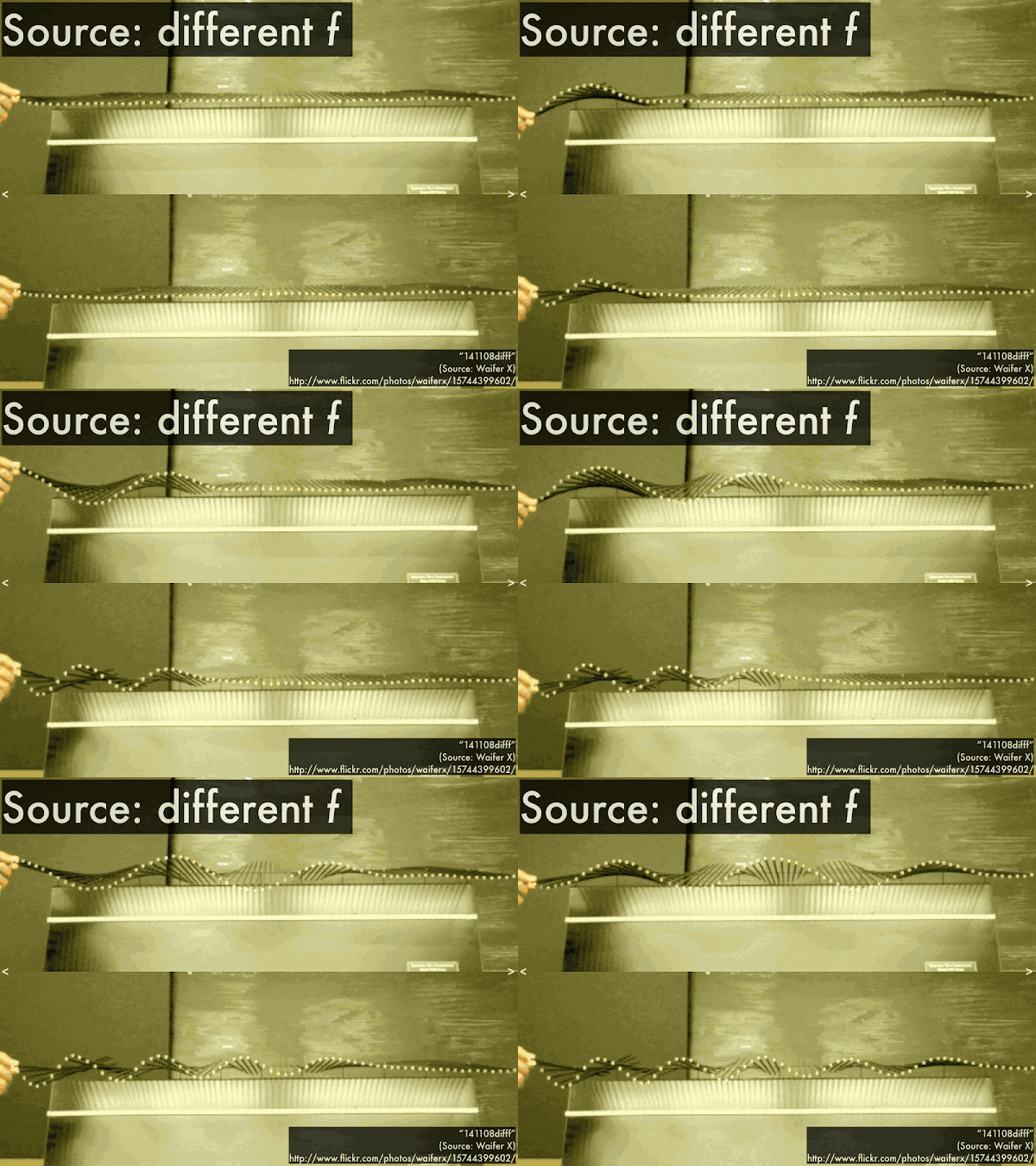
The following questions were asked on reading textbook chapters and previewing a presentation on waves.

Selected/edited responses are given below.
Describe what you understand from the assigned textbook reading or presentation preview. Your description (2-3 sentences) should specifically demonstrate your level of understanding.
Describe what you found confusing from the assigned textbook reading or presentation preview. Your description (2-3 sentences) should specifically identify the concept(s) that you do not understand.
A string of a given length has a certain linear mass density (mass/length) value. If this string is cut in half, then its linear mass density will:

(Only correct responses shown.)
(Only correct responses shown.)

(Only correct responses shown.)
For transverse waves on a string, classify each of these parameters are being "independent" (able to be changed without affecting other independent parameters), or "dependent" (will be changed when independent values are changed).
(Only correct responses shown.)
Ask the instructor an anonymous question, or make a comment. Selected questions/comments may be discussed in class.
Cuesta College, San Luis Obispo, CA
Students have a bi-weekly online reading assignment (hosted by SurveyMonkey.com), where they answer questions based on reading their textbook, material covered in previous lectures, opinion questions, and/or asking (anonymous) questions or making (anonymous) comments. Full credit is given for completing the online reading assignment before next week's lecture, regardless if whether their answers are correct/incorrect. Selected results/questions/comments are addressed by the instructor at the start of the following lecture.
The following questions were asked on reading textbook chapters and previewing a presentation on waves.
Selected/edited responses are given below.
Describe what you understand from the assigned textbook reading or presentation preview. Your description (2-3 sentences) should specifically demonstrate your level of understanding.
"Waves always create a disturbance and move energy from one place to another. A transverse wave has disturbance perpendicular to travel direction, and that a longitudinal wave has disturbance parallel to travel direction. The general parts of a wave, such as amplitude and period, as well as the equations that the book provided for those parts, also make sense to me."
"The motion of transverse waves is perpendicular to the direction the wave travels in. The motion of a longitudinal wave occurs parallel to its direction."
"Something I understood was waves because I learned it in chemistry. A wave can have a frequency, amplitude, wavelength, time, distance, and periods."
"As for the presentations, I am understanding what equations need to be used. I am better understanding the pendulum problems versus the oscillating springs. However I am having issues with my internet tonight so I can't see any of the GIFs so I am having a hard time with the waves presentation."
"Wavelength is the horizontal distance of a complete cycle of a wave, whereas a period is the time for one cycle to be completed. Amplitude is a measurement of distance between the highest or lowest point of a wave and the undisturbed position. Frequency is equal to one cycle per second, where the seconds represent the period. Since properties of the material/medium in which the wave travels determines the speed of a wave, we can find the speed by taking the square root of the force of tension divided by the mass per unit length."
"There are four different aspects of a wave; wave length, amplitude, frequency, and speed. Wavelength is the length that a wave stretches over itself. Amplitude is the height of a wave. Frequency is the amount of waves present or produced. Speed is the rate at which the waves move."
Describe what you found confusing from the assigned textbook reading or presentation preview. Your description (2-3 sentences) should specifically identify the concept(s) that you do not understand.
"I'm having trouble understanding the independent and dependent parameters in these equations."
"I do not understand the differences between the longitudal, periodic, transverse waves based on the pictures. The equations are also not making sense, mainly because there are so many variables to consider."
"Something that I found confusing was differentiating a period from a wavelength. The book did not do a great job at explaining the stuff."
"I think the most confusing is all these different symbols for each thing we learn. They are getting all jumbled up and it's annoying since I can't focus on what is actually what."
"Maybe it was because I had no available friends at the time of viewing these slides, but the example of the wavelengths being affected by either amplitude or frequency reached an amplitude above my head. Seemingly, the speed and wavelength are unaffected by the amplitude; however, frequency has some affect on those that I am confused about."
"I'm a little confused on how frequency and speed are independent but the wavelength is dependent on frequency and speed."
"From the presentation preview I was confused on the independent and dependent parameters at the beginning but then understood it once reading the what each symbol meant."
A string of a given length has a certain linear mass density (mass/length) value. If this string is cut in half, then its linear mass density will:
decrease. ************ [12] remain constant. ************** [14] increase. ************ [13] (Unsure/lost/guessing/help!) * [1]

(Only correct responses shown.)
Faster wave speed v: there is (approximately) a tie. [73%]
Longer wavelength λ: there is (approximately) a tie. [55%]

(Only correct responses shown.)
Faster wave speed v: there is (approximately) a tie. 38[%]
Longer wavelength λ: top wave (low frequency f). [75%]

(Only correct responses shown.)
Faster wave speed v: Along the right apparatus. [18%]
Longer wavelength λ: along the right apparatus. [88%]
Higher frequency f: there is (approximately) a tie. [18%]
For transverse waves on a string, classify each of these parameters are being "independent" (able to be changed without affecting other independent parameters), or "dependent" (will be changed when independent values are changed).
(Only correct responses shown.)
Amplitude A: independent. [65%]
Wave speed v: independent. [55%]
Frequency f: independent. [45%]
Wavelength λ: dependent. [65%]
Ask the instructor an anonymous question, or make a comment. Selected questions/comments may be discussed in class.
"How does Newton's second law cause a wall with a string attached to it to pull on the string in the opposite direction of its standing wave in order to make it reflect back the way it came?" (That sounds like Newton's third law to me.)
"I don't really understand the independent and dependent parameters of transverse waves, some review on that would be great."
"I think I just need a brief review of the independent and dependent parameters to verify I am understanding correctly."
"What is the difference between wavelength and period? Also, what are the equations that we will be using?"
"I really like this part of physics."
"Just need to hear you explain this."
"I am still confused about how to apply resonance." (We'll have a lab specifically on that later.)
20191104
Online reading assignment: simple harmonic motion
Physics 205A, fall semester 2019
Cuesta College, San Luis Obispo, CA
Students have a bi-weekly online reading assignment (hosted by SurveyMonkey.com), where they answer questions based on reading their textbook, material covered in previous lectures, opinion questions, and/or asking (anonymous) questions or making (anonymous) comments. Full credit is given for completing the online reading assignment before next week's lecture, regardless if whether their answers are correct/incorrect. Selected results/questions/comments are addressed by the instructor at the start of the following lecture.
The following questions were asked on reading textbook chapters and previewing a presentation on simple harmonic motion.

Selected/edited responses are given below.
Describe what you understand from the assigned textbook reading or presentation preview. Your description (2-3 sentences) should specifically demonstrate your level of understanding.
Describe what you found confusing from the assigned textbook reading or presentation preview. Your description (2-3 sentences) should specifically identify the concept(s) that you do not understand.


Ask the instructor an anonymous question, or make a comment. Selected questions/comments may be discussed in class.
Cuesta College, San Luis Obispo, CA
Students have a bi-weekly online reading assignment (hosted by SurveyMonkey.com), where they answer questions based on reading their textbook, material covered in previous lectures, opinion questions, and/or asking (anonymous) questions or making (anonymous) comments. Full credit is given for completing the online reading assignment before next week's lecture, regardless if whether their answers are correct/incorrect. Selected results/questions/comments are addressed by the instructor at the start of the following lecture.
The following questions were asked on reading textbook chapters and previewing a presentation on simple harmonic motion.

Selected/edited responses are given below.
Describe what you understand from the assigned textbook reading or presentation preview. Your description (2-3 sentences) should specifically demonstrate your level of understanding.
"Simple harmonic motion is repeated motion back and forth, assuming no outside forces interact with the object, and that under ideal circumstances the motion repeats continuously. When graphed, Simple harmonic motion tends to be similar to a sine/cosine function."
"That the period T is the time it takes for an object in simple harmonic motion to complete one cycle. I also understand that the frequency is related to the period in that the frequency is the number of cycles of the motion per second and can used to find the hertz, or one cycle per second."
"That total energy conservation equals a constant because as KE translational increases then PE elastic will decrease. I also know simple pendulum period is determined by the length of the string which is why in the billiard ball example they all start to swing at different rates even though they are released at the same time."
"That springs have no kinetic energy and maximum potential energy at compression and fully stretched, while they have maximum kinetic energy and no potential energy at equilibrium."
"I don't think I understand anything in this section. I've re-read the section multiple times."
Describe what you found confusing from the assigned textbook reading or presentation preview. Your description (2-3 sentences) should specifically identify the concept(s) that you do not understand.
"The part that confuses me is putting it all together. But lecture will help with that."
"I didn't really understand the pendulum period/length stuff."
"I did not really understand the units of certain variables in some of the new functions like L."
"Do pendulum/mass-spring periods always use 2π in the equation?"
"The mass spring period is a little confusing, I feel as though I understand the basis of it. Essentially more mass means more time or T in the mass spring period. Also a weaker spring constant would mean T would be greater. I think."
"There weren't any major things I found confusing. However, it is helpful when we go over the math of the problems and how to sub things in."
"I just need this taught to me. I don't learn well from reading."
"I first was confused on when to use the mass-spring period equation and the energy conservation equation. But then I realized that the first is used when given time and the other when focusing on energy."
"The math in how to perform these examples and the wording in the book is very confusing."
"I understand the basics but I guess the only thing I find 'confusing' is how many formulas are introduced in this chapter. I feel like normally we focus on one or two. I hope you will clarify which ones we will be using primarily."

origin (x = 0). ******* [7] turnaround points (x = ±A). ************************************* [37] (Both of the above choices.) * [1] (Neither of the above choices.) [0] (Unsure/lost/guessing/help!) [0]

origin (x = 0). ************************************* [37] turnaround points (x = ±A). ****** [6] (Both of the above choices.) [0] (Neither of the above choices.) ** [2] (Unsure/lost/guessing/help!) [0]

shorter than. ***************************************** [41] equal to. ** [2] longer than. [0] (Unsure/lost/guessing/help!) ** [2]

shorter than. ***** [5] equal to. ************** [14] longer than. ************************** [26] (Unsure/lost/guessing/help!) [0]

decrease. ************************* [25] have no affect on. * [1] increase. *************** [15] (Unsure/lost/guessing/help!) **** [4]

decrease. ********************** [22] have no affect on. **** [4] increase. *************** [15] (Unsure/lost/guessing/help!) **** [4]
Ask the instructor an anonymous question, or make a comment. Selected questions/comments may be discussed in class.
"Go over these."
"I didn't understand the swing question, they have different masses but appear to be swinging the same." (Yes, that is exactly what you should be seeing.)
"How much more will we be working with springs and stuff?" (You'll have a lab on this later, where you tinker around with periods of pendulum and mass-spring systems.)
"Seems simple enough."
"I'm never going to understand physics."
"Life is really getting to me now."
"I can't believe it's already November :|"
20191021
Physics quiz question: "superhero landing" impulse
Physics 205A Quiz 4, fall semester 2019
Cuesta College, San Luis Obispo, CA

20th Century Fox UK
youtu.be/EwUilIo036g
 In the movie Deadpool (2016), Angel Dust (portrayed by Gina Carano, mass 66 kg[*]) falls vertically downwards for a "superhero landing," coming to a complete stop from a downwards speed of 34 m/s in 0.24 s as she contacts the ground[**]. Ignore friction and drag. The magnitude of the stopping impulse of the ground on her was:
(A) 0 N·s.
(B) 2.2×10³ N·s.
(C) 9.4×10³ N·s.
(D) 3.8×10⁴ N·s.
[*] imdb.com/name/nm2442289/.
[**] Assuming an initial vertical speed of zero as she steps off the edge of a derelict helicarrier, with a flight deck assumed to be 60 m high above the ground.
Correct answer (highlight to unhide): (B)
From the impulse-momentum theorem, the impulse J on an object causes its initial-to-final change in momentum ∆p:
J = ∆p,
where ∆p = m·(vf – v0).
The initial velocity vector is v0 = –34 m/s (traveling downwards), and the final velocity vector is vf = 0 m/s ("a complete stop"). Then:
J = (66 kg)·((0 m/s) – (–34 m/s)) = (66 kg)·(+34 m/s) = +2,244 N·s,
or to two significant figures, the magnitude of the impulse is 2.2×10³ N·s (and the "+" sign indicates that it is in the upwards direction).
(Response (C) is the magnitude of the average stopping force over the 0.24 s stopping time interval; response (D) is the amount of translational kinetic energy dissipated by the landing.)
Sections 70854, 70855
Exam code: quiz04JuR4
(A) : 1 student
(B) : 27 students
(C) : 20 students
(D) : 4 students
Success level: 52%
Discrimination index (Aubrecht & Aubrecht, 1983): 0.73
Cuesta College, San Luis Obispo, CA
20th Century Fox UK
youtu.be/EwUilIo036g
In the movie Deadpool (2016), Angel Dust (portrayed by Gina Carano, mass 66 kg[*]) falls vertically downwards for a "superhero landing," coming to a complete stop from a downwards speed of 34 m/s in 0.24 s as she contacts the ground[**]. Ignore friction and drag. The magnitude of the stopping impulse of the ground on her was:(A) 0 N·s.
(B) 2.2×10³ N·s.
(C) 9.4×10³ N·s.
(D) 3.8×10⁴ N·s.
[*] imdb.com/name/nm2442289/.
[**] Assuming an initial vertical speed of zero as she steps off the edge of a derelict helicarrier, with a flight deck assumed to be 60 m high above the ground.
Correct answer (highlight to unhide): (B)
From the impulse-momentum theorem, the impulse J on an object causes its initial-to-final change in momentum ∆p:
J = ∆p,
where ∆p = m·(vf – v0).
The initial velocity vector is v0 = –34 m/s (traveling downwards), and the final velocity vector is vf = 0 m/s ("a complete stop"). Then:
J = (66 kg)·((0 m/s) – (–34 m/s)) = (66 kg)·(+34 m/s) = +2,244 N·s,
or to two significant figures, the magnitude of the impulse is 2.2×10³ N·s (and the "+" sign indicates that it is in the upwards direction).
(Response (C) is the magnitude of the average stopping force over the 0.24 s stopping time interval; response (D) is the amount of translational kinetic energy dissipated by the landing.)
Sections 70854, 70855
Exam code: quiz04JuR4
(A) : 1 student
(B) : 27 students
(C) : 20 students
(D) : 4 students
Success level: 52%
Discrimination index (Aubrecht & Aubrecht, 1983): 0.73
20190930
Online reading assignment: impulse and momentum
Physics 205A, fall semester 2019
Cuesta College, San Luis Obispo, CA
Students have a bi-weekly online reading assignment (hosted by SurveyMonkey.com), where they answer questions based on reading their textbook, material covered in previous lectures, opinion questions, and/or asking (anonymous) questions or making (anonymous) comments. Full credit is given for completing the online reading assignment before next week's lecture, regardless if whether their answers are correct/incorrect. Selected results/questions/comments are addressed by the instructor at the start of the following lecture.
The following questions were asked on reading textbook chapters and previewing a presentation on impulse and momentum.

Selected/edited responses are given below.
Describe what you understand from the assigned textbook reading or presentation preview. Your description (2-3 sentences) should specifically demonstrate your level of understanding.
Describe what you found confusing from the assigned textbook reading or presentation preview. Your description (2-3 sentences) should specifically identify the concept(s) that you do not understand.


Cuesta College, San Luis Obispo, CA
Students have a bi-weekly online reading assignment (hosted by SurveyMonkey.com), where they answer questions based on reading their textbook, material covered in previous lectures, opinion questions, and/or asking (anonymous) questions or making (anonymous) comments. Full credit is given for completing the online reading assignment before next week's lecture, regardless if whether their answers are correct/incorrect. Selected results/questions/comments are addressed by the instructor at the start of the following lecture.
The following questions were asked on reading textbook chapters and previewing a presentation on impulse and momentum.

Selected/edited responses are given below.
Describe what you understand from the assigned textbook reading or presentation preview. Your description (2-3 sentences) should specifically demonstrate your level of understanding.
"I understand that to clearly determine momentum you must have mass to figure out the amount of force the object is projecting on to another object. Also, impulse is the change in momentum over time which is used to determine how much net force is applied to an object, or the momentum-impulse theory. Finally, impulse can change an object's direction from left-to-right (or vice versa)."
"Momentum takes into account mass and speed of an object. Impulse takes into account net force and duration of time. The impulse-momentum theorem reflects the order of effects."
"Impulse is related to average force times the change in time and linear momentum is equal to max times velocity."
"The definition of impulse seemed pretty straightforward and I feel like I understand that, but I honestly think I'm going to have trouble with this chapter. It didn't really make sense to me when I was reading it. I think I'm going to need more practice questions."
Describe what you found confusing from the assigned textbook reading or presentation preview. Your description (2-3 sentences) should specifically identify the concept(s) that you do not understand.
"How is the impulse-momentum theory useful? When do we need it?"
"I'm having trouble grasping the concept of the impulse-momentum theorem."
"This only has to do with when two objects are touching?"
"What I initially found confusing was the second example of the presentation preview and how the direction towards the left was negative. But understanding that the left direction was considered negative for all the examples, then it wasn't so confusing."
"I'm just having trouble visualizing how all this works for different situations."
"However, the confusing aspect of the textbook and presentation is going to be the examples using it. I feel like it might be difficult and get confusing with all the other equations."
"The setup of impulse-momentum theorem in relation to the examples given in the book, need some lecture and problems to work to make the connection to visual ideas."
"After going through the presentation preview I released impulse was slightly confusing. Once I read through it a second time I was able to understand it."
"This seems pretty straightforward."

less; less. ***** [5] less; greater. ******* [7] greater; less. ***** [5] greater; greater. *************************** [27] (Unsure/lost/guessing/help!) * [1]
Golf ball's initial momentum p0: no direction (0). [87%]
Golf ball's final momentum pf: to the right (+). [87%]
Golf ball's initial-to-final change in momentum ∆p: to the right (+). [89%]
Golf club's impulse "J" on the golf ball: to the right (+). [76%]
Super Hornet's initial momentum p0: no direction (0). [87%]
Super Hornet's final momentum pf: to the left (–). [76%]
Super Hornet's initial-to-final change in momentum ∆p: to the left (–). [71%]
Catapult's impulse "J" on the Super Hornet: to the left (–). [58%]
Ford Ranger's initial momentum p0: to the right (+). [87%]Ask the instructor an anonymous question, or make a comment. Selected questions/comments may be discussed in class.
Ford Ranger's final momentum pf: to the left (–). [78%]
Ford Ranger's initial-to-final change in momentum ∆p: to the left (–). [53%]
Crash barrier's impulse "J" on the Ford Ranger: to the left (–). [67%]
"The impulse and the change in momentum is fun."
"I think I am not understanding the relationship between momentum and impulse."
"What actually is the impulse and how is it different than momentum?"
"I still don't understand the concept of finding the momentum or how the impulse is ever different than the change in momentum because I thought that was the same thing. I think I'm just lost." (Impulse causes the change in momentum, so calculating the impulse (caused by a force acting over a period of time) allows you to find out the change in momentum, since they're mathematically equal to each other.)
"Is it possible to have a change in momentum without an impulse?" (No. Since impulses cause changes in momentum, any change in an object's momentum (which has magnitude and direction) means that there must be an impulse acting on it. Also if there is no change in an object's momentum, the there is no impulse acting on it. (If those examples sound like Newton's second law and Newton's first law, then yes, they can be applied to the impulse-momentum theorem.)
"The concept behind 'impulse' is a little confusing. The name kind of implies that it's instantaneous and only happens at one point in time." (The common meaning of "impulse" means a sudden urge to act, but the older meaning comes from "impel," or to drive forward, urge, or command.)
"Is there a way to measure impulse in a lab setting, like with a special tool?" (Since impulse is the amount of force exerted over a duration in time, then all you would need to measure impulse is the force sensor to measure how much force is exerted, and a stopwatch to time how long you would exert that amount of force. But also since you have a motion sensor (or the video analysis tool) that can track the velocities of objects, you can use that to tell you the initial velocity and the final velocity of an object, and when you multiply those velocities with the object's mass, you can calculate the initial momentum and final momentum of the object; and the change in momentum (final momentum minus initial momentum) is also equal to the impulse.)
"Something I didn't understand is how is 'J' the impulse but it also mentions that 'F⋅Δt' is also impulse. There are many equations." (It's just a definition. You exert an impulse (denoted by the vector "J") on an object by exerting a force over a period of time.)
"Will these equations be given or do we have to memorize them?" (These impulse and momentum equations are given on the quizzes and exams.)
"I am very uncertain about my answers to these examples. I thought I understood the reading but I will definitely need some clarification of these examples in class please!"
"I hope I got these questions right."
"Please go over these in class! thx"
"This case of confusion only exists if I'm mistaken in my understanding of the relationship between impulse and momentum. Since impulse is the product of time and net force, the resulting change in momentum should also increase as is the tee ball case. If not, I'm lost and need help." (You should be okay, as your reasoning sounds good.)
"I'm a bit confused on the change in momentum example where a truck has an initial velocity of 11m/s to the right and bounces off of a crash barrier with a velocity of –2.2m/s to the left. I know that change in momentum is found by subtracting (∆pf – ∆p0). So, for this example, I'm assuming it would be m⋅((– 2.2m/s) – (+11m/s)) to find the direction of the truck's initial-to-final change in momentum ∆p, which would be mass times –13.2m/s to the left." (This looks good. Sounds like you aren't that confused at all.)
"When it comes to the energy transfer-balance equation, I'm struggling in knowing when to drop what is not needed and a little on how to set it up after." (If there is an energy form that doesn't apply, then you drop that term (for example, if there are no springs involved, then you can drop the ∆PEelas term. Or if there is no net initial-to-final change in that energy form, then you would also drop that term (for example, if an object is a rest on top of a vertical spring, which releases, and the object's final position is when it is (momentarily) at the highest point of its trajectory, then its initial and final translational kinetic energies are both zero, and then you would drop that term as ∆KEtrans = 0.)
"I'm enjoying this slightly cold weather."
Subscribe to:
Posts (Atom)